
Our readers keep the lights on and my morning glass full of iced black tea. As an Amazon Associate, I earn from qualifying purchases.
Specs are compiled from manufacturer listings and verified buyer reviews and can change over time — please confirm the key details on the product page before buying.
Seven-year-olds are at that sweet-spot age where they can follow multi-step instructions, hold a pencil with real control, and still believe a cardboard box is a spaceship. The best gifts for this age thread that needle: challenging enough to earn their focus, but playful enough that they never feel like homework. This guide breaks down nine picks that actually hold a 7-year-old’s attention past the wrapping-paper moment, from bath-time boat chases to circuit-building kits.
I’m Min — the founder and writer behind Gadgets Feed. This guide is built by comparing the manufacturers’ published specifications and the patterns across verified customer reviews, so you get each pick’s real strengths and trade-offs instead of marketing spin.
For a birthday or a just-because surprise, these 7 year old toys keep kids engaged with clear instructions and real skill-building they actually enjoy.
Our Picks at a Glance


How To Choose The Best Gift For A 7-Year-Old
The biggest mistake is buying for the age on the box instead of the actual kid. A 7-year-old who loves building will devour a 260-piece LEGO set, while the same set frustrates a child who prefers to be in motion. Match the toy to the child’s proven interests, not their grade level.
Independent Play vs. Family Time
Some gifts are meant to occupy a child solo — a handheld math game, a weaving loom, a circuit kit. Others are social by design, like a board game or a foosball table. Think about when the gift will actually be used. If it’s for a family that does game night every Friday, pick something collaborative. If it’s for a car ride or quiet afternoon, go solo.
Screen Time and Battery Reality
Many of the best picks here are proudly screen-free, which parents love. But some electronic games require batteries you must buy separately — always check the fine print so the gift works the moment it’s opened. A toy that needs batteries you forgot is a toy that gets set aside.
Quick Comparison
| Model | Best For | Play Style | Piece / Part Count | Batteries Needed | Amazon |
|---|---|---|---|---|---|
| LEGO City Police Boat Chase★ Best Overall | Bath-time & water play | Building + Water | 264 | No | Amazon |
| Number Hunter Math Board GameBest Value | Family game night | Board Game | 50 cards | No | Amazon |
| Educational Insights Math WhizTop Performer | On-the-go math practice | Handheld Electronic | 3 modes | 2 AAA | Amazon |
| National Geographic Junior Chemistry Set | Budding scientists | Science Kit | 50 experiments | No | Amazon |
| LEGO Technic Monster Jam Grave Digger | Pull-back racing action | Building + Racing | 263 | No | Amazon |
| Mini Foosball Table Game | Two-player head-to-head | Tabletop Game | 2 balls | No | Amazon |
| Educational Insights Math Slam | Fast-paced math challenges | Handheld Electronic | 5 game modes | 3 AA | Amazon |
| IQKidz Weaving Loom Kit | Creative craft time | Arts & Crafts | 224 loops | No | Amazon |
| SMILESSKIDDO Electronics STEM Kit | Young engineers | Circuit Building | 35 parts | AA (not incl.) | Amazon |
In‑Depth Reviews
1. LEGO City Police Boat Chase
Our pick — over 4.5★ from 450+ verified ratings; the strongest balance of quality and price.
The rare set that survives the build and ends up in the bathtub.
This 264-piece police boat set earns its top spot because it solves the classic LEGO problem: what happens after the build? Both the police patrol boat and the crook’s power dinghy actually float on water, so play continues in the tub, the pool, or a plastic bin on the kitchen floor. The set includes twin engines, a holding cell, three minifigures, and a shark figure to keep the chase narrative going.
At 1.4 pounds and measuring over 12 inches long when complete, it has a substantial presence that feels like a “real” toy, not a tiny tabletop set. The bricks meet LEGO’s industry standard, connecting and coming apart cleanly every time. Grandparents in particular report it as a reliable, crowd-pleasing gift that arrives looking perfect.
There’s one honest caveat: the floatability gets mixed reports. Some owners confirm the boats float perfectly in the tub and pool, while others say theirs don’t stay afloat as expected. If water play is the main reason you’re buying, keep that variance in mind — but as a building set with a bonus water feature, it’s still a standout.
thrilling water rescue
- Floating boats create play that outlasts the build — the thing owners praise most.
- Young builders complete both boats in under an hour with zero help.
- Age-appropriate difficulty and clear, easy-to-follow directions.
small pieces risk
- Floatability is genuinely mixed — some units don’t stay afloat as advertised.
- Water play means drying pieces properly to keep bricks in good shape.
young boat fans: you want a gift that works as both a challenging build and an enduring water toy.
toddler play: the floating feature is not guaranteed on every unit, so manage expectations if that’s the main draw.
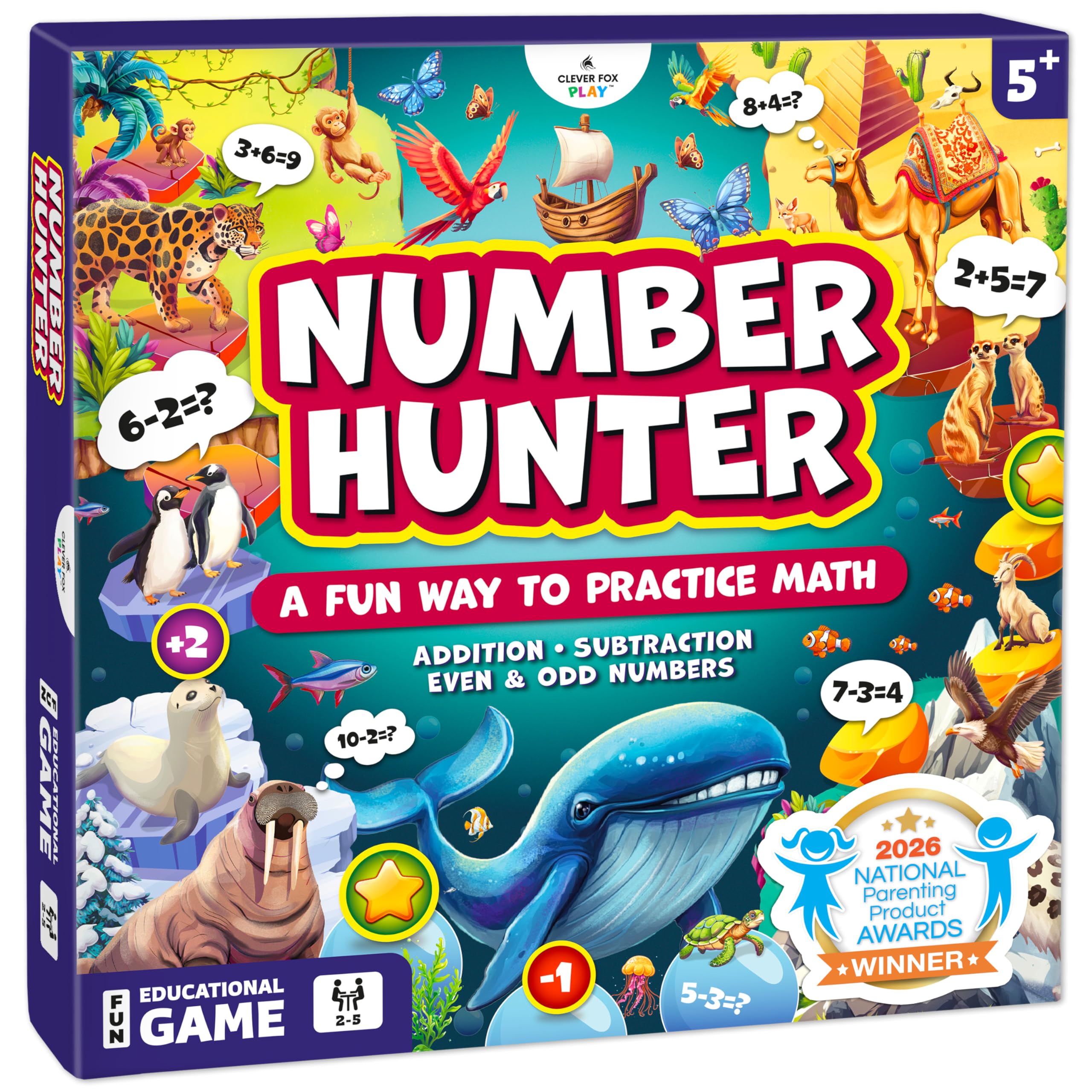
2. Number Hunter Math Board Game
The board game that sneaks math practice into family night without a single worksheet.
Number Hunter turns addition, subtraction, and even-and-odd recognition into a world-traveling race. Roll the dice, add or subtract to move forward, land on a star tile to face a challenge card — first to the finish line wins. The included components are generous: a game board, 5 game pieces, 2 number dice, 1 operation die, and 50 challenge cards in a reinforced box.
Owners rave about how often kids request this game, praising its frequent play. Parents report first-graders playing it daily, sometimes multiple times, with easy setup and a quick pace that keeps restless children engaged. It’s a great fit for families with multiple young kids because there’s no prep and no screen involved.
The honest trade-off is the challenge cards themselves, which get a mixed reception — some find them fun and silly with light physical activity, while others find them a bit ridiculous. And the board’s four sections are held together by a thin strip that some worry won’t survive heavy use. For the value, though, it’s a hard pick to beat for daily math reinforcement.
home practice: families who actually play games together and want math practice disguised as fun — particularly 6- and 7-year-olds just building fluency.
classroom groups: kids who already find math easy at an 8-year-old level — the challenge won’t stretch them much.
3. Educational Insights Math Whiz
A pocket-sized math tutor that hands out endless problems on demand.
For the child who constantly asks for math problems, the Math Whiz is a revelation. This compact handheld game practices addition, subtraction, multiplication, and division across three modes: Drill Mode (a progressively harder sequence of problems), Challenge Mode (a numbers elimination game), and Calculator Mode for checking work. It packs eight difficulty levels per skill in Drill mode, so it grows with the child from first grade well into upper elementary.
The portability is the standout feature — at just 0.28 kg and roughly the size of a thick smartphone, it slides into a backpack or glovebox for road trips, restaurants, and waiting rooms. The LCD screen and simple interface mean kids can practice independently, and the adjustable difficulty is what keeps it engaging rather than frustrating. Parents report it holds attention surprisingly well for a purely educational device.
The catch is reliability. The functionality feedback is genuinely mixed — a meaningful number of buyers report units that never worked or wouldn’t turn on after troubleshooting. It’s a gamble that pays off for most, but if you’re buying as a primary gift, be ready to test it immediately and exchange if needed. It also requires two AAA batteries (not included).
car rides: the math-loving kid who wants endless practice and the parent who wants screen-free skill-building.
quiet zones: you can’t risk a dud unit — the functional failure rate is higher than the other picks here.
4. National Geographic Junior Chemistry Set

Fifty experiments that turn baking soda and vinegar into an afternoon of wonder.
This chemistry set banks on the most reliable reaction in a kid’s world: the baking-soda-and-vinegar volcano. Blue Marble (the maker behind the National Geographic-branded kit) packs 50 hands-on experiments that use common household items, so the fun doesn’t end when the included supplies run out. Over 20 child-safe lab tools come in the box, including test tubes, goggles, and other lab essentials.
Owners mention kids playing for hours, making volcanoes, mixing colored reactions, and even using the tools in bath play. The fully illustrated, step-by-step instructions make it easy for young scientists to run experiments on their own with minimal adult help. One family reported the kit staying fun for over four months, which is a strong lifespan for a consumable science kit.
The reality check: not every ingredient for every experiment is included, so be prepared to raid the kitchen pantry. And value opinions split — some call it a steal, others wish more materials came in the box. It’s built for ages 4 and up, so a 7-year-old can absolutely handle it, possibly with a younger sibling joining in.
curious kids: you want a gift that sparks curiosity and works for a wide age range, from curious 4-year-olds to 12-year-olds.
mess-averse: you want a complete, all-inclusive kit — this one leans on household staples for many experiments.
5. LEGO Technic Monster Jam Grave Digger
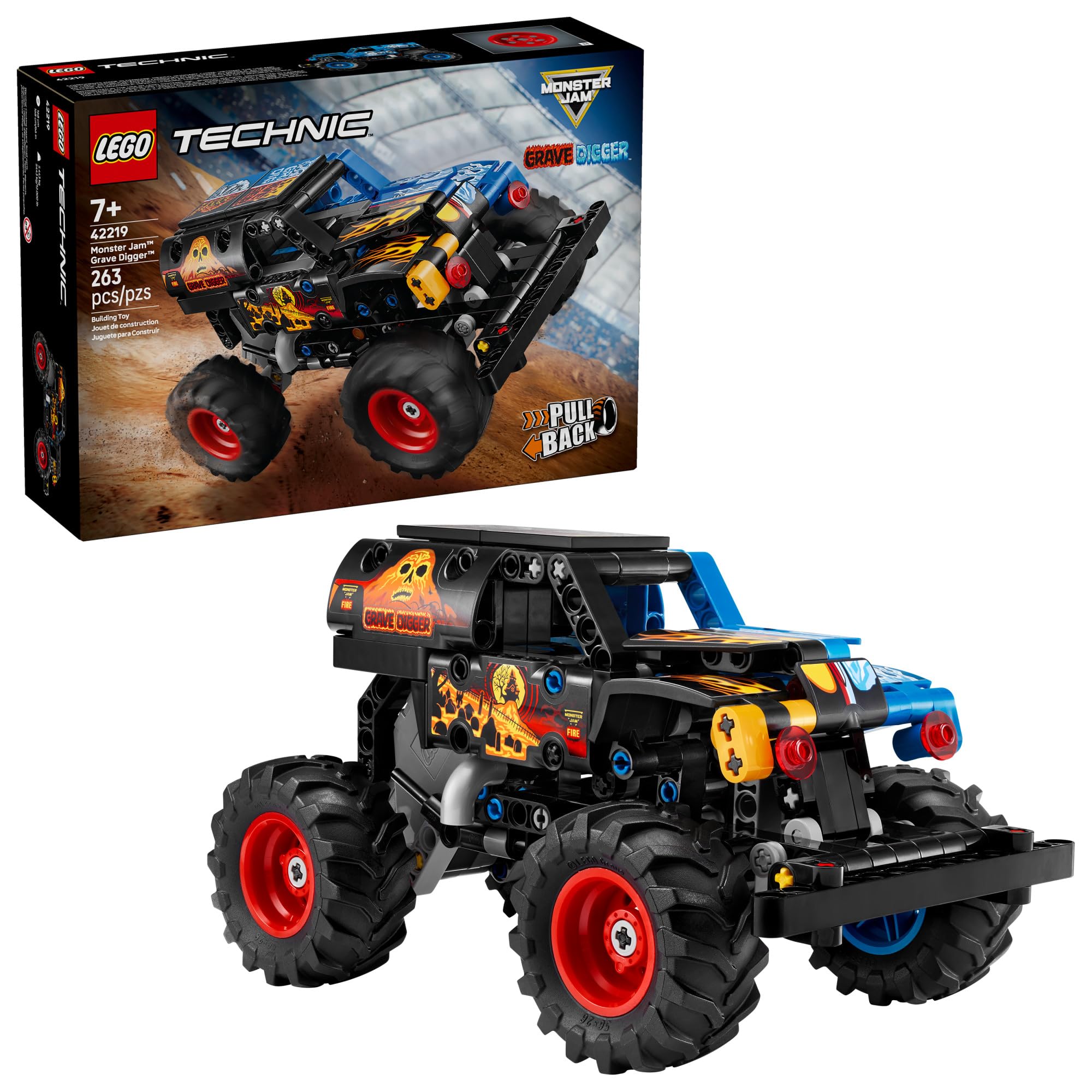
The Monster Jam truck that actually launches itself across the room.
For the 7-year-old who loves both building and racing, the LEGO Technic Grave Digger Fire and Ice delivers on both fronts. This 263-piece set recreates the real Monster Jam truck with fire and flames on one side and an icy design on the other. The signature mechanic is the pull-back action — wind it up, set it down, and watch it race forward to recreate arena stunts.
What sets this apart from the police boat set is the Technic line’s focus on moving parts and mechanical function. The finished truck measures over 4 inches high and 7 inches long, a compact size that’s easy to launch repeatedly on the floor. The LEGO Builder app adds 3D instructions that let kids zoom in and rotate the model during assembly, which is a genuinely useful digital companion for following along.
The build is reported as easy to follow with clear instruction pages, and the completed truck feels strong and substantial. The one note from owners: it assembles quickly — some kids finish in a few hours and want more. Quality is the most-praised aspect, with everything connecting cleanly as LEGO standard dictates. It’s a great pick if you want a focused, satisfying build with immediate racing payoff.
monster truck stunts: the pull-back racing action gives instant, repeatable play value that pure display builds lack.
long assembly time: a capable 7-year-old finishes this fast, so pair it with another gift if you want a longer project.
6. Mini Foosball Table Game
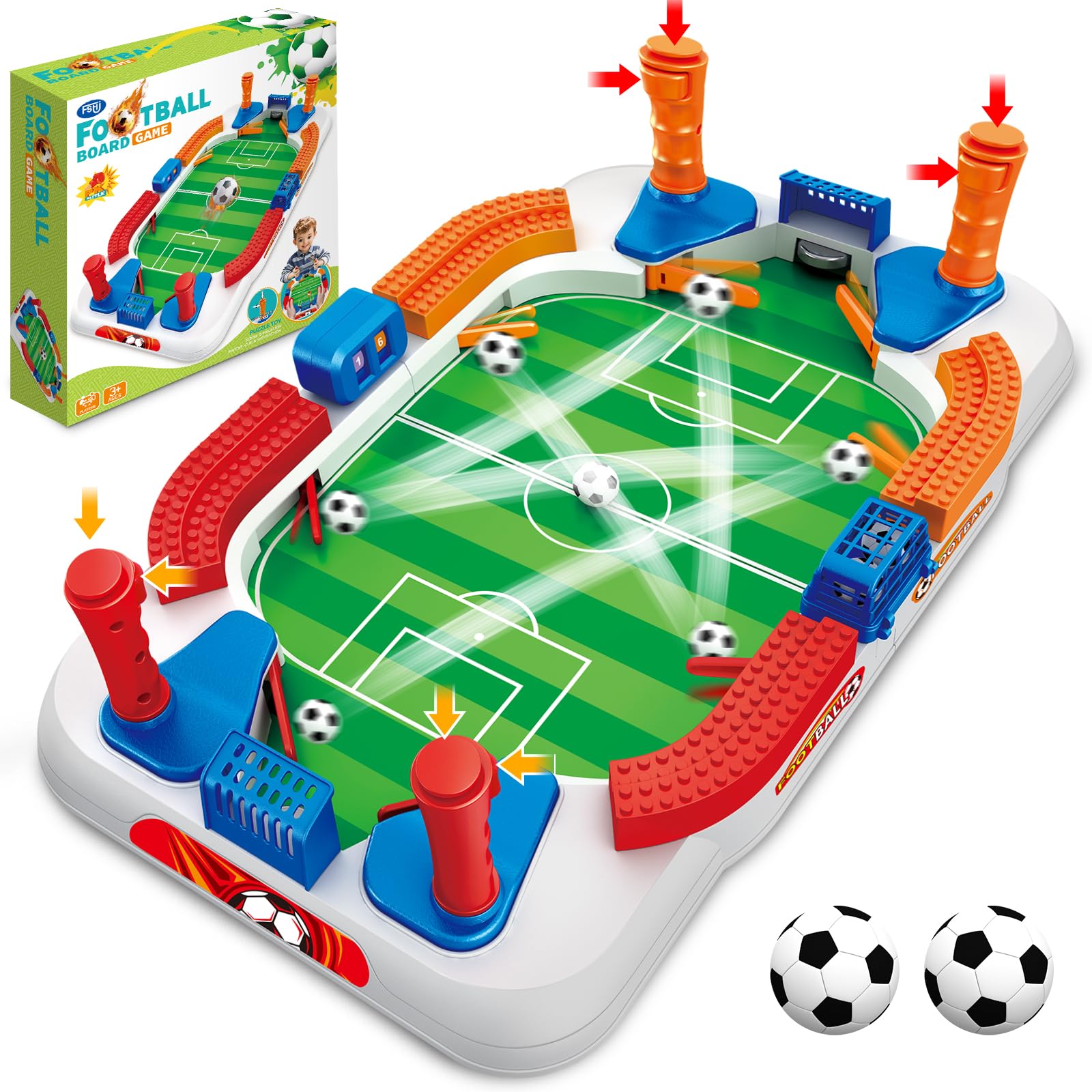
A proper tabletop foosball game, not a shrunken-down toy version.
This mini foosball table gets the proportions right. It’s designed as a true tabletop game with a 5-degree tilt that keeps the ball moving fast, plus a 4-flipper drive system controlled by smooth, responsive triggers. The included bell makes a satisfying ring when you score a goal, and there’s a built-in storage spot for the two balls so they don’t vanish under the couch.
The game earns its most praise for being genuinely enjoyable across all ages. Grandparents report it’s the first toy kids go for when they visit, and even 2-year-olds can grasp the concept well enough to play alongside older siblings. It’s easy to assemble, folds up for transport, and needs no batteries, making it a flexible addition to game rooms, parties, or camping trips.
The honest trade-off is durability. The buttons can stick occasionally, and the side baskets and nets have a tendency to fall off with rough handling. Some owners describe it as flimsy, while others find it surprisingly sturdy for the size. It’s a fun, affordable way to bring foosball to a small space, but it’s not built for tournament-grade abuse.
small spaces: a family that loves head-to-head games and wants something compact that actually works on any flat surface.
rough players: kids who play roughly — the smaller parts don’t handle aggressive treatment.
7. Educational Insights Math Slam

The math game that turns fact practice into a beat-the-clock arcade challenge.
Math Slam takes a different approach than the Math Whiz above: instead of just answering problems, kids literally slam the big buttons to answer before the timer runs out. The lights and sounds create genuine arcade energy, and the built-in timer motivates kids to beat their own records and challenge friends. Five game modes cover addition and subtraction from kindergarten through fifth grade, with an easy-to-read LCD window and LED number displays.
This device survived a road trip from the Outer Banks to Pennsylvania intact and became the favorite of the whole ride. It’s built sturdy enough to handle drops and tossing, and the instructions are simple enough for a 7-year-old to understand immediately. Even older siblings up to age 15 gave it two thumbs up, which says a lot about its broad appeal. The sound can be muted for car rides.
The caveat mirrors its sibling: functionality gets mixed feedback, with some units reportedly not working consistently. It requires three AA batteries (not included), so factor that into your first-use plan. For a child who thrives on competition and fast-paced challenges, this is a strong alternative to the Math Whiz — the slamming action makes it feel less like a quiz and more like a game.
fast-paced math game: the slam mechanic and timer make practice feel like an arcade game, which is exactly why kids keep coming back.
needs batteries often: three AAs not included, and the occasional unit has functional issues — test it on arrival.
8. IQKidz Weaving Loom Kit

The craft kit that turns a 7-year-old’s focus into a finished potholder she’s proud of.
For the child who loves making things with her hands, this weaving loom kit delivers a satisfyingly concrete result: a real potholder. The kit includes 224 loops in 8 rainbow colors made from high-quality nylon fibers, a solid loom frame with reinforcement pieces, and replaceable heart-shaped pegs that are easy to assemble. The step-by-step instructions (with a video option) get beginners started quickly.
This gift creates deep focus, with parents describing 6- and 7-year-olds working until the project is complete. Parents describe 6- and 7-year-olds becoming incredibly focused, working until the project is completed, then feeling genuinely proud of the result. It’s a confidence-builder that produces something usable, not just decorative — kids can make potholders, dolls, coin purses, and handbags by sewing the edges. All 224 loops and parts store neatly in the included storage box.
This toy suits kids from age 5 up to early teens, so it grows with your child. The nylon loops are soft and stretchy, so finished pieces feel textured and gentle on skin. For a screen-free, quiet-time activity that ends with a physical keepsake, this pick stands out.
creative weaving craft
- Produces a real, usable potholder — instant pride and a tangible result.
- 224 loops in 8 colors give plenty of creative combinations.
- Clear video and step-by-step instructions get beginners going fast.
frustrating for novices
- Kids who lose patience with repetitive, fine-motor work.
- Families looking for a high-energy, active toy.
9. SMILESSKIDDO Electronics STEM Kit

The snap-together circuit lab where 420+ projects teach real electrical engineering.
This is the deepest, most ambitious kit on the list. The SMILESSKIDDO Electronics STEM Kit comes with 35 circuit parts that snap together — no soldering, no extra tools — to build over 420 different projects. Kids can create a spray module, RGB light module, flying saucer accessories, a vacuum with a ball, a current indicator, a glowing cord, and more. The colorful 37-page manual and 4 indicator cards introduce circuits in 118 different ways.
Kids learn parallel and series circuit connections firsthand through hands-on assembly. Kids learn the difference between parallel and series connections firsthand, which is foundational electrical engineering knowledge presented in a safe, accessible way. The snap-together design means no welding and no frustration — just insert or tuck the circuits onto the plastic plate to start. Families report hours of play and kids genuinely excited to learn.
The manufacturing reality is the catch. The vacuum module stopped working after about two months in one reported case, and some components don’t stick firmly to the board and can fall off. The company’s customer service responded with refund or replacement offers, which is reassuring. It needs AA batteries (not included), and adult supervision is wise for younger users. For the entry price of a mid-range toy, the breadth of projects and the STEM depth are exceptional.
STEM beginners: the curious kid who asks “how does that work?” and wants to build things that spin, light up, and react.
young children: impatient kids who’d rather race a car than follow a circuit diagram — this one rewards careful assembly.
Understanding the Specs
Piece Count and Build Time
For building sets, the piece count tells you roughly how long the activity will last. A 264-piece set like the LEGO Police Boat gives a satisfying afternoon project for a 7-year-old, while the 263-piece Monster Jam truck builds faster. If you want a longer project, look for higher piece counts; if you want quick gratification, keep it under 300.
Battery Requirements
Electronic toys split into two camps. The Math Whiz needs 2 AAA batteries, and the Math Slam needs 3 AA batteries — neither includes them, so budget for that. Everything else on this list is battery-free, which means zero ongoing cost and zero “the toy died at grandma’s house” moments. Check this before gifting so the toy works immediately.
FAQ
Are LEGO sets for 7-year-olds too hard to build alone?
Do the LEGO City Police Boat boats really float?
Which is better for a 7-year-old, Math Whiz or Math Slam?
Do the science kits include all the materials needed for experiments?
What is the best gift for a 7-year-old girl who loves crafts?
Are the electronic math games durable for rough kid handling?
How many batteries do these toys need?
Can a 5-year-old use toys labeled for ages 7 and up?
Final Thoughts: The Verdict
For most families, the winner among these 7 year old toys is the LEGO City Police Boat Chase because it delivers both a satisfying build and an enduring water toy that kids return to long after assembly. If you want family game night fun, grab the Number Hunter Math Board Game — it’s the most-played pick on the list. And for the budding engineer, the SMILESSKIDDO Electronics STEM Kit offers the deepest, most ambitious learning experience at a value that’s tough to match.
How We Picked
We do not accept paid placement. Every pick is matched to a real buyer and a real use-case; we do not hands-on test units.
Sources & Methodology
Specifications: manufacturer listings and product documentation. Review insights: verified customer reviews, as of August 2026. Pricing: not shown on this page (it changes often); check the current price via the retailer link.
As an Amazon Associate, Gadgets Feed earns from qualifying purchases. This does not affect which products we feature.