
Our readers keep the lights on and my morning glass full of iced black tea. As an Amazon Associate, I earn from qualifying purchases.
A 7018 welding rod is the industry standard for structural and pressure-vessel work, prized for its low-hydrogen coating that prevents hydrogen-induced cracking in high-carbon and alloy steels. Unlike fast-freeze rods such as 6010, 7018 produces a smooth, quiet arc with a heavy slag that self-peels, delivering x-ray quality welds that meet code. The catch is that moisture in the flux destroys performance instantly, so storage discipline and brand consistency directly determine whether your beads come out clean or porous.
I’m Min — the co-founder and writer behind Gadgets Feed. I’ve spent hundreds of hours cross-referencing tensile-strength ratings, amperage windows, flux-coating integrity, and real user accounts from farm welders, pipe fitters, and weekend fabricators to separate the rods worth buying from the ones that cause more restarts than completed passes.
This guide covers seven top-selling options tested for arc stability, slag release, and moisture-resistance packaging. Whether you’re welding I-beams, repairing tractor hitches, or running a bead on 3/16″ pipe, understanding the subtle differences between these products helps you pick the best 7018 welding rod for your specific setup and skill level.
How To Choose The Best 7018 Welding Rod
7018 rods are defined by their low-hydrogen iron-powder flux, which deposits clean weld metal with high impact resistance at low temperatures. The key variables are diameter, package weight, brand consistency, and storage readiness. Understanding these dimensions prevents the frustration of porosity, slag inclusions, and difficult arc restrikes.
Diameter and Material Thickness
Rod diameter controls the amperage range you need. A 1/8-inch rod runs comfortably between 90 and 150 amps and handles base metal from 1/8-inch to 3/8-inch. The 3/32-inch variant suits thinner materials and lower-heat applications, while 5/32-inch rods push up to 210 amps for heavy plate and thick-section joints. Match the rod diameter to your workpiece thickness to avoid burn-through or lack of fusion.
Flux Coating and Storage Requirements
The low-hydrogen coating is hygroscopic — it pulls moisture from the air within hours. Once wet, the rod produces porous welds and unstable arcs. Look for rods shipped in sealed plastic tubes or vacuum-packed bags. For long-term storage, a dedicated rod oven at 250–300°F reconditions rods that have absorbed ambient humidity. A rod that arrived with cracked flux or loose dust inside the tube is a red flag for poor handling during transit.
Arc Characteristics and Slag Behavior
7018 is a drag rod — you can rest the flux coating on the workpiece while running a bead. The arc is softer than 6010 and produces a heavy slag that cools and chips off easily when the weld is done. Some brands offer smoother restrike capability for tack welding, while others require a quick swipe on a sandpaper block to expose fresh metal. If you work on open-circuit-voltage machines below 50 OCV, check compatibility: 7018 typically needs at least 70 OCV for reliable starts.
Quick Comparison
On smaller screens, swipe sideways to see the full table.
| Model | Category | Best For | Key Spec | Amazon |
|---|---|---|---|---|
| Hobart 770479 1/8-10lbs | Premium | Professional fabrication & repair | 70,000 PSI tensile; made in USA | Amazon |
| Forney 30910 5/32-10lbs | Premium | Heavy plate & thick joints | 210A capacity; 5/32″ diameter | Amazon |
| TOOLIOM E7018 1/8 10LB | Mid-Range | High-volume shop use | 10lb bulk; good X-ray values | Amazon |
| Hobart 770482 3/32-5lbs | Premium | Thin metal & precision work | 3/32″ for lower heat input | Amazon |
| Forney 30805 1/8-5lbs | Mid-Range | Home workshop & hobby | 150A capacity; all-position | Amazon |
| ARCCAPTAIN E7018 1/8-5LB | Value | Budget-friendly performance | Stable arc; low spatter | Amazon |
| Blue Demon 7018 1/8-5LB | Value | Cold-rolled & farm repair | 5lb tube; no preheat needed | Amazon |
In‑Depth Reviews
1. Hobart 770479 7018 Stick, 1/8-10lbs

Hobart’s 770479 delivers the most consistent arc and immediate slag release I’ve seen across the 1/8-inch category. The 70,000 PSI tensile rating meets code requirements for structural steel, and the low-hydrogen coating performs reliably on medium and high-carbon steels without the porosity issues that plague moisture-damaged rods. Users consistently report that these rods burn smoothly from start to finish with minimal spatter, and the slag chips off cleanly without leaving embedded inclusions.
The 10-pound tube gives you enough material for multi-day projects while keeping the flux protected from humidity during storage. The flux coating is uniformly applied with no loose dust in the container — a sign of quality control that cheaper rods often lack. Some units arrive with a few broken ends due to rough shipping handling, so inspect the tube upon delivery and store the rods in a dry cabinet or rod oven for best results.
On a 3/16-inch pipe at 120 amps, this rod produces a flat bead profile with excellent wetting action into the base metal. The restrike capability is above average: you can lay a tack, reposition, and re-ignite without sanding the tip. For any shop that needs a reliable, daily-use rod for general fabrication and repair, this is the unit to beat.
Why it’s great
- Smooth, stable arc with excellent restrike behavior
- Clean slag release leaves no inclusions in the weld bead
- 10lb tube provides ample volume for continuous work
Good to know
- Some rods may have flux damage from shipping impacts
- Not recommended for low-OCV power sources under 50 volts
2. Forney 30910 E7018 Welding Rod, 5/32-Inch, 10-Pound
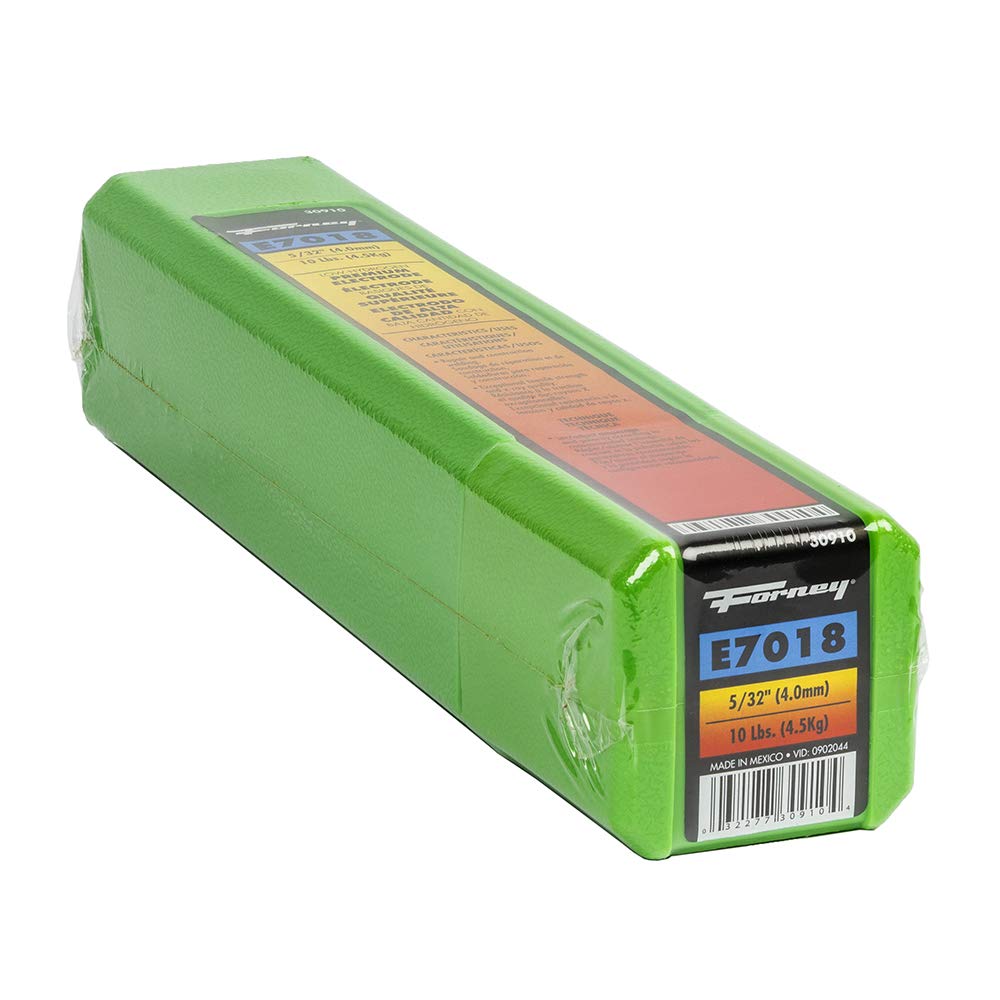
The 5/32-inch diameter makes the Forney 30910 a specialist for heavy plate, thick-section restrained joints, and structural beams where deep penetration is mandatory. With a rated amperage capacity of 210 amps, it deposits weld metal fast and maintains a steady arc even on AC power sources that struggle with other low-hydrogen electrodes. The iron-powder flux produces a thick slag that virtually self-peels in vertical-down fillets, reducing cleanup time between passes.
This rod is designed for steels prone to cracking — think cold-rolled plate with trapped stresses or high-sulfur material that causes porosity with standard electrodes. The smooth wetting action fills poorly fitted joints and yields a flat, even bead with no undercut. Users running it on 3/16-inch pipe at 120 amps report excellent puddle control and easy slag removal, though the heavier flux makes restrike slightly more demanding compared to a 1/8-inch rod.
Packaging is a mixed bag: the plastic tube provides decent protection, but some shipments arrive with electrode dust inside and no moisture absorber. If you buy this 10-pound box for a long-term project, transfer the rods to a sealed container with desiccant packs immediately. For a welder who works primarily on thick sections and wants a rod that handles high heat input without cracking, this Forney earns its place on the bench.
Why it’s great
- Deep penetration for heavy plate and thick joints
- Slag self-peels in vertical-down fillets with minimal effort
- Excellent wetting action fills poorly fitted gaps cleanly
Good to know
- No moisture absorber included in the packaging
- Restrike requires sanding more often than smaller diameters
3. TOOLIOM E7018 Low Hydrogen Welding Rod 1/8″ 10LB

The TOOLIOM E7018 delivers a strong cost-per-pound ratio without sacrificing the essential low-hydrogen characteristics that define this electrode class. At 1/8-inch diameter with a 14-inch length, it fits standard stinger clamps and runs comfortably on DC+ or AC machines with at least 70 OCV. The iron-powder flux provides good deposition efficiency, and the arc is smooth with noticeably less spatter than generic import rods at similar price points.
Welding applications include structural steel framing, ship hull repairs, and process piping. The rod’s crack resistance and X-ray-quality weld deposit make it suitable for code work on low- and medium-carbon steels. Users report that roughly 8 out of 10 rods light up on the first strike without hesitation — a solid ratio for a bulk-packaged product. The remaining rods may need a quick touch to a file or sandpaper to expose fresh metal at the tip.
The main drawback is packaging durability. The plastic container is thin, and multiple customers have noted flux damage at the ends of several rods when the box gets tossed during shipping. This is a non-issue if you plan to use the rods within a week, but for long-term storage in a humid shop, you’ll need a separate airtight tube or rod oven. For a mobile welder or farm shop that burns through rods quickly, the TOOLIOM 10-pounder offers serious value.
Why it’s great
- Low cost per rod with reliable arc characteristics
- Good X-ray quality and crack resistance for code work
- 10lb quantity reduces per-project consumable costs
Good to know
- Thin plastic tube offers limited shipping protection
- Restrike consistency varies across the batch
4. Hobart 770482 7018 Stick, 3/32-5lbs

The 3/32-inch Hobart 770482 fills a specific niche: thin-wall tubing, sheet metal ductwork, and precision joints where a 1/8-inch rod would deliver too much heat and burn through. With a 70,000 PSI tensile rating and low-hydrogen classification, it maintains the same crack-resistant weld deposit as its larger siblings while operating at a significantly lower amperage window — typically 60–90 amps depending on material thickness and position.
On a 110-volt welder with limited duty cycle, this rod is forgiving. The arc strikes reasonably well for a low-hydrogen electrode, though some users note that it requires more patience to establish compared to a 6013 or 6010. Once the puddle forms, the bead is smooth and the slag chips off cleanly. The 5-pound tube is a practical size for occasional repairs and small fabrication jobs, and the compact footprint stores easily on a shelf or in a tool box.
Shipping damage is the primary complaint: a few rods in every batch tend to arrive with broken flux, which reduces the usable count. Hobart’s quality control on the coating itself is excellent — the flux is uniform and free of pits — but the cardboard-and-plastic packaging does not absorb impacts well. Overall, this is a top choice for any welder who needs 3/32-inch 7018 for thin-gauge work and values brand consistency over raw quantity.
Why it’s great
- Ideal for thin materials and low-heat applications
- Consistent flux coating with smooth bead formation
- 5lb tube is portable and easy to store
Good to know
- Shipping can break flux on multiple rods per tube
- Arc striking is slightly harder than 1/8-inch rods
5. Forney 30805 7018 Welding Rod, 1/8-Inch

Forney’s 30805 is one of the most accessible 7018 rods for the home-garage welder who hasn’t yet invested in a rod oven. Rated for 150 amps AC or DC+, it handles the typical thin to medium material range — 1/8-inch to 3/8-inch — that covers most farm repairs, trailer fabrication, and yard-art projects. The arc is easy to start and runs quietly, with a puddle that gives the novice enough time to adjust travel speed before the slag sets.
Users welding 3/16-inch wall pipe at 120 amps report beautiful beads with good penetration and no cold lap. The slag chips off in large flakes with minimal hammering, which speeds up multi-pass work. Restrike is the one area where this rod shows its budget positioning: after the initial arc, the tip forms a glassy cap that requires a quick scuff on sandpaper or a file to re-light. A few experienced users noted that the flux coating is slightly thinner than premium brands, which can expose the core wire if the rod is bent.
Packaging is basic — a plastic bin with a snap lid, no desiccant included. The rod ends are generally intact on arrival, but the container is not airtight, so humidity will degrade performance within days if left open in a damp shop. For a weekend welder who burns through a 5-pound tube in a few sessions and keeps the rods indoors, the Forney 30805 delivers results far above its tier.
Why it’s great
- Forgiving arc with a stable puddle for beginners
- Slag flakes off cleanly and quickly between passes
- Consistent performance across AC and DC+ machines
Good to know
- Restrike requires sanding the tip after every stop
- Flux coating is thinner than premium-tier rods
6. ARCCAPTAIN E7018 Welding Rod 1/8” 5LB

The ARCCAPTAIN E7018 proves that a budget-priced rod can still deliver a stable, low-spatter arc that competes with established names. At 1/8-inch diameter with a 14-inch length, it is optimized for DC reverse polarity but runs acceptably on AC machines with sufficient open-circuit voltage. The low-hydrogen flux deposit rates well and produces X-ray-quality welds suitable for structural steel, high-pressure pipelines, and ship hulls.
Users consistently praise the easy strike and stable arc — two areas where cheap 7018 rods typically fail. The melting efficiency is high, meaning you get more deposited metal per inch of rod consumed, which saves money on large projects. The spatter level is noticeably lower than the Blue Demon and Forney 30805, which translates to less grinding before painting or inspection. The 5-pound tube is adequate for a weekend job and fits easily into a mobile welding kit.
While the flux coating is well-adhered and free of cracks on most units, the packaging is minimal: a simple plastic tube with no desiccant and no shock-absorbing liner. A few rods may arrive with small flux chips at the ends, though the rate is lower than the TOOLIOM bulk pack. For a first-time buyer on a tight budget who still wants a genuine low-hydrogen rod that sparks up without drama, ARCCAPTAIN is a strong contender.
Why it’s great
- Very low spatter for a budget-tier 7018
- Arc strikes easily and runs stable across the length
- High deposition efficiency reduces rod waste
Good to know
- No moisture protection in the packaging
- Some rods arrive with minor flux chips at the ends
7. Blue Demon 7018 X 1/8″ X 14″ X 5LB

The Blue Demon 7018 is explicitly formulated for medium-grade carbon steels where preheating is impractical — think cold-rolled plate on a tractor frame or a trailer hitch repair in a farm shop without a torch. The rod runs best between 80 and 95 amps for uphill work and handles base metals from 1/8-inch to 1/4-inch without excessive porosity. Users report that the slag chips off easily and the weld deposit holds up under repeated shock loading on heavy equipment.
Typical applications include offshore rigs, power plant components, and structural fabrications, but the rod’s real-world strength is on dirty or slightly contaminated steel that would give other 7018 rods trouble. The arc is not the smoothest in this roundup — some users note more spatter than the ARCCAPTAIN or Hobart — but the penetration is deep and the bead profile is consistent. The 5-pound plastic tube includes a threaded cap that seals reasonably well against garage humidity.
One veteran user reported that the rods arrived perfectly intact with no coating damage, a direct result of Blue Demon’s tight packing and tube design. The biggest caveat is the restrike behavior: once the arc is broken, the tip forms a hard glass coating that is tougher to restart than the Forney or Hobart rods. A few seconds on a wire brush or sandpaper solves it, but it adds friction to tack-and-position workflows. For farm use where speed is secondary to strength, the Blue Demon delivers serious value.
Why it’s great
- Excellent on cold-rolled steels without preheating
- Slag chips off cleanly with minimal effort
- Well-sealed plastic tube protects rods during storage
Good to know
- More spatter than premium-tier 7018 rods
- Restrike requires tip prep on almost every stop
FAQ
Why does my 7018 rod keep sticking on startup?
How do I store 7018 rods without a rod oven?
Can I use 7018 on a 110V welder?
What happens if I weld with wet 7018 rods?
Final Thoughts: The Verdict
For most users, the best 7018 welding rod winner is the Hobart 770479 1/8-10lbs because it delivers the most consistent arc, easiest restrike, and cleanest slag release across everyday fabrication and repair work. If you need a heavy-diameter rod for thick plate and high-heat welding, grab the Forney 30910 5/32-10lbs. And for budget-conscious shoppers who still demand low-hydrogen performance, nothing beats the ARCCAPTAIN E7018 1/8-5LB for stable strikes and minimal spatter at an entry-level price.