
Our readers keep the lights on and my morning glass full of iced black tea. As an Amazon Associate, I earn from qualifying purchases.
Specs are compiled from manufacturer listings and verified buyer reviews and can change over time — please confirm the key details on the product page before buying.
Buying a 72V lithium battery is not like buying a phone case — the wrong pack either won’t fit your frame, won’t talk to your controller, or won’t deliver the amps your motor actually asks for. The six packs below are split by what they’re built to power: golf carts and e-bike conversions. If you drive a golf cart, the answer is a 70.4V 105Ah LiFePO4 pack with a 200A BMS and a range claim of up to 60 miles. If you’re converting an e-bike, you want a lighter 72V 20Ah pack matched to your motor’s wattage.
I’m Min — the founder and writer behind Gadgets Feed. This guide is built by comparing the manufacturers’ published specifications and the patterns across verified customer reviews, so you get each pick’s real strengths and trade-offs instead of marketing spin.
Voltage gets all the attention, but the numbers that decide whether your cart climbs a hill or your e-bike stalls are capacity in amp-hours and the discharge rating of the BMS (the battery’s internal safety board). Every pick below is a true 72V-class pack, so the real sorting happens on capacity, BMS amps, and physical size. Here is how the field shakes out when you’re shopping for the best 72V lithium battery.
Our Picks at a Glance

How To Choose The Best 72V Lithium Battery
The mistake most first-time buyers make is ordering on voltage alone. Two packs can both say 72V and still be completely different animals — one is a golf-cart replacement that weighs as much as a small child, the other is a frame-mounted e-bike cell you can lift with one hand. Get these three numbers right — motor wattage, compartment size, and amp-hours — and the choice narrows fast.
Start With Your Motor’s Wattage, Not the Voltage
Your motor tells you how much current it will pull, and the BMS (the board inside that shuts the pack off if something goes wrong) has to be rated above that pull. A pack with a 50A BMS suits controllers rated at 50A or less and motors in the 250W–3600W band. A pack with an 80A BMS is built for the 2000W–5000W hub and mid-drive kits. Buy a 50A board for a 5000W motor and you’ve bought the wrong pack — the board will cut out under load.
Measure Your Compartment Before You Measure Anything Else
Battery dimensions are listed for a reason: they are the single most common reason a return happens. Do not trust a rough eyeball of the frame triangle or the cart’s battery tray. Write the internal clearance down in inches and compare it directly against the listed size. The packs here range from a compact 5.95 x 5.2 x 9.73 inches to a full-size 22.24 x 12.09 x 11.1 inches, so the spread is wide enough that guessing will cost you.
Decide How Much Range You Actually Need
Capacity in amp-hours (Ah) is your range dial. A 20Ah pack is a commuter or short-trail battery. A 45Ah pack pushes past 45 miles without pedaling. A 105Ah golf-cart pack is built for multi-day use between charges. Extra amp-hours add weight and bulk, so size the pack for your longest normal day, not your once-a-year epic.
Chemistry: LiFePO4 vs Lithium-Ion
LiFePO4 (lithium iron phosphate) is the chemistry most golf-cart and e-bike conversions now use, and the listings here advertise it as incombustible with good high-temperature resistance. Lithium-ion packs using Samsungcells are the other route, typically lighter for the capacity and rated for over 1000 charge cycles. Both are legitimate; LiFePO4 tends to be the choice for heavy, hot, or long-service applications, while lithium-ion suits weight-sensitive builds.
Quick Comparison
| Model | Best For | Capacity | BMS Rating | Weight | Amazon |
|---|---|---|---|---|---|
| VATRER POWER 72V (70.4V) 105Ah★ Best Overall | Golf cart replacement | 105 amp_hours | 200A | 132.3 pounds | Amazon |
| VATRER POWER 72V (70.4V) 105Ah Touch MonitorPremium Pick | Premium golf cart build | 105 amp_hours | 200A | 132.3 pounds | Amazon |
| ZLSHELIBK 72V 20Ah Samsungcell | High-power e-bike conversion | 20 amp_hours | 80A | 15.4 pounds | Amazon |
| 72V 45Ah LiFePO4 Ebike Pack | Long-distance e-bike range | 45 AH | 50A | — | Amazon |
| Wroyeti 72V 20Ah Metal Case | Weatherproof e-bike commuting | 20 Ah | 60A | — | Amazon |
| Cymoye 72V 20Ah LiFePO4 Pack | Budget DIY builds | 20 AH | 50A | 17.2 pounds | Amazon |
In‑Depth Reviews
1. VATRER POWER 72V (70.4V) 105Ah Lithium Golf Cart Battery
Our pick — 4.5+★ from 200+ verified ratings; the strongest balance of quality and price.
A 105Ah golf-cart pack that runs days between charges instead of hours.
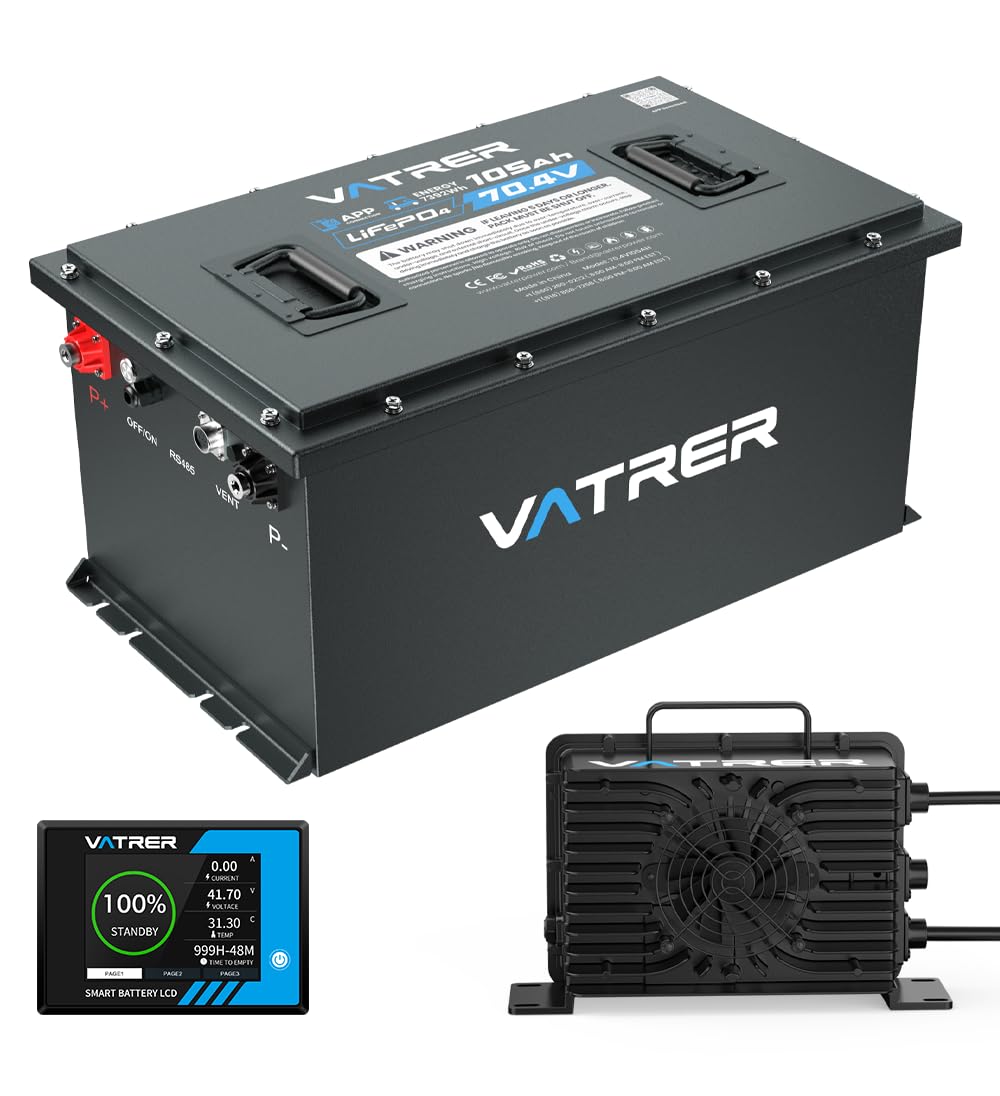
Here is the number that reframes your whole cart: 7.392kWh of usable energy, which the maker says is the equivalent of six 12V 100Ah LiFePO4 packs wired in series. That is a lot of stored power in one case — enough that Vatrer quotes up to 60 miles of continuous golfing on a single charge. The 70.4V label is just how a 72V-class lithium pack is honestly rated; it is the correct product for a 72V cart, not a downgrade.
What wins people over is the build. The high-strength cold-rolled sheet metal case is described as fireproof, shockproof and IP67 waterproof (IP67 means it shrugs off dust and survives a dunking), and the 200A BMS (the board that cuts power on over-charge, over-discharge, over-current, extreme temperature or a short) does the guarding. Peak output is quoted at 400A for 35 seconds and 600A for 3 seconds, so hard acceleration up a slope isn’t the stress test it once was. Buyers report charging roughly every three to four days and seeing 35 to 40 miles per charge in real use — comfortably inside the maker’s 60-mile ceiling.
The trade-off is heft. At 132.3 pounds the pack is 50% lighter than a lead-acid battery of the same capacity, per Vatrer, but it is still a heavy bench job. Against the Cymoye 72V 20Ah pack at 17.2 pounds, this is 132.3 pounds versus 17.2 — two very different installation days. The 79.2V 18A charger fills it 0% to 100% in 5.8 hours, and the 2.8-inch touchscreen plus the mobile app let you read state of charge without lifting a seat cushion.
Why carts feel new again
- 7.392kWh of stored energy with a 200A continuous discharge rating
- IP67 metal case rated fireproof and shockproof
- Onboard 2.8-inch touchscreen and app monitoring for live state of charge
- Maker quotes 4000+ cycles against 300–500 for lead-acid
What to plan around
- 132.3 pounds means two people and a plan, not a one-person lift
- Full charge takes 5.8 hours, so overnight charging fits best
Made for: anyone retiring a lead-acid cart pack who wants multi-day range and live battery readouts.
Not for: riders who need a battery they can pull out and carry up a flight of stairs.
2. VATRER POWER 72V (70.4V) 105Ah Lithium Golf Cart Battery with Touch Monitor
Same golf-cart muscle as the winner, with a longer manufacturer warranty behind it.
If the top pick is the sensible golf-cart answer, this is the same answer with a longer safety net. The pack carries a 5-year manufacturer warranty, and it shares the winner’s core numbers — 105 amp_hours of LiFePO4 capacity, a built-in 200A BMS, and 14.08kW of quoted power output. Where it pulls ahead for some buyers is the documentation of its limits: the listing spells out 2C discharge and 4000+ cycles as headline highlights rather than burying them in the fine print.
Battery life is what this pack is known for. Owners consistently describe it outlasting the lead-acid pack it replaced, with carts holding a charge far longer between top-ups and handling a continuous 110-to-175-amp pull without complaint. The weight story is just as clear: this is roughly a quarter of the weight of the previous battery, so the cart sheds a serious amount of mass. Combined with the 5.8-hour charge time on the included 79.2V 18A charger, you get a cart that charges overnight and runs for days.
One practical wrinkle Vatrer is upfront about: because the unit is so heavy, the battery, charger and accessories ship in two separate packages. Don’t panic if only the charger shows up first. And like the winner, at 132.3 pounds the pack is a two-person install in a cramped cart bay — worth scheduling help for rather than discovering it mid-job.
Where it wins: the 5-year warranty and full touch-monitor-and-app control make this the pick for a cart you plan to keep for years and want to keep eyes on.
Sizing note: it delivers the same 7.392kWh and 60-mile ceiling as its stablemate, so if you don’t need the extra warranty coverage, the winner above does the same daily job.
Reach for this: long-term cart owners who value warranty length and on-screen monitoring over saving on the entry version.
Think twice if: you want a single-box delivery arriving all at once.
3. ZLSHELIBK 72V 20Ah Samsungcell E-Bike Battery with 4A Charger

An 80A BMS for 2000W–5000W hub and mid-drive kits that pull hard under load.
Twenty amp-hours sounds modest next to the golf-cart packs, but this battery is playing a completely different game. Its 80A max continuous discharge rating feeds 2000W–5000W hub or mid-drive motors — that is the biggest BMS number in this e-bike group. The 20 amp_hours of Samsungcell lithium-ion capacity lives in a 15.4-pound pack, versus 132.3 pounds for the Vatrer golf-cart unit, which tells you exactly which machine each one belongs in.
Safety paperwork is where this one separates itself. The listing states UL2271 certification by ACT, described as independently tested and verified for electrical, mechanical and environmental safety. For a high-voltage e-bike build that certification is not marketing garnish — it is the difference between a pack that has been tested to a published standard and one that hasn’t. The built-in 80A BMS layers on short-circuit, over-charge, over-discharge, over-current and temperature protection. IP65 waterproofing covers light rain and typical outdoor conditions; it is not rated for submersion or prolonged heavy rain.
The charger is included and quick: a 4A unit that fills the pack in 5 hours, with a detachable design so you can carry the battery to a desk and charge it there. Samsungcells are quoted for over 1000 cycle life, and the listing contrasts that with generic unbranded packs. The catch is size — at 13.8 x 8.8 x 15.75 inches this is a frame-mounted triangle pack, and the maker asks for at least a 17-inch top tube, 14-inch seat tube and 20-inch down tube of clearance. Measure before you commit.
Your pick if: you’re running a high-wattage conversion kit and want certified cells with a matching 80A board.
Look elsewhere if: your frame is a step-through or compact design that can’t clear a full triangle pack.
4. 72V 45Ah LiFePO4 Ebike Battery Pack

45Ah of LiFePO4 for 45+ miles per charge without pedaling.
The headline here is distance: 45+ miles without pedaling on one charge, drawn from a 45AH LiFePO4 cell stack. Compare that to the Cymoye 20 AH pack and you’re looking at 45AH versus 20 AH — the difference between a short trail loop and a full day out. A 50A BMS supports 250W–3600W motors at a max constant discharge of 50A, so it matches the same controller band as the budget pick but with more than double the capacity behind it.
LiFePO4 chemistry is the sales pitch, and the listing makes its case plainly: it calls the cells incombustible, with long cycle life and good high-temperature resistance. There is also a genuinely useful note on charge voltage — a full pack reads 3.65v per cell, and the voltage settling back to 3.35v or above after the charger cuts off is normal, not a fault. The 80.4v to 87.6v window represents 99%–100% capacity, so don’t chase a phantom problem when your meter drifts down after a full charge.
Fit is the deciding factor. At 10.2 x 9.8 x 6.7 inches this pack needs a battery box with real volume, so measure your case before ordering. The listing also pairs the 50A BMS with over-charge, over-discharge, over-current and overheating protection, and backs the pack with three months of free return or replacement plus a 12-month service window. It’s a range-first buy for riders with the compartment to hold it.
The case for it: 45AH of LiFePO4 at a 50A ceiling is a serious range upgrade for anyone whose daily ride has outgrown a 20AH pack.
Before you click buy: the 10.2 x 9.8 x 6.7-inch footprint is the number to check first — this pack rewards buyers who measured and punishes those who guessed.
Best matched to: riders with a roomy battery box who want 45+ miles per charge at a mid-range controller rating.
Wrong fit for: compact frames with a tight, narrow battery compartment.
5. Wroyeti 72V 20Ah Metal Case E-Bike Lithium Battery
A glue-sealed metal case rated for rain on the daily commute.
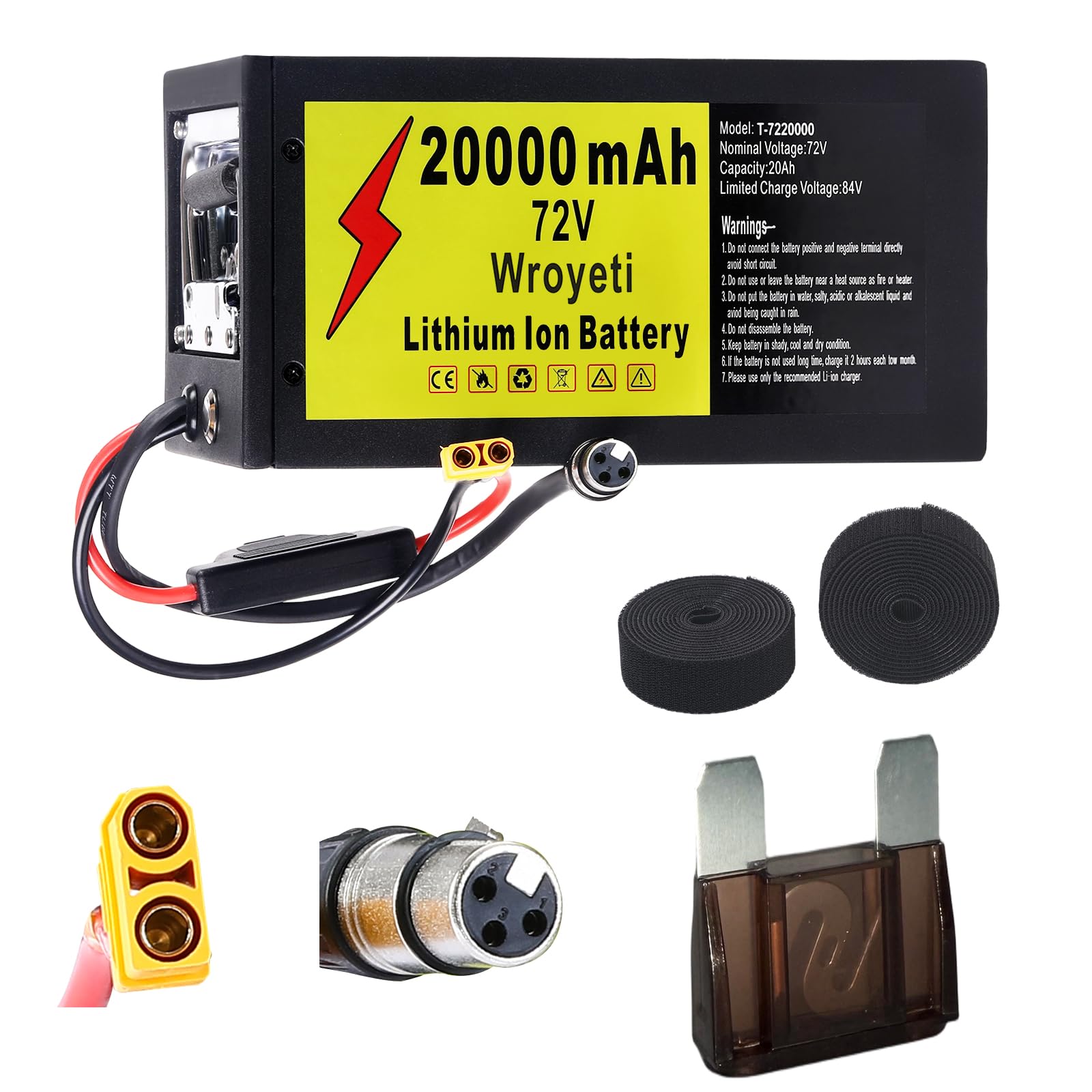
Where most e-bike packs treat weather as an afterthought, this one leads with it. The 1.3MM thick metal outer case is described as resisting bumps and scratches, and the entire internal space is filled with waterproof glue so rain during a ride stays outside. A 60A BMS handles over-charging, over-draining, over-current and short circuits, with an external safety fuse as a second line of defense. It’s rated for 200W–3000W 72V motors.
Two features make daily ownership easier than the spec sheet suggests. A spring rebound handle lets you pull, lift and move the pack to charge or store it, and an external power cutoff switch stops idle power loss while the bike sits. Inside, Grade A cells sit in fixed internal brackets so they don’t shake loose on bumpy off-road trails. Wiring is genuinely plug-and-play — the matching wires and plugs come pre-mounted — and the compact 5.95 x 5.2 x 9.73-inch body slides into far tighter frames than the triangle packs.
Value is where this one earns its keep. Owners consistently point to what you get for the outlay, and the power output backs it up — the pack pairs cleanly with a 3000w motor, which is the top of its rated band. Add a 12-month warranty and a 30-day full-refund-or-replacement window and the purchase feels low-risk. The honest limit is capacity: 20Ah is a commute and trail-loop figure, and riders chasing 45 miles should look up the range pick instead.
What riders keep pointing to
- Fully glue-sealed interior with a 1.3MM metal shell for wet-weather riding
- Spring pull handle and external power switch for day-to-day handling
- Compact 5.95 x 5.2 x 9.73-inch body fits tight frames
- Pre-mounted wiring means no soldering on install day
Set your expectations
- 20Ah capacity is a commuter figure, not a long-tour number
- 60A BMS caps you at 3000W motors, so high-wattage builds should size up
Made for: year-round commuters who ride through drizzle and want a pack that handles it without drama.
Skip it for: a 5000W conversion — the 60A board isn’t rated for that motor class.
6. Cymoye 72V 20Ah LiFePO4 Battery Pack with 50A BMS
The entry ticket into 72V LiFePO4 for a DIY bench build.
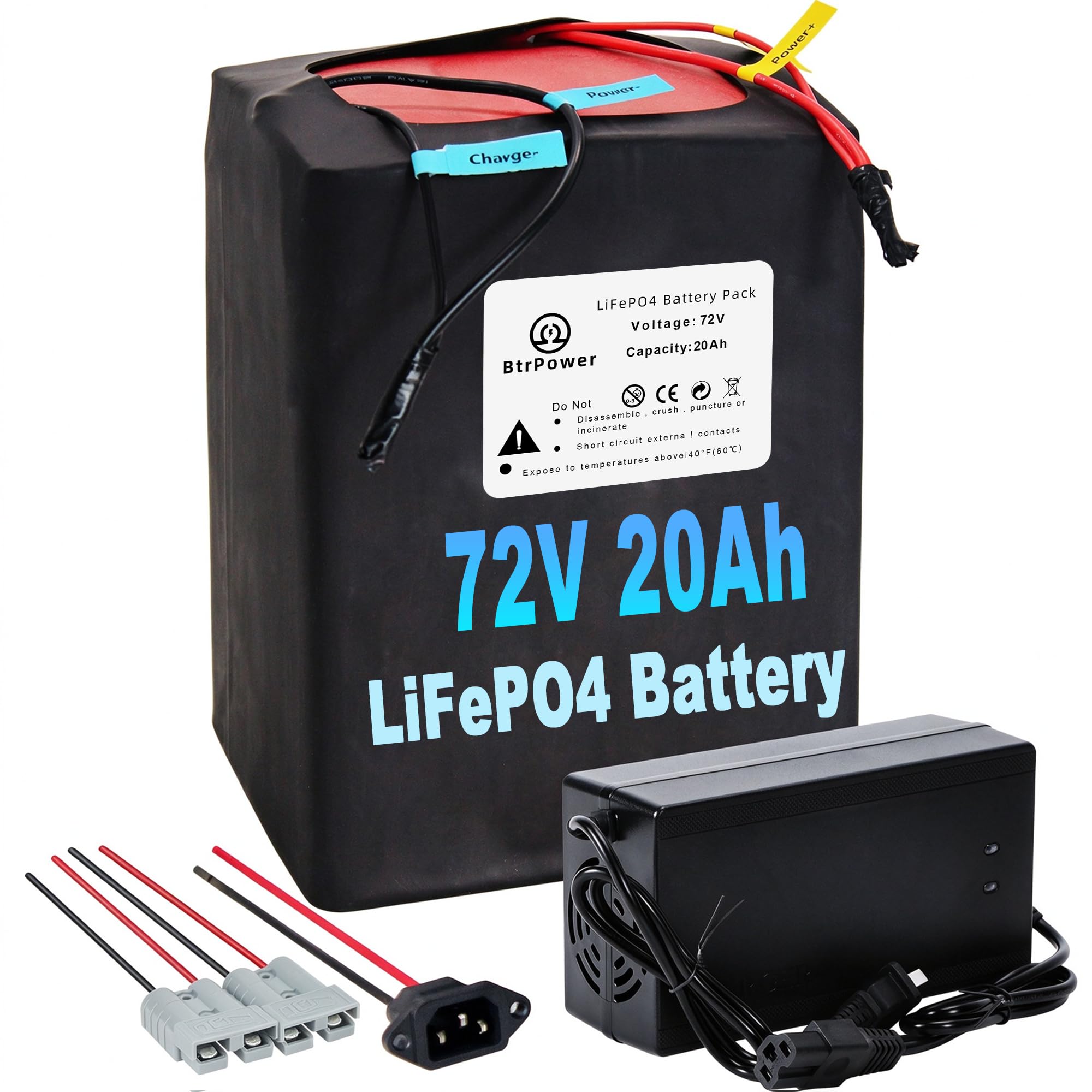
This pack is refreshingly upfront about who it’s for: a 72V controller rated at 50A or less, a motor in the 250W–3600W band, and a battery case with room for 7.09 x 6.69 x 10.24 inches. That’s the whole compatibility story in one line, and it saves you a guessing game. The cell chemistry is LiFePO4, and at 17.2 pounds it’s a pocket-sized step up from the larger e-bike packs and a world away from a 132.3-pound golf-cart unit.
What it does best is open the door to 72V for builders who don’t need huge capacity. Twenty amp-hours is a light-commute and DIY-project figure, and the 50A BMS ceiling means it pairs with modest controllers rather than the high-wattage kits. The 1-year warranty adds a layer of confidence for a first conversion. It’s the pack you buy when you’ve measured your box, checked your controller, and confirmed the numbers line up.
The catch is that the spec sheet is thin compared with the premium picks — no waterproofing claim in the listing, no cycle-life figure, and no charger listed among the included components (the box supplies the battery itself). That’s the honest trade for the entry point into the category. If you want rain sealing, onboard monitoring, or a bundled fast charger, the picks above cover those bases. If you want a straightforward 72V LiFePO4 pack for a 250W–3600W build and your controller sits at 50A or below, this is the sensible starting point.
Suits you when: your controller is 50A-rated and your battery box measures at least 7.09 x 6.69 x 10.24 inches.
Hold off if: you need a bundled charger or an advertised weatherproofing rating in the spec.
Understanding the Specs
Amp-Hours (Ah)
Amp-hours measure how much energy the pack holds — think of it as the size of your fuel tank. A 20Ah pack covers a commute or a short trail loop. A 45Ah pack pushes past 45 miles without pedaling. A 105Ah golf-cart pack runs for days between charges. More amp-hours means more range, but also more size and weight, which is why matching capacity to your longest normal day beats buying the biggest number on the page.
BMS Amperage
The BMS is the battery’s internal safety board — it cuts power if the pack is over-charged, over-discharged, over-current or too hot. Its amp rating sets the ceiling on what your motor can draw. A 50A board suits controllers up to 50A and 250W–3600W motors. A 60A board matches 200W–3000W motors. An 80A board serves 2000W–5000W kits. Buy a board rated below your controller and it will cut out under hard load.
Nominal Voltage Labels
A “72V” lithium pack is commonly rated at 70.4V nominal. This is not a bait-and-switch — it’s how lithium chemistry is labeled, and 70.4V is the working voltage of a true 72V-class pack. Check that your controller is specified for 72V and that any charge-voltage windows in the listing match your setup before you commit.
Waterproofing Ratings
IP ratings tell you how well the case keeps water out. IP67 means dust-tight and protected from immersion, which suits a golf-cart pack living outdoors. IP65 covers light rain and typical outdoor riding but not submersion or prolonged heavy rain. A glue-sealed interior with a metal shell is another way makers add wet-weather protection. Match the rating to the conditions where the battery actually lives.
FAQ
Is a 70.4V battery the same as a 72V battery?
Will a 50A BMS run a 5000W motor?
How do I know if a 72V battery will fit my e-bike frame?
Can I use a 72V lithium pack to replace a lead-acid golf cart battery?
Does a fully charged LiFePO4 battery voltage drop after the charger cuts off?
How long does it take to charge a 72V lithium battery?
Is LiFePO4 better than lithium-ion for an e-bike conversion?
What does IP65 or IP67 waterproofing actually protect against?
Do these 72V packs come with a charger included?
Final Thoughts: The Verdict
For most cart owners, the 72v lithium battery that does the job is the VATRER POWER 72V (70.4V) 105Ah — 7.392kWh of stored energy, a 200A BMS, an IP67 case, and a 60-mile range that real owners confirm comes close to on-road. It’s the full package, and its 4.5+ stars across 200+ ratings back that up. If a five-year warranty and touch-monitor control matter more to you than the entry version, step up to the Vatrer with the touch monitor. And for a high-wattage e-bike build, the ZLSHELIBK 72V 20Ah with its 80A BMS and UL2271 certification is the pack to reach for.
How We Picked
We do not accept paid placement. Every pick is matched to a real buyer and a real use-case; we do not hands-on test units.
Sources & Methodology
Specifications: manufacturer listings and product documentation. Review insights: verified customer reviews, as of November 2026. Pricing: not shown on this page (it changes often); check the current price via the retailer link.
As an Amazon Associate, Gadgets Feed earns from qualifying purchases. This does not affect which products we feature.