
Our readers keep the lights on and my morning glass full of iced black tea. As an Amazon Associate, I earn from qualifying purchases.
Specs are compiled from manufacturer listings and verified buyer reviews and can change over time — please confirm the key details on the product page before buying.
If your receiver keeps drifting to hiss on the station you actually want, the problem is almost never the tuner — it is the flimsy bit of wire hanging off the back of it. A proper 75 Ohm FM Antenna matches your receiver’s impedance (the electrical resistance the socket expects, measured in ohms), holds its position, and pulls in the stations a stock wire simply can’t reach. The quick answer up front: the four-element outdoor directional model is the safest all-round bet if you can get it outside or into an attic, a magnetic-base dipole is the best plug-and-play fix for a shelf indoors, and an amplified indoor panel is the move only if you sit within a comfortable radius of your local transmitters.
I’m Min — the founder and writer behind Gadgets Feed. This guide is built by comparing the manufacturers’ published specifications and the patterns across verified customer reviews, so you get each pick’s real strengths and trade-offs instead of marketing spin.
The picks below split cleanly into outdoor directional antennas for long-distance fringe reception and indoor dipoles for apartment shelves, and each one is judged on the same real specs: impedance, gain, cable length and range. By the end you’ll know which 75 Ohm FM Antenna fits your receiver and your distance.
Our Picks at a Glance


How To Choose The Best 75 Ohm FM Antenna
Start with where the antenna can physically live, because that single decision narrows your options faster than any spec sheet. An attic or rooftop gives you height and a clear line to the broadcast towers; a living-room shelf gives you convenience and nothing else.
Match the impedance or the signal fights itself
Your receiver expects a 75 ohm signal through an F-type connector — the threaded coaxial socket on the back of most home stereos. An antenna rated at the same 75 ohm feeds it exactly what it wants. Feed it the wrong figure and part of the signal reflects back down the cable instead of reaching the tuner. Every antenna in this guide is 75 ohm for that reason.
Directional versus multi-directional
A directional antenna points at one cluster of towers and pulls hard in that one direction — that is what its front-to-back ratio measures, or how well it ignores stations behind it. A multi-directional antenna skips the aiming entirely and grabs signals from several directions. Directional wins on distance; multi-directional wins on not having to climb back on the roof when you change stations.
Range claims and cable reality
Published range figures are best-case numbers over open ground, so treat them as a ceiling rather than a promise. The cable matters just as much: the 16 feet of coaxial bundled with the indoor dipoles lets you stretch the antenna toward a window, while a short run keeps signal loss low. Height, aiming and a clear path to the transmitter do more for your reception than any single number on the box.
Quick Comparison
| Model | Best For | Impedance | Gain / Range | Install | Amazon |
|---|---|---|---|---|---|
| Four Element Directional Outdoor FM Antenna★ Best Overall | Long-range outdoor reception | 75 ohm | 7dB max gain, 60–70 miles | Outdoor / attic boom | Amazon |
| Channel Master FM Antenna CM-3026HDPremium Pick | Premium outdoor / attic install | 75 ohm | 50+ mile range | Mast, wall or attic | Amazon |
| Pixel Technologies AFHD-4Most Versatile | AM and FM long-range mix | 75 ohm | FM 80 mi / AM 90 mi | Indoor or outdoor | Amazon |
| Televes DAT BOSS Mix LR 148383 | Full-band fringe coverage | 75 ohm | Up to 100 miles | Outdoor directional | Amazon |
| Amplified Indoor AM and FM Antenna | Plug-in amplified indoor use | 75 ohm | 50-mile range | Indoor, 6ft cable | Amazon |
| Antop High Gain Indoor Radio Antenna | Indoor AM/FM with adapters | 75 ohm | 50 miles | Indoor flat panel | Amazon |
| FM Antenna for Stereo Receiver – Magnetic Base | Indoor magnetic-base dipole | 75 ohm | 16ft cable | Indoor, retractable | Amazon |
| Universal FM Radio Dipole Antenna 75 Ohm | Wide-stretch indoor dipole | 75 ohm | 16ft cable | Indoor dipole, 196″ span | Amazon |
| 75 Ohm Indoor FM Antenna, 16Ft Dipole F Male | Budget indoor replacement | 75 ohm | 16ft cable | Indoor F-male dipole | Amazon |
In‑Depth Reviews
1. Four Element Directional Outdoor FM Antenna
Our pick — over 4★ from 100+ verified ratings; the strongest balance of quality and price.
The roof-riding boom that hauls in stations most indoor antennas never hear at all.
If your problem is distance rather than interference, this 7dB directional boom is the pick that fixes it. It is a dedicated outdoor FM directional antenna built around four elements, rated at 75 ohm impedance with a female F connector (the threaded coaxial socket that threads straight onto most receivers’ antenna input). Its forward gain tops out at 7dB, and its front-to-back ratio reaches 15dB — meaning it strongly favors whatever it’s pointed at while rejecting stations behind it. That directionality is the whole point: it is what finally separates the distant station you want from the powerful local one bleeding over it.
What wins people over is performance, and it is not close — the thing owners rave about most is how well it actually pulls in weak signals. Buyers report it locking onto stations 106 miles out, well past its published 60-to-70-mile nominal range. Attic mounting is a recurring favorite since it spares you the roof climb and the weather. Assembly earns steady praise too, generally described as straightforward.
The honest catch is the connector. The cable termination is the single most-flagged weak point — it feels delicate, and it’s the part to handle gently during install. A few also note the boom can flex in heavy wind compared to a heavier yagi. Neither is a reason to pass it up; both are reasons to treat it as an antenna you mount properly once and leave alone. If you’re aiming at one direction and want the biggest reach for the money, this earns its spot. skip it if you need something you can stick on a shelf — this one wants altitude.
Where it pulls ahead
- 7dB max forward gain with a 15dB front-to-back ratio keeps a strong local station from drowning out a distant one.
- Owners mention stations 106 miles away, far beyond the published 60-to-70-mile nominal range.
- Attic mounting works well and sidesteps the roof climb entirely.
- Straightforward assembly that buyers describe as easy.
The honest catches
- The cable connector is the most-flagged weak point — handle it carefully rather than yanking it into place.
- 3 pounds of boom means it needs a solid mast or mount to survive wind.
Reach for this if: you can put an antenna up high, you’re chasing distant or fringe stations, and you want the strongest all-around performer here.
Think twice if: you’re renting, can’t mount anything outside or in an attic, or just need a quick shelf fix.
2. Channel Master FM Antenna CM-3026HD
Heavy-duty aluminum built to shrug off a decade of wind and weather.
For a permanent attic or outdoor mount, this aluminum boom is the install-once pick. The Channel Master CM-3026HD is a multi-directional outdoor FM antenna rated for a 50+ mile range, and the reason it commands its tier is the construction: a boom and elements extruded, cut and drilled from 6061 and 6063 aluminum, with only minimal plastic in the build. At 1.8 pounds it’s light enough to handle solo but genuinely stiff. It’s assembled and packaged in Chandler, Arizona, and works with both standard FM and HD Radio signals.
Unlike the four-element boom above, this one is multi-directional, so there’s far less precise aiming required — a real comfort if your towers aren’t all in one line. Owners consistently single out build quality as its defining strength: solid, no-nonsense hardware that stands up to wind, plus channel quality that stays clean. Customers note clear reception at roughly 50 to 55 miles, and it includes a heavy-duty matching transformer for a direct coaxial run to your receiver. Mounting flexibility is a plus — mast, wall or attic all work (mast and wall hardware sold separately, so budget for that).
The trade-off is straightforward: this is a premium-tier price for a passive antenna, and some receivers need an adapter to convert from coaxial to their specific antenna port. Neither is a flaw — it’s simply the cost of buying the one that outlasts the cheap stuff. If long-term reliability matters more to you than saving a few dollars, the aluminum build is where your money goes.
Why aluminum wins: 6061 and 6063 extrusion resists weather far better than the thin hardware on budget dipoles, so it’s the pick for a permanent mount.
One thing to know: no mount hardware is included, so factor in a mast or wall bracket if you don’t already have one.
Best fit: a permanent attic or outdoor install where you want premium hardware and don’t mind paying for durability.
Less ideal for: someone testing the waters cheaply, since the mount hardware is a separate purchase.
3. Pixel Technologies AFHD-4 AM FM HD Radio Antenna
The rare antenna that handles AM and FM — and stands 48 inches tall doing it.
Most 75 ohm antennas here are FM-only, which is fine until you also want your AM talk station back. The Pixel AFHD-4 is the exception: it’s an omnidirectional (multi-directional, no aiming) antenna covering both bands, with published ranges of 80 miles for FM stereo, 90 miles for AM mono, 50 miles for FM HD Radio and 50 miles for AM HD Radio. It’s 48 inches tall, weighs 3 pounds, and ships with both 300 ohm twin-lead and 75 ohm single-lead wire so you can match whatever your receiver wants. Installation flexibility is broad — indoor, outdoor wall mount and pipe mounting hardware are all included.
Outside the four-element boom above, this is the strongest all-rounder for a mixed AM/FM listener, and owners confirm the signal-quality boost shows on the strength meter. Setup is well-regarded: clear instructions and easy assembly come up repeatedly, and it works well indoors for buyers hemmed in by space, budget or HOA rules.
The honest note is that AM is the harder band to satisfy. Reception is genuinely mixed across owners — FM tends to perform strongly, while AM results depend heavily on nearby interference, and complaints about price are the most common gripe overall. If AM is your priority, temper expectations and place it away from electronics; if FM plus occasional AM is the goal, it delivers.
Why people gravitate to it
- Covers both AM and FM, unlike the FM-only picks in this list.
- Omnidirectional design means no re-aiming when you change stations.
- Ships with both 300 ohm and 75 ohm wire for maximum receiver compatibility.
- Indoor and outdoor mounting hardware bundled in.
Worth weighing before you buy
- AM reception is inconsistent for some owners and sensitive to nearby electronic interference.
- It’s the pricier option, and cost is the most common complaint.
Who it’s for: the listener who wants one antenna for both AM and FM and values not having to aim it.
Who should look elsewhere: tune-obsessed FM-only buyers who’d rather spend that budget on maximum FM reach.
4. Televes DAT BOSS Mix LR 148383 Full-Band Antenna
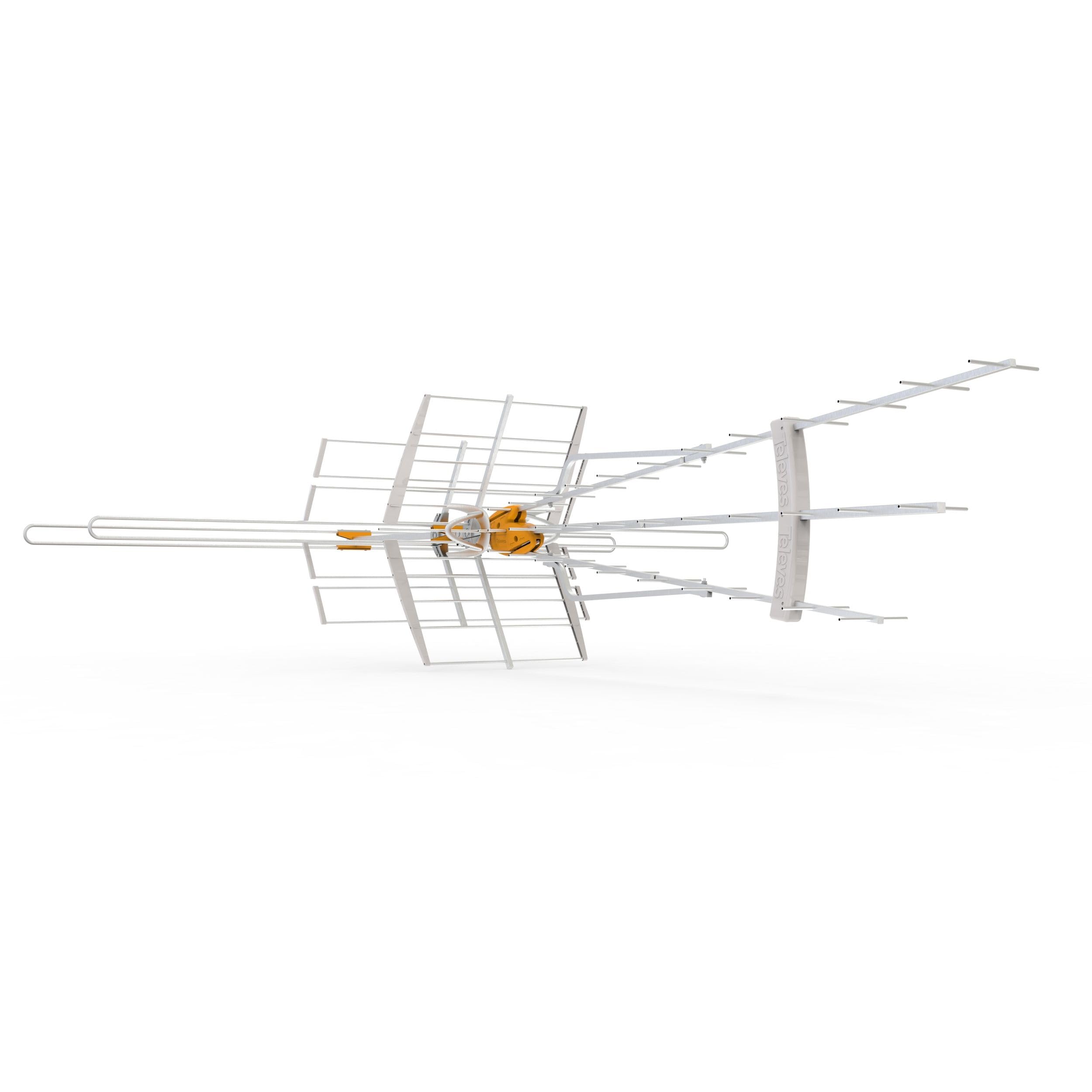
A full-spectrum powerhouse for the hardest fringe-reception homes in the country.
This is a different class of antenna, so it earns a different label — it is the most featured unit on this list by a wide margin. It is an outdoor directional with a built-in TForce preamplifier that auto-adjusts gain independently across Low VHF, High VHF and UHF bands (30, 38 and 46 dBi respectively), designed for long-range reception up to 100 miles. It filters out FM, LTE, 4G and 5G interference, and runs either amplified or in a passive mode if power drops. European-engineered, made in Spain with two patented technologies, and it’s ATSC 3.0 NextGen-ready.
If your situation is genuinely difficult — Low VHF stations, distant transmitters, all of it — this is the most capable tool here. Reviewers point out full signal strength across channels and station pickup past 65 miles. What everyone raves about is channel reception: it snags more channels than the gear it replaces.
The honest caveats are size and cost. Assembly comes in around an hour and is widely called mixed — instructions could be clearer and the assembled unit is big, so do the build outdoors. It’s also the premium tier by a good margin. But for a fringe-area home that has exhausted the cheaper options, the extra reach and filtering justify it.
Standout capability: the TForce system adjusts three bands independently, so it holds onto weak stations without overloading strong ones.
Practical reality: this thing is huge assembled and takes roughly an hour to build — plan the space before it arrives.
Ideal owner: someone in a rural or fringe area fighting Low VHF gaps who wants the maximum reach and filtering available.
Overkill for: city and suburb dwellers whose towers are already close, and anyone without outdoor space to assemble it.
5. Amplified Indoor AM and FM Antenna (AT-217FM)
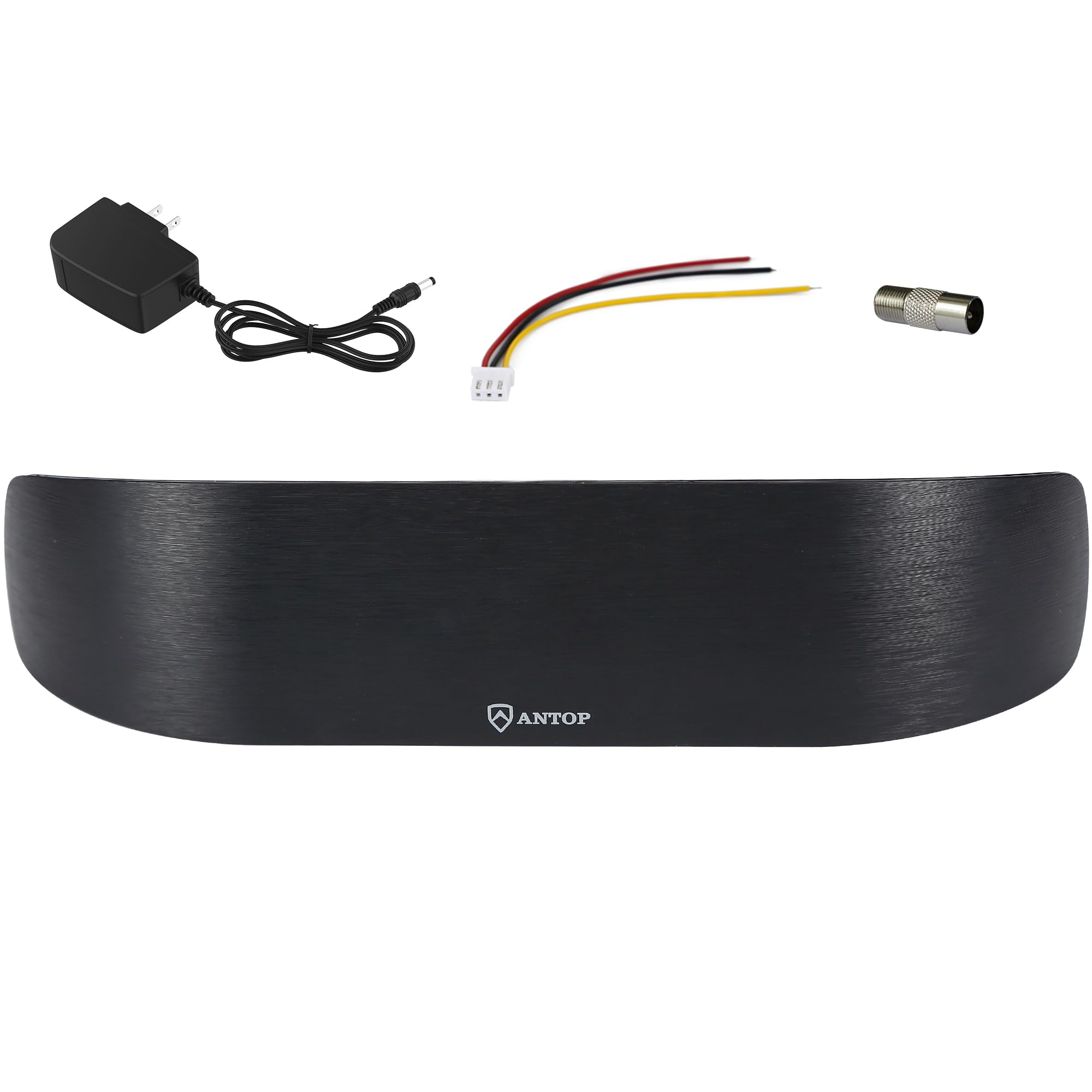
A slim, powered panel that targets one job — clean FM stereo indoors — and stays out of the way.
Despite the AM in its name, this one is a straight FM booster — the manufacturer flags clearly that it only amplifies FM signal and handles no AM at all, so don’t buy it expecting AM. What it is: a multi-directional indoor amplified antenna with a built-in amplifier, a 50-mile range, 75 ohm impedance and a 6-foot coaxial cable, wrapped in a slim black hairline finish that disappears against a wall. The built-in amplifier is the pitch — it boosts signal strength for better sound quality without you having to aim anything.
Where it genuinely shines is in one specific buyer’s hands: if you sit a reasonable distance from a major broadcast center, it does the job. The clearest success stories come from that exact scenario — an owner years into fussing with extended wires who finally got clean stereo sound, and promptly ordered a second for the garage. For its size, several owners say it works surprisingly well. Functionality is genuinely mixed overall, so as a fit note: it rewards you when your stations are strong-ish and distant enough to need a lift, and frustrates you when they’re too far for an amplified indoor panel to reach.
Two things to know before you buy. First, mounting: there’s no obvious bracket, and buyers mention wishing for a convenient way to mount it. Second, the range is a ceiling, not a guarantee — it’s an indoor panel, so treat 50 miles as best-case. Occupying minimal shelf space and running on its included 6-foot coax, it’s the right tool for a specific job: apartment-friendly FM with a bit of extra push.
Right for you if: you’re within a comfortable radius of your stations, want a tidy powered indoor panel, and only care about FM.
Look past it if: you need AM, or your stations are so far that a small amplifier won’t bridge the gap.
6. Antop High Gain Indoor Radio Antenna

A flat indoor panel that brings every adapter you’ll need — for the buyer who hates hunting for parts.
For someone staring at the back of an older radio with an unfamiliar port, this is the pragmatic choice. The Antop AFM is an indoor AM/FM antenna with a 50-mile range rating, a High Gain Smartpass amplifier, 4G filtering and an elegant bow-shaped flat-panel build. The real draw is the connector pack: it includes FM “F” female and AM spring clip connectors plus an IEC male to F female coaxial adapter, so it physically fits a wide spread of old and new radios without a trip to the hardware store.
Owners value that flexibility, and when the conditions are right, it does what it’s sold to do — some report greatly improved FM reception over plain wire, including a vintage Pioneer receiver pulling in a favorite station on a mountain-area translator. The flat panel is easy to slot anywhere, and installation is quick.
Now the honest part, because it matters here: functionality and reception both land in mixed territory across this many owners, and the recurring theme is that results swing widely with your specific location and radio. When it works, it works; when your signal is too weak or the interference too high, shoppers say it barely helps. There’s also a power-supply quirk — a few note the supply shortens the usable cable run, so plan placement accordingly. Buyer satisfaction depends on whether your setup matches its balance.
The connector advantage: the bundled F, AM clip and IEC adapters mean it fits radios that trip up simpler dipoles.
Fair warning: performance is genuinely hit-or-miss by location, so buy it for the connectivity convenience, not guaranteed boost.
Pick this when: you need an indoor AM/FM antenna that fits an awkward or older receiver port from the start.
Pass if: you want predictable strong reception — an outdoor directional will serve you better.
7. FM Antenna for Stereo Receiver – Magnetic Base, 16ft Coaxial Cable
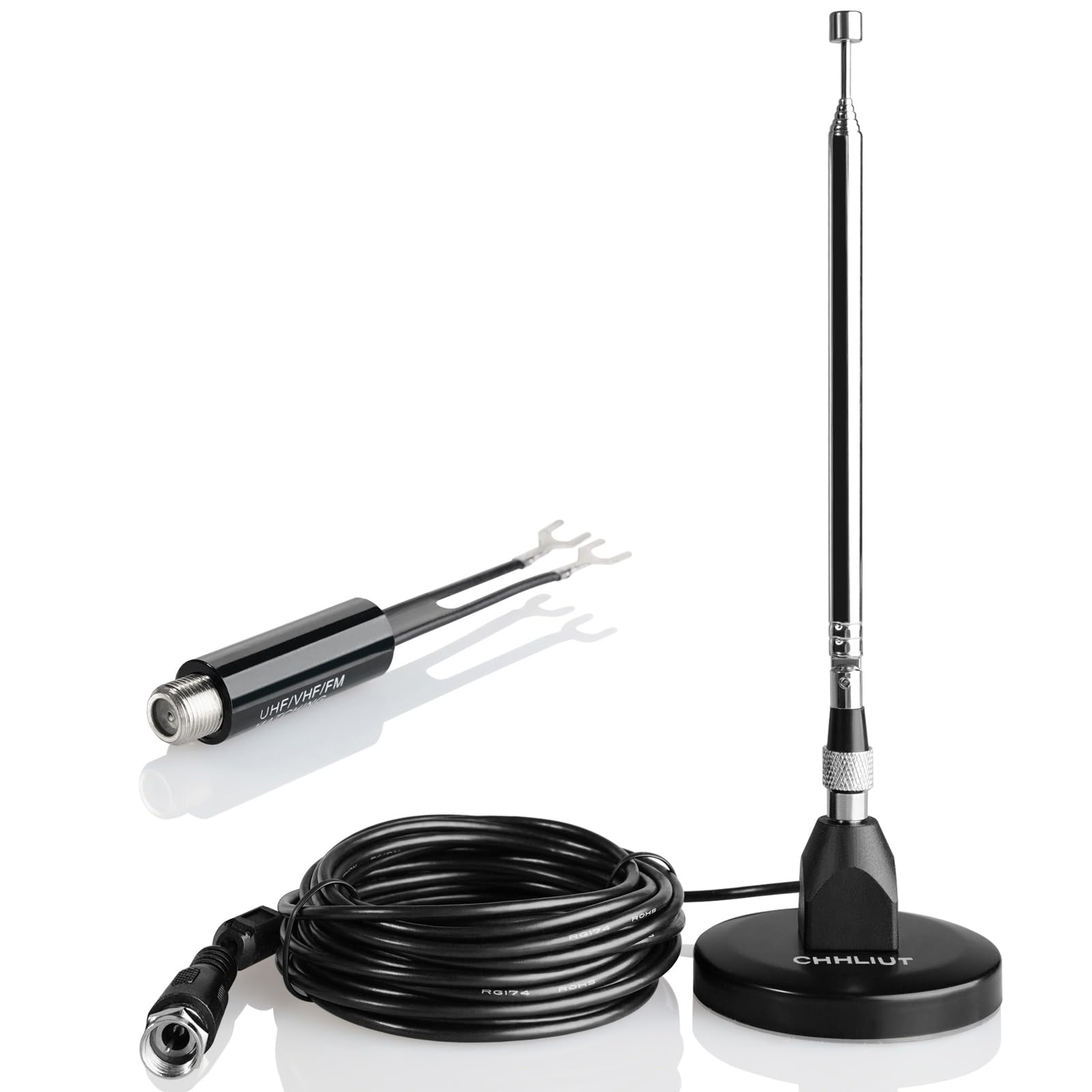
A magnetic, retractable dipole you stick anywhere metal and stretch toward the window.
Here’s your starting point if you just want better FM without committing to outdoor hardware. It’s an indoor dipole with a retractable arm, a strong magnetic base that clings to metal surfaces, a 16-foot coaxial cable rated to a 16-foot maximum range, and 75 ohm impedance. It works from the start with most major receiver brands, and the long cable is the quiet advantage — it lets you slide the antenna across the room toward a window instead of leaving it stuck behind the stereo.
Owners get the most value from the setup convenience: the magnetic mount and the long coax give you freedom to move the antenna around your space and find a cleaner signal spot. The build is compact and light, and it stows easily when you need it out of the way.
Know what you’re buying, though: this is a passive dipole, not a long-range puller. Reception is genuinely mixed across owners — the success cases cluster indoors and in places like metal garages or basements where moving the antenna around helps, while a few find it doesn’t improve things for their particular signal. Two limits to expect: it stays a short-range indoor tool, and the 75-ohm F connector is the standard receiver-input type, so if your receiver uses a screw-terminal AM/FM antenna input rather than a coaxial jack, you’ll need the matching adapter separately.
Choose it if: you want a low-commitment indoor FM upgrade and love that the magnetic base lets you reposition it freely.
Skip if: your stations are far away or your receiver lacks a 75 ohm coaxial input.
8. Universal FM Radio Dipole Antenna 75 Ohm for Stereo Receiver

The dipole that stretches almost the full width of a room to chase a stubborn station.
Length is this antenna’s entire personality, and it is dramatic. The dipole arms extend to a 196-inch span — nearly 16 and a half feet of reach — packed into a frame that’s just 11 inches wide and 0.7 inches tall before you unfurl it. It’s rated 75 ohm, comes with a 16-foot coaxial extension cable, and includes a 75 ohm to 300 ohm matching transformer adapter so it bridges both connection types. That enormous span is the engineering bet: a longer dipole grabs more of the FM signal, which is why buyers keep mentioning it.
The other half of the value is compatibility. It’s built to fit Yamaha, Marantz, Onkyo, Panasonic, Sony, Bose, Pioneer and other desktop stereo receivers, and setup needs no tools. When conditions align, buyers report pulling in stations they’d never received before, including an extreme case of running a dipole outside and finally decoding a basement stereo’s missing stations.
Straight talk on the flip side, because length has limits: reception is genuinely mixed across owners, and a longer dipole can’t conjure signal that isn’t there. When your target station is weak or your building blocks it, no amount of span fixes it — some buyers found it simply wasn’t strong enough. Treat it as a smart, low-cost indoor upgrade, not a fringe-area solution.
Why the length matters: at 196 inches the dipole captures a broad slice of the FM band, which helps in tough indoor spots.
Where it stops short: a passive dipole can’t manufacture gain — if your station is faint, distance still wins.
Your match if: you have an indoor setup, a coaxial input, and you want a cheap, tool-free way to squeeze a couple more stations out of the air.
Not your answer if: you’re chasing a genuinely weak distant signal that needs real gain outdoors.
9. 75 Ohm Indoor FM Antenna for Stereo Receiver, 16Ft Dipole F Male

The no-fuss budget dipole for replacing whatever flimsy wire came in the box.
When the paper-thin antenna that shipped with your receiver finally gives up, this is the simple swap. It is a 75 ohm indoor dipole with an F male plug, a 16-foot coaxial cable, and three connector adapters in the box so it slots into Yamaha, Onkyo, Marantz, Pioneer and other desktop receivers. At 2.59 ounces it’s feather-light, and setup is genuinely tool-free — plug it in, position it, done. It’s the lowest-commitment way to get a real coaxial antenna onto your stereo.
The buyers who get on with it are the ones replacing a broken or missing stock antenna and expecting a modest, honest improvement — and when their signal is reasonable, it delivers. What it won’t do is rescue a station that’s fundamentally out of reach; it’s a passive indoor dipole, so it works within the limits of where you can put it. Reception splits hard between owners who found it helped and those who found it made things worse, which is the nature of indoor FM: the same antenna performs completely differently two rooms apart. The 16-foot cable gives you the length to experiment with placement, and that’s your best lever.
At the budget end of this list, it’s the sensible pick when you need a dependable replacement, not a revelation. Move it around, get it near a window, and let it do its unglamorous job.
Go for it if: you need a cheap, tool-free replacement dipole and your signals are close to average strength.
Hold off if: you’re in a fringe area — the passive design won’t reach far, and a directional pickup will reward the spend.
Understanding the Specs
Impedance (75 ohm)
Impedance is the electrical resistance your receiver’s antenna socket expects, measured in ohms. Home stereo receivers are built around a 75 ohm input, so a 75 ohm antenna hands the tuner exactly what it wants to see. Mismatch the figure and part of your signal bounces back down the cable instead of reaching the tuner, so a careful 75 ohm match often beats a fancier antenna rated for a different figure.
Gain and Front-to-Back Ratio (dB)
Gain, in dB (decibels), tells you how much the antenna boosts signal compared with a plain reference — the four-element boom here tops out at 7dB. Front-to-back ratio measures how well it ignores stations behind it, and it’s the number that matters most for distance: a 15dB front-to-back ratio lets a directional antenna reject a strong local station so a faint distant one can come through.
Directional versus Multi-Directional
A directional antenna focuses reception toward one cluster of towers and needs aiming — great for distance, fiddly if your stations are spread out. A multi-directional model grabs signals from several directions at once, so you rarely re-point it. Match the type to your map: aim a directional if all your stations come from one spot, go multi-directional if they’re scattered or you’d rather never touch it again.
Coaxial Cable and Connectors
Coaxial cable carries the signal from antenna to receiver, and its length is your placement budget — a 16-foot run, for example, lets you move an indoor antenna toward a window. Connector type matters too: most receivers use a threaded F-type coaxial jack, but some older radios use screw terminals or a different plug. Check your receiver’s antenna input before you buy, and reach for a bundled adapter if the shapes don’t match.
FAQ
Will a 75 ohm FM antenna work with my Yamaha or Onkyo receiver?
Do I need an outdoor antenna to pull in distant FM stations?
What is the difference between a directional and a multi-directional FM antenna?
Will an FM antenna also improve my AM reception?
How do I connect a 75 ohm antenna if my receiver uses screw terminals?
Why does my antenna pick up some stations but not others?
How high should I mount an outdoor FM antenna?
Does the length of coaxial cable affect FM reception quality?
Will an amplified indoor FM antenna reach as far as an outdoor one?
Do I need to aim an FM antenna, and does a rotor help?
Final Thoughts: The Verdict
For most people fighting FM hiss, the 75 ohm fm antenna winner is the Four Element Directional Outdoor FM Antenna, because it pairs a real 7dB gain and 15dB front-to-back ratio with reports of stations coming in from over 100 miles out, and it has the deepest track record of any pick here. If you want premium build quality that lasts, the Channel Master CM-3026HD and its 6061/6063 aluminum boom is the buy. And for an indoor shelf where nothing else will fit, the Magnetic Base dipole is the one to reach for.
How We Picked
We do not accept paid placement. Every pick is matched to a real buyer and a real use-case; we do not hands-on test units.
Sources & Methodology
Specifications: manufacturer listings and product documentation. Review insights: verified customer reviews, as of September 2026. Pricing: not shown on this page (it changes often); check the current price via the retailer link.
As an Amazon Associate, Gadgets Feed earns from qualifying purchases. This does not affect which products we feature.