
Our readers keep the lights on and my morning glass full of iced black tea. As an Amazon Associate, I earn from qualifying purchases.
Specs are compiled from manufacturer listings and verified buyer reviews and can change over time — please confirm the key details on the product page before buying.
If you are shopping, you already know a 750 CFM carburetor is the standard muscle-maker for a hot small-block or a healthy big-block street car. The hard part is picking between a vacuum-secondary carb (which cruises smoothly like a daily driver) and a mechanical-secondary carb (which slams the secondaries open like a hammer). This guide compares eight models so you know exactly which one belongs on your intake.
I’m Min — the writer behind Gadgets Feed. This guide uses the manufacturers’ published specs and patterns from verified buyer reviews to show each carb’s real strengths and trade-offs, not just marketing claims.
The reality is that jetting (the size of the fuel-metering holes), choke type, and secondary design matter more than brand loyalty. Here is how to find the right 750 cfm carburetor for your engine and budget.
Quick Picks
- Edelbrock 1407 Performer 750 CFM Square Bore 4-Barrel Air Valve Secondary Manual Choke New Carburetor — Best Overall
- Holley 0-80508S 750 CFM Classic Holley Carburetor — Restoration Ready
- Holley 0-3310S Model 4160 Street Performance 750 CFM Square Bore 4-Barrel Vacuum Secondary Manual Choke New Carburetor — Street Machine Special
- Proform 67200 750 Cfm Race Series Carb — Track-Tuned Value
- Quick Fuel Brawler 750 Cfm Mech Sec Street — Entry Mechanical-Secondary
- NEW HOLLEY QUICK FUEL 750 CFM BRAWLER RACE CARBURETOR, RED BILLET, BLACK, MECHANICAL SECONDARIES, COMPATIBLE WITH 4150 MODELS — Red Billet Beauty
- Holley 0-4779C Model 4150 Double Pumper 750 CFM Square Bore 4-Barrel Mechanical Secondary Manual Choke New Carburetor — True Double Pumper
- Holley 750 Ultra Double Pumper W/Blue Billet — Billet Showpiece
How To Choose The Best 750 CFM Carburetor
A 750 CFM carburetor is a common upgrade for engines in the 350-454 cubic-inch range built for street or occasional strip duty. Before you start shopping, the big decision is how the secondaries open — that one choice shapes how the car drives more than any brand name.
Vacuum Secondaries vs Mechanical Secondaries
Vacuum secondary carbs (like the Holley 0-3310S) let the engine’s demand decide when the rear barrels open. The carb opens them only when the engine pulls enough air, which gives you smooth, predictable power on the street and better fuel economy. Mechanical secondary carbs (like the Holley 0-4779C Double Pumper) open the rear barrels as soon as your foot opens the throttle. This means instant fuel flow for a racier launch feel, but it risks a bog if your engine is too mild.
Choke Type: Manual, Electric, or None
An electric choke (Holley 0-80508S) is a daily driver’s best friend. It automatically closes the choke plate when cold and opens it as the engine warms, so you just turn the key and go. A manual choke (Edelbrock 1407) gives you positive control via a cable, and it works fine if your car lives in a temperate climate. Some race-model carbs skip the choke entirely because the engine rarely gets driven cold.
Fuel Inlet Setup
A single-feed fuel inlet (one fuel line) is simpler to plumb and works for most street applications up to about 400 horsepower. Dual-feed inlets (two fuel lines) supply fuel to both primary and secondary bowls at the same time, which helps keep a consistent fuel level during hard acceleration or sustained high RPM. Big blocks and strip-heavy cars benefit from dual-feed.
Quick Comparison
| Model | Best For | Choke Type | Secondary Type | Weight | Amazon |
|---|---|---|---|---|---|
| Edelbrock 1407 Performer | Bang-for-buck street cruiser | Manual | Air Valve | — | $474.95Amazon |
| Holley 0-80508S Classic | Muscle car restoration | Electric | Vacuum | 7.55 Pounds | $539.95Amazon |
| Holley 0-3310S Model 4160 | Street performance upgrade | Manual | Vacuum | 7.55 Pounds | $549.95Amazon |
| Proform 67200 Race Series | Track-capable street/strip | — | — | 9.1 Pounds | $632.05Amazon |
| Quick Fuel Brawler BR-67213 | Budget mechanical-secondary | — | Mechanical | 7 Pounds | $699.95Amazon |
| Southwest Speed/S Holley Brawler | Red billet looks | — | Mechanical | — | $870.95Amazon |
| Holley 0-4779C Double Pumper | Heavy street/strip builds | Manual | Mechanical | 6.13 Kilograms | $870.95Amazon |
| Holley Ultra Double Pumper 0-76750BL | High-performance show-stopper | Electric | Mechanical | 9.4 Pounds | $921.95Amazon |
In‑Depth Reviews
1. Edelbrock 1407 Performer 750 CFM Square Bore 4-Barrel Air Valve Secondary Manual Choke New Carburetor
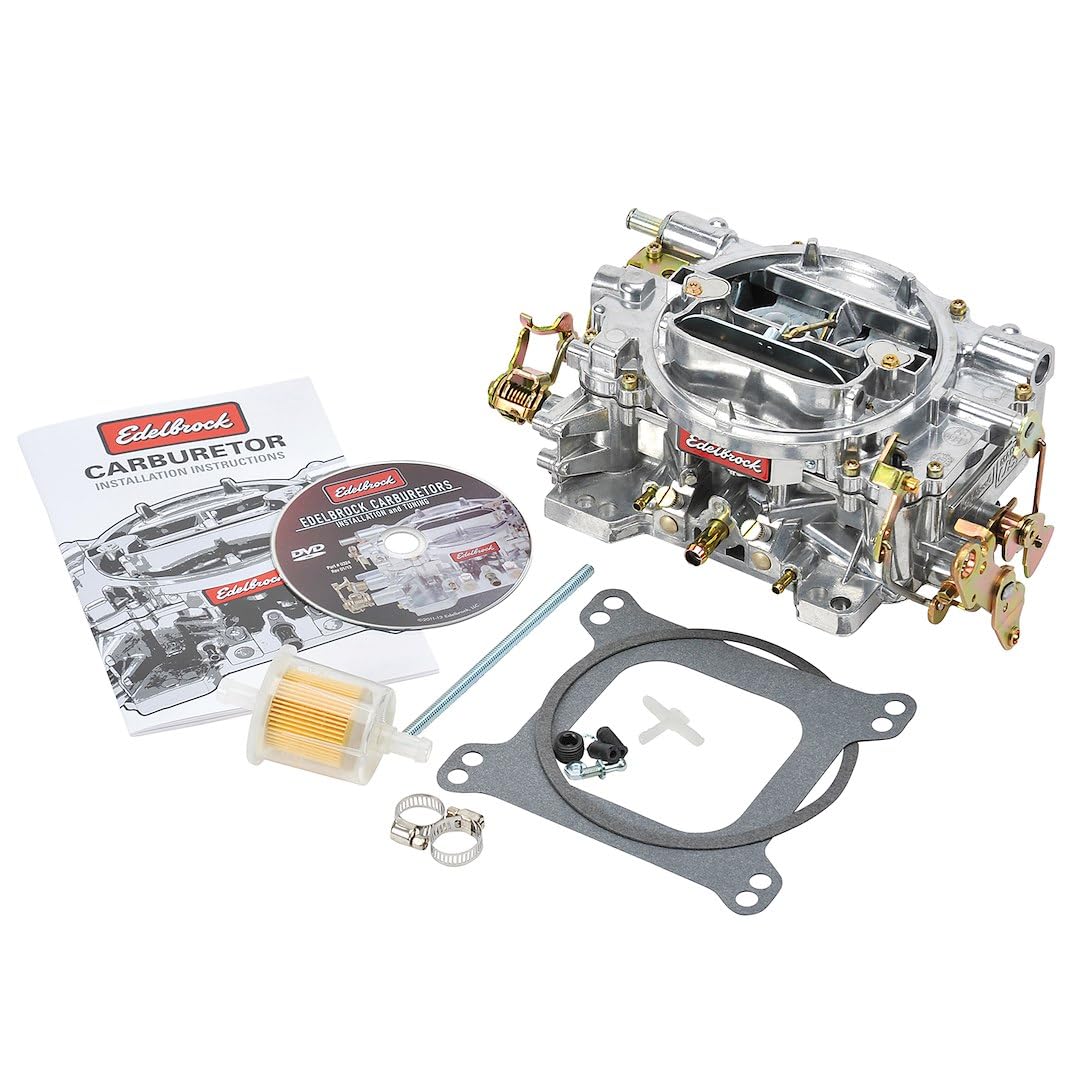
The no-tune bolt-on that fires up on a big-block and runs right the first time.
This carburetor lets you bolt it onto a 454 and drive away without touching a jet — buyers report exactly that on their “79 454,” saying it runs perfectly with no adjustments needed. The secret is the air valve secondary (a secondary design that uses the flowing air to open the rear barrels proportionally) combined with a bottom feed venturi booster that smooths out tip-in acceleration compared to a Holley. It also weighs 9.1 Pounds, which is heavier than the Quick Fuel Brawler at 7 Pounds, but the weight points to the thick cast metering blocks that resist warpage.
The manual choke requires a cable, but on most street cars that is a one-time wiring job. One buyer running a 355ci Chevy with 10.1 compression and a 488 lift cam says it works “much better than the Holley I had on there.” The single-feed fuel inlet is simpler than a dual-feed setup, and for street use below 450 horsepower it is plenty. However, a 3-star review warns you cannot corner hard — the fuel bowl design lets fuel slosh away from the pickup in long sweeping turns — so if your car sees autocross or road course use, a center-hung float bowl design is safer.
What makes it an easy choice
- Bolt-on calibration — multiple 5-star reviews say no jetting changes needed on 350-454 engines
- Air valve secondary delivers smooth part-throttle response that flatters a daily driver
- Ball-burnished finish resists corrosion without needing a clear coat
Where it loses points
- Single feed inlet cannot keep up with sustained high-RPM strip runs like a dual-feed
- Manual choke means pulling a cable every cold morning — electric choke models are more convenient
Reach for this if: you want a carb that drops onto a stock-ish 350-454 and runs without fighting it — especially if you are coming from an older Holley that gave you tuning headaches.
Look elsewhere if: your car sees hard cornering (road course, autocross) or you need a mechanical secondary for a built race engine above 450 horsepower.
2. Holley 0-80508S 750 CFM Classic Holley Carburetor

A vibratory polished classic that wakes up a vintage muscle car without modern fuss.
If you own a 1970 Cougar Eliminator, a 1966 Big Block Chevy 396, or an 1986 Chevy pickup with a 350, this is the carb Holley designed for that generation. The electric choke (a heated element that closes the choke plate automatically when cold and opens it as the engine warms) saves you the most daily hassle — one owner says his Cougar “starts reliably after winter storage with few pumps.” It also has vacuum secondaries, which means it self-tunes the secondary opening rate based on engine load so the secondaries do not hit you like a light switch.
The dual-feed fuel inlets deliver constant high-volume fuel to both bowls, a real advantage over single-feed carbs when you are running sustained highway speeds or a warm day at the strip. It weighs 7.55 Pounds per the specs. One reviewer noted a defective unit that flooded after 30 minutes and got unhelpful support from Holley, so double-check the float levels on arrival. But the broad pattern across reviews points to a carb that fires up, idles clean, and works with GM, Chrysler, and Ford A/T kickdown linkage (you may need extra parts for some kickdown levers).
The restoration pick with a modern upgrade: the electric choke and polished finish make it period-correct yet more convenient than the original carb that came on a 1970 muscle car. The trade-off is that the universal calibration may need jetting work for heavily modified engines.
Buy it for: a stock-to-mildly-modified classic car where you want electric choke convenience and vacuum secondary smoothness, especially for Ford and Chevy platforms.
skip it if: you need a manual choke for a race-only car or you are putting it on a high-compression race engine that needs mechanical secondaries.
3. Holley 0-3310S Model 4160 Street Performance 750 CFM Square Bore 4-Barrel Vacuum Secondary Manual Choke New Carburetor

The vacuum-secondary staple that upgrades a 350 or a 400 with minimal tuning fuss.
This carburetor is a bigger version of the classic 4160 that has been on small-block Chevys for decades. One buyer replaced a worn 600CFM Holley 4160 on a 1979 Ford F-150 6.6 (the “400” engine) and reported the 750 CFM upgrade delivered smooth 4-barrel operation with usable C6 kickdown and great throttle response — only the idle air screw needed adjustment. The gold dichromate finish provides corrosion resistance and gives it a classic Holley look under an open-element air cleaner.
The vacuum secondaries make it a forgiving partner on the street: you stay in vacuum at light throttle so the rear barrels stay closed, then as you stab the gas and engine load rises, the vacuum signal opens them gradually. One buyer running a 1965 Dodge Coronet 500 440 says his engine “runs perfectly” with minimal install effort. At 7.55 Pounds, it matches the weight of the Classic Holley above, but this one has a manual choke, which means pulling a cable is required — not a dealbreaker for non-daily cars. The single-feed fuel inlet is standard, though the listing shows one buyer needed to modify linkages for a Chevy 350 application.
Why street guys keep coming back
- Vacuum secondaries deliver progressive power that matches the engine’s demand — no sudden bog
- Gold dichromate finish resists fuel corrosion and looks vintage under the hood
- Plenty of verified reviews show it bolts onto 350, 396, 400, and 440 engines with minor tweaking
The manual choke reality
- You must run a choke cable to the cabin — not as convenient as an electric choke for daily use
- Single-feed inlet means you may want a dual-feed upgrade if the engine sees extended high-RPM running
Pick this for: a street-driven small-block or mild big-block where you want vacuum secondary smoothness and you are comfortable running a manual choke cable.
Consider the competition if: you want an electric choke or you are building a high-RPM strip engine that benefits from a mechanical secondary and a dual-feed setup.
4. Proform 67200 750 Cfm Race Series Carb

The race carb that punches above its price bracket against diamond competitors.
One buyer who has owned multiple Holley HP carbs and Demon carburetors calls this “one of the nicest carburetors I have ever bought,” praising the clean build and fitment. Another buyer says it outperforms a Diemond carb they previously owned. The Proform 67200 comes preset for high-performance engines — a buyer with a 10.75:1 compression 355 SBC says the jetting and settings were nearly perfect from the start. It weighs 9.1 Pounds, noticeably heavier than the 7 Pounds Quick Fuel Brawler, partly because of the thick billet metering blocks.
It is made in the United States, and the build quality leaves a strong impression — one reviewer reports this is their third purchase of the same model, and a buyer who switched from a Holley 750 vacuum secondary carb says “I am so glad I did.” The main flaw appeared in one review where the floats got stuck and flooded the engine, which is a risk on any mechanical-secondary race carb if the float drop is not set correctly. There is no choke listed, meaning it is purely a strip or warm-weather unit.
Real racer value for the dollar: at roughly half the price of some premium race carbs, it delivers comparable out-of-box performance and build quality, which is why repeat buyers exist. Just budget time for a float-level check before the first start.
Perfect for: a bracket-racer or weekend strip car where you want competitive airflow without spending on boutique race names, and where the lack of a choke is irrelevant.
Not the right fit for: a daily-driven street car that needs a choke for cold starts or a vacuum secondary for driveability in stop-and-go traffic.
5. Quick Fuel Brawler 750 Cfm Mech Sec Street

A light, affordable mechanical-secondary carb that puts you in the quick-fuel club on a budget.
The mechanical secondaries (rear barrels open instantly in sync with the throttle linkage) give it a snappier launch feel than a vacuum-secondary carb, which is why one buyer who runs two Quick Fuel carbs says they “both were great right from the start, minor adjustments.” The box says it is for street use, but “mechanical secondaries” means you need to match the engine combo — too much cam or too loose a converter can make it stumble.
However, quality control is a risk at this price point. Multiple 1-star reviews report gasket misalignment that prevented the butterflies from opening and leaking gaskets from long shelf storage. One buyer reports a shop called it defective after the car never ran properly. If you get a good one, it is a killer carb for a mild mechanical-secondary street setup; if you get a Friday-afternoon unit, you are rebuilding it before it ever runs. Check the gaskets and float levels immediately after unboxing.
The budget mechanical-secondary appeal
- Mechanical-secondaries for instant throttle response at a price well under premium double-pumpers
- Lightweight compared to full-race carbs — helps reduce overall engine-bay weight
The gamble you take
- Quality-control issues noted across reviews — gasket alignment, stuck floats, defective out of box
- No choke mechanism means cold starts require patience or starting fluid
Consider this if: you want your first mechanical-secondary carb on a street/strip car and you are comfortable doing a pre-install inspection of gaskets and float levels.
Think twice if: you need a carb that works 100% from the start with zero teardown, or if you drive the car in cold weather and need a choke.
6. NEW HOLLEY QUICK FUEL 750 CFM BRAWLER RACE CARBURETOR, RED BILLET, BLACK, MECHANICAL SECONDARIES, COMPATIBLE WITH 4150 MODELS

A show-quality red billet carb that acts as tough as it looks — if you get a clean one.
This is the aesthetic leader of the group — red anodized billet aluminum metering blocks against a black main body, giving a custom-look right from the start without sending the carb to a machine shop. It is mechanically compatible with all standard 4150 model intake manifolds, so if your street car or strip car runs a Holley-style flange, it drops on. Mechanical secondaries mean instant fuel flow when the throttle opens, and one buyer reports the carb “works great” right from the start after adjusting floats and the four-corner idle circuit.
But the performance is polarizing. The same buyer who says it works great also had to readjust the floats and all four corners, while another buyer calls it “the worst carb I’ve ever purchased” — one unit had a blockage from the factory that required a full teardown and cleaning. The red billet finish and the “Brawler Race” name suggest a performance-first attitude, but the lack of a choke makes it a fair-weather or trailer-only carb. If you are willing to strip and inspect it before install, you get a beautiful mechanical-secondary race carb at a strong price.
Visual impact that requires prep work: the red billet look is unique in the 750 CFM space, but the factory QC lottery means you should budget an hour to inspect the gaskets and jets before you bolt it on.
Choose this for: a show car or weekend strip car where the red billet look matches the engine bay theme and you are comfortable doing a pre-install inspection and tuning session.
Pass on it if: you want a carb to run from the start without adjustments, or you need a choke for cold weather driving.
7. Holley 0-4779C Model 4150 Double Pumper 750 CFM Square Bore 4-Barrel Mechanical Secondary Manual Choke New Carburetor

The classic double-pumper that kicks the tires sideways on a 383 or a 406.
The Holley “Double Pumper” name refers to the dual accelerator pumps (a separate shot of fuel from both the primary and secondary sides every time you stab the gas), which eliminates the lean bog that a single-pumper can experience when the secondaries hit. One buyer swapped an Edelbrock 750 CFM for this on a 1966 Dodge Charger 383 and reports “significantly improved engine performance.” Another bolted it onto a Chevrolet 350 in a 1964 Nova SS and says after a proper dial-in at a tuning shop, “it works flawlessly” — specifically recommending this carb for engines over 400 horsepower.
The mechanical secondaries are for serious use — a buyer running a built 406 SBC found the factory jetting (76 front, 80 rear) was too rich for street driving and had to lean it out. That is par for the course with double-pumpers: they come calibrated for a performance engine, so plan on re-jetting or reading spark plugs. The manual choke gives you cold-start control, and the dual-feed fuel inlets keep the bowls full during hard acceleration. Weight is listed at 6.13 Kilograms, which is heavier than many street carbs because of the dual-pump metering block.
Why hardcore builders reach for it
- Dual accelerator pumps prevent hesitation when you mash the pedal — critical for traction-free launches
- Mechanical secondaries give you full control over secondary timing via the throttle linkage
- Dual-feed fuel inlets keep up with sustained high-RPM operation better than single-feed
The prep factor
- Factory jetting tends to run rich for mild street builds — one buyer had to drop from 80/76 to leaner jets for a 406 SBC
- Manual choke cable required — not a convenience carb for daily driving in cold climates
Reach for this if: your engine is making 400+ horsepower and you want the instant fuel delivery of dual accelerator pumps for strip or aggressive street driving, and you accept that you will re-jet to match your combo.
Stay away if: you want a vacuum-secondary carb for smooth around-town driving or if you need an electric choke for easy cold starts.
8. Holley 750 Ultra Double Pumper W/Blue Billet

A billet blue double-pumper that blends show-car finish with race-ready fuel tuning.
This is the premium visual option in the lineup: blue anodized billet aluminum metering blocks and base plate that draw eyes at a car show, with the real-world benefit of true gasket sealing from the machined billet surfaces. The 4-corner idle system (independent idle-mixture screws for all four throttle bores) gives you precise idle tuning that a standard carb cannot match — you can lean out one corner at a time to solve a stumble or a lean surge. One buyer installed this on a 600-horsepower Chevy 400 small-block with a 700R4 transmission in a third-gen Trans Am and says “it was very surprising how easy this was to tune.”
The electric choke is a rare feature on a double-pumper — you get the instant fuel shot of mechanical secondaries combined with automatic cold-start convenience. Another buyer running a 1970 Pontiac 455 bored 0.30 over with stock heads, a mild cam, and headers reports “the most painless easiest power gain I have ever done to this car in 22 years.” The main downside is the weight — at 9.4 Pounds it is the heaviest carb in this roundup, which matters if you are obsessive about sprung weight on the nose. One buyer also says it “looked like it had been dropped several times” on arrival, so inspect the box for damage before installation.
The all-star feature set
- 4-corner idle adjustment allows fine-tuning on high-cam overlap engines that normal carbs cannot smooth out
- Electric choke on a mechanical-secondary carb is rare — you get race-style secondaries without the morning cold-start hassle
- Blue billet aluminum is a genuine show-car upgrade that does not require custom machining
Heavy and pricey
- 9.4 Pounds is the heaviest carb here — noticeable if you are weight-weenie about front-end mass
- Premium price tier, so if you are building a budget street car, a simpler vacuum-secondary carb makes more sense
Buy it for: a high-horsepower street/strip car where you want show-grade billet bling, electric choke convenience, and the tuning precision of 4-corner idle on a double-pumper.
pass on it if: your build is a budget street cruiser under 400 horsepower, or you prefer to keep weight off the nose and do not need the advanced idle tuning.
Understanding the Specs
Vacuum Secondaries vs Mechanical Secondaries
Vacuum secondaries use engine vacuum to decide when to open the rear barrels — they open only when the engine pulls enough air, so the power delivery is progressive and forgiving for street driving and automatic transmissions. Mechanical secondaries are linked directly to the throttle linkage: the secondaries open the instant the throttle opens beyond a set point. This gives instant power but requires a matched engine combo so the engine can actually breathe at that airflow without bogging. If your car is an automatic daily driver, vacuum secondaries are generally the smarter choice.
Choke Type and Your Climate
An electric choke uses a small heating element and a thermostatic spring to close the choke plate when the engine is cold and gradually open it as the engine warms. This makes cold starts automatic — turn the key, pump once, and go. A manual choke uses a cable that you pull from the dashboard: you engage it when cold and push it in when the engine reaches operating temperature. Manual chokes are cheaper and rarely break, but they are inconvenient in cold climates. Some race carbs have no choke at all, which is fine for a car that only runs in warm weather or is trailered to the strip.
FAQ
Will a 750 CFM carburetor fit my stock intake manifold?
Vacuum secondaries or mechanical secondaries for a daily driver?
Do I need an electric choke?
How do I know if my engine needs a 750 CFM carburetor?
What is a double pumper?
Can I use a 750 CFM carb on a 350 small block?
What does “vacuum secondary” mean in simple terms?
Do I need to re-jet a new 750 CFM carburetor?
Final Thoughts: The Verdict
Across the board, the 750 cfm carburetor winner is the Edelbrock 1407 Performer because it provides a true bolt-and-go experience on 350-454 engines, with air valve secondaries that deliver progressive power without jetting stress. If you want a classic Holley with electric choke convenience and vacuum secondary smoothness, grab the Holley 0-80508S Classic. And for a high-horsepower street/strip build that needs mechanical secondaries, dual accelerator pumps, and 4-corner idle tuning, the Holley 750 Ultra Double Pumper with blue billet is the top pick for buyers who want race hardware with show-car looks.
How We Picked
We do not accept paid placement. Every pick is matched to a real buyer and a real use-case; we do not hands-on test units.
Sources & Methodology
Specifications: manufacturer listings and product documentation. Review insights: verified customer reviews, as of July 2026. Pricing: not shown on this page (it changes often); check the current price via the retailer link.
As an Amazon Associate, Gadgets Feed earns from qualifying purchases. This does not affect which products we feature.
Product prices and availability are accurate as of the date/time indicated and are subject to change. Any price and availability information displayed on Amazon at the time of purchase will apply to the purchase of this product. As an Amazon Associate I earn from qualifying purchases.
CERTAIN CONTENT THAT APPEARS ON THIS SITE COMES FROM AMAZON. THIS CONTENT IS PROVIDED "AS IS" AND IS SUBJECT TO CHANGE OR REMOVAL AT ANY TIME.
Amazon and the Amazon logo are trademarks of Amazon.com, Inc. or its affiliates.