
The search for a genuine low-profile graphics card that fits a slim Dell Optiplex or HP EliteDesk without requiring a PSU upgrade narrows quickly. Most so-called “half-height” cards are either full-height in disguise or overpriced relics. The GTX 750 Ti, built on Nvidia’s Maxwell architecture, remains the goldilocks solution for this exact SFF niche — delivering 1080p gaming and multi-monitor output without a single external power cable, all inside a chassis where every millimeter counts.
I’m Min — the co-founder and writer behind Gadgets Feed. I’ve spent countless hours cross-referencing GPU core clocks, memory bandwidths, and customer-verified compatibility reports to separate the real Maxwell-based 750 Ti cards from the relabeled mobile chips and misleading generics flooding Amazon.
Whether you’re resurrecting an office PC for light gaming or building a compact media station, this guide pinpoints the only cards worth your time. Read on for the definitive breakdown of the best 750 ti low profile graphics card options that actually fit, work, and deliver on their promises.
How To Choose The Best 750 Ti Low Profile Graphics Card
Not every card that says “750 Ti” is a 750 Ti. Some are mobile GPUs on a PCB, others are GTX 750 (non-Ti) cards with a sticker change. For SFF builds, the constraints are tight: half-height bracket must be included, card length must clear the PSU shroud, and total draw must stay under 75W to avoid needing a power cable. Here’s exactly what to check.
Verify the Bracket: Full-Height vs. Low-Profile
A true low-profile card ships with the smaller half-height bracket installed or includes an adapter in the box. If the listing shows a tall bracket with dual fans and no mention of a low-profile bracket, it will not fit an Optiplex or HP SFF case. The QTHREE and GPVHOSO cards in this guide include the half-height bracket, while the msi GT 1030 also ships with both. Never assume — check the product images for the bracket type.
Power Draw: The 60W Wall
The Maxwell-based GTX 750 Ti has a TDP of 60W, drawing all its power from the PCIe slot itself. No 6-pin or 8-pin connector is required. In contrast, cards like the RX 580 draw 185W and need an 8-pin power connector, making them incompatible with 240W SFF power supplies. If your PSU lacks a dedicated GPU power rail, stick strictly with cards rated at 75W or less from the slot.
Memory VRAM: 2GB vs. 4GB vs. 6GB
A 4GB frame buffer on the 750 Ti handles 1080p textures in modern titles at medium settings without stuttering. The 2GB variants run out of VRAM fast in games like Forza Horizon 5 or Call of Duty Warzone. For a few extra dollars, the 4GB versions unlock playable performance. The RTX 3050 found in this list jumps to 6GB GDDR6, but at a premium price and requires careful SFF case clearance checking.
Port Selection: DVI, HDMI, VGA, or DisplayPort
SFF builds often use older monitors with VGA inputs or require multi-monitor setups. The Xynsviu GTX 750 card features 4x HDMI ports, ideal for a kiosk or 4-screen office workstation. Most 750 Ti cards offer DVI + HDMI + VGA, which covers nearly every legacy monitor. Cards missing VGA may require an active adapter for older screens, adding extra cost and bulk.
Quick Comparison
On smaller screens, swipe sideways to see the full table.
| Model | Category | Best For | Key Spec | Amazon |
|---|---|---|---|---|
| maxsun RTX 3050 6GB | Premium | Modern SFF Gaming | 1470MHz Boost / 6GB GDDR6 | Amazon |
| SAPLOS GTX 750 Ti 4GB | Mid-Range | True 750 Ti / Retro Builds | 1020MHz Core / 4GB GDDR5 / Single Slot | Amazon |
| QTHREE GTX 750 Ti 4GB | Mid-Range | Quiet Dual-Fan / Mid-Tower | 1072MHz Core / 4GB GDDR5 / Dual Fans | Amazon |
| GPVHOSO GTX 750 Ti 4GB | Budget | Entry-Level Gaming / Office | 1020MHz Core / 4GB GDDR5 / 60W | Amazon |
| Kelinx AISURIX RX 580 8GB | Premium | High-FPS 1080p Gaming | 1750MHz Mem / 8GB GDDR5 / 185W | Amazon |
| Xynsviu GTX 750 4GB 4xHDMI | Mid-Range | Multi-Monitor Kiosk / Office | 4x HDMI 2.0 / 4GB GDDR5 / 60W | Amazon |
| msi GT 1030 4GB DDR4 LP | Budget | Basic SFF Upgrade / Linux | 1430MHz Boost / 4GB DDR4 / 64-bit | Amazon |
In‑Depth Reviews
1. maxsun GeForce RTX 3050 6GB Graphics Card

This is the most capable low-profile GPU currently available that draws power exclusively from the PCIe slot. The 6GB GDDR6 memory running at 14,000 MHz and the Ampere architecture with DLSS support puts this card in a completely different league from any Maxwell-era option. The core clock of 1042MHz boosts to 1470MHz, delivering 80+ FPS in Warzone and Fortnite at 1080p on an Optiplex 5070 i7-9700 build with zero extra power cables.
The slim dimensions (6.65″ x 2.71″) are specifically designed for SFF cases like the Dell Optiplex 3060/5060/7060 series. It includes the low-profile bracket and requires only PCIe 4.0 x8 bandwidth, which is backward-compatible with older slots. Users report Furmark scores exceeding 3000 and total card draw maxing at 77W — impressively efficient for an RTX-class card. The single fan does spin up under load, but a quick MSI Afterburner curve tweak keeps it quiet during desktop use.
For Solidworks or 3D design work, the card supports Nvidia Studio Drivers and can even enable RealView in CAD software with a registry edit. The only real trade-off is the price point, which sits well above the classic 750 Ti budget tier. For anyone building a small form factor PC today who wants to play modern titles without upgrading the power supply, this is the definitive choice.
Why it’s great
- Ampere architecture with DLSS for modern game compatibility
- 6GB GDDR6 memory handles 1080p high textures with ease
- Runs entirely on PCIe slot power — no external connectors needed
- Includes low-profile bracket, fits Optiplex SFF natively
Good to know
- Fan gets loud under extended gaming load without manual curve adjustment
- Premium price point well beyond entry-level budgets
- PCIe x8 interface may slightly bottleneck on older Gen 3 slots
2. SAPLOS Geforce GTX 750 Ti 4GB

This SAPLOS card is the closest you will find to a genuine Nvidia reference GTX 750 Ti in low-profile form. It runs the true GM107 Maxwell core with 640 CUDA cores at 1020MHz, the 4GB GDDR5 frame buffer on a 128-bit bus, and a single-slot cooler that fits even the thinnest 2U-style SFF cases. Customer reports confirm it slides into Acer slim desktops and Dell Optiplex 3020 SFF units without contacting the PSU shroud or blocking adjacent slots.
The card draws its full 60W from the PCIe slot — no auxiliary power required — and drives two monitors simultaneously via DVI+HDMI or DVI+VGA. The VGA port is a killer feature for retro Windows XP builds or connecting older projectors without an adapter. Users report 30-60 FPS in older and mid-weight titles at 1080p medium settings, with Homeworld 2 and Dawn of War 3 hitting 120 FPS at ultra. However, the single fan is noticeably noisy under load, with several reviews noting the sound level as the main downside.
One critical caveat: this card lacks native DirectX 12 feature-level support, meaning some modern AAA titles like Dirt 5 or Halo Infinite simply will not launch. It’s also no longer receiving driver updates. For its intended use — turning a free office PC into a capable retro- and esports gaming machine — it delivers unbeatable bang for the buck. Just keep expectations realistic about modern game compatibility.
Why it’s great
- Genuine Maxwell GM107 core with 640 CUDA cores confirmed by users
- Single-slot low-profile design fits 2U and ultra-thin SFF cases
- VGA + DVI + HDMI output, ideal for legacy monitor compatibility
- Completely passive 60W draw, no power cable clutter
Good to know
- Fan is loud under gaming load; no cooling shroud for noise dampening
- No longer supported by Nvidia Game Ready drivers
- Lacks full DirectX 12 feature level, blocking some newer games
3. QTHREE GeForce GTX 750 Ti 4GB Dual Fans
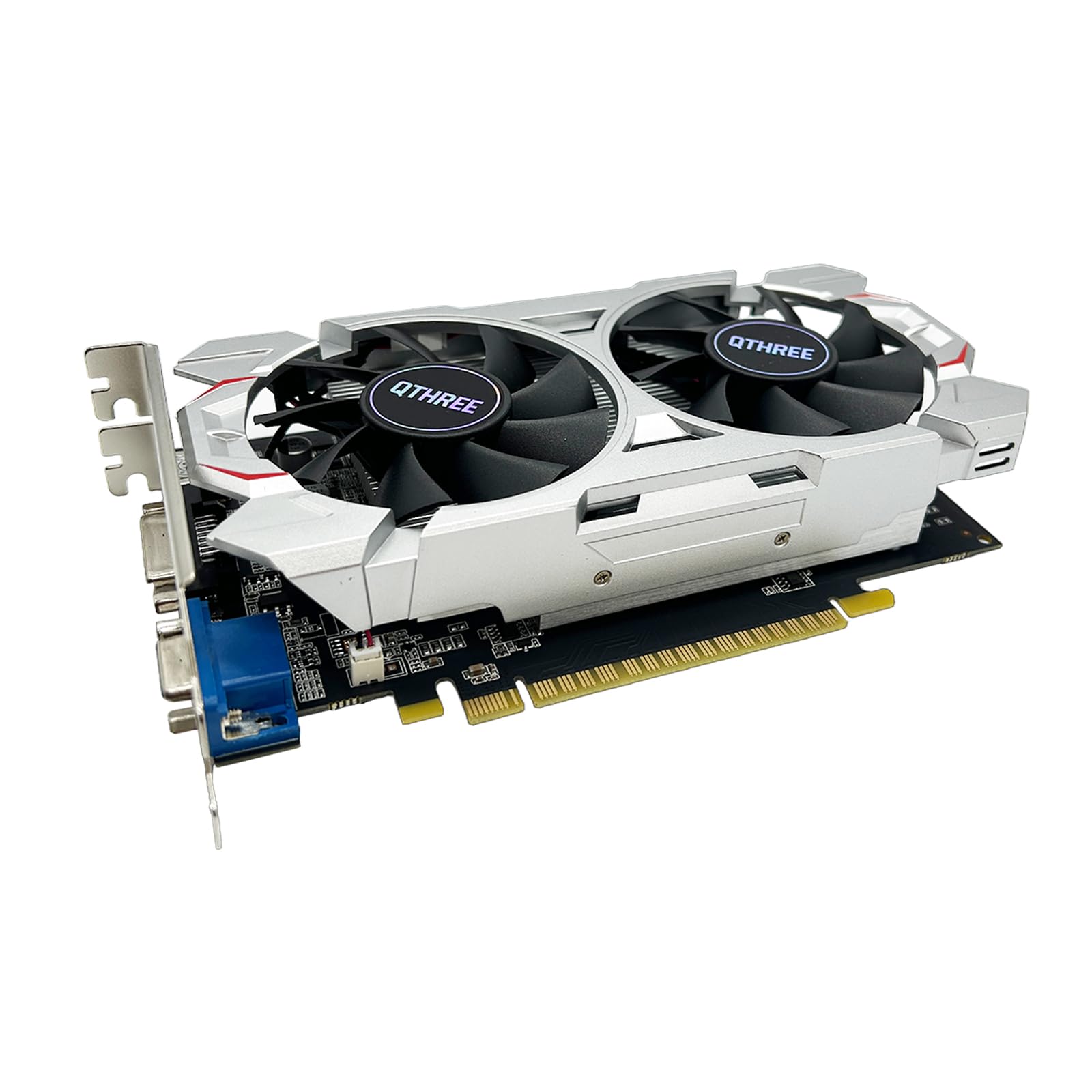
The QTHREE card stands apart from the single-fan crowd by packing a dual-fan cooling solution on a full-height bracket, with the core clock bumped to 1072MHz — 52MHz higher than the reference 750 Ti specification. This extra headroom translates to better sustained performance in 1080p gaming, with users reporting smooth rendering in Nvidia 3D demos and Carveco CAD software without thermal throttling.
The dual-fan setup moves more air at lower RPM, keeping noise levels down compared to the single-fan SAPLOS card. It still operates on a 60W TDP with no external power connector, making it compatible with the same 250W minimum PSU recommendation. The port selection includes HDMI, DVI-D, and VGA, supporting up to three monitors simultaneously — handy for multitaskers who run a spreadsheet, a browser, and a CAD viewport at the same time.
One important compatibility note: this card ships with a full-height bracket only. The product description explicitly states it is not suitable for SFF cases. It fits ATX, M-ATX, and larger ITX builds. For a mid-tower build needing a silent, powerful 750 Ti with better cooling than stock, this is a solid step up. But if you need low-profile, look at the SAPLOS or GPVHOSO cards instead.
Why it’s great
- Dual fans deliver quieter operation and better sustained thermal performance
- Factory-overclocked 1072MHz core outpaces reference 750 Ti
- Three output ports for multi-monitor productivity workflows
- No external power, 60W slot draw preserves older PSUs
Good to know
- Full-height bracket only — will not fit any SFF or slim case
- Plastic fan shroud adds unnecessary bulk in some tower builds
- Same Maxwell DirectX 12 limitations as other 750 Ti cards
4. GPVHOSO GTX 750Ti 4GB GDDR5
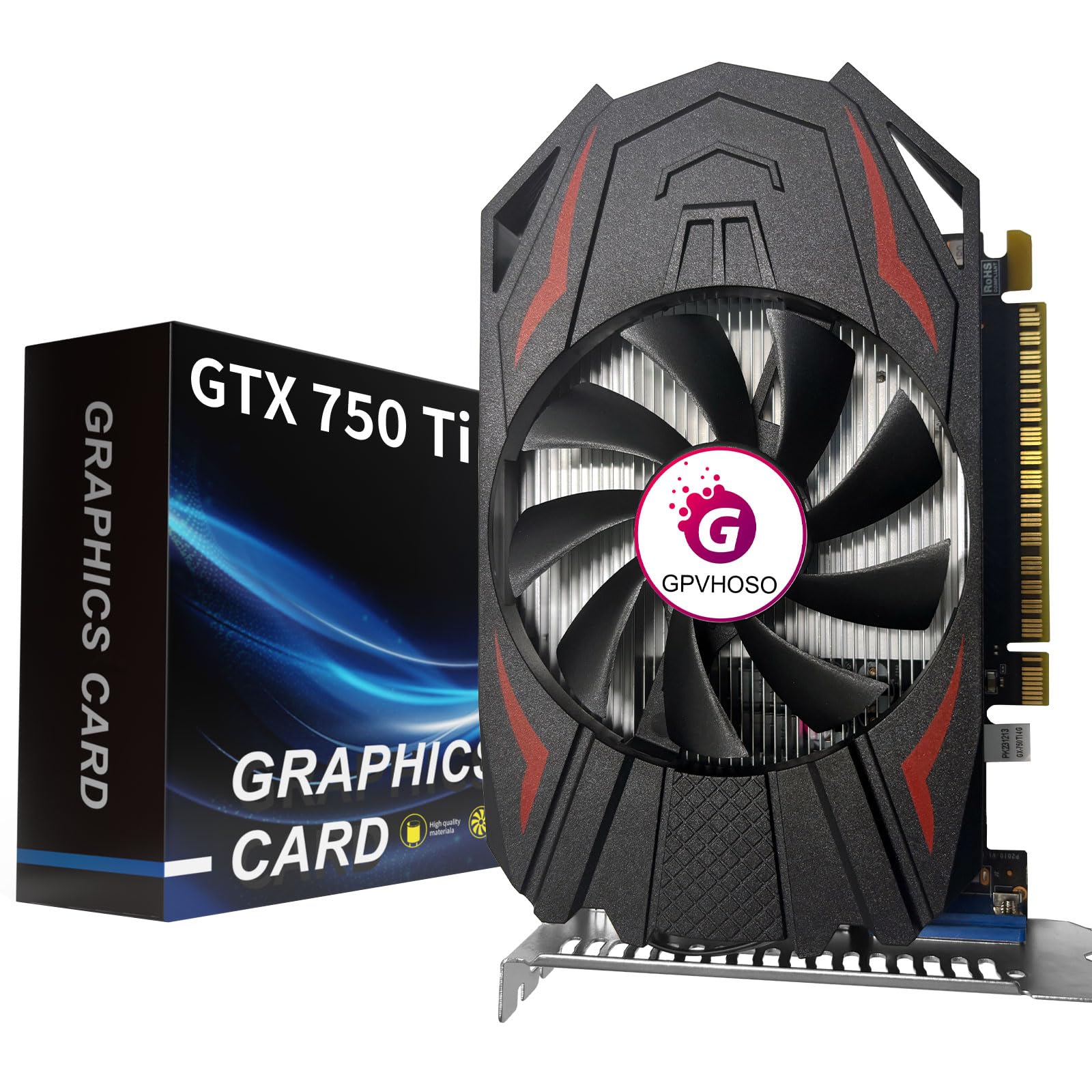
The GPVHOSO GTX 750 Ti is the entry-level workhorse in this roundup, offering a genuine 4GB GDDR5 frame buffer on a 128-bit bus at the lowest price point. The 1020MHz GPU core and 5400MHz memory clock are right at reference spec, supporting 4K HDR output at 3840×2160 for media playback on a compatible display. It runs silent according to multiple user reports, with the low 60W TDP meaning no fan noise under light desktop load.
Installation is straightforward on Windows 11 — the card auto-detects and a quick Nvidia driver download enables dual monitor support. The half-height short PCB fits SFF cases cleanly without protruding into drive bays. Verified reviews highlight its role as a “good lower end card for basic functions,” handling League of Legends, Dota 2, and classic titles at 1080p without breaking a sweat. For office tasks, web browsing, and multimedia, it is near-perfect.
A major red flag, however, emerges from customer reports stating the card is actually a GTX 860M mobile chip relabeled as a desktop GTX 750 Ti. The mobile GPU performs similarly in most scenarios but lacks the same driver support and may have the fan locked at 100% speed in some units. If you buy this card and the fan sounds stuck on high, verify the GPU ID in GPU-Z. For the price, it’s still functional — just manage expectations about what you are actually getting.
Why it’s great
- Lowest entry cost for 4GB GDDR5 VRAM in a low-profile format
- Silent fan operation during desktop use, no power cable required
- Supports 4K HDR output and dual monitor configurations
- Short PCB fits compact SFF cases without clearance issues
Good to know
- Several units confirmed to be GTX 860M mobile chips, not desktop 750 Ti
- Some reports of fan running at full speed continuously
- Limited gaming performance — best for casual and older titles
5. Kelinx AISURIX RX 580 8GB

The RX 580 8GB from Kelinx is not a low-profile card, and it is not a GTX 750 Ti — but it deserves a spot here as the premium alternative for anyone willing to move past the low-profile constraint. Built on the Polaris 20 architecture with 2048 stream processors and 8GB of GDDR5 on a 256-bit bus, this card annihilates 1080p gaming. The 1750MHz memory clock delivers the bandwidth needed for modern AAA titles at high settings without VRAM bottlenecks.
The semi-automatic fan system stops the fans entirely under low GPU loads, making it completely silent for office and browsing use. When the GPU heats up during gaming, the fans spin up gradually rather than pulsing. It supports up to two monitors via 2x DisplayPort and 1x HDMI, with 4K output at 3840×2160. The card is a dual-slot design and requires a standard ATX case — it will not fit any SFF chassis.
The major catch is power: the RX 580 draws 185W and requires a single 8-pin PCIe power connector. This rules out any build with a sub-450W power supply or a system lacking a dedicated GPU power rail. Customer reviews are split — some report rock-solid 1080p gaming, while others experienced GPU failure within a week. The quality control on these budget Polaris rebrands is inconsistent. If you are willing to gamble for high performance at this price range, it works when it works.
Why it’s great
- 8GB GDDR5 VRAM and 256-bit bus for high-resolution texture work
- Zero-RPM fan mode for silent desktop operation
- Far exceeds 750 Ti performance in modern AAA titles
- DisplayPort outputs for high-refresh-rate monitors
Good to know
- 185W power draw requires 8-pin connector and quality 450W+ PSU
- Full-height dual-slot — incompatible with any SFF or low-profile case
- Inconsistent quality control; some units fail within days of use
6. Xynsviu GeForce GTX750 4G 4xHDMI

This is the only card in the roundup designed specifically for multi-monitor productivity, packing four native HDMI 2.0 ports on a dual-slot low-profile PCB. The underlying GPU is a GTX 750 (non-Ti) with 4GB GDDR5 and 640 CUDA cores at 1020MHz core clock — slightly less raw gaming power than the 750 Ti, but the output flexibility is unmatched. It supports 4K at 60Hz on two screens simultaneously, or a stitched 8K display via 2×2 setup for digital signage and presentation walls.
The card draws its full 60W from the PCIe slot with no extra power connector, keeping installation dead simple even in compact ITX or proprietary SFF chassis. It works with Windows 7/8/10/11 out of the box, making it a drop-in replacement for aging office PCs that need to drive a multi-screen trading or surveillance station. Users upgrading from a VisionTek 5570 reported that Windows 11 drivers worked perfectly and sleep/wake cycles finally functioned correctly after the swap.
For gaming, the GTX 750 non-Ti is a step below the 750 Ti — expect playable frame rates in League of Legends and CS2, but not in demanding modern titles. The primary use case here is clearly professional multi-display work, where having four HDMI ports on a single low-profile card is extremely rare. If you are building a kiosk, a stock trading desk, or a museum interactive display, this card solves a connectivity problem no other low-profile GPU addresses.
Why it’s great
- Unique 4x HDMI 2.0 low-profile design — no adapter needed for multi-display
- 60W slot power draw with no external cable simplifies installation
- Supports 4K@60Hz dual output and 8K stitched display configurations
- Broad OS compatibility including full Windows 11 driver support
Good to know
- GTX 750 non-Ti core is slower in gaming than true 750 Ti variants
- Limited to productivity and light gaming use cases
- Requires new Nvidia app — legacy control panel not supported
7. msi Gaming GeForce GT 1030 4GB DDR4 LP OC

The msi GT 1030 is not a GTX 750 Ti — it’s a different architecture (Pascal-based GP108) that trades memory bandwidth for lower cost and compact size. The 4GB DDR4 memory runs on a 64-bit interface, which is half the bus width of the 750 Ti’s 128-bit GDDR5. The boost clock reaches 1430MHz, which helps offset the narrow memory bus in lighter workloads. The card includes both low-profile and full-height brackets, fitting Optiplex SFF and standard mid-towers alike.
The killer use case for this card is reviving older PCs on a strict budget. Users report it eliminates 1440p video stutter on 10-year-old AMD systems, makes Linux Mint graphics crisp and glitch-free, and solves overscan issues on Panasonic TVs. For a system with a 300W power supply or less, the GT 1030’s sub-30W draw is the safest option — it puts zero strain on aging PSUs. MSI’s build quality and heatsink design are also noticeably better than generic 750 Ti rebrands.
However, the 4GB DDR4 on a 64-bit bus significantly limits gaming performance compared to a true 750 Ti. Minecraft runs at 60 FPS rather than the expected 300-400 FPS, and modern titles at 1080p medium will struggle. This is strictly a productivity and media acceleration card, not a gaming GPU. For office upgrades or Linux-based HTPC builds, it’s a reliable, quiet, cool-running choice. For gaming, pass and get a 750 Ti instead.
Why it’s great
- Extremely low power draw (under 30W) safe for any PSU
- Includes both low-profile and full-height brackets in the box
- Excellent Linux support with native driver compatibility
- Decodes 4K video stutter-free on old hardware
Good to know
- 64-bit DDR4 memory bus severely limits gaming performance
- Slower than any GTX 750 Ti in 3D workloads
- Not suitable for modern 1080p gaming beyond esports on low settings
FAQ
Will a GTX 750 Ti low profile card fit my Dell Optiplex 3020 SFF?
Does the GTX 750 Ti support Windows 11 and current Nvidia drivers?
Can a GTX 750 Ti handle 4K video playback or 4K gaming?
How can I tell if my GTX 750 Ti card is a fake or a mobile chip rebrand?
Final Thoughts: The Verdict
For most users, the best 750 ti low profile graphics card winner is the maxsun GeForce RTX 3050 6GB because it delivers modern gaming performance with DLSS, fits SFF cases, and draws power from the slot alone. If you need a genuine 750 Ti at a budget-friendly price with true low-profile fitment, grab the SAPLOS GTX 750 Ti 4GB. And for a multi-monitor productivity setup where four HDMI ports are essential, nothing beats the Xynsviu GTX 750 4G 4xHDMI.