
A 750 Watt Inverter sits at a specific sweet spot in the power equipment world. It is just enough capacity to run a standard refrigerator, a sump pump, a large TV with a gaming console, or multiple computer workstations, yet modest enough to draw from a single 12V deep-cycle battery without requiring dual-battery setups or heavy-gauge wiring that larger 1500W+ units demand. The real challenge is not finding a box that converts DC to AC — it is finding one that delivers clean, stable sine-wave power without excessive fan noise or wasted standby drain that kills your battery overnight.
I’m Min — the co-founder and writer behind Gadgets Feed. I have spent countless hours cross-referencing datasheets, customer reliability reports, and real-world load tests to separate the units that hold steady under a 600W continuous load from those that overheat or trip their protection circuits prematurely.
After comparing continuous output ratings, surge capability, waveform purity, idle power draw, and physical build quality across seven different inverters, this guide identifies the best 750 watt inverter for your specific budget and use case.
How To Choose The Best 750 Watt Inverter
The wrong inverter can damage your electronics, drain your battery overnight, or simply shut down under load. Three specs separate the reliable units from the frustration machines.
Waveform Type: Pure Sine vs. Modified Sine
Pure sine wave inverters produce AC power indistinguishable from your home wall outlet. Sensitive electronics like variable-speed refrigerators, medical CPAP machines, laser printers, and modern TV power supplies rely on clean sine-wave input or they overheat, hum loudly, or fail prematurely. Modified sine wave units are cheaper and perfectly fine for resistive loads (incandescent lights, basic power tools, resistive heaters), but they cause digital clocks to run fast, audio equipment to buzz, and induction motors to run hotter. If your 750W load includes any electronics with microcontrollers or AC motors, spend the extra for pure sine.
Idle Power Draw and Low-Voltage Cutoff
An inverter that draws 2A of current with no load connected will drain a 100Ah battery to 50% depth of discharge in roughly 25 hours — that is useless for weekend camping or off-grid solar. Look for units advertising idle draw below 0.5A (ideally under 0.3A to 0.4A). Equally important is low-voltage cutoff: the inverter should automatically shut off when the battery voltage drops to around 10.5V to 11V to protect lead-acid or LiFePO4 batteries from deep discharge damage. Some budget units have fixed thresholds too high for lithium batteries; premium models offer adjustable cutoff voltage.
Surge Capacity and Thermal Management
A 750W inverter with a 1500W surge rating can start a refrigerator compressor or a submersible pump that draws 600W running but 1200W for the first 0.1 seconds. The surge rating must be genuine, not theoretical peak marketing. Also examine the cooling fan: cheap inverters run the fan constantly at full speed, creating noise and wasting power. Better designs use temperature-controlled fans that only spin when internal heat exceeds 40°C (104°F), keeping the inverter silent under light loads and extending fan lifespan.
Quick Comparison
On smaller screens, swipe sideways to see the full table.
| Model | Category | Best For | Key Spec | Amazon |
|---|---|---|---|---|
| Renogy P2 700W | Pure Sine | Off-grid solar & RV systems | 700W continuous / 1400W surge, 0.41A idle, UL 458 | Amazon |
| Schumacher XI75DU | Modified Sine | Emergency backup & power tools | 750W continuous / 1500W peak, includes battery clamps | Amazon |
| BELTTT 1000W | Pure Sine | Budget-conscious truck & camping | 1000W continuous / 2000W peak, LCD, 4.4 lbs | Amazon |
| VOLTWORKS 1000W | Pure Sine | Home backup & sensitive electronics | 1000W continuous, ETL UL458, 3-year warranty | Amazon |
| VOLTWORKS VS-1500SCR | Pure Sine | High-power inductive loads | 1500W continuous / 3100W peak, PD36W USB-C, remote | Amazon |
| VOLTWORKS 2000W | Pure Sine | Vehicle workshops & heavy gear | 2000W continuous, remote controller, 15ft cable, UL | Amazon |
| Tripp Lite APS750 | Modified Sine | UPS & permanent installation | 750W continuous / 1500W peak, auto-transfer, 20A charger | Amazon |
In‑Depth Reviews
1. Renogy P2 700W Pure Sine Wave Inverter

The Renogy P2 is the rare inverter that matches its rated 700W continuous output with a genuine 1400W surge capable of starting a fridge compressor or a 1/2-hp sump pump. Its idle current measures around 0.41A at 13.3V input, which means it drains only about 5Ah per day from a battery with no load attached — one of the more efficient figures in this class. The unit includes a wired 19.8ft remote controller, allowing you to mount the inverter out of sight and still turn it on or off from the cab or living area.
The waveform is genuinely pure sine, producing 122V RMS no-load and 117V RMS under a 550W resistive load with no audible transformer hum. Renogy includes two 3ft 6AWG battery cables, which are appropriately sized for the 700W max draw (around 66A at full load). The metal housing feels substantial at 5.6 lbs, and the high-speed ventilation fans only activate when internal temperature demands it, keeping the unit silent under typical TV and light-appliance loads. The UL 458 and CSA C22.2 No. 107.1 certifications provide real confidence for permanent RV and off-grid solar installations where safety inspections matter.
Customer reports confirm the unit handles living-room loads (lights, TV, DVD, stereo) with spare capacity and runs gas furnace electronics during winter outages without issue. Several users mention that pre-charging the input capacitors with a resistor during the initial connection prevents BMS trip on LiFePO4 batteries — Renogy customer service walks you through this, but the manual could be more explicit. For a pure sine wave inverter under the 750W threshold with solar-system-grade reliability, the Renogy P2 sets the benchmark.
Why it’s great
- Industry-low 0.41A idle current preserves battery life during standby periods
- Includes hardwire AC terminal block plus remote switch for hidden installations
- UL 458 and CSA certified for code-compliant RV and solar system wiring
Good to know
- Rated at 700W, not 750W — must confirm your load stays under the continuous limit
- Manual does not document capacitor pre-charge procedure required for LiFePO4 BMS compatibility
- Fanless at low load, but fan noise becomes audible under heavy continuous use
2. BELTTT 1000W Pure Sine Wave Inverter
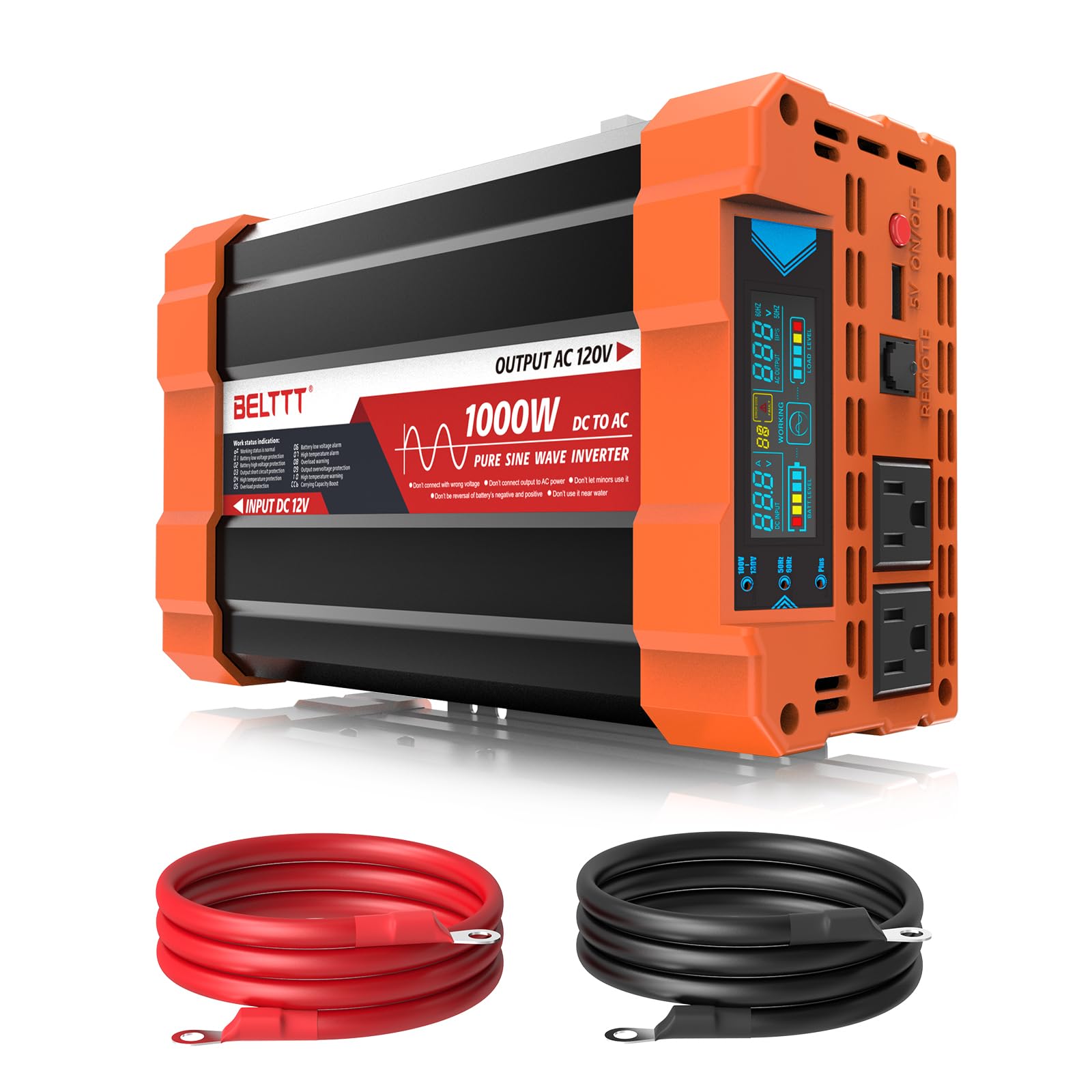
The BELTTT 1000W inverter punches well above its price point by delivering an actual 1000W continuous rating with a 2000W surge peak — sufficient headroom for starting a 750W refrigerator or microwave without tripping protection circuits. The unit weighs only 4.4 lbs, making it one of the lightest pure-sine inverters in this comparison, and its compact dimensions (11 x 6.36 x 3.49 inches) allow it to slide under truck seats or into small marine compartments where Renogy or Tripp Lite units would not fit.
The LCD display simultaneously shows input DC voltage, output AC voltage, load wattage, and battery level, which is genuinely useful for diagnosing problems at a glance. The fan is temperature-controlled and remains off during light loads, and users report it stays nearly silent when powering laptops, work lights, and small power tools. The included 5AWG 3ft battery cables and three 40A fuses are adequate for loads up to about 800W continuous, though some reviewers note the wire gauge is borderline if you plan to run the unit at its full 1000W rating for extended periods.
Real-world testing confirms the inverter produces a clean 119-120V output under an 860W shop-vac load with no flickering or audible distortion. The pure sine wave completely eliminates the buzzing that modified sine wave inverters cause in LED lighting and audio equipment. The downside is that the hardwire terminal is absent — you rely entirely on the dual AC outlets — and the LCD backlight does not dim automatically. For a budget-friendly entry into pure sine wave power at the 750W load level, the BELTTT is hard to beat.
Why it’s great
- Lightweight 4.4 lb design fits in tight RV, truck, or marine compartments
- Informative LCD displays input voltage, output voltage, and load wattage together
- 2000W surge handles refrigerator and pump startup without tripping
Good to know
- No AC hardwire terminal — limited to two front-panel outlets
- Provided 5AWG cables get warm above 800W continuous; upgrade for full 1000W use
- LCD backlight stays on permanently; may be distracting in dark bedrooms or RVs
3. VOLTWORKS 1000W Pure Sine Wave Inverter

The VOLTWORKS 1000W inverter distinguishes itself through certification and warranty depth. It carries the ETL UL458 mark, which means it has been independently tested to the same standard required for RV and marine installations, and the 36-month warranty provides three times the coverage of most competitors at this power level. The unit houses three AC outlets and two 2.4A USB ports, giving you more connection flexibility than the two-outlet Renogy P2 or the single-terminal BELTTT.
Build quality is immediately apparent: the aluminum housing dissipates heat effectively, and the internal cooling fan only activates when the inverter hits 104°F (40°C), resulting in silent operation during normal TV, laptop, and lighting loads. The LCD display cycles through input voltage, output frequency, load percentage, and battery level, but the lack of a numeric wattage readout is a minor omission compared to the BELTTT’s more detailed screen. The included 2-foot battery cables are on the short side for permanent installations but fine for temporary setups.
User tests show the unit handles 900W continuous loads without issue, with the fan remaining quiet enough for use inside a camper van while sleeping. The low-voltage cutoff works reliably, and the reverse-polarity protection adds peace of mind during first-time hookups. The main drawback is the black power switch that is difficult to see in low-light conditions — a minor ergonomic gripe. For buyers who prioritize warranty length and certified safety over raw surge numbers, the VOLTWORKS 1000W is the most secure investment.
Why it’s great
- ETL UL458 certification — the same standard required for hardwired RV and marine inverters
- 36-month warranty is triple the typical 12-18 month coverage in this class
- Three AC outlets and dual USB ports reduce need for external power strips
Good to know
- LCD display shows battery level bars but no exact wattage readout for the load
- Black switch blends into the housing; hard to locate in dimly lit compartments
- Battery cables are only 2ft long; you may need longer 2AWG cables for some setups
4. Schumacher Electric XI75DU 750W Power Converter

The Schumacher XI75DU is the only unit in this roundup with dual connection options: it comes with heavy-duty battery clamps for direct battery-terminal connection and a 12V accessory plug for lighter loads. This makes it uniquely suited for emergency roadside scenarios where you need to plug a power tool or medical device into your vehicle battery without permanent wiring. The 750W continuous / 1500W peak rating matches the strict 750W target of this guide, and it includes three AC outlets — more than most modified-sine competitors.
As a modified sine wave inverter, the XI75DU is best suited for resistive and universal-motor loads: incandescent lights, basic power drills, air pumps, and resistive heaters will work without issue. Digital clocks may gain roughly 2 seconds per minute of operation on battery power, and some dimmable LED bulbs may emit a faint buzz. The unit lacks any LCD display or remote switch — you get a simple power toggle and indicator LEDs for power and fault status. Build quality is typical Schumacher: rugged plastic housing that holds up to bumps and drops.
The main complaint from verified buyers is the fixed low-battery alarm threshold, which triggers at around 11.5V input and cannot be disabled. This is fine for standard car starter batteries but inconvenient for deep-cycle or trolling-motor batteries where you want to discharge to 10.5V. A minority of users report units failing after a few days of heavy use, though Schumacher’s warranty support is generally responsive. For quick emergency power where waveform purity is not critical, the XI75DU’s immediate hookup convenience is unmatched.
Why it’s great
- Includes both battery clamps and 12V plug — ready out of the box with no wiring
- True 1500W peak surge capability for starting power tools and pumps
- Three AC outlets provide flexibility without an external power strip
Good to know
- Modified sine wave output causes digital clocks to run fast and some LED lights to hum
- Low-battery alarm triggers at 11.5V — cannot be adjusted for deep-cycle battery use
- No remote control or display; must access the unit physically to toggle power
5. VOLTWORKS VS-1500SCR Pure Sine Wave Inverter
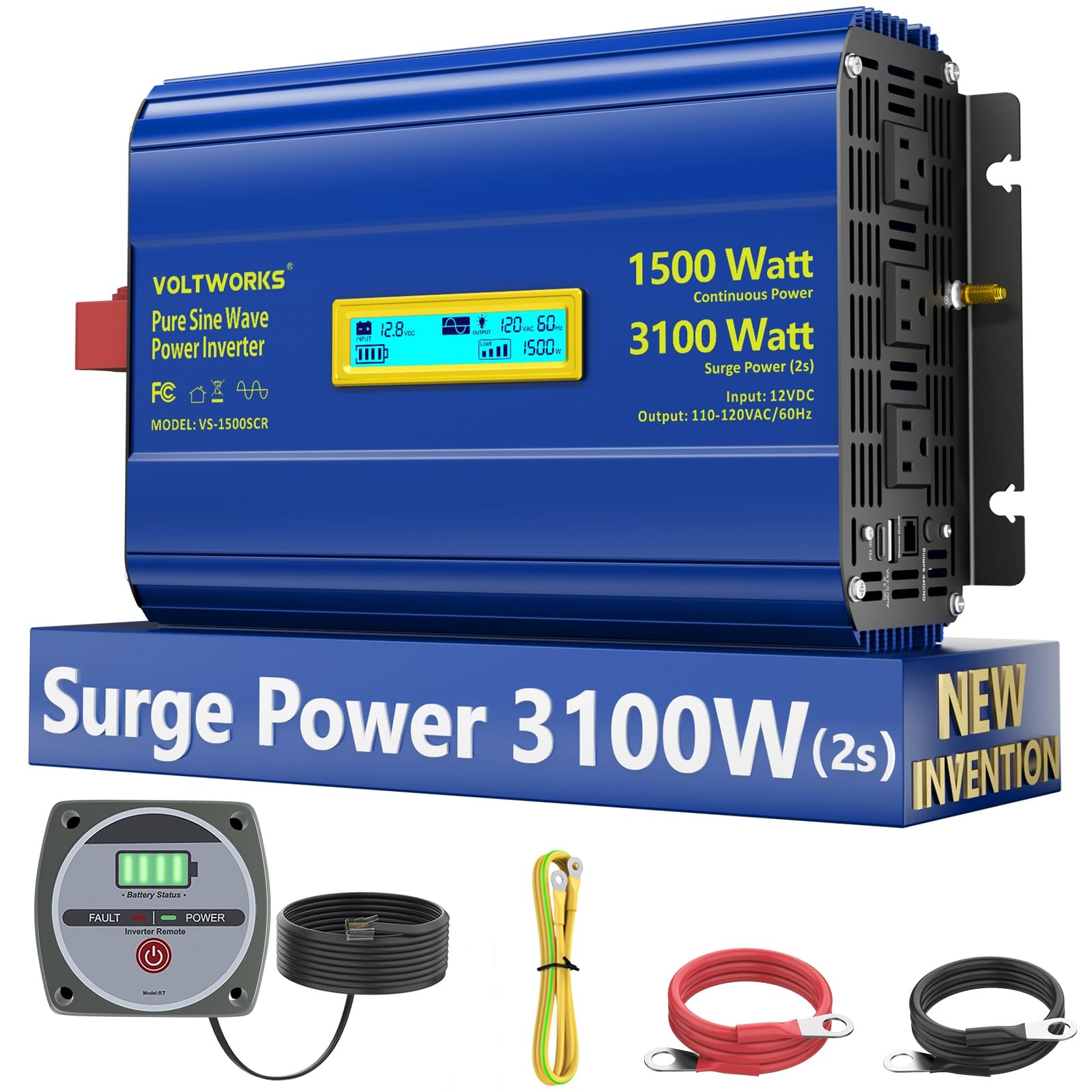
The VOLTWORKS VS-1500SCR is the most feature-rich inverter in this guide, packing a 1500W continuous output and a massive 3100W surge peak for 2 seconds — enough to start a microwave, a 1/2-hp well pump, or a rooftop air conditioner simultaneously. The adjustable input voltage function is a standout feature for LiFePO4 battery users: you can lower the low-voltage cutoff to 10.5V or raise it to 11.8V depending on your battery chemistry, which prevents nuisance shutdowns. The 15ft RJ10 remote controller with battery monitoring is included, and the inverter also has a PD36W USB-C port for fast-charging laptops and smartphones directly.
The LCD display is one of the most informative in this class, showing battery voltage, output voltage, load wattage, and protection fault codes. The screen auto-dims after one minute of inactivity, a small detail that matters when the inverter is mounted in a bedroom or camper interior. The cooling fan is temperature-controlled and stays off under typical 300-500W loads; users report the fan is barely audible even when running the unit near its 900W continuous limit. The dual AC outlets plus the 40A hardwire terminal give you installation flexibility for both portable and permanent setups.
The unit weighs roughly 8.6 lbs, which is heavier than the BELTTT but expected given the higher power components. Some users note that the black power switch is hard to locate in dim environments, and the manual has minor errors in describing the remote wiring. The 18-month warranty is shorter than the standard VOLTWORKS 1000W but still above the industry average. If your loads occasionally spike above 1000W and you want the extra surge headroom plus modern USB-C fast charging, this is the most capable inverter in the lineup.
Why it’s great
- Adjustable low-voltage cutoff optimized for both lead-acid and LiFePO4 batteries
- PD36W USB-C port charges laptops at full speed without an extra adapter
- 3100W surge peak handles demanding motor and compressor startups
Good to know
- Heavier than competitors at 8.6 lbs, more suited to permanent mounting than portable carry
- Black power switch hard to see; remote controller recommended for primary on/off control
- Manual contains minor errors in the remote connector wiring diagram
6. VOLTWORKS 2000W Pure Sine Wave Inverter

While the 2000W rating exceeds the 750W target of this guide, the VOLTWORKS 2000W is worth considering for buyers who anticipate future power expansion. If you currently run a 750W load but plan to add a microwave, a coffee maker, or a power saw, this inverter provides 2000W continuous and a surge peak that is not explicitly rated but handles motor startup without complaint. It includes two AC outlets plus a hardwire terminal rated for 20A, and the 15ft RJ10 remote controller keeps the switching convenient when the unit is mounted in a truck bed or cargo area.
The cooling fan strategy is the standout technical detail: the fan does not spin at all when the inverter is powered on, only activating when internal temperature reaches 104°F (40°C). This results in virtually silent operation under light-to-moderate loads — ideal for a work truck where noise is unwanted. No-load current draw is impressively low at around 3W idle power consumption, meaning the inverter sips only about 0.25A from the battery when nothing is plugged in. The aluminum housing is robust at 9.9 lbs, and the UL certification covers the unit for code-compliant installations.
Customer reports confirm the unit runs a full living room setup (TV, lights, CPAP, computer) continuously without fan noise and handles a 900W microwave with brief fan cycling. The remote gauge uses a four-bar LED display that is less informative than the VS-1500SCR’s numeric LCD — one green bar off indicates 10-20% reserve, which is vague. The main reservation is that the M6 DC input studs are smaller than the M8 that many installers prefer for high-current 2000W draws. For future-proof buyers who want to run 750W today with room to grow, this is the most headroom-rich option.
Why it’s great
- Fan completely off at startup and only activates at 104°F for near-silent operation
- Low 3W idle draw preserves battery capacity during long standby periods
- Hardwire 20A terminal plus remote controller suits permanent workshop installation
Good to know
- M6 DC input studs are smaller than the M8 standard preferred for 2000W installations
- Remote gauge uses vague LED bars, not a numeric wattage or voltage display
- At 9.9 lbs, it requires sturdy mounting and is not intended for portable carry
7. Tripp Lite APS750 750W Inverter/Charger

The Tripp Lite APS750 is not a standard inverter — it is a combined inverter, automatic transfer switch, and 20A battery charger designed for permanent installation as a UPS for critical loads. When shore power or grid AC is present, the unit bypasses the inverter and passes through utility power while simultaneously charging the battery with a 20A three-stage charger. When AC drops out, the auto-transfer switch switches to battery power within roughly 16ms, which is fast enough to keep computers, routers, and DVRs running without reboot. This makes it the only device in this guide that serves as a full battery backup system, not just a DC-to-AC converter.
The output is modified sine wave, so the same waveform caveats apply — digital clocks run fast (verified by users at roughly 2 seconds per minute lost on inverter power), and some audio equipment may hum. However, for the intended use case of powering LED TVs, networking gear, and residential lighting during outages, the modified sine wave is perfectly adequate. The built-in 20A battery charger is a powerful addition: it can replenish a depleted 100Ah battery from 50% to full in roughly 2-3 hours. The rugged polycarbonate housing is moisture-resistant, suitable for marine and outdoor shed installations. The unit includes a remote panel (APS RM4) for convenient monitoring.
The critical flaw reported by multiple verified buyers is that the APS750 may refuse to charge a deeply discharged battery — if the battery voltage drops below a certain threshold, the charger will not activate. Tripp Lite support has confirmed this limitation, which means you need an external charger to bring a dead battery back above the minimum starting voltage. This is a frustration for users who expect a fully autonomous UPS system. For permanent installations where battery discharge is controlled and shallow, the APS750’s integrated transfer-switch and charger capabilities are unmatched. For deep-cycle or solar backup where batteries routinely run low, consider one of the pure-sine inverters above.
Why it’s great
- Built-in 20A three-stage battery charger with automatic transfer switch for UPS operation
- Rugged polycarbonate housing resists moisture for outdoor and marine installations
- Supports up to 1500W instantaneous peak for motor loads and startup surges
Good to know
- Won’t charge a deeply depleted battery; external charger required to recover from full discharge
- Modified sine wave output causes digital clocks to run fast and some electronics to hum
- Heavy at 17 lbs (7.7 kg), requires secure mounting and is not portable
FAQ
Can a 750 watt inverter run a full-size refrigerator?
How long will a 100Ah battery run a 750 watt inverter at full load?
What is the difference between modified sine wave and pure sine wave?
Should I buy an inverter with a remote controller?
Final Thoughts: The Verdict
For most users, the best 750 watt inverter winner is the Renogy P2 700W Pure Sine Wave Inverter because its ultra-low 0.41A idle draw, genuine pure sine output, hardwire terminal, and UL 458 certification make it the most reliable and efficient choice for off-grid solar and RV systems in the 700-750W class. If you want the most surge headroom and modern USB-C fast charging, grab the VOLTWORKS VS-1500SCR. And for a budget-friendly entry into clean sine wave power without the high price tag, nothing beats the BELTTT 1000W.