
The 24GB frame buffer on the Radeon RX 7900 XTX isn’t just a number; it’s the difference between smooth 4K texture streaming and hitching, between fitting a large language model in VRAM and swapping to system memory. This generation of AMD’s RDNA 3 architecture delivers raw rasterization punch that often trades blows with the RTX 4080 Super, but you need to know which board partner cooler handles the 355W+ thermal load without sounding like a hair dryer.
I’m Min — the co-founder and writer behind Gadgets Feed. I have spent countless hours analyzing the thermal performance, VRAM configurations, and real-world driver stability of the Radeon RX 7000 series lineup to help you pick the exact partner card that fits your build.
After sifting through hundreds of verified buyer reports and technical spec sheets, this guide isolates the true contenders for the best 7900 xtx 24gb graphics card category across cooling, noise, and raw 4K gaming capability.
How To Choose The Best 7900 XTX 24GB Graphics Card
The 7900 XTX is a thermally dense card that pulls significant wattage under load. Choosing the wrong partner card can lead to hotspot throttling, noise complaints, and suboptimal boost clocks. Here are the specific factors that separate a good pickup from a regretful one.
Cooling Solution and Hotspot Temps
The 7900 XTX has a known tendency for high junction temperatures, often hitting 105-110°C on reference designs during extended 4K sessions. Cards with vapor-chamber coolers, such as the Sapphire Nitro+ Vapor-X, consistently report hotspot temps under 90°C, preserving boost clocks and extending card lifespan. The XFX MERC310 also uses a dense triple-fan array that keeps core temps near 60°C under load, making it a strong alternative.
Board Power Delivery and Dual BIOS Options
Stock power limit on the reference 7900 XTX is around 355W. Partner cards often include a dual BIOS switch—a quiet mode that reduces fan speeds and a performance mode that raises power limits for overclocking. The Sapphire Nitro+ and ASUS TUF Gaming models both offer this, allowing you to toggle between a silent desktop experience and a high-performance 4K gaming profile without software tweaks.
Physical Clearance and Case Fit
Many 7900 XTX partner cards exceed 12.5 inches in length and occupy three full slot widths. The MSI Gaming Trio Classic is notably one of the few high-end 24GB models that fits Mini-ITX cases at 325mm length, while the XFX MERC310 requires a larger mid-tower. Always measure your case’s GPU clearance and leave room for power cable bend radius, as these cards demand 3x 8-pin or dual 8-pin PCIe connections.
Quick Comparison
On smaller screens, swipe sideways to see the full table.
| Model | Category | Best For | Key Spec | Amazon |
|---|---|---|---|---|
| XFX Radeon RX 7900 XT 20GB | Mid-Range | AI & Workstation Value | 5376 Stream Processors | Amazon |
| Sapphire Nitro+ RX 7900 XTX Vapor-X | Premium | 4K Gaming & Quiet Cooling | 2680 MHz Boost Clock | Amazon |
| XFX Speedster MERC310 RX 7900 XTX Black | Premium | Raw Raster Performance | 2615 MHz Boost Clock | Amazon |
| XFX Speedster MERC310 RX 7900 XT White | Mid-Range | White Builds & 1440p Max | 2535 MHz Boost Clock | Amazon |
| Sapphire Pulse RX 7900 XT 20GB | Mid-Range | No-Fuss 4K Entry | 68°C Core Temp under Load | Amazon |
| Sapphire 21323-01-20G RX 7900 XT | Mid-Range | USB-C Output & Metal Build | 1x USB-C Port | Amazon |
| ASUS TUF Gaming RX 7900 XT OC | Premium | Durability & OC Headroom | Military-Grade Capacitors | Amazon |
| ASUS TUF Gaming RX 7900 XT OC (B0BSVLCJHL) | Premium | Ultrawide & Linux Gaming | 516W Power Draw OC | Amazon |
| MSI Radeon RX 7900 XTX Gaming Trio Classic | Premium | Mini-ITX Compact Builds | 325mm Length | Amazon |
| PowerColor AMD Radeon RX 7900 XTX | Premium | Reference-Style Performance | 6144 Stream Processors | Amazon |
In‑Depth Reviews
1. Sapphire Nitro+ RX 7900 XTX Vapor-X 24GB

The Sapphire Nitro+ offers the most robust vapor-chamber cooling on the 7900 XTX platform. Verified buyers consistently report core temps hovering around 60°C under sustained 4K loads, with the Vapor-X cooler keeping fan noise at a whisper compared to triple-fan rivals. The 2680 MHz boost clock out of the box is the highest among the premium cards here, delivering a tangible edge in raster-heavy titles like Cyberpunk 2077 and Warhammer Total War 3.
This card packs a dual BIOS switch, ARGB lighting, and Sapphire’s fan quick-connect system that simplifies case cable management. The 24GB GDDR6 buffer runs on a 384-bit bus, pushing 960 GB/s bandwidth that feeds the RDNA 3 compute units without bottlenecking at 4K native or ultra-wide resolutions. Users moving from a 3080 12GB to three ultrawide monitors report smooth 7680×1440 gaming at 120-160 FPS using AMD’s Eyefinity setup.
Some buyers received refurbished units with missing cover plates and experienced unstable performance, which points to seller variability rather than a design flaw. The card also demands a 1000W power supply and a spacious case, as the 3.5-slot heatsink extends to 320mm in length. For the quietest 4K RDNA 3 experience with the best outgoing cooling, this is the target.
Why it’s great
- Vapor-X cooler keeps hotspot under 60°C with low fan noise
- Dual BIOS and ARGB for flexible tuning and aesthetics
- 24GB GDDR6 handles multi-monitor ultra-wide setups without VRAM limit
Good to know
- Very large 3.5-slot design may not fit mid-tower cases
- Seller quality varies; some receive refurbished units with cosmetic damage
- Requires a robust 1000W PSU for stable peak loads
2. XFX Speedster MERC310 RX 7900 XTX Black 24GB

The XFX MERC310 Black is the go-to pick for raw 4K rasterization without the Sapphire premium. Its triple-fan MERC cooler maintains core temps around 60°C and hotspot at 75-80°C under standard gaming loads, though some units exhibited 105°C hotspot due to thermal paste pump-out that was resolved with PTM7950 repaste. Users upgrading from a 1080 Ti or 3060 Ti saw immediate 70-100 FPS gains in Battlefield 2042 at 4K native.
This card features the full 24GB GDDR6 on a 384-bit bus clocked to 20 Gbps effective memory speed. It includes DisplayPort 2.1 support, enabling 8K60 AV1 encoding output without compression artifacts. The design is among the largest at 13.5 inches, requiring careful case measurement, and it draws 390W under load—meaning an 850W PSU is the baseline. Adrenalin software integration is seamless, with no mandatory account requirement.
Customer reports note some initial instability tied to using the center DisplayPort, which resolved by switching to the first port. A small but notable number of users experienced outright card failure within months, with XFX’s RMA process requiring the customer to pay return shipping and potentially receiving a refurbished replacement. The performance-per-dollar ratio remains strong against the RTX 4080 Super, but the reliability lottery adds risk.
Why it’s great
- Excellent 4K gaming performance rivaling the RTX 4080 Super
- DisplayPort 2.1 enables 8K60 AV1 encoding
- Power efficiency at 60 FPS cap drops to ~200W in RDR2
Good to know
- Large 13.5-inch length incompatible with compact cases
- Some units experience 105°C hotspot needing thermal paste replacement
- XFX RMA process is slow and may send refurbished units
3. XFX Radeon RX 7900 XT 20GB

The 7900 XT 20GB is the most budget-conscious entry point into RDNA 3’s high-end segment without sacrificing VRAM density. With 5376 stream processors and a boost clock up to 2400 MHz, this card handles 4K gaming on titles like Call of Duty and Forza at high settings, landing roughly 10-13% behind the XTX variant. The 20GB buffer is still above the 16GB found on the RTX 4080, making it suitable for larger AI inference models and texture-heavy mods.
User reports highlight minimal coil whine and easy installation on Linux, with Fedora 44 adopting the card plug-and-play. The reference triple-fan design runs hot without a custom fan curve, and the compact 10.88-inch length makes it viable for smaller mid-tower builds. AMD’s driver updates have steadily improved performance, and the card achieves stable high framerates in competitive shooters like Overwatch 2 at 240+ FPS at 1440p.
There are isolated reports of persistent screen flickering and software glitches requiring driver reinstallation, particularly on systems paired with Ryzen 5600X CPUs where CPU bottlenecks exacerbate stability issues. The card’s performance ceiling is lower than the XTX, but for users who prioritize a larger VRAM pool over clock speeds, this is a well-balanced compromise.
Why it’s great
- 20GB GDDR6 is ideal for AI models and workstation loads
- Compact 10.88-inch length fits smaller cases
- Excellent Linux compatibility out of the box
Good to know
- Reference cooling runs hot without manual fan curve
- 13% performance gap vs 7900 XTX in 4K benchmarks
- Screen flickering reported in a small percentage of units
4. XFX Speedster MERC310 RX 7900 XT White 20GB
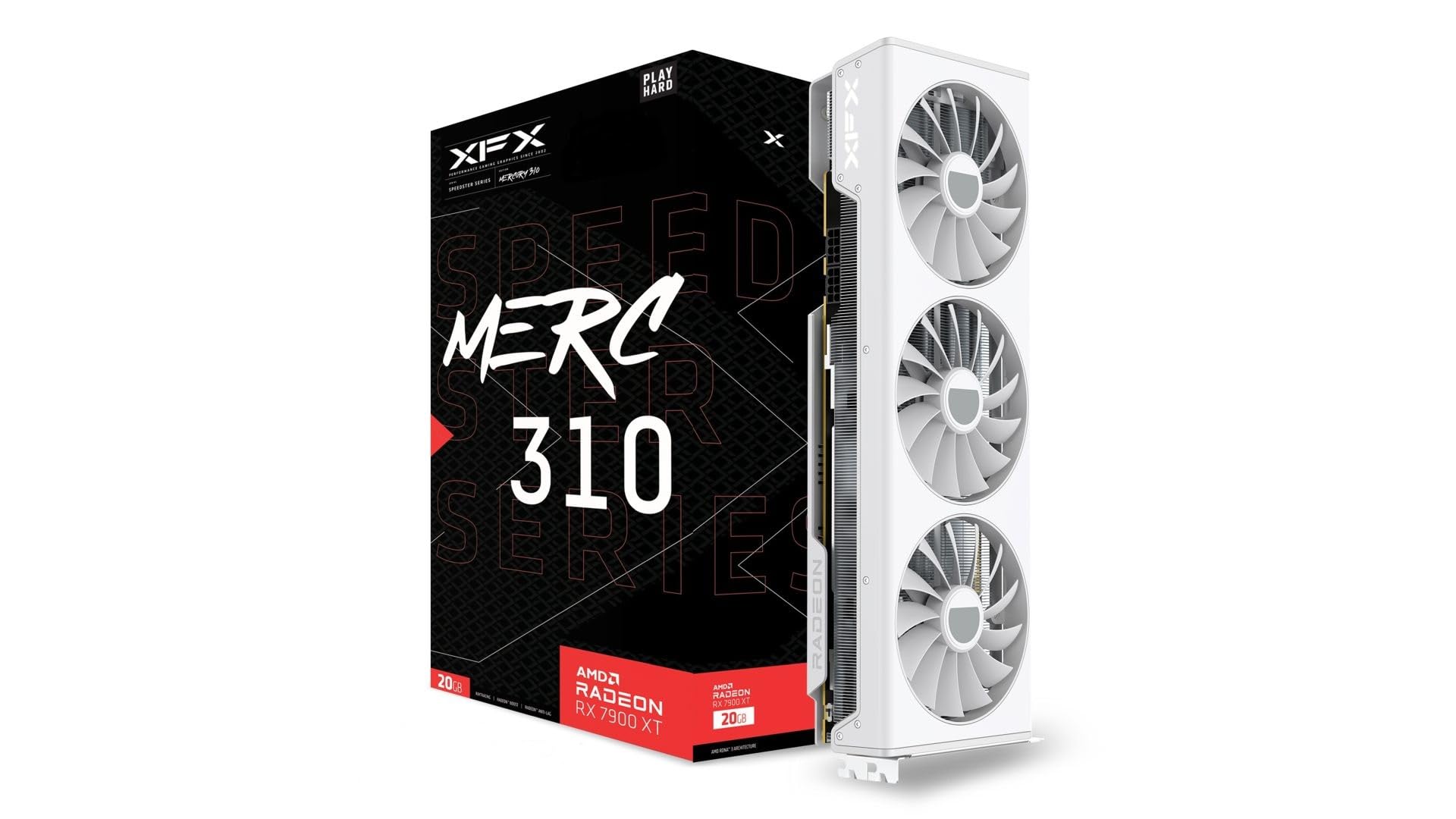
This white variant of the MERC310 brings the same triple-fan cooling hardware as its black counterpart but with a paint job that matches all-white builds. The 2535 MHz boost clock is slightly higher than the standard 7900 XT, contributing to smoother framerates in Space Marine 2 (230 FPS ultra) and Resident Evil Village (240 FPS ultra) at 1440p. Undervolting to 1075mV dropped temps from 69°C to 58°C, a common tweak that improves headroom significantly.
The card features 20GB GDDR6 on a 320-bit bus, paired with dual 8-pin power connectors that draw up to 345W under load. A support bar is included to counteract sag, which is essential given the weight of the triple-fan heatsink. User feedback confirms it outperforms the RTX 4070 Super Ti by a measurable margin in raw raster, while the white PCB and shroud look clean with vertical GPU mounting in cases like the NV7.
Fan noise becomes audible above 35% speed, and the card lacks a dual BIOS toggle, so silent operation requires manual fan curve adjustment. Some units ship without an anti-sag bracket despite the manufacturer listing, so confirm inclusion at purchase. It is a large card that demands an XL case, but the aesthetic payoff is significant for coordinated color schemes.
Why it’s great
- All-white design integrates perfectly with themed builds
- Undervolts well to 58°C core temp for silent operation
- Outperforms the RTX 4070 Super Ti in raster workloads
Good to know
- Fans audible above 35% speed without custom curve
- No dual BIOS toggle for quick switching
- Requires a large or extra-large case for fitment
5. Sapphire Pulse RX 7900 XT 20GB

The Sapphire Pulse series has a strong reputation for avoiding the hotspot issues that plague other 7900 XT cards. Owners reporting 68°C core and 85°C hotspot after three hours of 100% load in 26-31°C ambient temperatures demonstrate competent thermal management without vapor-chamber complexity. The dual 8-pin power input limits max draw to 340-345W, so overclocking headroom is narrower than higher-end models.
This card runs the stock 7900 XT configuration with 20GB GDDR6 and 5376 stream processors. It excels at 1440p max settings in demanding titles like Silent Hill 2 and Monster Hunter Wilds beta, where edge over the 4070 Super is noticeable. The Sapphire Pulse design uses a metal backplate and a single BIOS configuration, making it a straightforward drop-in upgrade for systems with 650W PSUs.
The board has physical space for three 8-pin connectors but only uses two, leaving an empty solder pad that some users find aesthetically jarring. It also lacks a USB-C output, which may be a consideration for VR headset connectivity. For buyers who want a known-quantity card with predictable cooling and no thermal paste lottery, this is the safest mid-range bet.
Why it’s great
- Proven 68°C core temps under sustained load in warm ambient
- Excellent 1440p max settings performance out of the box
- Works with 650W PSU without issue
Good to know
- No USB-C port for direct VR headset connection
- Blank spot on board where third 8-pin connector would go
- Limited overclocking due to 345W power cap
6. Sapphire 21323-01-20G RX 7900 XT 20GB

This Sapphire model is the only 7900 XT in this list with a dedicated USB-C port, making it a prime choice for VR headset users who need a direct DisplayPort-alt connection without adapters. The all-metal build and single 20GB GDDR6 configuration maintain 70°C core temps under 14-hour loads in titles like Elden Ring and Cyberpunk 2077 at 1440p max settings. A 650W PSU paired with a Ryzen 5600 chip is sufficient for stable operation.
The card uses a 320-bit DDR6 memory interface clocked at 20 Gbps effective, and the triple-slot form factor is long at 14.5 inches but fits standard ATX cases with room to spare. Positive user reports note that the card arrived at MSRP pricing and performed as advertised with no coil whine during idle operation. The fan ramps moderately under load but remains within acceptable noise levels for open-air cases.
Critical failure reports exist: a confirmed case where the card died within one hour of use, requiring RMA through the seller instead of Sapphire. Software issues, such as driver-related hard locks and monitor feed losses, worsened by late 2025 according to a verified long-term review. For buyers needing USB-C connectivity in the AMD ecosystem, this card fills a niche but carries some reliability concerns.
Why it’s great
- Rare USB-C port on a 7900 XT for VR and peripheral use
- All-metal construction feels premium and robust
- Maintains 70°C under sustained 14-hour loads
Good to know
- Some units fail within hours or experience driver lockups
- Software stability declined with driver updates by late 2025
- Long 14.5-inch card may not fit all mid-tower cases
7. ASUS TUF Gaming RX 7900 XT OC 20GB

The ASUS TUF Gaming RX 7900 XT OC Edition is built around military-grade capacitors rated for 20,000 hours at 105°C, giving it a durability edge for 24/7 workstation use. Axial-tech fans push 14% more airflow than standard blowers, and dual ball bearings extend fan lifespan beyond conventional sleeve-bearing designs. The factory OC mode runs at 2535 MHz boost, delivering 1440p max settings in titles like Monster Hunter Wilds at a native 4K average of 78 FPS with ray tracing enabled.
This card supports 16K display output at 60 Hz over DisplayPort 2.1, a spec that future-proofs for upcoming high-resolution monitors. The metal exoskeleton adds structural rigidity and vents for heat dissipation, keeping core temps around 70°C under load with an 85°C maximum. Users report stable undervolting to 1040mV at 3000GHz, demonstrating strong silicon quality for overclocking experiments.
The card is bulky and heavy, requiring proper case support brackets to prevent sag. Amazon pricing tends to fluctuate above MSRP, and some buyers report receiving units with box damage during shipping from overseas. The active cooling is audibly more present than the Sapphire Pulse, but the ASUS TUF line’s long-term reliability track record justifies the premium for users planning to keep the card for multiple GPU generations.
Why it’s great
- Military-grade capacitors rated for 20,000 hours at 105°C
- Strong factory OC with headroom for further undervolt tuning
- Dual ball bearing fans for extended durability
Good to know
- Very bulky and heavy; sag bracket is a necessity
- Pricing fluctuates above MSRP on Amazon
- Fan noise is more audible than vapor-chamber competition
8. ASUS TUF Gaming RX 7900 XT OC (B0BSVLCJHL)

This variant of the ASUS TUF Gaming RX 7900 XT OC is distinguished by its extreme overclocking potential, with user reports showing stability at 516W power draw—a 137% power target that rivals stock RTX 4090D benchmarks. In Warhammer 40K Darktide at 4K native epic settings, it achieves 93-129 FPS, and Stalker 2 runs at 65-78 FPS. The 20GB GDDR6 buffer enables small-to-medium large language model training without crashing into swap.
It drives the Samsung Neo G9 57″ ultrawide at 240Hz over DisplayPort 2.1, and Linux users confirm full kernel 6.8+ support without proprietary drivers. The axial-tech fan array with dual ball bearings maintains usable noise levels even under the increased thermal load. An 850W PSU is the minimum recommendation, with a strong CPU like the i9-12900K to avoid bottlenecking at this power draw level.
Some users experienced severe driver crashes with AMD Adrenaline despite extensive troubleshooting, while others noted that Amazon’s international shipping sometimes damages the outer box. The physical size (13.8 inches) requires careful measurement, and the GPU weight demands a dedicated support bracket. This card is for enthusiasts who plan to push silicon limits beyond standard operation thresholds.
Why it’s great
- Overclocks to 516W, rivaling RTX 4090D benchmarks
- Full Linux support on kernel 6.8+ without proprietary drivers
- Drives ultrawide 57″ displays at 240Hz over DP 2.1
Good to know
- Requires 850W+ PSU and strong CPU to avoid bottlenecks
- Some units suffer from AMD Adrenaline driver crashes
- Heavy weight requires a dedicated anti-sag bracket
9. MSI Radeon RX 7900 XTX Gaming Trio Classic 24GB

The MSI Gaming Trio Classic is the most compact 7900 XTX 24GB card that still fits Mini-ITX cases, measuring only 325mm by 56mm by 140mm. This makes it the only high-end XTX option for builders using SFF cases like the Cooler Master NR200 or the Fractal Terra. Verified Linux users with 7800X3D CPUs report flawless 1440p 144 FPS max settings performance without any ray tracing compromises, and the Torx Fan 4 design keeps noise minimal under standard loads.
The 24GB GDDR6 buffer runs on a 384-bit bus with a boost clock of 2500 MHz. The card achieves 80+ FPS at 4K ultra settings without ray tracing, and over 100 FPS with FSR enabled. Customer reports after two years of daily use confirm sustained high performance, handling 1440p 240 FPS in competitive shooters and digital art rendering. The included bracket prevents sag despite the card’s weight.
There are well-documented issues with black screens lasting 5+ seconds occurring hourly for some users, which MSI support was unable to resolve. The card also exhibits slight coil whine under load, though users rate it as acceptable given the form factor constraints. The lack of a dual BIOS toggle means you cannot switch between quiet and performance profiles without software intervention.
Why it’s great
- Only high-end 7900 XTX that fits Mini-ITX cases at 325mm
- Flawless Linux performance without proprietary driver issues
- Proven two-year durability in high-refresh 1440p daily use
Good to know
- Some units experience persistent black screens hourly
- Coil whine present under load, though not excessive
- No dual BIOS switch for quick profile changes
10. PowerColor AMD Radeon RX 7900 XTX 24GB

The PowerColor RX 7900 XTX sticks close to the AMD reference blueprint, offering the full 6144 stream processors and 24GB GDDR6 on a 384-bit bus. At 2500 MHz boost clock and 2300 MHz game clock, it delivers solid 4K performance in Call of Duty MW2 at 100-130 FPS ultra, though ray tracing performance is behind NVIDIA’s DLSS-equipped cards. The dual 8-pin power connector setup simplifies cabling in standard ATX builds.
It includes a Type-C port for VR connectivity, which is a rarity among 7900 XTX partner cards. The physical dimensions are more accommodating than the XFX MERC310 at 11.81 inches, fitting many mid-tower cases without removal of drive cages. Users migrating from a GTX 1080 Ti report a dramatic doubling of frame rates, with GPU temps maxing at 74°C and junction at 85°C under load, which is within safe margins but not as cool as the Vapor-X designs.
The 110°C junction temperature defect is a known risk on reference cards, with several buyers reporting thermal throttling and horrific coil whine above 2300 MHz. PowerColor’s MBA (Made by AMD) design lacks the robust cooling of premium partner cards, so buyers may need to repaste or undervolt. For those who want the cheapest path to the full 24GB XTX experience, this is the entry point, but the thermal gamble is real.
Why it’s great
- Full 6144-core Navi 31 chip with 24GB GDDR6 at the lowest entry
- Type-C port for direct VR headset connectivity
- Compact 11.81-inch length fits most mid-tower cases
Good to know
- 110°C junction temp defect causes thermal throttling for some units
- Coil whine becomes prominent above 2300 MHz
- Reference cooler is less effective than partner Vapor-X designs
FAQ
What power supply do I need for a 7900 XTX 24GB?
Does the 7900 XTX support AV1 encoding?
How does the 7900 XTX compare to the RTX 4080 Super for 4K gaming?
Final Thoughts: The Verdict
For most users, the best 7900 xtx 24gb graphics card winner is the Sapphire Nitro+ RX 7900 XTX Vapor-X because its vapor-chamber cooling sustains high boost clocks without thermal throttling and maintains whisper-quiet fan operation. If you want the highest raw overclocking headroom, grab the ASUS TUF Gaming RX 7900 XT OC (B0BSVLCJHL). And for space-constrained Mini-ITX builds, nothing beats the MSI Radeon RX 7900 XTX Gaming Trio Classic.