
Our readers keep the lights on and my morning glass full of iced black tea. As an Amazon Associate, I earn from qualifying purchases.
Specs are compiled from manufacturer listings and verified buyer reviews and can change over time — please confirm the key details on the product page before buying.
Choosing the wrong 8-channel amplifier can leave you with blown fuses, buzzing speakers, or a dead amp after one season. This guide helps you pick one that delivers clean, reliable sound for your exact setup—whether that is a pontoon boat, a whole-house system, or a commercial building with dozens of ceiling speakers—by cutting through the marketing power ratings.
I’m Min — the founder and writer behind Gadgets Feed. This guide is built by comparing the manufacturers’ published specifications and the patterns across verified customer reviews, so you get each pick’s real strengths and trade-offs instead of marketing spin.
You need a powerful, reliable 8 channel amplifier that matches your speakers and survives its environment, and this guide shows you exactly which ones are worth your money.
Our Picks at a Glance


How To Choose The Best 8 Channel Amplifier
Before you start comparing wattage numbers, figure out where the amp will live and what it will drive. A boat amp needs saltwater protection, a home rack amp needs enough inputs for your sources, and a commercial unit needs gain control to drive many small speakers. Your environment and your speaker count decide everything else.
Understand RMS vs Peak Power
Peak power is the maximum burst an amp can handle for a split second, which is why you see huge numbers like 3000 or 4000 watts on the box. RMS (Root Mean Square) is the continuous power the amp delivers, and that is the number you actually hear and feel. Match the amp’s RMS per channel to your speaker’s RMS rating to get clean volume without distortion or damage.
Check for Marine-Grade Protection
If the amp goes on a boat, look for a conformal-coated printed circuit board (a protective coating that shields the electronics from moisture and corrosion). Stainless steel hardware and gold-plated terminals also fight the salt in the air, so the amp lasts more than one season. A rugged metal casing with a heat sink keeps the amp from overheating during a long day on the water.
Count Your Inputs and Zones
A home or commercial system needs enough inputs for all your sources, like a CD player, a tuner, a Bluetooth receiver, or a microphone for announcements. If you want different music in different rooms, you need a multi-zone amp or one with independent channel volume controls. For a simple whole-house setup, a distribution amplifier with a simple gain switch often beats a complex receiver.
Quick Comparison
| Model | Best For | Max Power | Bluetooth | Key Feature | Amazon |
|---|---|---|---|---|---|
| Rockville Atom 8B★ Best Overall | Compact boat installs | 880W RMS | Yes (Auto-Pair) | Slim Design | Amazon |
| Rockville RXM8BTBTop Performer | High-power marine systems | 1500W RMS | Yes | Class D Efficiency | Amazon |
| Rolls RA163Commercial Workhorse | Commercial distribution | — | No | XLR Balanced I/O | Amazon |
| Pyle PLMRA820 | Power-hungry boat setups | 3000W Peak | No | Waterproof Ready | Amazon |
| Pyle PLMRA830BT | Boat systems with BT | 3000W Peak | Yes | Advanced Class D | Amazon |
| Pyle PT8050CH | Whole-home setups | 4000W Peak | Yes | 9 Total Inputs | Amazon |
| Pyle PT8000CH | Multi-zone home audio | 8000W Peak | No | 4 Bridgeable Zones | Amazon |
| Dayton Audio DAX88 | Premium whole-home matrix | 260W Bridged | Via Wi-Fi | App & Wi-Fi Control | Amazon |
In-Depth Reviews
1. Rockville Atom 8B
Our pick — over 4★ from 500+ verified ratings; the strongest balance of quality and price.
The best overall pick that fits in tight boat spaces while belting out serious sound.
The Rockville Atom 8B is the Best Overall pick because it strikes a strong balance of power, size, and wireless convenience for a boat. It delivers 880W Dyno-Certified RMS total across 8 channels, with up to 110W x 8 at 2 ohms, which is plenty to drive a full set of marine speakers and a subwoofer. The slim design measures just 6.7″ W x 2″ H x 10.8″ L, so it slips into console spaces where a bulky amp simply won’t fit.
What wins people over is the sound quality, which is the most-praised aspect across owner feedback. The built-in Bluetooth with auto-pairing lets you stream directly from your phone, and the independent crossovers for channels 1-4 and 5-8 let you fine-tune the highs and lows separately. One owner even noted they can hear it from the other side of the lake, and another mentioned it pushed a stock head unit to “full range of sound and loud” without needing a separate sub.
There is an honest caveat here: the “Quality” and “Reliability” mentions run mixed, and a few buyers report the amp switching into protection mode after only a few hours of use. A recurring comment is “Have about 4 hours of use on this amp” before it cut out mid-volume, so treat the volume knob with some respect. The conformal-coated PCB and stainless steel hardware resist saltwater corrosion.
What Owners Love
- Compact, slim design fits tight boat consoles
- 110W per channel at 2 ohms drives speakers and subs
- Bluetooth auto-pairing for quick wireless streaming
- Conformal-coated PCB resists saltwater corrosion
The Honest Trade-offs
- A few units hit protection mode after a few hours
- Quality and reliability feedback is mixed, not uniformly glowing
Reach for this if: you need a compact, Bluetooth-equipped amp that fits a small boat console and delivers 110W per channel while staying affordable.
Look elsewhere if: you plan to run the amp near maximum volume for hours at a time — the protection mode cutouts make that a risk.
2. New Rockville RXM8BTB
A Class D powerhouse that runs cool and delivers 1500W RMS without draining your battery.
If you want maximum clean power on the water, the Rockville RXM8BTB is the Top Performer. It delivers 1500W peak and 750W RMS across 8 channels, and you can configure it to run 65W x 8 at 4 ohms, 95W x 8 at 2 ohms, or bridge up to 190W x 4 at 4 ohms. It holds a major power advantage over its sibling, the Atom 8B, delivering 1500 watts versus 880 watts RMS—a 70% gap in raw output.
Its advanced Class D design (a type of amplifier that switches on and off rapidly to reduce heat and power loss) uses Texas Instruments switching technology to hit over 90% efficiency, so more power goes to your speakers and less current drains your boat’s battery. Owners consistently praise the sound quality, with one noting it “powers 8 speakers effectively” and another reporting it replaced amps that cost over with “near-identical highs, louder, pushes harder.” The Bluetooth auto-pairing lets you skip a head unit entirely and stream from a smartphone.
Build quality feedback runs mixed, and durability complaints are the recurring theme. One harsh review sums up the worst-case scenario: “Save your money and buy something with quality… only last 4 months and the amp gives off a buzzing sound and bt is even worse and the fuse they use on these things will burn causing it to fail.” That one failure stands against many more positive experiences, but it is a real pattern to weigh if you run the amp hard in a harsh environment.
Power Per Dollar: The “Performance” category draws the most owner comments, and while it runs mixed, the consensus is that this amp delivers far more clean volume than its price suggests—many owners describe it as unbeatable value against far pricier marine amps.
Who Should Think Twice: If your boat sits in saltwater year-round and you push the amp hard, the durability complaints make the cheaper Atom 8B or a premium option a safer bet.
Choose this for: a powerful 8-channel setup where you want 190W bridged output and over 90% Class D efficiency to protect your battery.
Consider another if: you demand maximum long-term reliability in constant saltwater — durability is the most mixed area in owner feedback.
3. Rolls RA163
The distribution specialist built to drive a hundred legacy speakers without breaking a sweat.
The Rolls RA163 is a distribution amp for commercial sound systems, not a marine power amp. It runs a mono input out to eight outputs, or stereo inputs to four stereo outputs, with all XLR jack inputs and outputs for a professional balanced connection. The +20 dB gain switch gives you a big clean boost when you need to drive a long line of low-level speakers.
The real-world proof is in a large commercial installation where this unit drove roughly 100 legacy 24V Simplex speakers across zones via CAT5 from a single VoIP box. The installer ran it at only 1/3 of max gain, called it highly cost-effective, and said it went in over days instead of weeks — saving tens of thousands of dollars. For a commercial or restaurant system with many small paging speakers, this is the kind of form-fitting power you want.
The honest catch is that nearly all XLR, balanced connections mean it is not built for typical home stereo RCA gear. The “stereo” mode is really two mono 4×1 distribution amps, so it lacks true stereo level controls — fine for paging and background music, confusing for live stereo zones. One unit arrived showing signs of prior use, which is worth checking when it lands, though most owners mention it “does what it’s supposed to do.”
The Commercial Edge: If you need to distribute one audio source to many speakers across a building, the RA163’s high gain and XLR routing make it the clear pick for that specific job.
The Home Catch: This is not the amp for a living room stereo — it is a distribution tool, so skip it if you want Bluetooth, subwoofer outputs, or RCA inputs.
Best suited for: commercial buildings, paging systems, and installers running 100+ ceiling speakers from one balanced source.
Not the pick for: home stereo listeners — there is no Bluetooth, no RCA in, and the mono/stereo routing confuses non-experts.
4. Pyle Hydra Marine Amplifier PLMRA820
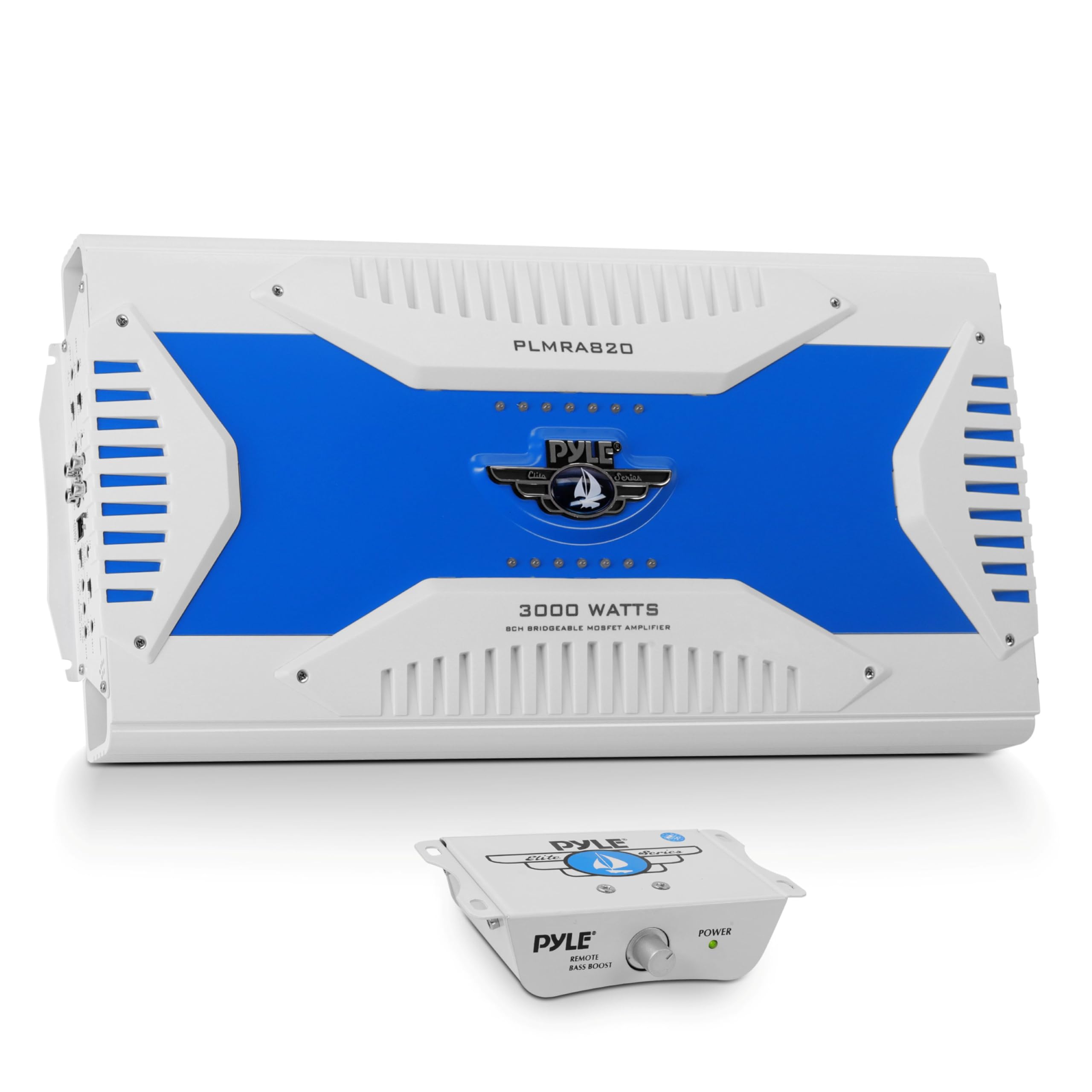
A high-output marine amp with a waterproof rating that brings monster watts to your boat.
The Pyle Hydra PLMRA820 is a bridgeable 8-channel marine amp with 3000W peak and dual 10k Ohm gain controls. It carries a Marine rating of IP-01, meaning it is waterproof ready, and the gold-plated speaker output terminal connectors are built to fight corrosion from long-term salt exposure. The heavy-duty Aluminum Alloy heatsink plus thermal overload and speaker short protection keep the amp and your boat’s electrical system safe.
Owners who need raw power love it here, with one describing it as a “Monster amplifier” powering 6 speakers and a subwoofer “with ease.” Another ran 4 boat speakers, 2 tower speakers, and a sub without breaking a sweat, noting it requires 3-gauge wire to deliver full performance. The high-level inputs are a smart touch—if your marine receiver lacks RCA output jacks, you can connect speaker output leads directly.
The durability record is genuinely mixed here, more so than the top picks. One owner reported the amp failed after minor rain despite dry storage, blowing a 100A fuse, and another noted a specific channel with no output. That said, it remains a powerful pick for the price, and many owners run it hard without issues.
Raw Power Value: This is among the most affordable ways to get 3000W peak output with waterproofing, and it delivers when it works—the power feedback is firmly positive.
The Reliability Bet: With mixed performance and quality marks, treat this as a budget workhorse, not a set-and-forget premium install.
Grab this if: you want maximum watts per dollar and need a waterproof-ready amp with high-level inputs for an older head unit.
pass on it if: your install is hard to access and you cannot tolerate the risk of failure — reliability draws the most mixed owner feedback.
5. Pyle Hydra Marine Amplifier PLMRA830BT
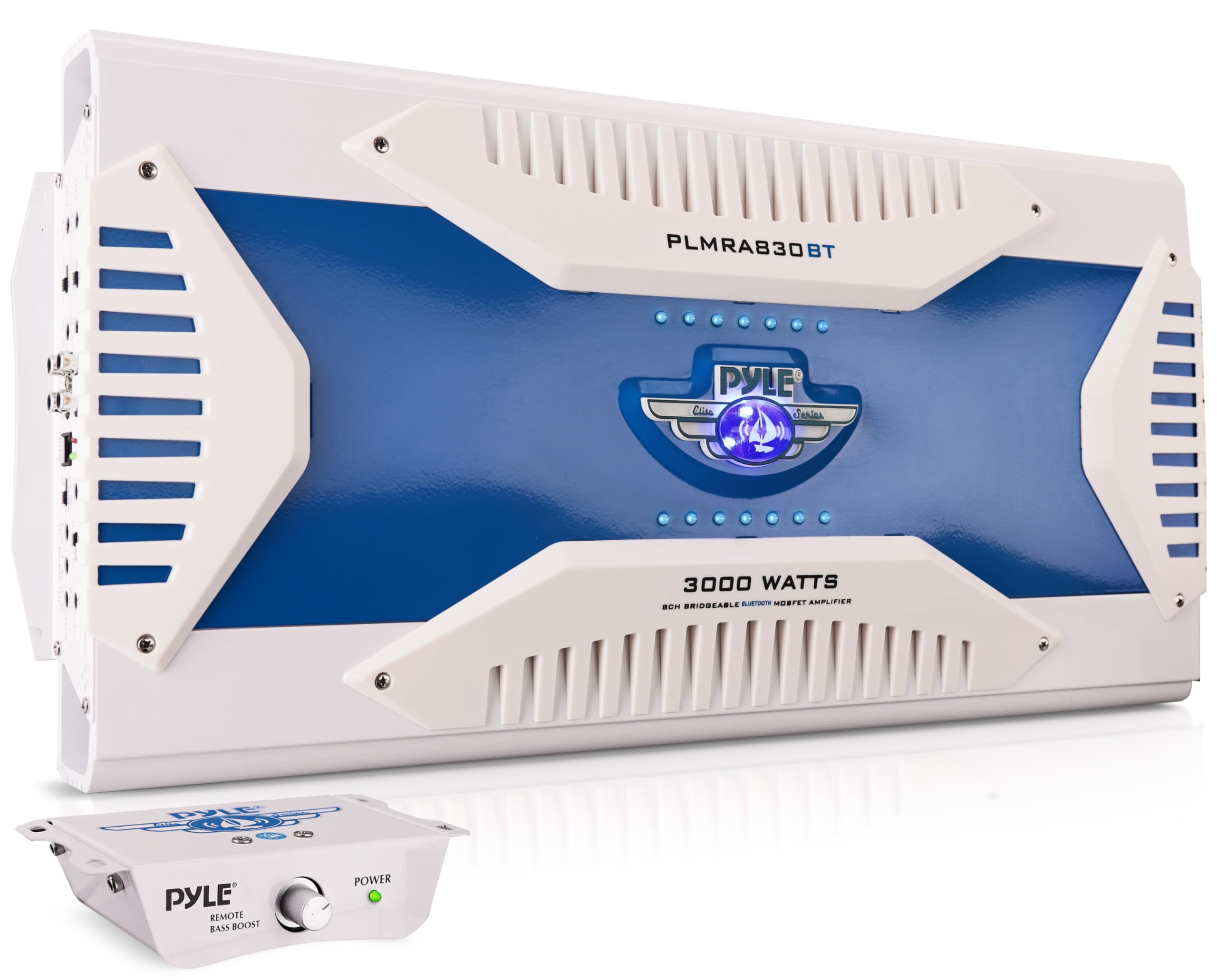
The waterproof Bluetooth marine amp that owners say rocks their pontoon without a head unit.
The Pyle Hydra PLMRA830BT adds Bluetooth to the 3000W peak, letting you stream from your phone without a head unit. It is a bridgeable 8-channel design with high and low electronic crossover filters, and the advanced Class D technology with a MOSFET power supply keeps it efficient. The IP-01 Marine rating means it is waterproof ready, and the gold-plated terminals resist corrosion.
Sound quality is where this unit wins owners over, with clean bass and strong value for money drawing the most praise. One owner reported the Bluetooth range is about 5 feet “through the boat floor,” while another drives 6 speakers and a sub with it and calls the sound “excellent” with no distortion. The unit is large, but it hides well under a console, and the Bluetooth lets you control everything from your phone. A few owners note it “sucks up the power,” so a bigger battery or a second one may be needed for long sessions.
The honest limitations show up in the details. The manual is sparse and covers multiple models, so owners have to do web research to nail the setup, and one installer found the shared RCA inputs confusing when running two amps. The power delivery is also mixed in feedback, with one report of channel 4 not working, though most owners are thrilled with the clean sound and volume this amp produces.
Sound-First Choice: The positive ratings for quality and sound outnumber everything else, and owners repeatedly describe the audio as clean, loud, and distortion-free.
Set-Up Patience Required: The vague manual and the power draw mean first-time installers should be ready to research and possibly upgrade their battery.
Best for: boat owners who want a single-box solution with Bluetooth streaming, clean bass, and enough power for 6 speakers plus a sub.
Consider another if: you are installing two amps in one system — the shared RCA inputs make sub control confusing in that setup.
6. Pyle PT8050CH

A whole-home receiver with nine inputs and all 8 channels independently controlled.
The Pyle PT8050CH is a rack-mount 8-channel receiver for whole-home and PA systems with 4000W peak. It shines on connectivity with 9 total inputs: 3 pairs of RCA for a tuner, CD player, or tape deck, 2 quarter-inch microphone inputs, plus AUX 3.5mm, USB, and SD card slot. The voice priority button automatically lowers the music when a mic signal hits Mic1, making it a natural fit for paging and announcements.
Owners consistently praise the value, calling it “outstanding value for money” and celebrating that you can control all 8 channels individually. One buyer wired up 8 ceiling-mounted speakers in about 15 minutes and called it “the perfect solution.” Another drives both outdoor speakers and Klipsch towers with surprising power, and the Bluetooth connects quickly with an upgraded antenna. For a budget whole-home setup, the flexibility here is tough to top.
The reliability record is the big asterisk on this pick — it draws the most owner comments and runs mixed, with one dramatic report of a unit failing after under a year. Other notes include a single tone knob instead of separate bass and treble, no subwoofer connector, and a slightly-taller-than-2U design that won’t rack mount without a shelf. For the price, most owners still say they’d rebuy it, but it is a value gamble, not a premium build.
The Input Jackpot: With 9 inputs and independent channel control, this is the most flexible budget option for a house with many sources and many rooms.
The Reliability Asterisk: The mixed reliability feedback, including a fire report after a power cycle, means this is best for accessible installs where replacement is not a nightmare.
Reach for this if: you need one box that handles a tuner, CD player, microphone, USB, and Bluetooth for a multi-room home or PA system.
Think twice if: you want separate bass and treble controls or a subwoofer output — this unit has neither, and reliability is the most mixed area.
7. Pyle PT8000CH

A heavy rack-mount amp that sends the same tune to every room, with 8 independent channels.
The Pyle PT8000CH is a 19-inch rack-mount amp for multi-room home audio with 8000W peak. It runs 100W per channel with 5-way speaker binding posts and a pass-through output for daisy-chaining external amps, and the integrated 4-channel bridgeable switches let you combine channels for high-powered zones. Speaker selectors with volume control let you manipulate the sound of multiple speakers at once, while the LED audio level display shows if the output is too loud or too soft.
Quality is the strength here, drawing far more praise than any other aspect, with owners calling it a versatile, powerful workhorse. The ability to connect up to 8 channels with shared or individual inputs earns consistent praise, and one owner powers seven 12-inch speakers without issue. For whole-home background music, “the thing everyone raves about” is the easy power delivery. The unit is heavy — reading 22.94 kg — so rack rails are mandatory.
There are real quirks to know about. The 8000W peak figure is widely acknowledged as exaggerated, so it is not for high-end home theater, and the gain knobs sit on the back which forces some owners to rack it backward. The 12V trigger does not function despite manual claims, and one owner described bright LEDs and a loud ground noise without a source. As a value play for reliable fill music across a home, most owners still call it unbeatable against pricier rivals.
Why Owners Love It
- Per-channel gain and shared or individual inputs for full flexibility
- 100W per channel with 5-way binding posts
- Bridgeable switches for high-power zones
- Low impedance protection shuts down only the faulty channel
Known Quirks
- Peak wattage is exaggerated — not for high-end theater
- Rear-mounted gain knobs are inconvenient mid-rack
- Heavy at 22.94 kg; rack rails are required
Pick this for: a whole-home system where you want one heavy-duty amp to drive 8 independent zones of background music.
Look past it if: you need a functional 12V trigger for automation — that feature is missing despite the manual’s claims.
8. Dayton Audio DAX88

The app-controlled matrix that routes 8 separate sources to 8 zones with 75W per channel.
The Dayton Audio DAX88 is the premium choice for anyone building a serious multi-room audio system, and it operates on a completely different level than the marine amps. It is an 8-source, 8-zone distributed audio matrix amplifier, delivering 75 watts per channel at 8 ohms with the ability to bridge channels up to 260 watts for bigger zones. The Wi-Fi and Matrio app route different sources to different rooms from your phone.
Functionality and performance are the most-praised aspects, and owners describe it as a versatile hub that replaced clunkier systems with dramatically better sound. You can adjust volume, balance, bass, and treble per zone, and multiple phones can control it simultaneously. AirPlay works well, and the setup is straightforward with clear documentation. One owner replaced a frustrating Juke system and called the DAX88 “exponentially better sound” at a lower cost, noting the responsive tech support that answers with a human.
The trade-off is that it is a premium investment, and it comes with a few app-world limitations. There is only one Wi-Fi input channel, which limits streaming to one phone at a time, and there is no up-to-date Android app — owners find the iPad experience excellent but dock a star for the Android side. There is no Bluetooth, and no physical remote, so the app is your primary control surface. The 5-year warranty covers the amp longer than most competitors.
The Whole-Home Standard: With 8 sources, 8 zones, per-zone tone controls, and Wi-Fi that reaches every room, this is the amp that scales with a serious audio setup.
The App Caveat: Android users should verify app support before buying — the single Wi-Fi input also means only one phone streams at a time.
Invest here if: you want a rack-mountable matrix amp with app control, independent per-zone tuning, and a full 5-year warranty.
Skip if: you rely on Bluetooth streaming or need multiple simultaneous Wi-Fi sources — this premium unit lacks both.
Understanding the Specs
RMS vs Peak Power
RMS (Root Mean Square) is the continuous power the amp can deliver, and it determines how loud and clean your music plays. Peak power is the maximum burst for a split second, which is why marketing numbers look so huge. Always compare RMS per channel when matching an amp to your speakers — that is the number that actually drives the sound.
Bridging Channels
Bridging combines two channels into one powerful output, giving you more watts to drive a subwoofer or a larger speaker. An 8-channel amp can become a 4-channel amp with roughly double the power per channel. Check the amp’s bridged rating, like 190W x 4, to see if it has the headroom for a subwoofer.
FAQ
What is the difference between RMS and peak wattage on an 8 channel amplifier?
How do I know if an 8 channel amplifier is truly marine grade?
Can I use a marine 8 channel amplifier in my house?
What does bridging channels on an 8 channel amplifier do?
Why does my 8 channel amplifier keep going into protection mode?
Do I need a separate subwoofer amplifier if I have an 8 channel amp?
What is a distribution amplifier and when do I need one?
How many speakers can an 8 channel amplifier power?
Final Thoughts: The Verdict
For most boat owners, the 8 channel amplifier winner is the Rockville Atom 8B because it delivers 110W per channel, Bluetooth pairing, and marine-grade corrosion resistance in a slim package that fits tight consoles. If you want the most raw power on the water, grab the Rockville RXM8BTB with 1500W RMS and over 90% Class D efficiency. And for a whole-home or commercial system, the Dayton Audio DAX88 is the one to reach for, with 8-source 8-zone routing and a 5-year warranty.
How We Picked
We do not accept paid placement. Every pick is matched to a real buyer and a real use-case; we do not hands-on test units.
Sources & Methodology
Specifications: manufacturer listings and product documentation. Review insights: verified customer reviews, as of August 2026. Pricing: not shown on this page (it changes often); check the current price via the retailer link.
As an Amazon Associate, Gadgets Feed earns from qualifying purchases. This does not affect which products we feature.