
Our readers keep the lights on and my morning glass full of iced black tea. As an Amazon Associate, I earn from qualifying purchases.
Specs are compiled from manufacturer listings and verified buyer reviews and can change over time — please confirm the key details on the product page before buying.
An 8-channel mixer is the nerve center for small bands, podcast studios, and mobile DJs who need more inputs than a compact 4-channel board but don’t want to haul a huge console. The core question isn’t really how many knobs you get — it’s whether the preamps stay quiet when you turn them up, and whether the routing actually fits how you work. This guide breaks down the real differences between digital app-controlled boards and classic analog mixers, so you can pick the one that sounds clean in your exact setup.
I’m Min — the founder and writer behind Gadgets Feed. This guide is built by comparing the manufacturers’ published specifications and the patterns across verified customer reviews, so you get each pick’s real strengths and trade-offs instead of marketing spin.
You want an 8 channel mixer that makes your voice or band sound clean without a hiss, connects to your gear easily, and gives you just the right amount of control. The best pick for most people is the Behringer FLOW 8, thanks to its near-silent 3 dB noise floor and Bluetooth app control, but the Mackie 802VLZ4 and Zoom LiveTrak L-8 each shine for specific needs.
Our Picks at a Glance


How To Choose The Best 8 Channel Mixer
Before you compare brands, you need to decide between a digital mixer you control from your phone and a traditional analog board with physical knobs for everything. Digital boards like the Behringer FLOW 8 give you wireless control and preset recall, while analog consoles like the Mackie 802VLZ4 offer immediate hands-on tweaking without any menus. Your choice depends on whether you prioritize portability and modern features or the tactile, plug-and-play reliability of an analog signal path.
Preamps and Noise Floor
Your microphone signal hits the preamp first, and that stage decides how clean your sound is. A good preamp adds gain without hiss or hum, so you can boost quiet sources like a soft-spoken guest. The Zoom LiveTrak L-8 has a -121dBu noise floor (a measure of background hiss), meaning you can push gain for quiet sources without hearing static.
Connectivity and Recording
Think about how you’ll actually use the mixer. If you’re recording to a computer or streaming, you need a built-in USB audio interface that sends your mix to your laptop. If you play live gigs, you might prioritize Bluetooth for wireless music breaks between sets, or XLR outputs to connect to powered speakers directly. Some mixers even record to SD cards on their own, like the Zoom L-8, which is perfect for podcasters who don’t want to bring a laptop on stage.
Quick Comparison
| Model | Best For | Noise Level | Weight | Key Inputs | Amazon |
|---|---|---|---|---|---|
| Behringer FLOW 8★ Best Overall | Digital control & portability | 3 db | 1400 g | 8 channels, Bluetooth | Amazon |
| Depusheng DT8Best Value | Budget multi-device mixing | 80 db | 3.4 kg | XLR, USB, Bluetooth | Amazon |
| NEW BAXS CT80SFX Powerhouse | Effects-heavy DJ setups | 22 db | 3.81 kg | 8 XLR, Bluetooth, USB | Amazon |
| Behringer XENYX 802S | Streaming & podcasting | — | 1610 g | USB, XLR, RCA | Amazon |
| Pyle PMX408ST | Compact studio & karaoke | — | — | XLR combo, Bluetooth | Amazon |
| Mackie Mix8 | Reliable analog simplicity | — | 1.34 kg | XLR, RCA | Amazon |
| Pyle PMXU88BT | Beginner DJ control | — | 8.4 lbs | XLR, USB, Bluetooth | Amazon |
| Mackie 802VLZ4 | Broadcast & premium analog | 60 db | 4.5 lbs | Onyx preamps, XLR/TRS | Amazon |
| Allen & Heath ZEDi-8 | Studio-grade USB interface | — | 2.8 lbs | GS-Pre XLR, HiZ | Amazon |
| Soundcraft EPM8 | Live band & drum pre-mix | 55 db | 12.3 lbs | XLR, TRS inserts | Amazon |
| Zoom LiveTrak L-8 | Portable recording & podcasting | 54 db | 1500 g | XLR, USB, SD card | Amazon |
In‑Depth Reviews
1. Behringer FLOW 8
Our pick — over 4.5★ from 800+ verified ratings; the strongest balance of quality and price.
The digital board that puts wireless control and studio-grade quiet in your pocket.
This is the mixer that wins people over with its dead-silent operation — the noise level sits at 3 db, which is dramatically quieter than even premium analog competitors like the Soundcraft EPM8 at 55 db. That means you can crank the gain on your microphones without hearing a hiss in the background, making it a genuine upgrade for mobile DJs and home studio owners who demand clean recordings.
You control this mixer wirelessly from your phone or tablet using the FLOW App over Bluetooth, so you can adjust levels from across the room. The 60 mm channel faders (sliders) and master rotary control with an LED collar give you tactile control, while the EZ-Gain function automatically sets the gain for you. Two Midas preamps with 48 V phantom power (for condenser mics) handle professional microphones, and it doubles as a USB audio interface for your computer.
The single recurring complaint is the app reliability: buyers report that the Flow mix app disconnects every ~15 min and needs the pair button pressed to reconnect. It’s a minor workflow hiccup rather than a dealbreaker, and the hardware itself is praised for its clean mic preamps, great effects, and excellent iPad connection. One owner even runs two stereo guitar multi-FX pedals and a stereo drum machine with two spare inputs left over — that’s the kind of flexibility that makes this the crowd favorite.
What Wins People Over
- Ultra-low 3 db noise floor keeps recordings hiss-free
- Bluetooth app control with automatic EZ-Gain setup
- Compact 6.5″D x 9.7″W footprint fits a 2U rack drawer
- Works with iPhone, iPad, Windows, and Mac
The Honest Trade-offs
- Flow app requires re-pairing roughly every 15 minutes
- Micro USB power connector is less sturdy than desired
- Weak headphone amp for critical listening
Reach for this if: you want a digital mixer with wireless phone control, ultra-quiet preamps, and a form factor that disappears into a rack drawer.
Look elsewhere if: you need a lunchbox-style console where every channel has its own physical fader and you never want to touch an app.
2. Depusheng DT8
A budget workhorse that expands a 4-input interface to a full 8 channels for drum recording.
This is the mixer beginners and gigging musicians rave about for its simple, clean, and quiet performance at a price that undercuts almost everything else. Owners mention it’s a “solid, quiet mixer for open mic/gigs” that has “held up over a year” of regular use — a durability note that outperforms pricier rivals. The analog console gives you XLR and 1/4″ inputs with +48V phantom power buttons, Bluetooth wireless streaming, and a USB port for MP3 playback and recording.
At 17.32″D x 16.14″W x 1.89″H, it’s a full-width desk console, but the 1.4-inch thin design and sealed rotary controls keep dust out of the faders. The onboard 3-band EQ on every channel plus a 10-segment stereo output level meter gives you real control without menus. One owner expanded their 4-input recording interface to 8 channels for drum recording and found the sound “perfect” — it’s that kind of practical, no-nonsense utility that makes it a top budget pick.
The main caveat is that sound quality gets mixed feedback: while many praise the preamps as noise-free, others report it “sounds terrible” for critical studio work. The EQ only works at preset frequencies and the built-in effects are considered weak, so this is best treated as a live mixing tool rather than a studio processor.
Why Buyers Love It
- Connects to USB, MP3, and Bluetooth devices for flexible input
- Thin 1.4-inch rugged chassis with dust-resistant controls
- crisp sound that rivals Tascam, Yamaha, and Alesis
Who Should Skip It
- Effects quality is weak — buy for basic mixing only
- EQ limited to preset frequencies, not studio-grade
- USB output is more of a novelty than a primary recording path
Best for: live drum pre-mixing, open mics, and gigging musicians who need 8 quiet channels without spending studio money.
Think twice if: you plan to rely on the onboard effects for polished studio recordings — you’ll want a mixer with stronger DSP.
3. NEW BAXS CT80S
A DJ-focused console with 16 DSP effects and an LED display for real-time performance tweaking.
This board is built for performers who want creative control without paying premium prices. The headline feature is the DSP (digital signal processor) with 16 preset effects — covering reverb, delay, and echo — plus DLY and REF controls that let you manipulate echoic attributes and spatial nuances in real time. At 3.81 kg, it’s noticeably heavier than the Depusheng DT8’s 3.4 kg, a sign of the beefier chassis that houses all eight XLR mic/line inputs.
The 7-bit LED display and high-accuracy LED indicator lights make it easy to monitor your signal levels during a live set. Bluetooth 5.0 lets you stream music from your phone or tablet directly into the mix, and the USB interface supports flash drive playback of MP3, WAV, and WMA files. The PFL/AFL independent channel monitoring lets you check each channel’s signal levels in real time from your mobile device — a genuinely handy tool for sound checks.
The thing everyone appreciates is the value: “the sound quality is great with no noise” and “all the channels operate” — you’re getting a full 8-channel DJ board with effects at an entry-level price. The catch is that the effects are basic but functional, and setup requires a bit of intuition since the manual is sparse. One owner noted the TAPE IN and TAPE OUT RCA connector colors are reversed, but as they put it, “the audio signal is colorblind” — it doesn’t affect the sound.
DJ’s toolkit: With 16 effects, Bluetooth 5.0, and an SD card player, this is the most effects-heavy board in the budget tier.
The trade-off: Basic instructions mean you’ll learn by experimenting, and the 220V power requirement needs an appropriate supply.
Grab it for: DJ sets, karaoke nights, and small PA systems where you want effects, Bluetooth, and 8 full XLR channels on a budget.
Pass if: you need a rack-mountable studio mixer with pristine effects — this is a live performance board first.
4. Behringer XENYX 802S

An analog mixing board built specifically to route clean PC and gaming audio into your stream.
If your entire mixing life happens in OBS Studio or a podcast recording app, this Behringer is engineered for exactly that workflow. The headline feature is direct mixing of PC or gaming sounds into the streaming output — you connect via the stereo USB audio interface, and your computer becomes just another input channel. Streamers and podcasters praise it as a reliable tool, with one reporting the USB output into OBS Studio “works flawlessly” through hours of live sports streaming.
The appeal is in its simplicity: analog mixing and equalization for pure sound, no menus, no apps. It’s quiet — owners describe it as having “no hum or white noise” and needing only half gain for a clean signal. The compact 19.69″D x 19.69″W chassis houses 8 channels with XLR, TRS, and RCA outputs, making it easy to drop into an existing setup or use as a video editor’s multi-source monitor.
The biggest recurring complaint is connectivity: several buyers mention missing USB cables in the box. The integrated USB DAC is adequate but noticeably lower quality than a dedicated sound card like the Sound Blaster Omni, and there’s no EQ on the USB output path. If you need deep USB-out tone shaping, this isn’t it — but for clean, dependable analog mixing with a simple USB tap, it’s a top-tier value.
Clean signal path: The quiet preamps and half-gain operation make it perfect for capturing vocals and instruments without hiss.
Setup note: The USB cable may not ship in the box — check before you start your first stream.
Suits: streamers, podcasters, and video editors who need a dependable analog mixer that talks to a computer over USB.
Not for: anyone needing EQ control on the USB output or who prefers a digital app-based workflow.
5. Pyle PMX408ST
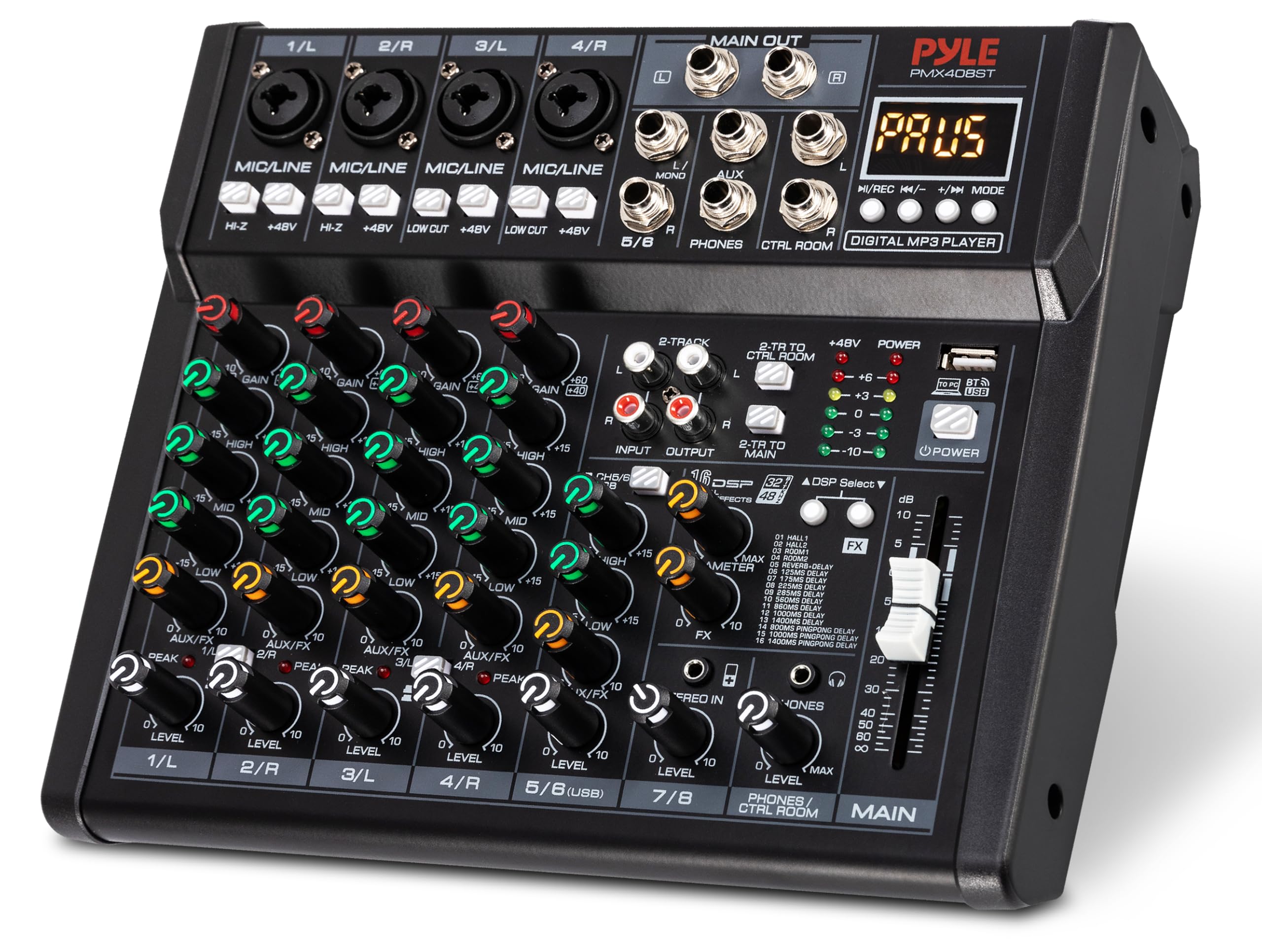
A desktop mixer that packs pro features into a 9-inch footprint for portable podcast studios.
This Pyle is a one-stop shop for mobile podcasters and home studio users who want a lot of control in a small space. The standout feature is the per-channel faders — a rarity at this price, where most budget mixers use simple knobs. Each of the four XLR/mic/line combo inputs gets individual +48V phantom power for condenser mics, plus Hi-Z switching to accept guitars directly without a DI box, and low-cut filters to eliminate rumble.
You get built-in DSP effects (digital sound processing) with presets like reverb and delay, plus a 3-band EQ (high, mid, low) on every channel — more tonal control than the 2-band EQ on budget boards. The dedicated Control Room output lets you create a separate monitor mix for your headphones, while the 2-track input/output handles recording. Bluetooth streaming and a built-in MP3 player complete the setup.
What owners can’t stop praising is the versatility — “a one stop shop for all of your audio needs,” as one DJ put it. The most-discussed trade-off is compatibility: some report static crackle in the voice memo app on iPhone during the first few minutes of recording, requiring a workaround to bypass the USB-to-iPhone connection. Sound quality and Bluetooth connectivity get mixed reviews, so it’s worth managing expectations on wireless reliability, but the core analog functionality earns strong build quality praise from over a hundred owners.
Packed With Features
- Individual channel faders instead of basic knobs
- 3-band EQ with low-cut filters on every channel
- Bluetooth, USB, and MP3 player in one compact unit
- Ships with power adapter and USB cable
Compatibility Caveats
- iOS recording may produce static without a USB workaround
- Bluetooth and sound quality receive mixed owner feedback
Pick this if: you want a portable podcast or karaoke mixer with faders, phantom power, and effects without a big desk footprint.
skip it if: you rely primarily on iPhone direct recording — the USB-to-iOS path needs a workaround.
6. Mackie Mix8 Bundle

The no-frills Mackie that delivers surprising quality for private events up to 300 people.
Sometimes you just want a mixer that works every time without any learning curve, and that’s exactly what the Mackie Mix8 delivers. At just 1.34 kg, it’s incredibly portable, and the bundle includes two EMB XLR cables plus a Gravity magnet phone holder — so you’re ready to plug in a couple of microphones the moment it arrives. The 2 mic/line input channels include switchable phantom power for condenser mics, and all channels get 3-band equalizers and an aux send.
The 2 stereo channels accept both balanced and unbalanced line inputs, and the Tape RCA I/O (input/output) gives you extra routing options. Owners call it “versatile” and say it “exceeds price expectations,” with a layout that’s “easy to navigate in dark settings” — a real plus for live gigs where you adjust knobs by feel mid-song.
A recurring theme in the reviews is that this Mackie is worth the extra cost over the ultra-cheap mixers on the market, with one owner calling it “a great value” and saying they’d happily take two. The only honest caveat is that it’s a small-format board — you’re getting 2 real mic preamps, not 8, so if you need phantom power on every channel, look at the larger units on this list. For private events, family gatherings, and small gigs, it’s a dependable performer.
Plug and play: Bundled XLR cables and phone holder mean zero extra purchases to start mixing.
Size note: This is a compact board for 2 mics plus stereo sources, not a full 8-mic console.
Choose it for: small private gigs, family events, and anyone who wants a trusted analog mixer that’s packable and immediate.
Pass it up if: you need phantom power for four or more condenser microphones at once.
7. Pyle PMXU88BT

A feature-packed DJ console that delivers pro-grade tools without overwhelming beginners.
This Pyle is the beginner DJ’s upgrade — owners call it “the DJ upgrade I didn’t know I needed.” It has 8 channels with 4 XLR mic inputs, 2 pairs of RCA inputs, 2 pairs of 1/4″ mono and stereo inputs, plus a 1/4″ Send and Return and headphone jack. The Bluetooth range stretches 15 ft, so you can cue music from across the room. The 7-band EQ and 16 DSP effects give you serious tonal control.
The +48V phantom power supply covers all XLRs for condenser microphones, and the 12-segment stereo output level meter (-30 to CLIP) makes it easy to keep your mix out of the red. Owners praise the sound quality for its low noise level and note the Bluetooth works “flawlessly” with a 16-inch MacBook Pro. The Pro-grade features — AUX Mix-Minus, PFL monitoring, FX/MP3/Sub Out sliders, and dual Main Outputs — come at a budget price, making it a genuine stepping stone for new DJs.
The most-discussed limitation is USB recording: the mixer reads USB drives but doesn’t write mixed audio to them, which caught a few owners off guard. The +48V phantom power also applies to all XLRs at once, and there’s no line input pad, so hot signals need careful gain staging. These are minor quirks for a board that otherwise delivers “pro features without overwhelm” for its intended beginner and karaoke audience.
DJ-friendly layout: Sliders for FX, MP3, and Sub Out alongside dual main outputs make live mixing intuitive.
Real limitation: USB is read-only for playback — you can’t save a mixed recording to a thumb drive.
Ideal for: beginner DJs, karaoke hosts, and event organizers who want an 8-channel board with effects and Bluetooth at a friendly price.
Not for: producers who need to record their mix directly to a USB stick.
8. Mackie 802VLZ4
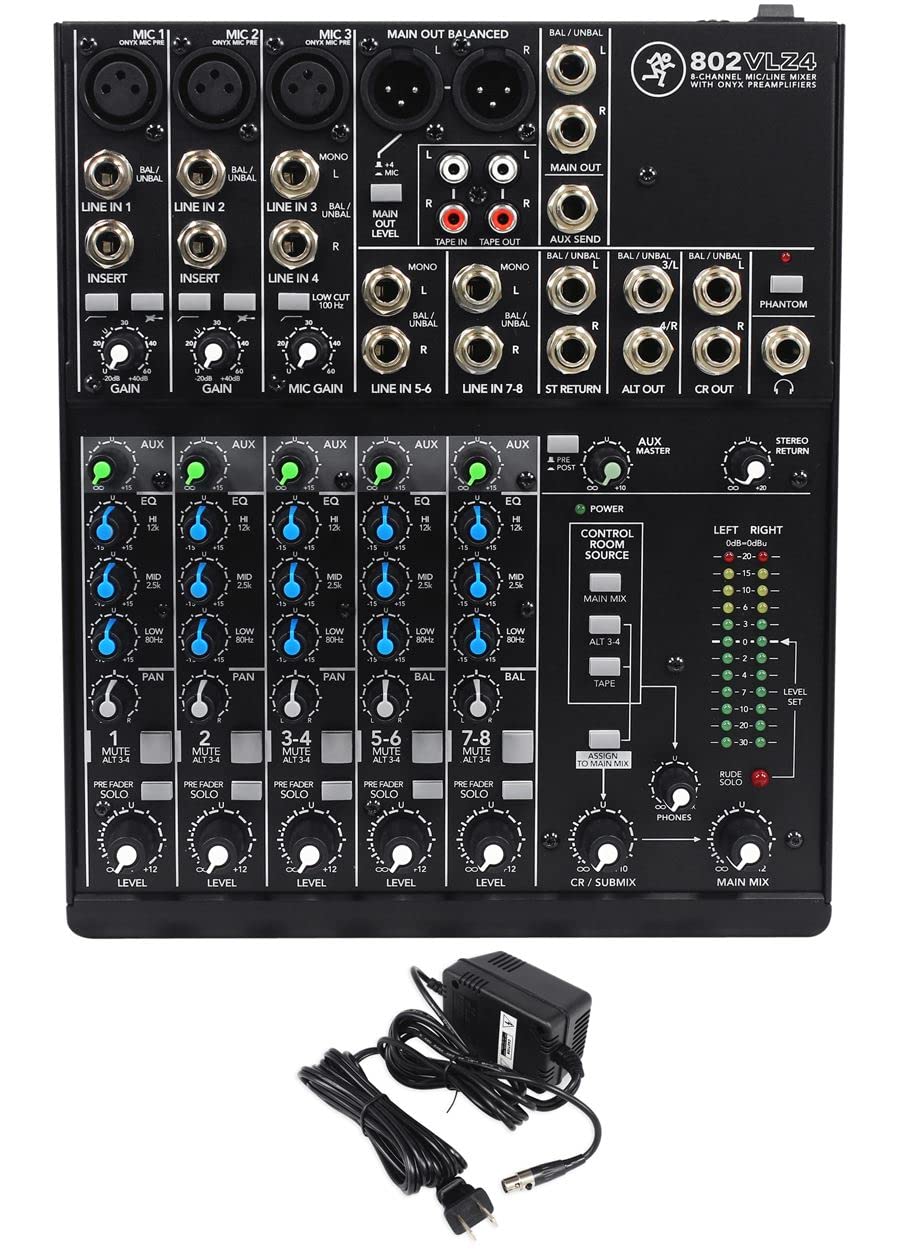
The tank-like analog board with boutique Onyx preamps and broadcast-grade RF rejection.
This is the mixer that studio owners and broadcasters trust for its signature high-headroom, low-noise design. The heart of the 802VLZ4 is its 3 boutique-quality Onyx mic preamps — the same preamp technology Mackie is known for — paired with 8 high-headroom line inputs. Its 60 dB noise floor and improved RF rejection eliminate the monitor interference owners reported with their PreSonus Eris E5 speakers.
What wins people over is the reliability and build: the metal chassis feels “tank-like,” the knobs are smooth, and there’s no signal coloration or added noise. The compact 15.8″D x 12.1″W x 4.3″H footprint packs a surprising number of features, including instrument switches on channels 1-2 that eliminate the need for DI boxes when plugging in guitars. The 3-band EQ has a surprising range, and the aux send with pre/post switching handles headset mics to PC setups cleanly.
The recurring gripe among owners is the small details: the knobs lack grip and center detents, and the headphone volume isn’t independent of the main mix. Some found the EQ easy to overboost and the board potentially complex for complete newbies. But the overwhelming consensus is that it’s clear, distortion-free, and dependable — one owner called it “a lifesaver” for keeping a podcast going, and the customer service reputation is excellent. If you want premium analog sound quality in a compact, battle-ready box, this is it.
Professional Grade
- Boutique Onyx preamps deliver clean, distortion-free gain
- RF rejection eliminates monitor interference
- Metal chassis built for frequent setup and teardown
- Instrument inputs remove the need for DI boxes
Minor Annoyances
- Knobs lack grip and center detents
- Headphone volume tied to the main mix
- EQ can be overboosted if you’re not careful
Invest here if: you need a reliable, broadcast-quality analog mixer for home studios, gigs, or podcasts and value clean preamps above digital bells and whistles.
Step back if: you want app control or USB recording built in — this is a pure analog board.
9. Allen & Heath ZEDi-8

A studio-grade hybrid with GS-Pre preamps and a 96kHz USB interface for serious recordings.
This is the mixer that brings big-console audio quality to a desktop form factor. The ZEDi-8 features GS-Pre XLR microphone preamps, developed from the acclaimed GS-R24 studio console, providing exceptionally low noise, massive headroom, and plenty of clean gain. Two HiZ connections let you plug electric, electro-acoustic, or bass guitars directly in without a separate DI box. At just 9.8″D x 9.3″W x 3.5″H and 2.8 lbs, it’s remarkably compact for the audio quality inside.
The standout recording feature is the built-in 96kHz stereo USB interface — class compliant, meaning it connects not just to Mac and Windows computers but also to tablets and smartphones. Customers note an “amazing signal to noise ratio” with a very low noise floor that yields roughly 58dB of dynamic range for speech recording, substantially better than budget competitors’ 48-50dB. The 100Hz high-pass filter on every mono input removes unwanted low frequencies, and the 3-band MusiQ EQ is tuned to keep your sound sculpting musical.
The most-discussed quirks are specific to certain setups: Mac users may need to toggle the unit off and on to establish connection, and the headphone mix runs in mono when headphones are selected without monitors. One owner had to download a driver manually because the URL in the manual was outdated, and another received a UK 220V power cord instead of a US 120V one. But the long-term reliability is proven — one owner has used it for 7 years without issues, and it works “really well as a sound card” for a laptop.
Recording pedigree: The 96kHz USB interface and low-noise GS-Pre preamps make this a genuine mini studio interface.
Setup reality: Mac users may need to power-cycle to connect, and the driver URL in the manual is occasionally outdated.
Best for: home studio owners and podcasters who want premium preamps and high-resolution USB recording in a compact hybrid.
Look elsewhere if: you need Bluetooth streaming or a large number of simultaneous mic preamps.
10. Soundcraft EPM8

A high-performance live board with swept mid EQ (adjustable mid-frequency) and a sturdy build for bands and venues.
This Soundcraft is the professional’s analog choice for live sound, built with the kind of component quality that touring consoles are known for. The headline feature is the 3-band EQ with a swept mid on mono inputs — meaning you can dial in the exact mid frequency you need to cut rather than being stuck with preset points. This is a massive advantage for taming problem frequencies on stage, whether it’s a ringing snare or a muddy vocal. The XLR-type and 1/4″ metal jack sockets are built to survive years of plugging and unplugging.
Owners call it “the nicest small format mixer” they’ve owned, praising its robustness and clean EQ. The 2 configurable auxiliary buses (for monitors or effects) give you flexible sends, and the TRS insert sockets on all mono inputs let you patch in external processors. One church band uses it to preamp both drums and the drummer’s headset mic — a combo other preamps couldn’t handle. It’s a versatile live tool that stays in constant rotation.
The quirks are honest: there’s no power button, so you’ll unplug it or use a power strip, and there are no onboard FX — a plus if you prefer external effects. The RCA phono stereo playback inputs and record outputs handle background music between sets. At 12.3 lbs, it’s the heaviest board here, built for permanent installation or serious gigging, not backpack portability.
Live sound sculpting: The swept mid EQ is the differentiator — you can target exact frequencies instead of fixed bands.
Installation note: No onboard FX and no power button mean you’ll bring your own effects and manage power externally.
Deploy this for: live bands, church sound, drum pre-mixing, and venues where a rugged, high-performance analog board will live for years.
pass on it if: you need a lightweight portable mixer or want built-in effects and Bluetooth.
11. Zoom LiveTrak L-8

The battery-powered mixer and recorder that captures 12 tracks to an SD card anywhere.
This is the ultimate grab-and-go solution for musicians and podcasters who want to record without dragging a laptop to every session. The LiveTrak L-8 captures 12 tracks simultaneously at 24-bit/96kHz directly to an SD card — professional-quality audio for podcasts, live performances, and studio sessions. It’s battery powered, so you can run a full rehearsal or podcast episode out in the field, and it doubles as a USB audio interface when you want to record to a computer at the same time.
The six preamps boast a -121dBu noise floor with up to +54dB of gain, meaning you get clean, quiet signal handling across your mix. Four headphone outputs with three independent monitor mixes let every performer craft their own personalized mix during rehearsals — a killer feature for bands. The 6 assignable Sound Pads with 13 sounds and menu-driven presets give podcasters fun production tools without extra gear.
What owners genuinely appreciate is the versatility and solid build: it works standalone without a computer, runs on a USB power bank, and outperforms typical USB interfaces for mobile recording. The honest trade-off is that reliability and ease of use get mixed feedback — some find the learning curve steep for beginners, saved settings can be frustrating, and channels 7-8 are considered less useful. But for podcasters and bands who need a self-contained recording studio in a 1500 g package, it’s a category-defining tool.
Portable Powerhouse
- Records 12 tracks at 24-bit/96kHz to SD card
- Battery powered with USB power bank compatibility
- Four headphone outputs with three independent mixes
- Ultra-quiet -121dBu noise floor preamps
Learning Curve
- Menu-driven presets require reading the user guide
- Reliability and ease of use receive mixed owner feedback
- Channels 7-8 are less flexible than 1-6
Take it if: you’re a podcaster or musician who needs a battery-powered mixer that records to SD card without a computer and offers per-performer headphone mixes.
Leave it if: you want a simple analog board with no menus and don’t need built-in multi-track recording.
Understanding the Specs
Preamps and Noise Floor
The preamp is the circuitry that boosts your microphone’s weak signal to a usable level. A lower noise floor — measured in dB — means less background hiss when you turn up the gain. The Behringer FLOW 8’s 3 dB noise floor is nearly silent, while the Depusheng DT8’s 80 dB spec adds noticeable hiss. If you record quiet sources like vocals or acoustic instruments, prioritize a mixer with a low noise spec.
Phantom Power and Hi-Z Inputs
Phantom power (+48V) sends voltage through the XLR cable to power condenser microphones that have no built-in battery. Hi-Z (high impedance) inputs let you connect electric guitars directly to the mixer without a separate DI box, since they match the instrument’s signal strength. If you use condenser mics or play guitar live, look for these features as non-negotiable basics.
FAQ
What does a 3 db vs 80 db noise level actually mean for my mix?
Can I record my mix directly to my computer with these mixers?
What is phantom power and why do I need it?
Will an 8-channel mixer work with my electric guitar?
What is the difference between a digital mixer and an analog mixer?
How many microphones can I plug into these mixers at once?
Can I stream music from my phone to these mixers?
What does DSP effects mean on a mixer?
Final Thoughts: The Verdict
For most people, the clear winner in the 8 channel mixer space is the Behringer FLOW 8 because its near-silent 3 dB noise floor and Bluetooth app control give you professional results without the learning curve of a full digital console. If you want premium analog sound and broadcast-grade reliability, grab the Mackie 802VLZ4 — its Onyx preamps and RF rejection (interference blocking) make it a studio staple. And for podcasters and bands recording on the go, the Zoom LiveTrak L-8 is the one to reach for, since it records 12 tracks to an SD card on battery power alone.
How We Picked
We do not accept paid placement. Every pick is matched to a real buyer and a real use-case; we do not hands-on test units.
Sources & Methodology
Specifications: manufacturer listings and product documentation. Review insights: verified customer reviews, as of August 2026. Pricing: not shown on this page (it changes often); check the current price via the retailer link.
As an Amazon Associate, Gadgets Feed earns from qualifying purchases. This does not affect which products we feature.