
Our readers keep the lights on and my morning glass full of iced black tea. As an Amazon Associate, I earn from qualifying purchases.
Specs are compiled from manufacturer listings and verified buyer reviews and can change over time — please confirm the key details on the product page before buying.
Ceiling speakers disappear into your room and leave the sound hanging in the air. An 8-inch in-ceiling speaker delivers full-range, room-filling audio while staying flush with the ceiling, eliminating the need for floor-standing or shelf-mounted boxes. This guide compares nine top 8-inch ceiling speakers, from five-speaker surround packs to single premium units, to help you match the right model to your receiver, room size, and installation constraints.
I’m Min — the founder and writer behind Gadgets Feed. This guide is built by comparing the manufacturers’ published specifications and the patterns across verified customer reviews, so you get each pick’s real strengths and trade-offs instead of marketing spin.
You want 8 inch ceiling speakers that match your amplifier’s power and fit your room—whether that means a weatherproof build for a patio or a tweeter you can aim at your listening spot.
Our Picks at a Glance


How To Choose The Best 8 Inch Ceiling Speakers
Start with your receiver. Ceiling speakers are passive, which simply means they have no amplifier built in, so your home theater receiver or amp must supply the power. Check how many watts per channel your receiver pushes, then look for speakers whose recommended power range sits inside that number. You also want to measure your ceiling cavity before you buy anything.
Know your ceiling space first
Every in-ceiling speaker needs a hole cut to a specific size and a depth behind the drywall to fit. Most 8-inch models need a cutout around 9.4 to 9.5 inches across, and mounting depths run from roughly 3.7 to 4.75 inches. Measure the space between your drywall and whatever is above it, because a shallow cavity will reject a deep speaker no matter how good it sounds.
Match the sound design to the job
A 2-way speaker splits the audio between one woofer and one tweeter, which is plenty for background music and most home theater. A 3-way design adds a separate midrange driver for clearer voices in the critical middle range. If a speaker will handle movie dialogue or directional Atmos height effects, look for a tweeter you can pivot or swivel to aim the sound at your listening spot.
Check sensitivity and frequency response
Sensitivity tells you how loud a speaker plays from a set amount of power, measured in decibels (dB). A speaker rated at 95dB is more efficient than one at 89dB, so it reaches the same volume with less amplifier effort. Frequency response describes the range of tones it can produce, from deep bass around 40Hz or 50Hz up to crisp highs at 20kHz or beyond; deeper bass in this range usually means you will still want a subwoofer for serious movie impact.
Quick Comparison
| Model | Best For | Power Handling | Sensitivity | Design | Amazon |
|---|---|---|---|---|---|
| Acoustic Audio CS-IC83 (5-Pack)★ Best Overall | Whole-home surround systems | 10-350W per channel | 95dB | 3-Way | Amazon |
| Acoustic Audio CSic83 (Pair)Best Value Pair | Budget surround pairs | 20-350W per speaker | 95dB | 3-Way | Amazon |
| Herdio Bluetooth (Pair)Wireless Pick | Wire-free rooms | RMS 50W (MAX 200W) | 89dB | 2-Way + Bluetooth 5.1 | Amazon |
| Pyle 8″ (Pair) | Flexible placement | 150W RMS (300W peak) | — | 2-Way, pivoting tweeter | Amazon |
| Micca R-8C (Each) | Critical listening | 120W each | 90dB | 2-Way, swivel tweeter | Amazon |
| OSD Audio ICE800WRS (Pair) | Damp patios and baths | 120W | — | Weatherproof | Amazon |
| Klipsch CDT-5800-C II (Each) | Atmos height channels | — | — | Horn-loaded, pivoting | Amazon |
| Yamaha NS-IC800 (Pair) | Reliable all-around sound | 140W max / 50W nominal | — | 2-Way, swivel tweeter | Amazon |
| Polk Audio MC80 (Each) | Music-first rooms | — | — | 2-Way, aim-ready tweeter | Amazon |
In‑Depth Reviews
1. Acoustic Audio by Goldwood CS-IC83 8” 3-Way (5 Speakers)
Our pick — over 4.5★ from 950+ verified ratings; the strongest balance of quality and price.
A five-speaker home theater kit that hides a full surround system in your ceiling.
The headline here is the count. This is one box with five CS-IC83 speakers, so you can wire a complete 5.0 or 5.1 surround setup across a room without buying pairs separately. Each unit is a full 3-way design with an 8″ poly cone woofer, a poly mica midrange, and a 13mm soft dome tweeter, which means voices and effects get their own dedicated driver instead of sharing one.
Owners treat this as a value play that punches far above its price, calling the sound indistinguishable from pricier speakers when used in a drop ceiling for a 7.1 setup. They consistently praise the included cut-out templates for making the install quick, with one buyer noting they did not need to crawl through the attic at all. The sound quality is what wins people over here, and the crowd favorite sits at 4.7 stars across 900+ ratings.
The catch is honest and repeated: this 3-way pack sounds great but lacks deep bass, and buyers agree you will want a subwoofer for the low end. The grilles are also genuinely fiddly — owners describe removal and reinstallation as harder than mounting the speaker itself, with some resorting to prying. Give it a fresh cutout and pair it with a sub, and you have a whole-house system for less than many single premium speakers cost.
The Crowd Pleaser
- Five speakers give you a complete surround setup in one purchase
- The 95dB sensitivity rating means efficient, loud playback from modest amp power
- Cut-out templates and a pressure-lock mounting system speed up drywall installs
The Honest Trade-Offs
- Bass is limited, so plan for a separate subwoofer
- Grilles are notoriously hard to remove and snap back in
- The 3.78″ mounting depth needs a deeper ceiling cavity than slim 2-way models
Grab it for: a full 5-speaker surround install on a budget, especially if you value efficient 95dB output and clear midrange dialogue.
Think twice if: you expect floor-shaking bass from the speakers themselves — this pack needs a subwoofer partner.
2. Acoustic Audio CSic83 in Ceiling 8″ Speaker Pair
The 3-way pair that delivers surprising bass once it is sealed in the ceiling.
If you only need two channels, this pair shares the same 3-way DNA as the five-pack above but in a smaller, cheaper package. The 8″ woofers use high-rigidity polypropylene cones with butyl rubber surrounds, and the 13mm soft dome tweeters handle the highs. Its recommended power range runs from 20 up to 350 watts per speaker — a 2.0x wider low-end floor than the ten-watt minimum on the five-pack, so it is more forgiving of modest amps.
Buyers report a fascinating quirk: the bass sounds weak during a bench test, then improves dramatically once the speaker is installed in the ceiling. The sealed air pocket behind the driver changes the low-end behavior, and owners describe the finished lows, mids, and highs as genuinely pleasing. The integrated mounting bracket gets specific praise for making installation into foam ceiling panels and standard drywall straightforward.
As surrounds in a Denon-based system, these earn high marks for detail, and the 95dB sensitivity means your receiver does not work hard to drive them. The mesh screen over the drivers is the one annoyance, with owners warning that removing it risks damage if you are not careful. For a stereo pair that outperforms cheaper Pyle and Vevor options while costing less than premium single speakers, this is the value balance.
Owner-Verified Bass: the thing everyone notes is that low-end weakens on the bench but tightens up after ceiling installation — a real-world reminder that install context changes sound.
Best matched to: budget surround pairs and stereo music zones where you want 3-way clarity without the five-pack surplus.
Reach for this if: you want an affordable 3-way pair with the wide 20-350W power window and efficient 95dB output for a stereo room or rear surrounds.
Look elsewhere if: the mesh driver screen removal feels risky to you — several owners found it genuinely fiddly.
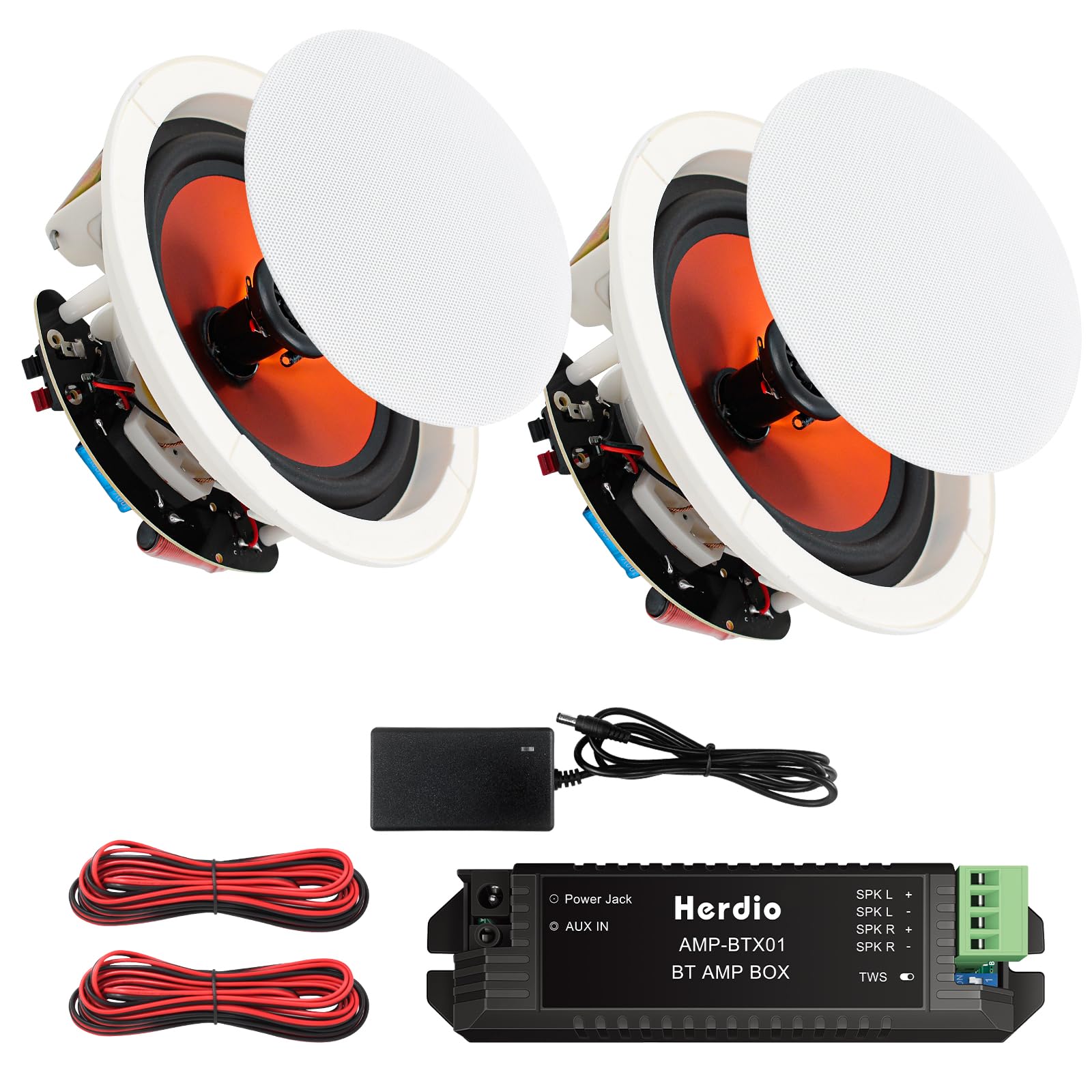
3. Herdio 8 Inch Bluetooth Ceiling Speakers (Pair)
The only pick here that streams straight from your phone with no receiver in sight.
This is the outlier of the group because it does not need a home theater receiver at all. Built-in Bluetooth 5.1 lets you pair a smartphone or tablet directly, and the package even includes the wall plate and power adapter to make it a self-contained system. The trade-off is efficiency: at 89dB sensitivity and a 50Hz-20KHz response range, it is a 25% narrower low-end reach than the 40Hz floor on the CS-IC83 five-pack, so do not expect subwoofer-level depth.
Reviewers describe the sound as good and the volume as surprisingly loud for a flush-mount design, with the retention claws praised for holding firm in the ceiling. One smart workaround owners found: the Bluetooth receiver can link into a Google Home setup, letting them stream over WiFi while the white covers stay nearly invisible against the ceiling. Slide the covers off and you reveal an orange base with a black woofer for a retro look.
The honest weakness here is reliability of the Bluetooth receiver itself. While many owners get fast auto-connection, some units connected only once or had the receiver fail entirely, and the receiver is a simple low-end design without aptX or HD codecs. This is the right pick for a bathroom, kitchen, or office where running speaker wire is a pain and you accept the wireless trade-off for total convenience.
Convenience king: Bluetooth 5.1 pairing plus the included wall plate and power adapter mean you can go from box to streaming without buying a receiver.
The reliability caveat: the simple Bluetooth receiver is the part most likely to disappoint — treat it as a convenience feature, not a rugged streamer.
Ideal for: wire-free rooms like kitchens and RVs where you value instant phone pairing over audiophile depth.
Not the pick if: you already own a good receiver and want the wider 40Hz bass reach of a wired model.
4. Pyle 8” In-Wall / In-Ceiling Speakers (Pair)

Two-way sound with a pivoting silk tweeter and a treble switch you can actually hear.
What sets this Pyle pair apart is control. A 1.0″ silk dome tweeter pivots so you can aim highs at your seating area, and a three-position treble switch (+3dB, 0, -3dB) lets you brighten or tame the top end without touching your receiver’s EQ. Under the hood you get an 8″ poly cone woofer handling the mid-bass, with 150W RMS and 300W peak power on tap and a frequency response reaching down to 35Hz.
The audio crowd is genuinely impressed here, with owners who run high-end gear describing cranked volumes with no distortion and calling the mid and high range the best they have owned. The pivoting tweeter earns frequent mention for letting them direct sound precisely, and the included cut-out template makes installs fast. What wins people over is the clarity per dollar — several note the sound quality makes it a “big bang for the price.”
The recurring gripes are physical. The mounting clips are the weak point, with several owners reporting breakage during installation, and the flush lip runs slightly smaller than the cutout so it needs sealing. Bass is respectable for an 8″ driver, though serious low-end still wants a subwoofer. Handle the clips gently and this pair delivers crisp, adjustable sound that belies its price.
Why Owners Stick With It
- Pivoting 1.0″ silk dome tweeter aims highs exactly where you sit
- The +3dB/0/-3dB treble switch tunes brightness per room
- 35Hz-20kHz response reaches deeper than many rivals in this tier
Installation Warnings
- Mounting clips can snap if you force them during install
- The slightly small flush lip needs caulk or sealant to sit flush
- True deep bass still requires a separate subwoofer
Choose this for: rooms where you want to aim the tweeter and tune treble per seat, backed by a deep 35Hz low end.
Handle with care: the mounting clips are the known fragile spot, so install slowly and avoid over-torquing.
5. Micca R-8C Reference 8-Inch 2-Way (Each)

A reference-grade 8-incher whose carbon-fiber woofer and swivel tweeter punch far above the price.
Micca built this for demanding listeners, and the parts list shows it. The 8″ woofer uses a vented carbon and glass fiber cone with a concave cap for vocal accuracy, while the fluid-cooled 1-inch aluminum dome tweeter mounts on a swivel bridge so you can aim it across a broad balance. Its 40Hz-22kHz frequency response extends higher than most rivals, and each speaker handles 120 watts.
Professional installers have switched to these for non-brand-specific projects because the build is that convincing — owners point to the air-core coils and film capacitors as components rarely seen at this price. Used as in-ceiling Atmos height speakers, owners mention the R-8C outperforms pricier dedicated elevation speakers for overhead effects. Individual woofer and tweeter tone switches, each with +3dB/0dB/-3dB settings, let you tailor the response to the room.
The honest limits: bass is restrained for an 8″ driver, and the 4.75″ depth demands a deeper ceiling cavity than slimmer options. Drop-ceiling installs need extra plywood support to stop tile sag, and the grilles are not magnetic. If you are building a high-end system and want ceiling speakers that disappear into it, this is the one.
Reference build: carbon/glass fiber woofer, fluid-cooled aluminum dome tweeter, and 22kHz top-end make this the most audiophile-leaning pick here.
Plan the install: at 4.75″ deep it needs a real ceiling cavity, and drop tiles need reinforcement to carry the weight.
Built for: critical listening and Atmos height channels where component quality and aimable highs matter more than raw bass.
Expect to add: a subwoofer for low end and a deeper cavity than slim 2-way models need.
6. OSD Audio ICE800WRS Weatherproof (Pair)

Weatherproof sound engineered to survive the steam of a bathroom and the damp of a porch.
Most ceiling speakers fear moisture, but this OSD Audio pair is built for high-humidity territory. The 8″ polypropylene woofer and polycarbonate tweeter deliver a rated 120 watts of coverage, and the Santoprene surround is chosen specifically so the driver does not harden or crack under extreme temperature swings. That makes it a fit for bathrooms, covered porches, and patios where a standard speaker would not last.
The value story is strong — owners who bought them twice over five years for outdoor patios call them an excellent bargain next to speakers costing three times as much. The 8″ driver produces surprisingly clean bass for an open-air install, with decent highs and great mids. Buyers found they work beautifully even with a modest, inexpensive amplifier driving them.
The trade-offs are honest. The mounting mechanism is the weak link, with owners describing a loose fit in thin or hard ceilings and one reporting the clamps can melt, so pre-threading screws is the recommended workaround. Sound quality drops noticeably when the speaker is installed directly into an attic cavity, but adding back covers restores it. And light packaging has let some grilles arrive dented. For damp spaces specifically, this pair earns its place.
Built for damp: the Santoprene surround and polypropylene cone resist the heat and humidity that kill standard drivers on porches and in baths.
Watch the install: the mounting clamps are the known weak spot — pre-run screws and add back covers in attic cavities for best sound.
Best suited to: covered outdoor areas, bathrooms, and any high-humidity room where a weatherproof build is non-negotiable.
Not for: pristine cardboard-box delivery — the packaging is light and grilles have arrived dented.
7. Klipsch CDT-5800-C II (Each)

Klipsch’s horn-loaded engineering that lets you aim the woofer and tweeter independently.
This is the premium name in the lineup, and Klipsch brings its signature Controlled Dispersion Technology and horn-loaded tweeter to the ceiling. The defining feature is adjustability: both the woofer and the tweeter can be tilted and pivoted separately, so you can direct sound precisely toward a listening area rather than blasting it straight down. Treble and midbass attenuation switches add further room-tuning control.
Buyers running these as Atmos height channels and rear surrounds describe the sound as clear and handling the full audio spectrum with ease. One owner paired five of them with a 1200W Pioneer receiver and called the result incredible at a quarter of the price of high-end alternatives. The magnetic grilles lay completely flat and look fantastic, a detail owners repeatedly single out, and the included stencil makes installation straightforward.
An audio engineer’s take is the honest counterweight: these sound good but not world-class, with average users most likely to be fully satisfied. Durability draws the most negative mentions of any aspect, so treat the pivoting hardware gently. For a dedicated home theater where you want directional ceiling sound from a trusted name, this is the premium play.
Directional control: separate woofer and tweeter pivoting plus treble and midbass switches make this the most tunable install in the lineup.
The premium caveat: praised for clarity and punch but not for ultimate fidelity — and the pivoting parts need gentle handling.
Worth it for: serious home theater builds where aimable, horn-loaded ceiling sound and flat magnetic grilles justify the premium.
Skip if: you want easy all-around music — a subwoofer and a capable amp are strongly recommended partners here.
8. Yamaha NS-IC800 140 Watt 8-Inch (Pair)

Yamaha’s workhorse 2-way pair that owners describe as sounding larger than they look.
Yamaha brings its engineering reputation to a straightforward 2-way design: an 8″ woofer crossed over at 3.50 kHz to a dome tweeter, handling a maximum of 140 watts with a 50-watt nominal rating at 8 ohms. The tweeter swivels up to 15 degrees so you can aim the highs, and the pair produces a frequency response reaching up to a very high 28 kHz for airy detail beyond human hearing range.
The install experience gets unusually strong praise here. Owners highlight the sturdy template, the magnetic grille that simply snaps on and off, and the gold spring-loaded posts that make wiring quick. The crowd favorite sits at 4.7 stars across 700+ ratings, and buyers describe the sound as crisp with punchy, distortion-free bass — one noted they “sound larger than expected” from a flush ceiling mount.
These have proven themselves as durable whole-home workhorses, with one owner buying 12 to replace 22-year-old in-ceiling speakers throughout a house. A few note that while the low-end is sturdy for music, the high frequencies are not the primary strength for dedicated music listening, and a subwoofer is still recommended for home theater impact. For a trusted brand pair that installs cleanly and sounds full, this is a top-tier pick.
What Owners Rave About
- Magnetic grille and sturdy template make install and painting genuinely easy
- The 15-degree swivel tweeter aims highs at your seating spot
- Crisp, punchy bass with zero distortion at high volume
The Fine Print
- High frequencies lean toward home theater rather than critical music listening
- A subwoofer still improve movie bass impact
- Requires a 4.3″ deep cavity for a flush fit
Reach for these if: you want a reliable, great-sounding pair from a trusted audio brand with an easy magnetic grille install.
Consider the alternative if: your listening is 100% music-first and you prioritize extended high-frequency sparkle above all else.
9. Polk Audio MC80 2-Way (Each)

Polk’s moisture-resistant 8-incher tuned to keep its musical detail even at low volume.
Polk designed the MC80 for natural musicality, and its Dynamic Balance technology is designed to deliver smooth, wide-range response with clear highs even when you are not cranking the volume. The 8″ midrange driver pairs with a 0.75″ aim-ready swivel tweeter, and the moisture-resistant build uses rustproof stainless-steel hardware and butyl rubber surrounds for bathrooms, kitchens, and covered porches.
Owners consistently describe the sound as room-filling, with one calling it very loud and very clear at every volume level, and another noting it shakes the floor above when pushed. The aim-ready tweeter lets you direct the highs, and buyers found these outperformed the pricier Polk RC80i in front and rear positions — leading one to return the RC80s and buy more MC80s. The 8″ driver delivers more bass than Polk’s MC65 model, reducing the need for a subwoofer in music setups.
Installation is straightforward with the Perfect Fit templates and rotating cams that secure the speaker vibration-free. The honest note: bass is still limited when mounted in a ceiling versus a wall, so the lowest octave wants a powered sub. Polk’s reputation for reliability and craftsmanship backs this as a premium single-speaker choice for music-first rooms where you value natural vocal detail.
Musical character: Dynamic Balance tuning keeps vocals and mids detailed and natural at low volumes, unlike speakers that only shine when pushed hard.
Moisture-safe build: rustproof stainless-steel hardware and butyl rubber surrounds let it live in kitchens, baths, and covered porches.
Pick this for: music-first rooms and covered outdoor spaces where natural vocal detail and moisture resistance matter more than raw output.
Add a sub if: you want the deepest movie bass — ceiling mounting still limits the lowest octave.
Understanding the Specs
Power Handling and Sensitivity
Power handling tells you how much amplifier wattage a speaker can accept, usually shown as a recommended range per channel. Match that range to your receiver’s output so you neither starve the speaker nor risk overpowering it. Sensitivity, measured in decibels, tells you how loud the speaker plays from a fixed amount of power; a 95dB speaker is notably more efficient than an 89dB one, so it reaches higher volume with less amp effort. These two numbers together decide whether your existing receiver will drive the speakers to satisfying levels.
Frequency Response and Crossover Design
Frequency response is the range of tones a speaker can reproduce, from deep bass to crisp highs. A response starting around 40Hz or 50Hz means the 8-inch woofer handles mid-bass, but true sub-bass below that still calls for a subwoofer. The crossover design splits the audio: a 2-way system divides sound between woofer and tweeter, while a 3-way adds a dedicated midrange driver for clearer voices and effects. Deeper frequency response and more drivers generally mean fuller, more detailed sound at the cost of a deeper mounting depth.
FAQ
Will 8 inch ceiling speakers fit in my ceiling cavity?
How many watts per channel do I need to drive these speakers?
What does a 3-way crossover do that a 2-way does not?
Do I still need a subwoofer if I buy 8 inch ceiling speakers?
What is a pivoting or swivel tweeter and why does it matter?
Can I paint ceiling speakers to match my ceiling?
What is the difference between 2-way and 3-way for ceiling speakers?
Are there waterproof options for bathrooms and covered porches?
Final Thoughts: The Verdict
If you want one dependable pick, the winner for 8 inch ceiling speakers is the Acoustic Audio CS-IC83 five-pack, because it delivers a complete 3-way surround setup with efficient 95dB output in a single purchase. If you want wireless freedom in a kitchen or RV, grab the Herdio Bluetooth pair. And for a damp patio or bathroom where weatherproofing is non-negotiable, the OSD Audio ICE800WRS pair is the one to reach for. Before buying, measure your ceiling cavity depth and cutout diameter, and budget for a subwoofer to handle the lowest frequencies.
How We Picked
We do not accept paid placement. Every pick is matched to a real buyer and a real use-case; we do not hands-on test units.
Sources & Methodology
Specifications: manufacturer listings and product documentation. Review insights: verified customer reviews, as of September 2026. Pricing: not shown on this page (it changes often); check the current price via the retailer link.
As an Amazon Associate, Gadgets Feed earns from qualifying purchases. This does not affect which products we feature.