
Cutting an 8-inch hole in drywall, plywood, or thin metal demands a tool that won’t grab, bind, or overheat halfway through. An 8 inch hole saw that flexes, chips, or runs out of round turns a five-minute job into a frustrating battle with kickback and chatter. The right saw delivers a clean, consistent circle without forcing you to muscle through every revolution.
I’m Min — the co-founder and writer behind Gadgets Feed. For this guide, I parsed dozens of data sheets and hundreds of verified owner reports across multiple sellers to isolate the bi-metal and carbide-tipped designs that actually hold edge and stay true at this large diameter.
Whether you are chasing a perfect fit for 8-inch recessed can lights, a ventilation duct, or a speaker baffle, the best 8 inch hole saw should balance tooth geometry, material compatibility, and arbor rigidity without emptying your wallet.
How To Choose The Best 8 Inch Hole Saw
An 8-inch hole saw is a large accessory that generates significant torque and heat. Picking the wrong one means stalled cuts, broken teeth, or a bent mandrel. Focus on these factors before adding one to your cart.
Tooth Material: Bi-Metal vs. Carbide-Tipped
Bi-metal hole saws use a strip of high-speed steel (often M42 with 8% cobalt) welded to a flexible steel body. They resist heat and handle wood, plastic, drywall, and thin metals well. Carbide-tipped saws offer tungsten-carbide teeth brazed onto the rim — they cut up to five times faster in abrasive materials like plaster and fiberglass but are brittle against nails or heavy steel. Match the tooth material to your primary substrate.
Arbor Quality and Pilot Bit Retention
A 210mm diameter saw exerts enormous lateral force. A cheap arbor that wobbles or a pilot bit that slips produces an oval hole and dangerous vibration. Look for an arbor with locking pins that engage the saw body fully and a hex-key retention system for the pilot bit. Some premium mandrels use a quick-release pin and spring-loaded centering.
Cutting Depth and Gullet Design
Standard 8-inch hole saws cut to about 38mm (1.5 inches) deep. If you are cutting through 2x lumber or thick wall assemblies, check the actual cutting depth of the saw body. Deeper gullets between teeth help clear chips faster, reducing friction in deep cuts. A shallow gullet in a large saw means frequent pull-outs to clear dust.
Quick Comparison
On smaller screens, swipe sideways to see the full table.
| Model | Category | Best For | Key Spec | Amazon |
|---|---|---|---|---|
| PLG2SUPT 8” HSS Bi-Metal | Premium | Thin metal & wood | 38 mm cutting depth | Amazon |
| HLOFIZI 8-1/4″ Carbide Tipped | Premium | Plaster ceilings & drywall | Carbide-tipped teeth | Amazon |
| cenyb 8″ Tungsten Carbide | Premium | Stainless steel & hard metals | 48 tungsten-carbide teeth | Amazon |
| REKCKRUL 8″ M42 Bi-Metal | Mid-Range | Drywall & light wood | M42 steel with 8% cobalt | Amazon |
| METALLIXITY 8-17/64″ Bi-Metal | Mid-Range | Hard steel sheets up to 8mm | 210 mm diameter | Amazon |
| VIKITON 8-1/4″ Bi-Metal | Mid-Range | General DIY wood & plastic | 50% lighter weight design | Amazon |
| GUICGOC 203mm HSS Bi-Metal | Budget | Entry-level ceiling speaker installs | High-speed steel body | Amazon |
In‑Depth Reviews
1. PLG2SUPT 8” HSS Bi Metal Hole Saw Cutter
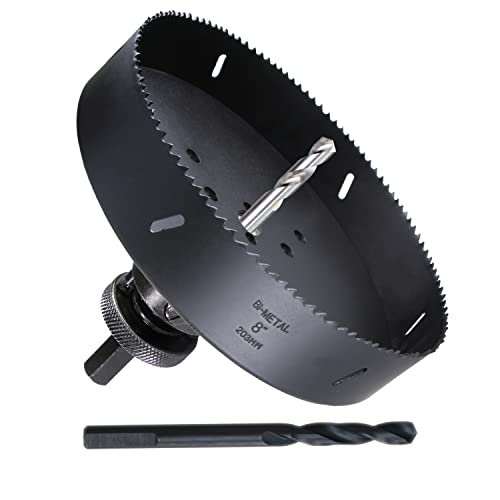
This 8-inch bi-metal saw uses laser-welded M42 strip with vacuum heat treatment, giving it the hardness to chew through 0.12-inch low carbon steel plate for up to 30 holes. Owners consistently report clean cuts in 3mm steel at 150–200 rpm with cutting oil, and the 38 mm cutting depth handles one pass through 2-inch hardwood with proper speed management.
The kit includes two pilot bits — one HSS for soft materials and a black HSS bit for harder metals — plus a mandrel that fits standard chucks. Several users noted that the arbor pins feel slightly loose and opted to swap to a Snap-on or Lenox mandrel for critical alignment. The saw itself runs true and the laser-welded seam holds up under heavy side load.
Speed discipline is essential here. At 70 rpm with pecking and lubrication, this saw cut hardened 4140 steel (32 Rc) in a milling machine test. Overspeed in metal destroys the edge instantly. For wood siding, drywall, and thin metal, this saw delivers professional-grade longevity with the caveat that you may want a better arbor.
Why it’s great
- Laser-welded M42 bi-metal construction survives hard metals
- Two included pilot bits extend usable range
- Consistent clean holes in steel sheet up to 3 mm thick
Good to know
- Included arbor pins can be loose; arbor swap may be needed
- Requires slow speed and lubrication for metal cuts
2. HLOFIZI 8-1/4 Inch Carbide Tipped Hole Saw
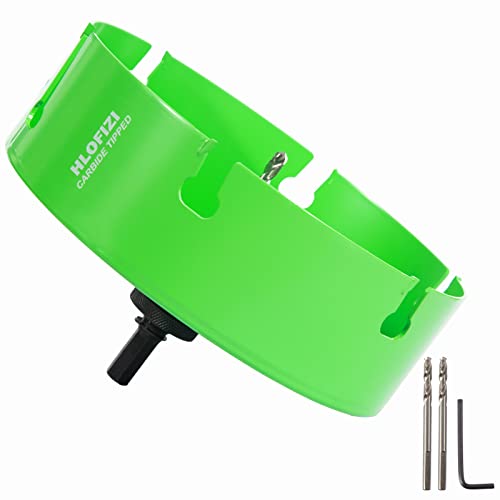
The carbide-tipped teeth on this 8.25-inch saw cut through plaster ceilings and drywall at a reported 8 seconds per hole — roughly five times faster than standard bi-metal designs. One user documented 22 holes in 1-inch plaster in 28 minutes, compared to 10 holes with a previous saw. The tungsten-carbide tips resist dulling from abrasive joint compound and old plaster.
A heavy-duty solid backing plate prevents flex at this large diameter, which means the hole remains round even when you push at an angle. The saw can also enlarge existing holes, a trick that saves time when retrofitting can lights. The 7/16-inch shank requires a 1/2-inch chuck — 3/8-inch drills are too small. The optimized slot design helps with plug removal, though the carbide teeth leave a kerf about 1/8-inch wide.
This saw generates noticeable torque. Owners recommend using a 1/2-inch corded drill with a stabilizing handle to control kickback. It is not recommended for metal, but for drywall, plaster, fiberglass, PVC, and wood, it is the fastest option in this roundup with no loss of cut quality.
Why it’s great
- Carbide teeth cut through plaster and drywall at roughly 5X speed
- Solid backing plate eliminates flex for accurate round holes
- Slot design allows quick plug removal
Good to know
- Only fits 1/2-inch chuck drills
- High torque requires a stabilizing handle
3. cenyb 8 inch Tungsten Carbide Tipped Hole Saw
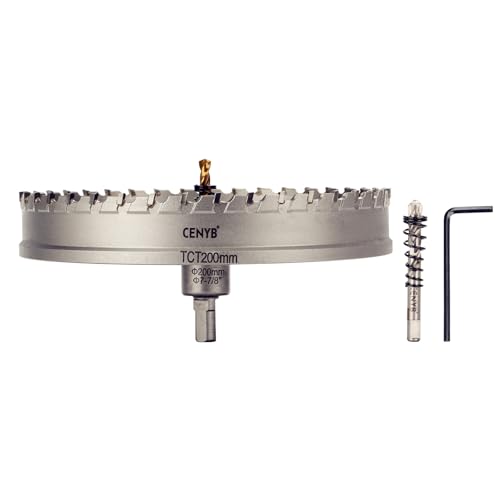
Forty-eight tungsten-carbide teeth with a three-blade design (outer, middle, inner) give this 200 mm saw the aggression to cut through stainless steel, cast iron, and aluminum alloy where standard bi-metal saws would lose edge in minutes. The titanium-plated pilot bits resist corrosion and stay sharp. One user reported cutting drain holes in stainless steel pans after ruining two steel-tooth saws.
The cutting depth is 25 mm, which is shallower than the bi-metal competitors at 38 mm. This is a trade-off for the extreme tooth hardness — deeper cuts in thick material require pecking. The 10 mm shank fits bench drills, magnetic drills, and gun drills. The saw comes packaged in a plastic box with two pilot bits and a hex wrench.
Some owners noted the set screw for the pilot bit is short and can fall out if not fully engaged. The saw is not for concrete, tile, or stone. For anyone regularly cutting hard metal, the upfront cost pays for itself in avoided tool replacement. The saw works on wood and plastic too, but that is not its calling card.
Why it’s great
- 48 tungsten-carbide teeth cut hard metals other saws cannot
- Three-blade tooth geometry improves chip clearance
- Includes two titanium-plated pilot bits
Good to know
- Only 25 mm cutting depth requires pecking on thick stock
- Set screw design for pilot bit is finicky
4. REKCKRUL 203mm M42 Bi-Metal Hole Saw Kit
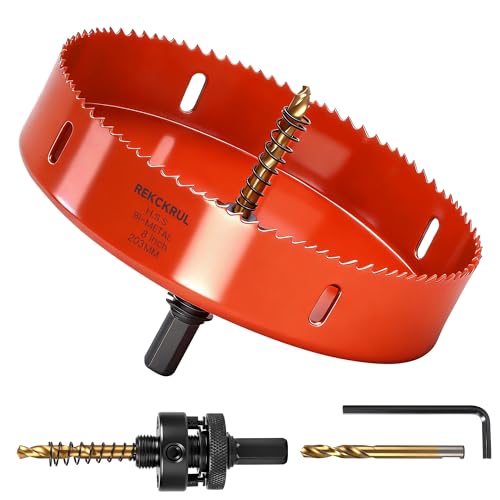
This kit combines an M42 high-speed steel body with 8% cobalt content, giving the teeth exceptional heat resistance for prolonged cuts in metal, wood, plastic, drywall, and PVC. Owners report clean, non-binding cuts in drywall ceiling applications for pancake lights, with the arbor’s pin-and-rotate pilot bit lock ensuring secure alignment during startup. The set includes the saw, arbor with pilot bit, a replacement drill bit, and a hex key.
The deep gullets on the tooth profile help clear dust efficiently, reducing friction and heat buildup in thicker materials. One user successfully enlarged a door hole to standard size with a single pass. The saw body weighs close to 2 kilograms, so a drill with a side handle is recommended — a standard pistol-grip drill will struggle with the mass at full speed.
Performance drops noticeably when cutting wood compared to a dedicated carbide-tipped saw, and the 4-inch diameter variant was noted to be exactly 4 inches, which may be undersized for standard dryer ducting. At 8 inches, the fit is consistent for recessed lighting and vent pipe openings. The complete package offers strong value for mixed-material work.
Why it’s great
- M42 steel with 8% cobalt delivers heat resistance for metal cuts
- Complete kit includes arbor, two pilot bits, and hex key
- Deep gullets clear chips efficiently in drywall and wood
Good to know
- Heavy weight requires a drill with side handle
- Not the best choice for dense hardwood
5. METALLIXITY Bi-Metal Hole Saw 8-17/64″

The 210 mm (8-17/64 inch) diameter of this bi-metal saw gives you a slightly larger hole than the standard 203 mm, which matters when you need clearance for a vent pipe or conduit with a coupling. The M42 teeth include 8% cobalt and receive a nitriding surface treatment plus paint coating for wear resistance and rust prevention. The cutting depth is 30 mm, and the triangular shank provides positive grip in a drill chuck.
Owner reports confirm clean cuts in thin metal sheets with no wobble, though one user noted that a 52 mm saw from the same brand had runout issues. The 210 mm version runs true for most users. The saw is explicitly designed for stainless steel up to 8 mm thick and general metal sheet up to 12 mm — the manufacturer advises against wood and plastic, so stick to metal work.
Installation requires attention: you must rotate the center drill, align the locking pin with the groove using the hex key, and ensure the spring is properly seated before tightening. The saw works with hand drills, bench drills, and magnetic base drills. For metal-only applications at this large diameter, it offers a strong value with exact sizing.
Why it’s great
- 210 mm diameter provides extra clearance for vent and conduit work
- Nitride surface treatment resists wear and rust
- Triangular shank improves chuck grip
Good to know
- Not recommended for wood or plastic
- Spring and pin alignment during installation is fiddly
6. VIKITON 8-1/4 Inch Bi-Metal Hole Saw
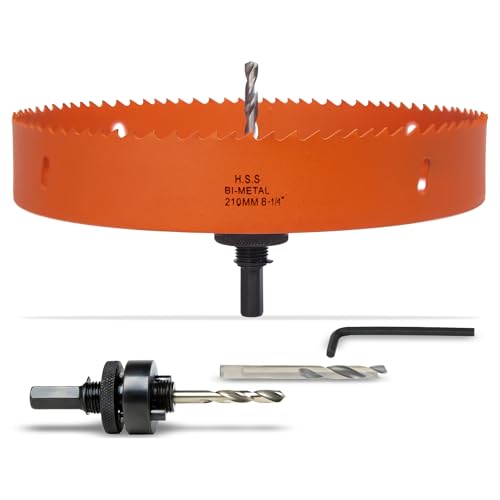
Structural upgrades reduced the weight of this 8.25-inch bi-metal saw by 50 percent compared to standard designs, making it significantly easier to control with a handheld drill. The 20 high-speed steel teeth cut clean holes in 3/4-inch plywood in about one minute per hole, according to owner tests, with no chattering in plastic or wood. The arbor runs true, and an extra pilot bit is included.
Several users noted that the saw works well for DIY projects like cornhole boards, ceiling fan boxes, and drywall openings. The reduced mass means less fatigue during multi-hole runs, but the lighter body also means less momentum, so the saw relies more on tooth sharpness than inertia. One owner mentioned that material plug removal is difficult because the saw lacks a pin-type ejection head.
The manufacturer explicitly warns against using this saw on glass, ceramic, or concrete. Adding coolant or water when drilling metal improves cut quality and tooth life. For the average DIYer cutting wood, plastic, and drywall, this saw offers a smooth experience with less arm strain — just be prepared to wrestle with the plug if it swells inside the cup.
Why it’s great
- 50% lighter than standard 8-inch saws reduces arm fatigue
- Cuts clean holes in wood and plastic without chattering
- Includes extra pilot bit and hex key
Good to know
- Lacks pin-type ejection for easy plug removal
- Not for glass, ceramic, or concrete
7. GUICGOC 203mm HSS Bi-Metal Hole Saw
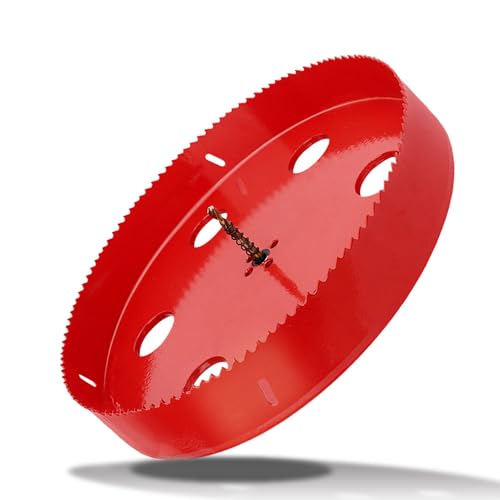
This 203 mm high-speed steel saw is a straightforward, no-frills option for anyone cutting drywall for 8-inch ceiling speakers or can lights. Owners report that it cuts clean, consistent holes without binding and holds up well for dozens of cuts in drywall and softwood. The red finish makes it easy to spot in a toolbox. It includes a single pilot drill bit.
The saw is heavy — one user warned to hold on tight because the mass generates serious torque when the bit grabs. Another mentioned that if the saw binds in a high-torque hand drill, it can sprain a wrist. A handle extension or a drill with a side handle is strongly advised. The cutting performance is solid for the cost, but the fit and finish are noticeably simpler than the mid-range and premium competitors.
Material compatibility covers plastic, wood, plywood, and thin steel. The included pilot bit is basic but functional. For a one-time project like mounting six ceiling speakers in drywall, this saw delivers the hole you need without demanding a premium investment. Just respect the mass and use a proper drill setup.
Why it’s great
- Affordable entry point for 8-inch drywall and wood cuts
- Clean holes with no binding in ceiling speaker installs
- Sturdy enough for dozens of cuts in drywall
Good to know
- Heavy weight requires a drill with side handle for safety
- Basic pilot bit and no replacement included
FAQ
Can an 8 inch hole saw cut through stainless steel?
Why does my 8 inch hole saw grab and kick back?
Final Thoughts: The Verdict
For most users, the best 8 inch hole saw winner is the REKCKRUL M42 Bi-Metal Kit because it combines a complete accessory package with proven M42 + 8% cobalt teeth that handle wood, drywall, plastic, and thin metal without breaking the budget. If you want the fastest cuts in plaster ceilings and drywall, grab the HLOFIZI Carbide Tipped saw. And for cutting stainless steel and hardened metals, nothing beats the cenyb Tungsten Carbide.