
Our readers keep the lights on and my morning glass full of iced black tea. As an Amazon Associate, I earn from qualifying purchases.
Specs are compiled from manufacturer listings and verified buyer reviews and can change over time — please confirm the key details on the product page before buying.
If your music sounds thin and lifeless, an 8-inch subwoofer adds the deep bass you’re missing without the bulk of a 12-inch box. The right pick depends entirely on where it will live: your car, your home theater, or your desktop. For a car, you’ll need a passive driver (a bare speaker cone that requires a separate amplifier and enclosure), while a home sub has the amp built in and just needs power and an audio signal.
I’m Min — the founder and writer behind Gadgets Feed. This guide is built by comparing the manufacturers’ published specifications and the patterns across verified customer reviews, so you get each pick’s real strengths and trade-offs instead of marketing spin.
The honest truth is that for most rooms and most cars, a quality 8-inch subwoofer speaker delivers the punch you feel without the space or cost of a larger driver.
Our Picks at a Glance


How To Choose The Best 8-Inch Subwoofer Speaker
Decide first: is this sub for your car or your home stereo? A car sub is usually a passive driver (a bare speaker cone needing a separate amp and box), while a home sub has the amplifier built in, so you only plug in power and an audio cable.
Powered or passive: the first fork in the road
If you want the least hassle, a powered sub (often called an “active” sub) is the one. You plug it in, run one cable from your receiver, and you’re done. Passive subs save money on the driver itself but force you to buy or already own an external amplifier, plus a properly sized enclosure. For a car install, a shallow-mount passive driver can slip behind a seat, but a powered all-in-one box saves you the wiring work.
How low does it go
The frequency response tells you the range of bass notes a sub can produce. A number like 35Hz means it can reach down to the 35-hertz range (a very low, rumbling note) — the lower the number, the deeper the bass. An 8-inch driver physically can’t move as much air as a 12-inch, so it trades some of that ultra-deep rumble for a smaller footprint and faster, tighter response. If you mostly listen to rock or pop, that’s a fair trade.
Wattage: RMS is the honest number
Manufacturers love to print a giant “peak” wattage, but the number that matters is RMS — the continuous power the sub can handle or deliver without distorting. A 150W RMS home sub will fill a small-to-medium room, while a 250W RMS unit gives you more headroom before the sound breaks up. For cars, match the sub’s RMS to your amplifier’s output so you don’t overpower or underpower the driver.
Quick Comparison
| Model | Best For | Type | Power | Frequency Response | Amazon |
|---|---|---|---|---|---|
| Yamaha HS8S★ Best Overall | Studio Accuracy | Powered | 150W | 22Hz – 150Hz | Amazon |
| KICKER CWCD84Car Upgrade | Factory Car Replacement | Passive | 200W RMS | 30Hz | Amazon |
| BESTISAN Powered SubBudget Champion | Budget Home Theater | Powered | — | — | Amazon |
| Pioneer TS-A2000LD2 | Tight Car Spaces | Passive | 250W RMS / 700W Max | — | Amazon |
| Edifier T5s | Desktop & Small Rooms | Powered | 70W RMS | 35Hz | Amazon |
| Klipsch R-8SW | Compact Home Theater | Powered | 150W Peak | — | Amazon |
| Rockford Fosgate P300-8P | All-in-One Car Bass | Powered | 300W | — | Amazon |
| Alpine PWE-S8 | Under-Seat Car Install | Powered | 120W RMS / 240W Peak | 32Hz – 150Hz | Amazon |
| Audioengine S8 | Desktop & Music Systems | Powered | 250W | — | Amazon |
In-Depth Reviews
1. Yamaha HS8S Powered Studio Subwoofer
Our pick — over 4.5★ from 350+ verified ratings; the strongest balance of quality and price.
The studio-reference sub that reveals the room’s true acoustics instead of just shaking it.
This is the choice when accuracy matters more than raw volume. The 8-inch bass-reflex design reaches down to 22Hz — low enough to expose the sub-bass rumble in a mix that smaller subs miss entirely — while the 150W amp keeps everything tight and controlled. Buyers report the bass is “pro-level accuracy, noise-free,” and that it works flawlessly alongside other Yamaha monitors as well as Genelec, Mackie, and B&W studio speakers.
What separates this from a home-theater sub is the control panel. You get a low cut switch, a low cut control (80–120Hz), a high cut control (80–120Hz), and a phase switch, so you can carve exactly where the sub hands off to your main monitors. That flexibility is what earns it the praise as “the thing everyone raves about” — the sound quality that lets you hear the difference between the room and the speaker.
The one honest trade-off is physical: the rear heat sink can block angled XLR connectors, so you may need to plan your cable routing. The crowd — sitting at an exceptional 4.8 stars across hundreds of owners — is overwhelmingly satisfied, and for a monitor setup, nothing here gets you closer to a true reference sound at this size.
What makes it a studio staple
- Reaches 22Hz deep bass that exposes the low rumble in recordings
- Full crossover controls let you blend it with any monitor pair
- Build quality praised as top-notch and completely rattle-free
Before you buy
- Rear heat sink can block angled XLR plugs
- Priced for professionals, not casual listeners
Reach for it if: you mix or master audio and need a sub that tells the truth about low end.
Look elsewhere if: you want chest-thumping home theater bass on a tighter budget.
2. KICKER CWCD84 CompC 8″ Subwoofer
The drop-in factory replacement that makes old car audio systems thump again.
If your car’s factory sub has gone flat, the Kicker 43TCWRT82 brings back the punch. This passive driver (needs a separate amp and box) is rated at 200W RMS and 400W peak, with an injection-molded polypropylene cone and a ribbed polyurethane surround. Owners say it sounds as good as pricier subs in a ported box tuned around 35-40Hz; one buyer swapped it into an ’06 Lexus LS 430’s Mark Levinson system and called the bass harder and better than factory.
The dual 4-ohm voice coils give you wiring flexibility, so you can match it to a wide range of amps. Fit is the recurring theme in the feedback: it slides into a Toyota Tundra’s factory box with no problems and sits in a Dodge Dart’s rear deck nicely alongside a CX400.1 amp. The catch, which comes up honestly, is that some vehicles need bracket or box modification — the ’04 4Runner install needed significant trimming — so set aside time if your car isn’t a common swap candidate.
Owners describe the performance as a clear step up from factory subs at a fraction of the cost, and the build quality gets consistent praise. For anyone reviving an aging car stereo without ripping out the whole setup, this is the value play.
Owner-approved swap: the thing everyone agrees on is the sound quality upgrade — harder, cleaner bass than any factory driver — at an entry-level price.
Fit note: check your vehicle’s enclosure before buying; some need trimming to seat properly.
3. BESTISAN Powered Subwoofer
A compact, down-firing sub that adds real boom to a small home theater without the big-box footprint.
The BESTISAN is all about easy, wide compatibility. Its down-firing woofer (a driver that points at the floor) spreads bass across the room, and the rear panel has RCA, AUX, LFE, and high-level speaker inputs, so it works with soundbars, bookshelf speakers, receivers, TVs with analog output, and even turntables with a preamp. A coaxial cable is included for a quick start. After a week, owners mention being “very pleased” and call the bass booming for the price.
Honest trade-offs appear in the feedback. At very low volumes, the bass can sound muddy — one owner noted it struggles with jazz and classical, adding hum instead of texture — and it performs best with line-level signals at or below 850mV. This sub suits rock, pop, movies, and games in a small room, not a high-end critical listening setup. Pair it with BESTISAN’s own speakers or a soundbar for the cleanest result.
What wins people over is the value: real, room-filling low end from a box small enough for a 10×10 room, at a price that leaves room in the budget for the rest of the system. The controls are basic and the performance is “good for the money” rather than stellar, but for a first subwoofer, it hits the brief.
Small-room specialist: the most-discussed strength is the surprising low-end output for the footprint.
Keep expectations in check: it’s not for high-volume critical listening or complex classical passages.
4. Pioneer TS-A2000LD2 Shallow-Mount 8″ Subwoofer

The 2.625-inch mounting depth that lets deep bass live behind seats and inside door panels.
Pioneer engineered this one for vehicles where a normal sub enclosure simply won’t fit. The shallow-mount design, with a 2.625-inch mounting depth, is made for a 0.5 cu. ft. sealed enclosure and slips into tight factory locations. It’s a passive driver rated at 250W nominal and 700W max, with a glass-fiber and mica reinforced IMPP cone (a rigid composite that keeps the cone from flexing) for detailed, high-impact bass. The 2-ohm single voice coil makes wiring simple.
The reviews read like a vehicle compatibility list: it’s called a must-have for Ford Mustang Shaker 500-1000 systems from 2005 through 2014, a perfect replacement for the 2005 4Runner woofer, and a definite upgrade in the 2011 Tundra. Owners consistently describe the sound as cleaner and deeper than factory with the rattle eliminated — and the high-quality push-style wire connectors make the swap easier than soldering.
There’s no hiding that this is a replacement part, not a bass-head’s weapon. The mounting holes can be finicky to align, and some installs need the magnet cover removed to fit the factory enclosure. But if you want to resurrect a factory sub location with a genuine upgrade, this is the proven route.
Why it fits the bill
- Shallow 2.625-inch depth fits under seats and in factory enclosures
- 700W max power with a rigid reinforced cone for punchy bass
- Push-style connectors make DIY install straightforward
Know before you go
- Mounting holes can be hard to align — a jig helps
- Requires an external amplifier since it’s a passive driver
Best for: anyone refreshing a factory sub location in a Mustang, 4Runner, or Tundra.
Not for: builds that want maximum SPL without concern for mounting depth.
5. Edifier T5s Powered Subwoofer
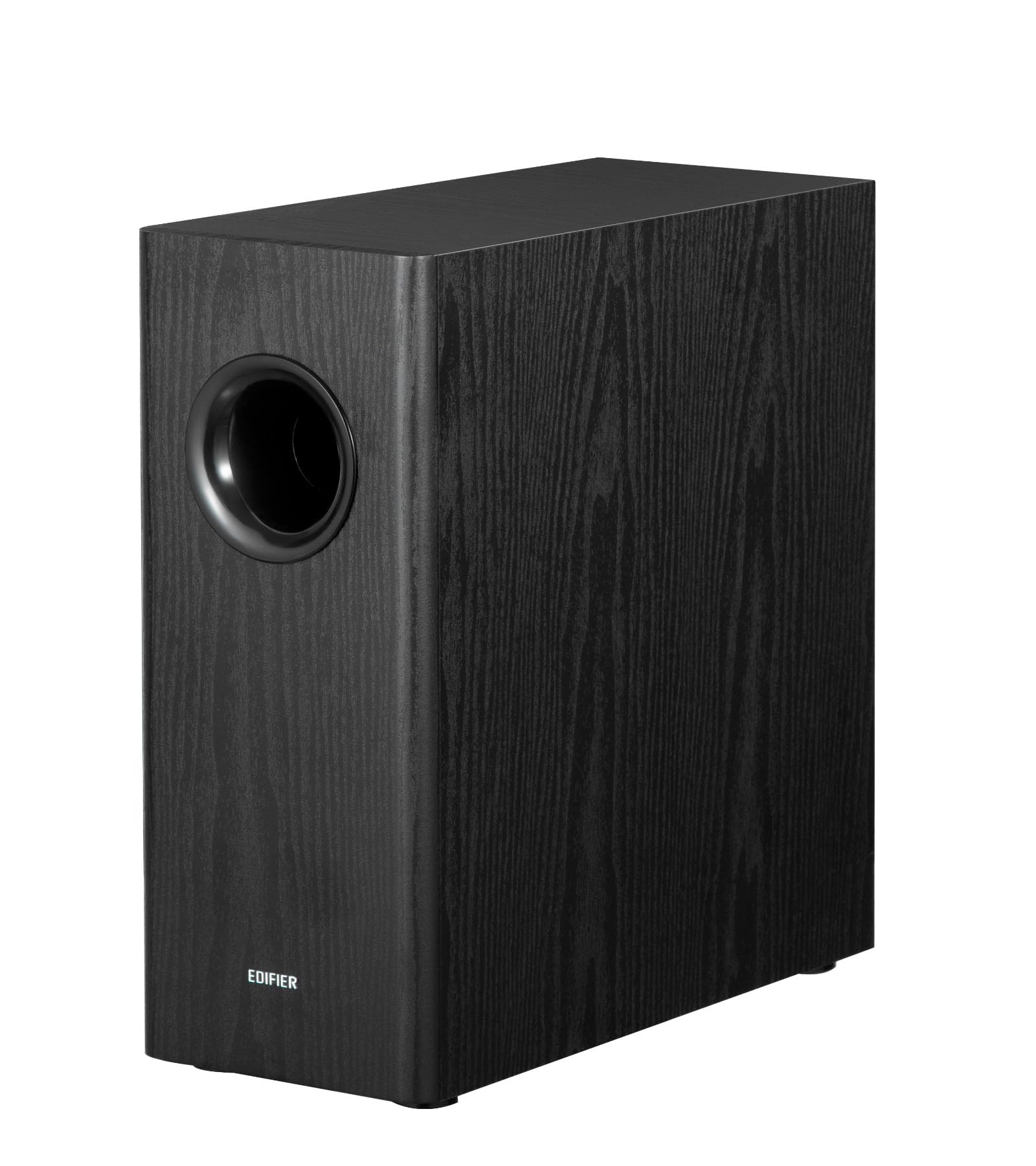
A slim powered sub that slips under a desk and rounds out bookshelf speakers with 35Hz depth.
The Edifier T5s is the rare powered sub that works with speakers that don’t have a sub output. Its 8-inch long-throw woofer and 70W RMS Class-D amp deliver 35Hz deep bass, and the rear panel includes a low-pass filter adjustable from 30Hz to 160Hz plus a 0°/180° phase selector. For speakers with a sub out, you run one RCA cable. For those without, you run the audio source through the T5s and out to the main speakers — as long as those speakers accept a line-in signal. Owners call the sound quality “built like a rock” and say it blends perfectly with soundbars and Edifier’s Bluetooth speakers.
The 18mm MDF cabinet — a dense wood composite that resists resonance — with a front-firing driver and right-firing port keeps the bass clean and tight, and the wood-grain finish looks at home next to furniture. It’s compact enough to hide under a desk, a point that comes up again and again. Auto-standby kicks in after 15 minutes of inactivity, saving power without you lifting a finger, and the included 3.5mm-to-RCA and RCA cables mean it’s ready from the start.
The recurring theme in feedback is “big power in a small package” — walls shake at low volume. It’s best suited to a desktop or small-to-medium room; it’s not the sub for a cavernous home theater. For the money, it’s a remarkably complete package.
Under-desk wonder: the praise is led by sound quality, with owners calling the bass deep, rich, and powerful at modest volume settings.
Right-sized: meant for small and medium rooms — don’t expect it to pressurize a large open space.
6. Klipsch Reference R-8SW Subwoofer

The compact Klipsch that makes a small living room’s stereo come alive without rattling the neighbors.
Klipsch delivers its signature sound in a compact, down-firing 8-inch design. The spun copper IMG woofer (a material blend that keeps the cone light and stiff) is powered by an all-digital amplifier rated at 150 watts peak, and the down-firing driver pushes bass into the floor for a room-filling effect. Owners say it makes their stereo come alive and praise the easy setup — ideal for small living rooms and pairs especially well with Klipsch’s own R-15PM powered speakers.
The R-8SW is tuned for music and movies in a modest space. Feedback describes it as a great small-room sub that outperforms older dual 6.5-inch Pioneer setups, with an adjustable gain that sits perfectly at the halfway point. The trade-off is honest: it lacks the booming, wall-rattling low-level rumble of a bigger driver, so it’s not the pick for very large rooms or home-theater-level depth. One owner noted a pop when powering down with certain Klipsch speakers, so it’s worth testing that pairing.
At this size, the value argument is strong. It’s a compact, solidly built sub that adds genuine punch to a small entertainment center, and the visual design is intentionally understated — a generic black box that lets the bass do the talking.
Small-room sweetener: sound quality is the most-praised aspect, with owners calling the bass strong, clean, and punchy for an 8-inch driver.
Size ceiling: not built for large rooms or theater-level depth — keep it in a den or apartment.
7. Rockford Fosgate Punch P300-8P

A self-contained amplified sub that drops serious bass into a truck or small car with minimal wiring.
This is the “all-in-one” answer for car audio. The P300-8P packs an 8-inch high-output subwoofer and a built-in 300-watt Class-D amplifier into a slim ported enclosure measuring 11.4 x 17.6 x 5.6 inches — thin enough to slide behind a rear seat. You connect it via speaker-level inputs for a factory system or line-level inputs for an aftermarket one, and the onboard adjustable 12dB/octave low-pass crossover, bass boost EQ, and phase switch let you dial in the sound. The remote Punch level control gives you bass adjustment from the driver’s seat.
Owners consistently call it the best value for getting bass into a vehicle without a full component install. It beats factory systems easily and gets near the low bass of a 12-inch while staying far more compact. The build quality reinforces Rockford’s reputation, and the 1-year warranty backs it. One buyer called it “three reasons to love this subwoofer: it sounds great, it’s thin, and it’s easy to install.”
The honest limitation shows up at high volume: the port can produce audible air noise, and it’s best described as daily bass rather than a pounding SPL machine. It wants to fill in missing low end, not shake the windows. For most daily drivers, that’s exactly the right job.
Why it’s the easy win
- Built-in 300W amp means no separate amplifier to buy or wire
- Slim 5.6-inch depth fits behind seats in trucks and small cars
- Remote Punch level control puts bass adjustment at your fingertips
The honest catch
- Audible port noise if you push the volume hard
- Daily-driver bass, not a high-volume SPL weapon
Grab it for: a factory or aftermarket system that needs clean, compact bass without a major install.
Skip it for: serious bass-head builds that demand high-volume output.
8. Alpine PWE-S8 Powered Subwoofer

A compact powered sub that hides under a seat and adds clean low end without touching the trunk.
The Alpine PWE-S8 solves the “I don’t want to lose trunk space” problem. It’s a self-contained powered sub with a built-in Class-D amplifier rated at 120W RMS and 240W peak, driving an 8-inch high-excursion woofer with a frequency response of 32–150Hz. The whole unit is sized to fit under a car seat — owners have tucked it under the driver’s seat of a 2015 Jetta, under a Civic seat, and under the rear seat of a Jeep Wrangler. One installer called it a complete DIY job in about 30 minutes.
Owners describe the bass as tight and controlled rather than overwhelming, with one noting it “nicely fills out the spectrum below 50Hz.” The remote level control is genuinely useful for adjusting output on the fly. The build quality gets consistent praise, and it’s repeatedly called a perfect addition to a small cabin — it rounds out the low end that factory speakers simply can’t reach.
There are honest fit notes: under some driver seats it’s too large (heat ducts get in the way, so the trunk under the spare is a fallback), and it’s not a boomer for bass-heavy rap at full tilt. The installation detail that comes up is grounding — one owner found a poor ground connection caused no power until the paint was sanded to bare metal. Know that and the install goes smoothly. For small cabins and clean, musical bass, it’s the proven compact solution.
Compact and clean: the leading praise is sound quality — agile, round bass that fills the cabin without distortion.
Know the limits: not for bass-heads or large SUVs; it’s designed to supplement, not dominate.
9. Audioengine S8 Powered Subwoofer

A 250-watt desktop sub that turns a pair of small monitors into a room-filling 2.1 system.
The Audioengine S8 is the premium end of the desktop subwoofer spectrum. Its 250-watt amplifier drives an 8-inch down-firing woofer that produces what owners call smooth, room-shaking bass, and it’s specifically designed to pair with Audioengine’s HD3, A2+, and A5+ powered speakers. The down-firing design means you can place it almost anywhere — under a desk works well — and it even supports a wireless kit if you want to skip the cable run. Customers note hooking it up in about 10 minutes.
The control flexibility is a big part of the appeal: adjustable crossover, phase, and volume let you dial the sub into any setup, and owners say the bass stays tight and distortion-free even at higher volumes. It’s repeatedly described as the missing piece that completes a 2.1 system — one user runs it with a Sonos setup, another uses it with SteelSeries gaming speakers via a simple audio splitter. The build quality and clean appearance get consistent nods.
The realistic caveats: sharp pointed feet can scratch hardwood floors (a swap to flat feet helps), and like any 8-inch sub, it’s tune for small-to-medium rooms rather than large open spaces. The value argument is strong — owners call it powerful, accurate, and worth every dollar for the size. For a desktop or small studio, it’s the premium pick that leaves nothing missing.
What justifies the premium
- 250W of clean, room-shaking power in a compact box
- Flexible crossover and phase controls for any setup
- Down-firing design allows flexible placement under desks
Small things to know
- Sharp feet can scratch hardwood floors
- Best in small-to-medium rooms, not large home theaters
Choose this if: you have powered desktop speakers that need deep, accurate bass to feel complete.
Think twice if: you’re filling a large room and need maximum SPL over finesse.
Understanding the Specs
Frequency Response
This is the range of bass notes a sub can reproduce, written like “35Hz – 150Hz.” The lower number is what matters most: it tells you how deep the sub can reach into the low end. A spec of 35Hz means it produces notes down to 35 hertz (a very low rumble), while 22Hz goes even deeper — that’s the difference between feeling the bass and just hearing it. For music listening, 35-40Hz is plenty; for home theater, deeper is better.
RMS vs Peak Wattage
RMS (root mean square) is the honest continuous power rating — how much power the sub can handle or deliver cleanly over time. Peak wattage is the brief maximum burst, which is more marketing than reality. When comparing subs, ignore the peak number and compare RMS. A 70W RMS home sub fills a small room; a 250W RMS unit gives you more headroom before distortion kicks in. For passive car subs, match the RMS to your amplifier’s output.
FAQ
What’s the difference between a powered and passive 8-inch subwoofer?
Will an 8-inch subwoofer fit under my car seat?
Can I connect a subwoofer to speakers that don’t have a sub output?
How low should an 8-inch subwoofer go?
What does a down-firing subwoofer design do?
Does a bigger subwoofer always sound better than an 8-inch?
Can I install an 8-inch subwoofer myself?
What’s a low-pass crossover and do I need to adjust it?
Is it better to buy a subwoofer that matches my speaker brand?
Why does my subwoofer make a popping sound when I turn it off?
Final Thoughts: The Verdict
If you want one dependable pick, the 8-inch subwoofer speaker winner is the Yamaha HS8S because its studio-grade accuracy, 22Hz depth, and full crossover controls make it the most versatile and trustworthy sub on this list — the crowd favorite at 4.8 stars across 300+ owners. If you want an all-in-one car solution that skips the amplifier headache, grab the Rockford Fosgate P300-8P. And for a desktop or small room where the sub has to live under a desk, the Edifier T5s is the one to reach for.
How We Picked
We do not accept paid placement. Every pick is matched to a real buyer and a real use-case; we do not hands-on test units.
Sources & Methodology
Specifications: manufacturer listings and product documentation. Review insights: verified customer reviews, as of August 2026. Pricing: not shown on this page (it changes often); check the current price via the retailer link.
As an Amazon Associate, Gadgets Feed earns from qualifying purchases. This does not affect which products we feature.