
An 8 ohm amplifier is the quiet workhorse behind every great pair of passive bookshelf or tower speakers, yet most buyers pick one that either clips the moment the volume knob turns past noon or forces speakers to whisper when they should roar. The mismatch between amplifier power and speaker impedance is the single fastest way to drain the life out of a stereo system, turning a promising setup into a thin, distorted mess. Finding the right 8 ohm amplifier means understanding power delivery at that specific impedance, not just looking at a peak wattage number designed to impress on paper.
I’m Min — the co-founder and writer behind Gadgets Feed. My research for this guide involved cross-referencing power output graphs, THD measurements, and real-world thermal behavior across dozens of user setups to separate marketing wattage from usable clean power.
Whether you are pairing a compact Class D mini amp with desktop bookshelf speakers or feeding a full home theater system with a professional PA rack unit, finding the best 8 ohm amplifier starts with matching your speakers’ sensitivity to an amplifier that can actually deliver current at the impedance you need.
How To Choose The Best 8 Ohm Amplifier
Choosing the right 8 ohm amplifier is less about finding the highest wattage number and more about understanding how that amplifier behaves when driving your specific speakers. An 8 ohm nominal speaker can dip to 4 ohms at certain frequencies, so the amplifier’s power supply and current delivery matter more than its peak sticker spec. Below are the three most important factors that differentiate a great amplifier from an underpowered one.
Continuous RMS Power vs Peak Power
Peak power is a burst number that lasts milliseconds and is nearly irrelevant for sustained listening. RMS power tells you how much clean, continuous power the amplifier can produce without distortion. For an 8 ohm load, a quality 50W RMS per channel amplifier will comfortably drive most bookshelf speakers to moderate room-filling levels. An amplifier claiming 1000W peak but only delivering 25W RMS is a telltale sign that the power supply is too weak for high-volume, low-impedance dips.
Power Supply Voltage and Current
Class D amplifiers like those built on the TPA3255 chip are incredibly sensitive to the supplied voltage. A 24V power adapter might yield 40W per channel into 8 ohms, but a 48V adapter can push that toward 100W. More voltage gives headroom for dynamic peaks. It is always worth checking if the amplifier ships with a high-voltage power supply or if you need to buy one separately to unlock full performance. Higher voltage also reduces current draw at 8 ohms, keeping the amplifier cooler.
Input Flexibility and System Integration
An 8 ohm amplifier is only as useful as its inputs allow. A dedicated phono stage is essential for turntables, digital inputs (optical/coaxial) simplify TV or DAC connections, and Bluetooth enables wireless streaming from a phone. If you plan to bridge two amplifiers for a mono block setup, ensure the amplifier has a physical mono switch and an auxiliary line output. Donner-style receivers with multiple mic inputs are built for karaoke, while a unit like the Audiolab 6000A prioritizes clean DAC integration.
Quick Comparison
On smaller screens, swipe sideways to see the full table.
| Model | Category | Best For | Key Spec | Amazon |
|---|---|---|---|---|
| AIYIMA A07 MAX | Class D | Value + Mono Bridge | 107W x2 @ 4Ω Stereo | Amazon |
| Fosi Audio V3 | Class D | Desktop Clarity | SINAD 88dB / 48V PSU | Amazon |
| Donner Receiver | Receiver | Karaoke Parties | 25W x 4 RMS | Amazon |
| Fosi Audio MC331 | Tube + DAC | Warm Desktop Sound | 105W x2 @ 4Ω | Amazon |
| Rockville RPA9 | Pro PA | Live Sound/DJ Rig | 3000W Peak / 800W RMS | Amazon |
| Crown XLi800 | Pro PA | Venue/Live Stage | 200W x2 @ 8Ω | Amazon |
| Cambridge Audio AXA35 | Class AB | HiFi Analog System | 35W x2 @ 8Ω | Amazon |
| Audiolab 6000A | Integrated + DAC | High-Resolution DAC | 50W x2 @ 8Ω | Amazon |
| Denon PMA-900HNE | Network Integrated | Whole-Home Streaming | 85W x2 @ 6Ω | Amazon |
In‑Depth Reviews
1. Denon PMA-900HNE

The Denon PMA-900HNE is a Class AB integrated amplifier rated at 85W per channel into 6 ohms, which translates to robust current delivery at 8 ohms thanks to Denon’s Advanced High-Current single push-pull circuit. The ESS 9018K2M DAC inside handles DSD and FLAC HD files, while the built-in HEOS platform streams TIDAL, Spotify, and other services over Wi-Fi or Ethernet. The phono stage supports both MM and MC cartridges, making it a truly versatile hub for any system.
Real-world reviews confirm that this amplifier produces warm mids, a slightly recessed treble, and tight bass when paired with sensitive speakers like Klipsch KG 4.5s. The fixed 100Hz subwoofer crossover is a limitation for those who want to fine-tune bass integration, and the chassis runs noticeably warm during extended listening sessions — a known trait of high-bias Class AB designs. HEOS app functionality is sometimes clunky, but direct Spotify Connect and AirPlay 2 work reliably without app interference.
If you want a single-box solution that streams audio to multiple rooms, handles vinyl with a high-quality phono stage, and delivers enough current for moderately sensitive tower speakers, the Denon PMA-900HNE justifies its premium tier positioning. The lack of HDMI ARC and a user-replaceable subwoofer crossover are the only real compromises to consider.
Why it’s great
- Built-in HEOS multi-room wireless streaming with high-res support
- MM/MC phono stage eliminates the need for an external preamp
- Advanced High-Current circuit provides clean power into complex 8 ohm loads
Good to know
- Subwoofer crossover is fixed at 100Hz with no adjustment
- Runs hot during high-volume use; needs ventilation space
- HEOS app interface can be slow compared to dedicated streaming software
2. Audiolab 6000A

The Audiolab 6000A delivers 50W per channel into 8 ohms, but its real strength lies in the onboard ESS 9018K2M DAC, which decodes up to 24-bit/192kHz via optical and coaxial inputs. The amplifier operates in three selectable modes: Integrated, Pre-Power, and DAC-only, giving you flexibility to pair it with external amplifiers later. Its small footprint and cool-running Class AB design make it one of the more rack-friendly high-fidelity options available.
Customer reports note that the 6000A’s internal DAC sounds slightly dull compared to an external solution like the Cambridge Audio DACMagic 200M, but for most listeners the difference is subtle. Bluetooth connectivity is included but limited to the standard SBC codec, making a wired digital connection preferable for critical listening. A few units have exhibited channel imbalance issues early in ownership, though most users report consistent performance after a brief break-in period.
The Audiolab 6000A is a strong choice for those building a desktop hi-fi system where space and clean aesthetics matter. It pairs beautifully with KEF Q350 bookshelf speakers and rewards high-quality source material. If raw power headroom is your priority, you may want to consider the Denon PMA-900HNE instead.
Why it’s great
- Three operating modes give system configuration flexibility
- Exceptional 8 ohm power delivery with low distortion and noise
- Compact chassis runs cool and fits tight equipment racks
Good to know
- Internal DAC is outclassed by dedicated external DACs
- No USB audio input; relies on optical and coaxial
- Some units may have initial channel imbalance requiring break-in
3. Cambridge Audio AXA35

The Cambridge Audio AXA35 is a purely analog integrated amplifier rated at 35W per channel into 8 ohms, with a Class AB output stage that prioritizes current over raw power. It includes a dedicated moving magnet phono stage, four RCA line inputs, and a front-panel 3.5mm auxiliary input for easy smartphone connection. There are no digital inputs, Bluetooth, or streaming features, which keeps the signal path simple and the noise floor exceptionally low.
Owner reviews frequently compare the AXA35 favorably against the NAD 3020 and Denon PMA-600NE, citing a wider soundstage, punchier bass, and clearer highs when driving speakers like the B&W 606 or Polk towers. The built-in phono stage is surprisingly capable for the price point, offering warm vinyl playback without the need for an external preamp. The speaker binding posts are slightly cramped compared to other mid-range amplifiers, making thicker cable terminations a bit fiddly.
The AXA35 is not for buyers who need digital inputs or streaming. It is built for someone who wants a no-compromise analog signal path to drive bookshelf or floorstanding speakers in a dedicated listening room. Pair it with an external DAC and streamer for a complete system, or just connect a turntable and enjoy vinyl.
Why it’s great
- One of the best-sounding analog amplifiers at its price for 8 ohm speakers
- Built-in MM phono stage is clean, quiet, and musical
- Simple, reliable build avoids unnecessary digital complexity
Good to know
- No Bluetooth, optical, or any digital inputs at all
- Speaker terminals are cramped with large gauge cable
- Only 35W per channel limits loudness with low-sensitivity speakers
4. Crown XLi800

The Crown XLi800 is a professional-grade two-channel amplifier delivering 200W per channel into 8 ohms, with the ability to bridge to 600W into 8 ohms for single-channel use. It features electronically balanced XLR and RCA inputs, along with binding post and SpeakON outputs for maximum connectivity flexibility. This is a Class AB amplifier with efficient forced-air cooling, meaning the fans will be audible in quiet listening environments but keep performance steady during long DJ sets or live shows.
User reports confirm the XLi800 is a staple in auditoriums and houses of worship because of its bulletproof build. The two-layer steel chassis weighs in at 25.1 pounds and includes protection circuitry against short circuits, no-load conditions, and RF interference. At home, it has replaced lower-powered receivers to drive BIC RTR 1530 speakers with surprising clarity, though the lack of a 12V trigger makes smart power strip integration necessary for remote power control.
If you need a PA amplifier that can drive passive speakers in a medium to large venue, or if you simply want headroom for dynamic music peaks at home, the Crown XLi800 is a professional-grade workhorse. It is not a living-room-friendly design, but it delivers clean power that many consumer amplifiers cannot match.
Why it’s great
- Professional balanced inputs (XLR and RCA) for noise-free long cable runs
- Bridged mono mode delivers 600W into 8 ohms for subwoofer use
- Durable steel chassis and forced-air cooling for sustained high-output use
Good to know
- Fans are audible and may be intrusive in quiet rooms
- Heavy at 25 pounds; designed for rack mounting, not shelf placement
- No 12V trigger; requires smart power strip for automated on/off
5. AIYIMA A07 MAX

The AIYIMA A07 MAX is a TPA3255-based Class D amplifier that outputs 107W per channel into 4 ohms in stereo mode and can be switched to a bridged mono mode producing 190W into 4 ohms. The small chassis includes a 36V 6A power adapter in the box, and the amp supports upgrading to a 48V 10A supply for significantly more power. Japanese ELNA and Nichicon capacitors paired with a NE5532 op-amp keep the noise floor low and the sound signature surprisingly musical for an amp in this price range.
Owner feedback highlights a warmer tonality compared to similar TPA3255 amplifiers like the Fosi V3, with a slightly rearward soundstage that some find more immersive and less fatiguing. The volume knob has no detents and acts as the power switch, requiring about the 12 o’clock position to start getting meaningful output. In mono mode, some users report audible crosstalk at very high volumes, but this is typical for bridgeable Class D designs and rarely affects real-world listening at reasonable levels.
The A07 MAX is the best entry point for anyone wanting to dip into the TPA3255 ecosystem without a large investment. It lacks Bluetooth and any digital inputs, so you will need an external DAC or source preamp. For the price, it is nearly impossible to beat in terms of power per dollar into 8 ohm loads.
Why it’s great
- Bridgeable mono design lets you dual-amp for high-power systems
- Upgradeable to 48V PSU for significant power headroom increase
- Warm, non-fatiguing tonality that outperforms its price
Good to know
- No Bluetooth or digital inputs require an external source
- Volume knob is a potentiometer with no detents
- Mono mode introduces minor crosstalk at extreme volume levels
6. Fosi Audio V3

The Fosi Audio V3 is a TPA3255-based Class D amplifier that ships with a 48V 5A power adapter, delivering noticeably more headroom than the standard 32V-36V supplies that come with other mini amps. It is rated at up to 300W per channel into 4 ohms, and real-world measurements show it can push 86dB-sensitive ELAC B6 bookshelf speakers to satisfying levels without distortion. The V3 uses premium components like Japanese NCC, ELNA, and WIMA capacitors along with Sumida inductors, which is rare at this price.
User reviews consistently praise the V3 for its clarity and low noise floor, measuring a SINAD of 88dB and a noise floor of only 140uV. The pre-out is volume-controlled, which allows for easy integration with a powered subwoofer. Unlike many competitors, the V3 runs remarkably cool thanks to its whole-body heatsink design and top/bottom ventilation, making it ideal for enclosed shelves. The NE5532 op-amp is socketed and user-replaceable, enabling an easy upgrade path to Sparkos or MUSES op-amps for sound signature tailoring.
The Fosi V3 is the best pure desktop amplifier in the sub-150 range if you value clarity, low noise, and the option to upgrade op-amps later. The included 48V supply is already a step above what most competitors include, so you are not forced into an immediate upgrade path. It is a clean, powerful, and versatile mini amp that punches well above its class.
Why it’s great
- 48V power supply included, offering superior headroom
- Socketed op-amps allow easy sound customization
- Volume-controlled pre-out for subwoofer integration
Good to know
- No Bluetooth or digital inputs — analog only
- High volumes on low-sensitivity speakers may lack “thunder”
- Binding posts are close together, requiring slim banana plugs
7. Fosi Audio MC331
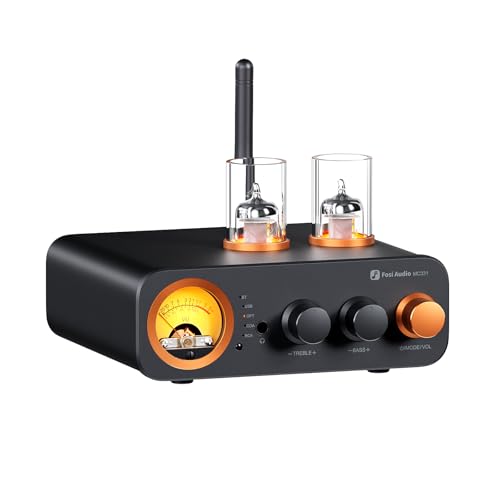
The Fosi Audio MC331 is an integrated tube DAC amplifier that combines a 5725W vacuum tube preamp stage with a Class D power section rated at 105W per channel into 4 ohms. It includes Bluetooth, USB-C, optical, coaxial, and RCA inputs, plus a 3.5mm headphone output that automatically mutes the speakers when connected. The analog VU meter and visible tubes offer a retro visual aesthetic that stands out from the plain black boxes dominating this category.
Owner reviews highlight that the tube stage genuinely adds a slight warmth and character to the sound after a 10-15 minute warm-up period, distinguishing it from typical Class D chipsets. Some units ship with tubes that fail within a few days, necessitating a replacement, but the amplifier’s performance with upgraded tubes is praised as “incredible.” The remote control has an unusual 2-second latency and requires direct line-of-sight, which irks some users, but the core functionality remains solid.
The MC331 is a great fit for a desktop hi-fi setup that also doubles as a headphone amplifier. It packs an enormous number of features into a compact, visually appealing chassis. If you are looking for a budget-friendly way to explore tube sound without sacrificing the convenience of digital inputs and Bluetooth, this is the best option available.
Why it’s great
- Multiple digital inputs including USB-C, optical, and coaxial
- Replaceable tube stage adds audible warmth to the sound signature
- Headphone amplifier with automatic speaker muting
Good to know
- Tubes can fail early; replacement tubes may be necessary
- Remote control has a 2-second latency and needs line-of-sight
- Output power in 8 ohms is lower than many discrete Class D competitors
8. Donner Stereo Receiver

The Donner Stereo Receiver is a multi-purpose karaoke amplifier claiming a 1000W peak power rating, though its actual RMS output is 25W per channel across four channels. It includes Bluetooth 5.0, USB playback up to 64GB, FM radio, two 1/4-inch microphone jacks with echo and talkover functionality, plus digital optical/coaxial inputs for TV connection. It can support up to four independent speaker pairs rated between 4 and 8 ohms, making it unusually flexible for a budget all-in-one receiver.
User feedback is sharply divided: some buyers rave about the sound quality and ease of use with basic satellite speakers, while others report that the amplifier cannot properly drive higher-end Jamo towers or Sony reference speakers, producing thin bass even with EQ settings maxed out. The EQ only affects high frequencies, and the 4-channel speaker binding posts are arranged confusingly, with eight physical terminals for four channels. The unit runs cool thanks to its Class D topology and includes a useful remote control for adjusting treble, mid, bass, and echo settings.
The Donner Receiver is best suited for casual karaoke parties or background music in a kitchen or garage with efficient speakers. It is not designed for critical music listening or high-fidelity reproduction. For the price, it offers unmatched feature density, but buy it for its party features, not its sound quality.
Why it’s great
- Dual microphone inputs with echo and talkover for karaoke
- Digital optical and coaxial inputs for TV integration
- Runs cool and includes a full-featured remote control
Good to know
- RMS power is only 25W x 4, not 1000W peak; will not drive demanding speakers
- EQ only affects high frequencies, leaving bass thin
- Speaker terminals are confusingly arranged for 4-channel use
9. Rockville RPA9

The Rockville RPA9 is a pro-audio two-channel power amplifier rated at 800W RMS total and 3000W peak, with XLR, 1/4-inch, and RCA inputs alongside SpeakON and banana-style outputs. This amp is built for DJs and live audio applications, with a dual-fan cooling system and front-panel LED indicators for signal presence, clip, and protect status. It operates in 2 ohm, 4 ohm, or 8 ohm modes, making it versatile for various speaker configurations.
Customer reviews are mixed but skew positive, with many users satisfied using the RPA9 to drive passive PA speakers for small to medium venues. A common criticism is that the real-world RMS power is closer to 200W per channel than the advertised 400W per channel into 8 ohms, meaning it may not be sufficient for large venues requiring sustained high SPL. The fans are audible and this amplifier is not recommended for quiet home listening, but for a live sound environment, the noise is completely masked by the music.
The Rockville RPA9 is an excellent budget choice for a band practice space, mobile DJ setup, or any situation where loud, clean sound is needed and fan noise is acceptable. It offers professional connectivity options at an entry-level price. For higher power needs, users should look at the Rockville RPA16 or a Crown variant.
Why it’s great
- Professional XLR and SpeakON connectors for reliable pro audio integration
- Dual-fan cooling system prevents thermal shutdown during long sessions
- Bridgeable to 2-ohm loads for subwoofer applications
Good to know
- Real-world RMS power at 8 ohms is lower than advertised
- Fans are too loud for quiet living room use
- Power rating is optimistic; peak vs sustained output gap is significant
FAQ
How much power do I actually need for 8 ohm speakers?
Can I use a 4 ohm amplifier with 8 ohm speakers?
What is the difference between Class D and Class AB for 8 ohm amplifiers?
Why does my 8 ohm amplifier feel hot even when playing quietly?
Final Thoughts: The Verdict
For most users, the 8 ohm amplifier winner is the AIYIMA A07 MAX because it delivers clean, upgradable power with a warm tonality and the unique ability to bridge into mono for system expansion. If you want a feature-packed all-in-one with streaming and digital inputs, grab the Denon PMA-900HNE. And for a pure analog hi-fi experience that sounds far more expensive than it is, nothing beats the Cambridge Audio AXA35.