
An 8-port USB to serial adapter solves one of the most persistent frustrations in industrial computing: running out of native COM ports when you need to connect multiple RS232 devices simultaneously. Whether you are managing programmable logic controllers, barcode scanners, point-of-sale terminals, or scientific instruments, daisy-chaining single-port adapters creates a rats nest of cables and driver conflicts that waste hours of setup time. A dedicated 8-port hub consolidates eight serial connections into a single USB link, bringing order to your workstation and stability to your data flow.
I’m Min — the co-founder and writer behind Gadgets Feed. I have spent countless hours analyzing technical specifications, cross-referencing driver compatibility across Windows, macOS, and Linux environments, and studying real user deployments in server rooms, observatories, and manufacturing floors to separate the reliable solutions from the troubleshooting nightmares.
This guide examines the top contenders on the market to help you find the best 8-port usb to serial adapter for your specific setup, whether you need rugged industrial construction, rock-solid COM retention, or flexible mounting for your rack or workbench.
How To Choose The Best 8-Port USB To Serial Adapter
Selecting an 8-port USB to serial adapter requires more than just counting ports. You need to evaluate the controller chipset, power delivery architecture, physical mounting options, and COM port management to ensure your multi-device setup works reliably every single time you boot up.
Chipset Selection — FTDI vs The Rest
The chipset inside the adapter determines driver compatibility across operating systems and long-term reliability. FTDI chipsets are the gold standard in the industrial serial world because they offer native drivers on Windows, macOS, and Linux without third-party headaches. Prolific and other generic chipsets can work, but they often require driver version hunting and may fail after OS updates. For an 8-port unit that you intend to use for years, FTDI-based adapters justify their premium price through sheer consistency.
Power Delivery — Bus Power vs External Adapter
An 8-port adapter draws significantly more current than a single-port dongle. Bus-powered models draw everything from the USB host port, which can lead to voltage drop or device disconnection if you connect power-hungry serial equipment. Externally powered models include a dedicated power brick that ensures each RS232 port receives stable voltage regardless of load. If your serial devices include long cable runs or active converters, choose an adapter with an external power input — it eliminates the most common source of intermittent connection errors.
Mounting and Form Factor
Permanent installations in server racks or industrial panels benefit from DIN rail clips and wall-mount brackets. A loose adapter sitting on a workbench invites accidental cable pulls that can corrupt data transmissions. The best 8-port adapters include integrated mounting hardware or optional kits that let you secure the unit inside an enclosure or on a rack rail. For portable or temporary setups, a compact desktop form factor with rubber feet may be sufficient, but confirm the cable strain relief is adequate for eight connected DB9 cables.
Quick Comparison
On smaller screens, swipe sideways to see the full table.
| Model | Category | Best For | Key Spec | Amazon |
|---|---|---|---|---|
| StarTech ICUSB2328I | Premium | Industrial 8-port setups | FTDI chipset, COM retention | Amazon |
| StarTech ICUSB2324I | Mid-Range | 4-port deployments | FTDI chipset, DIN rail mount | Amazon |
| TRIPP LITE USA-19HS | Single-Port | Single device connection | 230 Kbps, 3-ft cable | Amazon |
| PUSR USR-TCP232-410S | Serial-to-Ethernet | Network-enabling serial gear | Dual RS232/485, MQTT | Amazon |
| PUSR TCP232-306 | Serial-to-Ethernet | Modbus RTU/TCP gateway | ARM Cortex-M0, watchdog | Amazon |
| MLEEDA 10-Port KVM | KVM | Multi-PC control | 10-port, 4K@60Hz, RS232 | Amazon |
| JideTech 8-Port KVM | KVM | Rack-mount server control | 8-port, 4K@60Hz, 1U rack | Amazon |
In‑Depth Reviews
1. StarTech.com 8 Port USB to Serial RS232 Adapter (ICUSB2328I)

This is the adapter that industrial IT professionals reach for when they need eight reliable RS232 ports from a single USB connection. The StarTech ICUSB2328I uses genuine FTDI chipsets for each of its eight DB9 ports, which means Windows, macOS, and Linux all recognize the adapter without driver hunting. The rugged all-metal enclosure withstands the vibration and temperature swings of a factory floor or server room, and the integrated DIN rail clips and wall-mount brackets let you secure it permanently inside a cabinet.
COM port retention is the killer feature here. Once you assign COM10 through COM17 to your eight serial temperature controllers or PLCs, those assignments survive reboots and reconnections. No more re-mapping every time you move the adapter to a different USB port. Users report running eight devices simultaneously at 38.4 Kbps with zero communication errors, and the per-port activity LEDs make troubleshooting a breeze. The adapter is primarily bus-powered but includes an optional 5V external input for scenarios with longer cable runs or power-hungry peripherals.
Real-world feedback confirms flawless operation across Windows 7 through 11, with auto-install on recent builds. Deployments range from astronomical observatories controlling telescope mounts to ham radio stations managing multiple radios and a weather station from one USB host. The only minor quirk is non-sequential COM port mapping — port 1 may appear as COM10 rather than COM5 — but since mappings are persistent after initial setup, this is a one-time configuration step rather than a recurring frustration.
Why it’s great
- Eight genuine FTDI ports for universal driver support
- Sturdy metal case with DIN rail and wall-mount options
- COM retention survives reboots and USB reconnections
Good to know
- Port mapping can be non-sequential on first install
- Requires external power for heavy serial loads
2. StarTech.com 4 Port USB to Serial RS232 Adapter (ICUSB2324I)

If you need fewer than eight ports but refuse to compromise on build quality, the 4-port sibling of the ICUSB2328I delivers the same industrial-grade design at a more accessible entry point. Each of the four DB9 ports runs on an independent FTDI chipset, ensuring the same driver stability and OS compatibility that makes the 8-port version a favorite among IT pros. The all-metal housing with integrated wall-mount brackets and included DIN rail clips provides the same permanent-installation flexibility in a more compact form factor.
This adapter is bus-powered via a single USB connection, and for four ports that is typically sufficient. Users report successfully connecting weather stations, multiple ham radios, and communications devices simultaneously without external power. The COM retention feature works identically to the 8-port version — assign your ports once and they stay locked across reboots. Each port has its own activity LED, which is invaluable when diagnosing which device is actively transmitting in a multi-drop setup.
Customer deployments reveal a wide range of applications. Observatory operators use this hub to control telescope mounts, focusers, and filter wheels from a single USB extender run over hundreds of feet. Industrial users connect eight RS232 temperature controllers to one PC by combining two 4-port units, reporting that the non-sequential but persistent port mapping is a minor trade-off for the rock-solid reliability. If you anticipate eventually needing eight ports, consider starting with the ICUSB2328I directly — but for a permanent four-device installation, this is the most reliable option at this tier.
Why it’s great
- Same FTDI chipset and build as the 8-port version
- Compact form factor with DIN rail and wall-mount included
- USB-powered with optional external 5V input
Good to know
- Only 4 ports — may require two units for 8 devices
- Non-sequential COM mapping on first setup
3. TRIPP LITE Keyspan High-Speed USB to Serial Adapter (USA-19HS)

When you only need to connect a single serial device like a Cisco console, a card dealer machine, or an older printer, the Keyspan USA-19HS remains the gold standard for single-port USB-to-serial conversion. This adapter uses a dedicated high-speed controller that supports data transfer rates up to 230 Kbps — double the speed of a standard built-in serial port — which matters for devices that push continuous data streams. The 3-foot USB cable is permanently attached to the DB9 male connector, and the detachable USB cable section allows compact storage when not in use.
Driver support is this adapter’s strongest suit. It is plug-and-play on Windows 11, 10, 8.1, and 7, and it also works on macOS (OS 9 and OS X) and Linux (recognized as /dev/ttyUSB0). Users report flawless operation with Palm Pilot synchronization, Duplimate card dealers, and Cisco networking equipment. The green LED provides immediate visual confirmation of data activity, which helps when diagnosing whether the issue is the adapter or the connected device. An external power adapter is not needed because the adapter draws power directly from the USB port.
The two-part design — a short DB9-to-USB dongle with a separate USB cable — is a thoughtful touch for field work where you need to minimize desk clutter. A single caveat: the drivers are OS-specific, meaning you cannot have both macOS and Windows drivers installed simultaneously without reinstalling. For Mac users dealing with older serial peripherals, this is widely considered the most reliable solution on the market, with many reviewers reporting that it replaced cheap eBay cables that produced garbage data.
Why it’s great
- Proven driver compatibility across Windows, Mac, and Linux
- 230 Kbps data rate for high-speed serial communication
- Two-piece design for compact storage and travel
Good to know
- Only one OS driver set can be active at a time
- Cannot adjust RS232 settings in Windows Device Manager
4. PUSR USR-TCP232-410S Dual Serial Device Server

For scenarios where your serial devices are physically distant from the host computer, the PUSR USR-TCP232-410S converts RS232 and RS485 signals to Ethernet, enabling control over your local network. This unit features one RS232 port and one RS485 port operating simultaneously, with a 10/100 Mbps RJ45 Ethernet connection. The Cortex-M4 processor running at 120 MHz handles the protocol conversion, and power consumption stays under 1 watt, making it suitable for always-on installations in remote panels.
The device supports Modbus RTU to Modbus TCP conversion with multi-host polling, which is essential for industrial SCADA systems and PLC integration. It can also encode collected data in JSON format and transmit it via MQTT to IoT cloud platforms, supporting up to 128 data points. SSL/TLS encryption for TCP client, HTTP client, and MQTT modes, plus two-way certificate authentication, adds a layer of security for data transmitted across untrusted networks. The operating temperature range of -40°C to 85°C confirms its industrial design intent.
User feedback highlights a steep documentation curve. The default static IP is 192.168.0.7 with admin/admin credentials, and no printed instructions are included — you must access the web interface to configure work mode, local port number, and serial parameters. Some users report a failure rate after a week of operation, with the web interface becoming unresponsive while data processing continues. For point-to-point bridging across distances rather than local USB connectivity, this device works well once configured, but it demands more networking knowledge than a standard plug-and-play adapter.
Why it’s great
- Network-enables RS232 and RS485 devices over Ethernet
- Supports Modbus RTU/TCP and MQTT IoT protocols
- Wide operating temperature range for harsh environments
Good to know
- No printed documentation included in the package
- Some units lose web interface access after a week
5. PUSR TCP232-306 RS232 RS485 RS422 to Ethernet Gateway

If you need to convert a single RS232, RS485, or RS422 device to Ethernet, the PUSR TCP232-306 offers a compact, low-cost gateway with an ARM Cortex-M0 core and optimized TCP/IP protocol stack. Unlike the 410S model, this unit has only one serial port, but it supports all three serial standards (RS232, RS485, RS422) through terminal block connectors and a DB9 cable. The 10/100 Mbps Ethernet port with Auto MDI/MDIX simplifies integration into existing networks without crossover cable concerns.
This gateway is specifically designed for Modbus RTU to Modbus TCP conversion and multi-host polling, making it a natural fit for industrial automation environments where legacy serial instruments need to communicate with modern Ethernet-based controllers. Hardware and software watchdog timers automatically restart the device if it becomes unresponsive, which is a critical feature for unattended remote installations. The input voltage range accepts up to 36V DC, providing flexibility for powering the device from industrial power supplies.
Customers report using this as a drop-in replacement for Newport serial-to-Ethernet servers with straightforward configuration: set the PC Ethernet port to the 192.168.0.x subnet, access the web interface at 192.168.0.7, and configure TCP server mode with the desired local port. Python socket scripts can then communicate with the serial device over the network. The language barrier in documentation and Chinese-language customer support are noted frustrations, but once an engineer provides correct setup instructions, the device works reliably. Consider this for single-device network-enabling projects where the 410S dual-port model is overkill.
Why it’s great
- Supports RS232, RS485, and RS422 in one device
- Hardware and software watchdog for unattended operation
- Wide input voltage range up to 36V DC
Good to know
- Single serial port only
- Documentation has broken links and language barriers
6. MLEEDA 10 Port KVM Switch HDMI 4K@60Hz

This is not a serial adapter in the traditional sense, but it features RS232 control that makes it relevant for buyers searching for multi-port RS232 solutions. The MLEEDA 10-port KVM switch lets you control up to ten computers from a single monitor, keyboard, and mouse, with RS232 commands as one of three switching methods alongside front-panel buttons and a wired remote. The EDID simulation stores the monitor’s resolution and refresh rate, preventing windows from rearranging when you switch between computers — a common frustration in multi-PC setups.
The KVM supports 4K resolution at 60Hz over HDMI, with backward compatibility to 4K@30Hz and 2560×1440@120Hz. Four USB 3.0 ports provide data transfer speeds up to 5 Gbps for sharing keyboards, mice, printers, and flash drives across all connected computers. The included 12V/2A power adapter is mandatory for operation, and ten USB 3.0 cables (1.5 meters each) are included, though you must supply your own HDMI cables. RS232 control operates at a baud rate of 115200, which aligns with standard serial automation equipment.
User feedback reveals quality control inconsistencies. One unit arrived with faulty ports but was replaced promptly. The MicroUSB connector on the wired remote is fragile and should be disconnected during initial cabling. With switch time around 4 seconds, this KVM works well for shared workstation scenarios where quick switching is not critical. The active computer sees a USB hub, so plugging storage drives directly into the KVM risks data corruption when switching — stick to keyboard and mouse devices only. For users building a home lab with multiple servers, this KVM offers decent value when paired with a remote KVM-over-IP solution.
Why it’s great
- 10 ports with EDID simulation for stable display switching
- RS232 control at 115200 baud for automation integration
- USB 3.0 hub with 5 Gbps data transfer
Good to know
- Quality control issues reported with some units
- Wired remote connector is fragile
- Not recommended for USB storage drives
7. JideTech 8-Port HDMI KVM Switch 4K@60Hz
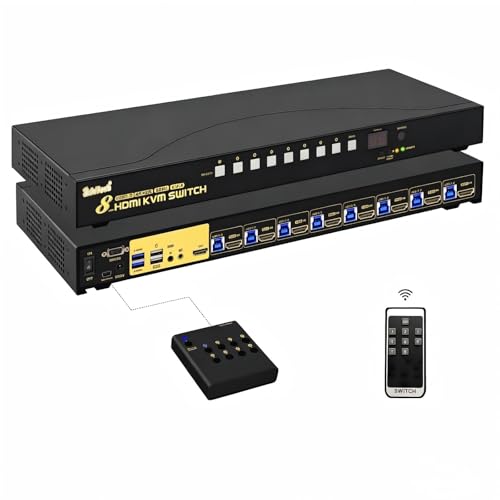
For buyers who need a professional rack-mount solution with RS232 control, the JideTech 8-port KVM switch fills a specific niche. This 1U 19-inch metal unit fits standard server racks and supports up to eight computers sharing one monitor, keyboard, and mouse. Six switching methods — front panel buttons, keyboard hotkeys, mouse double-click, wired remote, IR remote, and RS232 commands — provide flexibility for different operational workflows in server rooms and broadcast environments.
The video output supports 4K resolution at 60Hz via HDMI 2.0 with HDCP compliance, delivering clear image quality for monitoring applications. The built-in USB 3.0 hub transfers data at up to 5 Gbps, and audio input/output plus microphone support make this KVM suitable for multimedia workstation sharing. The metal rack-mount design with included rack ears ensures stable operation and organized cable management inside a standard 19-inch rack. No driver installation is required — the unit is plug-and-play with Windows, macOS, and Linux.
User reports are overwhelmingly positive for homelab and production setups. One reviewer manages a 16-port version of this KVM (the same series) controlling a desktop, Mac Mini, multiple servers, NUCs, a firewall, and a laptop. Mac compatibility is highlighted as a strength, with both Apple and PC keyboards and mice working correctly through hotkey switching. The unit runs cool and has been deployed 24/7 without issues. For users building a rack-based multi-computer control center where RS232 automation is required alongside KVM functionality, this is the most capable option in this lineup.
Why it’s great
- 8-port KVM with 1U rack-mount form factor
- Six switching methods including RS232 and hotkeys
- 4K@60Hz video with USB 3.0 and audio support
Good to know
- Premium price point for the full feature set
- Requires own HDMI cables for each connected computer
FAQ
Can I connect all eight ports to different devices simultaneously?
Why does my 8-port adapter need external power in some setups?
Will an 8-port USB to serial adapter work with my Linux system?
What is the difference between RS232 and RS485 for multi-port adapters?
Final Thoughts: The Verdict
For most users, the best 8-port usb to serial adapter winner is the StarTech ICUSB2328I because it combines genuine FTDI chipsets, permanent COM retention, and industrial-grade metal construction with DIN rail mounting into a single reliable package. If you only need four ports and want the same build quality at a lower investment, grab the StarTech ICUSB2324I. And for network-enabling legacy serial gear across long distances, the PUSR USR-TCP232-410S provides the most versatile protocol bridging capabilities in this lineup.