
Our readers keep the lights on and my morning glass full of iced black tea. As an Amazon Associate, I earn from qualifying purchases.
Specs are compiled from manufacturer listings and verified buyer reviews and can change over time — please confirm the key details on the product page before buying.
An 80-amp home EV charging station is the difference between topping up overnight and topping up in a few hours. But the real question isn’t just speed — it’s whether your vehicle can accept this power, and which charger will still work reliably years from now.
I’m Min — the founder and writer behind Gadgets Feed. This guide is built by comparing the manufacturers’ published specifications and the patterns across verified customer reviews, so you get each pick’s real strengths and trade-offs instead of marketing spin.
Before you buy, check if your EV’s onboard charger can handle 80 amps — not every car can. Matching a 80 amp home ev charging station to your vehicle is the first step to getting the right one.
Our Picks at a Glance
How To Choose The Best 80 Amp Home EV Charging Stations
Buying an 80-amp charger isn’t like buying a toaster — it connects to your home’s electrical panel and demands a dedicated 100-amp circuit for full output. Before you compare brands, check your EV’s onboard charger specs. A car that maxes out at 48 amps won’t charge faster on an 80-amp station, so you’d be paying for unused capacity. Focus on build quality, smart features, and warranty length instead.
Vehicle Compatibility First
You need an EV with a 19.2 kW onboard charger to actually use 80 amps. Popular models like the Ford Lightning, Cadillac Lyriq (optioned), Lucid Air, and Chevy Silverado EV support this rate. If your car tops out at 48 amps or 11.5 kW, a 60-amp circuit and a 48-amp charger will serve you better — and cost you less.
Hardwire vs. Plug-In
Every 80-amp station on the market today is hardwired only. A plug-in NEMA 14-50 or 6-50 outlet cannot handle the sustained 80-amp continuous current safely. Plan on hiring a licensed electrician to install a 100-amp breaker, appropriate gauge wire (usually 3 AWG copper), and a dedicated conduit. The installation cost often matches the charger’s price, so include that in your budget.
Certifications and Build
A UL or ETL certification means the unit has passed safety testing for overcurrent, ground fault, and temperature protection. Look for a metal or flame-retardant enclosure if the charger lives outdoors or in a garage. A 3- to 5-year warranty is the industry standard for reliable units. Shorter warranties or missing certifications are red flags for a product meant to last a decade.
Quick Comparison
| Model | Best For | Max Output | Cable Length | Smart Features | Amazon |
|---|---|---|---|---|---|
| Autel MaxiCharger★ Best Overall | Best Overall — AI scheduling & commercial-grade build | 80A / 19.2 kW | 25 ft | Wi-Fi + Wi-SUN, app, remote locking, 10-year lifespan rating | Amazon |
| Grizzl-E Ultimate | Tank-like durability — metal enclosure, UL certified | 80A / 19.2 kW | 25 ft | Wi-Fi, load balancing, adjustable amperage | Amazon |
| PRIMECOM 80A | Feature-packed display — LED screen & RFID access | 80A / 19.2 kW | 18.5 ft (up to 50 ft available) | App, RFID, LED display, delay timer, 15‑hour countdown | Amazon |
In‑Depth Reviews
1. Autel MaxiCharger Level 2 EV Charger
Our pick — over 4★ from 350+ verified ratings; the strongest balance of quality and price.
The fastest home charger that also thinks ahead about your electricity bill.
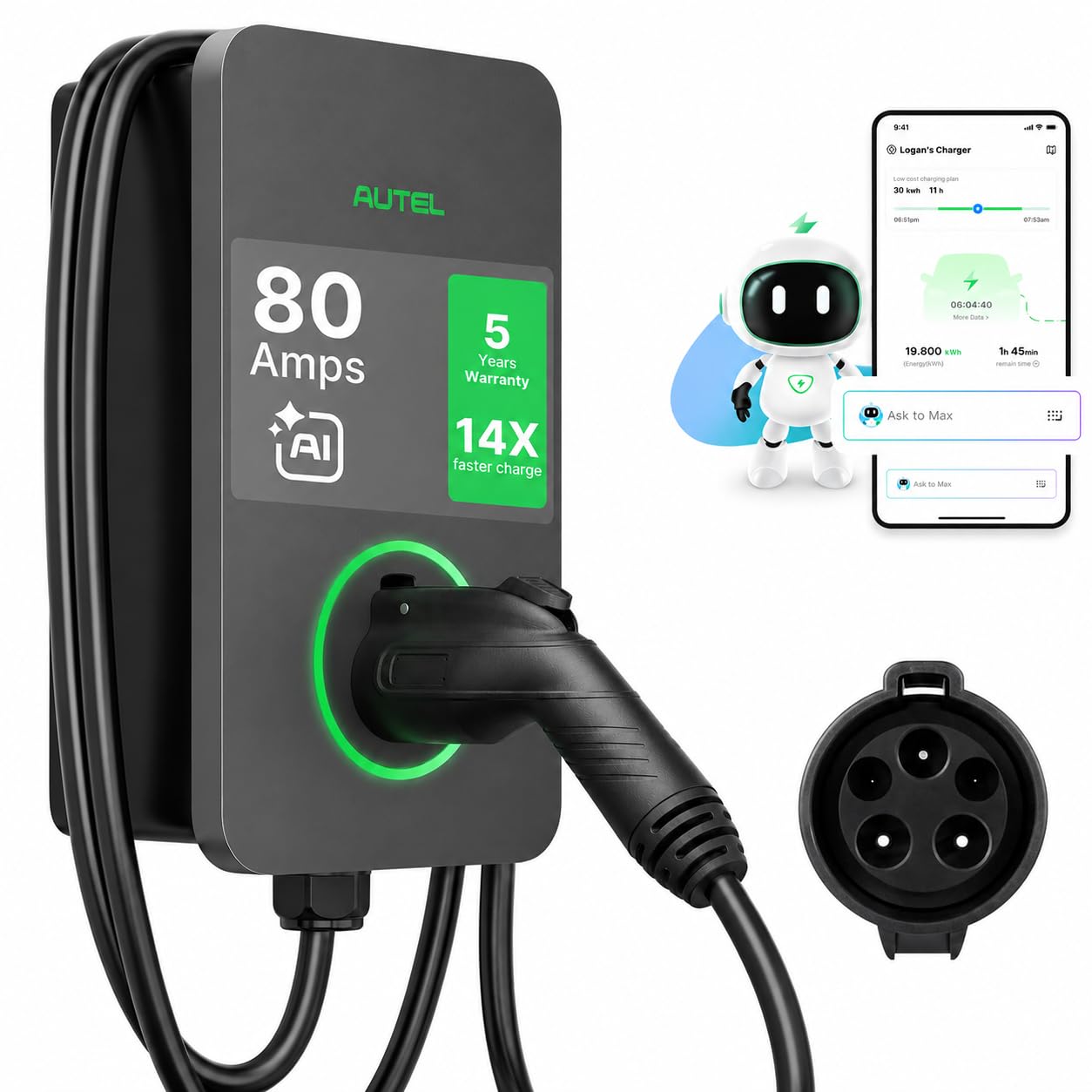
You get up to 19.2 kW at 80 amps, adding about 70 miles of range per hour — roughly 14 times faster than a standard Level 1 outlet. Buyers report it is “noticeably faster charging than a 50A unit for a 2026 Cadillac IQ.” The 25-foot J1772 cable is long enough for most garage layouts and works with all North American EVs and PHEVs (plug-in hybrid electric vehicles); Tesla owners will need a NACS (North American Charging Standard) adapter. The station is CSA certified (UL by CSA), and Autel backs it with a 5-year warranty.
What earns this the top spot over the Grizzl-E is the AI-integrated app. You can schedule charging based on time-of-use utility rates, adjust current in single-amp increments (6-80A), and monitor real-time energy data. The dual-network Wi-Fi plus Wi-SUN promise over 99.9% uptime, and the tamper-resistant screws plus remote locking add theft protection for residential and commercial installs alike. The internal temperature monitoring and flame-retardant enclosure are rated for a 10-year lifespan.
Reliability is the most-praised aspect among owners, with quality coming in second. A few owners found the app’s QR code scan finicky and the included PIN was wrong, but the unit still works as a “dumb” charger without any app at all — you can plug in and charge immediately. One vocal complaint involved a unit that developed fault messages after six months and support that the owner felt was unhelpful. That level of hassle appears rare given the volume of positive reliability feedback.
What owners rave about
- Installation is a 20-minute job for an electrician — clean internal wiring with easy connections
- Fine-grained current limiting down to a single amp (6-80A), not just preset steps
- Commercial-grade heft that makes the charger feel like it belongs in a fleet depot, not a home garage
The honest trade-offs
- Requires a 100-amp circuit breaker for full 80A output — a pro install is non-negotiable
- App setup had a weak spot: QR code scan failed for some, PIN was wrong
- A small number of owners hit support dead ends; the warranty is 5 years, but getting help took three sessions for one owner
Grab this if… You own an EV that can handle the full 80 amps (Ford Lightning, Lucid Air, Chevy Silverado EV) and you want the most polished software for time-of-use scheduling.
Look elsewhere if… Your car maxes out at 48 amps — you’d pay for speed you cannot use, and a lower-amp unit would be a better value.
2. Grizzl-E Ultimate 80A EV Charger
The EV charger you bolt to the wall and forget about — literally.
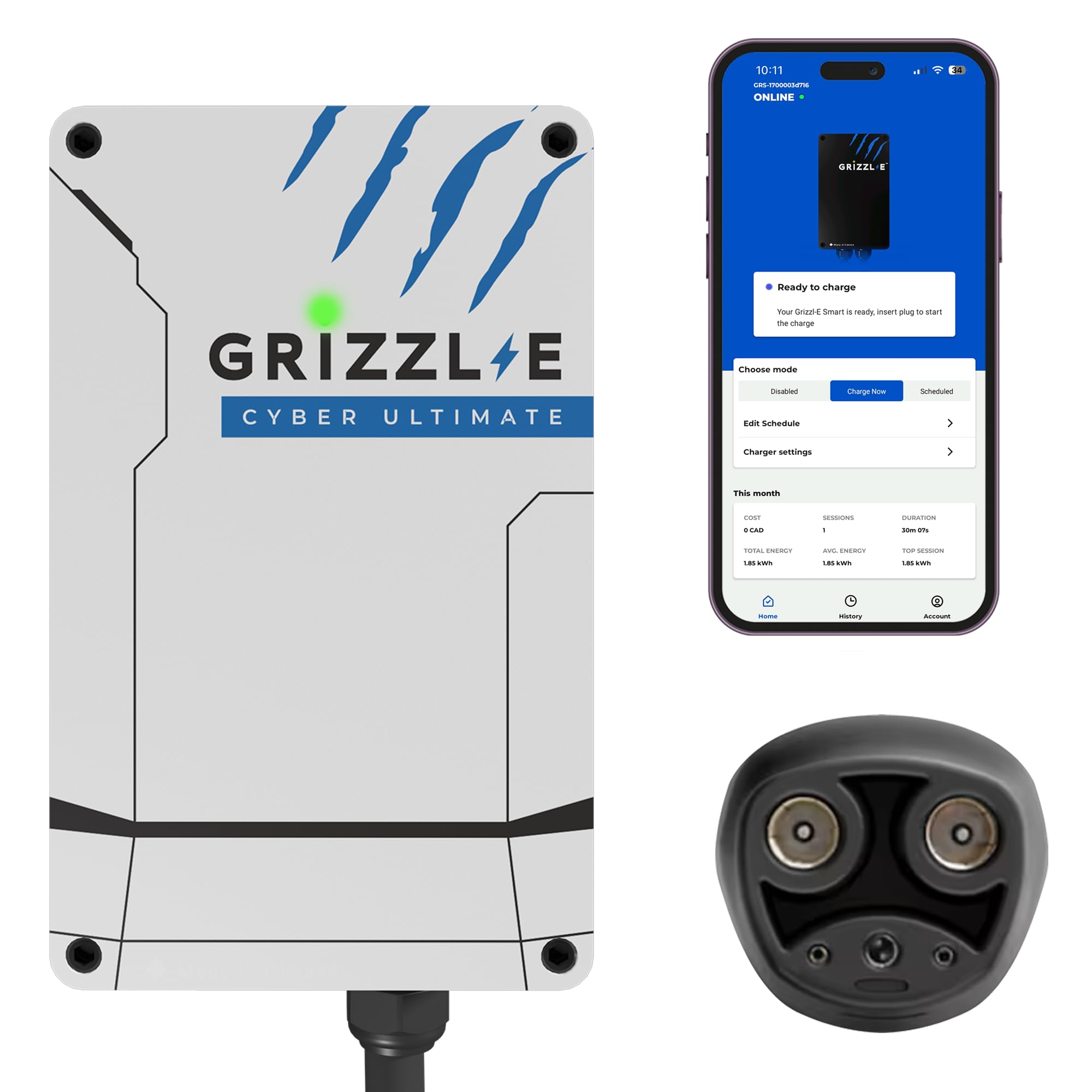
This Canadian-made charger uses a heavy-duty UL Type 4 rated metal enclosure, which means it shrugs off rain, snow, and temperature swings better than any plastic unit on the market. It delivers 80 amps (19.2 kW) from a hardwired installation and includes a 25-foot cable in either J1772 or NACS configurations. The Grizzl-E fits a 100-amp breaker for max output, but you can also adjust it down in steps (48A, 40A, 32A, 24A, 16A) to match a smaller circuit. Unlike the Autel, it does not offer single-amp increments — the adjustments are step-based.
The Wi-Fi “Grizzl-E Connect” software handles real-time monitoring, schedules, and energy consumption tracking, with an external antenna for better reception. The load balancing feature is genuinely useful if you install two units: you can set equal sharing across both cars or prioritize the daily driver. Owners who installed this themselves praised the straightforward wiring, with one achieving 78.52A / 18.66 kW on a self-run 50-foot conduit with 3 AWG copper and a 100-amp breaker. The 3-year warranty is one year shorter than the Autel’s, but the build weight and UL certification give long-term confidence.
The charging performance category is the most-discussed aspect, and reviews are mixed — not because the charger underperforms, but because some owners didn’t realize their EV can’t pull 80 amps. A Tesla owner noted the car maxes at 48A, so the full capacity goes unused. Two owners received units that had a three-blink red-light fault during charging or failed from the start entirely. The metal enclosure and safety protections (overcurrent, overvoltage, ground fault, overtemp, power outage recovery) are the real draw — durability is the main reason to pick this over the Autel.
Why it stands out
- Metal Type 4 enclosure is easily the toughest housing here — no plastic to crack or yellow
- Kit includes terminal lugs and heat shrink wrap for a clean hardwire job
- Load balancing across multiple units is a rare feature that matters for two-EV households
Know before you buy
- Only copper wire is recommended — aluminum causes overheating and shutdowns per owner experience
- Charging performance reports are mixed; the station works only as fast as your car permits
- Some units arrived faulty from the start, and support turnaround was slow for those owners
Reach for this if… Your charger sits fully exposed to rain or snow and you want a metal housing that you will not have to replace in a few years.
Think twice if… You want a proven, polished app experience — the Autel’s software and reliability track record are more mature.
3. PRIMECOM 80 Amp Level 2 EV Charger
A feature-packed display and RFID access for shared or commercial use.
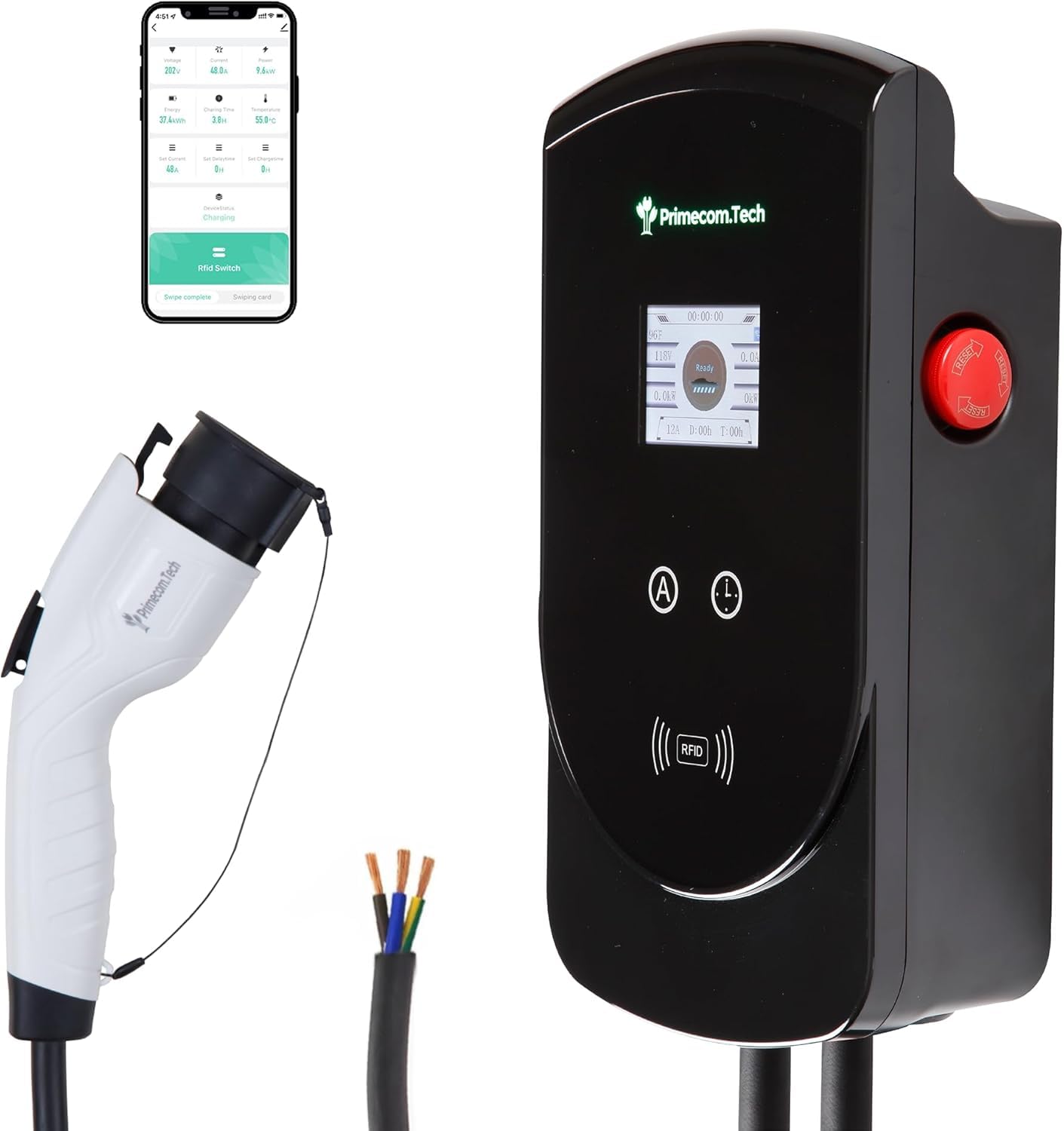
PRIMECOM differs from the Autel and Grizzl-E by including a real-time LED data screen that shows current amperage, voltage, kilowatt consumption, and temperature — plus a delay timer up to 15 hours in 1-hour increments so you can align charging with off-peak electric rates. The station delivers up to 19.2 kWh at 80 amps and claims up to 75 miles of range per hour (versus the Autel’s 70, essentially in the same ballpark). The adjustable amperage range is the widest here: 80A down to 24A in increments of 8 or 10A (80, 50, 48, 40, 32, 30, 28, 24).
Cable options range from 18.5 to 50 feet, which is more flexible than the fixed 25-foot cables on the other two picks. A company that bought six units for its electric delivery trucks reported everything worked as expected and praised the customer support. The unit is ETL certified rather than UL, which still qualifies for most safety checks and utility rebates, but it is not as widely recognized as a UL mark. The waterproof design and included RFID key fobs make it a strong candidate for a shared parking spot where you want to limit access.
Charging speed is the standout praise among owners, with performance and reliability both receiving positive notes. A Chevy Silverado EV WT 2024 owner confirmed it works well at 80A with a dedicated breaker. The downsides are harder to dismiss: a pair of reviews from one buyer described a unit damaging a Hummer EV’s internal charging components, followed by a replacement unit that also failed. The support team eventually stopped responding, according to that owner. That pattern is a greater risk than with the Autel or Grizzl-E.
What makes it interesting
- On-unit LED screen shows live charging data other chargers hide in the app
- RFID key fobs let you authorize specific users — handy for apartments or workplace parking
- Cable length choices from 18.5 ft to 50 ft cover nearly any parking layout
Honest concerns
- ETL certification is less universal than UL for some utility rebate requirements
- Two failed units in one buyer’s account raise reliability questions that the Autel and Grizzl-E don’t face
- Self-installers must avoid coiling the cable or closing a garage door on it due to heat buildup
Choose this for… A workplace, apartment complex, or any setup where you need an on-screen readout, RFID locks, and multiple cable lengths.
skip it if… You want the most proven reliability record or UL certification for confidence — the Autel or Grizzl-E are safer bets.
Understanding the Specs
80 Amps vs. Onboard Charger
The station can supply 80 amps, but your car’s onboard AC-to-DC converter determines the actual charge rate. Many EVs cap at 48 amps (11.5 kW) or 32 amps (7.7 kW). Only vehicles with a 19.2 kW onboard charger — like the Ford Lightning or Lucid Air — will pull the full 80 amps. Check your owner’s manual before you buy; otherwise, you are paying for speed that sits idle.
Hardwire and the 100-Amp Circuit
Every 80-amp Level 2 charger must be hardwired — no plug options exist because a standard outlet cannot safely sustain 80 amps continuously. You need a 100-amp breaker, 3 AWG copper wire, and a licensed electrician. The installation cost often matches the charger’s price, so factor that into your decision.
FAQ
Will an 80-amp charger work with my Tesla?
Is it worth buying an 80-amp charger if my EV only supports 48 amps?
Does the Autel MaxiCharger need Wi-Fi to function?
Can I install an 80-amp charger outdoors?
What does the RFID key on the PRIMECOM do?
How long does it take to fully charge a 100 kWh battery at 80 amps?
Is UL or ETL certification more important for an EV charger?
Can two 80-amp chargers run on the same house panel?
What happens if I use aluminum wiring with an 80-amp charger?
Does the PRIMECOM charger have a longer warranty than one year?
Final Thoughts: The Verdict
For most people, the 80 amp home ev charging station winner is the Autel MaxiCharger because it combines a strong 4.4-star crowd rating, a mature AI-driven app, and the most reassuring 5-year warranty. If you need a tank-like metal enclosure that weathers anything, grab the Grizzl-E Ultimate. And for a shared or commercial setting where an on-unit display and RFID access beats app-only control, the PRIMECOM is the one to reach for.
How We Picked
We do not accept paid placement. Every pick is matched to a real buyer and a real use-case; we do not hands-on test units.
Sources & Methodology
Specifications: manufacturer listings and product documentation. Review insights: verified customer reviews, as of July 2026. Pricing: not shown on this page (it changes often); check the current price via the retailer link.
As an Amazon Associate, Gadgets Feed earns from qualifying purchases. This does not affect which products we feature.