
An antenna that actually catches the elusive 800 MHz public safety and cellular band is the difference between hearing static and hearing the full picture. Many multi-band antennas claim wide coverage but roll off sharply above 700 MHz, leaving you with dead air where police, fire, EMS, and modern LTE signals live. The right design uses precise element phasing or a trap-tuned whip to keep the 800–900 MHz slice resonant and efficient.
I’m Min — the co-founder and writer behind Gadgets Feed. This guide comes from many hours analyzing frequency resonance curves, VSWR sweeps, and real-world user performance data across mobile, base, and scanner antenna types to isolate what actually works on 800 MHz.
Whether you’re scanning local emergency channels, adding a cellular boost to a remote router, or working dual-band ham gear, you need a unit that doesn’t treat 800 MHz as an afterthought. That’s why we built this breakdown of the 800 mhz antenna market — separating the tuned performers from the broadband compromises.
How To Choose The Best 800 MHz Antenna
Not every antenna labeled “wideband” actually pulls in the 800 MHz range efficiently. A unit that is flat from 25 to 1300 MHz on paper may have a VSWR spike right at 850 MHz, making it useless for both scanning and transmitting in that band. The key is verifying the tuned coverage across three specific bandwidth zones: VHF (150–165 MHz), UHF (450–470 MHz), and the critical 800–960 MHz slice. A purpose-designed tri-band whip or a discone with proper radial length will hold a low VSWR across all three zones.
Mounting Method and Coax Quality
The mount type defines both signal path and installation complexity. NMO mounts provide the lowest loss and the most secure ground plane for roof or hood use, while magnetic bases offer temporary flexibility but can detune the antenna slightly on 800 MHz if the cable is poor quality. For the 800 MHz range, cable attenuation is punishing — an RG58A cable loses nearly 7 dB per 100 feet at 900 MHz. Keep the coax run under 20 feet and use RG-8X, LMR-240, or better to preserve signal at the radio end.
Transmitting vs. Receiving Only
If you only scan or receive, VSWR is less critical — a discone or scanner antenna with mediocre 800 MHz match still pulls in signals. But if you plan to transmit on 800 MHz (public safety, GMRS, or ham privileges), the antenna must show a VSWR under 1.5:1 at your specific frequency. A unit that is resonant on 450 MHz and 700 MHz may reflect half your power back into the radio on 850 MHz, potentially damaging the final amplifier. Check published bandwidth specs and real user VSWR reports before buying for transmit use.
Quick Comparison
On smaller screens, swipe sideways to see the full table.
| Model | Category | Best For | Key Spec | Amazon |
|---|---|---|---|---|
| Larsen NMO150/450/800 | Tri-Band NMO | Public safety & scanner | 806–940 MHz with NMO mount | Amazon |
| Proxicast ANT-129-001 | Directional Panel | 4G/5G cellular MIMO | 7–10 dBi gain, dual N-Female | Amazon |
| Tram 1411 Discone | Base Discone | Wideband scanning & transmit | 25–1300 MHz, 300W power | Amazon |
| Midland MXTA12 | Mag Mount Base | Vehicle GMRS/HAM mobile | NMO female, strong magnet | Amazon |
| Midland MXTA27 | Lip Mount | Trunk/hood NMO mount | NMO adapter, 20 ft cable | Amazon |
| Eightwood Dual Band | Mobile Mag Mount | Budget VHF/UHF mobile | PL259, 5 m RG58 cable | Amazon |
In‑Depth Reviews
1. Larsen NMO150/450/800 Tri-Band NMO Antenna

The Larsen NMO150/450/800 is the only whip in this roundup specifically tuned with a trap for the 806–940 MHz ISM and public safety band. Most scanner whips cover 150–470 MHz and hope the 800 MHz range works — Larsen engineered the top element to resonate that third band separately, which is why users consistently report stronger NOAA and 800 MHz trunked system reception compared to untuned whips of the same height.
At 16.5 inches, it is compact enough to clear garage door frames without folding, yet the stainless steel construction handles the physical rigors of a daily-driven vehicle mount. The NMO base is the professional standard for mobile mounting, giving you the lowest DC ground resistance and most consistent impedance match from 150 MHz through 900 MHz.
Real-world reports show this whip pulling in Fire/EMS channels on the 800 MHz band that a longer discone missed entirely, and the VSWR curve stays well below 1.5:1 across the 850–870 MHz window. If you want one mobile antenna that genuinely covers the 800 MHz public safety slice without compromise, this is the choice.
Why it’s great
- Dedicated trap tuning for 806–940 MHz ensures real 800 MHz performance
- Compact 16.5 in stainless steel whip handles daily mobile abuse
- Industry-standard NMO mount for lowest-loss vehicle installation
Good to know
- Does not include an NMO mount — you need to buy a separate mag or lip mount base
- Limited power handling for high-power transmitting on 800 MHz
2. Proxicast ANT-129-001 Directional Panel Antenna

If your 800 MHz need is cellular data rather than scanning, the Proxicast ANT-129-001 is the best tool for the job. This cross-polarized MIMO panel antenna covers the full 600–960 MHz range (Band 71 through the 800 MHz cellular bands) with a focused 75-degree beamwidth and 7–10 dBi gain — enough to turn a marginal rural tower into a solid 45–50 Mbps pipe.
Real user data shows it consistently improves RSRP by 8–15 dBm and SINR by 3–6 dB when mounted 10–30 feet above ground on a pole or gutter. The dual N-Female pigtails require two coax extension cables (not included), but the MIMO architecture is essential for modern LTE and 5G routers that rely on two spatially separated signals to aggregate bandwidth.
Unlike omni whips that receive equally from all directions, this panel rejects noise from the side and rear, cleaning up the signal-to-noise ratio exactly where the 800 MHz cellular band is often crowded. For rural internet users, RV dwellers, or remote site operators who need reliable throughput on AT&T, Verizon, or T-Mobile Bands 12/13/71/5, this panel delivers measurable gains.
Why it’s great
- Genuine MIMO with dual N-Female connectors for full LTE/5G carrier aggregation support
- Directional pattern provides 8–15 dB improvement in RSRP versus omni antennas
- Weather-resistant UV-stable housing rated for continuous outdoor deployment
Good to know
- Requires two coax cables — not included — which adds –50 to the total install cost
- Directional nature means precise aiming toward the tower is critical for maximum gain
3. Tram 1411 Discone Antenna
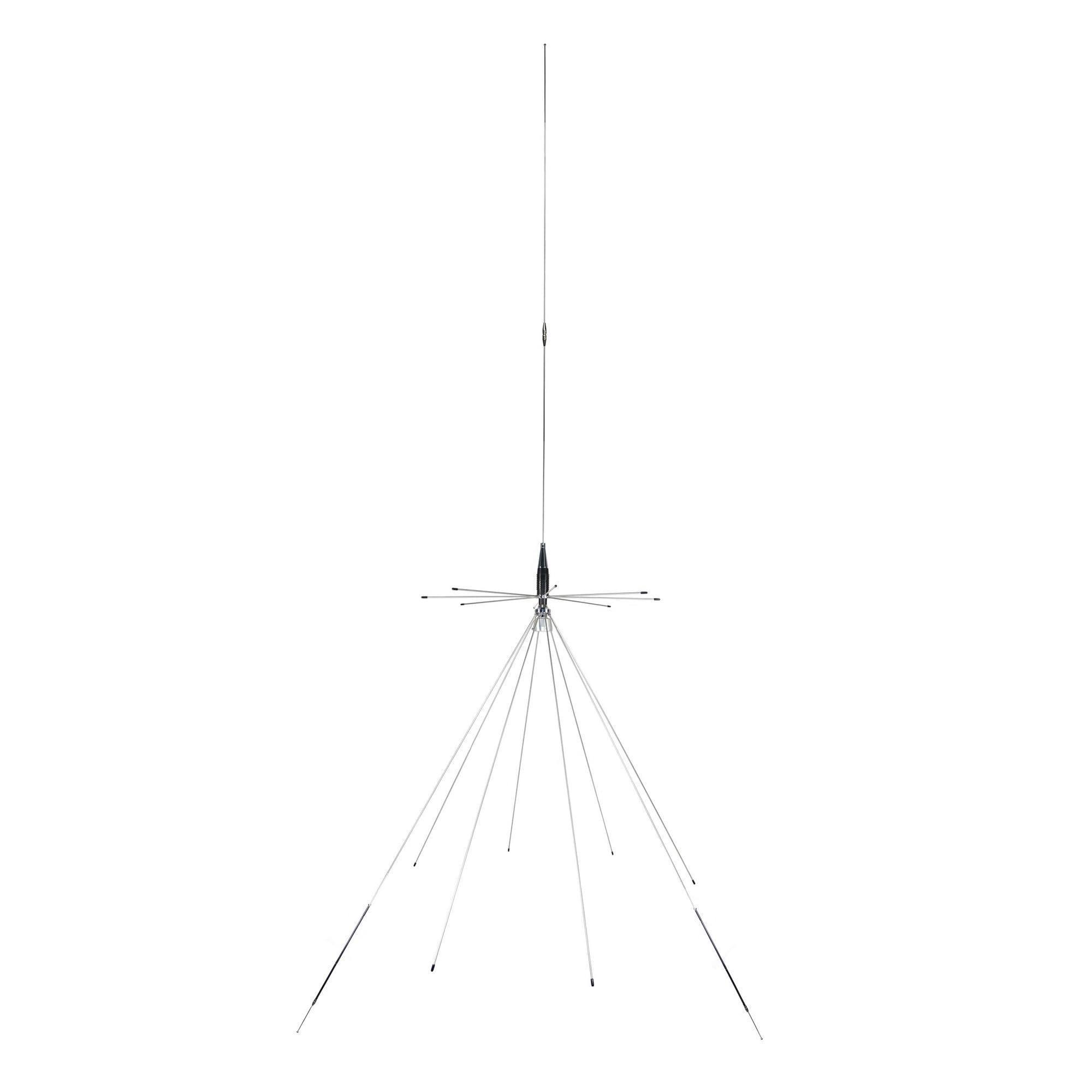
The Tram 1411 is a stainless steel discone that covers the entire 25–1300 MHz range without traps or tuning coils, making it the only base antenna in this lineup that can simultaneously receive HF, VHF, UHF, and 800 MHz with a single feedline. On the 800 MHz window, the broad radial design inherently maintains a low VSWR — useful for scanning police and fire trunked systems in the 850–870 MHz range.
Assembly requires matching the six lower radials (32 inches each) and two adjustable lower radials (48–53 inches) to the eight upper radials (10.5 inches), plus the 55-inch top whip. The aluminum hub and stainless spokes are well-constructed, though the SO239 connector lacks the typical notch for PL259 spike locks, which can allow the connector to rotate under wind load over time.
Users report CB SWR below 1.1:1 on Channel 19 after tuning, and the unit works well on 2 meters and 70 cm. On 800 MHz scanner use, the discone delivers clear reception from an attic mount when paired with an Uniden or Whistler base scanner. It is tall (roughly 6 feet assembled), so attic clearance and sturdy mast pipe are essential.
Why it’s great
- True broadband coverage from 25 MHz to 1300 MHz with one coaxial cable feed
- Rust-free stainless steel radial and whip construction for long outdoor life
- Transmit-capable on CB, 2-meter, and 70-cm bands with up to 300W power handling
Good to know
- SO239 connector lacks notch for PL259 spike lock — can loosen in wind or vibration
- Large physical footprint (6 ft tall, radials spread over 8 ft) limits installation spaces
4. Midland MXTA27 Lip Mount

The MXTA27 is a universal lip mount that fits trunk lids and hood edges without drilling, providing a secure NMO foundation for any 800 MHz whip or tri-band antenna. It comes with a UHF-to-NMO adapter, an FME-to-UHF adapter, and a 20-foot pre-terminated cable — everything you need to get a clean signal path from the antenna to a Midland or ham mobile radio.
Build quality is excellent: thick paint, robust metal bracket, and a gasket that prevents water intrusion around the lip clamp. Users report drastic range improvements from under one block to over three miles in hilly terrain after switching from a magnetic base to this lip mount, thanks to the solid ground plane and consistent cable impedance.
The main trade-off is that the bottom screw has a tendency to work loose every 6–7 months, especially on rough trails or off-road use. A dab of thread-locker on the hinge screw solves the issue permanently. For anyone running a Larsen NMO150/450/800 or similar tri-band whip, this is the mount that makes the antenna work as designed.
Why it’s great
- No drilling required — clamps securely to trunk or hood edges with a protective gasket
- Pre-terminated 20 ft cable with UHF and NMO adapters reduces installation complexity
- Delivers consistent 50W transmissions without SWR changes versus magnetic base mounts
Good to know
- Bottom hinge screws may loosen over months; thread-locker strongly recommended
- Ribbed rubber pad can detach after extended UV exposure or car-wash cycles
5. Midland MXTA12 Mag Mount Base

The MXTA12 is a magnetic NMO mount base that provides a solid 50-ohm anchor for any NMO-style antenna covering 800 MHz. The magnet is strong enough to stay planted at 80 mph on highway runs and in high winds, while the 12-foot RG58 cable offers enough reach for most SUV roof-to-dashboard routing without significantly degrading the 800 MHz signal.
Unlike some budget magnetic bases that use brass or steel nodes prone to rust, the MXTA12 uses a corrosion-resistant node that stays clean even after weeks of rain and road salt exposure. Users report that the magnet holds well on curved roof panels and does not shift during off-pavement driving. The NMO female receptacle gives you the flexibility to swap between a tri-band whip for scanning and a GMRS-specific whip for family radio use.
The RG58 cable is the limiting factor at 800 MHz — expect roughly 3–4 dB of loss through the 12-foot run at 850 MHz. If you are pushing a transmitter at full power, upgrading to a short LMR-240 jumper before the mount is a smart move. But for scanning and receiving, the MXTA12 performs admirably.
Why it’s great
- Strong neodymium magnet holds securely at highway speeds and on curved panels
- Corrosion-resistant node and quality coax reduce degradation from weather
- NMO female base accepts any standard NMO whip for flexible band coverage
Good to know
- RG58 cable introduces ~3–4 dB loss at 850 MHz, limiting transmit efficiency
- Magnetic base can add slight capacitance detuning on 800 MHz versus a hard-mount NMO
6. Eightwood Dual Band VHF UHF Antenna

The Eightwood is a low-profile dual-band antenna built for the VHF and UHF ham bands (136–174 MHz and 400–470 MHz). It does not cover 800 MHz natively — it is included here as a baseline comparison for buyers who want to understand what a standard dual-band mobile antenna misses. The compact black whip with a PL259 connector and 16-foot RG58 cable makes it easy to install on a vehicle for 2-meter and 70-centimeter repeater access.
Reception reports are mixed on this unit. Several users confirm it reaches repeaters 10–15 miles away reliably and fits under a standard garage door without removal. However, a critical review reveals that the VSWR is mediocre outside of a narrow 147 MHz sweet spot, and the high impedance on UHF could stress a transmitter. The unit is also unbranded and ships with no documentation or SWR chart.
If your needs are strictly 2-meter and 70-centimeter mobile use at a low price point, the Eightwood can work for casual daily commuting. But for any 800 MHz scanning or transmitting application, this antenna is not the tool — look instead at the Larsen NMO150/450/800 for real third-band coverage.
Why it’s great
- Very low cost — entry-level price for a mobile antenna with 16 ft cable included
- Low-profile design fits under most garage doors; no folding needed
- Works with Baofeng, Yaesu, Icom, and Midland radios via the PL259 connector
Good to know
- No 800 MHz coverage — tuned only for VHF 136–174 MHz and UHF 400–470 MHz
- High VSWR outside 147 MHz spot; risk of transmitter damage if used across broad transmit band
FAQ
Does an 800 MHz antenna cover cellular frequencies?
Can I use an 800 MHz antenna on a CB radio?
Why does my 800 MHz antenna have poor reception on 850 MHz?
Will a magnetic mount affect 800 MHz antenna tuning?
Final Thoughts: The Verdict
For most users, the 800 mhz antenna winner is the Larsen NMO150/450/800 because it is the only whip with dedicated trap tuning for the 806–940 MHz public safety and ISM band, delivering real reception and transmit capability where generic antennas fall silent. If you need cellular data improvements, grab the Proxicast ANT-129-001 directional panel for measurable MIMO gain on 4G and 5G bands. And for maximum broadband scanning coverage from a base station, nothing beats the Tram 1411 Discone — it pulls in everything from HF through 1300 MHz with a single feedline.