
Upgrading from your ISP’s rental router to your own 802.11ac model is the single most impactful cost-saving move you can make for your home network. The jump from wireless N to AC dual-band coverage not only slashes monthly fees but also delivers the sustained throughput needed for 4K streaming, lag-free gaming, and a house full of smart devices without constant buffering.
I’m Min — the co-founder and writer behind Gadgets Feed. I’ve spent countless hours analyzing the real-world throughput, range performance, and feature depth of the latest AC-class routers to separate the signal champions from the spec-sheet heroes.
Whether you need to cover a 3,000-square-foot home or simply want to stop paying your provider ten bucks a month for outdated gear, this guide to the best 802.11ac router will help you find the perfect balance of speed, reliability, and value for your home network.
How To Choose The Best 802.11ac Router
Selecting the right AC router is a balance of three things: your internet plan’s maximum speed, the physical size and construction of your home, and the number of devices competing for bandwidth. A router can handle a 100 Mbps plan in a small apartment, while a premium model with external antennas and a multi-gig port is needed to saturate a fiber connection in a multi-story home.
Speed Rating vs. Real-World Throughput
The “ACXXXX” number (e.g., AC1900) is the combined theoretical bandwidth of both bands, but real-world 5 GHz throughput typically hits 60-70% of that figure. For a 200 Mbps internet plan, an AC1200 or AC1900 router is plenty. Only upgrade to AC3200 or higher if you have gigabit fiber or frequently transfer large files over your local network.
Range, Antennas, and Building Materials
Three external detachable antennas with beamforming technology are the best bet for penetrating walls and covering 2,000+ square feet. Routers with internal antennas or two-antenna designs tend to struggle in homes with plaster, brick, or multiple floors. If your home has challenging materials, prioritize models with high-power amplifiers and adjustable antenna positions.
Firmware and Open Source Support
For tech-savvy users, a router that supports OpenWRT, DD-WRT, or LEDE can extend its useful life by years beyond the manufacturer’s last firmware update. Models like the Linksys WRT series and certain ASUS routers are famous for their robust third-party firmware communities, giving you advanced features like VPN servers, ad blocking, and traffic shaping.
Quick Comparison
On smaller screens, swipe sideways to see the full table.
| Model | Category | Best For | Key Spec | Amazon |
|---|---|---|---|---|
| Linksys WRT1900AC | Premium | Open-source enthusiasts & large homes | 1.2 GHz dual-core + 4 antennas | Amazon |
| Linksys WRT1200AC | Mid-Range | USB 3.0 & eSATA file sharing | 1.3 GHz dual-core + eSATA | Amazon |
| TP-Link Archer AX80 | Premium Wi-Fi 6 | Future-proof multi-gigabit | 2.5 Gbps WAN/LAN + 8 antennas | Amazon |
| ASUS RT-AX58U (Renewed) | Mid-Range Wi-Fi 6 | AiMesh whole-home mesh | 3000 Mbps + AiMesh support | Amazon |
| TP-Link Archer C1900 | Mid-Range | Gaming & 4K streaming | 1900 Mbps + 900 mW amps | Amazon |
| NETGEAR R6700AX | Budget Wi-Fi 6 | Saving on ISP rental fees | AX1800 + 1500 sq ft coverage | Amazon |
| T-Mobile AC1900 by ASUS | Budget | T-Mobile home internet & flashing | 1 GHz dual-core + Trend Micro | Amazon |
In‑Depth Reviews
1. Linksys WRT1900AC

The Linksys WRT1900AC remains a legend in the open-source community, powered by a professional-grade 1.2 GHz dual-core ARM CPU and four high-performance external antennas. In real-world testing, it delivers 600 Mbps on the 2.4 GHz band and 1300 Mbps on the 5 GHz band, providing solid coverage across a 4,000-square-foot home. Users report the network being detectable three blocks away, and the beamforming technology focuses signal strength directly to connected devices, eliminating the need for multiple access points.
What makes the WRT1900AC stand out is its “Open Source Ready” designation, which unlocks a vibrant ecosystem of third-party firmware. Flashing to OpenWRT or LEDE gives you granular control over QoS, VPN servers, and traffic shaping, though early driver issues on the Marvell chipset have since been resolved. The built-in eSATA and USB 3.0 ports allow for fast NAS-level file sharing, with USB 3.0 read speeds reaching 95 MB/s — a massive leap over the competition’s USB 2.0 performance.
Its OEM firmware is solid but feature-poor, lacking frequent updates after 2015. The unit runs quiet and cool, but the 2.4 GHz radio has been reported to fail after extended use in some V1 units, though Linksys customer support has been known to offer replacements. This is the ultimate router for those who want to tinker and squeeze maximum performance from their wireless AC network.
Why it’s great
- Exceptional 4,000+ sq ft coverage with strong signal penetration
- Open-source firmware support extends lifespan and feature set
- eSATA and USB 3.0 provide near-NAS file sharing speeds
Good to know
- OEM firmware lacks advanced features and hasn’t been updated since 2015
- V1 model may experience 2.4 GHz radio failure after prolonged use
2. Linksys WRT1200AC

The Linksys WRT1200AC delivers AC1200 speeds (N400 + AC867 Mbps) driven by a 1.3 GHz dual-core CPU, making it a more affordable entry into the WRT ecosystem without sacrificing the open-source compatibility that defines the series. Real-world 5 GHz throughput reaches 400+ Mbps, and users with 90 Mbps internet plans report saturating the line easily. The two adjustable, removable antennas and beamforming technology ensure solid range in single and multi-story buildings, with one user reporting 95% coverage of their home over seven years of use with OpenWRT.
Its standout feature is the combination of a dedicated eSATA port for data transfers up to 3 Gbps and a USB 3.0 port that achieves 95 MB/s read speeds — a dramatic improvement over the 15 MB/s seen on many TP-Link models. This makes the WRT1200AC an excellent choice for home offices that need fast, shared network storage without a dedicated NAS. The Smart Wi-Fi platform with Network Map allows remote monitoring and control, though the web UI can be confusing for beginners and struggles to handle both bands simultaneously with a high device count.
Setup takes roughly 27 minutes, and the router handles 23+ wireless devices without drops. However, it’s worth noting that the USB NAS feature may not work with certain enclosures, and the router’s compatibility with modern ISPs may degrade over time — some users found it dropped connections hourly after moving to a new provider. The WRT1200AC is ideal for tech-savvy users who value speed, storage, and long-term firmware flexibility over plug-and-play simplicity.
Why it’s great
- eSATA + USB 3.0 combo delivers 95 MB/s file transfer speeds
- Full OpenWRT/DD-WRT support for advanced customization
- Light 7W power draw is efficient for 24/7 operation
Good to know
- Web UI is confusing for non-technical users
- Struggles with simultaneous dual-band usage at high device counts
3. TP-Link Archer C1900

The TP-Link Archer C1900 is a proven mid-range powerhouse that uses three detachable dual-band antennas paired with 900 mW high-powered amplifiers to deliver exceptional range. In a 3,000-square-foot two-story home, users reported that the 2.5 GHz band reached approximately 500 feet from the second floor — outperforming more expensive competitors. The 1 GHz dual-core processor handles simultaneous wired and wireless connections without interruption, and the four gigabit Ethernet ports provide lightning-fast wired connections for gaming consoles and PCs.
The Archer C1900’s feature set is surprisingly deep for its price tier. It includes separate guest networks for both bands, a built-in DLNA server, and easy NAS access via USB 2.0 (though not USB 3.0). One notable limitation is that the US version cannot be flashed with DD-WRT, locking users into TP-Link’s firmware. The user interface is clean and intuitive, but the “Virtual Servers” labeling for port forwarding can be confusing. A minor firmware glitch causes the reboot button not to work, and the front LEDs cannot be dimmed or turned off individually, which can be distracting in a bedroom.
After six months of continuous use, the Archer C1900 remains stable with no drops or slowdowns, handling two desktop PCs, a VoIP line, and Wi-Fi streaming to two tablets and a phone without buffering. It’s the best value option for users who need reliable AC1900 performance, strong range, and easy setup without the complexity of open-source firmware.
Why it’s great
- 900 mW amplifiers provide exceptional 500-foot range on 2.5 GHz
- Stable performer with no drops over months of continuous use
- Built-in DLNA server and guest network support
Good to know
- US version cannot be flashed with DD-WRT
- Front LEDs cannot be dimmed or turned off
4. TP-Link Archer AX80

The TP-Link Archer AX80 bridges the gap between AC and Wi-Fi 6, offering 4804 Mbps on the 5 GHz band and 1148 Mbps on the 2.4 GHz band. Its eight high-gain antennas with beamforming technology provide vast coverage, with users reporting it replaced three separate access points in a large home. The 2.5 Gbps multi-gigabit WAN/LAN port is a standout feature, ensuring your router won’t bottleneck a fiber connection above 1 Gbps. In practice, the AX80 delivered 355 Mbps down on a 300 Mbps plan, with the farthest devices still pulling 270+ Mbps — impressive for a router in its class.
The AX80 supports MU-MIMO and OFDMA to handle many devices simultaneously, making it ideal for homes with 20+ IoT gadgets, cameras, and multiple streams. The OneMesh compatibility allows you to add a range extender seamlessly, creating a single Wi-Fi network without the complexity of a full mesh system. The TP-Link HomeShield security service provides free basic network protection, IoT device identification, and parental controls, though the premium tier requires a subscription. The USB hub feature with DC power is convenient for shared storage, though hot-swapping drives requires a reboot.
Setup is straightforward via the TP-Link Tether app, and the web interface offers deep control over QoS settings. Some users reported that enabling QoS caused intermittent dropouts, so it’s best left disabled unless you have a specific need. One limitation is that the router cannot bypass Starlink CGNAT, which may cause moderate NAT type issues on Xbox Live. Overall, the Archer AX80 is the best choice for users who want Wi-Fi 6 speeds with a multi-gig port today, while remaining backward compatible with all their AC devices.
Why it’s great
- 2.5 Gbps multi-gig port prevents ISP speed bottlenecks
- Eight antennas with beamforming cover entire large homes
- OneMesh support for easy whole-home Wi-Fi expansion
Good to know
- QoS feature may cause intermittent dropouts if enabled
- Cannot bypass Starlink CGNAT, causing moderate NAT on Xbox
5. ASUS RT-AX58U (Renewed)

The ASUS RT-AX58U (identical hardware to the RT-AX3000) is a Wi-Fi 6 router that hits an impressive sweet spot for those wanting next-gen speeds without a premium price tag. Supporting 160 MHz bandwidth and 1024-QAM, it delivers a total network speed of 3000 Mbps — 575 Mbps on the 2.4 GHz band and 2402 Mbps on the 5 GHz band. In real-world usage, renewed units from Amazon often look and perform like new, with one user reporting 700 Mbps throughput on the 5 GHz band, close to their 1 Gbps line speed. The router runs cool and is compact at roughly the size of a paperback book, though the permanent antennas add significant weight.
The defining feature of the RT-AX58U is AiMesh technology, which allows you to mix and match with other compatible ASUS routers to create a seamless whole-home mesh network. This is a massive advantage over locked ecosystems, as you can gradually expand coverage by adding older ASUS hardware. The AiProtection Pro suite, powered by Trend Micro, provides commercial-grade network security and advanced parental controls at no extra cost. Setup is handled via the ASUS Router App, which gives you full control over every feature from your phone.
However, the RT-AX58U is not without quirks. Renewed units often ship with outdated 2020 firmware, which can cause mesh setup issues until manually updated. The rear WPS button is tiny and hard to press, and the right-angle DC power plug covers the power switch — a clear design oversight. The smartphone app is less capable than the web interface, and firmware upgrades can sometimes fail mid-process. Despite these minor annoyances, the RT-AX58U is an excellent value for those building an ASUS mesh system or wanting reliable Wi-Fi 6 performance on a budget.
Why it’s great
- AiMesh support allows mixing with other ASUS routers
- Real-world 700 Mbps 5 GHz throughput close to line speed
- AiProtection Pro provides free commercial-grade security
Good to know
- Renewed units may ship with outdated firmware requiring manual update
- DC plug covers power switch; WPS button is excessively small
6. NETGEAR R6700AX
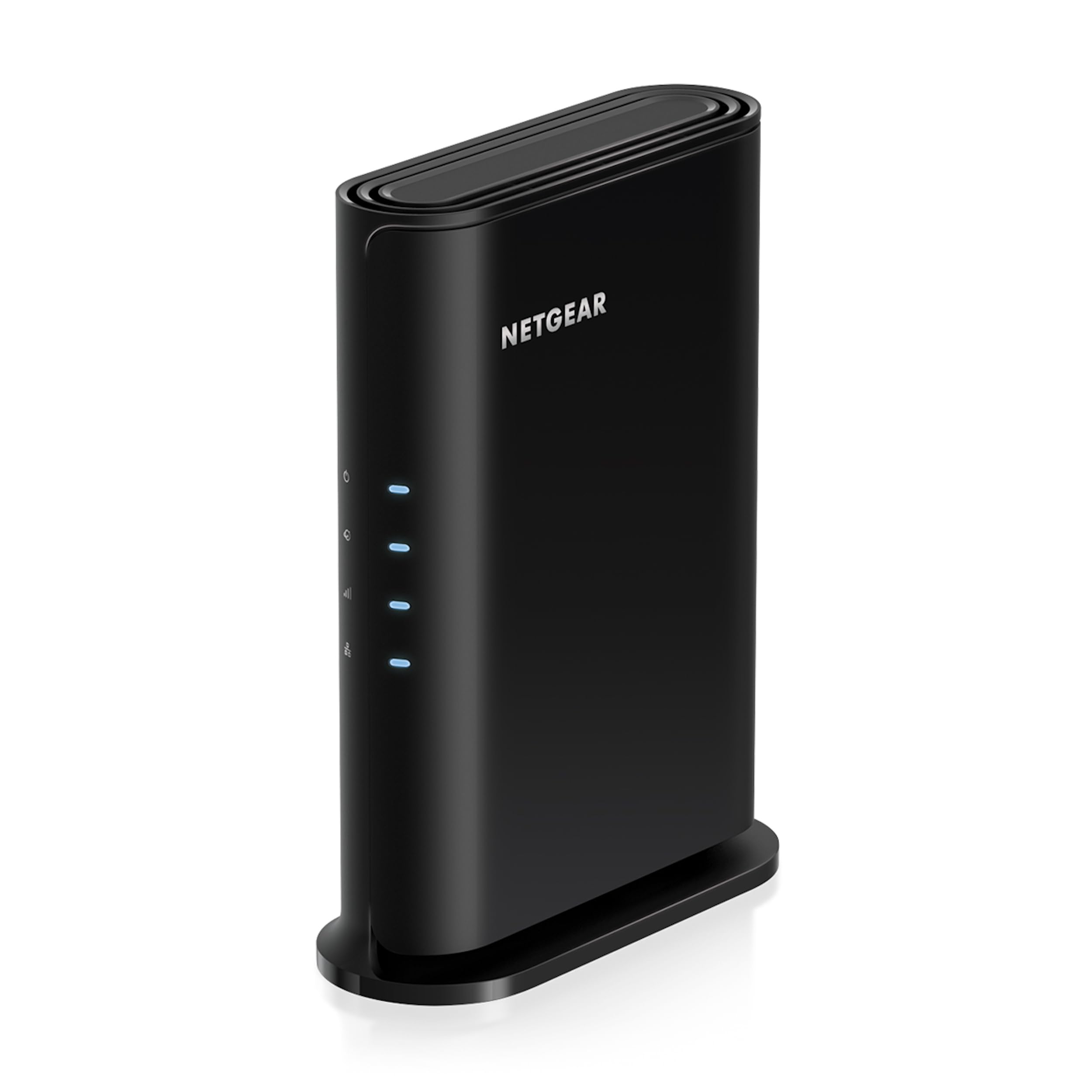
The NETGEAR R6700AX is a Wi-Fi 6 router that hits the entry-level price point perfectly, offering AX1800 speeds (up to 1.8 Gbps across both bands) and coverage up to 1,500 square feet. In a 1,500-square-foot condo, it delivered 113.72 Mbps down and 12.07 Mbps up with a 15 ms ping — excellent for a 100 Mbps plan. The compact design and internal antennas make it unobtrusive, and the 4 gigabit Ethernet LAN ports provide ample wired connections for gaming consoles and streaming devices. Setup via the free NETGEAR Nighthawk app is intuitive, with built-in troubleshooting that guides you through common issues.
This router is designed for small to medium homes with up to 20 devices, handling simultaneous streaming, video calls, and smart home devices without noticeable slowdown. It’s backward compatible with Wi-Fi 6 and older devices, so you can upgrade now and enjoy better performance on your current laptops and phones. The WPA3 encryption and automatic firmware updates come at no extra cost, offering a solid baseline for security. The optional NETGEAR Armor security suite includes a 30-day free trial, but it requires a paid subscription to continue.
The biggest selling point of the R6700AX is the financial savings. Replacing an ISP rental router that costs /month pays for this router in less than five months. Users consistently report identical or better performance compared to provider-issued equipment, with one user stating it works “just as well or better” than their Spectrum rental. However, this is a router-only device, so you’ll need a separate modem or ISP gateway. Some users have reported reliability issues after a year, with a small number experiencing hardware failure and poor support experiences without a paid subscription.
Why it’s great
- Pays for itself in under 5 months vs. ISP rental fees
- App-based setup with excellent troubleshooting guidance
- WPA3 encryption and automatic updates included at no cost
Good to know
- Router-only; requires a separate modem for internet access
- Some units may experience hardware failure within a year of use
7. T-Mobile AC1900 by ASUS

The T-Mobile AC1900 by ASUS is essentially a carrier-locked variant of the legendary ASUS RT-AC68U, powered by a 1 GHz dual-core CPU and 3×3 802.11ac technology for combined speeds up to 1900 Mbps. This router is physically identical to the RT-AC68U but is locked to the T-Mobile GSM network, meaning it will NOT work with any other carrier unless you flash the firmware. For T-Mobile home internet users, this is a straightforward plug-and-play upgrade that delivers 200+ Mbps throughput with better coverage than a standard wireless N router, easily handling 35 devices without drops.
For the technically inclined, this router is a goldmine. Flashing it to standard RT-AC68U firmware unlocks the full ASUS feature set, including Trend Micro AiProtection, VPN, traffic shaping, and shared storage via USB. In access point mode, users have reported 220 Mbps down throughput throughout a house, outperforming dedicated enterprise access points like the UAP-AC-PRO-US. The 256 MB of RAM and 800 MHz dual-core CPU (or 1 GHz in some revisions) provide plenty of headroom for open-source firmware like DD-WRT or Tomato.
However, the T-Mobile lock is a double-edged sword. Without flashing, you lose access to Trend Micro security features, and some T-Mobile versions ship with older, feature-stripped firmware. There’s also a risk of bricking the router during a firmware flash if not done correctly. For T-Mobile subscribers willing to tinker, this is the best value AC1900 router available. For everyone else, the carrier lock makes it a non-starter. The router’s Wi-Fi calling support is a bonus for users with weak cell signals, and its longevity outlasts many routers on the market.
Why it’s great
- Can be flashed to full RT-AC68U firmware for advanced features
- Handles 35+ devices without drops, outperforming enterprise APs
- Supports Wi-Fi calling and has excellent longevity
Good to know
- Locked to T-Mobile network; will not work with other carriers
- Stock firmware lacks Trend Micro security; flashing required to unlock
FAQ
Can I use an 802.11ac router with a fiber gigabit internet plan?
How do I flash third-party firmware on my AC router?
Will an 802.11ac router work with my older wireless N devices?
Final Thoughts: The Verdict
For most users, the best 802.11ac router winner is the TP-Link Archer C1900 because it delivers exceptional range via 900 mW amplifiers and rock-solid stability at a mid-range price point. If you want open-source firmware flexibility and massive coverage, grab the Linksys WRT1900AC. And for those saving on ISP rental fees with reliable budget performance, nothing beats the NETGEAR R6700AX.