
Our readers keep the lights on and my morning glass full of iced black tea. As an Amazon Associate, I earn from qualifying purchases.
Specs are compiled from manufacturer listings and verified buyer reviews and can change over time — please confirm the key details on the product page before buying.
A quick note before the picks: this list uses flexible, human-like matching for engine displacement. That means you may see the standard 66cc/80cc class sold as “80cc” alongside a couple of larger-bore kits that serve the same conversion purpose. Not every pick is the exact number you typed into the search bar. The nearest same-type size does the same job, and you deserve to know that upfront.
I’m Min — the founder and writer behind Gadgets Feed. This guide is built by comparing the manufacturers’ published specifications and the patterns across verified customer reviews, so you get each pick’s real strengths and trade-offs instead of marketing spin.
Fitting one means hand tools, patience, and a real afternoon of work — not a plug-and-play upgrade. Below you’ll find the genuine standouts for anyone shopping for the best 80cc bike motor kit, plus the frame measurements and break-in habits that decide whether your build actually runs.
Quick Picks
- 80cc Bicycle Engine Kit, 2 Stroke Motorized — Best Overall
- Sange 2 Stroke Pedal Cycle Petrol Gas Motor — Best for Tinkerers
- 2 Stroke 100cc Bicycle Motorized Gasoline — Fastest Kit
- 80cc 2 Stroke Bicycle Engine Motor Gas — Best Fit Spec
- IMAYCC Bike Motor Kit 80cc Motorized Bike Kit 2 — Most Reviewed
- TDPRO Upgraded 80cc Motorized Bicycle Bike 2 — Longest Range
How To Choose The Best 80cc Bike Motor Kit
You want a motorized bike that runs for years, not one that rattles apart in a week. A motorized bike kit is a pile of metal parts plus an engine, and the difference depends on three or four measurements you can take with a tape measure before you buy anything.
Measure your frame before you measure anything else
The single most common mistake is buying by engine size and ignoring the frame. You want a V-frame bike — the older triangle shape, not a step-through — in the 26 to 28 inch wheel range.
The critical gap is the space between your bottom bracket (the crank housing at the base of the frame) and the top bar. One of the kits here calls for 9 to 11 inches of clearance, while another asks for 10 inches and up. Measure this first.
Frame tube diameter matters too. A tube around 25 to 29 millimeters, roughly an inch, is what the mounting brackets are built to clamp onto. Fat-tire cruisers and oversized tubes will fight you the whole way.
Know what “80cc” actually means at the counter
Almost everything sold as an 80cc kit is the standard 66cc class engine — the same casting, marketed with the bigger number. That is normal in this category, and it is why this guide treats the 66cc/80cc class as one family.
What actually separates kits is not the printed displacement. It is the carburetor quality, the clutch pin length, the chain and sprocket pairing, and whether the mounting hardware was cut to fit a real bike frame.
Budget for the second trip to the hardware store
Every kit here assumes you have basic hand tools and some mechanical confidence. Realistically, plan on a chain breaker, a center punch, and time to chase down a shorter spark plug or an angled intake manifold if your frame is tight.
You also need to mix fuel yourself. New engines want a richer oil ratio during break-in, then settle into a leaner mix once the rings seat. Get this wrong and the engine pops, jerks, and never settles into a smooth idle.
Quick Comparison
| Model | Best For | Engine | Top Speed | Fitment | Amazon |
|---|---|---|---|---|---|
| 80cc Bicycle Engine Kit with Digital Computer | First-time builders who want the electronics included | 80cc 2-stroke, 2.1KW, 2.58hp | 23.61 mph | 26-28″ V-frame | Amazon |
| Sange 2 Stroke Pedal Cycle Conversion Kit | Mechanical tinkerers who enjoy the build | 80cc single-cylinder, air-cooled | 45km/h | 26″ or 28″ frames | Amazon |
| 2 Stroke 100cc Bicycle Motorized Engine Kit | Riders chasing outright top speed | 100cc 2-stroke | 55km/h | 26″ or 28″ bikes | Amazon |
| 80cc 2 Stroke Bicycle Engine Motor Kit (Red) | Riders wanting a defined clearance spec to measure against | 80cc 2-stroke, 5hp at 6000r/min | 38km/h | 26″ or 28″ V-frame, 9-11″ clearance | Amazon |
| IMAYCC Bike Motor Kit 80cc | Buyers who want the most documented owner experience | 80cc single-cylinder, 2.1Kw/5000rpm | — | 26-28″ V-frame, 10″ clearance | Amazon |
| TDPRO Upgraded 80cc Motorized Bicycle Kit | Long-distance riders who want tank range | 80cc 2-stroke, single-cylinder | 38 mph | 24″ or 26″ bikes | Amazon |
In‑Depth Reviews
1. 80cc Bicycle Engine Kit, 2 Stroke Motorized Bike Kit, Petrol Bikes Motor with Digital Computer for 26-28″ Bikes
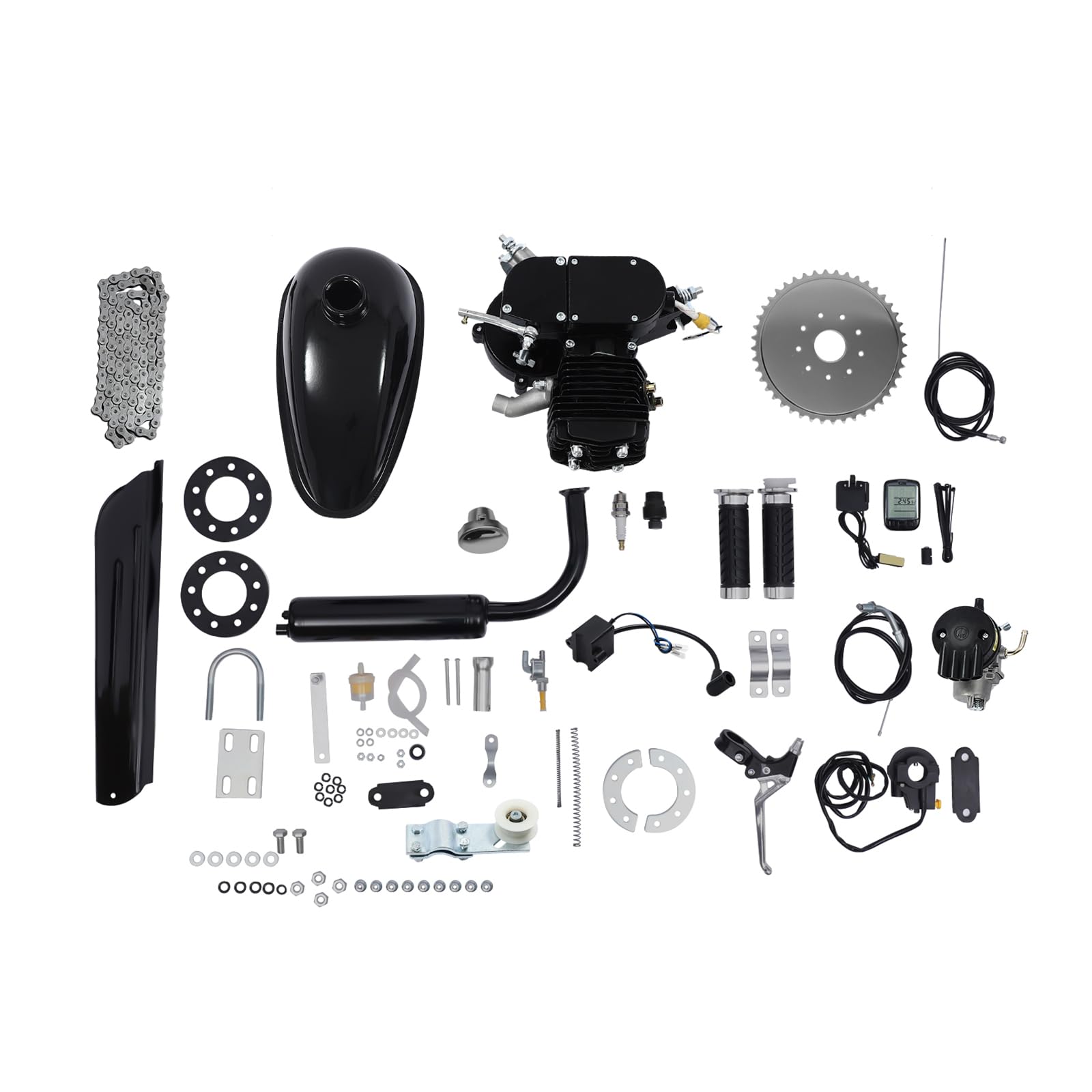
The rare kit that ships with the dashboard already in the box.
Most motor kits leave you guessing your speed and counting fuel stops in your head. This one includes an electronic speedometer as standard, along with the engine, muffler, carburetor, fuel tank, chain, ignition coil and CDI, and two rubber grips. You unbox one purchase and have the full conversion.
The 2-stroke engine makes 2.1KW (2.58hp) and tops out at 23.61 mph (about 38km/h). It burns roughly 0.53 gallons per 62.14 miles, and the aluminum-and-iron body is rated for impact resistance. It fits most 26-28 inch V-frame bikes, mountain and road models included.
The honest part: this is a kit that rewards patience over speed. Buyers report it starts near 15mph and needs about a week of riding to loosen up and reach its full 28mph. A few units have arrived without spark from the start. Plan your first week as a break-in period, not a debut.
What the box actually delivers
- Speedometer included — no separate gauge purchase
- Full assembly hardware: chain, tank, carburetor, CDI, muffler, grips
- 2.58hp and 23.61 mph top speed for a 26-28″ V-frame
- Aluminum and iron construction rated for impact resistance
Before you commit
- Break-in takes about a week of riding before full speed arrives
- No-spark units have shown up in the reviews
- Front-wheel-drive drivetrain and caliper brakes only — not a disc-brake setup
The build for you if: you want a complete first conversion — speedometer, tank, and all mounting hardware in one order — on a standard 26-28 inch V-frame.
Think twice if: you need day-one full speed, or you ride a step-through or fat-tire frame, which won’t clear the mounting hardware.
2. Sange 2 Stroke Pedal Cycle Petrol Gas Motor Conversion Kit, Air Cooling 80cc

A build for the person who owns an angle grinder and isn’t scared of it.
The core is a single-cylinder, air-cooled 2-stroke 80cc gasoline engine made of steel, rated for strength and hardness. It converts a regular pedal bike into a motorized one and tops out at 45km/h. Ignition runs on a capacitor discharge system, and the motor is tuned to keep noise and vibration low so you can ride it in a residential neighborhood without getting the side-eye.
What wins people over here is how much fun the finished bike is to ride — the joy of the build genuinely comes through in the owner feedback. It burns 3 liters per 100 kilometers, and the kit includes the engine, fuel tank, muffler, and mounting hardware for most 26 or 28 inch mountain bikes, road bikes, and cruisers. It weighs 24.2 pounds before installation.
This kit assumes you have mechanical skill. The build involves drilling and angle grinding (cutting metal with a spinning abrasive disc), and among the most-discussed issues is carburetor trouble right from the start — the carburetor mixes fuel and air for the engine. A handful of owners mention they had to upgrade the throttle handle because it was attached with glue that gave out. If you enjoy the challenge, that’s the point. If you want a bolt-and-go experience, look elsewhere. As buyers put it: “The hardest part was the back wheel, I loved the challenge!!!”
Where the money goes: A steel engine with discharge ignition, low-vibration tuning, and a full hardware set for the 26-28 inch frame family — you’re paying for the engine and the raw materials, not for pre-fitted conveniences.
The honest trade-off: The kit is roughly a quarter heavier than the IMAYCC system — 24.2 pounds versus 11.14 kg, which works out to a meaningful difference in what you’re muscling onto the frame. And it’s a project, not a product.
Worth it for: experienced home mechanics who already own a drill and an angle grinder and want a project bike that’s genuinely fun once it rolls.
Pass if: you’ve never rebuilt a carburetor and want your first kit to bolt on without modification.
3. 2 Stroke 100cc Bicycle Motorized Gasoline Engine Motor Kit (Black)
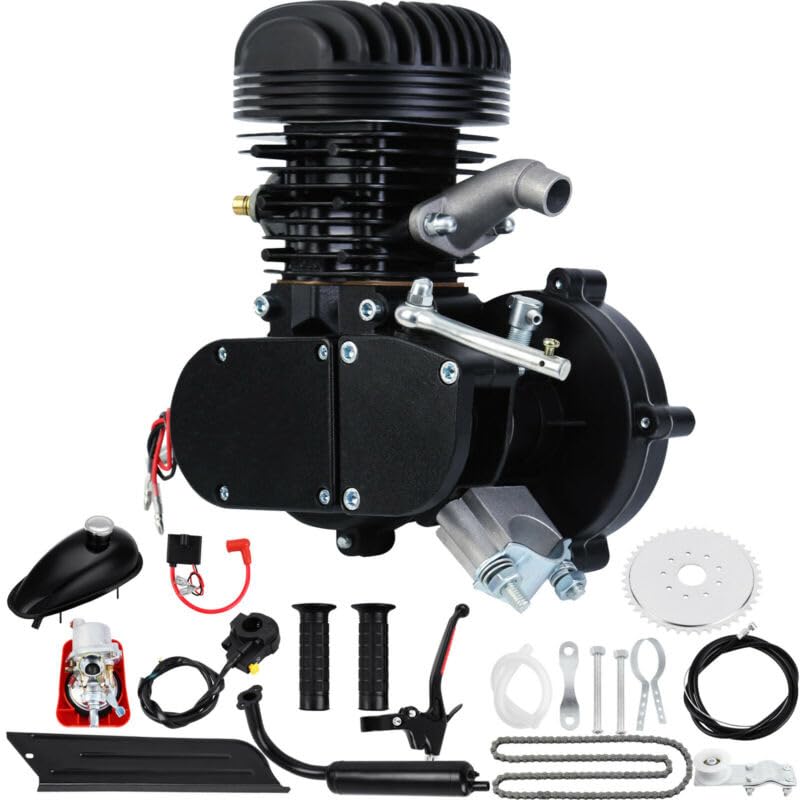
The one that leaves the others standing at the traffic light.
If you want the biggest engine available in this bracket, the 100cc is definitive — it laps the 38km/h Red kit by a wide margin and even beats the fast 55km/h figure cleanly. At 55km/h, you can keep pace with city traffic on a bicycle frame. It burns 2.5 liters per 100 kilometers — the lowest fuel use on this list — and it’s also the fastest. Ignition runs on capacitor discharge with electronic ignition, and the kit ships with all required hardware plus a detailed instruction manual.
Owners back up the fundamentals: one put five miles on it during proper break-in and called it great, and another confirmed it hits the claimed 55mph. Owners call the build quality solid and the manual’s color pictures well laid out.
This kit has a familiar catch for anyone who has bought from this category before: at least one unit required the carburetor to be rebuilt before the engine would run at all, and the included instructions didn’t cover the job — that owner had to hunt down a video tutorial. This engine also runs hot and requires you to add lubricant oil before every startup. Skip a step and you risk cylinder scoring (scratches inside the engine that cut power). Follow the maintenance routine and this is the fastest kit you can get here.
The top-speed case: Nothing else on this list matches 55km/h. Where the Red 80cc kit hits 38km/h and the Sange 80cc tops out at 45km/h, the 100cc pulls ahead with a real margin.
Fuel economy advantage: At 2.5 liters per 100km, this 100cc kit uses less fuel than the Sange’s 3 liters per 100km — the fastest engine here is also the thirstiest to cross off your list.
Grab this if: top speed is the whole point for you, and you’re ready to add oil before every single start and treat the carburetor as a wear component.
Reconsider if: you want a turnkey engine that runs correctly the first time or you’re unwilling to mix oil at an 18:1 ratio for break-in.
4. 80cc 2 Stroke Bicycle Engine Motor Gas Motorized Bike Motor Kit (Red)

One of the few kits that tells you exactly what size your frame needs to be.
Ask anyone who has wrestled a motor onto a bike frame and they’ll tell you the spec that matters is clearance. This kit actually spells it out: your V-frame needs 9 to 11 inches between the bottom bracket and the top bar, and your frame tubes should measure 25 to 29 millimeters in diameter, roughly an inch. It fits most 26 or 28 inch wheels across mountain, cruiser, chopper, and road styles. Measure first — this is the pick to buy against your tape measure.
You get a top speed of 38km/h from an 80cc 2-stroke engine (a simple engine that fires once per revolution and needs oil mixed in) rated at 5 horsepower at 6000r/min, with a 47mm bore and 40mm stroke. It burns 2.5 liters per 100 kilometers of fuel, so a short commute barely touches the tank. Installation runs 2-3 hours for a rider with basic hardware tools and skills. The box includes the engine, sprocket clamp assembly, exhaust muffler, push-button clutch, heavy-duty chain, bearing chain tensioner, carburetor, CD ignition coil, kill switch on the throttle, chain guard, spark plug, gas tank mounting brackets, and a plug removal tool. Item weight is 24.7 pounds.
Two honest notes. At 38km/h this is one of the slower kits here — the 100cc beats it on outright speed by a wide margin — so buy it for the fitment guidance and the well-documented frame spec, not the stopwatch. And you’ll need to add lubricant to the cylinder before every start to avoid scoring, same as any 2-stroke in this class.
Documentation that actually helps: The 9-11 inch clearance figure and 25-29mm tube spec are published up front, so you can rule this kit in or out before you order. Most kits leave you to figure that out after the box arrives.
A slower engine with a bigger price: 38km/h doesn’t beat the 45km/h Sange or the 55km/h 100cc, and it costs more than either. You’re paying for the comprehensive parts list and the fitment clarity.
The right call for: anyone who prefers to measure their frame’s bottom-bracket clearance first and buy a kit they already know will fit.
Not the pick if: speed is your priority, or your frame measures outside the published clearance range.
5. IMAYCC Bike Motor Kit 80cc Motorized Bike Kit 2 Stroke Gas Bicycle Engine Conversion Kit
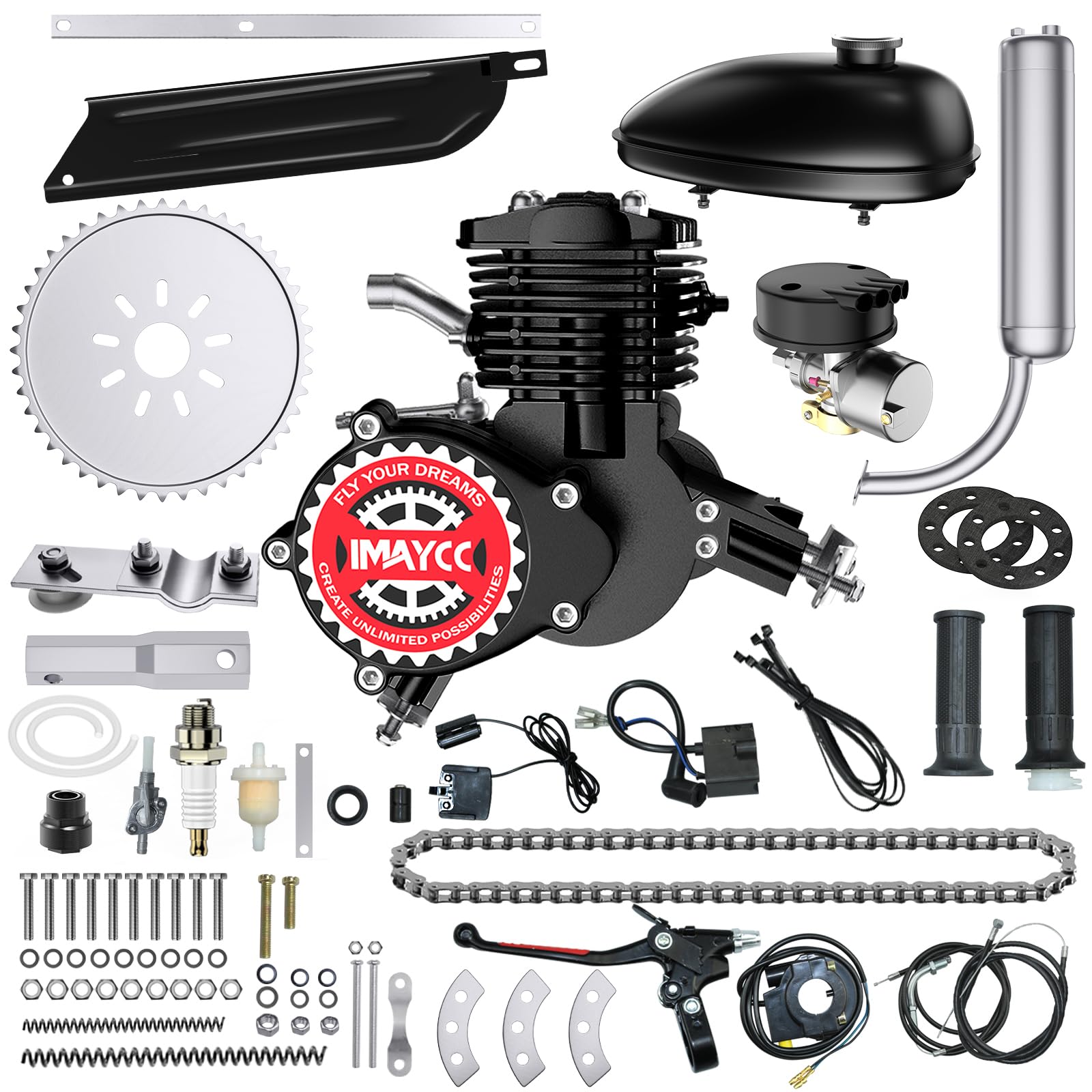
The most-documented kit here — and the one with the longest list of owner advice.
No kit here has a bigger owner track record than this one, and the guidance that comes with it is unusually specific. The 80cc air-cooled two-stroke single-cylinder engine puts out 2.1Kw at 5000rpm, drives through a 44-tooth sprocket and a 110-link chain, starts by foot pedal, and fires on CDI ignition. It fits 26-28 inch V-frame bikes with 10 inches or more of clearance at the bottom bracket. The teardrop fuel tank holds 2.5 liters, and fuel consumption runs 2-2.5 liters per 100km at 20-25km/h on smooth road.
Customers note that a 15-year-old built one in two days and it ran great; another build hauled a 211-pound rider plus a 56-pound frame up a slight incline at 35mph on a 26-inch mountain bike. The engine itself earns praise for feeling strong and reliable, with the recurring advice being to throw out the printed manual and follow a YouTube walkthrough instead. Several owners recommend checking frame clearance before you start the detail work, and one notes the coil arrived defective and needed replacing.
The real limitation is space. That same rider found the fit so tight on a 26-inch frame there was no clearance for the spark plug or carburetor, and solved it with a shorter spark plug and a 90-degree offset intake. If your frame is roomy this is a fantastic kit for the money. If it’s tight, budget for a couple of extra parts before your first ride.
What owners keep confirming
- 2.1Kw at 5000rpm engine with 44-tooth sprocket and 110-link chain
- 2.5L teardrop tank; 2-2.5L fuel use per 100km at 20-25km/h
- Fits 26-28″ V-frames with 10″+ bottom-bracket clearance
- Largest verified owner feedback base of any kit in this guide
What to plan around
- Spark plug and carburetor clearance is tight on smaller frames
- Printed instructions are widely ignored in favor of video tutorials
- Occasional defective coil reported on arrival
Buy this for: the strongest real-world proof of what the engine can do, combined with a 2.5L tank and a documented 26-28 inch fitment standard.
Budget for: a shorter spark plug or offset intake if your 26-inch frame runs tight, plus 2-4 hours of install and tuning time on your first build.
6. TDPRO Upgraded 80cc Motorized Bicycle Bike 2 Stroke Gas Motor Engine Kit

The distance cruiser of the bunch — a full tank gets you a serious ride.
If your build is for commuting or long weekend rides rather than buzzing around the block, range is the number that matters. This TDPRO kit runs a 2L gas tank that the maker rates at around 55 miles. Considering the Red kit’s 24.7-pound total weight and the IMAYCC’s tighter tank capacity, this one is built to keep you rolling without a fuel stop interrupting the trip.
The engine is an 80cc 2-stroke single-cylinder, air-cooled, driving a 415 chain through a chain-drive setup and a single speed. It fits 24-inch and 26-inch bikes. The kit arrives complete with mounting brackets, gaskets, and installation hardware, and one reviewer noted the parts were well-packaged and the install went smoothly despite a plastic bag splitting in transit.
The catch is the speed. It’s rated at 38 mph, and even that figure is soft — one buyer mentioned it’s “not that fast.” A few units have shown up with fuel leaks, so check the seals straight from the start. If you need to cover ground rather than win races, this is the pick. If top speed is what you’re after, the 100cc above leaves this one behind at the traffic light.
The range argument: A 2L tank rated for around 55 miles is the strongest endurance figure here. For a weekly commuter, that’s fewer fuel stops and less mixing.
Speed reality check: 38 mph is the ceiling, and owners describe it as adequate rather than quick. The promised speed and the felt speed don’t always match.
Choose it for: commuting and distance riding where the 55-mile tank range and 24-inch/26-inch fitment suit your bike.
Look past it if: you want a fast build, since 38 mph is the cap and the 100cc kit rides comfortably above it.
Understanding the Specs
Fuel-to-oil ratio
A 2-stroke engine has no separate oil reservoir, so the oil that lubricates the cylinder rides in the gasoline you mix. New engines want a richer mix so the rings seat without scoring the cylinder bore. Once broken in, you lean the ratio out. Running a lean mix before break-in, or forgetting to add oil before a cold start, is the fastest way to score a cylinder.
Frame clearance and V-frame fitment
The engine mounts between the bottom bracket (the crank housing) and the top tube. That gap decides whether the motor drops in or fights you. Kits here list 9-11 inches of minimum clearance, with some specifying 10 inches and up, and tube diameters around 25-29mm. Fat-tire cruisers and step-through frames usually won’t clear the mounting brackets.
Chain drive and sprocket teeth
Power reaches the rear wheel through a chain and sprocket. Kits list 415 chain or 110-link chains with 44-tooth sprockets, and you’ll often need to shorten the chain to fit your bike’s rear triangle. A chain breaker helps, though tighter kit chains sometimes need a punch instead.
Ignition and cooling type
These kits use capacitor discharge ignition — a spark system that fires from a stored charge rather than a points setup — and are air-cooled, meaning fins on the cylinder shed heat as you ride. That’s why adding lubricant before every start matters: air cooling plus a dry cylinder is how engines seize.
FAQ
Will an 80cc bike motor kit fit my mountain bike frame?
What fuel and oil ratio should I use for break-in?
How long does it take to install one of these kits?
Why does my new motorized bike engine pop and jerk at first?
Do I need a special chain tool for the kit?
How fast do these 80cc motor kits actually go?
Can I install one on a fat tire cruiser bike?
What spare parts should I keep on hand for a motorized bike?
Is the 100cc kit better than the 80cc kits?
Where should I mount the fuel tank and what range should I expect?
Final Thoughts: The Verdict
For most builders, the 80cc bike motor kit that makes the most sense is the 80cc Bicycle Engine Kit with Digital Computer — it’s the one complete package here that includes a speedometer alongside the engine, tank, carburetor, and full mounting hardware, so there’s no second order to chase down. If you want the fastest kit on the list and don’t mind adding oil before every start, the 100cc 2 Stroke kit claims 55km/h and runs on 2.5 liters per 100km. And if you own a drill and an angle grinder and want a project that’s genuinely fun once it rolls, the Sange 80cc conversion kit is built for exactly that kind of tinkerer.
How We Picked
We do not accept paid placement. Every pick is matched to a real buyer and a real use-case; we do not hands-on test units.
Sources & Methodology
Specifications: manufacturer listings and product documentation. Review insights: verified customer reviews, as of September 2026. Pricing: not shown on this page (it changes often); check the current price via the retailer link.
As an Amazon Associate, Gadgets Feed earns from qualifying purchases. This does not affect which products we feature.