
An 80mm bike stem is the Goldilocks length for many riders, offering a direct steering feel without forcing you into an overly stretched or cramped position. Getting the right one means the difference between predictable cornering and a front end that wanders when you push the pace.
I’m Min — the co-founder and writer behind Gadgets Feed. I’ve spent dozens of hours poring over alloy grades, clamp designs, and steerer compatibility specs to separate the stems that truly hold torque from the ones that slip under load.
After researching over a dozen models and weighing feedback from hundreds of real-world trail and pavement miles, I’ve landed on the stems that earn a spot on any short list of the 80mm bike stem category.
How To Choose The Best 80mm Bike Stem
An 80mm stem sits in a versatile sweet spot — long enough for stable cross-country and gravel positioning, yet short enough to sharpen steering on technical singletrack. But not all 80mm stems are built equal. The alloy grade, faceplate design, and steerer compatibility determine whether your build feels locked-in or flexy.
Material and Construction Quality
6061-T6 aluminum is the baseline for durable stems. Look for forged or CNC-machined construction from a single billet rather than welded pieces. A 3D-forged stem resists twisting forces better under heavy braking or sprinting — the clamp face stays true over thousands of miles.
Clamp Design and Rise Angle
Four-bolt faceplates distribute clamping pressure more evenly across the handlebar than two-bolt designs, reducing the risk of denting carbon bars. Rise angle — typically 0 to 30 degrees — directly controls how much stack height you add. A 7-degree rise is standard for most 80mm stems because it lifts the bar slightly without a noticeable visual tilt. Higher-rises (20–30 degrees) suit riders looking to raise the front end for a more upright posture.
Steerer Tube and Bar Diameter Compatibility
The vast majority of 80mm stems fit a 1-1/8-inch (28.6mm) steerer tube and a 31.8mm handlebar clamp. Verify your fork’s steerer outer diameter before ordering — oversized 1.5-inch steerers require specific stems or shims. An incompatible steerer diameter leads to dangerous play at the headset junction.
Quick Comparison
On smaller screens, swipe sideways to see the full table.
| Model | Category | Best For | Key Spec | Amazon |
|---|---|---|---|---|
| Thomson X4 | Premium | Stiffness & weight balance | Aerospace 6061-T6, 4-bolt | Amazon |
| Race Face Atlas | Premium | Aggressive MTB riding | U-Shaped interlocking clamp | Amazon |
| PNW Components Coast | Premium | Gravel & light trail | 123g weight, detachable mount | Amazon |
| Ritchey Comp 4-Axis | Mid-Range | Adjustable rise setups | 30-degree rise, 150g | Amazon |
| Funn Stryge | Mid-Range | Value with style options | Forged 6061, 7-degree rise | Amazon |
| FIFTY-FIFTY 80mm Stem | Budget | Entry-level builds | CNC 6061-T6, includes spacers | Amazon |
| FIFTY-FIFTY MTB Stem 35mm | Budget | Short-reach MTB | 143.5g, 0-degree rise | Amazon |
In‑Depth Reviews
1. Thomson X4 31.8 Bicycle Stem

The Thomson X4 is often called the gold standard for a reason — its precision-machined 6061-T6 body and four-bolt clamp offer nearly zero torsional flex under full power. Riders report that once torqued to 5 Nm, the stem never needs retightening, even after aggressive trail sessions. The 80mm version maintains that same structural integrity, providing a planted feel for both road and off-road builds.
Its relatively low torque tolerance (specs recommend 5 Nm max on bolts) makes it especially kind to carbon handlebars, where over-clamping can cause cracking. The X4’s understated black finish and sharp CNC edges give it a purposeful look that appeals to weight-conscious builders who value function over flash. At around 150 grams in the 80mm length, it’s not the featherweight king, but the rigidity payoff justifies the extra grams for riders who push hard.
The one nuance is that Thomson’s steerer clamp is known to be slightly tighter-tolerance than other brands — if your fork’s steerer has anodizing thickness variation, you may need to deburr the inner clamp surface. This isn’t a common issue, but it’s worth noting for perfectionists building a dream bike.
Why it’s great
- Superior machining prevents handlebar slippage even under high torque.
- Low clamping pressure protects carbon bars from stress risers.
Good to know
- Tight steerer bore can be fussy with thicker anodized forks.
- Premium pricing puts it above casual budgets.
2. Race Face Atlas Mountain Bike Stem

The Race Face Atlas stem uses an interlocking U-Shaped clamp geometry that physically captures the handlebar rather than merely squeezing it from top and bottom. This design dramatically reduces stress risers on the bar — a critical advantage for riders running carbon bars on aggressive enduro or downhill rigs. The 80mm version delivers a direct steering response that Race Face is known for, with zero discernible flex at the clamp interface.
Build quality is superb: the black anodized finish resists scratching from cable rub, and the four-bolt faceplate includes torque markings on the fasteners. Owners frequently comment that the Atlas transformed a vague front end into a razor-sharp turning tool, especially when paired with a 35mm riser bar. At 155 grams, it’s on par with the Thomson X4 in weight but offers a slightly more distinct visual identity with its topographic graphic options.
The main trade-off is that the interlocking design makes installation slightly more fiddly — you must align the bar perfectly before tightening, as the U-channel leaves less room for adjustment once snug. Also, the 80mm is commonly out of stock, so you may need to watch availability carefully if your build timeline is tight.
Why it’s great
- Interlocking clamp eliminates bar stress risers for carbon compatibility.
- Torque-indicating bolts simplify proper installation.
Good to know
- U-shaped design makes bar angle adjustments less forgiving.
- 80mm length has spotty restock availability.
3. PNW Components Coast Stem

The PNW Coast stem hits a rare trifecta: it’s light (just 123 grams in the 80mm length), well-finished, and includes a detachable mount for an action camera or compatible light. That mount is a clean, integrated solution for gravel riders and bikepackers who want to attach a GoPro or exposure light without adding handlebar clutter. The 7-degree rise is exactly the right angle for endurance positioning — it lifts the bars just enough to take pressure off the lower back without making the front end feel floaty.
PNW’s painted finish is noticeably thicker and more durable than basic anodizing, resisting fading from UV exposure and chips from trail debris. The faceplate uses T25 Torx bolts that are less prone to stripping than hex heads, a small but meaningful detail for trailside repairs. Owner reports frequently mention how the stem’s finish stays pristine even after muddy winter miles, which speaks to the quality of the surface prep and paint application.
The main limitation is that the integrated mount isn’t compatible with every accessory — PNW’s own light and GoPro adapters work flawlessly, but third-party options may need shimming. Additionally, the 80mm version can be slightly harder to find in the color variants compared to the 70mm and 90mm lengths.
Why it’s great
- Ultralight 123g without compromising structural integrity.
- Integrated accessory mount reduces cockpit clutter.
Good to know
- Mount is proprietary and doesn’t fit all accessories.
- Limited color options for the 80mm variant.
4. Ritchey Comp 4-Axis 30D Stem

The Ritchey Comp 4-Axis stem uses an innovative multi-directional clamping design that allows you to flip the stem or rotate the faceplate to achieve several distinct rise and angle combinations. In its standard orientation, the 30-degree rise dramatically lifts the handlebar — perfect for riders converting a low-stack road bike into a more comfortable endurance setup. The 80mm version is widely used by cyclists dealing with neck or shoulder pain who need an extra 15–20mm of stack without swapping to a riser bar.
Heavy-duty 6061 construction ensures that the extra adjustability doesn’t introduce flex — the clamp remains rigid even under hard sprinting. The black anodized finish holds up well against weather, and the included stainless steel hardware resists corrosion better than the zinc-plated bolts found on lower-priced stems. At 150 grams, the weight is competitive for a stem with this much adjustability.
The one caveat is that the 4-Axis system adds rotational complexity during installation — you’ll need to experiment with bolt torque sequencing to keep the faceplate aligned evenly. A torque wrench is absolutely mandatory here; under-tightening the 4-Axis bolts can cause the bar to slip on bumpy descents.
Why it’s great
- 30-degree rise adds significant stack for comfort-oriented builds.
- Stainless hardware resists rust in wet climates.
Good to know
- Multi-axis adjustment requires careful torque sequencing.
- Slightly heavier than minimalist 0-degree stems.
5. Funn Stryge Bike Riser Stem

The Funn Stryge stem stands out visually thanks to its dual-surface finish — a mix of matte and polished faces that catch light differently depending on the angle. Beyond aesthetics, it’s a genuinely functional piece: the 7-degree rise provides a moderate elevation increase, and the forged 6061 construction delivers solid torsional stiffness for cross-country and light trail use. Owner feedback frequently notes that the stem looks far more expensive than its price suggests, especially in the striking orange and blue colorways.
At 40mm stack height, the Stryge sits slightly taller than some competitors, which helps riders who need to raise the bar height without adding spacers. The four-bolt faceplate uses captured washer bolts that prevent scratching the faceplate during installation — a thoughtful detail for anyone who takes pride in their bike’s finish. Riders report the stem feels planted on 100-mile road rides just as well as on gravel grinders, thanks to the forged one-piece construction that eliminates weld failure risk.
The only drawback reported by some users is that the 80mm version’s faceplate graphics can wear off over time if you frequently adjust bar angle. Also, the included hardware uses low-grade steel bolts — swapping to stainless steel Torx bolts is a worthwhile upgrade for long-term reliability.
Why it’s great
- Forged one-piece design eliminates weld weak points.
- Unique dual-finish surface stands out in a crowd.
Good to know
- Faceplate graphics may wear with repeated adjustments.
- Hardware benefits from upgrading to stainless steel Torx bolts.
6. FIFTY-FIFTY Bike Stem 31.8mm 80mm

The FIFTY-FIFTY 80mm stem punches well above its price category — the CNC-machined 6061-T6 body exhibits clean chamfers and consistent wall thickness that you’d normally expect from stems costing twice as much. The 7-degree rise matches what you get from mid-range competitors, and the inclusion of three headset spacers (two 2mm and one 5mm) is a thoughtful addition that saves you a separate purchase during a new build or fit adjustment.
Multiple owner reports confirm that this stem holds up on e-MTBs, where higher torque from the motor and extra overall weight put extra stress on the stem-to-steerer interface. The four-bolt faceplate provides even clamping pressure, and the black anodized finish resists fading during exposure to UV and trail debris. For a budget entry, the machining consistency across units appears to be solid — no reports of misaligned bolt holes or off-center steerer bores.
That said, the included bolts are standard hex heads that are prone to stripping if you over-torque them past 5 Nm. Upgrading to a set of stainless steel Torx bolts will cost under ten dollars but will pay dividends in long-term reliability. Also, the stem is slightly heavier than premium alternatives, sitting around 140–150 grams depending on the batch.
Why it’s great
- CNC-machined 6061-T6 build rivals stems at twice the cost.
- Included spacers simplify front-end setup.
Good to know
- Hex bolts strip easily at higher torque values.
- Heavier than purpose-built ultralight stems.
7. FIFTY-FIFTY Mountain Bike Stem 35mm
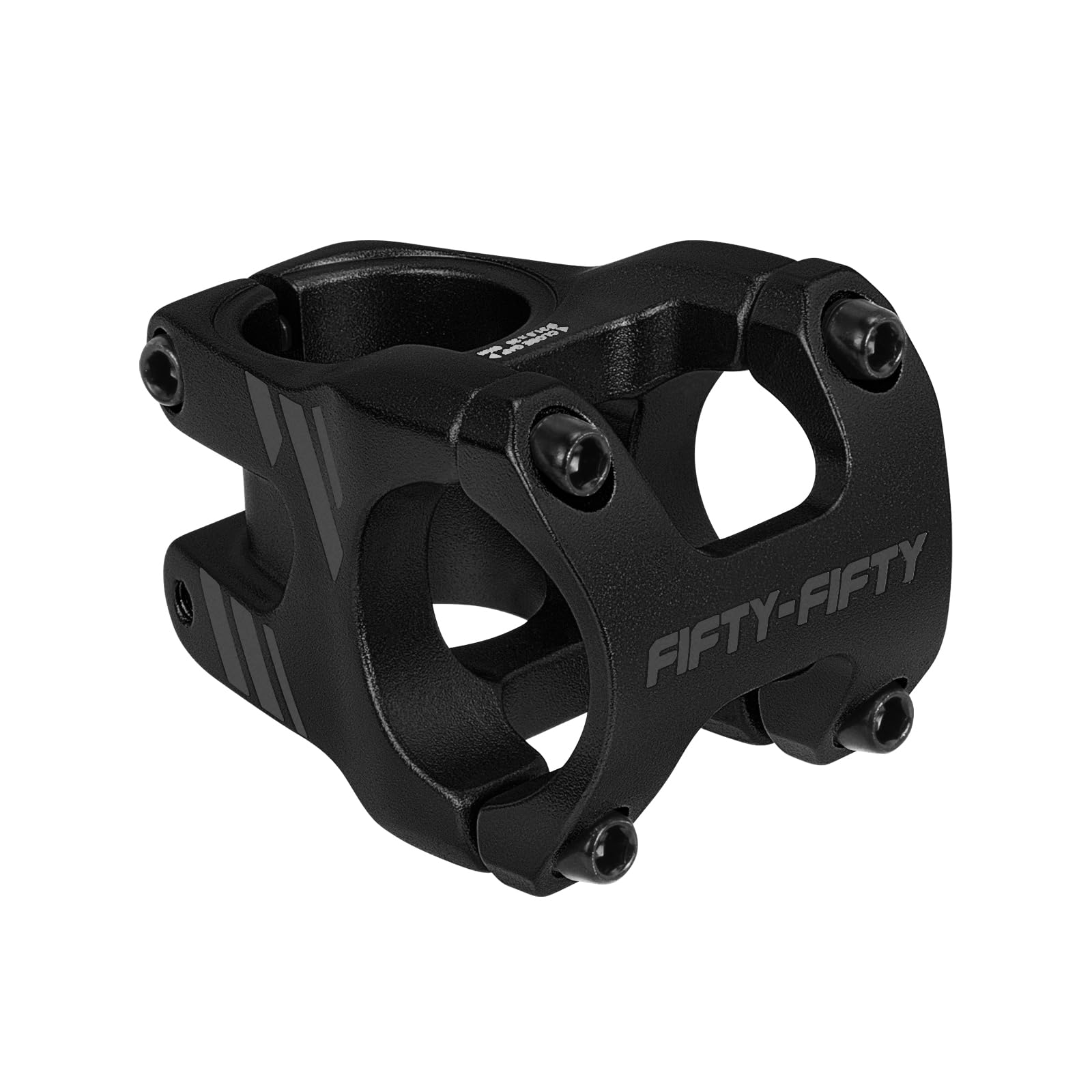
While this entry from FIFTY-FIFTY is a 35mm length rather than 80mm, it deserves mention for the engineering approach that carries across the brand’s lineup. The close-gap faceplate design simplifies handlebar installation — you can pre-align the bar before tightening the bolts, reducing the frustration of juggling a misaligned faceplate. The 0-degree rise keeps the bar height unchanged, making it ideal for downhill and enduro riders who want a low, aggressive front end.
At just 143.5 grams, it’s lighter than many stems that cost twice as much, and the 6061-T6 construction holds up to repeated hard landings. The five available color options let you match your bike’s accent color without paying a premium for custom anodizing. Owner feedback from riders using these on Magician Alpha builds and other freeride setups confirms the four-bolt clamp holds the bar securely through rough compressions.
The main consideration is that the 35mm length significantly shortens your reach — it’s intended for riders who want to pull the bars closer, not for those seeking a standard neutral position. If you’re not in the market for a short stem, focus on the 80mm variant from the same brand. The close-gap design also means that the faceplate gap can trap mud and grit if you ride in wet conditions frequently.
Why it’s great
- Ultra-light 143.5g weight for an aggressive trail stem.
- Close-gap design simplifies bar alignment.
Good to know
- 35mm length dramatically shortens reach — not a standard fit.
- Faceplate gap can accumulate trail debris.
FAQ
What does the rise angle on an 80mm stem actually change?
Can I use an 80mm stem on a bike originally specced with a 100mm stem?
Final Thoughts: The Verdict
For most users, the 80mm bike stem winner is the Thomson X4 because its precision machining and four-bolt clamp offer zero-compromise stiffness for both road and trail builds. If you want integrated accessory mounting for bikepacking or gravel, grab the PNW Components Coast. And for an adjustable rise that transforms a low-stack bike into a comfortable all-day cruiser, nothing beats the Ritchey Comp 4-Axis.