
Our readers keep the lights on and my morning glass full of iced black tea. As an Amazon Associate, I earn from qualifying purchases.
Specs are compiled from manufacturer listings and verified buyer reviews and can change over time — please confirm the key details on the product page before buying.
If your keyboard wobbles every time you play a heavy chord, the fix is not a better keyboard — it is a proper desk or stand built for a full 88-key instrument. The short answer: the Liquid Stands Piano Keyboard Stand and Bench Set gives most home players the best mix of rock-solid support, a matching bench, and a frame that adjusts to you. Everything below is sorted by what actually matters when you sit down for an hour of practice — how much weight it holds, how tall it goes, and how much it shakes.
I’m Min — the founder and writer behind Gadgets Feed. This guide is built by comparing the manufacturers’ published specifications and the patterns across verified customer reviews, so you get each pick’s real strengths and trade-offs instead of marketing spin.
You will see the same handful of problems come up again and again: stands that sway side to side, desks whose keyboard trays sit too high for your thighs, and pieces that look great in photos but buckle under a heavy keyboard. Each pick here solves one of those problems in a slightly different way. So this guide sticks to the specs you can measure — width, height range, weight limits, and whether the frame stays put — and matches each stand or desk to your room and your playing. This breakdown of the 88 key keyboard desk covers stands, benches, and full studio workstations for every budget.
Our Picks at a Glance

How To Choose The Best 88 Key Keyboard Desk
An 88-key board is long and heavy, and that changes what you need underneath it. A stand that flexes under a 20 lb keyboard will feel shaky no matter how well you play. Before you pick anything, work out three things about your own space: whether you sit or stand, how much room you have, and whether the piece needs to do double duty as a desk.
Weight Limit Is The First Number To Check
The load capacity is how much weight the stand or tray is rated to hold, and it is the number that decides whether you get a steady feel or a sway. A Z-style frame rated for 250 pounds stays calm under a heavy digital piano, while a lighter wooden stand with a lower rating suits a slim keyboard. Always leave yourself headroom — if the capacity is close to your keyboard’s weight, the whole thing will feel nervous when you play hard.
Height And Width Adjustment Decide Seated Versus Standing
Look for the actual adjustment range, not just the word “adjustable.” A stand that climbs through a wide height range lets you sit on a bench for practice and stand up for performance without buying anything new. Width matters too, because a full 88-key board needs a frame wide enough that the ends are not hanging off the edge.
Bench, Tray, Or Full Workstation
There are three real shapes here. A stand-and-bench set gives you a place to sit and play. A desk with a pull-out keyboard tray gives you a surface for a laptop or monitor above the keys. A studio workstation adds rack space and cable routing for recording gear. Pick the shape by how you play — seated practice, laptop work above the keys, or rack gear — not by how it looks in a photo.
Quick Comparison
| Model | Best For | Load Capacity | Height Range | Build | Amazon |
|---|---|---|---|---|---|
| Liquid Stands Stand and Bench Set★ Best Overall | Most home players | 250 pounds | 22.5″–33.5″ | Stainless steel | Amazon |
| L85 Keyboard StandReal-Piano Look | Real-piano look | 21 pounds | 26″ fixed | 18mm wood board | Amazon |
| Liquid Stands Rolling DJ TableRolling Studio | Moving between rooms | 250 pounds | 26″–36.5″ | Alloy steel | Amazon |
| KUMENG Digital Piano Desk | Desk-to-piano conversion | — | — | Wooden cabinet | Amazon |
| UISCOM 88 Key Weighted Piano | Beginners wanting presets | — | — | Flip-top model | Amazon |
| STRICH SDP-350S | Furniture-grade finish | — | — | Wood-textured | Amazon |
| LYYL Workstation 88 Desk | Producer setups | 55 pounds (tray) | 4 tray positions | MDF and steel | Amazon |
| Glorious Sound Desk Pro | Full studio buildout | — | 4 tray positions | Wood with struts | Amazon |
In‑Depth Reviews
1. Liquid Stands Piano Keyboard Stand and Bench Set
Our pick — 4.5+★ from 800+ verified ratings; the strongest balance of quality and price.
The stand that stops the sway — a 250-pound rated Z-frame and a matching bench in one box.
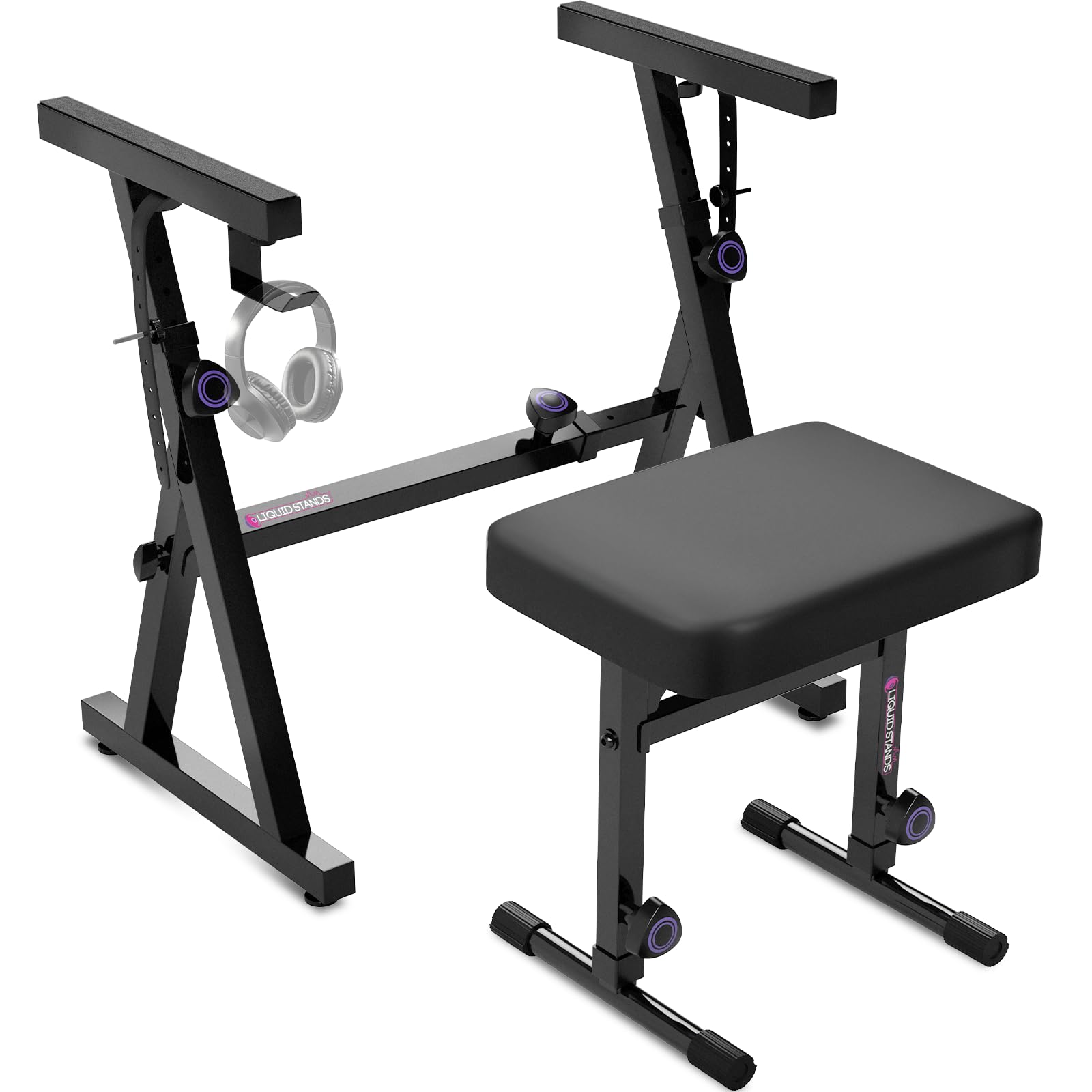
The number that earns this the top spot is 250 pounds. That is the load rating on the frame, which means a heavy 88-key board sits on it without the frame flexing. A Z-style base spreads the load out and is less likely to tip than the common X-style fold-up you have probably seen, so a hard chord does not send the whole thing rocking. You get a height range of 22.5 to 33.5 inches in 1.5-inch steps, and a width range of 22.5 to 33.5 inches in 2-inch steps — enough to line a full-size keyboard up properly and to sit or stand while you play.
It adjusts from 17.5 to 22 inches in 1-inch steps, so you can dial in a seated position where your forearms sit level with the keys. The bench is stainless steel with a padded seat and carries the same 250-pound limit as the stand. The whole set is nine pounds for the bench, easy to carry between gigs or break down for storage. Four adjustable feet, anti-skid foam pads, a headphone hook, and two anchoring straps that tie the keyboard down to the frame all come in the box.
What wins people over here is how well it is built and how quickly it goes together — the quality of the hardware and the simplicity of the assembly are the two things that come up most in the reviews, and they carry the consensus. The honest catch is the one that applies to any strap-anchored stand: the straps make the board secure, but you do need to actually fit them every time you set up, which slows the first few minutes. That is a small step for the stability you get in return.
What holds up under real practice
- A 250-pound load rating so a heavy digital piano stays calm under your hands.
- Height and width both adjust — you can sit on the bench or stand to play.
- Bench, headphone hook, foam pads, and two anchoring straps all included.
- The frame is stainless steel, not a flimsy tube that flexes on a loud chord.
The small stuff to know
- You have to loop the two anchoring straps each time you set up.
- No wheels, so moving it means picking it up rather than rolling it.
Sits right for: the home player who wants a stand and a bench that work together, at a mid-range price and without any wobble.
Think twice if: you need to roll the rig around a room — the wheels on the Liquid Stands rolling table below handle that better.
2. L85 Keyboard Stand for Adult
A wooden stand that makes a stage piano look like living-room furniture, not a music-shop display.
If the look of the thing matters as much as the feel, this is the pick. The top is an 18mm wood board — thick enough that it reads as furniture rather than a metal rack — with a smooth polished finish. At 52.2 inches wide, 11.5 inches deep, and standing 26 inches high, it is sized so an adult’s thighs clear the underside of the piano while seated. That 26-inch height is fixed, so this is a sit-down stand, not one you play standing. The metal brackets underneath are what carry the weight and keep a heavy keyboard from rocking.
The way it looks and the way it stays still are what the reviews keep returning to. Owners compare it directly to X-style stands and come away preferring it because it does not shake or creep when you dig into the keys. Assembly is straightforward — the predrilled screw holes line up cleanly and the instructions are readable, so one person can finish it without a second set of hands.
Here is the number you have to respect: the published load capacity is 21 pounds. That is a modest rating, and it is the honest limit of a wooden design. It comfortably holds a stage piano or a slim 88-key board, but it is not the frame for a heavy cabinet piano — for that, the Liquid Stands set above at 250 pounds is the safer choice. The item weight is 9.55 kg, so you are not lifting it up stairs alone without effort.
The trade-off worth knowing: a beautiful wooden stand with a 21-pound ceiling. Match it to a stage-style keyboard and you will love it; hang a heavy cabinet piano on it and you are asking too much of the board.
Pick this for: a Yamaha-style stage piano you want sitting in the living room looking like real furniture.
Look past it if: you play standing up — the 26-inch height does not adjust.
3. Liquid Stands Piano Keyboard Stand for 49 54 61 88 Key
Three-inch locking wheels and a 250-pound steel frame, for the player who never keeps the keyboard in one spot.
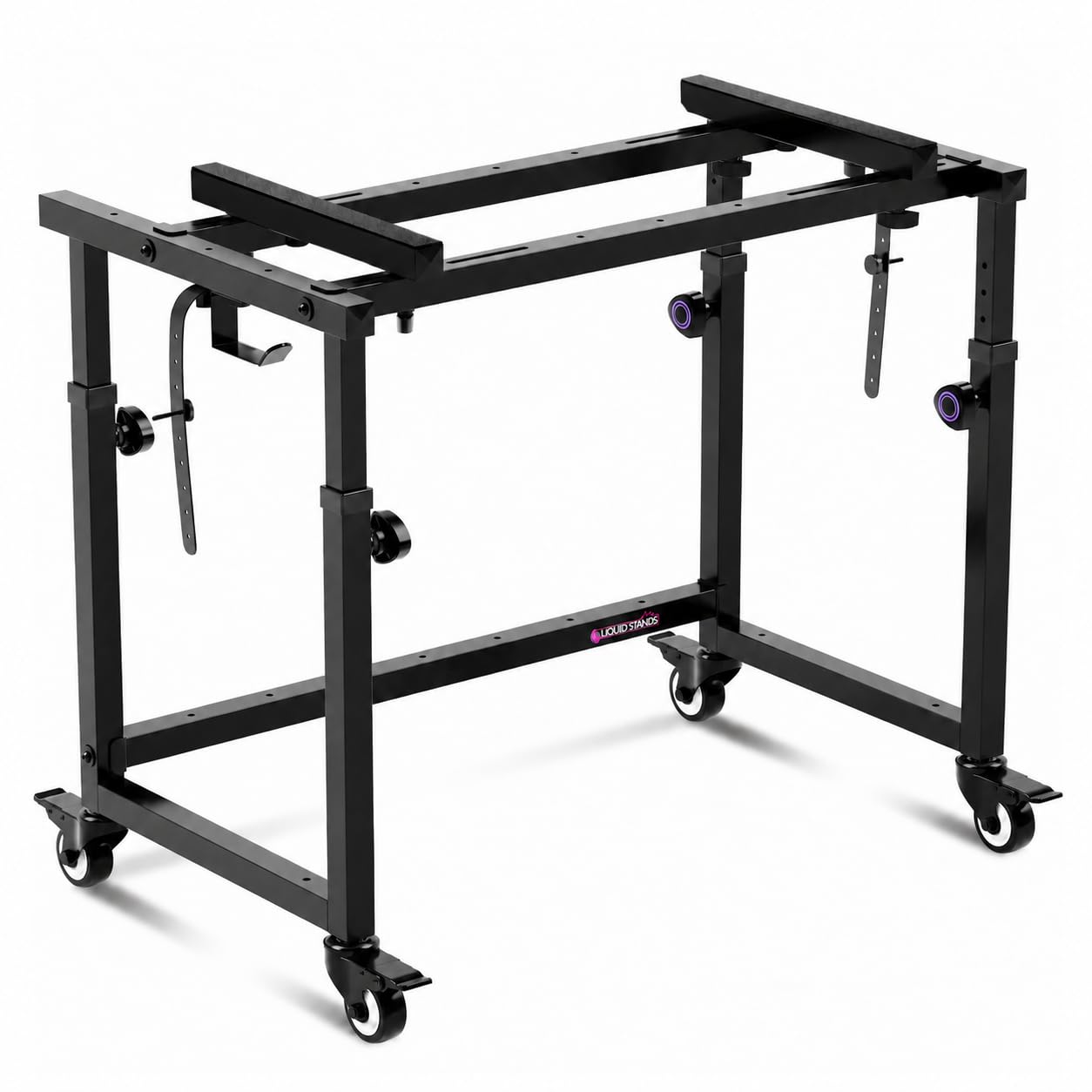
Rolling beats lifting for anyone who moves between a bedroom, a studio, and a stage. The three-inch locking wheels lock so the stand does not creep while you play, then release so you can wheel the whole rig into the next room. The frame is alloy steel with a 250-pound load rating, which is the same limit as the top pick and plenty for a heavy 88-key board. Height adjusts from 26 to 36.5 inches, which stretches the range past the sit-down wooden stand above so you can stand and play.
What people like most is exactly that combination — a solid frame that does not wobble, plus wheels that make it easy to move out of the way. Assembly is simple enough that it goes together without fuss. Security straps and a headphone hook are included, so the keyboard ties down to the frame and your headphones have a home.
The honest wrinkle is the height adjustment. It is a mixed bag in the reviews — some find the range easy to work with, others want more control over it. Treat it as a stand you set once at the height you like rather than one you tweak every session. There is also real flexibility built in: it takes the company’s second-tier attachments, tabletop, and speaker mounts, and includes 18 M6 rivnuts and 23 M8 through holes so you can bolt or clamp on third-party accessories.
Room to grow: the 23 M8 through holes and 18 M6 rivnuts mean this frame accepts clamps, mounts, and a tabletop, so it becomes a production desk as your setup grows. The 10-year warranty covers a steel frame from a company that has sold more than 250,000 units.
Built for: the player whose keyboard moves room to room and who wants a stand that converts to a production surface later.
Less ideal if: you want a single fixed seating height you set and never touch — this one rewards a little fiddling.
4. KUMENG Digital Piano 88 Key Weighted Keyboard
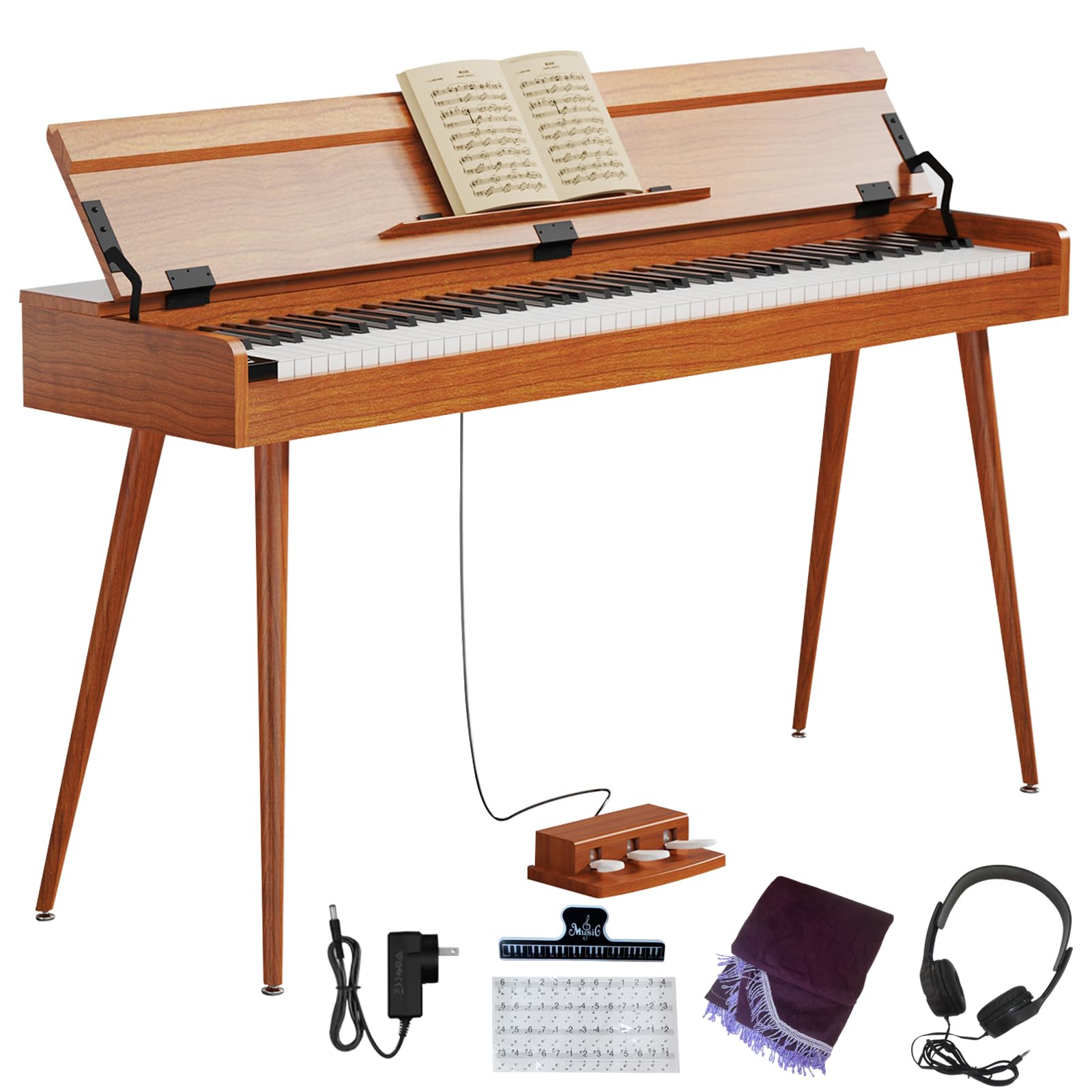
An 88-key weighted piano that flips into a work desk when the cover closes — two rooms in one piece.
This is the one to look at if your apartment has a keyboard corner and a work corner and you would rather they were the same corner. It is a full-size 88-key weighted keyboard built into a wooden cabinet with a flip key cover, so when you are not playing the top closes over and becomes open workspace. The weighted keys use a progressive hammer action, which means the lower notes feel heavier than the high ones, the way an acoustic piano does.
The digital side is generous. There are 800 tones to choose from and 128 polyphonies — polyphony being how many notes can sound at once — so a sustained passage with both hands and the pedal down does not cut off. A multi-function panel handles tone selection, recording control, and a double keyboard split function that lets a beginner put bass in the left hand and piano in the right. Connectivity runs through USB and MIDI, so it plugs into a computer, and USB also plays MP3 files.
The sound is what carries the consensus here — the chip underneath does a credible job of mimicking a real piano, and the weighted keys are the other thing owners keep praising because they feel like the real thing rather than a soft synth key. The catch is the footprint: the cabinet measures 12.4 inches deep, 53 inches wide, and 30.3 inches high, so measure your wall before you buy. It weighs 24.49 kg, which is a two-person job to move.
Strengths it earns
- 88 full-size weighted keys with progressive hammer action for realistic touch.
- Flips from a piano into a flat work desk with the wooden flip key cover.
- 800 tones and 128 polyphonies for layered, sustained playing.
- USB and MIDI connectivity, plus MP3 playback from a drive.
Limits to weigh first
- 24.49 kg of cabinet — plan a helper and a permanent spot.
- The 53-inch width needs a wall with real clearance.
Good fit for: the home-office player who wants one piece of furniture that becomes a piano after hours.
Pass it if: you need a folding stand you can tuck into a closet — this is furniture, not portable gear.
5. UISCOM 88 Key Weighted Home Digital Piano
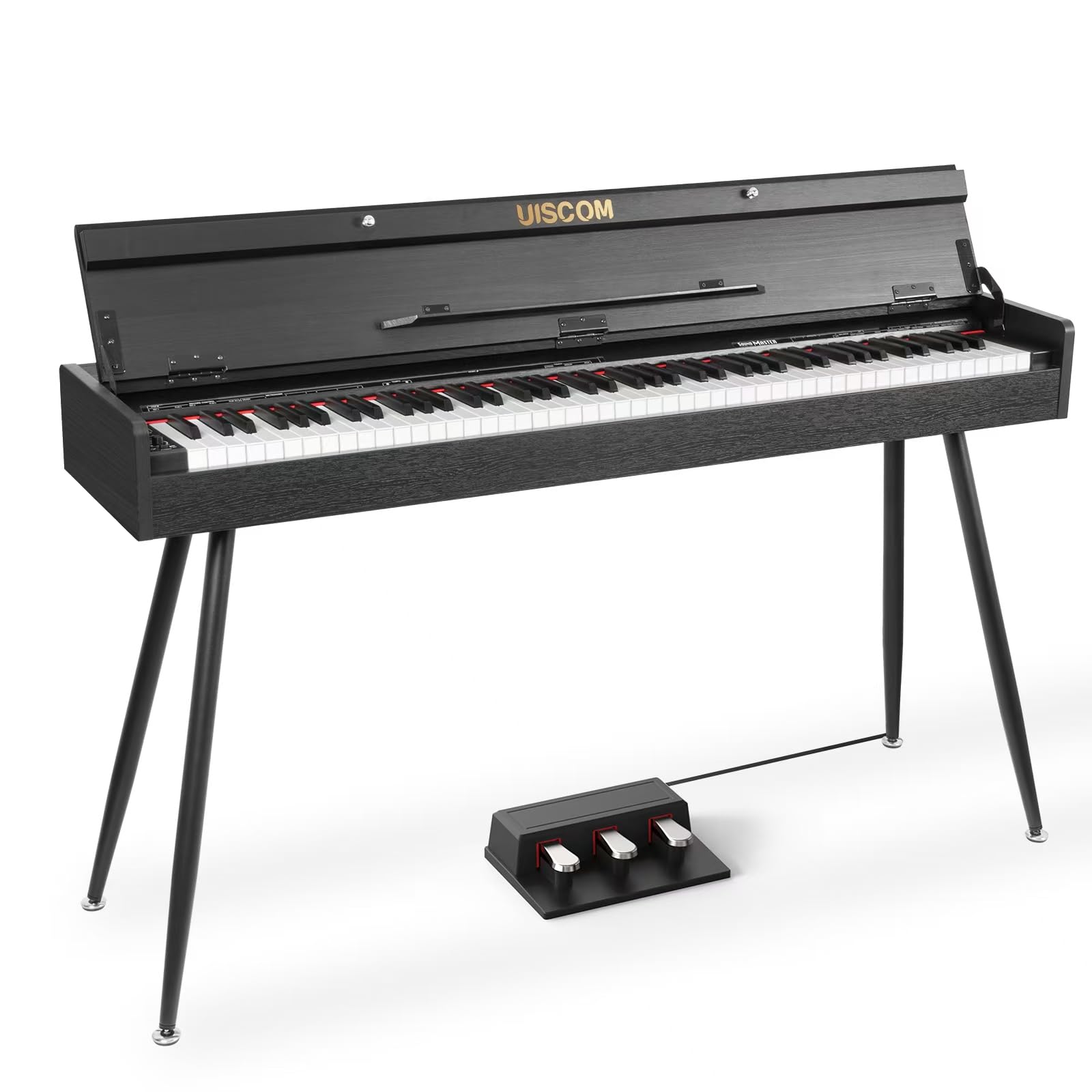
Same flip-top trick as the KUMENG, but with dual headphone jacks and a deeper preset library for practice.
The 8 sound presets are the number to start with here. This weighted 88-key piano ships with eight crafted voices drawn from a French sound source, plus 40 built-in practice pieces, so a beginner has material to work through on day one rather than sitting down to a single piano tone. It is a flip-top model — the same shape as the KUMENG above — so it converts between an upright piano and a desk or vanity surface when closed.
The practice features are where it puts distance between itself and the KUMENG. You can fine-tune key sensitivity to match how hard you play, and you get adjustable reverb, chorus, and metronome settings, which lets you shape the sound rather than just accept it. Two headphone jacks mean a teacher and a student can both plug in and listen without disturbing anyone. USB lets you play, pause, and control tracks from the piano, and there is a three-pedal system for sustain, legato, and soft playing.
What owners respond to is that it feels like a real piano — the weighted keys are smooth under the fingers and the touch is even. The recurring gripe is the pedals, which are the one part people are less sure of over time; treat the three-pedal system as the piece to keep an eye on rather than the keybed. It is a well-regarded starter instrument, but the three-pedal system is the part to check on arrival.
The pedal question: the touch and the tone are what sell this piano, and the weighted keys deliver the real-piano feel a beginner needs to build good habits. The pedals are the part that draws the occasional second look, so that is what to check when it arrives.
Reach for it when: you are starting out and want practice pieces, adjustable key sensitivity, and two headphone jacks built in.
Look elsewhere if: you want a pure stand or desk only — this is a full instrument, not furniture for an existing keyboard.
6. STRICH 88 Key Digital Piano SDP-350S

A wood-textured cabinet with simulated ivory keys and 25W speakers — the one that disappears into a farmhouse living room.
Two 25W speakers are the headline hardware, and they are why this piano sounds fuller than a thin under-cabinet keyboard. The cabinet wears a premium wood-textured finish that is built to sit with farmhouse, industrial, or modern rooms rather than shout “instrument.” A sliding key cover keeps dust off the keys, and when it closes the top becomes a flat tabletop or vanity, so the piano earns its floor space between sessions.
The keybed is the part that earns the praise. All 88 keys are fully weighted and full-size with a simulated ivory texture, and the hammer action reproduces the feel of a grand piano — a heavy low end and a lighter top that rewards proper technique. Under the hood there are 128 preset timbres, 200 drum rhythms, and 128 polyphony at max, plus an intelligent auto chord function. Chorus effects, layer/split, octave shift, and transpose let you shape the sound, and the audio-in port lets you run an external source through the 25W speakers to play along.
What you should know before buying: sound quality is the mixed note here. Some owners love it, others want more from it, so if you are chasing a concert-grade tone you may want to demo or return-window test it. Assembly gets a lighter mention, and reliability draws some questions too. The wood-textured cabinet, sliding key cover, and 128-timbre feature stack are what keep it on the shortlist.
Where it shines
- Wood-textured finish and sliding cover turn it into furniture when not in use.
- 88 fully weighted, full-size keys with simulated ivory texture.
- Dual 25W speakers plus audio-in for playing along with external sources.
- 128 timbres, 200 drum rhythms, and 128 polyphony at max.
What to weigh up
- The sound splits opinion more than the keybed does.
- Assembly draws lighter mention than rivals, so budget a session for it.
Fits the room that cares about looks: this is the piano you leave out because it belongs in the room.
Think carefully if: the tone is the whole point for you — test the sound before committing.
7. LYYL Music Studio Desk with Keyboard Tray
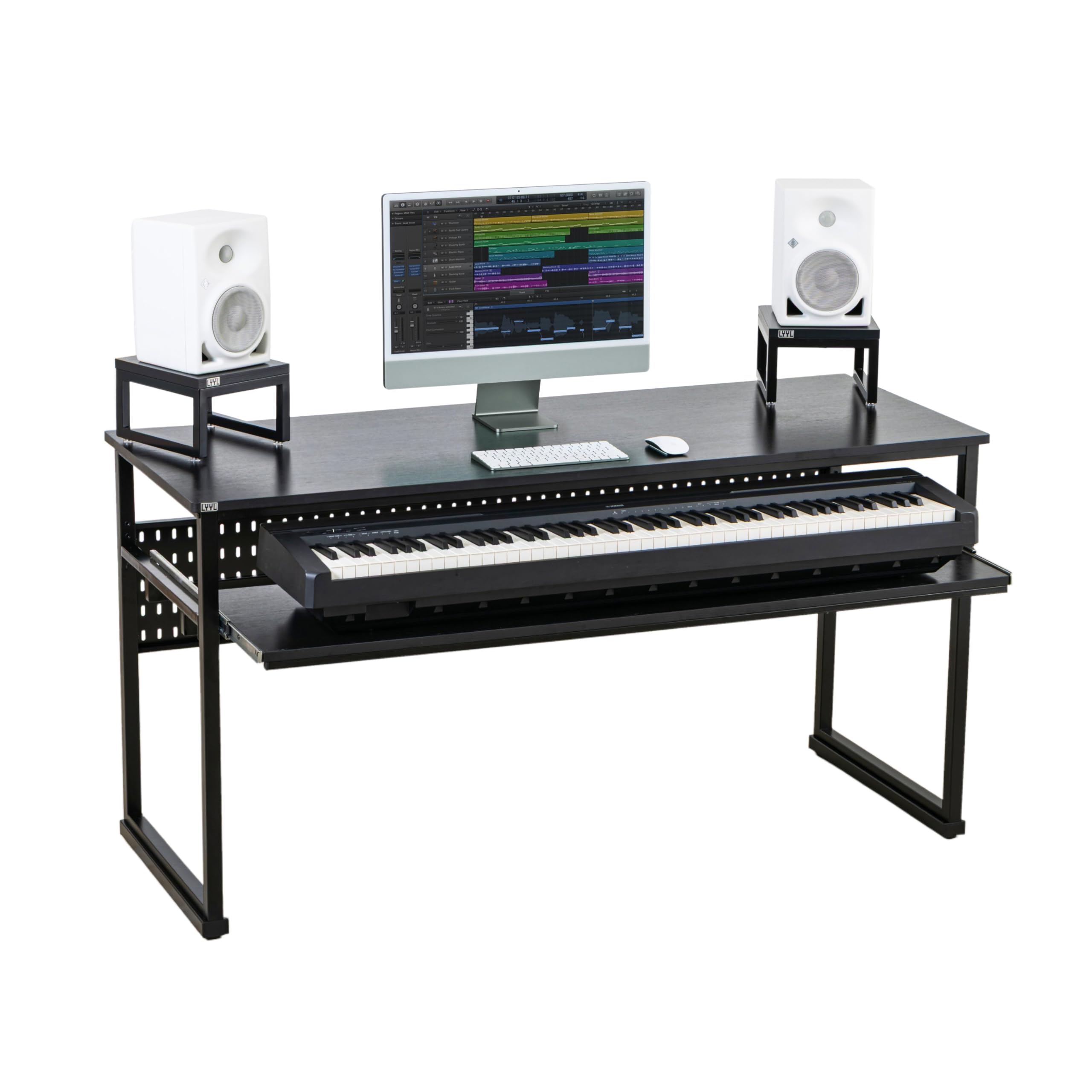
A real desk with a dedicated keyboard tray, a height bracket, and a rail system rated for 55 pounds.
The 55-pound tray capacity is the number that separates a real workstation from a novelty desk. The keyboard tray sits on a globally patented 3-way rail system built to stop the wobble, and it gives you four height positions so you can set the keys at the right level for your seat. Above it, the height adjustment bracket raises the main desktop to line up with the tray, which is the part most desks get wrong — you end up with a keyboard tray too low or a monitor too high and your shoulders pay for it. Here the two work together.
For a producer setup, this is the strongest desk in the roundup. The 23.6-inch depth and 61.4-inch width give you real surface for a monitor, a screen, an interface, and a full 88-key board tucked underneath. The construction uses Häfele rails and CARB Phase 2 Compliant MDF wood with industrial-grade steel, so the frame is meant to outlast the trend. A multi-panel and cable tray system keeps the cables out of sight, though the cable tray is sold separately.
Assembly is the part that surprises people — you hook the keyboard tray onto pre-set bolts with no second person needed, so it is a solo job. The desk weighs 74.8 pounds, so you want the spot picked before you build. Quality and sturdiness carry the consensus here; the honest caveat is the 6-month manufacturer warranty, which is short for a piece of furniture at this level.
Built for the long session: a four-position tray, a height-matched desktop, and a 3-way rail system are exactly what a producer needs to sit at a keyboard for hours without discomfort.
Pick it if: you need a proper production desk that holds a full 88-key board on a tray and a monitor above it.
Hold off if: you want a desk that does the job of furniture only — the 6-month warranty is a short window for the money.
8. Glorious Sound Desk Pro Professional Studio Workstation

A three-level workstation with two 3U racks — the desk for a room that is a studio first, a home second.
Two integrated 3U racks are the defining feature. A 3U rack is a standard slot for rack-mount studio gear — a preamp, an interface, a compressor — and having two of them built into the desk means your outboard gear lives in the furniture instead of on a shelf. Beyond that, the desk produces on three levels at once: a keyboard tray down low, a working surface in the middle, and space up top for a monitor and studio monitors. The tray is a pull-out drawer that takes up to 88 keys and adjusts through four height positions.
The build uses added struts for stability, and the desk routes cables through ducts on the top, the interior, and the ground, so a studio full of cables does not look like a studio full of cables. A center storage compartment holds a laptop or interface, and there is room for MIDI controllers, synths, and a 19-inch rack unit. Assembly instructions are written so one person can build it solo.
You should go in knowing that this desk divides opinion. Appearance, space, and functionality earn strong praise, but sturdiness, quality, and value are mixed — some owners find it solid and worth it, others do not. If a three-level layout and two built-in 3U racks are what your studio needs, few desks match that shape. Treat the stability question as the thing to check on arrival.
The honest read: the layout is the selling point — three working levels, two 3U racks, and cable ducts everywhere. The sturdiness and value side is where owners split, so buy it for the layout, not for the finish.
Worth it for: the home studio builder who needs rack space and a multi-level workflow in one piece.
Skip the splurge if: you only want a keyboard tray — the LYYL above does that job with a stronger stability story.
Understanding the Specs
Load Capacity
Load capacity is how much weight the stand or tray is rated to carry. On a stand like the Liquid Stands set, a 250-pound rating means a heavy digital piano sits still and does not flex the frame. On a wooden stand like the L85, the 21-pound rating tells you it is built for a stage-style keyboard, not a heavy cabinet piano. Match the rating to your keyboard’s weight and leave headroom, because a stand rated right at the limit tends to feel nervous under a hard chord.
Height and Width Range
The height range is the span between the lowest and highest the stand or tray can sit. A wider range lets you set up to play seated, either on a bench or on a chair, and raise it to stand. Width range matters because a full 88-key board needs a frame wide enough that the ends are fully supported rather than hanging over the edge. Check the increments too — small steps let you dial in the exact height you want.
FAQ
Will a Liquid Stands keyboard stand fit a full 88-key keyboard?
What does load capacity mean on a keyboard stand?
Can I play standing up on these stands?
How is a keyboard desk different from a keyboard stand?
What is a 3U rack and do I need one?
Can a digital piano act as a desk when I am not playing?
How much room do I need for an 88-key keyboard desk?
How many height positions does a keyboard tray usually offer?
Do these stands come with a bench or a seat?
Can I put wheels on a keyboard stand or desk?
Final Thoughts: The Verdict
For most people buying an 88 key keyboard desk, the winner is the Liquid Stands Piano Keyboard Stand and Bench Set because a 250-pound load rating, a matching bench, and a Z-style frame add up to a setup that does not sway under your hands. If you want your stage piano to look like furniture, grab the L85 Keyboard Stand. And if you are a producer who needs a full recording workstation, the LYYL Workstation 88 Desk is the one to reach for. Whatever you pick, sit down, play a loud chord, and check that the frame stays calm — that is the one job a keyboard stand has to do.
How We Picked
We do not accept paid placement. Every pick is matched to a real buyer and a real use-case; we do not hands-on test units.
Sources & Methodology
Specifications: manufacturer listings and product documentation. Review insights: verified customer reviews, as of November 2026. Pricing: not shown on this page (it changes often); check the current price via the retailer link.
As an Amazon Associate, Gadgets Feed earns from qualifying purchases. This does not affect which products we feature.