
Our readers keep the lights on and my morning glass full of iced black tea. As an Amazon Associate, I earn from qualifying purchases.
Specs are compiled from manufacturer listings and verified buyer reviews and can change over time — please confirm the key details on the product page before buying.
An 88-key synthesizer is a big commitment for your back and your budget, so you need to know which one is worth buying before you commit. The real choice depends on your playing style: a gig-ready workhorse, a self-contained stage piano, or a deep sound-design lab.
I’m Min — the founder and writer behind Gadgets Feed. This guide is built by comparing the manufacturers’ published specifications and the patterns across verified customer reviews, so you get each pick’s real strengths and trade-offs instead of marketing spin.
We’ve weighed weighted actions, portability, and sound engines to help you find the ideal 88 key synthesizer that matches your workflow without breaking your back.
Our Picks at a Glance


How To Choose The Best 88 Key Synthesizer
An 88-key synth is a different beast from a smaller workstation. You are buying a full piano experience with the guts of a tone laboratory, so the features you prioritize need to match how you actually make music.
Weighted Action vs. Synth Action
Weighted keys simulate the resistance of an acoustic piano, which is essential if you practice piano technique. Lighter “synth action” keys are faster for organ or lead parts but feel foreign to a pianist.
Sound Engine and Expansion
The sound engine is the heart of the instrument. Some use sample-based playback (romplers) that mimic real instruments, while others offer virtual analog modeling for synthesis. Look for expansion slots or software integration if you plan to grow your sound library.
Portability and Power
Consider whether this lives on a stand in your studio or travels to gigs weekly. A 40-pound board is a workout for stairs, while a lighter model might compromise on keybed depth or speaker power.
Quick Comparison
| Model | Best For | Action | Weight | Sound Engine | Amazon |
|---|---|---|---|---|---|
| Roland JUNO-DS88★ Best Overall | Gigging performers | Ivory Feel-G | 16.2 kg | JUNO-Di sounds | Amazon |
| Yamaha CK88Premium Pick | Stage & home use | Wooden Hammer | 28.9 lb | Piano & Organ | Amazon |
| Roland FANTOM-08 | Production power users | Weighted | 40 lb | ZEN-Core | Amazon |
| Korg SV2-SP | Vintage piano lovers | RH3 | 64.7 lb | 72 sounds | Amazon |
| Arturia AstroLab | Software synth users | Velocity/Aftertouch | 65 lb | 1,800+ presets | Amazon |
In‑Depth Reviews
1. Roland JUNO-DS 88
Our pick — over 4.5★ from 450+ verified ratings; the strongest balance of quality and price.
The gig-ready workhorse that packs a massive sound library into a shockingly portable frame.
For the working musician, this Roland is the pick that balances live performance with serious sound depth. It carries over 1200 instrument sounds, and the built-in eight-track pattern sequencer lets you build full arrangements without a laptop. The Ivory Feel-G keybed gives you a weighted-action touch that responds under your fingers, all in a body that runs on batteries when you need to busk or play a remote set.
You can expand it through the wave expansion slot, downloading free waveforms from Roland’s Axial website. The sample import function lets you play your own WAV files across the keys, while eight Phrase Pads trigger those samples or audio songs stored on USB. It even has a mic input with Reverb, Vocoder, and Auto Pitch effects for adding vocals to your performance.
The honesty here: this is a rompler rather than a true synth, so you are working with high-quality samples rather than raw oscillators. Sequencing is limited compared to a full DAW, and some owners note it lacks real MIDI file playback — a gap even a budget Casio covers.
Stage-Ready Strengths
- Battery-powered portability for gigs anywhere
- Massive 1200+ sound library in a lightweight body
- USB audio/MIDI and DAW Control mode for studio work
Home-Studio Limits
- Lacks real MIDI file playback for basic sequencing
- 8-track sequencer requires workaround for 16 tracks
Best for gigging players: who need pro sounds, easy transport, and battery freedom in one board.
Look elsewhere if: you need deep DAW-less sequencing or raw synthesis rather than sample playback.
2. Yamaha CK88
A lightweight stage piano with authentic wooden hammer keys and speakers built right in.
The CK88 suits you if you want a real piano feel without hauling 40 pounds to every rehearsal. At 28.9 pounds, it is noticeably lighter than the Roland FANTOM-08’s 40 pounds, so a weekly load-in is far more manageable. The wooden hammer-action keys (keys that mimic the weighted feel of an acoustic piano) deliver a response pianists immediately recognize, and the onboard speakers let you practice anywhere without an amp.
Yamaha focused this board on expressive, authentic sounds — the kind you hear on classic rock, pop, and jazz records. It covers vintage drawbar organ to transistor-based combo tones, realistic strings and brass, plus two split points so you can play three different sounds across the keyboard simultaneously. The interface uses direct-access knobs and color-coded functions for on-the-fly changes mid-performance.
The trade-off shows up in the speakers, which sound thin at volume. Owners also point to a steep learning curve and note that the music rest is poor or unavailable as a separate purchase. A sustain pedal is absent from the box, which is an extra cost to factor in.
Expressive performer: the sound shaping via reverb, delay, unison, and two multi-effect slots makes this ideal for traditional sounds that need subtle depth.
Reach for it if: you want a genuine hammer action with built-in sound for home and stage use.
Think twice if: you rely on powerful built-in monitors or need an included pedal and music rest.
3. Roland FANTOM-08
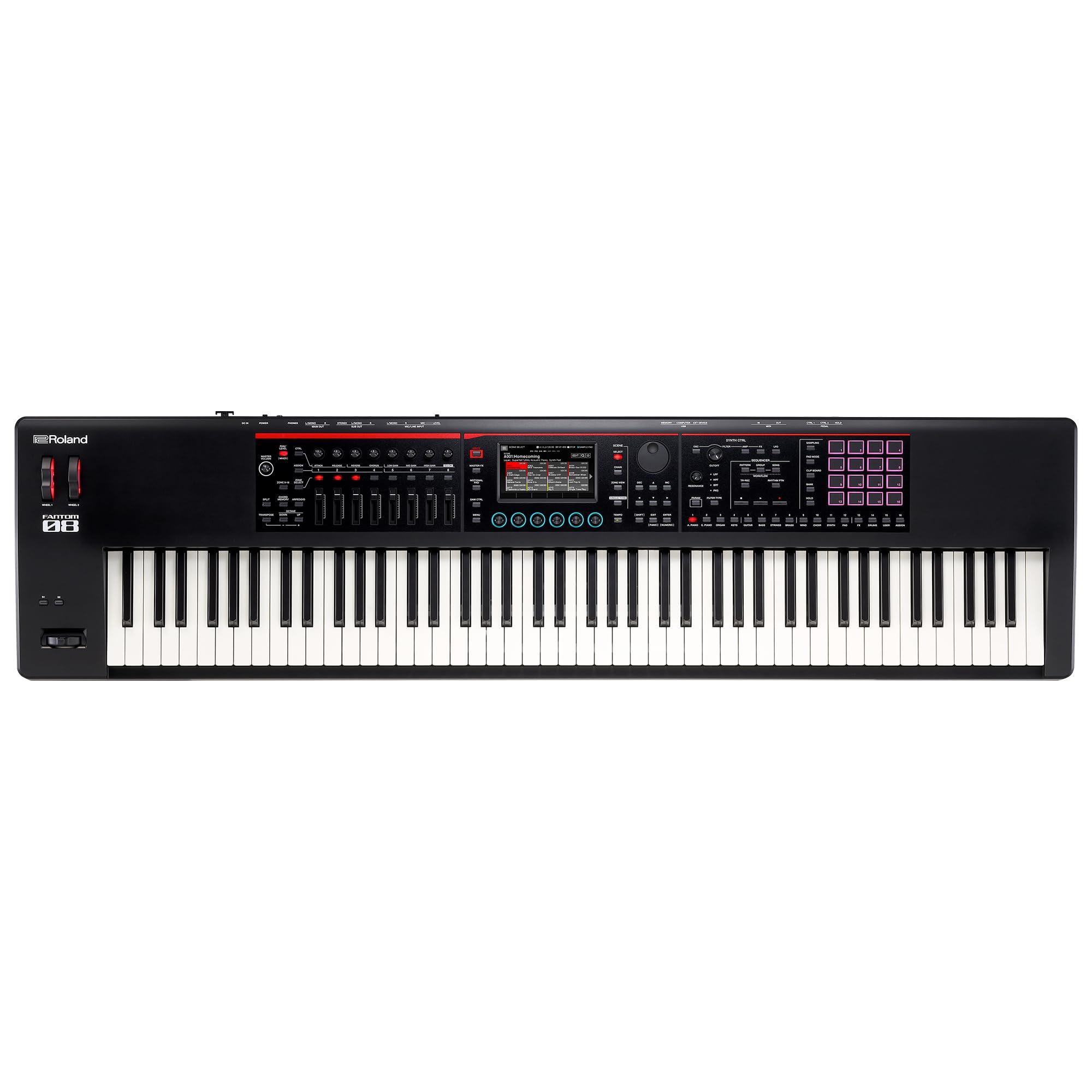
A production powerhouse that pulls the flagship Fantom workflow into a streamlined 88-key board.
This is the board for players who treat their keyboard as a creative hub rather than just a stage instrument. The FANTOM-08 runs on Roland’s ZEN-Core and SuperNATURAL technologies, giving you thousands of electronic and acoustic sounds, including new SuperNATURAL pianos with authentic grand-piano response. You get a color touchscreen, high-resolution knobs, sliders, and RGB performance pads for hands-on control.
Production tools run deep here. The TR-REC sequencer is inspired by classic Roland drum machines, while Scenes store settings for all 16 layers plus effects and patterns. Clip-based sequencing lets you record and trigger patterns instantly. It even has onboard sampling, so you can grab audio and manipulate it without reaching for a computer.
The 40-pound chassis sits between the lightweight JUNO-DS and the hefty Korg. The honest limit is the 256MB tone memory, which is smaller than the flagship Fantom’s 1GB. Shipping damage has occasionally been reported, so inspect your unit on arrival — but when it arrives intact, owners describe the keys as playing “like butter.”
Creative Depth
- ZEN-Core engine with thousands of sounds and deep sampling
- Clip-based sequencing with TR-REC for rapid idea capture
- Color touchscreen and RGB pads for tactile control
Real Trade-Offs
- 256MB tone memory limits huge sample libraries
- Heavier and bulkier than other portables on this list
Your studio centerpiece: if you produce, perform, and want everything in one instrument.
Not for the casual player: if you just want a piano sound for home practice, this is more machine than you need.
4. Korg SV2-SP

A designer stage piano with tube warmth and four national grand-piano characters built in.
If your music leans vintage — electric pianos, organs, and lush strings — the SV2-SP is a love letter to that era. Its speakers were designed by the Italian company K-ARRAY, delivering 15 Watts of power per side, which is surprisingly usable for small-group rehearsals. The keyboard holds 72 different sounds across 64 memory locations, anchored by professional German, Italian, Austrian, and Japanese grand piano samples.
Korg packed over ten times the sample data of previous SV models into this board. That depth shows in the expressive grand pianos and the electric piano tones that come alive when you engage the tube amp drive. The action is dynamically responsive, and half-pedaling is supported for nuanced sustain control.
At 64.7 pounds, this is the heaviest keyboard in this lineup — plan your travel accordingly. Owners describe the keybed as slightly dull or cheap-feeling compared to premium rivals, though it plays dynamically. The built-in tube can die after a couple of years, with replacements running roughly from third-party sellers.
Character-rich: the onboard tube adds authentic warmth to electric piano tones that sample-only boards lack.
Built for sound quality: the four grand-piano characters give you concert-hall variety without needing external modules.
The catch: 64.7 pounds is a serious lift, and the tube is a consumable part with a finite life.
5. Arturia AstroLab 88
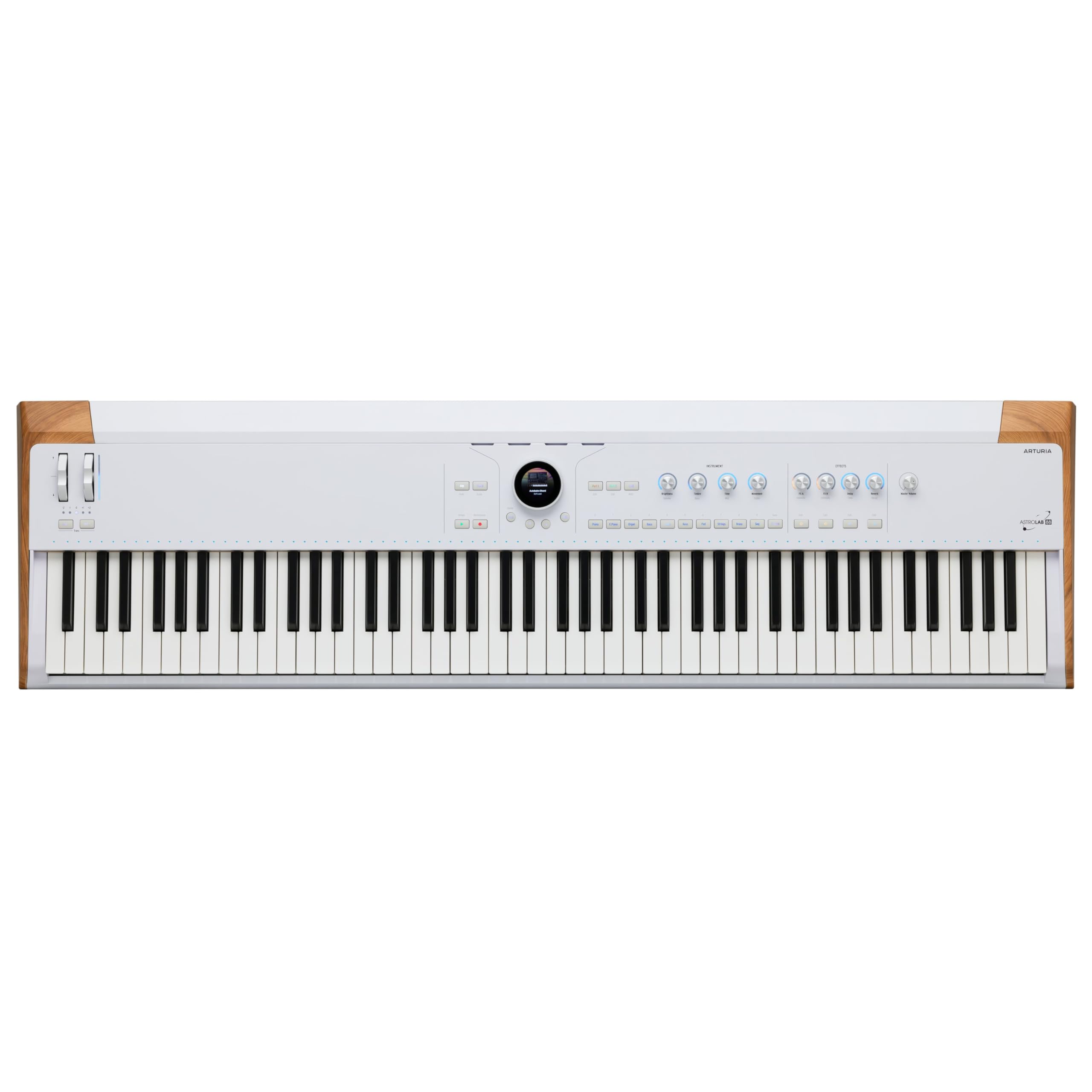
The bridge between software synthesis and a live 88-key instrument, with 1,800+ presets onboard.
Arturia built this for players who live in the world of virtual instruments but want to step away from the laptop on stage. The AstroLab holds instant access to over 1,800 curated presets spanning analog synths, vintage keyboards, and acoustic instruments from 40+ onboard instruments. Expand that to 10,000+ sounds by connecting to Analog Lab Pro, V Collection, and Pigments software.
The 88-note keybed is velocity-sensitive with aftertouch — a feature that lets you add expression by pressing harder after the initial note strike. Eight durable macro encoders let you shape sound in real time, backed by Chord and Scale modes plus a multi-lane arpeggiator. It even includes powerful vocoder presets for vocal effects.
This is a niche instrument, and owners are clear about that. It is fantastic for synth-focused players who want hardware control of enormous software libraries. But if you need stage-ready electric pianos or deep sample-based sounds, the onboard EPs fall short, and the sample loading can feel slow. The 65-pound weight also makes this less of a grab-and-go board.
Software-bridge specialist: if your sound library lives in Arturia’s software, this is the ultimate hardware controller for it.
The limitation: stage-value sounds like electric pianos are weaker, and it’s heavy for a controller-style board.
Understanding the Specs
Weighted Action vs Synth Action
Weighted keys use hammers to simulate an acoustic piano’s resistance, which builds proper finger strength. Full-weighted boards typically weigh more because of the mechanical parts involved, so pairing a weighted keybed with a lightweight body is a genuine engineering feat.
Sound Engines and Synthesis Types
Some boards are romplers that play back high-quality samples of real instruments. Others offer virtual analog or physical modeling engines that generate sound from oscillators in real time. True synths let you sculpt raw waveforms, while romplers excel at realistic instrument emulation.
Built-In Speakers vs. External Systems
Onboard speakers are great for practice and small rehearsals, but they rarely have the headroom for a loud stage. If you play gigs, plan to run through a PA or powered monitors. Also consider the speaker wattage and placement before relying on them in a live mix.
Sample Memory and Expansion
Boards with sample-import or expansion slots let you add your own WAV files or download new waveforms. This grows your sound palette over time without buying a new keyboard. Memory is measured in megabytes, and larger libraries demand more space.
FAQ
Why should I choose weighted keys over synth action keys on an 88-key board?
Can I use these keyboards without a computer or external speakers?
What is the difference between a rompler and a true synthesizer?
How much does weight matter for an 88-key board I plan to gig with?
Will an 88-key synth replace my digital piano for practice?
What does aftertouch do, and do I need it?
How do I add new sounds to my keyboard later?
Is a sequencer essential for live performance?
Final Thoughts: The Verdict
For most players seeking a true all-rounder, the 88 key synthesizer winner is the Roland JUNO-DS 88 because it packs pro-grade sounds and battery portability into a frame you can actually carry. If you want a genuine hammer-action piano feel with built-in speakers, grab the Yamaha CK88. And for production-focused players who need deep synthesis and sampling, the Roland FANTOM-08 is the one to reach for.
How We Picked
We do not accept paid placement. Every pick is matched to a real buyer and a real use-case; we do not hands-on test units.
Sources & Methodology
Specifications: manufacturer listings and product documentation. Review insights: verified customer reviews, as of September 2026. Pricing: not shown on this page (it changes often); check the current price via the retailer link.
As an Amazon Associate, Gadgets Feed earns from qualifying purchases. This does not affect which products we feature.