
Our readers keep the lights on and my morning glass full of iced black tea. As an Amazon Associate, I earn from qualifying purchases.
Specs are compiled from manufacturer listings and verified buyer reviews and can change over time — please confirm the key details on the product page before buying.
If you are shopping for an 88 key weighted keyboard, the first thing you need to know is that not all “weighted” keys feel the same — and the difference in piano sound and build quality between a model and an model is massive. the balance for building proper finger technique starts at mid-range models, where hammer action and polyphony specs separate a practice instrument from a toy.
I’m Min — the founder and writer behind Gadgets Feed. This guide is built by comparing the manufacturers’ published specifications and the patterns across verified customer reviews, so you get each pick’s real strengths and trade-offs instead of marketing spin.
Whether you are a beginner looking for your first full-size digital piano or an experienced player searching for a compact second instrument, this guide to the best 88 key weighted keyboard breaks down the real-world feel, sound quality, and connectivity options that actually matter when you sit down to play.
Quick Picks
- Casio Privia PX-870 — Premium Console
- Yamaha YDP105 — All-in-One Upright
- Yamaha DGX-670B — Feature-Packed Studio
- Donner DDP-300 — Smart Value Slam
- Casio CDP-S160 — Portable Slab
- AODSK B-83S — All-In-One Furniture
- UISCOM 1852 — Desk-Friendly Convertible
- UMOMO UMP-718 — Value Duet Package
- STRICH SDP-120 — Best Value
How To Choose The Best 88 Key Weighted Keyboard
The first thing to get right is the action type — “weighted keys” is a broad term. You want hammer action or graded hammer action, which means the keyboard uses actual mechanical hammers (or a weighted system that mimics them) to recreate the feel of an acoustic piano. Cheaper “semi-weighted” or “touch-sensitive” options won’t build the finger strength you need.
Polyphony — How Many Notes Can You Play at Once?
Polyphony is the number of notes the keyboard can produce simultaneously. For a beginner playing simple melodies, 64-note polyphony (the number you see on many entry-level models) might be enough. But once you start using the sustain pedal and playing chords with both hands, a 128-note polyphony count is the safer bet — it prevents notes from dropping out mid-performance. The UMOMO lists 64-note polyphony.
Connectivity and Extra Features
If you plan to use learning apps like Simply Piano or GarageBand, ensure the keyboard has a USB-MIDI port or built-in Bluetooth MIDI. A headphone jack (ideally two for duet practice with a teacher) is non-negotiable for silent practice. Triple pedals (soft, sostenuto, sustain) become important as your repertoire grows into classical pieces requiring half-pedaling technique.
Quick Comparison
| Model | Best For | Key Action | Polyphony | Speakers | Amazon |
|---|---|---|---|---|---|
| Casio Privia PX-870 | Premium console feel at home | Tri-Sensor II Scaled Hammer Action | — | 40W 4-Speaker | $799.99Amazon |
| Yamaha DGX-670B | Massive voice library & band-style accompaniment | Graded Hammer Standard | — | — | $799.99Amazon |
| Yamaha YDP105 | Traditional upright with bench included | Graded Hammer Standard | — | built-in stereo | $899.99Amazon |
| Donner DDP-300 | Bluetooth MIDI & 128-note polyphony | Graded Hammer Action | 128 | dual tweeters + subwoofer | $579.99$689.99Amazon |
| Casio CDP-S160 | Portable slab for students on the go | Scaled Hammer Action | — | built-in | $439.99$549.99Amazon |
| AODSK B-83S | Full furniture package with triple pedals | Hammer Action | — | built-in amplifier | $349.99Amazon |
| UISCOM 1852 | Desk-to-vanity convertible design | Progressive Hammer-Action | — | via French Dream5704 chip | $299.00Amazon |
| UMOMO UMP-718 | Duet bench for teacher-student lessons | Progressive Hammer Action | 64 | built-in speakers | $299.99Amazon |
| STRICH SDP-120 | Budget-friendly with wireless MIDI | Fully-Weighted Hammer Action | 128 | 2x15W | $259.99Amazon |
In‑Depth Reviews
1. Casio Privia PX-870
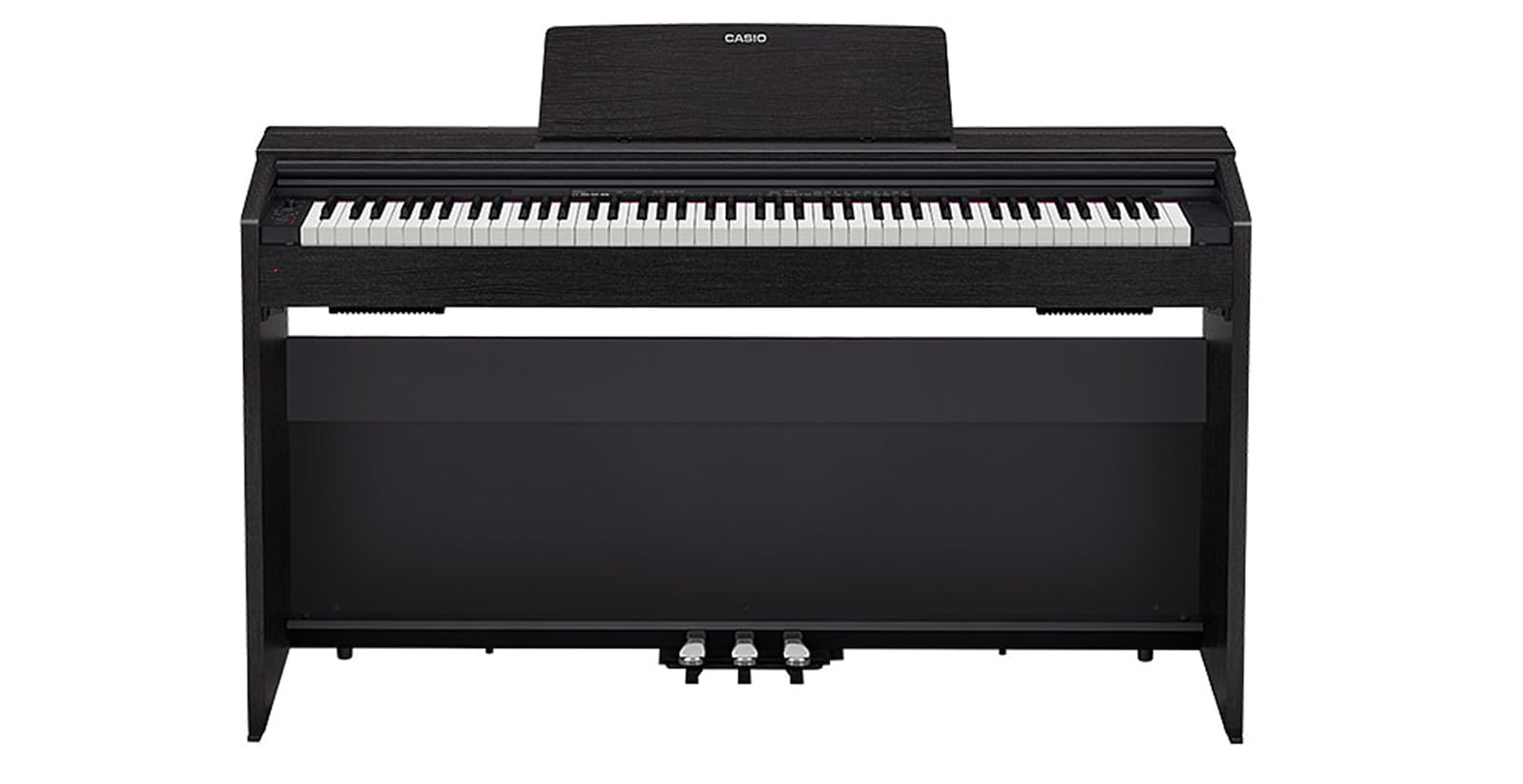
The console that fills a room with concert-grade sound and feels every bit like a real grand.
If you have the space for a furniture-style cabinet and you want a playing experience that rivals acoustic pianos costing thousands more, the Casio Privia PX-870 is your pick. Its Tri-Sensor II Scaled Hammer Action keyboard has simulated ebony and ivory key textures (so your fingers don’t slip during fast passages), and the three sensors capture each key press with remarkable speed and accuracy. The result is superior dynamic control — you can play whisper-quiet soft or thundering loud just by how hard you press.
The sound system is where the PX-870 separates itself from the pack: a 40W 4-speaker Sound Projection system that fills a living room like a real upright. It also includes Duet Mode (splits the keyboard into two equal pitch ranges for teacher-student lessons), dual headphone jacks, 60 built-in songs, and a 2-track MIDI recorder. One reviewer noted that this Casio’s sound quality “rivals Yamaha pianos” — a strong claim that tracks with the engineering here.
The catch is the cabinet: it weighs 75.6 pounds, making it a one-time placement item, not something you move around easily. And some buyers mention that the cabinet uses laminated board with plastic screw covers that feel less premium than the keyboard itself. But for a dedicated home piano that looks and sounds the part, this is a standout.
What separates it
- Tri-Sensor II Scaled Hammer Action with ebony/ivory texture keys for authentic grand-piano touch
- 40W 4-speaker Sound Projection system delivers rich, room-filling sound
- Duet Mode and dual headphone jacks make it ideal for teacher-student lessons
Limitations to know
- Cabinet is laminated board, not solid wood — some buyers report cheap plastic screw covers
- At 75.6 lbs, it is a permanent piece of furniture, not portable
- Pedal bar can click on hardwood floors, according to one reviewer
Your home’s centerpiece: This is for the intermediate player or serious student who wants a console that plays like a grand, sounds like a grand, and sits in the living room permanently.
Two warnings: The cabinet finish isn’t as high-end as the keyboard itself, and you’ll need a strong friend to help move it into place.
2. Yamaha YDP105
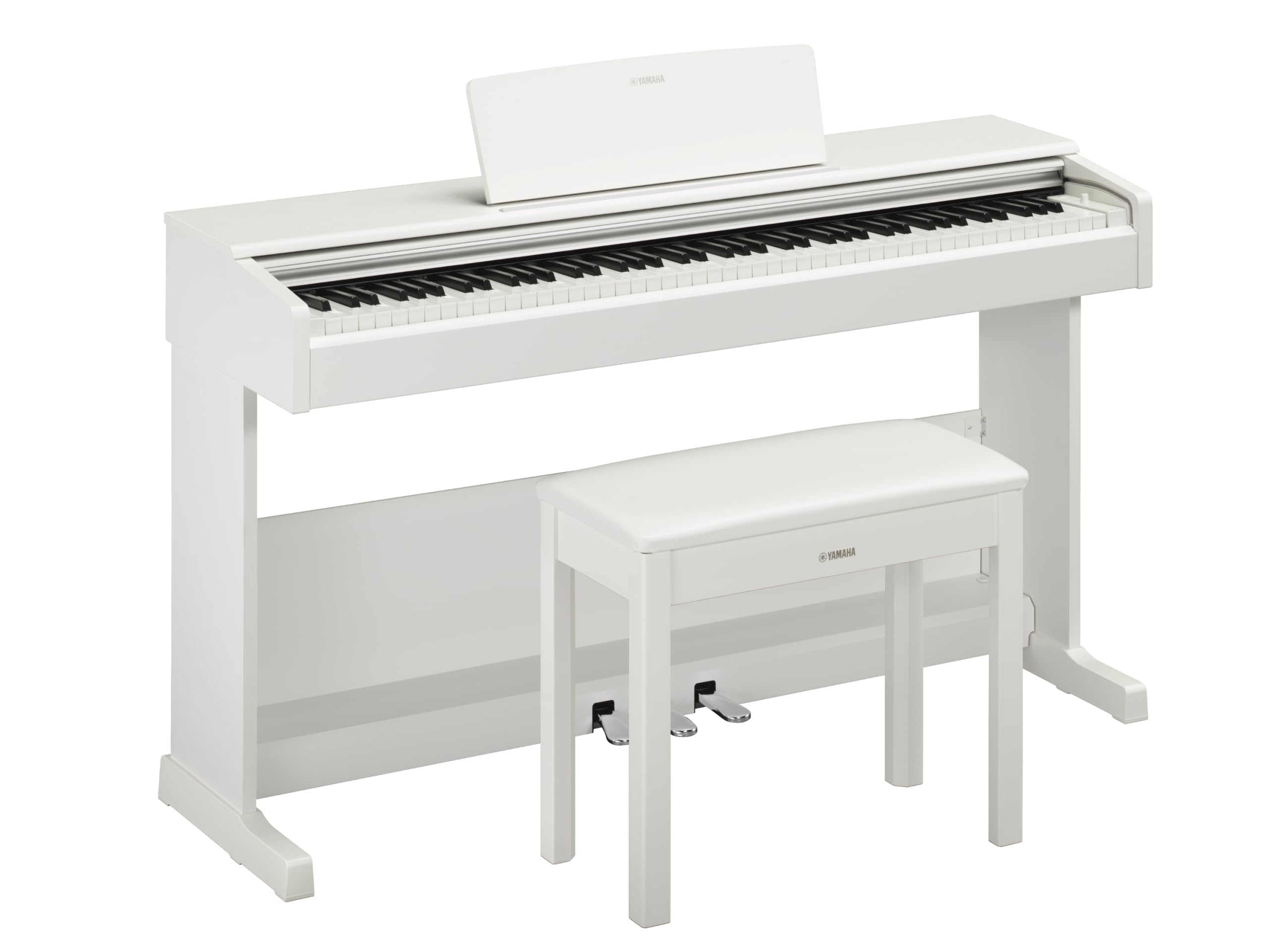
A traditional upright that brings acoustic feel and a padded bench to your living room.
The Yamaha YDP105 is built for the buyer who wants a dedicated upright digital piano — not a portable keyboard on an X-stand, but a proper piece of furniture that looks like a real piano and includes everything you need to start playing. Its Graded Hammer Standard (GHS) keyboard action feels heavier in the low keys and lighter in the high keys, just like an acoustic upright, with Touch Response that adjusts the volume based on how hard you press.
Inside, you get 10 instrument Voices (including the essential grand piano sound), 10 voice demo songs, and 10 piano preset songs — enough variety for a beginner to explore. The 3-pedal unit (soft, sostenuto, sustain) is built into the cabinet, not a separate box that slides on the floor. And Yamaha includes a padded bench, which many competitors at this price do not. Reviewers consistently praise the “responsive key touch” and “room-filling sound,” with one buyer calling it “a wonderful piano to have in a home.” The dual headphone jacks let a student and teacher listen together silently.
Compared to the Casio PX-870 above, the YDP105 has a more traditional upright look (available in white or black) and a lighter action that some beginners prefer. But the PX-870 has a more advanced 4-speaker system and more built-in songs. If you want a name-brand, bench-included package that feels like a real upright from day one, this is your move.
Acoustic feel: The GHS action and 3-pedal unit deliver an authentic upright-piano experience that builds proper technique for beginners and intermediate players.
The setup gotcha: One buyer mentioned the pedals were initially defective and required a technician repair — so check the pedal function early in your return window.
For the traditionalist: If you want a real upright look, a padded bench in the box, and Yamaha’s trusted GHS action, the YDP105 is the complete package.
Consider the PX-870 instead if: You prefer the more powerful 4-speaker sound system and don’t mind a slightly less traditional cabinet.
3. Yamaha DGX-670B
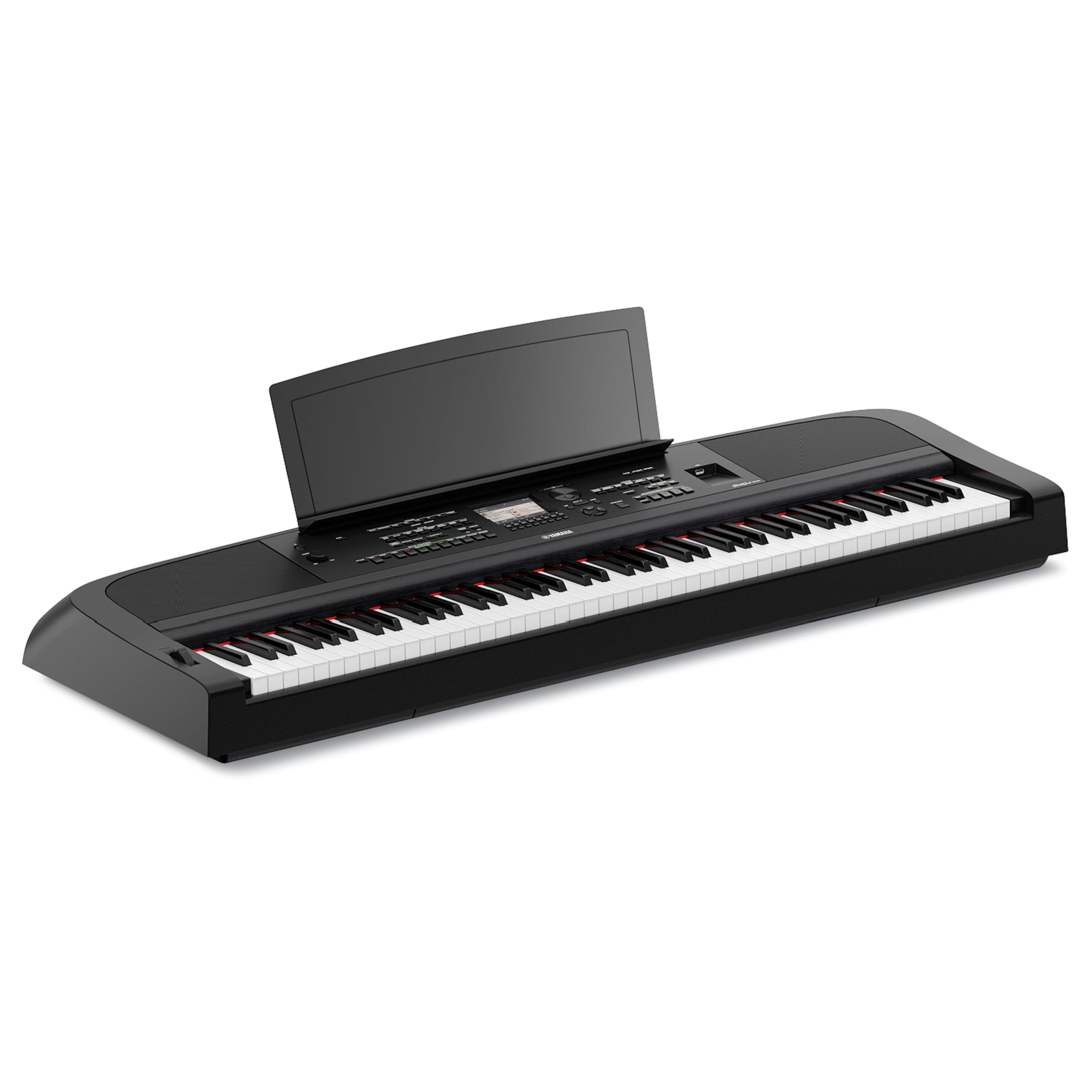
A digital piano that doubles as a one-person band with 630 sounds and automatic accompaniment.
The Yamaha DGX-670B is the perfect pick if you want more than just piano sounds — it is loaded with 630 instrument Voices (pianos, organs, strings, synth leads, you name it) and 263 Automatic Accompaniment Styles that create the feel of playing with a full band. You can be practicing a Chopin etude one minute and playing a jazz organ with a backing drum track the next. The Graded Hammer Standard keyboard action (heavier in the bass, lighter in the treble) means you still get proper weighted-key feel for building technique.
One standout feature is Adapted Style: the accompaniment automatically adjusts its intensity based on how hard you play — if you hit the keys harder, the backup band plays more energetically. That is a rare trick at this level. Connectivity is strong too: Bluetooth for MIDI connections to apps and devices, plus a USB port and a 3.5mm headphone jack. The black matte finish is subtle and professional.
The catch: the furniture stand is sold separately, so this is essentially a “slab” keyboard (the main body) that you need to buy a stand for. The included accessories are just the sustain foot switch, music rest, and power adapter. For a living-room setup, budget extra for a sturdy stand. But if you want the most versatile voice library in this guide, the DGX-670B is class-leading.
Versatility king: With 630 voices and 263 accompaniment styles, this is a digital piano that never gets boring — great for hobbyists who enjoy exploring different genres.
Budget for the stand: Unlike the YDP105 or PX-870, this is a slab-style keyboard that needs a separate furniture stand (sold separately) to look like a home piano.
Reach for this if: You are a pianist who likes to noodle across genres — classical, rock, R&B, dance — and want a keyboard that supports your creativity with hundreds of built-in sounds and auto-accompaniment.
Look elsewhere if: You want an all-in-one console with a stand and bench included in the box.
4. Donner DDP-300

A 128-note polyphony powerhouse with Bluetooth MIDI that punches well above its mid-range price.
The Donner DDP-300 delivers something you usually must pay significantly more for: 128-note polyphony, Bluetooth MIDI, and a full graded hammer-action keyboard, all in a handsome dark rose furniture cabinet. That polyphony count (the number of notes it can sound simultaneously) is double the 64-note limit of many entry-level models — a real advantage when playing complex classical pieces with the sustain pedal held down. There is no note-dropping or cutoff; every note rings.
The sound engine offers 10 HD grand piano voices with 4 reverb types, and the speaker system gets interesting: dual tweeters plus a subwoofer, giving you an unusually full-range sound for this price bracket. There are two headphone jacks for silent duets, and the partition mode splits the keyboard into two equal-pitch sections — perfect for a teacher and student sitting side-by-side. Reviewers praise the “great action and tone” and note that it “plays, sounds, and feels like an acoustic piano.”
On the downside, some owners mention sticky keys and occasional silent notes under hard pressing, and the volume knob feels wobbly. No bench is included, so factor that into your purchase. The Donner DDP-300 is a close competitor to the Casio CDP-S160 below — the Donner has better polyphony and a subwoofer, but the Casio wins on portability and brand reputation.
Why it punches high
- 128-note polyphony ensures complex sustained passages never drop a note — a rare spec at this price
- Bluetooth MIDI for wireless connection to learning apps and music software
- Dual tweeter + subwoofer speaker system delivers warm, full-range sound
Potential headaches
- A few customers note sticky C keys and occasional silent notes under hard playing
- Volume knob feels wobbly, and no bench is included in the box
- Color is nearly black rather than the “dark cherry” it appears in photos
Grab it if: You want a furniture-style digital piano with 128-note polyphony, Bluetooth, and a subwoofer — specs usually reserved for more expensive models — at a mid-range price.
skip it if: You need a portable keyboard to move between rooms, or you want the polish of a bigger brand like Casio or Yamaha.
5. Casio CDP-S160

At just 23.1 lbs and able to run on batteries, this portable slab goes where others cannot.
The Casio CDP-S160 is for the pianist who needs a weighted-key instrument that can move between rooms, go to a lesson, or even play in the backyard. It weighs only 23.1 pounds (about the same as a large bag of dog food) and can run on 6 AA batteries in addition to the included power adapter — so you are not tethered to a wall outlet. The Scaled Hammer Action keyboard with simulated ivory and ebony key surfaces offers a realistic feel that one owner reported “beats the Yamaha P-45/71/145 and Roland FRP-1” in the same price ballpark.
You get 10 built-in tones including a beautiful grand piano, plus layer mode (two sounds at once), adjustable reverb and chorus effects, a built-in metronome, and a one-button MIDI recorder. The USB-MIDI port connects to any Mac, PC, iOS, or Android device with zero driver installation — just plug and play. The free Casio Music Space app lets you control settings, learn MIDI songs, and adjust audio pitch and tempo in real time. Duet Mode splits the keyboard into two equal ranges, ideal for lessons.
Compared to the Donner DDP-300 above, the CDP-S160 is far more portable but has fewer built-in tones (10 vs 10 is actually the same here, but Donner offers more reverb and a subwoofer) and no Bluetooth MIDI — only USB MIDI. The two are aimed at different buyers: one values portability and battery power, the other values furniture-style home integration and higher polyphony.
Maximum mobility: At 23.1 lbs and with battery power, you can literally take this keyboard anywhere — practice in the park, at a friend’s house, or on the tour bus.
One or two small dings: Some units ship with a non-original power adapter (the reviewer had to buy one separately), and the included sustain pedal is basic — not enough for serious performance use.
Your go-anywhere piano: Perfect for students who travel, musicians with limited space, or anyone who wants a weighted-key practice instrument that fits in the car.
Not for you if: You want a furniture console with a bench, triple pedals, or Bluetooth connectivity — this is a stripped-down slab designed for mobility first.
6. AODSK B-83S
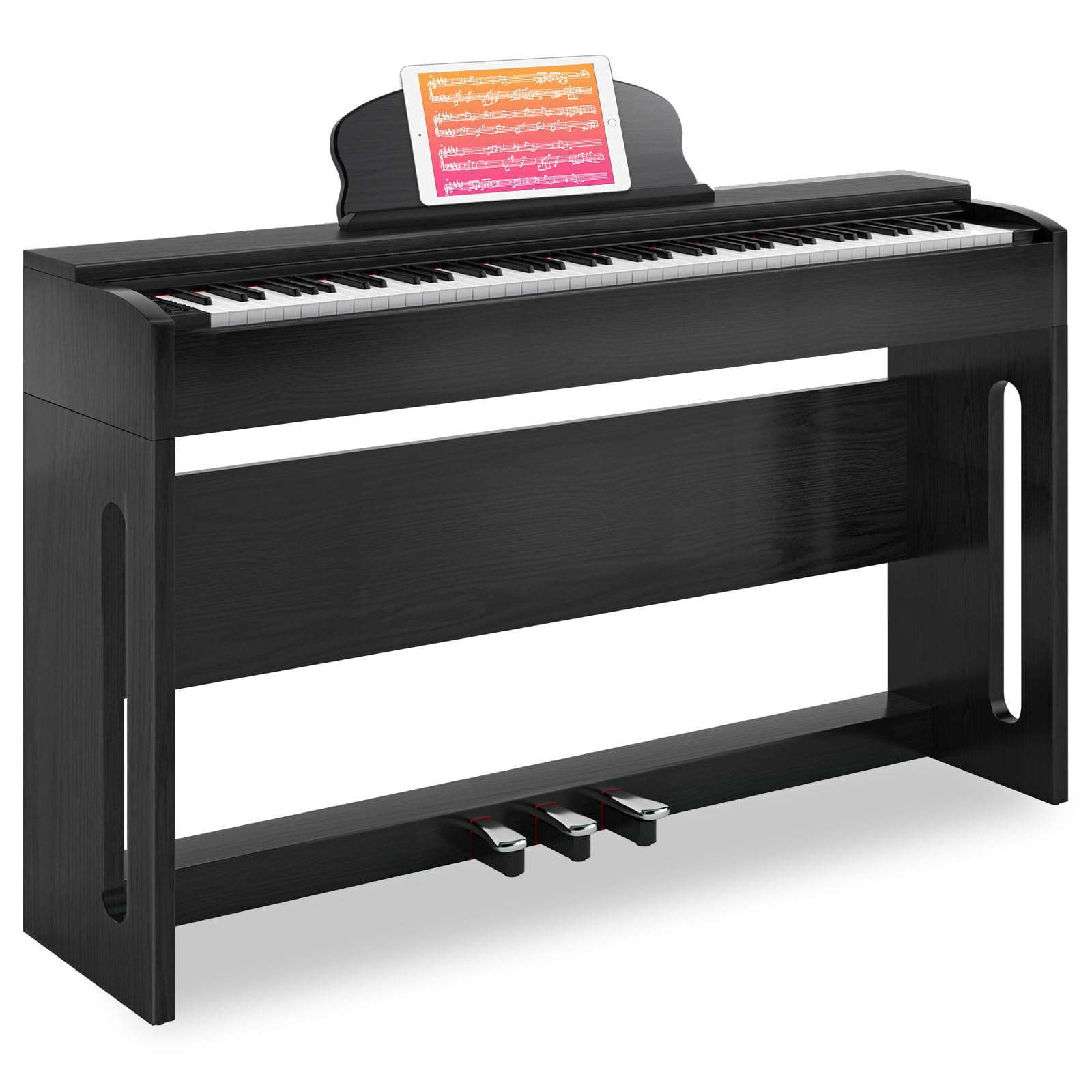
A full-size furniture piano with triple pedals, 128 timbres, and a 30-day beginner course.
The AODSK B-83S is an all-in-one package that includes a furniture stand and triple pedals (soft, sostenuto, sustain) right in the box — no hunting for accessories. Its fully weighted hammer-action keys aim to “provide a smooth and high-response piano playing experience” with 128 timbres (built-in instrument sounds) and 88 demo songs. The UMOMO, by comparison, lists 64-note polyphony for complex, sustained passages.
The keyboard includes volume adjustment, multi-tone selection, recording, playback, split mode, and a teaching function. You can also connect an MP3 player to play through the built-in amplifier. The headphone jack supports two headphones simultaneously — great for quiet practice with a teacher or partner. AODSK also offers a 30-day beginner course if you contact them, adding educational value for new learners. One customer observed “you can’t go wrong with this one” after 5 months of issue-free use.
The downside: at 71.2 pounds and with dimensions of 53.94 inches wide, this is a heavy, furniture-style instrument that is a one-and-done placement. Assembly is moderate — you’ll need your own screwdriver, and the instructions are reportedly unclear. A reviewer noted the key action feels “slightly light” for advanced players, making it more suited to beginners and intermediate students than serious performers.
In the box completeness
- Furniture stand and triple pedals included — no extra purchases needed
- 128 timbres give beginners a wide range of built-in sounds to explore
- Two headphone jacks enable silent duets with a teacher or partner
Assembly & feel trade-offs
- Assembly instructions are unclear and require your own screwdriver
- Key action feels slightly light for advanced players, per reviewers
- At 71.2 lbs, it is a permanent furniture piece, not portable
Best for beginners who want the full package: If you want a furniture piano with stand, pedals, a beginner course, and 128 timbres — all at a mid-range price — the AODSK is a strong, complete choice.
Not for advanced players: The key action is lighter than professional-grade instruments, and the assembly experience is a bit rough.
7. UISCOM 1852

A wooden desk that transforms into a digital piano — ideal for tight spaces and multi-use rooms.
The UISCOM 1852 solves a problem no other piano on this list addresses: it is a wooden desk that converts into a digital piano, and then back into a vanity or writing desk. For an apartment, dorm, or spare bedroom where you cannot dedicate floor space to a full console, this hybrid design is a clever space-saver. The Progressive Hammer-Action keyboard (full-size weighted keys) aims to “feel like a standard piano,” powered by the French Dream5704 sound chip for rich, rich acoustics.
You get 8 distinct tones, 40 demo songs, dual-tone mode (layer two sounds), reverb and chorus effects, a metronome, and the ability to record and playback your performances. There is a USB port for MP3 or hard drive playback, and the triple pedals (sustain, sostenuto, soft) add expressiveness. One reviewer, whose household used it daily with 4 children for a year, reported “no issues” — a solid durability signal.
The main trade-off: some buyers feel the keys are “less weighted than desired,” meaning the action is lighter than a true acoustic piano. If you are a serious player building advanced technique, this might feel a bit soft. But for a beginner, casual player, or a family that needs the dual function, the flexibility is tough to top. Unlike any other pick here, this also works as a desk for your laptop or makeup.
Space-saving genius: The 2-in-1 desk/piano design means you don’t sacrifice a whole room to the instrument — it folds back into a functional piece of furniture.
Feel compromise: The key action is noticeably lighter than a true progressive hammer action on a console piano — fine for practice, but a serious classical player may find it lacking.
Perfect for small-space dwellers: If you need a piano that doubles as a desk or vanity in a spare room, apartment, or shared space, the UISCOM is uniquely suited.
Not for classical purists: The key weight is lighter than what you’d get from a Casio Privia or Yamaha upright — serious players should prioritize feel over form factor.
8. UMOMO UMP-718
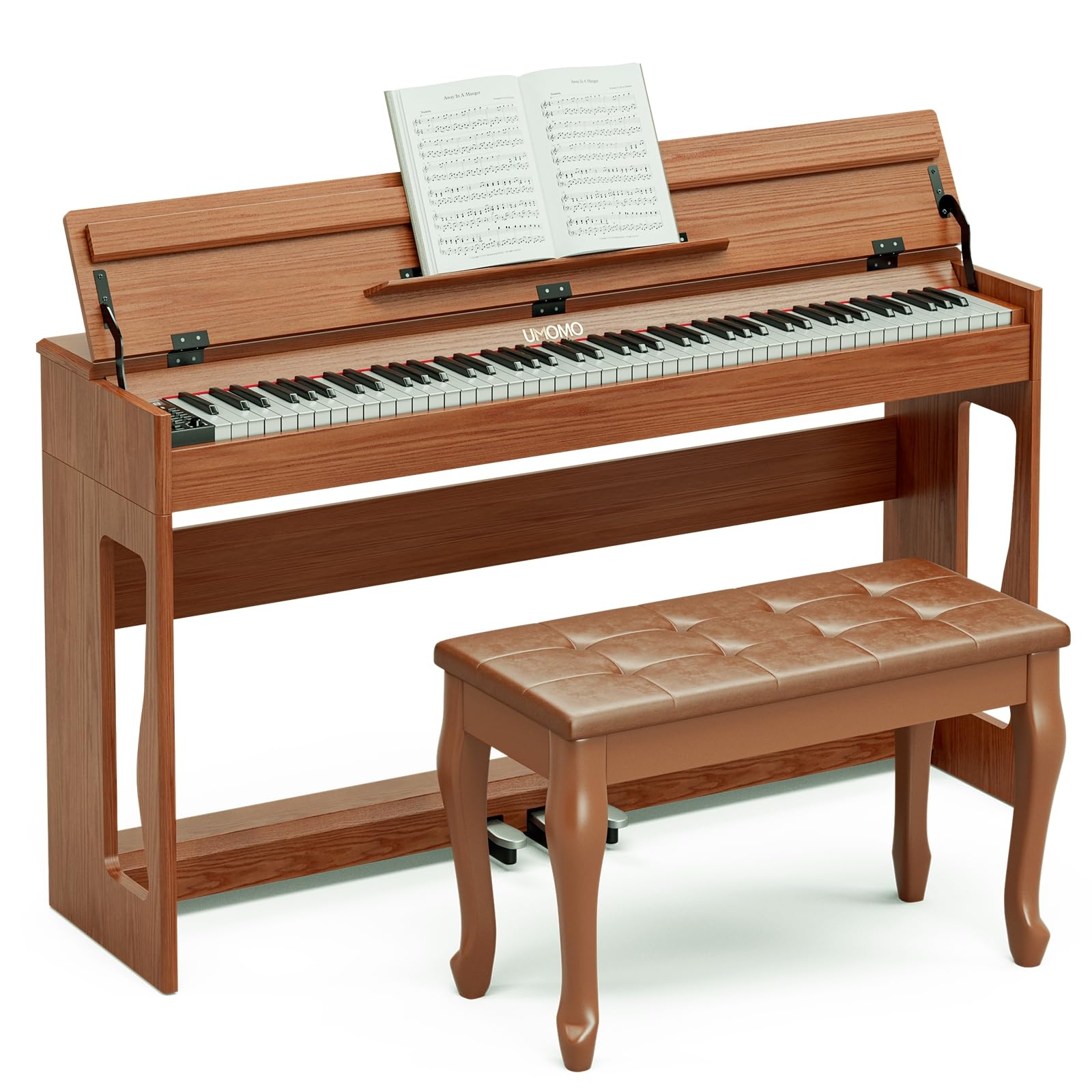
A budget-friendly weighted keyboard that throws in a duet bench and triple pedals — but check the speakers.
The UMOMO UMP-718 is the most feature-packed entry-level option in this guide. For a starting price, you get a genuine Progressive Hammer Action keyboard (heavier bass, lighter treble, just like an acoustic), a duet piano bench (padded and wide enough for two), a full 3-pedal unit (soft, sostenuto, sustain) with a fixed pedal board, and 128 tones, 128 rhythms, and 80 demo songs to explore. You also get USB MIDI, standard MIDI ports, and a 3.5mm headphone jack for silent practice.
The 64-note polyphony is a notable limitation — lower than the Donner’s 128-note polyphony. That means during complex, sustain-pedal-heavy pieces, some notes may cut off early. And here is the honest catch: reviewers point out that the “speakers are poor quality, worse than a Yamaha” — one verbatim quote. The default piano sound is described as “mediocre,” and the volume knob causes distortion and rumble past halfway. For the price, the inclusion of a duet bench and triple pedals is generous, but the sound delivery through the built-in speakers is the weakest point in this entire roundup.
If you plan to use headphones (which masks the speaker weakness) or external powered speakers, and you value the duet bench for lessons, this is a decent budget buy. If you want to fill a room with rich acoustic sound without headphones, look at the STRICH or Donner above.
What you get for the price
- Progressive Hammer Action keyboard with genuine heavier-bass/lighter-treble feel
- Sturdy duet piano bench and full 3-pedal unit included in the box
- 128 tones and 128 rhythms offer plenty of variety for beginners exploring different sounds
Major speaker weakness
- 64-note polyphony limits complex sustain-pedal passages — notes may drop out
- Built-in speakers are widely criticized as “worse than a Yamaha” by reviewers
- Volume knob creates distortion and rumble past the halfway point
A budget package for headphone users: If you always practice with headphones and want the most accessories (bench, triple pedals) for the lowest price, the UMOMO delivers value — but only through headphones.
Look elsewhere for room-filling sound: The speakers are the weakest in this guide — if you want to play aloud, the STRICH SDP-120 or Casio CDP-S160 are dramatically better.
9. STRICH SDP-120

A budget-friendly weighted keyboard with 128-note polyphony, wireless MIDI, and no assembly required.
The STRICH SDP-120 is the entry-level champion that doesn’t feel cheap. It gives you 128-note polyphony, a fully-weighted hammer-action keyboard, and an impressive 2x15W speaker system (30 watts total) — all at a budget-friendly price. There is also built-in wireless MIDI (no cables needed to connect to apps), plus USB, MIDI, and audio input ports, and a clear LCD display. You get 128 tones, 200 rhythms, and 110 demo songs to explore, plus a sustain pedal included.
One of the standout details from real buyers: “Arrived in 2 days” and “no assembly needed” — just take it out of the reinforced packaging, plug it in, and play. That matters when you are gifting this to a child or just want immediate gratification. Reviewers also praise the lighter weighted action, which “reduces fatigue” compared to big-brand alternatives — helpful for young beginners who might struggle with heavy keys. The black lacquered finish and 51.18-inch width make it a slim, elegant addition to any room.
The weaknesses are minor but real: the sheet music holder is described as “too short and weak,” and the pedal cord is short, limiting placement options relative to the outlet. But for raw spec-to-dollar value at the entry level — 128-note polyphony, 30-watt speakers, wireless MIDI — the STRICH is the strongest budget option and a legitimate rival to the UMOMO for first-time buyers.
Why it tops the budget tier
- 128-note polyphony is class-leading for the price — no note dropout during complex pieces
- 2x15W speakers (30W total) deliver rich, room-filling sound that beats the UMOMO hands-down
- Built-in wireless MIDI and no assembly required — open the box, plug in, and play immediately
Small but real quibbles
- Sheet music holder is too short and weak to hold thicker books, per buyer feedback
- Pedal cord is short, which may limit where you place the piano relative to a power outlet
- Advanced functions require trial and error — instructions are sparse
Best budget entry point: The STRICH SDP-120 is the smart choice if you want a legit weighted keyboard with high polyphony, loud speakers, and wireless connectivity — and you want to start playing the same day it arrives.
Upgrade if: You need a more sturdy music stand, a longer pedal cord, or a full furniture cabinet with a bench and triple pedals.
Understanding the Specs
Hammer Action vs Weighted Keys
Not every “weighted” keyboard uses the same mechanism. Hammer action or graded hammer action means there are actual mechanical weights or simulated hammers inside each key, replicating the heavier bass and lighter treble of an acoustic piano. This builds proper finger strength and technique. Cheaper “semi-weighted” or “touch-sensitive” keys use a spring system that feels nothing like a real piano. If you or your child is learning piano seriously, hammer action is non-negotiable.
Polyphony — How Many Notes Matter
Polyphony is the maximum number of notes the keyboard can produce at once. Entry-level models often cap at 64 notes. That is fine for simple melodies, but when you hold the sustain pedal and play a rich chord with both hands, a 64-note limit can cause the earliest notes to drop out. 128-note polyphony (found on the AODSK, Donner, and STRICH in this guide) ensures that even complex classical pieces or layered accompaniments ring clearly without cutoffs. If you plan to use the sustain pedal regularly, aim for 128.
FAQ
What is the difference between weighted keys and hammer action keys?
Do I need 128-note polyphony or is 64-note polyphony enough?
Can I use an 88 key weighted keyboard with learning apps like Simply Piano?
Is a portable slab keyboard or a furniture console better for me?
Do I need triple pedals or is a single sustain pedal enough?
How important are built-in speakers for a weighted keyboard?
Can I connect a weighted keyboard to a computer or recording software?
What is the best 88 key weighted keyboard for a child beginner?
How much space do I need for a furniture-style weighted keyboard?
Do weighted keyboards need tuning like acoustic pianos?
Final Thoughts: The Verdict
For most people, the best 88 key weighted keyboard winner is the Casio Privia PX-870 because it combines the most realistic Tri-Sensor II hammer action with a powerful 40W 4-speaker sound system and a furniture console that feels like a real piano. If you want a portablepiano you can take anywhere, grab the Casio CDP-S160, which weighs just 23.1 lbs and runs on AA batteries. And for a budget-friendly entry with no assembly required, the STRICH SDP-120 delivers 128-note polyphony and wireless MIDI that out-specs most keyboards at twice its price.
How We Picked
We do not accept paid placement. Every pick is matched to a real buyer and a real use-case; we do not hands-on test units.
Sources & Methodology
Specifications: manufacturer listings and product documentation. Review insights: verified customer reviews, as of July 2026. Pricing: not shown on this page (it changes often); check the current price via the retailer link.
As an Amazon Associate, Gadgets Feed earns from qualifying purchases. This does not affect which products we feature.
Product prices and availability are accurate as of the date/time indicated and are subject to change. Any price and availability information displayed on Amazon at the time of purchase will apply to the purchase of this product. As an Amazon Associate I earn from qualifying purchases.
CERTAIN CONTENT THAT APPEARS ON THIS SITE COMES FROM AMAZON. THIS CONTENT IS PROVIDED "AS IS" AND IS SUBJECT TO CHANGE OR REMOVAL AT ANY TIME.
Amazon and the Amazon logo are trademarks of Amazon.com, Inc. or its affiliates.