
Our readers keep the lights on and my morning glass full of iced black tea. As an Amazon Associate, I earn from qualifying purchases.
Specs are compiled from manufacturer listings and verified buyer reviews and can change over time — please confirm the key details on the product page before buying.
You unroll the package and the panel refuses to lie flat, or you score it with a knife and it cracks anyway. This guide separates the panels that behave from the ones that fight you, so you can pick the right thickness and style for your greenhouse, window cover, or workshop project without wasting a single sheet.
I’m Min — the founder and writer behind Gadgets Feed. This guide is built by comparing the manufacturers’ published specifications and the patterns across verified customer reviews, so you get each pick’s real strengths and trade-offs instead of marketing spin.
The best 8×4 polycarbonate sheets balance flatness, cutability, and UV protection so your project looks great and lasts through real weather.
Our Picks at a Glance
How To Choose The Best 8×4 Polycarbonate Sheets
A full 4×8 sheet is about the size of a standard door, which creates a unique shipping problem: most arrive rolled into a tube. That single fact drives more buyer frustration than any other spec, because a tightly-rolled panel can be very hard to flatten for flat projects like tables or windows.
Decide between solid sheet and twin-wall panel
A solid 1/16-inch sheet is a flat, clear material you cut and bend for window replacements, machine guards, and craft projects, and it weighs far less than a thick panel. A twin-wall panel around 0.24 inches thick has two layers with air channels between them, which traps heat and diffuses light — the classic greenhouse choice. Match the style to your goal: maximum clarity for viewing through, or insulation for growing plants.
Check the flatness story before you buy
Rolled sheets flatten well if you unroll them immediately and lay them under weight, and some makers add a protective grid film that helps with layout and keeps the surface clean. Panels delivered flat on a pallet skip that hassle entirely, but they are heavier and cost more to ship. Look for a listing that honestly describes how the panel ships and how long flattening takes.
Quick Comparison
| Model | Best For | Thickness | Coverage | Weight | Amazon |
|---|---|---|---|---|---|
| Robosource 1/16″ Solid Sheet★ Best Overall | Flat, clear DIY projects | 1/16 inch | 32 Square Feet | — | Amazon |
| Beeveer 1/16″ Clear Sheet | Wide coverage on a budget | 1/16 inch | 48 Square Feet | 9.4 pounds | Amazon |
| EVERECO 6-Pack Greenhouse Panel | Replacing damaged greenhouse panels | 0.24 inch | — | 40.9 pounds | Amazon |
| Sinimaka 8-Pack Twin-Wall Panel | Whole-greenhouse builds | 0.24 inch | 288 Square Feet | — | Amazon |
In‑Depth Reviews
1. Robosource 1/16″ Clear Polycarbonate Sheet
Our pick — over 4.5★ from 150+ verified ratings; the strongest balance of quality and price.
The flat-friendly 1/16-inch sheet that measures, cuts, and lays flat without the usual wrestling match.
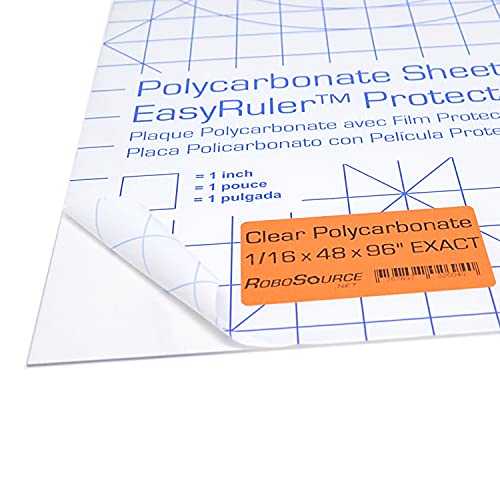
This solid polycarbonate sheet is the easiest pick to live with because it ships rolled and flattens out very well if you unroll it immediately, according to the manufacturer. The protective film printed with a one-inch grid is a real time-saver for laying out window well covers or map-table tops, and the 32 Square Feet of coverage is plenty for a first project. It arrives at 48 x 96 x 0.06 inches, so you get the full 4×8 footprint.
Buyers report that it cuts cleanly with a box cutter, jigsaw, or bandsaw, and one owner summed it up directly: “Easy to work with I cut it with vinal siding shears.” That ease comes from a 100% virgin polycarbonate resin that resists cracking and chipping, and it is UV stabilized for general-purpose use with moderate sunlight. It even handles a heat gun for bending or thermoforming if your project calls for curves.
The honest trade-off is that full 4×8 sheets are too large to ship flat, so it must arrive rolled. A few owners called out the price as the steep part of the deal, but the material’s flexibility, crack resistance, and clarity tend to win the argument — it is the crowd favorite at 4.6 stars.
What Earns the Top Spot
- One-inch grid film makes measuring and layout genuinely faster
- Cuts with simple tools (box cutter, jigsaw, bandsaw) without cracking
- Lays flat quickly if you unroll it right away
- UV stabilized for moderate sun exposure
Fair Warnings
- Ships rolled, so flatness depends on unpacking it promptly
- Some buyers found the cost on the higher side
Reach for this if: you want a clear, flat sheet for windows, table tops, or craft work and you value easy cutting over saving a few dollars.
Think twice if: your project will sit in strong direct sun all day — that scenario calls for a UV-coated panel instead of UV-stabilized material.
2. Beeveer 1/16″ Clear Polycarbonate Sheet

A generously sized 48 Square Feet of impact-resistant sheet at a price that’s easy on the wallet.
This pick delivers noticeably more coverage than the Robosource — 48 Square Feet versus 32 — and it weighs just 9.4 pounds, which is a 4.4x gap against the thick 40.9-pound greenhouse panel, so it’s genuinely easy to carry and maneuver. The value play is strong: you get a full 48 x 96 inches of clear polycarbonate at 1/16 inch thick with dual-sided UV coating that resists yellowing over time, making it suitable for both indoor frames and outdoor greenhouses.
Durability is the thing owners consistently praise — the material is stout enough that one buyer installed it over a porch screen and stopped raccoons from getting through that same night. It’s also marketed as impact-resistant and workable with scissors, a hacksaw, or a drill, and it heat-forms cleanly with a heat gun. For a windshield, poster protection, or a critter barrier, it does the job well.
The catch here is real and well-documented: this sheet ships rolled tight and is genuinely hard to flatten. Owners mention the material “will not flatten out no matter what I tried,” with the flatness complaints being the most common theme by far. One user who made a junior dragster windshield found it easy to cut with a jigsaw, but saw “lines of distortion” looking through it. For curved or rolled projects it may be ideal, but for a flat, optically-clear surface, treat this as a gamble.
Smart save: the best budget route if you need maximum square footage per dollar and you’re covering something curved or protective rather than a display window.
Watch it: the rolled, curling delivery is the recurring gripe — plan for 24–72 hours under weight, and even then success isn’t guaranteed.
Best suited for: budget-conscious buyers covering greenhouses, screens, or rounded projects where a slight curl won’t ruin the look.
Look elsewhere if: you need a perfectly flat, distortion-free viewing surface — the roll-flattening struggle makes that an uphill battle.
3. EVERECO 6-Pack Greenhouse Panel
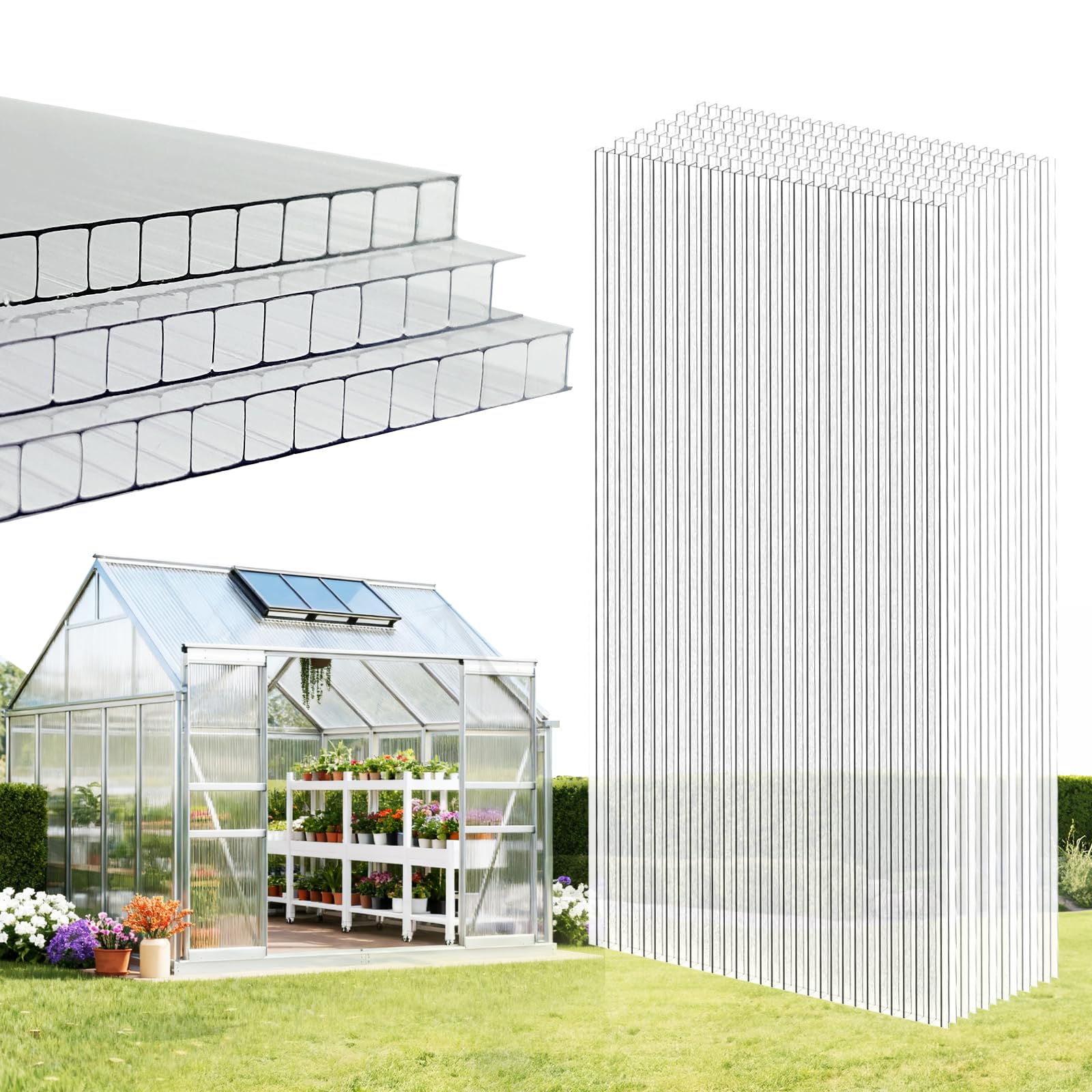
A six-panel set with optical-grade clarity and a UV coating that keeps plants sunbathing safely.
This is the pick for anyone repairing or building a greenhouse, because it’s the only one here that ships as a six-pack of panels rather than a single rolled sheet — no flattening struggle at all. Each panel measures roughly 8′ x 4′ x 0.24″, and the whole package weighs 40.9 pounds, which tells you these are rigid, twin-wall style panels built for structure, not flimsy film. Optical-grade material delivers over 90% light transmittance for photosynthesis.
The UV coating blocks 99% of UV rays, and the maker claims impact resistance 200x that of glass—ideal for hail or falling branches. Rated for -40℃ to 120℃, it withstands frost and summer heat without cracking or softening. Owners who replaced storm-damaged panels found these more sturdy than the cheap originals, calling the price cheaper than buying a single 4×8 sheet at the home improvement store.
The durability feedback is a little mixed — most owners find them relatively strong, though a few described them as flimsy, so treat them as solid greenhouse-grade panels rather than bulletproof armor. The real praise centers on value for money, with multiple owners noting the multi-pack price beats buying singles locally, even if the upfront cost feels high.
Best value read: cheaper per panel than sourcing 4×8 sheets at a big-box store, with extras included for future damage.
Honest limit: a handful of owners found them less rigid than expected, so they suit framed greenhouses more than unsupported spans.
Grab these if: you’re replacing winter-damaged greenhouse panels and want UV protection, light transmission, and a multi-pack price break.
Skip if: you need a single flat sheet for a window or display — this is a greenhouse product through and through.
4. Sinimaka 8-Pack Twin-Wall Panel

An eight-panel arsenal with 288 Square Feet of twin-wall coverage for a full greenhouse build.
If you’re building a greenhouse from the ground up, this is the coverage king: eight panels at 8 x 4 feet each, totaling 288 Square Feet — the largest footprint in this lineup by a wide margin. Each panel is approximately 0.24 inches thick with a twin-wall design, meaning two layers with air between them that trap heat and diffuse light softly for healthier plant growth. Rated for -40°C to 120°C, it handles hail, heavy rain, and snow loads.
The UV coating blocks 99.9% of UV while allowing 89% light transmission, and the panels cold-bend for curved roofs. Customers note they’re lightweight, easy to cut without splintering, and perfect for winterizing a chicken coop or replacing wind-blown panels — one buyer’s replacements held through several more high-wind days after the originals blew out. The value-for-money praise is the top theme here, with buyers calling it well worth the spend for a whole greenhouse.
Two honest notes before you commit. First, some owners found the panels about 23 inches wide rather than a full 2 feet, which means splicing if your greenhouse frame expects exact 2-foot spacing. Second, sturdiness and transparency both draw mixed feedback — a few found them flimsy, and one reviewer noted the material looked “very smoked” and couldn’t see through it at all, so expect a translucent, diffused look rather than crystal clarity.
Why It’s a Whole-Build Winner
- 288 Square Feet covers an entire greenhouse in one order
- Twin-wall design traps heat and diffuses light for plants
- Cold-bends for curved roofs without cracking
- Survives hail, snow loads, and -40°C to 120°C swings
Measure Twice
- Panels run about 23 inches wide, not a full 2 feet — factor in splicing
- Appearance leans translucent/smoked, not perfectly clear
- Sturdiness reads mixed; some owners found them flimsy
Choose this for: a full greenhouse rebuild or new build where maximum square footage, insulation, and cold-bending flexibility matter most.
Hold off if: you need crisp viewing panels or exact 2-foot widths — the smoked look and 23-inch width will frustrate you.
Understanding the Specs
Thickness: 1/16 inch vs 0.24 inch
A 1/16-inch solid sheet is thin, light, and bends easily with a heat gun — perfect for windows, guards, and crafts where clarity matters. A 0.24-inch twin-wall panel is rigid with air channels inside, giving you insulation and impact resistance for greenhouses at the cost of weight and a less crisp view.
UV Stabilized vs UV Coated
UV-stabilized material has protection mixed into the resin, which suits moderate sun exposure. UV-coated panels block up to 99% of UV rays and resist yellowing for years of full-sun use—ideal for greenhouses and outdoor roofs.
FAQ
How do I flatten a polycarbonate sheet that arrived rolled?
What’s the difference between a solid sheet and a twin-wall panel?
Can I cut polycarbonate with regular tools?
Is polycarbonate better than plexiglass for outdoor use?
How much area does a single 4×8 sheet cover?
Will polycarbonate yellow over time in the sun?
Can I bend polycarbonate to make a curved roof?
How heavy is a 4×8 polycarbonate panel?
Final Thoughts: The Verdict
For the widest range of flat, clear projects, the 8×4 polycarbonate sheets winner is the Robosource 1/16″ sheet because it lays flat, cuts cleanly, and carries the strongest crowd approval. If you want maximum square footage for the least money and don’t mind managing a curl, grab the Beeveer. And for a greenhouse repair or full build, the EVERECO six-pack and the Sinimaka eight-pack are the ones to reach for.
How We Picked
We do not accept paid placement. Every pick is matched to a real buyer and a real use-case; we do not hands-on test units.
Sources & Methodology
Specifications: manufacturer listings and product documentation. Review insights: verified customer reviews, as of August 2026. Pricing: not shown on this page (it changes often); check the current price via the retailer link.
As an Amazon Associate, Gadgets Feed earns from qualifying purchases. This does not affect which products we feature.