
Dialogue clarity, precise overhead effects, and room-shaking low-end define the difference between a flat movie watch and being inside the action. A 9.1 surround sound system delivers exactly that: true discrete channels with dedicated height speakers that place sounds above you, not just around you — creating a fully immersive 3D audio bubble. The challenge is finding a system that balances powerful bass, seamless wireless connectivity, and a setup that doesn’t require a professional installer.
I’m Min — the co-founder and writer behind Gadgets Feed. I’ve spent countless hours analyzing channel configurations, amplifier power ratings, driver types, and room calibration technologies across dozens of models to pinpoint exactly which systems deliver on their promises and which ones fall short.
This guide breaks down the top contenders for the best 9.1 surround sound system, covering everything from all-in-one soundbars to component-based bundles that offer real theater-grade immersion.
How To Choose The Best 9.1 Surround Sound System
Selecting a 9.1 system means committing to a specific ecosystem and physical layout. The core question is whether you want a soundbar-based solution for simplicity or a traditional AV receiver with passive speakers for maximum flexibility and upgrade potential. Understanding a few key differentiators will prevent costly mistakes.
Channel Count vs. Real Drivers
Not all 9.1-channel systems are created equal. A soundbar labeled 9.1.4 may use fewer physical drivers that are virtually placed, while a component-based system uses nine physically discrete speaker locations. The Nakamichi Dragon, for example, uses six dedicated height drivers, whereas some soundbars rely on psychoacoustic trickery. Always count the physical up-firing drivers if overhead sound is your priority.
Room Calibration Technology
Room acoustics are the single biggest variable affecting sound quality. Systems like the Onkyo TX-RZ50 with Dirac Live and the LG S95TR with AI Room Calibration use microphones to measure reflections and adjust timing, EQ, and levels. A system without calibration requires perfect speaker placement, which is rare in real living rooms. Prioritize models with automatic calibration over those that rely on manual settings.
Wireless Reliability and Connectivity
Rear speakers that cut out or produce static ruin the experience. Look for systems with dedicated wireless protocols rather than standard Bluetooth for rear channels. HDMI eARC support is essential for lossless Dolby Atmos from streaming apps and Blu-ray players. The Nakamichi Ultra 9.2.4 uses RCA connections between the surrounds and subwoofers, which trades some convenience for absolute reliability.
Subwoofer Size and Configuration
A 9.1 system’s “1” refers to the LFE subwoofer channel, but that channel can be served by one large driver or two smaller ones. Dual subwoofers, like the Nakamichi’s dual 10-inch configuration, provide smoother bass distribution across the room. A single premium 12-inch driver, like the JBL Bar 1300XMK2, delivers more raw impact but may have a narrower sweet spot. Consider your room size when choosing between bass quantity and evenness.
Quick Comparison
On smaller screens, swipe sideways to see the full table.
| Model | Category | Best For | Key Spec | Amazon |
|---|---|---|---|---|
| Nakamichi Dragon 11.4.6 | Premium Soundbar | Cinema-grade immersion | 7x HiFi AMT tweeters + 6 height channels | Amazon |
| Samsung Q990F | Wireless Soundbar | Seamless TV integration | 11.1.4ch with true wireless rear speakers | Amazon |
| Nakamichi Shockwafe Ultra 9.2.4 | Modular Soundbar | Dual-sub bass performance | Dual 10″ subs + 4 modular surrounds | Amazon |
| Onkyo TX-RZ50 + Speakers | AV Receiver Bundle | Custom component setups | 9.2 channels, Dirac Live, THX Certified | Amazon |
| Sonos Arc Ultra | Premium Soundbar | Multi-room audio ecosystem | 9.1.4 spatial audio, Sound Motion tech | Amazon |
| JBL Bar 1300XMK2 | Detachable Soundbar | Portable rear speakers | 11.1.4ch, 12″ sub, detachable battery surrounds | Amazon |
| Bose Ultra Soundbar System | Lifestyle Soundbar | Wireless simplicity & design | Bose Bass Module 700 + wireless surrounds | Amazon |
| LG S95TR | TV-Matching Soundbar | LG TV owners wanting synergy | 9.1.5-ch, triple up-firing, WOWCAST wireless | Amazon |
| Klipsch Cinema 5.1.4 Bundle | Component Bundle | Traditional speaker system value | Klipsch speakers + Onkyo TX-RZ30 receiver | Amazon |
In‑Depth Reviews
1. Nakamichi Dragon 11.4.6-Ch Surround System

The Nakamichi Dragon is not a soundbar in the traditional sense; it is a full-scale, cinema-grade home theater system that happens to connect via a single HDMI cable. Its 58-inch wide main chassis houses seven HiFi Air Motion Tweeters that deliver pristine highs with zero distortion, even at reference volume. The six discrete height channels — more than any other soundbar-based system — use bipolar surrounds and a PerfectHeight mechanism to lock overhead effects to your specific listening position.
The dual-opposing 8-inch subwoofers control bass with authority, avoiding the muddy artifacts common with single-driver designs. The Pro Cinema Engine processes Dolby Atmos up to a staggering 24.1.10 and DTS:X Pro up to 30.2 — specifications that rival dedicated preamplifier-processors costing several times as much. Setup is plug-and-play, but owners report that fine-tuning the subwoofer distance and crossover at 120Hz eliminates any residual boominess.
For buyers who want AVR-grade sound without the complexity of wiring separate components, the Dragon is the ultimate expression of what a soundbar platform can achieve. It ships in three boxes and weighs over 100 pounds total, so it demands a dedicated AV cabinet capable of supporting its physical presence.
Why it’s great
- Unrivaled height channel count and precision with AMT tweeters
- Pro Cinema Engine processes Dolby Atmos far beyond soundbar norms
- Dual-opposing subs deliver clean, controlled bass without distortion
Good to know
- Extremely heavy and large — requires significant physical space
- No automatic room calibration; manual distance settings needed
- Firmware updates require a USB drive, not OTA
2. Samsung Q990F 11.1.4ch Soundbar

The Samsung Q990F is the 2025 flagship that refines an already excellent platform. Its 11.1.4-channel configuration uses physical drivers in the front bar, a dedicated wireless subwoofer, and two wireless rear speakers that each contain up-firing drivers. The result is a convincing overhead sound field that requires no cable routing to the rear of the room — the surrounds only need a power outlet.
Q-Symphony allows the soundbar to work in tandem with compatible Samsung TV speakers for a wider front soundstage, while Game Mode Pro reduces latency to near-zero for console gaming at 4K/120Hz. The SmartThings app provides granular control over individual channel levels and includes an AI-based adaptive sound feature that analyzes ambient noise to boost dialogue automatically. The subwoofer, though compact, produces chest-thumping bass that rivals much larger drivers in short-term burst tests.
One limitation is the physical input count: only two HDMI inputs are provided, which may require an external switcher for users with multiple 4K sources. Owners upgrading from previous Q-series models report noticeably improved clarity in the height channels and a wider soundstage, making this the mid-range champion for those prioritizing wireless convenience.
Why it’s great
- True wireless rear speakers with up-firing drivers for overhead effects
- Q-Symphony integrates seamlessly with Samsung TVs for enhanced soundstage
- AI Adaptive Sound and Game Mode Pro for automatic optimization
Good to know
- Only 2 HDMI inputs — may need a switcher for multi-device setups
- Remote is minimal; the app is required for full control
- Height effects can be subtle until properly calibrated via the app
3. Nakamichi Shockwafe Ultra 9.2.4

The Nakamichi Shockwafe Ultra 9.2.4 is the system that proved dedicated dual subwoofers could work in a soundbar form factor. Its two 10-inch wireless subwoofers eliminate the hot spots and null zones that plague single-sub setups, delivering bass that is felt evenly across the entire room. The four modular surround speakers can be used as individual units for wider dispersion or attached to dipole mounts for a more focused rear sound field.
SSE MAX processing drives the 1300-watt total output, and the system supports Dolby Atmos and DTS:X with convincing overhead effects from the up-firing drivers in both the front bar and the rear surrounds. The included HDMI eARC port and three HDMI inputs support Dolby Vision and 4K HDR passthrough. Owners consistently praise the clarity of dialogue even at moderate volumes, a testament to the dedicated center channel design.
The caveat is that each surround speaker connects to its respective subwoofer via a supplied RCA cable, not wirelessly. This trades the ultimate convenience of a fully wireless system for rock-solid reliability — no Bluetooth dropouts or static. With 32-foot cables included, placement flexibility is still generous, but the cables need to be hidden during installation.
Why it’s great
- Dual 10-inch subs provide room-filling bass with no dead spots
- Four modular surrounds for flexible room layouts
- Excellent dialogue clarity and easy setup out of the box
Good to know
- Surround speakers connect to subs via RCA cables, not fully wireless
- Subwoofers and speakers are physically large — need floor space
- Included power cable has a right-angle plug that may not fit all outlets flush
4. Onkyo TX-RZ50 9.2-Channel AV Receiver

The Onkyo TX-RZ50 is an AV receiver, not a soundbar, and it demands that you provide your own speakers. It processes up to 11.2 channels internally — you can configure it for a full 7.2.4 Dolby Atmos setup with the addition of an external two-channel amplifier for the rear height speakers. The 120 watts per channel into 8 ohms is genuine, not peak-hyped marketing power, and it drives even low-sensitivity speakers to reference level without strain.
Dirac Live room calibration is included out of the box, which is a significant value add versus competitors that require a paid license. Dirac Live measures your room’s frequency response across multiple listening positions and applies precision filters to correct for bass modes and reflection issues. The receiver is THX Certified, meaning it passes strict distortion and noise tests across its entire signal path. HDMI 2.1 inputs support 8K/60 and 4K/120 pass-through, making it gaming-ready for the latest consoles.
The trade-off is that you need to source, wire, and position at least five speakers and a subwoofer to create a 5.1 system before you hear anything. The setup process via Dirac Live takes about 30 minutes, and the included calibration microphone is adequate for most rooms. For buyers who want total control over speaker selection and the ability to upgrade components individually over time, the TX-RZ50 is the foundation without equal in this price bracket.
Why it’s great
- Dirac Live included at no extra cost for pro-grade room calibration
- THX Certified and 120Wpc delivers genuine high-current amplifier performance
- HDMI 2.1 with 8K/60 and 4K/120 for future-proof gaming
Good to know
- Requires separate speakers, subwoofer, and speaker wire — not for the casual buyer
- HDMI switching can have a 12-15 second delay when changing inputs
- Onkyo’s app experience is less polished than competitors
5. Sonos Arc Ultra Soundbar

The Sonos Arc Ultra represents the company’s most ambitious acoustic design, introducing proprietary Sound Motion technology that places multiple audio transducers inside a single slim enclosure to create a wide, room-filling soundstage. The 9.1.4-channel spatial audio profile, combined with Dolby Atmos decoding, produces a convincing height layer that does not require ceiling-mounted speakers. The AI-driven Speech Enhancement is genuinely effective — it detects the human voice against background noise and clarifies dialogue without making everything sound artificial.
Trueplay tuning uses the microphone built into your iOS or Android device to measure how sound reflects off walls, furniture, and curtains, then applies a precise EQ curve. The system integrates into the broader Sonos ecosystem seamlessly, allowing you to add a Sonos Sub and a pair of Era 300 speakers as rear surrounds for a true Dolby Atmos experience. Control is available via the app, your TV remote, Sonos Voice Control, or Amazon Alexa.
The barrier here is the cost of building out the full system. The Arc Ultra alone is just the start — adding the Sub and Era 300s more than doubles the total investment. Owners who run the bar alone note that the bass response, while impressive for its size, cannot match a dedicated subwoofer during explosive movie sequences. If you are already invested in Sonos or plan to expand room by room, the ecosystem cohesion is unmatched.
Why it’s great
- Sound Motion tech creates a wide soundstage from a slim bar
- AI Speech Enhancement improves dialogue clarity without sounding processed
- Seamless multi-room expansion with other Sonos components
Good to know
- Optimal surround sound requires buying additional Sonos speakers and sub
- Firmware updates can occasionally cause connection issues
- Higher total cost for a full 9.1.4 setup compared to all-in-one rivals
6. JBL Bar 1300XMK2
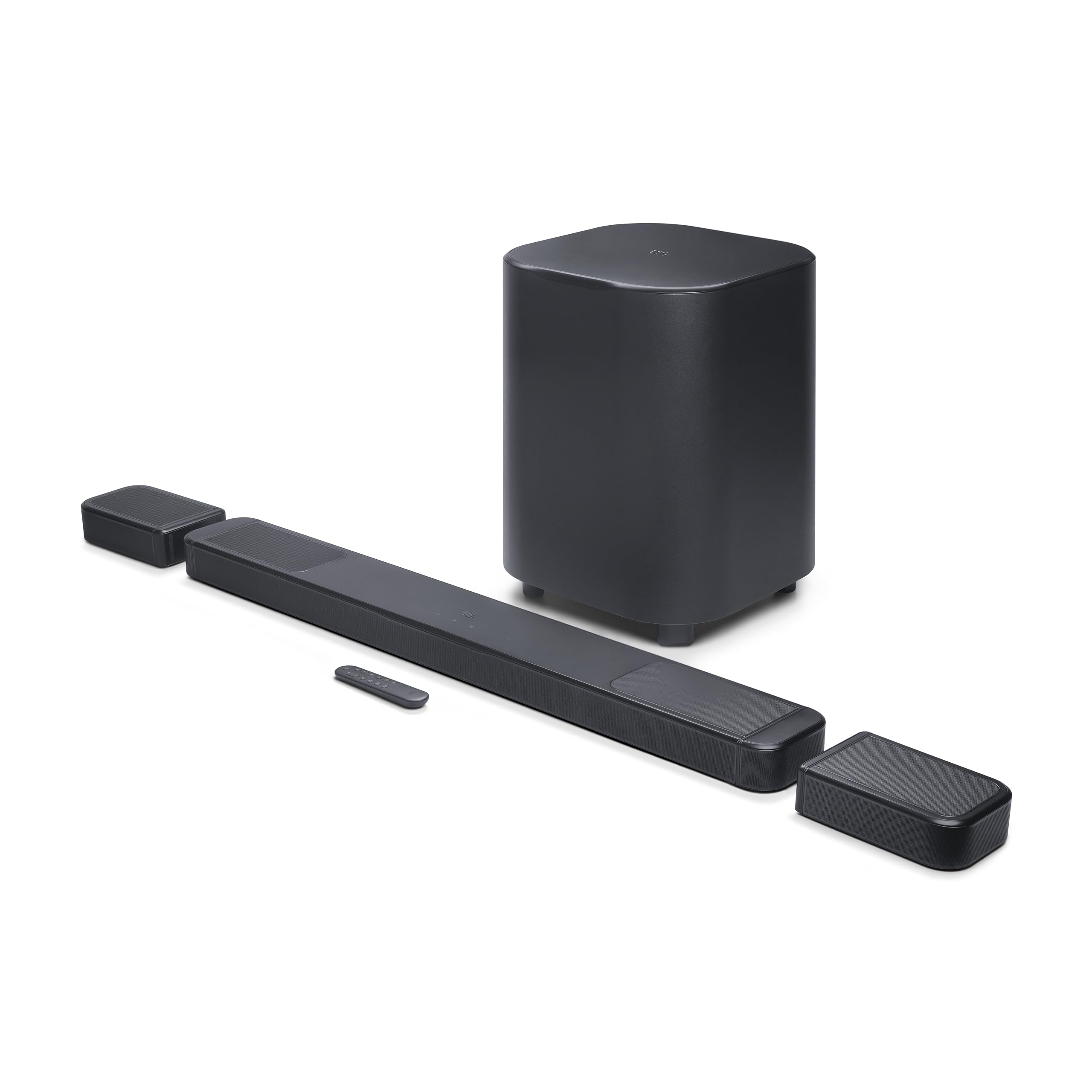
The JBL Bar 1300XMK2 solves one of the most persistent annoyances in surround sound: what to do with the rear speakers when they are not in use. Its detachable surround speakers lift off the main bar with one hand, contain their own rechargeable batteries, and provide four to five hours of continuous playback. When the movie ends, they dock back onto the bar to recharge overnight — no wall outlets, no cables, no extra power bricks near your couch.
The 11.1.4-channel configuration uses six up-firing drivers across the main bar and rears to deliver true Dolby Atmos overhead effects, while a 12-inch wireless subwoofer provides 1570 watts of maximum output. The subwoofer is substantial — it produces deep, physical bass that is felt at volumes well below its distortion threshold. PureVoice 2.0 automatically adjusts dialogue levels based on ambient scene noise and the volume setting, so whispered conversations remain audible without blasting the room.
MultiBeam 3.0 creates a wide soundstage that expands the sweet spot beyond a single chair. The detachable speakers also support a Broadcasting mode: bring one speaker into the kitchen to hear the game while retaining stereo sound in the living room. The main compromise is battery life versus wired reliability — heavy users who watch consecutive three-hour films may need to recharge mid-session.
Why it’s great
- Detachable, battery-powered rear speakers eliminate all wiring
- 12-inch wireless subwoofer delivers house-shaking bass
- Broadcasting mode lets you take sound to other rooms
Good to know
- Rear speakers have a finite battery life of 4-5 hours per charge
- Large subwoofer and bar require significant cabinet space
- Height effects are convincing but not as detailed as dedicated ceiling speakers
7. Bose Home Theater System
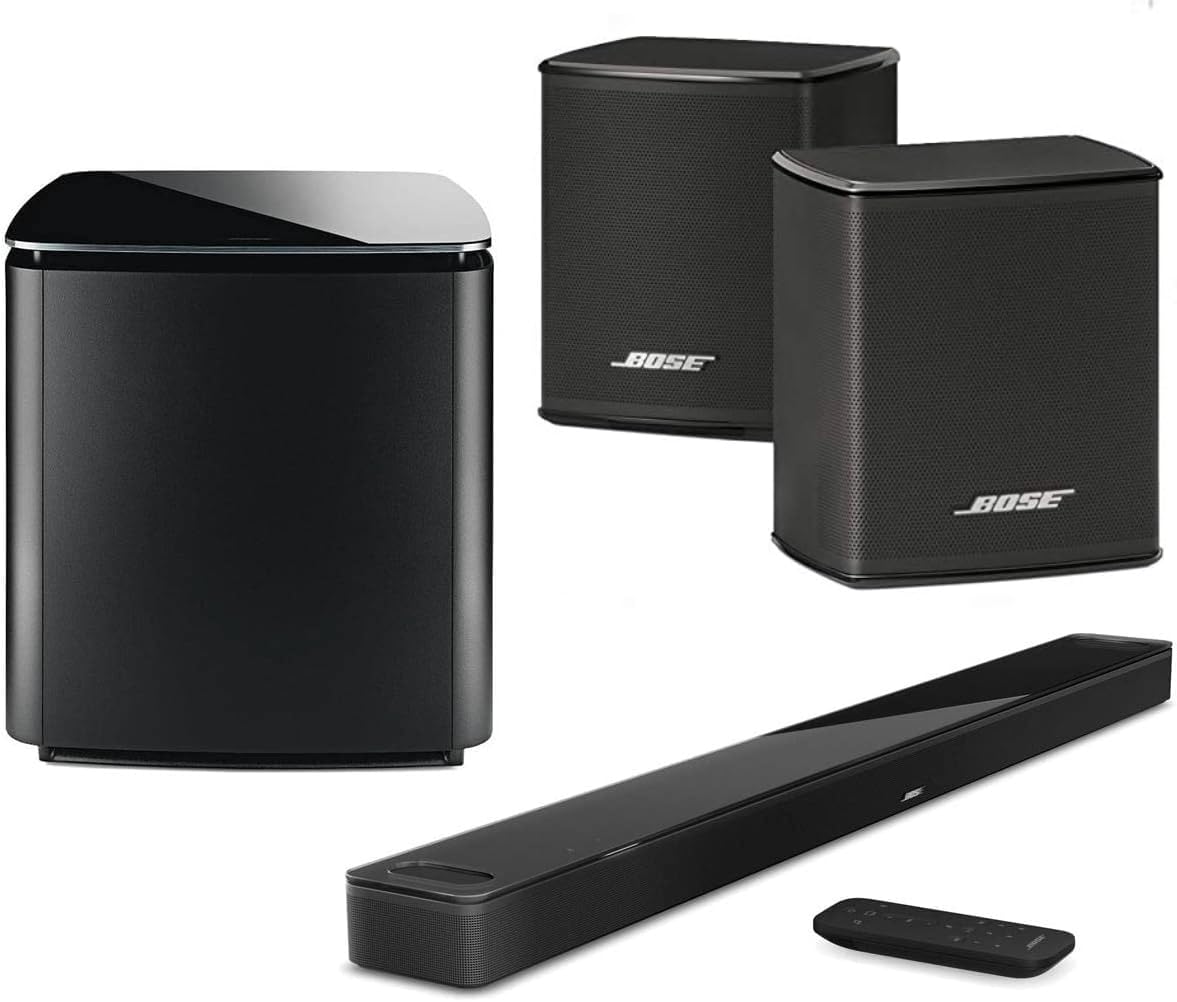
The Bose Home Theater System combines the Smart Ultra soundbar with the Bass Module 700 and two wireless surround speakers to create a complete 5.1.2 Dolby Atmos setup. Bose’s proprietary PhaseGuide technology reflects sound off the ceiling and walls to create height effects without requiring up-firing drivers, which means the soundbar maintains a low profile on your media console. The 700 subwoofer uses a downward-firing design that minimizes localization — you feel the bass rather than hearing where it originates.
Setup is genuinely plug-and-play. The wireless surrounds pair automatically with the soundbar, and the ADAPTiQ headset included with the soundbar performs a room calibration that takes under five minutes. Voice4Video technology allows you to control your TV, cable box, and soundbar through a single voice command via Alexa or Google Assistant. The sound signature is balanced rather than aggressive, making it ideal for mixed usage that includes music, TV, and movies.
The primary limitation is that this is a 5.1.2 system, not a full 9.1 configuration. It processes Dolby Atmos to create virtual height effects, but it lacks the discrete rear up-firing channels that true 9.1 systems provide. Owners who push the bass module to high volumes during action scenes report occasional “woofy” overhang — a slight lack of tightness compared to sealed subwoofer designs.
Why it’s great
- Extremely easy wireless setup — five minutes from unboxing to sound
- PhaseGuide creates convincing overhead effects without visible drivers
- Balanced sound profile works well for music, movies, and dialogue
Good to know
- Only 5.1.2 channels — lacks the discrete overhead channels of real 9.1 systems
- Bass Module 700 can sound slightly loose at very high volumes
- Firmware updates may occasionally require extended downtime
8. LG S95TR 9.1.5-Channel Soundbar

The LG S95TR is engineered specifically for LG OLED TV owners. Its 9.1.5-channel configuration includes a unique center up-firing driver — an industry exclusive — that focuses dialogue clarity in the vertical plane while the outer up-firing drivers handle atmospheric effects. WOWCAST technology transmits Dolby Atmos wirelessly from compatible LG TVs to the soundbar with no perceptible lag, eliminating the need for an HDMI cable between the TV and soundbar if your TV supports it.
Advanced Room Calibration uses the soundbar’s built-in microphone to measure room dimensions and rear speaker placement, then applies AI-based optimization. The rear speakers are truly wireless — they only need a power outlet — and they include their own up-firing drivers. WOW Orchestra mode synchronizes the LG TV’s internal speakers with the soundbar for a wider front soundstage, and VRR/ALLM passthrough at up to 120Hz makes this a solid companion for PC and console gaming.
Some owners note that out-of-the-box tuning emphasizes bass at the expense of midrange clarity, which can cause dialogue to sound slightly recessed. Increasing the center channel input in the settings resolves this. The bass response, while impactful, is less nuanced than higher-end competitors like the Nakamichi or Samsung Q990F. For LG TV owners who value a clean, single-remote setup and wireless Atmos, this is the most streamlined option available.
Why it’s great
- Industry-exclusive center up-firing driver for focused dialogue height
- WOWCAST wirelessly transmits Dolby Atmos from compatible LG TVs
- AI Room Calibration adapts to rear speaker placement automatically
Good to know
- Dialogue can sound recessed until center channel level is manually increased
- Bass is strong but less tight compared to premium rivals
- Best value when paired with an LG OLED — less compelling with other TV brands
9. Klipsch Reference Cinema 5.1.4 with Onkyo TX-RZ30

The Klipsch Reference Cinema 5.1.4 bundle packages four Atmos-enabled satellite speakers, a center channel, a 10-inch powered subwoofer, and the Onkyo TX-RZ30 receiver into a single box. This is a true component system — each speaker requires speaker wire, the subwoofer needs an RCA cable, and the receiver must be placed in a ventilated rack or cabinet. The payoff is the signature Klipsch sound: horn-loaded tweeters that deliver crisp, dynamic highs and a low-distortion midrange that makes dialogue pop.
The TX-RZ30 receiver is a 9.2-channel unit with Dirac Live room correction built in. It supports Dolby Atmos, DTS:X, IMAX Enhanced, and HDMI 2.1 with 8K/60 and 4K/120 passthrough. The bundle has been designed so that a 5.1.4 configuration — four height channels using the Atmos-enabled satellites — is the default setup path. The subwoofer includes Klipsch’s Reference-level 10-inch driver, which provides tight, musical bass suitable for both movies and music.
The primary concerns are receiver reliability and system weight. Several customers report the Onkyo receiver failing after short periods, with loud pops followed by a dead unit. The bundle also does not include speaker wire, which is an unexpected expense. The physical size of the speakers — even the satellites — is larger than many expect, making this unsuitable for tight media cabinets or minimalist living rooms.
Why it’s great
- True Klipsch horn-loaded tweeters provide unmatched clarity and dynamics
- Includes Dirac Live room correction on the bundled Onkyo receiver
- 5.1.4 configuration with dedicated height channels for proper Dolby Atmos
Good to know
- Receiver reliability has been inconsistent, with some units failing
- Speaker wire is not included — factor that into total cost
- Satellite speakers are larger than most modern soundbar surrounds
FAQ
What does the number 9.1 actually mean in a surround sound system?
Can I use a 9.1 soundbar without a separate AV receiver?
Do I need special HDMI cables for Dolby Atmos on a 9.1 system?
Is a 9.1 system better than a 5.1 system for a small room?
Final Thoughts: The Verdict
For most users, the best 9.1 surround sound system winner is the Samsung Q990F because it delivers true 11.1.4-channel immersion with fully wireless rear speakers and seamless Samsung TV integration at a price that undercuts premium alternatives. If you want the absolute pinnacle of overhead precision and bass control, the Nakamichi Dragon 11.4.6 is in a class of its own. And for a pure component-based system that lets you choose every speaker and upgrade over time, nothing beats the Onkyo TX-RZ50 as the foundation of a custom home theater.