
Our readers keep the lights on and my morning glass full of iced black tea. As an Amazon Associate, I earn from qualifying purchases.
Specs are compiled from manufacturer listings and verified buyer reviews and can change over time — please confirm the key details on the product page before buying.
If you are building a true home theater with height speakers and two subwoofers, the receiver is the piece that either makes it work or holds it back. A 9.2 receiver (nine main channels plus two independent subwoofer outputs) is what lets you run a Dolby Atmos setup with overhead sound and separate bass from two boxes. The catch most buyers hit is not channels, it is room correction and setup — that is where these five picks separate. If you want the strongest all-rounder, the Onkyo TX-RZ50 leads this list on quality and sound, and it holds the highest owner satisfaction here.
I’m Min — the founder and writer behind Gadgets Feed. This guide is built by comparing the manufacturers’ published specifications and the patterns across verified customer reviews, so you get each pick’s real strengths and trade-offs instead of marketing spin.
You will see which receivers run Dirac Live (a calibration system that measures your room and adjusts each speaker), which support HDMI 2.1 for 4K/120 gaming, and where setup trips people up. 9.2 receiver buyers should weigh channel count, room correction, and HDMI 2.1 support together before spending.
Our Picks at a Glance

How To Choose The Best 9.2 Receiver
A 9.2 receiver is not just a box with more speaker terminals. The nine means nine amplified channels, and the.2 means two separate subwoofer outputs, so you can run a taller Atmos layout and two bass boxes without adding external gear. What separates a pass from a keeper is how well the receiver measures your room, how current its HDMI chips are, and how many speakers you can actually drive at once.
Start with room correction, not channel count
Room correction is the software that fires test tones through each speaker, listens with a microphone, then reshapes the sound to suit your walls and furniture. Dirac Live is the system Onkyo uses here, and it is the single feature owners credit most for the jump in clarity. Yamaha uses YPAO R.S.C. with 3D multipoint measurement, and Sony uses Digital Cinema Auto Calibration IX. Whichever brand you pick, the calibration tool does more for what you hear than an extra watt ever will.
Check HDMI 2.1 before you plug in a console
HDMI 2.1 is the newer cable standard that carries 8K60 and 4K/120 video, plus gaming features like VRR (Variable Refresh Rate, which stops screen tearing) and ALLM (Auto Low Latency Mode, which cuts input delay). If you own a PlayStation 5 or Xbox Series X, you want inputs that support these, and you want the receiver to pass them through without stripping the signal. The Yamaha notes that some 4K/120 support arrived through a firmware update, so always confirm the current state of any receiver’s HDMI features.
Match amplification to your speakers
Power per channel tells you how hard the receiver can push demanding speakers without strain. The Sony quotes 120W into 8 ohms, and the TX-RZ30 is rated at 100 watts per channel. If you run power-hungry towers, preamp outputs let you add an external amplifier later, and the Onkyo and Yamaha models both offer that path.
Quick Comparison
| Model | Best For | Channels | Room Correction | HDMI Outputs | Amazon |
|---|---|---|---|---|---|
| Onkyo TX-RZ50★ Best Overall | Best all-round home theater | 9.2 | Dirac Live | 2 | Amazon |
| Onkyo TX-NR7100Best Value | Gaming and zones on a budget | 9.2 | Dirac Live | 3 | Amazon |
| Onkyo TX-RZ30 | Premium calibration out of box | 9.2 | Dirac Live Full Bandwidth | — | Amazon |
| Yamaha RX-A6A AVENTAGE | Multi-zone audiophile setups | 9.2 (11.2 processing) | YPAO R.S.C. with 3D | 3 | Amazon |
| Sony STRAZ3000ES | Custom integration and 360 sound | 9.2 | D.C.A.C. IX | 2 | Amazon |
In‑Depth Reviews
1. Onkyo TX-RZ50 9.2-Channel THX Certified AV Receiver
Our pick — over 4★ from 600+ verified ratings; the strongest balance of quality and price.
The calibration-first receiver that turns a nine-channel room into a 7.1.4 Atmos theater.
If you already own a good set of speakers and want the biggest clarity boost for your money, this receiver delivers. It combines solid build with great sound, thanks to Dirac Live room correction — a tool that measures your room and adjusts each speaker so everything blends perfectly. Buyers upgrading from older receivers report a huge jump in clarity, with enough power for tower speakers and a subwoofer without strain. It also supports a 7.1.4 Dolby Atmos and DTS:X setup with nine channels and two separate subwoofers.
The physical build backs up the sound. It measures 15.68″D x 17.13″W x 7.94″H, and compared with the TX-NR7100 below at 14.9″D x 17.13″W x 6.8″H, this one runs a deeper, taller chassis. That extra depth is why it accommodates the connectivity a serious theater wants: 6 HDMI inputs, 2 HDMI outputs, component and composite video, a phono input for a turntable, and zone outputs for a second room. Buyers report it “Handles 7.1.4 Atmos/DTS:X, 9 channels + 2 subs,” which is the exact layout this receiver was built to drive.
Setup is where it asks for patience. Dirac Live gives the best results here, but the process frustrates some owners — an occasional Dirac error that only resolves after hunting through forums. Input switching also takes a beat, with one owner timing it at 12-15 seconds between sources. Neither is a deal-breaker on a receiver rated 4.4 stars across 600+ ratings; it is the trade you make for calibration this good at this level.
What earns its keep
- Dirac Live correction reshapes each speaker to the room for real clarity gains
- Nine channels plus two sub outss drive a 7.1.4 Atmos and DTS:X layout
- 6 HDMI in and 2 out, plus a phono input and zone outputs
- THX Certified and priced well below premium-tier rivals
Where it asks patience
- Dirac setup can throw errors that need some troubleshooting
- Input switching runs slow at 12-15 seconds per change
- No printed manual in the box and no speaker cables included
Go here if: you want the best balance of sound quality, calibration, and price in this whole list.
Pause if: you prefer a receiver that is simple to configure without any calibration fiddling.
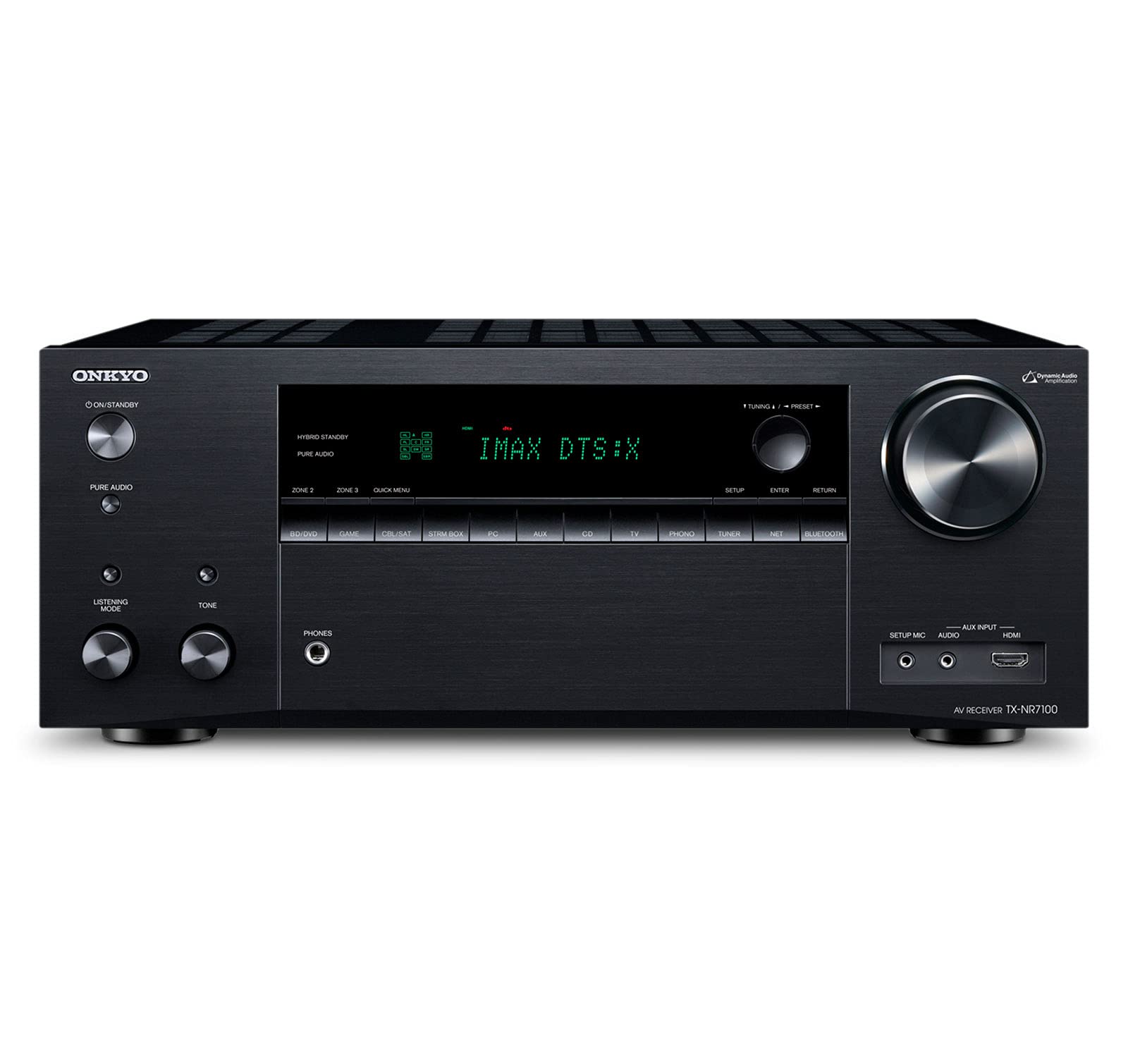
2. TX-NR7100 9.2-Channel THX Certified AV Receiver
Three HDMI outputs and a gaming-ready chip make this the smart split-room pick.
Here is the receiver for a household that needs one box to do two jobs. The defining feature is its three HDMI outputs with discrete zone 2 switching — so you can run a movie in the theater while the kids watch cartoons in the playroom, from the same unit. It pushes 9 channels of processing, delivers uncompressed HDMI at 40 Gbps, and supports 8K60 and 4K/120 with VRR, ALLM, and QFT for console gaming. If you want a 9.2 receiver that doubles as a whole-home hub, this does the heavier lifting than the single-purpose picks.
The sound is serious for the money. Dirac Live is included, and the receiver is THX Certified, Dolby Atmos and DTS:X capable, and works with Sonos through a Sonos Port across up to three zones. Owners mention it “TX-NR7100 delivers clean, dynamic sound, drives Klipsch RP-8000F II 7.2.2 system well,” which matches the reviews’ overall read: it is a performer that also asks a little of your room. It runs warm in use, and the chassis is a hair shallower than the RZ50 above, at 14.9″D x 17.13″W x 6.8″H versus 15.68″D x 17.13″W x 7.94″H, so give it breathing room on an open shelf.
The catch is the software around it. Dirac configuration trips up a fair number of people, and one recurring annoyance is a brief audio dropout each time content starts, plus flaky Wi-Fi for a few. The plastic faceplate and knobs also feel lighter than the price suggests. Still, at 4.2 stars across 600+ ratings, the value story is clear — this is a lot of 9.2 receiver for a value-tier spend.
The zone argument: no other pick here advertises three HDMI outputs with discrete zone 2 switching, which is exactly what you want if two rooms share one receiver.
The honest trade: that versatility leans on a Dirac setup that fights some owners, and on Wi-Fi that can drop. Plan to configure it with the wired mic first.
Reach for it when: gaming and multi-room viewing share one unit in your house.
Look elsewhere if: you want premium-feeling knobs and a setup that runs itself.
3. Onkyo TX-RZ30 9.2-Channel AV Receiver

Wide-bandwidth amplification with a full Dirac license already in the box.
You get full calibration right from the start. The TX-RZ30 includes a Dirac Live Room Correction Full Bandwidth license — not a limited version — and it delivers 100 watts per channel to power all nine channels. The RZ Ultra-Wide Bandwidth amplifier handles frequencies from 5 Hz (deep bass) up to 100 kHz (very high treble), so you feel rumbling lows and hear crisp highs. Klipsch tune Mode lets you load exact crossover settings for specific Reference Premiere speakers, so the handoff between speaker and receiver is correct from day one.
Paired with Dolby Atmos object audio, Dolby Vision, and IMAX Enhanced, this is the pick that covers both the object-based sound and the picture-side processing. Customers note “Sounds great with my Klipsch rp speakers. Dirac live is very cool and does a nice job of correcting room issues,” and the dual amping of front speakers is described as simple to do on this unit. It also works with Sonos through a Sonos Port and offers external amp expansion for later growth.
The question is whether the setup rewards the effort. For most it does, and the reviews describe six months of flawless operation with sound that makes movies come alive. For a minority, Dirac failed to tune the speakers after hours of attempts and multiple support calls, and the Onkyo menu structure is not beginner-friendly. That is the split on a receiver rated 4.3 stars across 100+ ratings — brilliant when it settles, patience-testing while it does.
The mic-drop spec: a 5 Hz to 100 kHz bandwidth means deep, deep bass and fine high-frequency detail, and the full Dirac bandwidth license is the real upgrade over the cheaper picks.
Who should look at the RZ50 instead: if you want the same Dirac calibration for less money, the RZ50 handles 9.2 channels and Dirac but uses an older amplifier design. You give up the full-bandwidth license and the wider rated bandwidth.
The right buyer: someone with a Reference Premiere or reference-tier speaker set who wants pro-grade calibration on day one.
Before you commit: confirm you are comfortable running a room-calibration session, because this one expects it.
4. Yamaha RX-A6A AVENTAGE 9.2-Channel AV Receiver

For tinkerers who want eleven processing channels, four zones, and room for everything.
This is the deepest feature set here, and it starts with the channel math. The RX-A6A runs a 9.2-channel configuration with 11.2-channel processing, so you have headroom beyond the nine amplified channels, plus Zone 2, Zone 3, and Zone 4 support. On the video side it carries 7-in/3-out HDMI with HDCP 2.3 and eARC, and all HDMI inputs support 8K60 and 4K/120 at 40 Gbps with ALLM and VRR, plus Dolby Vision, HDR10+, HLG, and BT.2020. If you want the receiver that will not run out of connections, this is it.
What makes this receiver stand out is its audio processing. It decodes Dolby Atmos, DTS:X, and Auro-3D, and adds Surround:AI, which adjusts sound and effects in real time. Calibration uses YPAO R.S.C. with 3D multipoint measurement (a system that measures sound from several spots), precision EQ, and a low-frequency mode. The included YPAO microphone helps you set it up — follow the advice to take extra measurements at different positions. Buyers praise the high-quality DACs (digital-to-analog converters) the most. Streaming is covered by Wi-Fi, Bluetooth, AirPlay 2, Spotify Connect, and MusicCast, and it works with Sonos through a Sonos Port.
The caveats are worth knowing before you buy. Some 4K/120 support required a manual firmware update, and HDMI handshake with certain consoles has been finicky for some. The MusicCast app divides owners — capable but not intuitive. There is no shortage of value on a receiver rated 4.2 stars across 100+ ratings, but this is a pick for someone who enjoys the setup side.
Reasons to pick it
- 11.2-channel processing with 9.2 amplified and Zone 2/3/4 support
- Dolby Atmos, DTS:X, and Auro-3D decoding plus Surround:AI
- 7-in/3-out HDMI, all inputs at 8K60 and 4K/120 (40 Gbps)
- YPAO R.S.C. with 3D multipoint calibration for precision tuning
Things to plan around
- Some 4K/120 support needs a manual firmware update
- MusicCast app is not intuitive for every owner
- Console HDMI handshake can require a fix on some setups
Best for: multi-room and multi-source households that want extra processing headroom.
Think twice if: you want the simplest possible path from box to sound.
5. Sony STRAZ3000ES Premium ES 9.2 CH 8K A/V Receiver

A custom-install receiver whose 360 Spatial Sound Mapping makes small rooms feel big.
If a professional installer wires your system, or you want a receiver that fits into a control system, this one is built for that. It is a 9.2-channel AVR rated at 120W plus 120W into 8 ohms, and its key audio feature is 360 Spatial Sound Mapping, which creates phantom speaker positions from a standard layout. It also runs Digital Cinema Auto Calibration IX and decodes Dolby Atmos and DTS:X. smooth IP control integration with leading control systems and a built-in graphical interface make it the choice for a custom home.
The connections cover 8K and 4K/120 HDMI 2.1 with 6-in/2-out. It offers 8K and 4K/120 HDMI 2.1 connectivity with 6-in/2-out, supports Dolby Vision, HDR10, Hybrid Log Gamma, and IMAX Enhanced, and works with Sonos through a Sonos Port. It streams over Bluetooth, Wi-Fi, Chromecast built-in, Spotify Connect, and Apple AirPlay, and it ties into Google Assistant for voice control. What customers praise most is the sound — reviewers describe a well-set 5.1.2 arrangement sounding like a full 7.1.4 system, which is exactly what the 360 mapping is meant to do.
The downsides show up in daily use. It weighs 32.8 pounds, and some owners notice a hiss from channels without a discrete signal when using the 360 mode, plus slow on-screen menus. Many find the lack of a mobile app to control the receiver annoying, and a few mention quirks with dual-subwoofer output and subwoofer distance calibration. Still, reviewers call the sound excellent and crisp, with superb picture, making it a strong pick for the right room.
Pick it if: you want 360 Spatial Sound Mapping and IP control for a professionally wired system.
Be cautious if: you expect full app-based phone control or perfectly silent 360 upmixing.
Understanding the Specs
Channels and the.2 Subwoofer Output
The “9.2” tells you two things. The nine is the number of amplified channels the receiver can drive at once, which is what lets you build a taller Atmos layout with height speakers instead of stopping at a basic surround setup. The.2 is the number of separate subwoofer outputs, so two bass boxes each get their own feed rather than sharing one. More amplified channels means more speakers under one roof, and separate sub outputs mean better balance between two bass boxes. On the TX-RZ50 and TX-NR7100 both sub outs are wired together, so plan your sub placement knowing they move as a pair.
Room Correction: Dirac Live vs YPAO vs D.C.A.C.
Room correction is the software that measures your actual room and adjusts each speaker so the sound fits the space rather than fighting the walls and furniture. Dirac Live, used on the Onkyo models here, is the system owners credit most for the clarity jump, and the TX-RZ30 ships with the Full Bandwidth license. Yamaha’s alternative, YPAO R.S.C. with 3D multipoint measurement, takes readings from several positions for a more precise result. Sony uses Digital Cinema Auto Calibration IX on the STRAZ3000ES. Whichever you choose, expect to run a calibration session and sometimes to troubleshoot it — that is normal across all three systems.
HDMI 2.1, 8K, and Gaming Features
HDMI 2.1 is the standard that carries the newest video and gaming signals. It supports 8K60 and 4K/120, and it brings VRR (Variable Refresh Rate, which removes screen tearing) and ALLM (Auto Low Latency Mode, which reduces input lag). The Yamaha and Onkyo picks here list 40 Gbps transfer for that full bandwidth, and the Sony’s inputs carry 8K and 4K/120 too. If you plug a modern console into a receiver, you want these features present, and you want them working on the inputs you actually use — verify the current firmware state before buying, since some features arrive through updates.
Zones, Processing Headroom, and Preamp Outs
Zones let one receiver send different audio to different rooms, and the number after “Zone” tells you how many extra areas it can drive. The Yamaha goes furthest here with Zone 2, 3, and 4 plus 11.2-channel processing, and the TX-NR7100 offers three independent zones through its HDMI switching. Preamp outs let you add an external amplifier later when your speakers demand more than the internal amps can give, and the Onkyo RZ models and Yamaha both offer that upgrade path. The Sony leans the other way, giving a clean path for control-system integration instead of expansion.
FAQ
What does 9.2 mean on an AV receiver?
Is Dirac Live better than YPAO room correction?
Do I need HDMI 2.1 for a PlayStation 5 or Xbox Series X?
How many speakers can a 9.2 receiver actually power?
Can a 9.2 receiver send sound to a second room?
Will a 9.2 receiver drive two subwoofers properly?
Is Dirac Live hard to set up on these receivers?
Can I add an external amplifier to a 9.2 receiver later?
Does a 9.2 receiver work with a Sonos system?
Should I pick the Yamaha or the Onkyo for Atmos?
Final Thoughts: The Verdict
For most home theaters, the 9.2 receiver winner is the Onkyo TX-RZ50 because it pairs Dirac Live calibration with nine amplified channels and two sub outs, and owners consistently credit it with a real clarity jump. If you want three HDMI outputs and discrete zone 2 switching so gaming and movie nights do not fight over one room, grab the TX-NR7100. And for the widest processing headroom with Zone 2, 3, and 4 plus Auro-3D, the Yamaha RX-A6A is the one to reach for. Whichever you choose, the calibration feature is what will shape how your room actually sounds — give it the time it deserves.
How We Picked
We do not accept paid placement. Every pick is matched to a real buyer and a real use-case; we do not hands-on test units.
Sources & Methodology
Specifications: manufacturer listings and product documentation. Review insights: verified customer reviews, as of September 2026. Pricing: not shown on this page (it changes often); check the current price via the retailer link.
As an Amazon Associate, Gadgets Feed earns from qualifying purchases. This does not affect which products we feature.