
A single tinny vocal or a rumbling subwoofer can ruin an entire mix. Whether you are dialing in the perfect car audio soundstage, eliminating feedback on a live stage, or correcting the frequency response of your studio monitors, a precise graphic equalizer gives you the surgical control you need to shape your sound. It is the difference between a muddy mess and a crisp, defined audio landscape.
I’m Min — the co-founder and writer behind Gadgets Feed. I’ve spent countless hours researching signal pathways, comparing circuit topologies, and analyzing how different EQ designs handle noise floors and headroom to bring you a guide that cuts through the marketing noise.
This guide evaluates the top contenders on the market to help you find the absolute best 9 band eq for your specific audio rig, from car audio installations to home studio signal chains.
How To Choose The Best 9 Band EQ
The right EQ can transform a mediocre system into a spectacular one. Before you buy, focus on three factors that define performance in this category: how much voltage it can push to your amplifier, how clean that signal remains, and how flexible its routing options are for your specific gear.
Output Voltage and Line Driver Strength
For car audio applications, the EQ’s max RMS output voltage is the single most important spec. A unit capable of 9V output, like many of the models reviewed here, allows you to drive external amplifiers harder before introducing noise. If your unit only outputs 2V or 4V, you may find yourself needing to crank the amp gain much higher, which invites hiss and distortion into the signal chain. Higher voltage essentially gives you a cleaner, stronger handshake with your amplifier.
Boost/Cut Range and Band Selection
The standard adjustment range on most 9-band EQs is ±12dB per frequency. This gives you plenty of headroom to either notch out a problematic resonant frequency or push up a missing presence region. For live sound and studio use, some units offer a selectable ±6dB switch for finer, more subtle adjustments. Pay attention to the specific frequencies offered — standard car audio bands often start at 50Hz and top out at 16kHz, while home and studio units might cover a slightly different spectrum.
Connector Types and Signal Integrity
Your choice of connectors dictates the quality of the signal path. Gold-plated RCA jacks provide superior corrosion resistance and conductivity. For studio and live sound, balanced XLR and 1/4″ TRS connectors are essential for rejecting hum and interference over long cable runs. A unit with a 3.5mm auxiliary input is a major convenience for integrating a phone or secondary source directly into the EQ without needing a separate mixer.
Quick Comparison
On smaller screens, swipe sideways to see the full table.
| Model | Category | Best For | Key Spec | Amazon |
|---|---|---|---|---|
| BOSS EQ-200 | Premium Pedal | Guitar/Bass Pedalboard | Dual 10-Band / 128 Presets | Amazon |
| Behringer FBQ800 | Rack/Desk | Live Sound/Studio | FBQ Feedback Detection | Amazon |
| Audiopipe EQ-909X | Car Audio | High-Output Car System | 9V Line Driver / 0.005% THD | Amazon |
| Douk Audio T7 | Home Audio | Home Stereo/Desktop | XLR Balanced I/O | Amazon |
| Gravity EQ19 | Car Audio | Entry-Level Car System | 9V RMS Output | Amazon |
| Hifonics HFEQ7 | Car Audio | Simple Car Upgrade | 7-Band / High-Level Input | Amazon |
| Graphic Equalizer EQ-231 | Rackmount | Pro Studio/Live | 31-Band / XLR I/O | Amazon |
In‑Depth Reviews
1. BOSS EQ-200 Graphic Equalizer

The BOSS EQ-200 is a digital powerhouse that redefines what a pedal-based equalizer can do. It features two independent 10-band EQs that can be run in stereo, parallel, or series, all powered by a 32-bit AD/DA converter and a 96 kHz sampling rate. This is a precision instrument for tone shaping, not just a simple tool for cutting feedback. The ability to save 128 presets allows a guitarist or bassist to recall their exact EQ curve for any room or any guitar with a single footswitch press.
Each band offers a generous 15 dB of boost or cut, which is more than enough to handle drastic tone shifts, like turning a humbucker-equipped guitar into a passable single-coil sound, or creating a massive mid-scoop for metal rhythm tones. The three different range settings let you tailor the response to perfectly match your instrument or application, from 30 Hz to 12.8 kHz all the way down to a sub-bass-focused 28 Hz to 14 kHz. It also features an insert function for routing external effects into the EQ chain.
The build quality is exactly what you expect from BOSS — a rugged metal chassis designed to survive years of stomping on a pedalboard. The menu system takes a few minutes to learn, but the payoff in versatility is enormous. This is the ultimate EQ for the musician who treats their pedalboard like a high-end studio rack.
Why it’s great
- Dual independent 10-band EGs with stereo/parallel/series routing
- 128 user presets for instant recall in any situation
- Ultra-low noise 32-bit processing and 96 kHz sampling
Good to know
- Requires a dedicated 300-500mA power supply
- Larger footprint than standard BOSS compact pedals
2. Behringer MiniFBQ FBQ800

The Behringer FBQ800 packs professional live-sound features into an ultra-compact 9.5-inch chassis. Its standout feature is the revolutionary FBQ Feedback Detection System, which uses the LED faders themselves to show you exactly which frequency is ringing out, letting you kill a howling monitor mix in seconds. This tool alone makes it invaluable for solo performers, small clubs, and houses of worship where finding a feedback frequency by ear is a guessing game.
Beyond the feedback killer, it functions as a standard 9-band graphic EQ with a ±12 dB boost/cut range per band, which is plenty for sculpting a PA system or monitor wedge. The additional low-cut filter at 75Hz is perfect for rolling off unwanted floor rumble or wind noise that can muddy up a vocal mic or acoustic guitar DI. The accurate 6-digit LED input/output meters give you a constant visual of your signal level, helping you avoid clipping.
The build is a lightweight plastic chassis, which is its primary compromise. It also has a known quirk where the left channel can cut out with a weak input signal, a defect that some users have reported. Despite these issues, it remains a staple in the budget-friendly pro audio world because its FBQ function and dual-range selector (6dB and 12dB) offer genuinely useful tools that are rarely found at this price point.
Why it’s great
- FBQ feedback detection lights make ringing frequencies instantly visible
- 75Hz low-cut filter cleans up muddy signals quickly
- Selectable ±6dB or ±12dB range for fine or broad adjustments
Good to know
- Plastic chassis feels less durable than metal rack units
- Some units have an intermittent left-channel dropout issue
3. Audiopipe 9 Band Graphic Equalizer (EQ-909X)

The Audiopipe EQ-909X is a masterclass in providing exactly what a serious car audio enthusiast needs without any frills. Its headline feature is the powerful 9-volt line driver, which ensures a clean, hot signal to your amplifiers, allowing you to keep your amp gains low and the noise floor even lower. The distortion figure of 0.005% THD is remarkably low for this category, meaning the signal remains pristine throughout the EQ stage.
The frequency bands are perfectly tuned for a three-way car audio system: 50Hz and 250Hz for subwoofer blending, 1kHz and 2kHz for mid-range punch, and 8kHz and 16kHz for tweeter sparkle. The individual left and right sensitivity controls for the auxiliary input is a smart touch for balancing different source volumes. The nickel-plated locking knobs are a welcome upgrade over standard plastic caps, offering precise and secure control.
One of its best features is the selectable subwoofer crossover at 60Hz or 90Hz, allowing you to fine-tune the blend between your subwoofer and mid-bass drivers. The push-button knobs and the straightforward layout make installation and tuning simpler than many competing units. For anyone building a competitive sound quality (SQ) system on a mid-range budget, this EQ is the benchmark.
Why it’s great
- 9V preamp output drives amps cleanly with low noise
- Exceptionally low 0.005% THD for a graphic EQ
- Selectable 60Hz/90Hz subwoofer crossover for system integration
Good to know
- Only two crossover settings (60Hz or 90Hz) may limit fine-tuning
- Push-button knobs can be less intuitive than sliders for quick visual adjustment
4. Douk Audio T7 7 Band Equalizer

The Douk Audio T7 is a home audio specialist that brings high-fidelity balanced connectivity to the desktop or stereo rack. Unlike car audio units, this equalizer uses both XLR and RCA inputs and outputs, making it a seamless fit for studio monitors, high-end amplifiers, and DACs. The signal-to-noise ratio exceeds 104dB, and the distortion is as low as 0.003%, ensuring it adds no coloration of its own to the signal path.
Its 7-band EQ operates within a ±6dB range, which is ideal for subtle room correction and fine-tuning speaker imperfections rather than making drastic tonal shifts. The frequency bands cover the critical range of the audible spectrum: 64Hz, 125Hz, 250Hz, 500Hz, 2KHz, 4KHz, and 8KHz. The elegant black aluminum alloy casing provides excellent shielding against electromagnetic interference, a common issue in desktop setups near computers and monitors.
One standout detail for the audiophile community is that the T7 uses 15 socketed NE5532P dual op-amps. This allows for easy future upgrades to higher-performance op-amps like Burson or Sparkos, letting you tweak the sound character at the component level. The unit is plug-and-play, with no volume knob, meaning it simply passes your source signal through the EQ stage. This is a pure, transparent tool for the discerning listener.
Why it’s great
- Both XLR and RCA inputs/outputs for balanced home audio integration
- Socketed op-amps allow for DIY upgrade path to audiophile components
- Exceptional >104dB SNR and extremely low 0.003% distortion
Good to know
- 7-band design covers less granularity than a 9-band unit
- ±6dB range may be insufficient for drastic tone shaping
5. Gravity EQ19 9 Band Car Audio Equalizer

The Gravity EQ19 delivers the core function of a car audio EQ at a very accessible price point. It provides a full 9-band graphic EQ with standard frequencies (50Hz to 16kHz) and a master volume control that outputs up to 9 volts RMS. This high output voltage is a surprising find in this value tier and allows it to drive most aftermarket amplifiers to their full potential without introducing noise from a weak signal.
Its design includes a built-in 3.5mm AUX input and a DVD select switch, which is a legacy feature for integrating older DVD-based head units. The unit provides three stereo RCA outputs for front, rear, and subwoofer channels, giving you the basic routing needed for a standard four-channel amplifier plus a separate sub amp. The build feels adequate for the price, with a standard half-DIN chassis that fits into most universal installation kits.
The biggest physical compromise is the tiny terminal block for power, ground, and remote connections. Users with 4-gauge or thicker wire may struggle to get a secure fit, requiring add-on distribution blocks. The sound quality, however, has been praised as being better than expected for its cost, offering a clean signal path that lets you shape your car’s audio character without breaking the bank.
Why it’s great
- 9V RMS output for driving amplifiers cleanly
- Built-in 3.5mm AUX input for secondary source integration
- Very budget-friendly entry point into car audio EQ
Good to know
- Terminal block is too small for thick power/ground wire
- Basic build quality compared to more expensive units
6. Hifonics HFEQ7 7-Band Pre-Amp Equalizer

The Hifonics HFEQ7 is a 7-band equalizer that simplifies the installation process by offering high-level speaker inputs in addition to standard RCA inputs. This is a critical feature if you are adding an EQ and amplifier to a factory stereo that lacks RCA outputs. It converts the speaker-level signal to a preamp level without needing a separate line output converter, saving space and cost in your installation.
Despite having only 7 bands, the unit still drives a powerful 9-volt preamp signal through its RCA outputs, ensuring clean headroom for your amplifiers. It features a selectable subwoofer output frequency (60Hz, 80Hz, or 120Hz) and both front and rear active crossovers. The frequency response is limited to 10Hz – 20kHz, which is standard for the car audio environment and covers the full audible spectrum.
The layout is clean and intuitive, with master volume control for the entire system. The build quality is solid, consistent with Hifonics’ reputation. If you already have an aftermarket head unit with good RCA pre-outs, the high-level inputs are unnecessary, but for anyone integrating with a stock system, this unit removes a significant hurdle and provides a clean signal foundation.
Why it’s great
- Accepts high-level speaker inputs for factory stereo integration
- 9V preamp output drives amplifiers cleanly
- Selectable subwoofer crossover (60Hz/80Hz/120Hz)
Good to know
- 7-band design offers less control over specific frequencies than a 9-band
- RCA inputs may be redundant for some aftermarket head units
7. Graphic Equalizer 31-Band Stereo EQ (EQ-231)
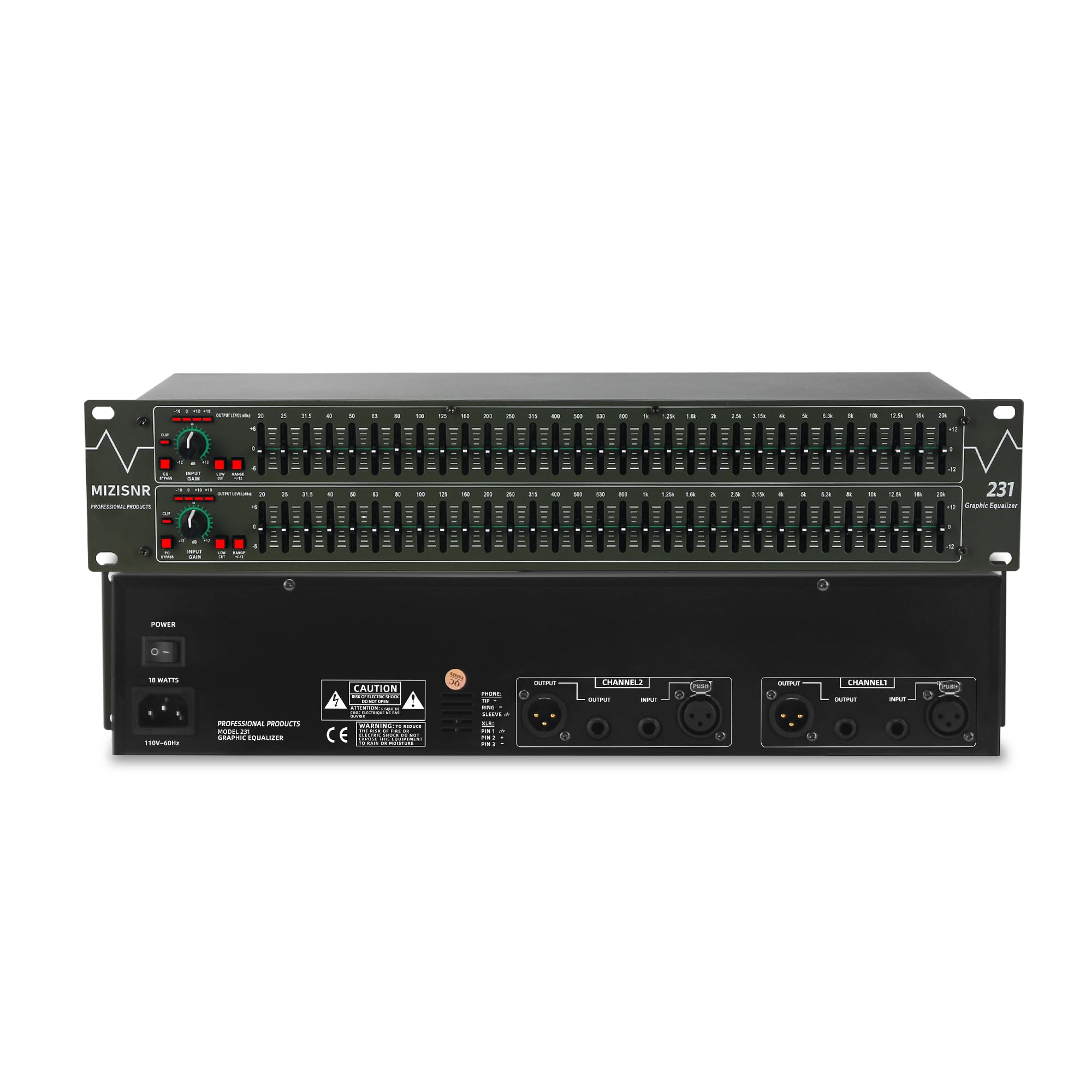
The 31-Band Graphic Equalizer (EQ-231) is a professional dual-channel unit built for permanent installation in studios and live sound racks. While it exceeds the 9-band format, it represents the absolute pinnacle of graphic EQ control. Each of the 31 bands offers a ±12dB adjustment range, allowing for surgical precision in attacking a single problematic frequency in a room, something a 9-band unit cannot do with the same granularity.
It features balanced XLR and unbalanced 1/4″ TRS inputs and outputs, making it compatible with professional mixing consoles and high-end studio monitors. The built-in LOW-CUT switch effectively eliminates low-frequency noise like wind rumble and electrical hum, while the BYPASS switch allows for instant A/B comparison of the processed versus raw signal. The 4-segment LED ladders provide comprehensive visual feedback on gain reduction and output levels.
Build quality can be inconsistent at this price point, with some units arriving with issues like green-tinted faceplates or non-functional channels. The high channel count (over 15 bands) can be overkill for many home users, but for a dedicated audio professional tuning a complex PA system or a live room, this kind of control is indispensable. This is the tool for someone who needs to fix a 160Hz standing wave and nothing else.
Why it’s great
- 31 bands per channel offer surgical frequency control
- XLR and TRS balanced I/O for professional audio integration
- BYPASS switch for instant A/B comparison
Good to know
- Quality control can be inconsistent between units
- More bands than most home users need, adding complexity
FAQ
What is the difference between a 7-band and a 9-band EQ for car audio?
Does a graphic EQ make my music sound better or just different?
Why is a 9V output important in a car audio EQ?
Can I use a pro audio rack EQ for my home stereo?
How do I set up a graphic EQ for a live vocal mic?
Final Thoughts: The Verdict
For most users, the 9 band eq winner is the Audiopipe EQ-909X because it combines a powerful 9V line driver, ultra-low THD, and a complete set of features specifically tailored for car audio at a price that represents phenomenal value. If you need balanced XLR connectivity for a home studio, grab the Douk Audio T7. And for the ultimate in live feedback control and compact portability, nothing beats the Behringer FBQ800.