
Our readers keep the lights on and my morning glass full of iced black tea. As an Amazon Associate, I earn from qualifying purchases.
Specs are compiled from manufacturer listings and verified buyer reviews and can change over time — please confirm the key details on the product page before buying.
That awkward sliver of space next to the fridge or between the stove and wall is wasted square footage until you drop a narrow cabinet into it. A 9-inch base cabinet turns dead air into real storage for spices, cleaning supplies, or serving trays — but this size is rare and varies in build quality and actual dimensions. This guide compares the top options to help you find the one that fits your gap and your standards.
I’m Min — the founder and writer behind Gadgets Feed. This guide is built by comparing the manufacturers’ published specifications and the patterns across verified customer reviews, so you get each pick’s real strengths and trade-offs instead of marketing spin.
You have an awkward gap in your kitchen or living room, and you need a cabinet that fits it without looking like an afterthought. The right 9-inch base cabinet depends on if you need a furniture-style sideboard for a hallway or a true under-counter unit for a kitchen remodel.
Our Picks at a Glance

How To Choose The Best 9 Inch Base Cabinet
Before you measure the gap, measure the reality check: a cabinet labeled “9-inch” can actually be 9 inches wide, 9.25 inches wide, or something close but not exact. Always compare the published dimensions against your opening before you order, and remember that depth matters as much as width when you are sliding a unit into a tight corner.
Match the Depth to the Space
Base cabinets under a counter typically sit at a standard 24-inch depth, but a freestanding sideboard for a hallway or dining room is often much shallower. A 24-inch-deep unit will not work flush against a narrow entryway, while a shallow sideboard leaves a big ugly gap if you use it under a deep kitchen counter.
Decide How Much Assembly You Can Tolerate
Ready-to-assemble cabinets vary from a simple sliding dovetail you click together in about 20 minutes to a build that requires re-drilling pilot holes and clamping drawers. If you lack tools or patience, prioritize units with labeled parts and clear steps, or budget for a professional to handle the complicated ones.
Check the Safety Hardware
Tall, narrow cabinets are naturally top-heavy, so a wall anti-tip kit is not a luxury — it is the difference between a wobble and a tipped-over piece of furniture. Look for included anchoring hardware or plan to add it, and remember soft-close hinges on the doors spare you from slams and pinched fingers.
Quick Comparison
| Model | Best For | Width | Height | Depth | Amazon |
|---|---|---|---|---|---|
| LKTART Narrow Sideboard★ Best Overall | Freestanding mid-century style in a hallway or dining room | 9.25 inches | 32.63 inches | 39 inches | Amazon |
| Design House Brookings Base Cabinet | Kitchen counter support with a real cabinet door and drawer | 9 inches | 34.5 inches | 24 inches | Amazon |
| Quicklock RTA Base Cabinet | Filling a kitchen gap with a paintable raw maple finish | 9 inches | 34.5 inches | 24 inches | Amazon |
In-Depth Reviews
1. LKTART 39″ Real Wood Veneer Narrow Sideboard
Our pick — 4.5★ from 50+ verified ratings; the strongest balance of quality and price.
The shallow-depth showpiece that turns a skinny hallway wall into a proper mid-century buffet.
If you want a cabinet that looks like furniture in a living room or entryway, the LKTART Narrow Sideboard delivers with a walnut finish and solid wood strips across the doors. Its 9.25-inch width fits a gap that a standard kitchen cabinet cannot, and owners most often praise the build quality, with appearance a close second.
This sideboard gives you real shelf space for books, dishes, or a coffee station, because it is 39 inches deep and 32.63 inches tall — a full 15 inches deeper than the 24-inch Quicklock base unit, though about 2 inches shorter. Two outlet holes in the back let you park it against a wall socket and charge a phone or coffee maker inside without crushing the plug.
Assembly runs about an hour with a basic screwdriver, and all parts arrive labeled with clear steps. The honest trade-off is balance: owners describe it as a bit top-heavy, so use the included wall anti-tip hardware to anchor it rather than relying on the pedestal base alone. Shallow depth like this takes to a narrow room side beautifully, and the slim profile is exactly the space-saving trick most buyers are hunting for when they search this size.
What owners rave about
- Quality construction that looks far pricier than it costs
- Mid-century styling that matches real wood furniture
- Outlet holes in the back keep plugs usable against a wall
What to watch
- Top-heavy, so wall anchoring is a must, not an option
- Door fit needed a little adjustment during assembly
Reach for this if: you want a freestanding, furniture-grade cabinet that adds storage and style to a narrow living room or entry wall.
Look elsewhere if: you need a true under-counter kitchen base cabinet, since the 39-inch depth is far deeper than a standard 24-inch counter run.
2. Design House Brookings Kitchen Base Cabinet, 9″, White

The true under-counter base unit with a 34.5-inch height built to sit flush in a kitchen run.
For a kitchen remodel that needs a true base cabinet at 9 inches wide, the Design House Brookings measures exactly 9 inches wide by 34.5 inches tall and 24 inches deep — the standard kitchen shape, not a freestanding sideboard. It has one door, one drawer, and one adjustable shelf, with a solid wood face and door frame and 1/2-inch plywood sides. The 6-way adjustable soft-close hinges close gently and quietly, so you never hear a door slam.
Owners consistently call out the sturdiness as the standout strength — solid dovetail drawers and a sturdy plywood build that looks great once assembled. It matches the Quicklock on height at 34.5 inches and on depth at 24 inches, but holds a tighter 9-inch width versus the LKTART’s 9.25-inch footprint. The catch is assembly: buyers report the instructions are genuinely hard to follow, with unlabeled parts and no pre-drilled pilot holes, which can push some builds past two hours and into frustration.
For a handy DIYer with a drill and clamps, the finished result is solid and professional-looking. For anyone expecting snap-together assembly, the Brookings will test your patience, and a handful of buyers describe receiving a previously returned unit with missing hardware. Treat this as a cabinet for the prepared builder, not the casual assembler, and the sturdy foundation it delivers is worth the effort.
Solid bones, tricky build: Owners praise the sturdiness and looks above all, but the assembly experience splits opinions — some find it easy, many call it a challenge.
The honest fit: This is the genuine under-counter kitchen unit at 9 inches wide, best for someone comfortable with tools and clamps, not a furniture-grade sideboard.
Best for: the confident DIY remodeler who wants a true 24-inch-deep kitchen base cabinet and can handle drilling pilot holes and clamping drawers.
Think twice if: you want a quick, tool-free assembly — the instructions demand patience and the build rewards experience.
3. Quicklock RTA Base Kitchen Cabinet, 9″ W x 34.5″ H x 24″ D
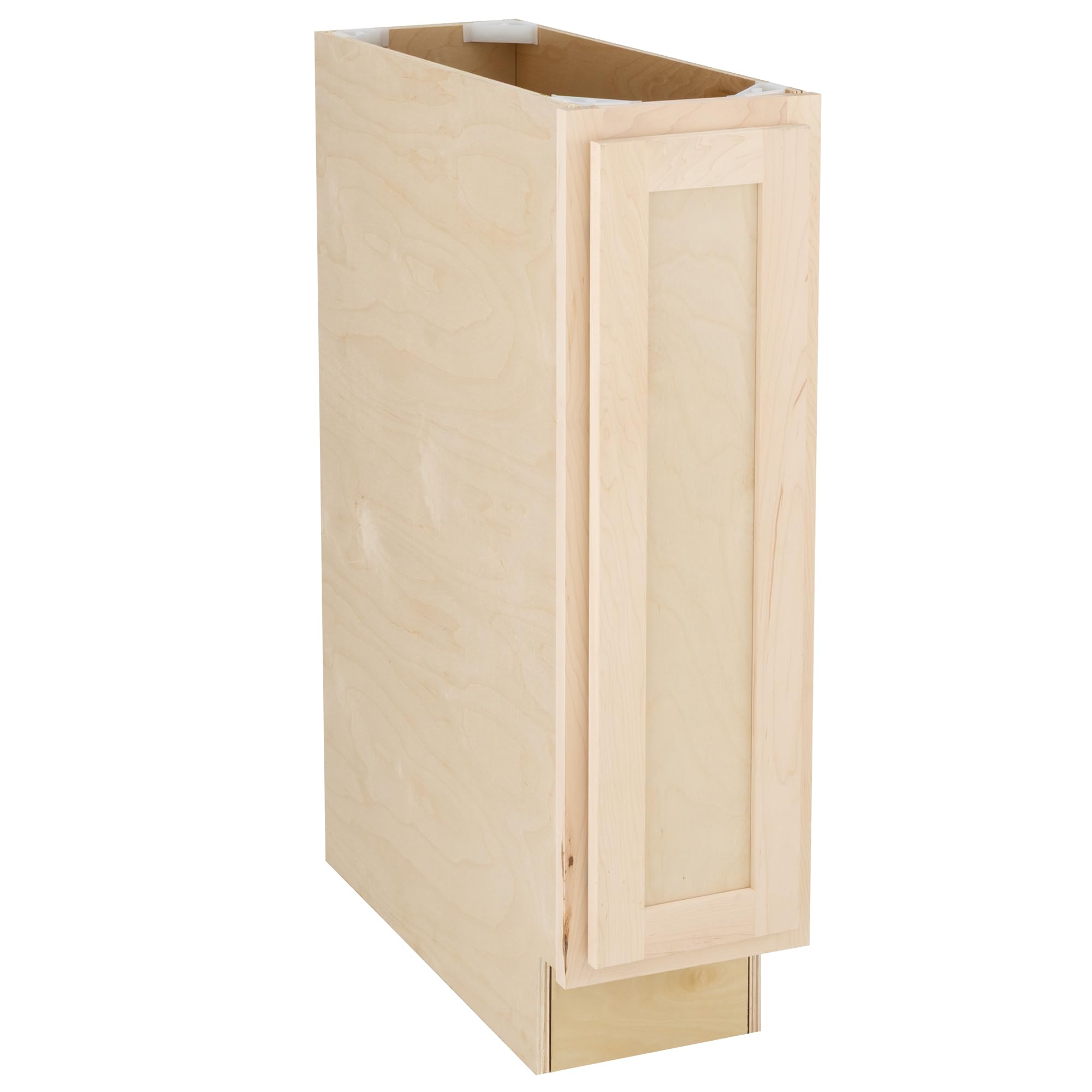
The 20-minute assembly base cabinet that fills a kitchen gap and takes paint or stain beautifully.
If you pulled out a large cabinet to fit a dishwasher and now have a gap to seal, the Quicklock fits the standard base cabinet footprint at 9 inches wide, 34.5 inches tall, and 24 inches deep. Its sliding dovetail joints click together in about 20 minutes, owners mention, with no clamps and no re-drilling. The raw maple exterior works as-is for rustic charm, or you can paint, stain, or varnish it to match your existing cabinets exactly — a big plus for a renovation.
Buyers are drawn to the high-quality plywood back and sides, a maple wood frame, and a slow auto-close door feature that owners call neat. It beats the Brookings on assembly ease: where that cabinet needs drilling and clamps, the Quicklock’s dovetail joints slide together by hand. At 24 inches deep versus the LKTART’s 39 inches, it is the right shape for true under-counter use. The recurring note is that the included instructions can be difficult to follow, so the mechanical assembly is easy but the manual does not always make it look that way.
The standout praise is quality, with owners calling it beautiful, solid, and easy to assemble, and several ordering more for other projects after the first one. If your gap is a standard kitchen opening and you want something you can build quickly and finish to match your décor, this is the most painless path to a done renovation.
Why it wins
- Sliding dovetail joints assemble in about 20 minutes without clamps
- Raw maple finish accepts paint, stain, or varnish to match your kitchen
- Soft-close doors and high-quality plywood back and sides
The only hurdle
- Instructions are the most-discussed aspect and they are genuinely hard to follow
Grab this one if: you want a true 24-inch-deep kitchen base cabinet that assembles fast, feels sturdy, and can be finished to blend into your existing cabinets.
skip it if: you do not want to finish the wood yourself — the raw maple needs paint or stain to look finished.
Understanding the Specs
Nominal vs. Actual Width
A cabinet labeled “9-inch” can measure 9 inches exactly or 9.25 inches across the actual footprint. The LKTART sideboard, for example, is 9.25 inches wide while the Design House and Quicklock are both a true 9 inches. Always compare the published dimensions to your measured opening — that quarter-inch matters when you are sliding a cabinet into a tight slot.
Depth: Sideboard vs. Base Cabinet
Depth is the spec that decides where a cabinet can live. A kitchen base cabinet typically runs 24 inches deep to sit flush under a counter, while a freestanding sideboard can be much deeper — the LKTART runs a full 39 inches. A 39-inch-deep unit will not fit under a standard counter, and a 24-inch base cabinet looks awkward standing alone against a hallway wall. Match the depth to the job.
FAQ
Will a 9 inch base cabinet fit in the gap next to my dishwasher?
What is the difference between a base cabinet and a sideboard?
How long does assembly take for these narrow cabinets?
Do these cabinets come with soft-close hinges?
Is a 9 inch cabinet tall enough to use as a kitchen base cabinet?
Do I need to anchor a narrow cabinet to the wall?
Which cabinet is easiest to assemble for a beginner?
Can I paint or stain these cabinets to match my kitchen?
Final Thoughts: The Verdict
For most people, the 9 inch base cabinet that fits the widest range of situations is the LKTART Narrow Sideboard, because its 9.25-inch width and furniture-grade walnut finish work in a hallway, entryway, or dining room — and it is the crowd favorite, holding a 4.5-star score from dozens of owners. If you want a true under-counter kitchen unit with the least assembly pain, grab the Quicklock for its 20-minute dovetail build and paintable raw maple. And for a classic kitchen base cabinet with soft-close hinges at a genuine 9-inch width, the Design House Brookings is the one to reach for, provided you have the tools and patience its assembly demands.
How We Picked
We do not accept paid placement. Every pick is matched to a real buyer and a real use-case; we do not hands-on test units.
Sources & Methodology
Specifications: manufacturer listings and product documentation. Review insights: verified customer reviews, as of August 2026. Pricing: not shown on this page (it changes often); check the current price via the retailer link.
As an Amazon Associate, Gadgets Feed earns from qualifying purchases. This does not affect which products we feature.