
Our readers keep the lights on and my morning glass full of iced black tea. As an Amazon Associate, I earn from qualifying purchases.
Specs are compiled from manufacturer listings and verified buyer reviews and can change over time — please confirm the key details on the product page before buying.
A bad front tire makes every turn feel like a gamble — especially on mixed terrain where one wrong spec can scrub off grip fast. The 90/90-21 size fits a huge range of dual-sport, adventure, and cruiser bikes, but each tire in this class trades differently between pavement mileage, off-road bite, and load-carrying backbone. This guide breaks down the real differences — from rubber compounds to ply ratings — so you match the right tread to your actual ride.
I’m Min — the founder and writer behind Gadgets Feed. This guide is built by comparing the manufacturers’ published specifications and the patterns across verified customer reviews, so you get each pick’s real strengths and trade-offs instead of marketing spin.
Whether you commute on asphalt every day or spend weekends clawing through rocky trails, the right 90/90-21 motorcycle tire decides whether your bike feels planted or twitchy at speed.
Our Picks at a Glance


How To Choose The Best 90/90-21 Motorcycle Tire
Picking a front tire in this narrow size is not just about the brand on the sidewall. The 90/90-21 dimension fits everything from lightweight dual-sports to heavy cruisers, so you need to look at construction style, ply rating, and tread purpose before spending a cent. Here is what separates a tire that lasts from one that lets you down mid-curve.
Ply Rating: The Backbone You Feel at Every Pressure
The number of plies — the layers of cord inside the rubber — directly determines how much weight the tire can carry and how stiff it feels on the road. A 4-ply tire gives a supple ride that conforms to bumps, but a 6-ply or 12-ply tire resists punctures better and holds its shape when you load the bike down with camping gear. If you ride loaded adventure routes, lean toward a higher ply count.
Bias vs. Radial: How the Case Is Built
Most 90/90-21 tires use a bias-ply construction, where the cord layers cross at an angle. That design delivers stable straight-line tracking and a lower cost. A radial tire, where cords run straight across, usually rolls easier on pavement and dissipates heat better at sustained highway speeds. Michelin is the main brand offering a radial option in this size — a key detail if your ride is heavy on tarmac miles.
Tread Pattern: Where the Rubber Meets the Dirt
Look at the space between the knobs. A tire with tall, widely spaced knobs — like the Dunlop D606 — claws through mud and loose rocks but hums loudly on asphalt and wears faster. A tire with a continuous center rib — like the Michelin Commander II — stays quiet and stable on the highway but spins out if you hit a gravel patch. Decide where you spend 80 percent of your miles, then pick the tread that matches.
Quick Comparison
| Model | Best For | Construction | Ply | Weight | Amazon |
|---|---|---|---|---|---|
| Bridgestone Exedra Max★ Best Overall | Long-haul cruiser mileage | Bias | H Load Range | 13.13 lb | $133.97Amazon |
| Tusk Waypoint AdventureBest Value | Budget dual-sport on/off-road | Bias | 4-Ply | — | $69.88Amazon |
| Tusk 2Track Adventure | Heavy mixed-terrain riding | Bias Belted | 12-Ply | 15.03 lb | $99.99Amazon |
| Dunlop D606 | Aggressive off-road terrain | Bias | 6-Ply | 10 lb | $133.99Amazon |
| Michelin Anakee Adventure | Premium wet-weather touring | Radial | M Load Range | — | $161.11Amazon |
| Michelin Commander II | Maximum cruiser tread life | Bias | — | 9 lb | $161.99Amazon |
| Dunlop Trailmax Mission | True 50/50 adventure riding | Bias-Ply | 4-Ply | 14.62 lb | $172.99Amazon |
In‑Depth Reviews
1. Bridgestone Exedra Max Motorcycle Tire (90/90-21)
Our pick — over 4.5★ from 350+ verified ratings; the strongest balance of quality and price.
The cruiser-class rubber that turns asphalt into easy mileage without wearing out fast.
Bridgestone designed the Exedra Max specifically for big touring and cruiser bikes, so the rubber compound is engineered for one thing: long miles. The unique wider profile helps spread your weight across the contact patch, which reduces fatigue on full-day highway stints — a relief on heavy bikes that punish narrow tires.
The tread pattern and rubber formulation enhance water evacuation, so you keep grip in both dry and wet conditions. With a load capacity of 908 pounds and a maximum 35 PSI pressure rating, this tire supports serious luggage loads without squirming. Its 13.13-pound weight gives it a planted feel, and the bias construction keeps straight-line tracking predictable.
You can plug a roadside puncture faster with the tubeless design than with a tube-type tire. Bridgestone includes a manufacturer warranty, so you get coverage for the long haul. Buyers report the Exedra Max delivers notably smoother highway wear than many off-road-focused alternatives in the same 90/90-21 size.
What Lifts It Above the Rest
- Rubber compound tailored for cruiser applications delivers long tread life
- 908-pound load capacity handles fully-loaded touring setups
- Tubeless construction simplifies on-road puncture repairs
Where It Falls Short
- Bias construction rides stiffer than a radial on rough pavement
- Not designed for aggressive off-road terrain — knobs are too shallow
Your best match if: you log highway miles on a cruiser or touring bike and want a front tire that holds its tread shape past 10,000 miles.
Look elsewhere if: your riding mix includes serious gravel or mud — the Exedra Max is a street-first cruiser tire.
2. Tusk Waypoint Adventure Motorcycle Front Tire – 90/90-21
The entry-level dual-sport tire that punches above its price tag on both pavement and trail.
Tusk’s Waypoint is a budget-friendly pick that does not skimp on the basics. The aggressive knobs dig into loose dirt and gravel, yet the tread profile is shaped to keep predictable handling when you transition back to asphalt.
D.O.T. compliant means it is fully legal for highway use, and the year-round rubber compound is formulated for consistent grip across temperature swings. The simple bias construction keeps costs down without sacrificing durability for light-to-medium off-road work. At 4-ply, this tire is noticeably more flexible than the heavier 12-ply 2Track, which helps soak up trail vibration on a lighter bike.
Owners mention that the Waypoint holds its own on wet pavement better than expected for an aggressive-pattern tire. The trade-off for that off-road bite is a slight hum on smooth freeways — typical for any dual-sport knobbie at this level.
Why It Earns Its Spot
- Predictable on-road handling with aggressive off-road traction in tough conditions
- D.O.T. compliant for legal street use right from the start
- Year-round compound provides long-lasting wear across seasons
The Real Trade-Off
- 4-ply casing offers less puncture resistance than a 6- or 12-ply tire for sharp rocky trails
- Weight is unlisted in the data, so you cannot compare it directly to competitors on the scale
Ideal for: dual-sport riders on a budget who need a legal, all-round tire for gravel roads and daily commutes.
Not ideal if: you carry heavy loads through sharp rock gardens — step up to a higher-ply tire like the Tusk 2Track.
3. Tusk 2Track Adventure Front Motorcycle Tire 90/90-21
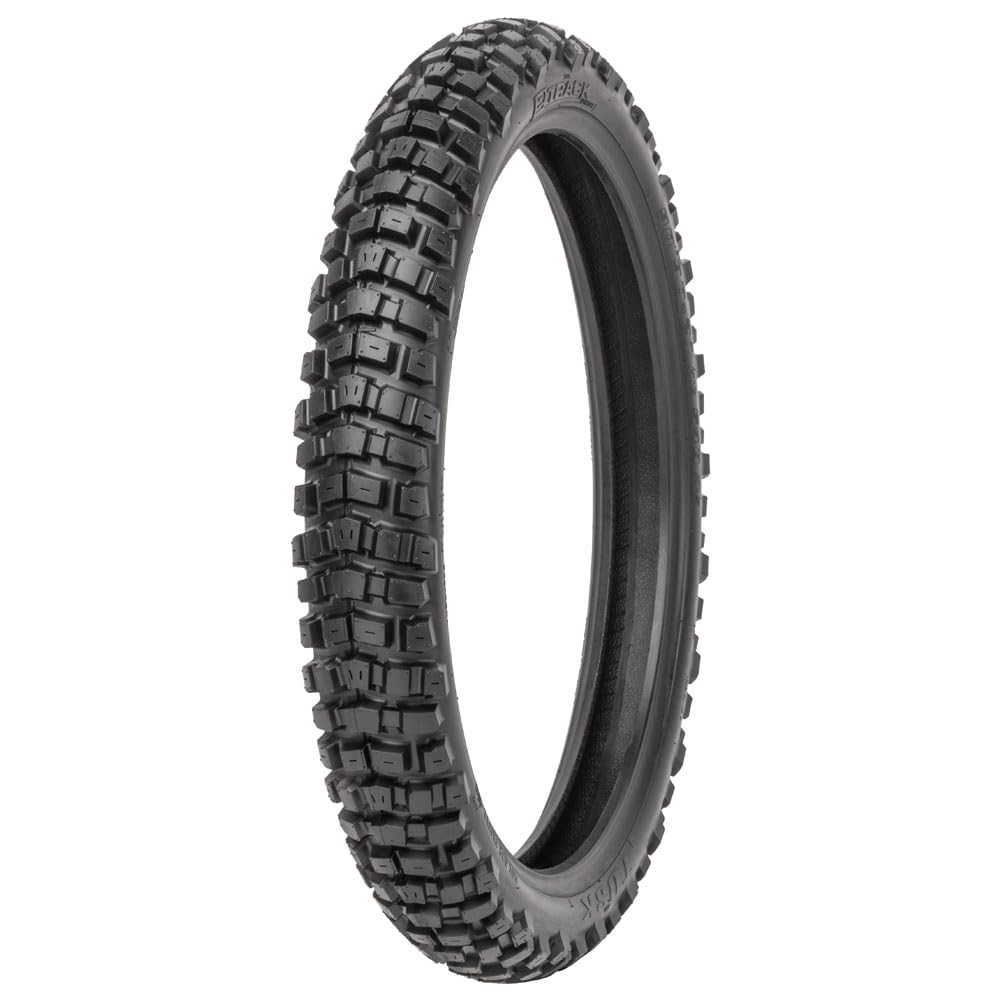
The 12-ply beast that shrugs off sharp rocks and heavy loads where lighter tires give up.
If you pack your bike to the brim for remote adventure routes, the 2Track’s 12-ply casing is the structural difference between finishing the trail and patching a sidewall. At 15.03 pounds, it is the heaviest tire in this comparison (5.03 pounds heavier than the Dunlop D606 at 10 pounds), but that weight translates directly into puncture resistance and stability under load.
The bias belted construction uses strategically reinforced and connected knob bases that keep the tread blocks from squirming during hard cornering. Large tread blocks provide consistent on-road handling, while the deep tread gives the tire an aggressive look and feel. The durable rubber compound is designed for confidence-inspiring traction and long-lasting wear even in brutal conditions.
The 2Track feels noticeably stiffer than the 4-ply Waypoint — that is the nature of a 12-ply tire. Customers note that it tracks straight on highway grooved pavement where softer tires wander. The catch is that stiffness also transmits more vibration through the handlebars on rough pavement compared to a radial tire like the Michelin Anakee.
What Makes It a Tank
- 12-ply rating provides maximum puncture and pinch-flat resistance for rocky terrain
- Reinforced knob bases increase handling precision and stability at speed
- Deep, large tread blocks deliver consistent traction on mixed surfaces
What You Sacrifice
- 15.03-pound weight increases unsprung mass, affecting suspension response
- Stiff ride on pavement — not as compliant as a 4-ply or radial tire
Reach for the 2Track when: your bike carries heavy panniers through sharp, rocky trails and you need a puncture-proof front tire.
Skip it for: daily commuting on smooth highways where the stiff ride and weight are unnecessary drawbacks.
4. Dunlop D606 Dual Purpose Tire – Front – 90/90-21

The lightest front tire in the lineup, built for riders who spend 90 percent of their time off-road.
At 10 pounds, the D606 is 5.03 pounds lighter than the Tusk 2Track — a difference you feel instantly when you lift the front end over logs or through deep ruts. Dunlop states the D606 is for 10% on-road, 90% off-road use, making it the most dirt-biased tire in this group. The 6-ply carcass strikes a middle ground between the Tusk Waypoint’s 4-ply flexibility and the 2Track’s 12-ply rigidity.
The tall, widely spaced knobs are designed to clear mud and bite into loose soil. On the road, those same knobs create a noticeable hum and wear much faster than a street-oriented tire. The bias construction (labeled “B” in the specs) keeps the tire predictable during hard braking on loose surfaces but lacks the high-speed damping a radial offers.
The D606 has been a go-to for enduro-style riders for years. Its 54 load index means it supports a moderate load index value matching the Tusk 2Track and Dunlop Trailmax Mission, so it works on heavier dual-sports as long as you are not maxing out luggage capacity.
Where It Dominates
- 10-pound weight reduces front-end inertia for easier steering in technical terrain
- Aggressive knob pattern provides exceptional traction in mud and loose dirt
- 6-ply casing offers solid puncture resistance without excessive stiffness
Where It Struggles
- Intended 90% off-road use means short tread life and road noise on pavement
- Not tubeless — requires a tube for most rim setups
Ideal for: riders who prioritize dirt performance and are willing to swap tires more often for maximum off-road grip.
Not for: highway-centric commuters who want a quiet, long-wearing front tire — the D606 wears fast on asphalt.
5. MICHELIN Anakee Adventure Front Tire (90/90-21)
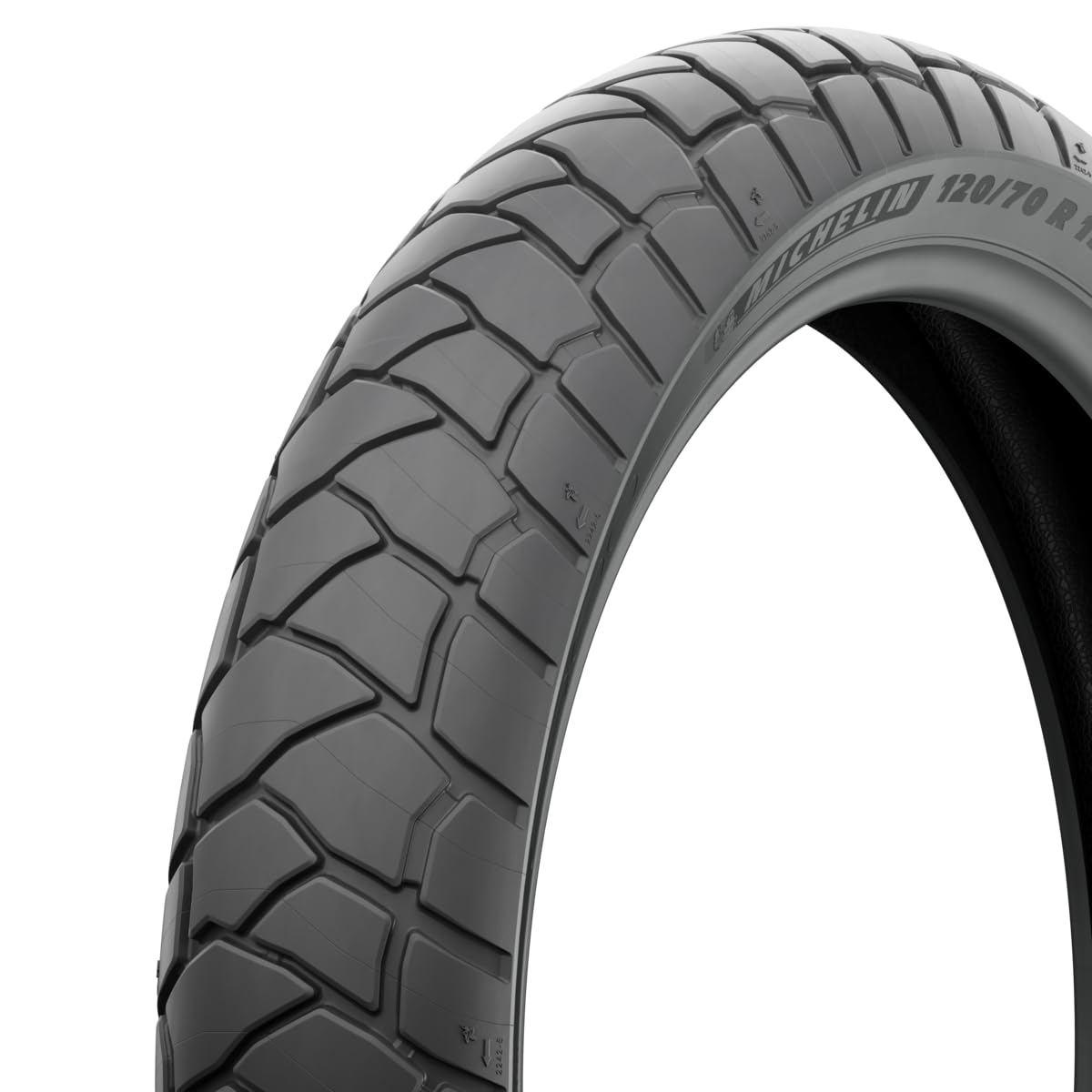
The radial-construction adventure tire that uses silica rubber to claw into wet pavement.
Michelin is the only brand here offering a radial construction in the 90/90-21 size — a meaningful difference if your ride is heavy on tarmac. The radial design lets the sidewall flex independently from the tread, which reduces heat buildup at sustained highway speeds and gives a more compliant ride over bumps. The new silica tread compounds provide excellent wet grip, giving you added confidence on slippery roads where bias-ply tires often wash out.
Michelin Bridge Block Technology, borrowed from the Anakee Wild line, delivers a new level of stability on-road. The fully grooved geometric tread pattern ensures uncompromising traction for off-road use, but the emphasis is clearly on paved-road confidence. Michelin 2CT and 2CT+ compounds (in the rear tire) and the tune profile give this front tire precise handling and long-lasting performance.
The Michelin Anakee Adventure handles moderate front loads thanks to its M load range rating (a standard that tells you the tire can carry a specific weight at a given pressure). The trade-off for that technology is a higher price than most competitors here — but if wet-weather touring is your primary scenario, the silica rubber and radial construction (where the cords run across the tire for better grip) are tough to top.
what separates it
- Radial construction provides better heat dissipation and a smoother highway ride
- Silica tread compound delivers tremendous wet grip on slippery surfaces
- Bridge Block Technology from the Anakee Wild line enhances on-road stability
Considerations
- Premium price is significantly higher than the entry-level Tusk Waypoint
- Less aggressive off-road tread than the Dunlop D606 for muddy conditions
Your companion for: adventure touring that leans toward paved roads and long days in rainy conditions, where radial comfort and wet grip matter most.
Better options exist if: your budget is tight or your riding is 90% hard-core off-road trails.
6. Michelin Commander II Cruiser Front Motorcycle Bias Tire – 90/90-21

The cruiser tire with Amplified Density Technology that reportedly doubled the life of competitors at launch.
Michelin made waves with the Commander II when it first came out, claiming third-party tests showed it almost doubling the tire life compared to the Metzeler ME880 and Dunlop D407/D408 tires in comparable sizes. That longevity claim comes from the specialized rubber compound and the Amplified Density Technology (ADT), which increases responsiveness by packing the tread compound denser to resist squaring off under highway cruising.
At 9 pounds, the Commander II is the lightest tire in this roundup — even lighter than the Dunlop D606. That low weight reduces rotating mass at the front wheel, making steering inputs feel quicker on a cruiser. The bias construction is standard for the cruiser class, prioritizing stability over the supple ride of a radial. The tire measures 27.4 x 27.4 x 3.6 inches, very close to the dimensions of the Dunlop Trailmax Mission.
This is purely a street tire. It lacks any off-road tread, so it is the wrong choice for gravel or dirt. Reviewers point out the Commander II wears evenly and lasts well past what they expected from previous cruiser tires, matching Michelin’s durability promise for riders who put high mileage on their front tire.
The Big Advantage
- Amplified Density Technology improves responsiveness and extends tread life
- Light 9-pound weight reduces front-end inertia for easier steering at low speeds
- Proven track record for long wear in cruiser applications
What It Cannot Do
- Zero off-road capability — the shallow tread pattern has no bite in dirt
- Bias construction rides firmer than a radial on expansion joints and rough pavement
Best choice for: cruiser owners who eat up interstate miles and want a light, long-lasting front tire that resists premature squaring.
Skip it for: any route that includes gravel, fire roads, or double-track — this tire stays on pavement only.
7. Dunlop Trailmax Mission Front Tire (90/90-21)

The two-years-in-development adventure tire that delivers knobby-like off-road grip without punishing your daily commute.
Dunlop spent over two years developing the Trailmax Mission to close the gap between off-road capability and street ride quality. The aggressive tread pattern gives you traction in hard terrain, but the real innovation is the Staggered Step design — a step-down feature on the rugged tread blocks that adds rigidity in the contact patch (the part touching the road) for better stability and handling on pavement.
Wrap-around lugs extend onto the tire’s edge to protect it from sharp rocks while adding extra off-road traction when you lean the bike over. Despite that aggressive look, the Mission uses a 4-ply bias-ply construction, keeping it lighter and more compliant than a 6- or 12-ply tire. At 14.62 pounds, it is 0.41 pounds lighter than the Tusk 2Track but carries the same 54 load index, so it handles similar loads.
The Mission measures 27.5 x 27.5 x 3.75 inches — very close to the 27 x 27 x 4-inch Tusk 2Track. Shoppers say that the Mission strikes a rare balance: it rides smoother on the highway than the Dunlop D606 but digs in better on loose climbs than pure street tires. The catch is price — the Mission sits at the premium end of the spectrum.
What Makes It Special
- Staggered Step design enhances stability and handling in the contact patch
- Wrap-around lugs protect the tire edge and improve off-road traction at lean angles
- Impressive on-road ride quality with knobby-like performance in hard terrain
The Trade-Offs
- 4-ply casing offers less puncture protection than the Tusk 2Track for heavy loads on sharp rocks
- Premium price is the highest in this comparison
Reach for the Mission when: you ride a 50/50 mix of pavement and dirt and want a premium tire that does not force you to compromise heavily on either surface.
Consider a different tire if: your budget is tight or you ride mostly deep mud where a more aggressive knob pattern like the D606 works better.
Understanding the Specs
Ply Rating & Load Range
The number of plies — the internal cord layers — determines the tire’s structural strength. A higher ply count, like the Tusk 2Track’s 12-ply, means stiffer sidewalls and better puncture resistance, ideal for loaded adventure riding on sharp terrain. Lower ply ratings — like the Tusk Waypoint’s 4-ply — provide a more comfortable ride but are more vulnerable to cuts. Load Range letters (B, H, M, LL) indicate the same concept in a different labeling system; H and M ranges support higher air pressures and heavier loads.
Bias vs. Radial Construction
Bias-ply tires have cord layers that cross at an angle. They offer stable straight-line tracking, a stiffer sidewall feel, and a lower price — the most common type in the 90/90-21 size. Radial tires have cords that run straight across from bead to bead, allowing the sidewall to flex independently of the tread. That reduces heat buildup at highway speeds and gives a more compliant ride. The Michelin Anakee Adventure is the only radial option here, making it a standout for pavement-heavy adventure touring.
Load Index & Speed Rating
The load index (like 54, 79, or 54T) tells you the maximum weight a single tire can support at full inflation. A higher index number means a higher load capacity — the 79 on the Bridgestone Exedra Max is significantly higher than the 54 common on dual-sport tires, which means it supports heavier bikes and luggage. The speed rating (T, H, V, R) indicates the maximum safe speed. Never exceed either rating; doing so risks tire failure.
Tubeless vs. Tube-Type
A tubeless tire seals against the rim and holds air without an inner tube, making roadside puncture repairs easier using a plug kit. Most modern tubeless rims work with tubeless tires. Tube-type tires require a separate inner tube; if you get a flat, you must remove the wheel to replace or patch the tube. The Bridgestone Exedra Max is explicitly tubeless. Other tires here may require a tube depending on your rim — always check the manufacturer’s fitment notes.
FAQ
What does 90/90-21 actually mean on a motorcycle tire?
Can I use a 90/90-21 tire on a bike that came with a 3.00-21 tire?
Is a higher ply rating always better?
How do I know if a 90/90-21 tire is tubeless or needs a tube?
Can I mount a dual-sport 90/90-21 tire on a cruiser bike?
What is the difference between bias-ply and radial construction in this size?
How long should a 90/90-21 front tire last?
What is the Staggered Step design on the Dunlop Trailmax Mission?
Do I need a specific load index for my bike’s front tire?
Can I mix a radial front tire with a bias-ply rear tire?
Final Thoughts: The Verdict
For most riders, the 90/90-21 motorcycle tire winner is the Bridgestone Exedra Max because its cruiser-specific rubber compound and 908-pound load capacity deliver real mileage stability on heavy touring bikes. If you want a true 50/50 adventure tire that handles dirt without punishing your commute, grab the Dunlop Trailmax Mission. And for maximum wet-road confidence on long pavement tours, the radial Michelin Anakee Adventure is your best bet.
How We Picked
We do not accept paid placement. Every pick is matched to a real buyer and a real use-case; we do not hands-on test units.
Sources & Methodology
Specifications: manufacturer listings and product documentation. Review insights: verified customer reviews, as of July 2026. Pricing: not shown on this page (it changes often); check the current price via the retailer link.
As an Amazon Associate, Gadgets Feed earns from qualifying purchases. This does not affect which products we feature.
Related Guides
Product prices and availability are accurate as of the date/time indicated and are subject to change. Any price and availability information displayed on Amazon at the time of purchase will apply to the purchase of this product. As an Amazon Associate I earn from qualifying purchases.
CERTAIN CONTENT THAT APPEARS ON THIS SITE COMES FROM AMAZON. THIS CONTENT IS PROVIDED "AS IS" AND IS SUBJECT TO CHANGE OR REMOVAL AT ANY TIME.
Amazon and the Amazon logo are trademarks of Amazon.com, Inc. or its affiliates.