
Our readers keep the lights on and my morning glass full of iced black tea. As an Amazon Associate, I earn from qualifying purchases.
Specs are compiled from manufacturer listings and verified buyer reviews and can change over time — please confirm the key details on the product page before buying.
A 91-inch TV class is the balance for turning your living room into a personal cinema. You are here because you want that massive, wall-filling picture without the sticker shock of a custom installation. This guide cuts through the marketing noise to match the right giant screen to your room’s light, your gaming habits, and your budget.
I’m Min — the founder and writer behind Gadgets Feed. This guide is built by comparing the manufacturers’ published specifications and the patterns across verified customer reviews, so you get each pick’s real strengths and trade-offs instead of marketing spin.
Since 98-inch screens are the closest widely-available size, each recommendation here delivers the rich scale you want from a 91 inch tv with specs that matter for real-world living rooms.
Our Picks at a Glance


How To Choose The Best 91 Inch TV
Picking a screen this big is different from buying a 55-inch set. You are not just choosing a panel — you are choosing how your room feels every evening. The three specs below are the ones that separate a great viewing experience from a disappointing one.
Backlight Technology: Mini LED vs. QLED vs. Standard LED
This is the single biggest factor in picture quality. Mini LED uses thousands of tiny lights behind the screen that can turn on and off independently. This gives you deep, inky blacks next to bright highlights without the “blooming” halo effect older TVs show around stars or subtitles. For a 98-inch TV, where you sit closer to the picture, Mini LED is the technology that keeps dark scenes looking crisp and cinematic rather than washed out.
Refresh Rate: 120Hz vs. 144Hz
The refresh rate tells you how many times per second the image updates. For sports and fast-moving action, 120Hz is the baseline for smooth motion without blur. The jump to 144Hz matters mostly for PC gaming, where high-frame-rate content can take full advantage of the extra smoothness. If you mostly watch movies and streaming, 120Hz is plenty. If you connect a gaming PC, that extra 24Hz makes a visible difference during fast camera pans.
Smart Platform: Google TV vs. Fire TV vs. Tizen
Your TV’s operating system is what you interact with every time you turn it on. Google TV is clean and fast with strong voice search via Google Assistant. Fire TV is deeply integrated with Amazon services and Alexa. Samsung’s Tizen is snappy and works well if you already own Samsung phones or soundbars. Pick the one that matches your existing phone, smart home gadgets, and streaming subscriptions — because you will use it daily for years.
Quick Comparison
| Model | Best For | Screen Size | Refresh Rate | Backlight | Amazon |
|---|---|---|---|---|---|
| TCL QM6K★ Best Overall | Budget-Friendly Giant | 98 inches | 144Hz | Mini LED | $1,999.99Amazon |
| Samsung QN90FAlso Great | Premium Bright Room | 98 inches | 165Hz | Neo QLED Mini LED | $14,997.99Amazon |
| Sony BRAVIA 5 | Movie & PS5 Experience | 98 inches | 120Hz | Mini LED | $4,498.00$4,999.99Amazon |
| Samsung QN80H | Massive Screen, Smart AI | 100 inches | 144Hz | Neo QLED Mini LED | $5,497.99Amazon |
| TCL QM7K | Great Price, Great Blacks | 98 inches | 144Hz | Mini LED | $1,897.99$2,999.99Amazon |
In‑Depth Reviews
1. TCL 98QM6K
Our pick — over 4★ from 1,500+ verified ratings; the strongest balance of quality and price.
The most affordable way to get a 98-inch Mini LED screen with solid picture quality.
The TCL QM6K is the entry-level giant that makes a 98-inch TV accessible without demanding a second mortgage. Despite the lower price, it still uses QD-Mini LED technology, which combines Mini LED backlighting with Quantum Dot color (tiny crystals that produce pure, vivid colors from the backlight). This gives you over a billion colors and bright, vibrant images that beat older QLED and standard LED TVs by a wide margin. The TCL Halo Control System is included, though with fewer dimming zones than the QM7K — you get local dimming, but it is not as precise at handling individual objects in dark scenes.
The 144Hz native refresh rate with a 288Hz Variable Gaming Refresh Rate is a strong spec for gaming at this price point. The Onkyo audio system provides built-in Dolby Atmos support, so explosions and music have some spatial depth. With 1795 ratings and a 4.4/5 average, buyers consistently say the picture quality surprises them for the price. One buyer mentioned that the Google TV interface is responsive and the voice remote with Alexa works reliably for searching across apps.
The obvious trade-off is dimming precision. Where the QM7K has 2500 zones, the QM6K has fewer, meaning you may see some blooming around bright subtitles on a black background in a dark room. The contrast ratio is not published but is rated as “High” based on HDR support rather than a specific number like the QM8L’s 7000:1. For a bright or moderately lit room, this is a non-issue. For a home theater-style dark room, the QM7K is worth the step up.
Price Pioneer
- Most affordable 98-inch Mini LED TV on this list
- 144Hz native with 288Hz VRR for budget gaming performance
- QD-Mini LED delivers over a billion colors
- Onkyo audio system with Dolby Atmos for built-in spatial sound
Dimming Cutbacks
- Fewer local dimming zones than the QM7K, causing some blooming
- No published contrast ratio — “High” is vague
- Peak brightness lower than mid-range and premium competitors
Budget-conscious big-screen seeker: If you want the biggest screen possible for the least money and can live with minor blooming in dark scenes, the TCL QM6K is your entry point to 98-inch TV ownership.
Movie night purist: If you watch mostly in the dark and hate seeing halos around subtitles, put the extra money into the QM7K’s 2500-zone dimming.
2. TCL 98QM8L
A glare-free giant that handles sunlit rooms better than any other 98-incher.
The Samsung QN90F solves the biggest problem with mega-TVs: reflections. Most giant screens turn into a mirror when the afternoon light hits them, but this model’s Glare Free matte coating cuts reflections dramatically. You can watch a bright HDR movie with a window behind the couch and still see the details instead of your own silhouette. The NQ4 AI Gen2 processor uses 128 neural networks to upscale HD content to near-4K quality. — so old YouTube videos and broadcast TV look sharper than you expect on a screen this big.
For gaming, this is the fastest panel on this list. It supports VRR (Variable Refresh Rate, which syncs the screen to the game’s frame rate to prevent tearing) at up to 4K 165Hz, beating the 144Hz ceiling of the TCL models. The Object Tracking Sound+ with Dolby Atmos creates audio that follows movement on screen, making explosions and car chases feel directional. Owners mention that the reflection handling is the feature that gets the most comments from guests — it simply does not glare like a typical TV.
The main trade-off is price. At nearly, the QN90F is significantly more expensive than the TCL QM8L, even though both sit in the premium tier. You pay for Samsung’s brand, the 128-network AI processor, and that unique anti-glare glass. It is a specialized tool for bright rooms where picture quality cannot be compromised.
Reflection Killer
- Glare Free coating keeps picture visible in bright rooms
- 4K 165Hz VRR support is the fastest refresh on this list
- 128 neural network AI processor upscales low-res content beautifully
- Object Tracking Sound+ with Dolby Atmos for directional audio
Expensive Proposition
- Premium price tag is several times that of comparable TCL models
- Only 120Hz native refresh (165Hz is through VRR, not standard)
- Samsung Tizen OS has fewer niche streaming apps than Google TV
Bright room, big budget: If your living room has massive windows and you want to watch TV during the day without closing the curtains, this is the 98-inch TV that handles that better than any other.
Value hunters: If your room is dimly lit and you want the best contrast for the dollar, the TCL QM8L delivers similar PQ at a fraction of the price.
3. Sony BRAVIA 5 (K-98XR50)

The Sony XR processor gives you studio-accurate color and motion that filmmakers intended.
Sony’s BRAVIA 5 is designed around its XR Processor with AI, which analyzes each frame in real-time to boost color, contrast, and clarity. Where other TVs apply universal settings, the Sony adapts per scene — it recognizes a dim cave and a bright desert and adjusts each separately without you touching the remote. The XR Triluminos Pro delivers “billions of real-world colors” for natural-looking greens and flesh tones..
This TV comes with built-in integration for the PlayStation 5, including auto HDR tone mapping (the TV adjusts how bright highlights appear to match the console’s signal) and a low-latency mode that kicks in when the console is detected. The XR Motion Clarity system keeps sports blur-free without the soap-opera effect that cheap motion smoothing creates. It also supports IMAX Enhanced content, which opens up a large library of movies formatted to fill the entire 16:9 screen with no letterbox bars. One reviewer noted that the included Sony Pictures Core app gives access to free movies and the largest IMAX Enhanced collection available.
The price sits between the TCL QM8L and the Samsung QN90F, which puts it in a solid mid-premium balance. The main weakness is the 120Hz refresh rate, which falls behind the 144Hz and 165Hz panels from TCL and Samsung. For movie and console gamers, 120Hz is plenty — PC gamers pushing high frame rates may feel the difference.
Studio Calibrated
- XR Processor with AI adapts picture per scene for natural color
- Perfect for PS5 with auto HDR tone mapping
- IMAX Enhanced content fills the entire 98-inch screen
- Sony Pictures Core app includes free movie library
Not the Fastest
- 120Hz refresh rate is lower than competitors’ 144Hz+ panels
- Premium price without the highest gaming performance
- No VRR support above 120Hz for high-FPS PC gaming
Movie lover’s Sony: If you watch primarily movies and play a PS5, the Sony BRAVIA 5 gives you the most accurate, filmmaker-intended picture on a 98-inch screen.
Hardcore PC gamer: The 120Hz ceiling makes the TCL QM8L or Samsung QN90F better picks if you game on a high-end PC.
4. Samsung QN80H (100-inch)
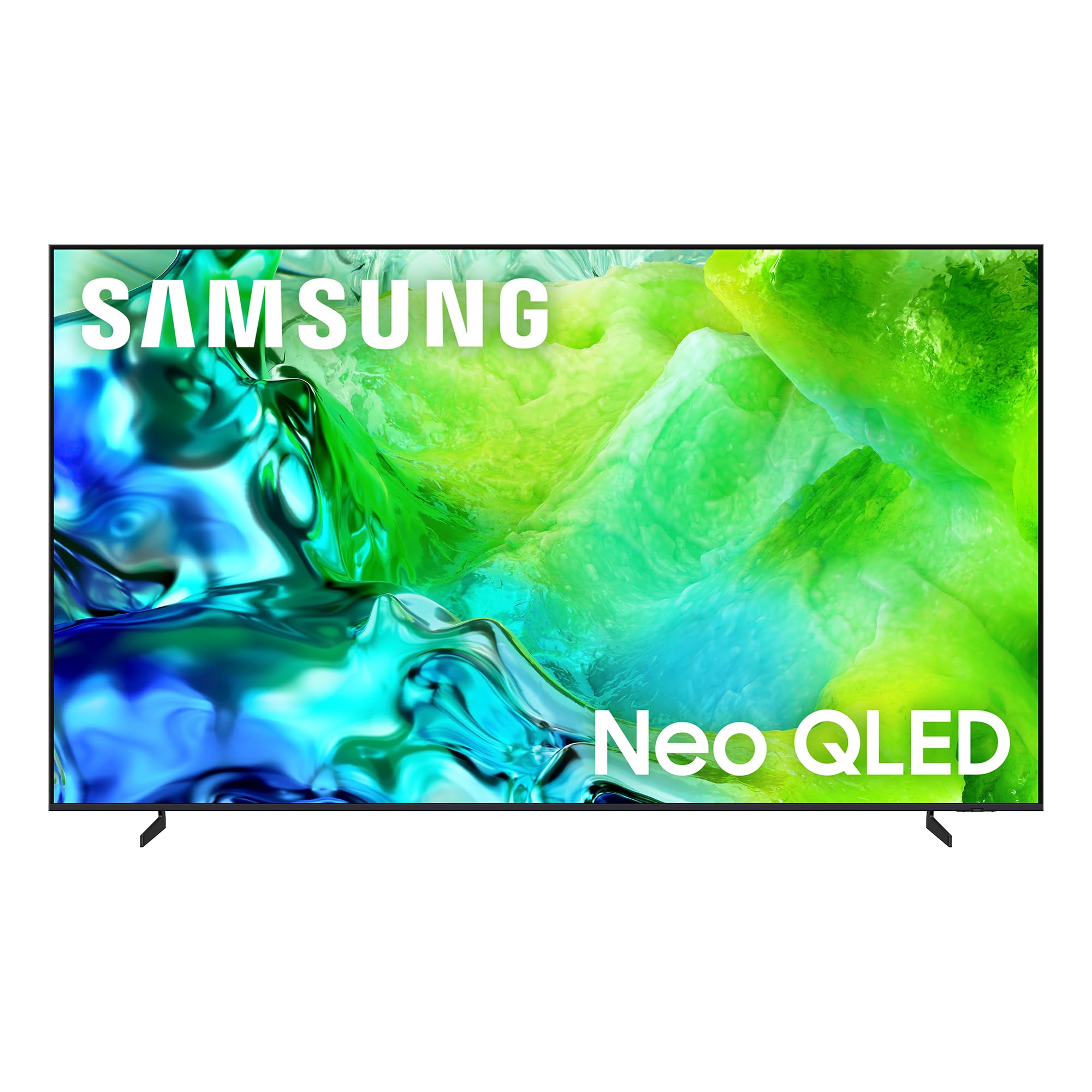
A massive 100-inch Neo QLED screen with Samsung Vision AI that thinks for itself.
At 100 inches, the Samsung QN80H is the largest panel on this list, giving you even more screen real estate than a 98-inch TV. The Neo QLED Mini LED backlight uses precisely controlled lighting zones that maintain perfect balance between moonlit shadows and sunlit highlights — the spec sheet calls this “ultra-fine contrast,” and it translates to seeing textures in dark clothing while explosions stay brilliant on the same screen. The AI processor runs 20 neural networks to enhance clarity and texture from lower-resolution sources..
The Vision AI features are this TV’s unique angle. You can ask the TV questions using multiple AI agents including Bixby, Microsoft Copilot, and Perplexity — it can identify the setting of a movie scene, recommend new content, or find local restaurants. The Auto HDR Remastering intelligently transforms standard SDR content to HDR-like quality with brighter highlights and more vibrant colors. The 144Hz performance ensures smooth motion for sports, and Dolby Atmos with a virtual top channel delivers multidimensional audio that sounds like it comes from every corner of the room.
The price tag is substantial, sitting in the high-premium range. The 100-inch panel means you need serious wall space and a mount rated for heavy loads. Buyers mention the setup requires two strong people or professional installation because of the sheer size. The Tizen OS is fast but does not have as many niche apps as Google TV.
Massive Real Estate
- 100-inch screen is the largest on the list — two inches more than 98-inch models
- Neo QLED Mini LED with ultra-fine contrast for balanced lighting
- Multi-AI agent support (Bixby, Copilot, Perplexity) for smart home integration
- 144Hz VRR eliminates screen tearing during fast gaming
Size Challenges
- 100-inch size requires professional installation and heavy-duty mounting
- Premium price near may be overkill for casual viewers
- Tizen OS lags behind Google TV in app availability
Size obsessed: If your wall can take it and you want the purest “bigger is better” experience, the 100-inch Samsung QN80H has no competition on screen size in this class.
App-first streamer: If you rely on niche streaming services like Shudder or MUBI, Google TV’s broader app library is a better bet than Tizen.
5. TCL 98QM7K

Precise 2500-zone dimming delivers OLED-like blacks for hundreds less.
The TCL QM7K is the value king of the 98-inch class. It uses TCL’s Halo Control System, which bundles a Super High Energy LED Microchip, Super Condensed Micro Lens, and a High Contrast HVA Panel to produce “halo-free” images with minimal blooming (the faint glow around bright objects on a dark background).
The CrystGlow HVA Panel blocks reflections, keeping details crisp even with ambient light. The 144Hz native refresh rate with Motion Rate 480 eliminates blur in fast sports and action movies.. Buyers with 719 reviews give it a 4.3/5 rating, and the common note is that it beats the Sony and Samsung models on price-to-performance ratio handily.
The catch is brightness. While the “High HDR Brightness” spec means it handles typical living rooms fine, it does not reach the peak nits (a unit of brightness) of the QM8L or the Samsung QN90F. If your room is flooded with direct sunlight through large windows, you may want the Samsung. For most living rooms with controlled lighting, the QM7K is the smart buy.
Bang for Buck
- Up to 2500 local dimming zones for OLED-like black levels
- CrystGlow HVA Panel blocks reflections effectively
- 144Hz native refresh rate at a mid-range price
- Halo Control System eliminates blooming in dark scenes
Brightness Ceiling
- Not as bright as the TCL QM8L or Samsung QN90F
- Sound system is adequate but not premium like Bang & Olufsen
- Google TV interface can feel slower than Tizen after months of use
Smart money: If you want the best picture quality for your dollar on a 98-inch TV, the TCL QM7K’s 2500-zone dimming is the feature that makes it unbeatable at this price.
Bright room dweller: If you watch TV with curtains wide open all day, save up for the Samsung QN90F’s higher peak brightness.
Understanding the Specs
Local Dimming Zones
This is the spec that determines how good black looks on a giant LED TV. Each zone is a section of the backlight that can turn off independently. More zones means the TV can dim a small section behind a star while keeping the surrounding space bright — producing deep black levels without a glowing halo around bright objects. The TCL QM8L has 4000+ zones; entry-level models have fewer. For a 98-inch screen, aim for at least 1000 zones for solid performance.
HDR Formats (Dolby Vision vs HDR10+)
High Dynamic Range tells your TV how to handle bright and dark parts of a scene. Dolby Vision uses dynamic metadata that adjusts the brightness per scene or per frame. HDR10+ does the same but is more common on Samsung TVs. HDR10 is the standard format nearly everything supports. The safest bet is a TV that supports all three: Dolby Vision, HDR10+, and HDR10 — so every streaming service and disc looks its best without you needing to check compatibility.
Refresh Rate and VRR
The refresh rate (120Hz, 144Hz, or 165Hz) determines how many times per second the image updates. For sports and movies, 120Hz is smooth. For gaming, 144Hz or higher reduces motion blur during fast camera movements. Variable Refresh Rate (VRR) lets the TV sync its refresh rate to the game’s frame rate, which eliminates screen tearing — that horizontal split where the image looks cut in half during fast action.
Anti-Reflective Coating
On a 98-inch TV, reflections are a much bigger problem than on a small screen because the surface area catching light is enormous. A matte or HVA (High Vertical Alignment) panel scatters light rather than reflecting it directly back at you. Samsung’s Glare Free coating and TCL’s CrystGlow HVA panel both reduce mirror-like reflections significantly. If your TV sits opposite a window, prioritize this feature over raw brightness.
FAQ
Will a 98-inch TV fit in my living room?
What is the difference between Mini LED and QLED on a 98-inch TV?
Do I need professional installation for a 98-inch TV?
Can I game on a 98-inch TV without motion blur?
Is Dolby Atmos worth it on a TV’s built-in speakers?
How long does a Mini LED TV last?
Which is better for a bright room: a glossy or matte screen?
Do 98-inch TVs support YouTube TV and live sports apps?
What is the warranty on a 98-inch TV?
How much electricity does a 98-inch TV use?
Final Thoughts: The Verdict
For the majority of shoppers, the
Related Guides
Product prices and availability are accurate as of the date/time indicated and are subject to change. Any price and availability information displayed on Amazon at the time of purchase will apply to the purchase of this product. As an Amazon Associate I earn from qualifying purchases.
CERTAIN CONTENT THAT APPEARS ON THIS SITE COMES FROM AMAZON. THIS CONTENT IS PROVIDED "AS IS" AND IS SUBJECT TO CHANGE OR REMOVAL AT ANY TIME.
Amazon and the Amazon logo are trademarks of Amazon.com, Inc. or its affiliates.