
A power outage doesn’t just turn off the lights — it shuts down your well pump, your furnace, your refrigerator, and your sense of security. A conventional generator delivers power, but it often comes with dirty electricity that can fry sensitive electronics and a roar that disrupts the entire neighborhood. For whole-home backup or serious job site power, you need a machine that balances raw output with clean, stable voltage and reasonable noise levels.
I’m Min — the co-founder and writer behind Gadgets Feed. I’ve spent countless hours analyzing engine displacements, THD ratings, fuel consumption curves, and real-world user reports to separate the machines that deliver on their sticker specs from those that fall short under load.
After weeks of research, I’ve narrowed the field to the models that truly earn the label best 9500 watt inverter generator, focusing on startup reliability, power cleanliness, fuel flexibility, and overall build quality.
How To Choose The Best 9500 Watt Inverter Generator
Choosing the right generator involves balancing power output, fuel type, noise, and portability. Here are the key factors that separate a good investment from a frustrating one.
Fuel Source: Dual Fuel vs. Tri-Fuel
Dual-fuel models run on gasoline and propane, while tri-fuel adds natural gas. Propane stores indefinitely and burns cleaner, making it ideal for emergencies. Natural gas offers unlimited runtime if you have a residential line, but it reduces peak wattage. Consider your long-term fuel storage plan before deciding.
Inverter Technology and THD
Inverter generators produce clean sine wave power with Total Harmonic Distortion (THD) under 3%, making them safe for sensitive electronics like laptops, variable-speed refrigerators, and CPAP machines. Non-inverter models often have THD above 6%, which can damage these devices over time.
Starting vs. Running Watts
Motors like well pumps and air conditioners require a surge of 2-3x their running wattage to start. A generator rated at 9500 peak watts might only deliver 7500-8000 continuous watts. Always calculate your startup surge requirements — not just the running total — to ensure your generator doesn’t bog down or trip its breaker.
Quick Comparison
On smaller screens, swipe sideways to see the full table.
| Model | Category | Best For | Key Spec | Amazon |
|---|---|---|---|---|
| Westinghouse iGen12000TFc | Inverter | Whole Home Backup | 9,000W running / 12,000W peak | Amazon |
| Champion 201407 | Inverter | Quiet Operation | 459cc engine / 64 dBA | Amazon |
| Pulsar PGD105TiSCO | Inverter | Tri-Fuel Versatility | 8,500W running (gas) / 62 dBA | Amazon |
| AIVOLT VS12000411 | Inverter | HVAC & RV | 9,000W running (gas) / 50A RV | Amazon |
| Generac GP9500 | Tri-Fuel | Budget Tri-Fuel | 9,500W running / 12,500W peak | Amazon |
| GENMAX GM10500XiT | Inverter | Compact Tri-Fuel Inverter | 7,800W running / 10,500W peak | Amazon |
| Gidrox GNV | Inverter | Extended Runtime | 8.7 gal tank / 21 hrs runtime | Amazon |
| GENMAX GM9000iEDC | Inverter | Dual Fuel Quiet | 7,600W running / 9,000W peak | Amazon |
| Pulsar PGD95BISCO | Inverter | Quiet Dual Fuel | 7,600W running (gas) / 62 dBA | Amazon |
| Westinghouse WGen9500DFc | Dual Fuel | Dual Fuel Value | 7,500W running / 9,500W peak | Amazon |
| DuroStar DS13000MXT | Tri-Fuel | High Output Tri-Fuel | 500cc engine / 13,000W peak | Amazon |
| DuroMax XP11000iH | Inverter | Premium Dual Fuel Inverter | 9,000W running / 11,000W peak | Amazon |
| DuroMax XP15000HXT | Tri-Fuel | Maximum Power | 15,000W peak / 500cc engine | Amazon |
In-Depth Reviews
1. Westinghouse iGen12000TFc
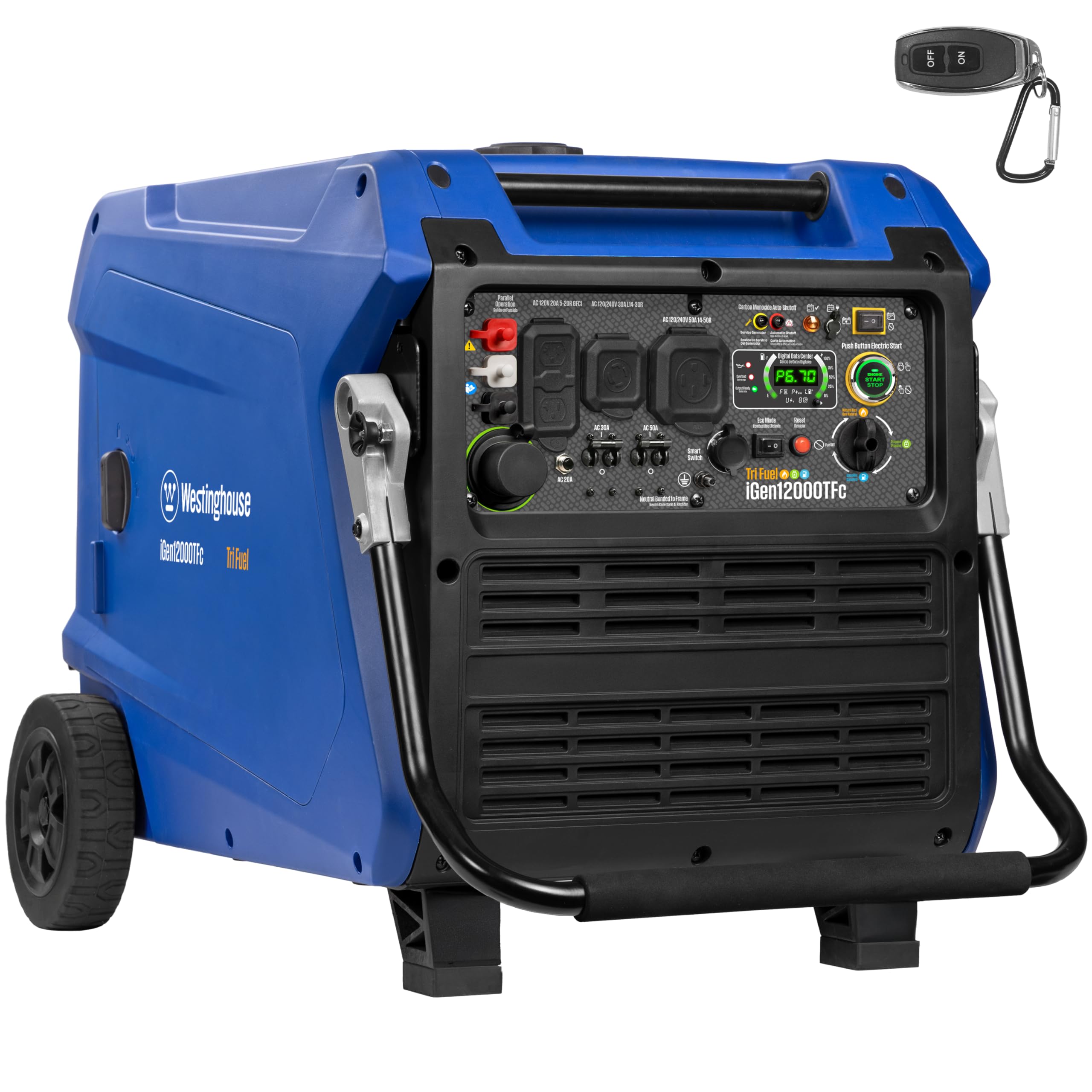
The Westinghouse iGen12000TFc is a fully-enclosed inverter generator that delivers 9,000 running watts on gasoline and 8,100 on propane, with a peak of 12,000 watts. The 457cc 4-stroke OHV engine is paired with a large 7.9-gallon fuel tank, offering up to 19 hours of runtime at 25% load. Noise levels are kept to a neighborhood-friendly 64 dBA thanks to the insulation and Eco Mode, which adjusts engine speed to match demand.
What sets this unit apart is its tri-fuel capability—gasoline, propane, and natural gas—giving you long-term fuel flexibility during extended outages. The control panel includes a 50A 14-50R outlet for whole-home or RV backup, a 30A L14-30R twist-lock, and a GFCI 20A duplex. The LED data center shows fuel level, power output, remaining runtime, and lifetime hours, so you always know what’s going on.
Users report straightforward setup with included tools, a quality build, and reliable starting via push-button, remote key fob, or recoil. Some units arrived with minor cosmetic shipping damage, but the overwhelming sentiment is that this generator produces clean sine wave power suitable for sensitive electronics and heavy loads alike. The CO sensor and low-oil shutdown add essential safety layers.
Why it’s great
- Tri-fuel capability with 50A outlet for full home backup
- Very low THD (<3%) safe for sensitive electronics
- Quiet operation at 64 dBA with Eco Mode fuel savings
Good to know
- Heavy unit at 191 lbs, requires planning for transport
- Some units arrive with minor shipping cosmetic damage
2. Champion 201407 11,000-Watt Inverter

The Champion 201407 is a gasoline-only inverter generator that delivers 9,000 running watts and 11,000 starting watts from a reliable 459cc Champion engine. It runs up to 15 hours on a full tank and operates at a remarkably low 64 dBA from 23 feet — quiet enough for residential use. The wireless remote key fob works up to 80 feet away, making it easy to start from inside the house or a camper.
This unit is CARB-compliant, so it’s available in all 50 states, including California. The panel includes two GFCI 120V 20A duplex outlets, a 120/240V 30A locking outlet, a 120/240V 37.5A outlet, and a 12V automotive-style port. Cold Start Technology ensures reliable startup in freezing weather, and the CO Shield auto-shutoff provides peace of mind.
Real-world users report that this generator powers whole homes easily, including 3-ton AC units, well pumps, and mini-splits, without bogging down. The quiet operation is frequently praised — it’s described as half as loud as comparable non-inverter units. A few users noted a sensitive CO sensor that can shut down the unit prematurely in high winds, but overall the Champion is seen as a reliable, high-value performer backed by a 3-year warranty.
Why it’s great
- Exceptionally quiet at 64 dBA for an 11kW generator
- Wireless remote start works from up to 80 feet
- Cold Start Technology ensures reliable winter operation
Good to know
- Gasoline only — no propane or NG option
- CO sensor can be overly sensitive in certain wind conditions
3. Pulsar PGD105TiSCO Tri-Fuel Inverter

The Pulsar PGD105TiSCO is a tri-fuel inverter generator rated at 8,500 running watts on gasoline, 8,000 on propane, and 6,800 on natural gas, with peak outputs of 10,500, 9,500, and 8,400 watts respectively. The 458cc OHV engine and 6.9-gallon fuel tank support up to 9 hours of continuous operation at half load, and the unit operates at a very quiet 62 dBA.
This generator is CARB-compliant and features a fully digital control center displaying hours, voltage, load, and frequency. The outlet selection is generous: four GFCI 120V 5-20R outlets, a 120/240V L14-30R twist-lock, and a 120/240V 14-50R 50A outlet, plus USB-A and USB-C ports. Remote start, electric start, and recoil backup give you multiple ways to get it running.
Users who have used this generator for real emergencies — including Hurricane Beryl — report it runs entire homes on natural gas without issues. The quiet idle and easy maintenance (oil drain tube, carburetor bowl drain) are appreciated. However, some buyers experienced defective units out of the box, and a few report the generator cannot reach its advertised full power under load. Overall, it’s a well-featured tri-fuel inverter if you get a good unit.
Why it’s great
- Tri-fuel operation with genuine inverter clean power
- Very quiet at 62 dBA with full enclosure
- Includes USB-A, USB-C, and 50A RV outlet
Good to know
- Some units arrive defective or fail to meet full power specs
- Heavy at 247 lbs, transport requires planning
4. AIVOLT VS12000411 Dual Fuel Inverter
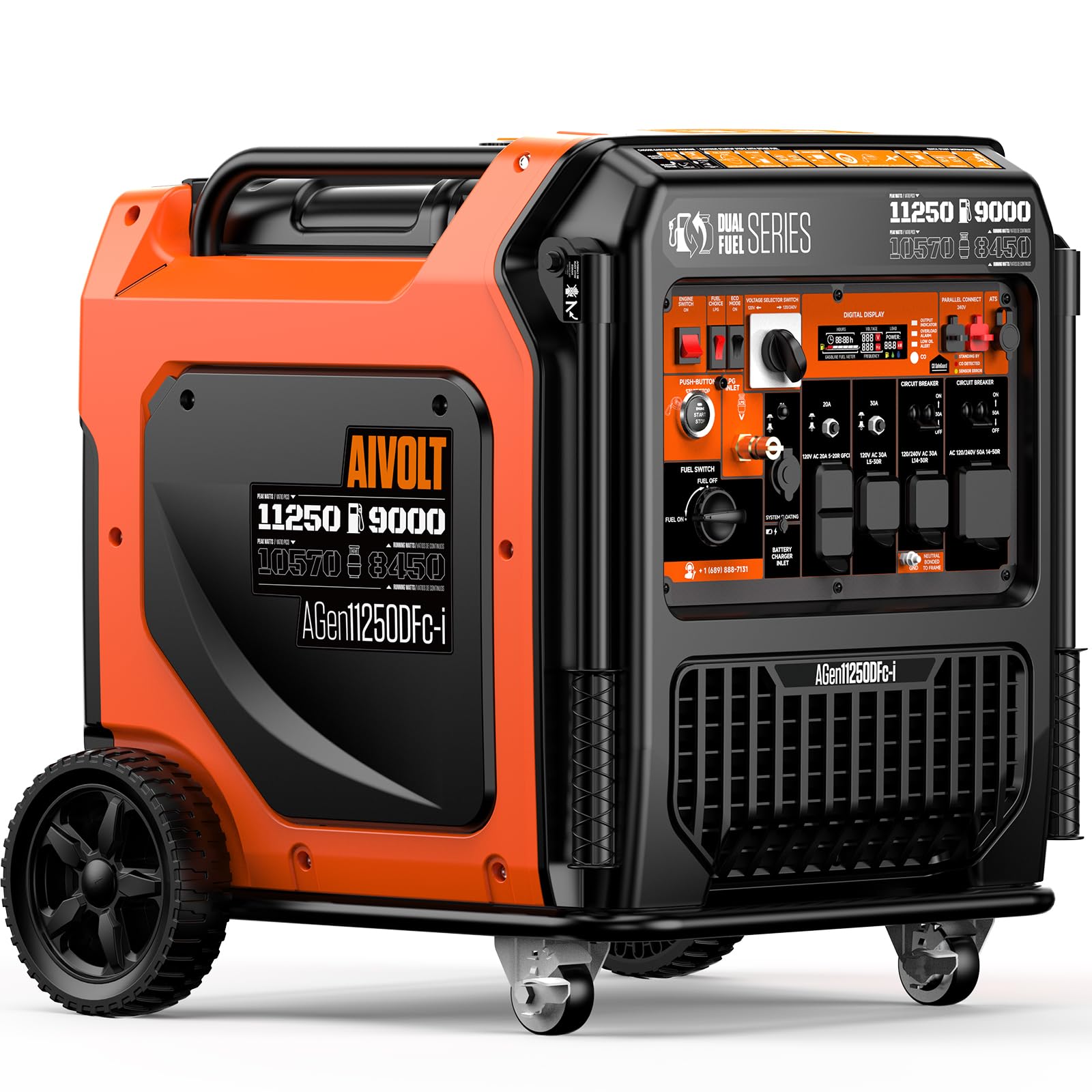
The AIVOLT VS12000411 is a dual-fuel inverter generator with 9,000 running watts on gasoline and 8,540 on propane, peaking at 11,250 and 10,570 watts respectively. It features remote, electric, and recoil start, plus a 50A RV outlet. The Eco Mode allows over 19 hours of runtime at lighter loads, and the unit is CARB-compliant for 50-state sale.
This generator is built with a fully enclosed design for quiet operation — users report around 72-73 dBA at 5 feet, which is slightly louder than the claimed 57 dBA but still reasonable for the power output. The panel includes multiple outlets and a digital display showing fuel level, voltage, and runtime. Parallel capability means you can double your power with a second unit.
Real-world reviews are mixed. Many users are pleased with the power output for home backup and RV use, citing quiet operation and easy starting. However, a notable number of failures have been reported, including units that ran for just one hour before losing voltage output. Customer support is reportedly based overseas, which complicates warranty claims. It’s a solid value if you get a good unit, but reliability is a gamble.
Why it’s great
- Good value for a dual-fuel inverter with 50A RV outlet
- Eco Mode delivers over 19 hours runtime
- CARB-compliant for 50-state availability
Good to know
- Mixed reliability — some units fail very early
- Customer support is based overseas
5. Generac GP9500 Tri-Fuel
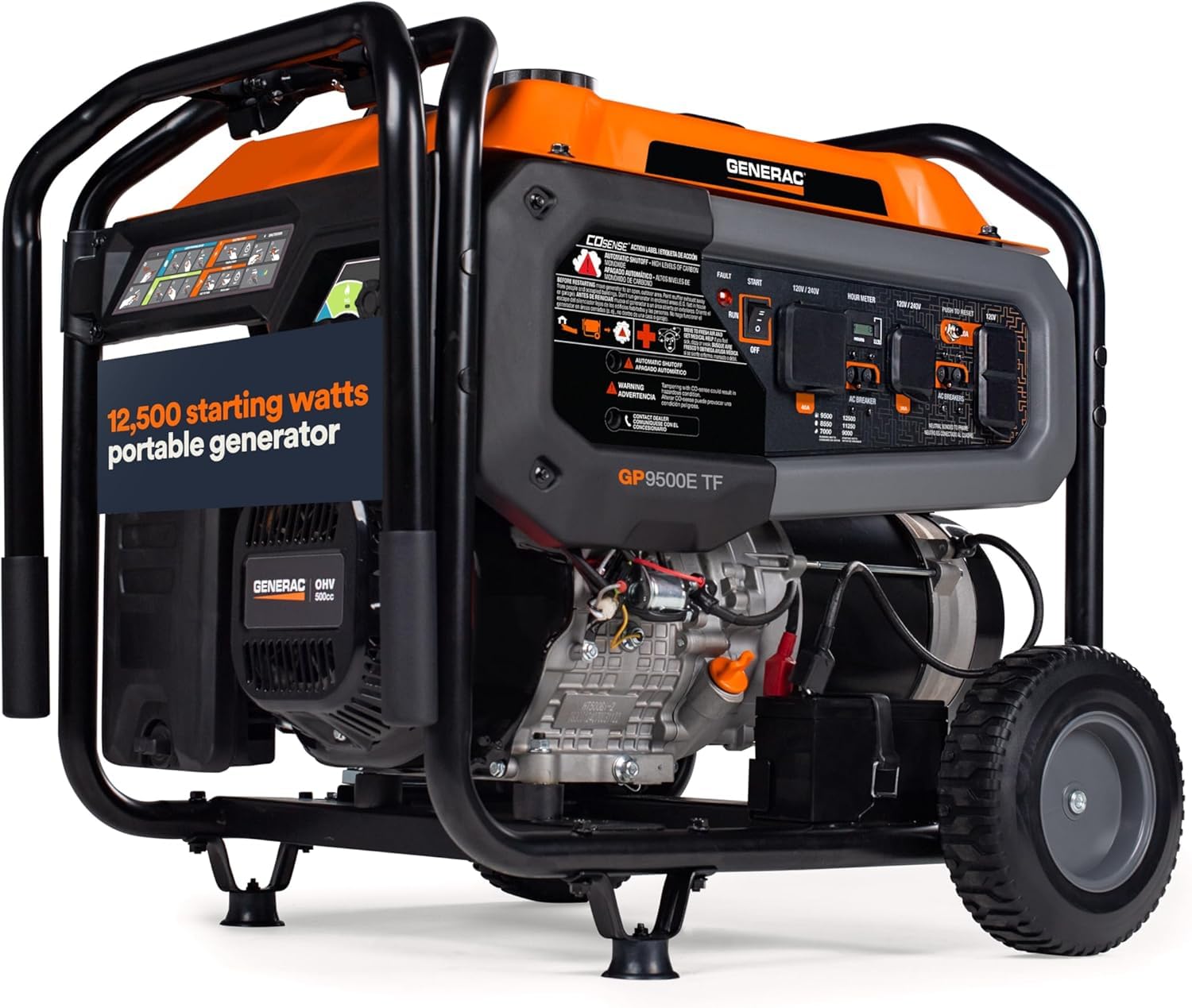
The Generac GP9500 is a tri-fuel portable generator delivering 9,500 running watts and 12,500 starting watts. The 500cc Generac OHV engine with a 7.5-gallon steel fuel tank provides up to 9.5 hours of runtime at 50% load on gasoline. It runs on gasoline, liquid propane, or natural gas, with a simple fuel selector dial for switching between them.
This unit features push-button electric start with a rechargeable battery, eliminating manual pull-cord cranking. The COsense technology continuously monitors CO levels and automatically shuts down the generator if dangerous levels are detected. The rugged steel tube cradle frame and never-flat wheels with a fold-down handle make transport manageable despite the 219-lb weight.
Users report easy assembly, intuitive controls, and reliable operation during real power outages. The unit runs refrigerators, stoves, microwaves, fans, water pumps, and boilers without issue. However, some buyers reported that the natural gas conversion kit is not included, requiring a separate purchase and certified plumber installation. There are also isolated reports of units failing after one month, though most feedback is positive for the price point.
Why it’s great
- Tri-fuel flexibility at a mid-range price
- COsense auto-shutdown for safety
- Easy push-button start with included battery
Good to know
- Natural gas conversion kit not included
- Some units have experienced early failures
6. GENMAX GM10500XiT Tri-Fuel Inverter

The GENMAX GM10500XiT is a tri-fuel open-frame inverter generator with a rated output of 7,800 watts and a peak of 10,500 watts. It features a compact and lightweight design relative to its power class, with a full tank runtime of up to 13.5 hours at 25% load. The engine is designed for fuel efficiency, consuming less than 370 grams of fuel per kilowatt-hour.
This generator supports 2-wire automatic start/stop for integration with solar batteries or ATS systems. The intelligent control panel includes multiple DC outputs, USB ports, a multi-functional digital display, and a CO alarm. It operates on gasoline, propane, and natural gas with one-button, remote, and recoil start options.
Users praise the instant propane starting and quiet operation, noting it’s quieter than comparable units from Champion. However, several buyers report that the generator cannot deliver its full rated continuous power — tests show roughly 6,500W max on gas and 5,800W on propane before voltage drops. The power ratings appear inflated, and surge capacity is insufficient for some loads. It’s a feature-rich inverter at a good price if you don’t need full nameplate power.
Why it’s great
- True inverter with clean power and tri-fuel capability
- 2-wire ATS/solar battery integration ready
- Compact and relatively lightweight for the output class
Good to know
- Power ratings are inflated — expect ~85% of advertised continuous watts
- Surge capacity is insufficient for some motor loads
7. Gidrox GNV Tri-Fuel Inverter

The Gidrox GNV is a tri-fuel inverter generator delivering 11,000 peak watts with pure sine wave technology (<3% THD). Its oversized 8.7-gallon fuel tank provides up to 21 hours of runtime, making it one of the longest-running options in its class. The unit operates at a whisper-quiet 62-65 dBA and includes a CO sensor for safety.
This generator is equipped with a dedicated ATS port for automatic transfer switch integration, a heavy-duty 50A 14-50R outlet for luxury RVs, and a 30A L14-30R 240V outlet for whole-house backup. All outlets have waterproof rubber covers and GFCI protection. The push-button electric start with remote and manual backup ensures reliable power-up.
Early reviews are positive, with users noting easy setup, quiet operation, and thoughtful design features like an oil drain tube and carburetor bowl drain. The tri-fuel hoses are included in the box, which is a significant value-add. Long-term reliability is untested, and the unit is heavy at 258 lbs empty, but for buyers needing extended runtime and fuel flexibility, this is a compelling option backed by a 3-year warranty.
Why it’s great
- 8.7-gallon tank delivers up to 21 hours of runtime
- Tri-fuel with all hoses included in the box
- Quiet operation at 62-65 dBA with full enclosure
Good to know
- Heavy at 258 lbs — transport requires planning
- Long-term reliability data is not yet available
8. GENMAX GM9000iEDC Dual Fuel Inverter

The GENMAX GM9000iEDC is a dual-fuel inverter generator producing 7,600 running watts and 9,000 peak watts from a 458cc 4-stroke OHV engine. The 6.9-gallon fuel tank provides solid runtime, and the generator operates at as low as 62 dBA at 25% load from 23 feet. It features remote and electric start, plus recoil backup.
This unit is parallel-capable, allowing you to connect two GM9000iEDC inverters to double output to 18,000 peak watts and 15,200 running watts. The 5-in-1 digital data center shows hours, voltage, loading, gas fuel meter, and frequency. The CO detection system automatically shuts down the generator when unsafe CO levels are detected, and the low idle mode maximizes fuel efficiency.
Owner feedback is mixed. Many users love the quiet operation and dual-fuel flexibility — it powers RVs with both AC units running and runs food trailers without issues. However, significant quality control problems exist: one user reported the display constantly switching between 120V/240V in 240V mode, and support was unhelpful. The handle pin also broke early for some users. A reliable performer if you get a good unit, but consistency is lacking.
Why it’s great
- Very quiet at 62 dBA with low idle fuel saving mode
- Parallel capable for doubling power output
- Clean inverter power safe for sensitive electronics
Good to know
- Quality control issues reported — display and handle problems
- Customer support experience varies significantly
9. Pulsar PGD95BISCO Dual Fuel Inverter
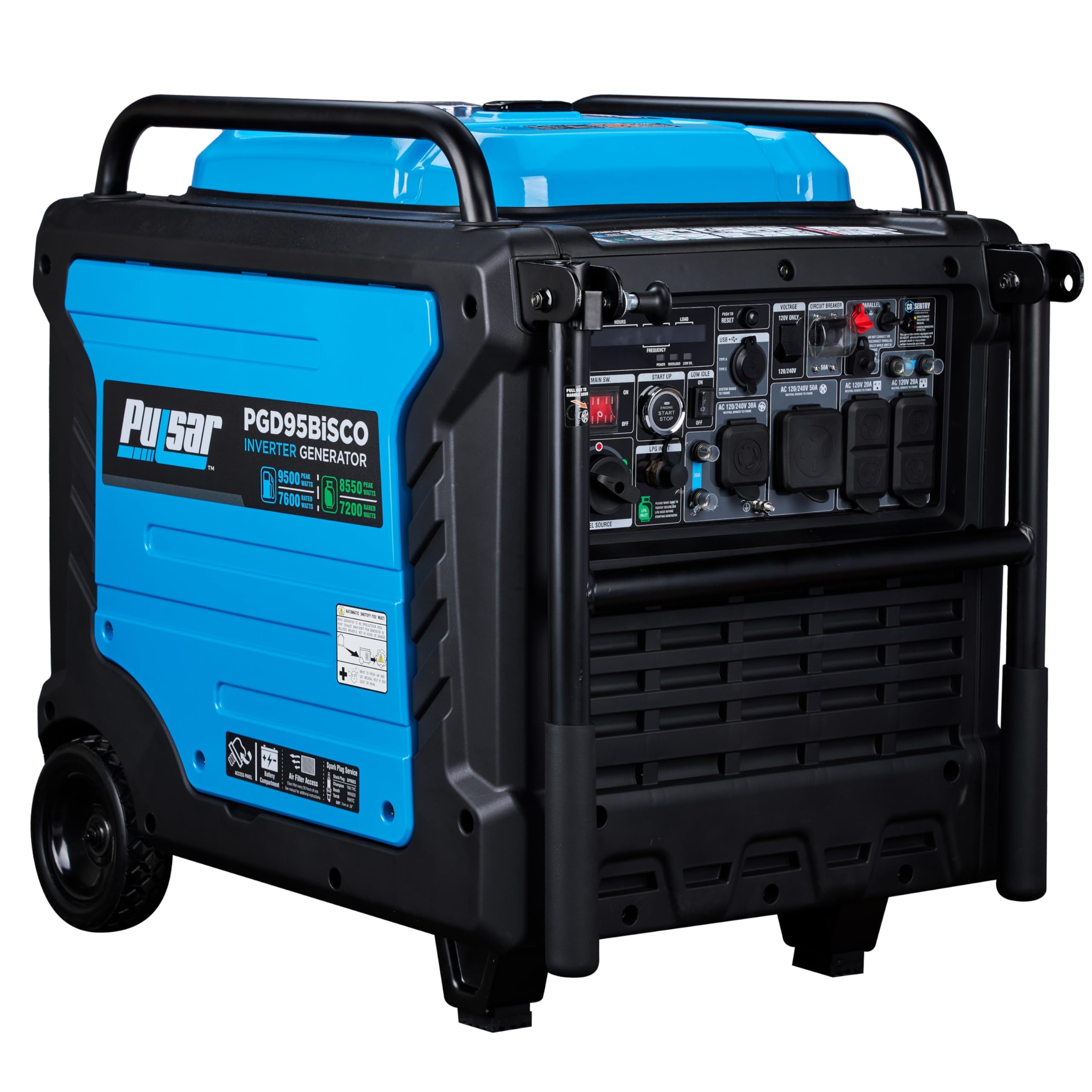
The Pulsar PGD95BISCO is a dual-fuel inverter generator with a super-quiet 62 dBA rating. It delivers 7,600 running watts on gas (9,500 peak) and 7,200 running watts on propane (8,550 peak). The 6.9-gallon fuel tank provides up to 9.5 hours of runtime at half load, and the clean sine wave power is safe for all sensitive electronics.
This generator features a digital control center with Econ Mode, CO sentry for automatic shutdown, and low battery/low oil shutoff. The outlet selection includes a 120/240V 30A and 50A outlet for home backup and RV use. Remote start with key fob and electric start provide convenient operation, and foam-insulated panels help keep noise down.
Users report that this generator is genuinely quiet, with a deeper, less annoying sound than many competitors. Eco mode significantly improves fuel economy — a 20-lb propane tank can last around 12 hours. It has powered entire homes, including well pumps, for weeks during hurricane aftermath, though load management is required for high-draw appliances. However, some users find it louder than advertised, especially in food truck applications, and the 120V-only mode limits the available outlets to roughly 1kW each.
Why it’s great
- Genuinely quiet at 62 dBA with foam-insulated panels
- Eco mode provides excellent fuel economy on propane
- Proven ability to run whole homes during extended outages
Good to know
- 120V-only mode limits each outlet to ~1kW
- Some users report it’s louder than the 62 dBA claim
10. Westinghouse WGen9500DFc Dual Fuel

The Westinghouse WGen9500DFc is a dual-fuel portable generator with 7,500 running watts and 9,500 peak watts on gasoline (6,750 running on propane). The 420cc Westinghouse 4-stroke OHV engine features a long-lasting cast iron sleeve. The 6.6-gallon fuel tank includes a fuel gauge, and electric push-button start with a remote key fob provides convenient operation.
This is a non-inverter generator, meaning THD is higher than inverter models — it’s not recommended for sensitive electronics without additional protection. The control panel features two GFCI 120V 20A household duplex outlets and one L14-30R 120/240V 30A twist-lock outlet with rubber covers. The unit includes CO shutdown and automatic low-oil shutdown for safety.
Users report easy 15-20 minute assembly with included tools and oil, and the generator starts on the first try. It has proven reliable during multi-day outages, powering fridges, fans, and TVs in 100°F+ conditions. Noise is comparable to a lawn mower, and the weight (202 lbs) makes the wheel kit essential. Some units arrived with shipping damage, and a few buyers experienced initial startup issues due to carburetor residue, but overall this is a solid budget-friendly dual-fuel option for those who don’t need inverter clean power.
Why it’s great
- Value-packed dual fuel with remote start at a budget price
- Proven reliable during extended real-world outages
- Cast iron sleeve engine for long engine life
Good to know
- Non-inverter — not safe for sensitive electronics without a conditioner
- Noisy operation comparable to a lawn mower
11. DuroStar DS13000MXT Tri-Fuel
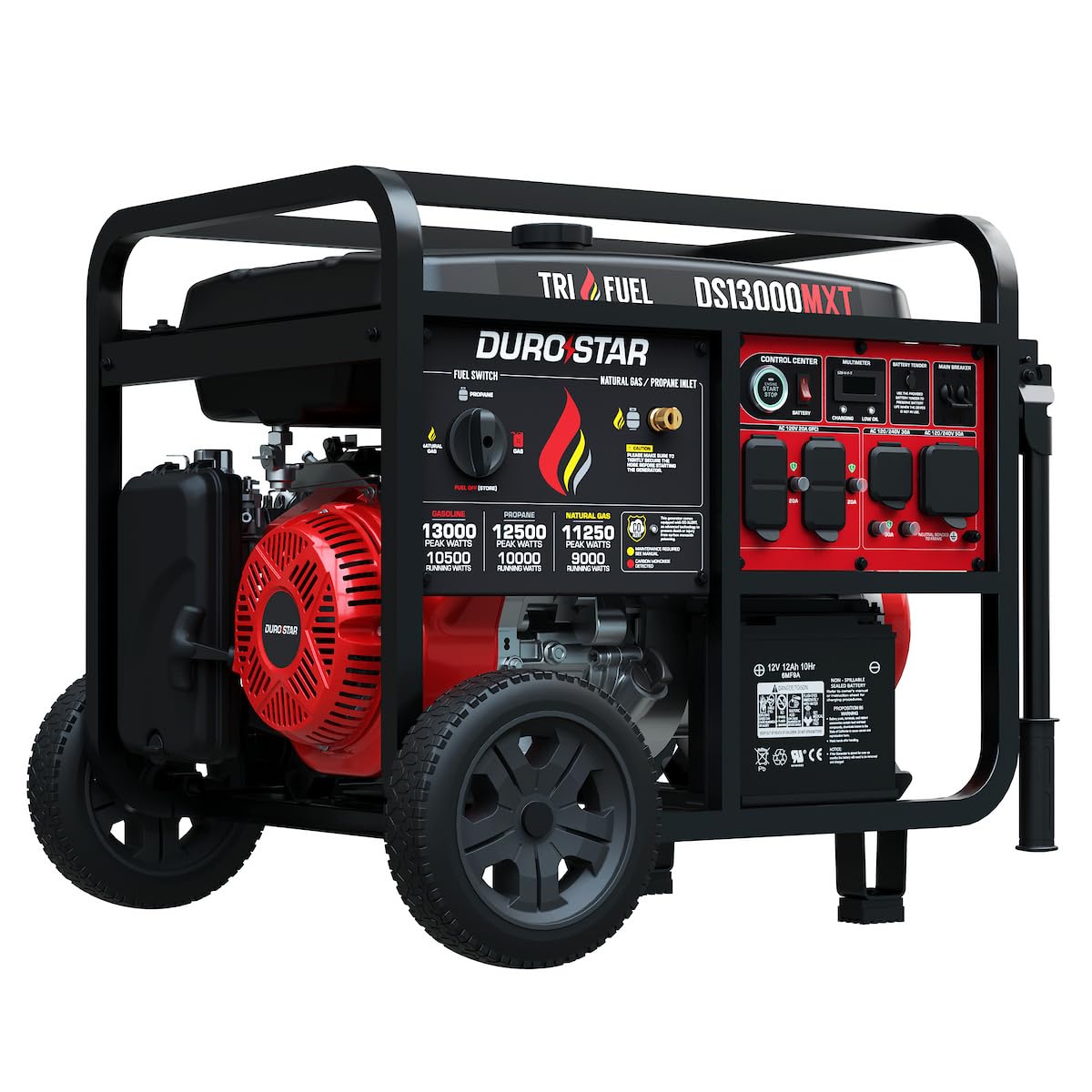
The DuroStar DS13000MXT is a tri-fuel generator with a massive 500cc 4-stroke OHV engine, delivering 13,000 peak watts and 10,000 running watts. It runs on gasoline, propane, and natural gas, with a fuel selection knob for easy switching. The unit includes a push-button electric start, CO Alert auto-shutdown, and a full power panel with a 50A outlet.
This is a non-inverter generator, so THD is higher — it’s best for powering resistive and motor loads like well pumps, AC units, and power tools. The included 15-foot natural gas hose and propane regulator make tri-fuel setup straightforward. The steel frame construction and included wheel kit handle the heavy unit, though it’s one of the heaviest in this comparison.
User reviews are very positive overall. The generator starts easily on both gasoline and propane, and has proven reliable for running food trucks, powering homes for weeks during outages, and handling heavy loads. Assembly is straightforward with the included tool kit. The main complaint is noise level — it’s noticeably loud, which is typical for a non-inverter generator of this size. Oil is not included, so you’ll need to supply your own.
Why it’s great
- Powerful 500cc engine with tri-fuel flexibility
- CO Alert auto-shutdown for safety
- Fast assembly and reliable starting on all fuels
Good to know
- Non-inverter — high THD, not for sensitive electronics
- Very loud during operation
12. DuroMax XP11000iH Dual Fuel Inverter
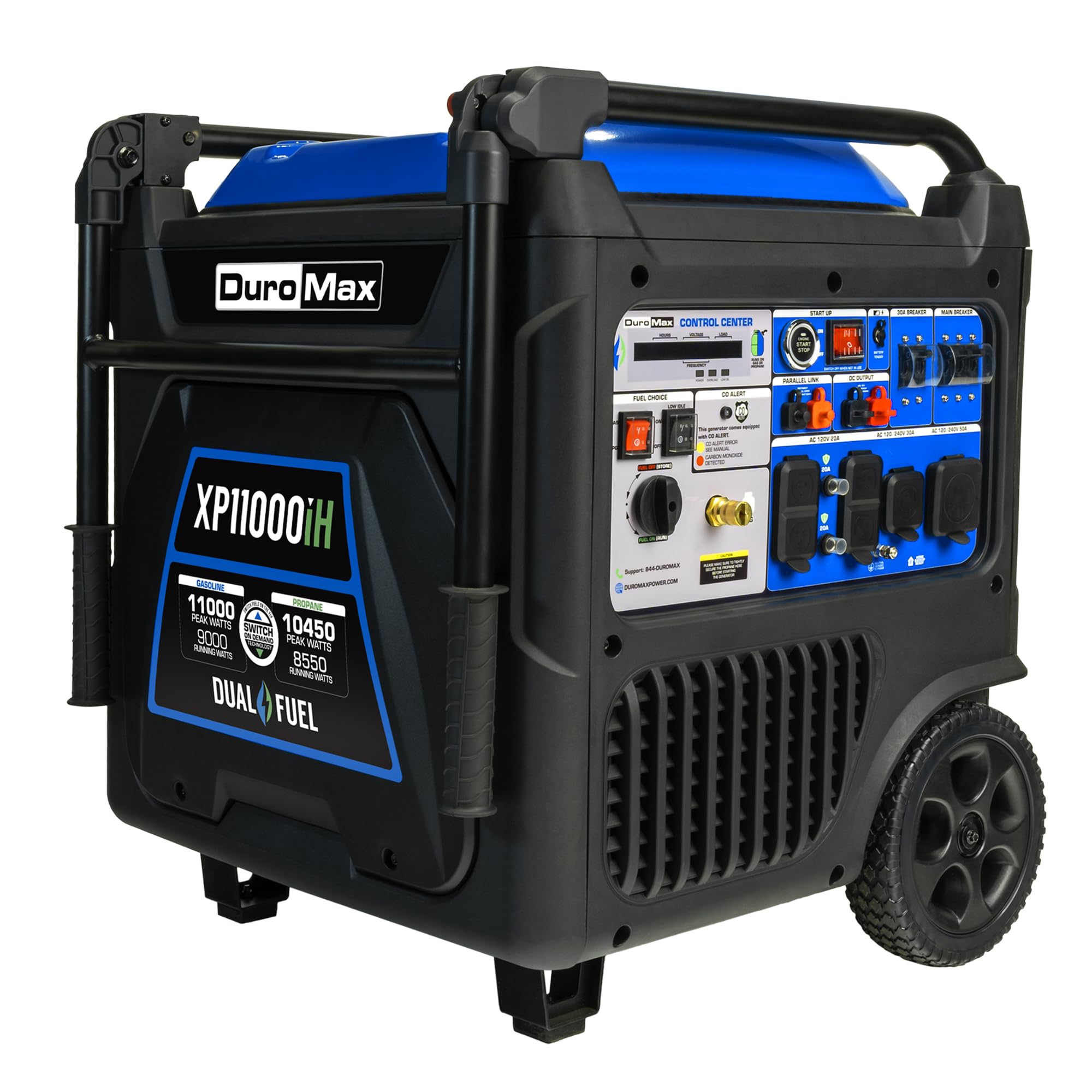
The DuroMax XP11000iH is a dual-fuel inverter generator with 9,000 running watts and 11,000 peak watts. The 459cc engine and 7+ gallon fuel tank provide all-night runtime at moderate loads. It features remote start, a battery tender to keep the start battery charged, and CO Alert auto-shutdown. Parallel capability allows connecting two units for up to 22,000 peak watts.
This generator is EPA and CARB-compliant, so it’s available in all 50 states. The ATS outlet makes connection to a compatible automatic transfer switch straightforward. Inverter technology provides clean, stable power for sensitive electronics including televisions and computers. The digital display shows runtime metrics, and the low oil shutoff protects the engine.
Owners generally praise the power output and quiet operation, noting it’s much quieter and more fuel-efficient than the non-inverter unit it replaced. It powers 50-amp travel trailers with both AC units running and runs all night on a tank of gas. However, there are concerning reports of units that stall under moderate loads (like a coffee maker pulling 3.5kW), and unstable voltage that damaged electronics. The oil dipstick location is also awkward, making changes messy.
Why it’s great
- Clean inverter power with dual fuel flexibility
- Parallel capable for power doubling
- Battery tender keeps the start battery ready
Good to know
- Some units stall under moderate loads or produce unstable voltage
- Oil dipstick location is poorly designed, causing spills
13. DuroMax XP15000HXT Tri-Fuel
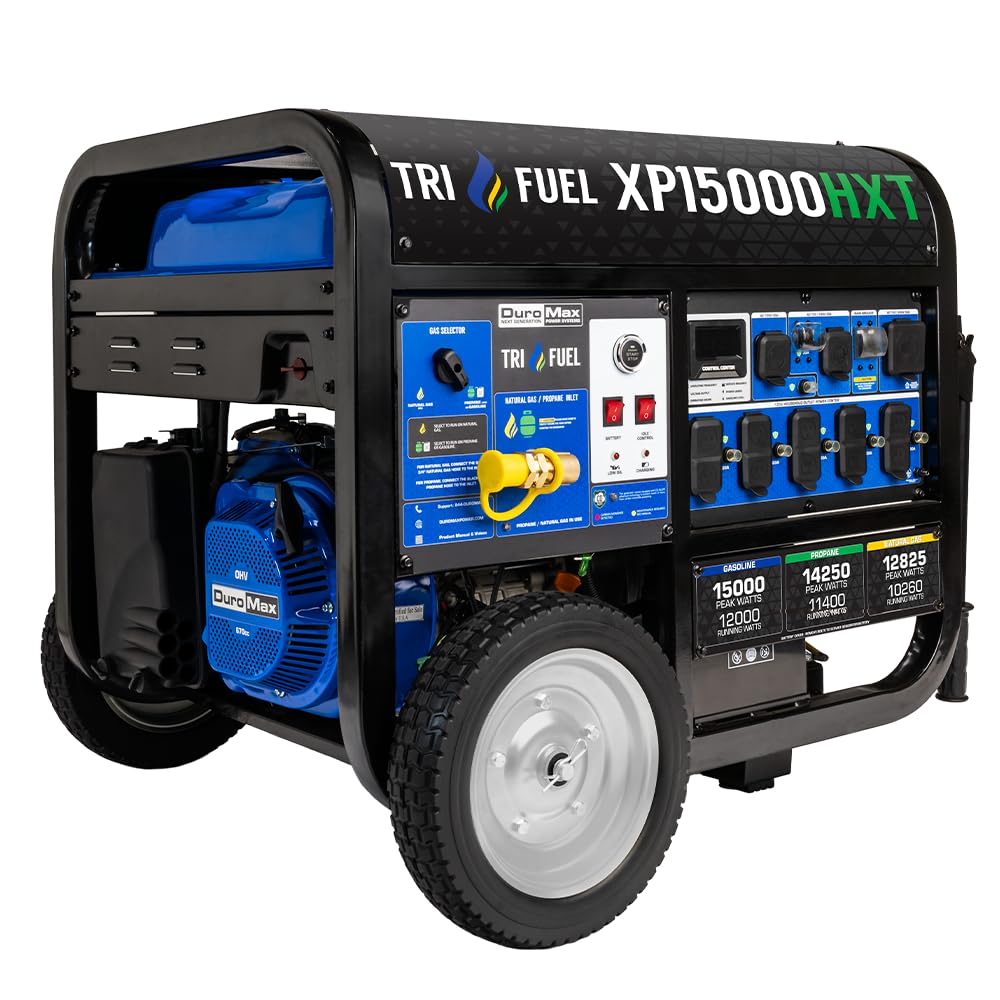
The DuroMax XP15000HXT is a tri-fuel generator with a massive 15,000 peak watts from a 500cc OHV engine (upgraded to 670cc in some versions). It runs on gasoline, propane, and natural gas, with a front-facing interface to change fuel type in seconds. Push-button and remote start provide convenient operation, and the CO Alert auto-shutdown system is included for safety.
This generator features 100% copper windings for superior heat conductivity and extended life. The fully loaded power panel includes four 120V 20A GFCI outlets, a 120V 30A twist-lock, a 120/240V 30A twist-lock, and a 120/240V 50A heavy-duty outlet. The advanced computer interface with a large LED display shows gas gauge, load gauge, voltage, frequency, and runtime.
Users describe this unit as an “absolute tank” that powers medium all-electric homes with ease when paired with a gradual start for HVAC. It runs on natural gas and propane with all hookups included, and the remote starter works well. However, some buyers report the new model has significant design changes that don’t fit older mounts, and breakers trip unexpectedly. One user claims it doesn’t put out the claimed 15,000 watts and is dissatisfied with the changes. At over 400 lbs, this is a stationary backup unit, not a portable one.
Why it’s great
- Immense 15,000W peak power for whole-home backup
- Tri-fuel with natural gas hose included
- 100% copper windings for durability
Good to know
- Non-inverter — not for sensitive electronics
- New model has design changes that may not fit existing mounts
FAQ
Can a 9500-watt inverter generator run a 5-ton central AC unit?
What is the difference between running watts and peak watts?
How long will a 9500-watt inverter generator run on a tank of propane?
Final Thoughts: The Verdict
For most users, the best 9500 watt inverter generator winner is the Westinghouse iGen12000TFc because it delivers true inverter clean power, tri-fuel flexibility, and a 50A outlet for whole-home backup in a well-built, neighborhood-friendly package. If you want the quietest operation with proven reliability, grab the Champion 201407. And for maximum fuel flexibility at a mid-range price, nothing beats the Pulsar PGD105TiSCO.