
A noisy, underpowered 9V supply is the fastest way to ruin a pedalboard’s sound, introducing hum, buzz, and dropouts that no pedal can fix. Relying on a daisy chain for digital delays or high-current drives invites signal degradation that cheap adapters simply cannot filter out.
I’m Min — the co-founder and writer behind Gadgets Feed. I’ve spent hundreds of hours poring over technical specifications, isolating noise floor ratings, current draw limits, and output configurations to separate truly isolated power supplies from merely “labeled” isolated units.
Whether you’re powering two overdrives on a cramped board or ten glitching delays in stereo, choosing the right 9v power supply for guitar pedals determines whether your rig remains dead quiet or buzzes through every performance.
How To Choose The Best 9V Power Supply For Guitar Pedals
Not all adapters labelled “9V” deliver clean, steady power. Selecting the right unit demands a close look at output isolation, current per channel, voltage flexibility, physical footprint, and the quality of the included cabling — factors that directly affect signal integrity and pedalboard layout.
True Isolation vs. Filtered Outputs
Only fully isolated outputs prevent ground loops between pedals. Check for a separate transformer winding per outlet rather than a shared rail with simple filtering. Units marketed as “isolated” sometimes only filter the noise without breaking the ground path, which leaves hum intact.
Current Per Output (mA)
Digital pedals — delays, reverbs, loopers — can pull 200 mA to 500 mA each. A supply offering only 100 mA per port will starve those units. Ensure enough headroom per channel, and look for at least two high-current 500 mA or 300 mA outputs on the unit.
Voltage Versatility: 9V, 12V, 18V
Many modern pedals support 12V or 18V for increased headroom. A supply with switchable or adjustable outputs allows you to run a standard 9V overdrive next to an 18V boost pedal without buying an additional adapter or risking damage from mismatched voltage.
Quick Comparison
On smaller screens, swipe sideways to see the full table.
| Model | Category | Best For | Key Spec | Amazon |
|---|---|---|---|---|
| Voodoo Lab Pedal Power 2 Plus | Premium | Versatile pro board | 8 isolated, 4 switchable 9/12V + sag | Amazon |
| Truetone 1 SPOT PRO CS7 | Premium | Small/medium pedalboards | 7 isolated, 4 switchable 9/12V | Amazon |
| CIOKS DC7 | Premium | High-end, expandable rigs | 7 outlets, 4 selectable voltages each | Amazon |
| Ghost FIRE GP8-SV2 | Mid-Range | Budget-friendly isolation | 8 isolated, 2 adjustable 9-18V + 5V USB | Amazon |
| Donner DP-2 | Mid-Range | Budget-conscious isolation | 10 isolated, 2 high-current 500 mA ports | Amazon |
| Ernie Ball Volt | Mid-Range | Ultra-compact boards | 5 outputs, 300 mA per port | Amazon |
| MXR DC Brick M237 | Mid-Range | Compact value build | 8x9V + 2x18V, short-circuit LEDs | Amazon |
In‑Depth Reviews
1. Voodoo Lab Pedal Power 2 Plus

This stainless-steel workhorse has anchored pro pedalboards for years thanks to its true isolated transformer outputs and voltage flexibility. Four of the eight outputs can be switched between 9V and 12V, and two outputs include a “sag” dip switch emulating a dying battery for vintage fuzz tones. The 1100 mA total capacity easily handles a mix of analog drives and moderate digital effects.
The user reviews consistently highlight how the Pedal Power 2 Plus eliminates hum that cheaper adapters cannot fix, even when running two tube amps in stereo. The included voltage doubler cables let you create an 18V output for high-headroom pedals. Its benchtop form factor is slightly larger than some modern brick-style units, but the mounting bracket makes it simple to secure under a Pedaltrain board.
Critics point to the higher investment compared to entry-level supplies, though the consensus is that the noise floor and reliability justify the cost. The standard PC-style power cord is a welcome upgrade over undersized wall warts, ensuring a secure, grounded connection in any venue.
Why it’s great
- Proven isolated design that kills ground loop hum across multiple digital pedals
- Dip-switch sag feature gives vintage fuzz an authentic dying-battery response
Good to know
- Higher price point than daisy-chain or non-isolated alternatives
- Larger footprint than compact brick-style supplies
2. Truetone 1 SPOT PRO CS7
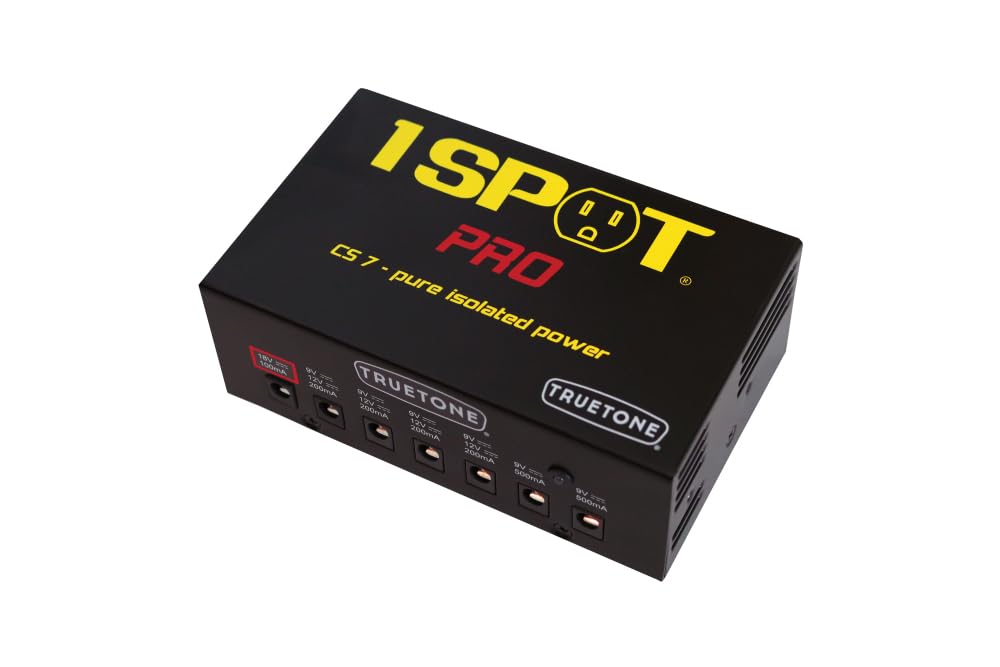
Often called the gold standard for small to medium pedalboards, the CS7 delivers seven fully isolated outputs with four of them switchable between 9V and 12V. Its switch-mode design with multistage filtering keeps noise incredibly low, even when powering digital delays and reverbs alongside high-gain distortion pedals. The unit includes a dedicated 18V output for pedals that require extra headroom.
Reviews from gigging guitarists note that upgrading from a cheap, non-isolated supply to the CS7 solved persistent noise issues that nothing else could fix. The ultra-compact chassis mounts easily under boards like the Pedaltrain Novo or Classic series with the included brackets. Several users reported flawless operation with no hum or interference after months of weekly transport.
A minor criticism is the lack of a built-in on/off switch, though this is easily managed with a power strip or switched IEC cable. Some users also noted that the included patch cables are on the shorter side, so you may need to purchase longer cables for oversized pedal configurations.
Why it’s great
- Switch-mode design delivers ultra-low noise with high efficiency
- Small footprint makes under-board mounting easy on most pedalboards
Good to know
- No built-in on/off switch requires a power strip or external switch
- Included DC cables are relatively short for large boards
3. CIOKS DC7

The CIOKS DC7 redefines what a compact power supply can do, packing seven fully isolated outputs — each individually selectable for 9V, 12V, 15V, or 18V — into a chassis barely wider than a deck of cards. Its 2-stage switch-mode topology with multistage filtering achieves noise levels that rival linear supplies while delivering a combined 48 watts of clean power. This makes it one of the most flexible supplies on the market for hybrid digital/analog rigs.
Musicians who switched from older linear supplies report a dramatic reduction in hum, especially with high-current digital pedals. The DC7 includes twelve Flex cables with right-angle connectors, covering nearly any pedal configuration out of the box. Its expandability via CIOKS Link ports means you can daisy-chain multiple DC7 units for enormous boards without sacrificing isolation.
One notable quirk: the outputs use RCA phono jacks rather than standard 2.1mm barrel connectors, so existing cables or voltage doubler cables are incompatible without adapters. The included Flex cables solve this, but users with proprietary cable sets may need to order replacements. A few buyers noted receiving units that appeared returned due to confusion about the connector type.
Why it’s great
- Per-output voltage selection from 9V to 18V covers any high-headroom pedal
- Expandable design with link ports supports massive boards
Good to know
- RCA-style outputs require special Flex cables — standard barrel plugs won’t fit
- Higher investment than most other 7-output supplies
4. Ghost FIRE GP8-SV2

The Ghost FIRE GP8-SV2 brings true isolated outputs to the budget-friendly market without skimping on features. It offers six dedicated 9V outputs at 500 mA each plus two adjustable voltage outputs (9V, 12V, 15V, or 18V) that can power high-current digital pedals or older 18V units. An additional 5V USB output lets you charge a phone or power an LED strip on your board without stealing a pedal port.
Users repeatedly confirm that this unit eliminates pedal buzz and hum that plagued their earlier daisy-chain setups, even with power-hungry Strymon bigSky and Eventide pedals. The independent short-circuit protection on each channel means a single cable failure won’t take down your entire board — the affected LED shuts off automatically until the fault clears
While most buyers praise its quiet operation and solid build, a few note that the included power brick is not a wall-wart but a separate unit that adds a bit of cable clutter. The form factor is compact enough for most pedalboards, though the overall dimensions are slightly larger than the ultra-compact Ernie Ball Volt or CIOKS DC7.
Why it’s great
- Eight isolated outputs at a price point far below most competitors
- Adjustable voltage channels and USB port increase board flexibility
Good to know
- External power brick adds cable management challenges
- Not as compact as some premium brick-style supplies
5. Donner DP-2

Donner’s DP-2 is a budget-friendly workhorse that packs ten isolated outputs into an aluminum housing small enough for even compact boards. Two of those outputs deliver 500 mA each, enough to power a Line 6 M5 or similar digital multi-effects pedal without sag. The remaining eight outputs run at 100 mA, covering most analog overdrives, distortions, and tuners without issue.
Reviewers consistently describe the noise floor as “extremely low” or “none,” even when powering an 18V Dunlop Slash Wah alongside standard 9V pedals. The inclusion of two polarity reversal cables is a thoughtful touch for vintage pedals that require center-positive connections. Users also appreciate the bright blue LEDs that double as board lighting, though some wish they could be switched off.
A common complaint is the short AC adapter cord, which often requires an extension cord or power strip to reach outlets. Some users also note that while the DP-2 handles moderate use well, its lighter-duty components may not survive the constant vibrations and temperature extremes of heavy touring schedules.
Why it’s great
- Ten isolated outputs for a price that beats most 8-output competitors
- Two 500 mA high-current ports cover digital multi-effects pedals
Good to know
- Short AC adapter cord may require extension or power strip
- Build quality is acceptable for home use but less suited to heavy touring
6. Ernie Ball Volt

The Ernie Ball Volt prioritises ultra-compact dimensions and silent operation, fitting comfortably under even the smallest pedalboards — it is barely taller than an Altoids tin. Despite its tiny footprint, each of its five outputs delivers a substantial 300 mA, enough to power digital delays and reverbs that would choke 100 mA ports. The unit includes a 9V and 18V output for voltage flexibility in a space-conscious design.
Users switching from a daisy-chain One Spot report the Volt completely eliminates bass buzz and ground loop hum, even with high-gain setups. The bright orange LEDs provide clear power status indicators, though some find them overly bright in dark stage environments. The included universal AC adapter comes with interchangeable plugs for Type A, C, G, and I sockets, making it travel-friendly.
The main trade-off is the limited number of outputs — five ports may not suffice for larger boards without daisy-chaining from a single output. The wall wart itself is somewhat bulky for its size, and the short DC cables can make under-board routing tighter than preferred.
Why it’s great
- Extremely compact size fits under any mini pedalboard
- 300 mA per port handles digital pedals that need more current
Good to know
- Only five outputs limit expansion without daisy-chaining
- Wall wart is relatively large and the short cable can be awkward
7. MXR DC Brick M237

The MXR DC Brick M237 is a sturdy, metal-encased power supply that offers eight 9V outputs and two 18V outputs in a compact brick-style design. Each 9V output features a red LED that illuminates in case of a short circuit, providing immediate visual feedback during setup. This unit handles roughly double the power of the original DC Brick, making it suitable for boards with moderate current draws.
Many users report that the DC Brick cleaned up noise and hum that plagued their previous daisy-chain adapters, restoring clarity to their overall sound. Its compact dimensions — roughly 9 x 4 x 2.7 inches — fit neatly under most pedalboards without crowding out patch cables. The all-metal enclosure feels substantially built and roadworthy.
However, the DC Brick does not provide true isolated outputs between channels, meaning ground loops can still occur with certain pedal combinations. It relies on filtered, shared rails, which work well for analog pedals but may leave digital units exposed to noise. Users with high-gain or time-based effects often need to step up to a fully isolated supply to eliminate all hum.
Why it’s great
- Sturdy metal housing and compact size fit under most boards easily
- Short-circuit LEDs simplify troubleshooting on stage
Good to know
- Non-isolated design may allow ground loop hum with digital pedals
- Maximum per-port current is limited for power-hungry units
FAQ
Can I power an 18V pedal from a 9V-only output?
What happens if my total pedal current exceeds the supply’s rating?
Final Thoughts: The Verdict
For most users, the 9v power supply for guitar pedals winner is the Voodoo Lab Pedal Power 2 Plus because it combines proven isolation, flexible voltage options, and pro-level reliability that works for any rig size. If you want a compact, expandable powerhouse for the most demanding digital pedals, grab the CIOKS DC7. And for a truly budget-friendly yet fully isolated setup, nothing beats the Ghost FIRE GP8-SV2.