
Letting your engine run lean under load is the fastest way to melt a piston, yet most car guys still tune by ear or by plug-chop reading. A wideband A/F ratio gauge removes the guesswork by measuring the precise oxygen content in your exhaust stream, translating it into the exact air-fuel mixture your cylinders are seeing in real time. That single data stream separates a reliable, high-horsepower build from a catastrophe waiting to happen.
I’m Min — the co-founder and writer behind Gadgets Feed. I’ve cross-referenced dozens of wideband controller response times, sensor accuracy specs, and data-logging protocols to find the setups that actually deliver trustworthy AFR information at the track and on the dyno.
Whether you are tuning a boosted daily driver, dialing in a race carb, or bringing an old project car back to life, investing in a precise a/f ratio gauge is the single most important diagnostic decision you will make for your engine’s health and performance.
How To Choose The Best A/F Ratio Gauge
The difference between a gauge that saves your engine and one that leaves you stranded comes down to three variables: sensor technology, controller response rate, and data output capability. A good wideband kit is more than a pretty display — it is a measurement system that must be fast enough to catch lean spikes your eyeballs cannot see.
Response Time and Sensor Generation
A wideband controller is only as good as its closed-loop reaction speed. Look for a kit that uses a Bosch LSU 4.9 sensor — the current industry standard — paired with a controller that can update the reading at 20ms or faster. Slower controllers mask transient lean conditions during throttle transitions, giving you false confidence right when you need accuracy most.
Display Type and Data Output
Daylight readability separates usable gauges from dashboard jewelry. Multi-color LED or digital numeric displays with dimming capability work best across varying light conditions. Beyond the face, check for a 0-5V analog output or digital protocol like CAN-bus or RS232 — those outputs let you log wideband data into your tuning software or ECU, turning the gauge into a genuine tuning tool.
Installation Complexity and Mounting
Not all kits arrive ready to weld. Some include a stainless steel bung and detailed wiring harnesses; others require you to source hardware separately. Consider where the control box must be mounted — compact gauge bodies with shallow depth (under one inch) fit cramped pods and custom panels far easier than full-depth units. Pre-calibrated sensors that skip free-air calibration simplify the process significantly for first-time installers.
Quick Comparison
On smaller screens, swipe sideways to see the full table.
| Model | Category | Best For | Key Spec | Amazon |
|---|---|---|---|---|
| AEM 30-0334 X-Series | Premium | FASTEST response with OBD-II logging | 0.825 in. gauge depth; CANbus | Amazon |
| AEM 30-0333 X-Series OBDII | Premium | CAN-bus integration for late-model cars | CAN passthrough; 0-5V output | Amazon |
| Auto Meter 4379 Ultra-Lite | Premium | Traditional analog styling, proven reliability | 0.1 AFR resolution; LSU 4.2 sensor | Amazon |
| Innovate Motorsports DLG-1 | Premium | Dual-bank monitoring for V-config engines | Dual lambda; left & right bank | Amazon |
| GlowShift 7 Color Digital | Mid-Range | Customizable look with complete kit | 7-color display; E85 compatible | Amazon |
| Prosport EVO Wideband | Mid-Range | Slim housing for tight dash locations | 1.5 in. depth; 0-5V logging | Amazon |
| Gledewen 30-0300 | Mid-Range | Budget-friendly with 20ms response claimed | ±1% accuracy; 20ms response | Amazon |
| ZHSYMX Universal Digital | Budget | Lowest entry price for basic AFR monitoring | LSU 4.9 sensor; 52mm housing | Amazon |
| ZHSYMX Upgrade Digital | Budget | Multi-fuel compatibility on a tight budget | Multi-fuel; ABS housing | Amazon |
In‑Depth Reviews
1. AEM 30-0334 X-Series Wideband UEGO AFR Sensor Controller

The AEM X-Series 30-0334 uses patented X-Digital wideband technology that an independent test ranked as the fastest responding controller against 17 competitors. That speed matters when you are tuning near the edge — catching a lean spike before it becomes a knock event is exactly what this gauge is built for. It uses a Bosch LSU 4.9 sensor and ships with a factory-calibrated resistor so you never have to perform free-air calibration unless you choose to later.
The data output options are where this kit separates itself from the mid-range field. Alongside the standard 0-5V analog output, you get RS232 serial and AEMnet CANbus connectivity for direct integration with ECUs, data loggers, and even daisy-chaining up to 16 cylinders across multiple controllers. The gauge body itself is astonishingly shallow at just 0.825 inches deep, making it one of the easiest widebands to fit into a tight gauge pod or custom dash panel.
On the display side, it reads AFR values in hundredths of a percent, giving you finer resolution than the tenth-point increments common at this price tier. The 52mm diameter fits standard pods, and the machined exterior gives it a quality feel that justifies its premium positioning. For anyone serious about tuning with HP Tuners, DiabloSport, or a standalone ECU, this is the benchmark.
Why it’s great
- Class-leading response time in independent testing
- Five data outputs (0-5V, RS232, CANbus) for advanced logging
- Ultra-slim 0.825-inch depth for tight installations
- Factory pre-calibrated — no free-air step needed
Good to know
- CANbus output requires pro-level tuning software to access
- Premium price reflects professional-grade features
2. AEM 30-0333 X-Series Wideband UEGO with OBDII Connectivity

The 30-0333 variant of the AEM X-Series adds direct OBD-II passthrough capability, which means it can inject AFR data directly into the factory ECU CAN-bus network on vehicles from approximately 2008 and newer. For tuners using HP Tuners, DiabloSport, or any open-source software that reads CAN datastreams, this eliminates the need for separate analog wiring and ground-offset compensation. The response remains as fast as the 30-0334 — the controller hardware is identical.
Installation is straightforward: wire the sensor into the exhaust bung, connect switched power and ground, and splice into the OBD-II CAN wires. The gauge reads AFR values in hundredths with the same 0-5V analog backup output, so even if your logging software cannot accept CAN data, you still have a fallback. Reviewers consistently confirm that it works seamlessly with modern Chargers, Mustangs, and late-model GM platforms running custom tunes.
The one catch is that this unit is designed specifically for CAN-bus vehicles — older 1990s and early 2000s cars using serial data protocols will need the 30-0334 instead. If your build is a 2013 or newer street car that you plan to tune via the OBD port, this is the correct choice. The gauge cup depth is only 0.2 inches, so it sits nearly flush in a pod.
Why it’s great
- Direct CAN-bus integration for late-model OBD-II tuning
- Fastest response time in its class
- Analog 0-5V backup for legacy logger compatibility
- Ultra-flush gauge cup installation
Good to know
- Not compatible with pre-2008 serial-data vehicles without pin swapping
- Requires pro-level HP Tuners or similar software for CAN logging
3. Auto Meter 4379 Ultra-Lite Wide Band Air Fuel Ratio Kit

Auto Meter has been the standard-bearer for aftermarket gauges for decades, and the 4379 Ultra-Lite kit brings that heritage into the wideband world. It uses a Bosch LSU 4.2 sensor — the predecessor to the 4.9 — paired with a controller that delivers 0.1 AFR resolution and a 0-4V linear data output. The gauge face uses a digital segment display with an LED bar graph sweep, giving you both numeric precision and quick-glance pattern recognition.
The kit is impressively complete right out of the box: you get the sensor, an 8-foot wiring harness, a 304 stainless steel weld-in bung, and all mounting hardware. This is the kit you want if you are building a classic muscle car or a street rod and prefer the look of a traditional round gauge with an LED radial sweep rather than a fully digital screen. Reviewers consistently report that the readings match dyno results and that the gauge has held up for years in daily-driven project cars.
The trade-off is that the LSU 4.2 sensor is one generation behind the 4.9. While it is still a perfectly capable wideband sensor for naturally aspirated and moderately boosted applications, the controller response may not be as instantaneous as the AEM X-Series when chasing high-RPM transients. The 2.3125-inch diameter is also slightly larger than the standard 52mm pod size, so confirm your pod fitment before ordering.
Why it’s great
- Proven reliability with decades of Auto Meter engineering
- Complete kit with bung, harness, and detailed instructions
- 0-4V analog output for ECU or data logger integration
- LED bar graph and numeric display for dual readability
Good to know
- Uses older LSU 4.2 sensor instead of current 4.9
- 2.3125-inch diameter may not fit standard 52mm pods
4. Innovate Motorsports DLG-1 Dual Lambda Oxygen Gauge Kit

The Innovate DLG-1 solves a problem that most wideband kits ignore: monitoring both exhaust banks of a V-engine on a single gauge. Instead of buying two separate kits and splitting your visual attention, the DLG-1 displays left- and right-bank AFR simultaneously on one screen. For anyone tuning a V8 with independent fuel trims per bank — common on carbureted setups with dual-plane manifolds or late-model EFI — this is a massive time saver.
Beyond the dual-bank capability, the DLG-1 is compatible with leaded fuel, unleaded, diesel, E85, and more, making it a true multi-fuel diagnostic tool. The sensor response is instantaneous, and the included software allows you to log and compare bank-to-bank behavior on a laptop. Many users mount the unit in a portable ammo-can case and use it as a rolling diagnostic station for tuning multiple vehicles.
The downside: the DLG-1 requires two separate wideband controllers (LC-2 modules sold separately or included depending on the kit version) and proper 12V supply wiring — a low-amp connection can trigger E9 error codes. The gauge body is physically larger than a standard 52mm unit, so plan your mounting location carefully. For serious dual-bank tuning, however, no single-gauge solution is more capable.
Why it’s great
- Displays both exhaust banks on one screen
- Works with leaded, unleaded, diesel, ethanol, and E85
- Logging software for bank-to-bank comparison
- Instantaneous sensor response
Good to know
- Requires two LC-2 controllers for full dual operation
- Larger gauge body may not fit standard pods
5. GlowShift Black 7 Color Digital Wideband AFR Gauge Kit

GlowShift’s 7 Color Series wideband kit puts a strong emphasis on dashboard aesthetics without cutting corners on the sensor side. The gauge reads gasoline AFR from 10.00 to 20.00 and E85 from 6.00 to 12.00, which means it directly supports flex-fuel tuning. The display offers seven solid color modes and two cycling modes to match factory lighting or just add a custom look, with a dimmer wire that cuts brightness by 30 percent when the headlights are on.
The kit is shockingly complete: it includes a Bosch 4.9 LSU wideband sensor, weld-in bung, control box, 10-foot sensor harness, 7-foot gauge-to-box harness, 5-foot power harness, a 3-foot data logging wire, gauge visor, and mounting bracket. That is everything you need for a clean install. GlowShift backs it with a one-year warranty, free lifetime tech support, and a 30-day return policy — support that matters if you are new to wideband installation.
The main complaints from long-term users center on longevity. Some owners report the gauge freezing at a fixed reading (usually 14.7 AFR) or failing to power up after a couple of years. The response time is adequate for steady-state tuning but may lag during rapid throttle transitions compared to the AEM or Auto Meter units. For a weekend tuner who wants a great-looking, complete kit at a reasonable price, this is a solid contender.
Why it’s great
- Seven customizable display colors for interior matching
- Includes everything for a full installation
- E85 fuel range supported alongside gasoline
- Strong warranty and lifetime technical support
Good to know
- Some units report freezing or failure after extended use
- Not as responsive as premium-tier controllers
6. Prosport EVO Wideband Digital Air Fuel Ratio Gauge 52mm

The Prosport EVO Series solves a physical installation problem that many wideband kits ignore: gauge depth. At just 1.5 inches deep including the mounting studs, this is one of the slimmest full-featured wideband gauges available, making it the go-to choice for cramped gauge pods, shallow dash panels, and a-pillar mounts where every millimeter counts. The blackout face hides the display completely when the ignition is off, giving the cabin a clean, uncluttered appearance.
Inside, the kit uses a Bosch LSU 4.9 sensor with a 10.0:1 to 20.0:1 AFR display range, a selectable blue or red digital readout, and a 270-degree sweep LED bar graph for quick-glance monitoring. It also provides a 0-5 volt data logging output, so you can feed AFR data into your tuning software or standalone ECU. The complete package includes the sensor, bung, wiring harnesses, and instructions — nothing else to buy.
The trade-off for the slim housing is that the display can be hard to read in direct sunlight, as several reviewers note. The bar graph LEDs are bright at night but wash out during daylight hours, so position the gauge where it is shaded if your car sees a lot of sun. For tuners prioritizing a clean interior fit and a brand with a solid track record, the Prosport EVO delivers on the mechanical side.
Why it’s great
- Exceptionally slim 1.5-inch depth for tight mounting
- Blackout face for a clean off-state look
- Includes Bosch LSU 4.9 sensor and full wiring kit
- 0-5V analog output for data logging
Good to know
- Daylight visibility is poor in direct sun
- Selectable display limited to blue or red
7. Gledewen 30-0300 Wideband UGEO AFR Gauge 52mm

The Gledewen 30-0300 punches well above its price bracket with a 20ms typical response time and a claimed ±1 percent measurement accuracy — numbers that sit much closer to premium kits than budget ones. The gauge face features a 24-color sweeping LED display and a four-digit central readout, and it can toggle between AFR, lambda, and oxygen percentage display modes at the push of a button. The faceplate is reversible and two-sided, giving you two visual styles in one box.
It uses a Bosch LSU 4.9 UEGO sensor, and the controller supports two calibration methods: a factory trim resistor mode (rCAL) that requires no user action, or a free-air mode (ACAL) for those who prefer to calibrate manually as the sensor ages. The included sensor connector carries the trim resistor, so most users can install the kit without ever thinking about calibration. The measuring range spans 0.55 to 2.00 lambda, covering everything from rich cruise to full-lean decel.
The reliability reviews are mixed — while many owners report trouble-free use on Honda Civics, four-wheelers, and carbureted muscle cars, a small but notable number of buyers have received units that jump erratically or fail to output a voltage signal. Gledewen offers a 12-month replacement or refund warranty, but the quality control variance means you may need that warranty. For the price, the performance when it works is genuinely impressive.
Why it’s great
- 20ms response time rivals premium kits at half the price
- Dual calibration modes (rCAL and ACAL) for flexibility
- Reversible faceplate with three display modes
- 12-month replacement warranty included
Good to know
- Inconsistent quality control across units
- Plastic housing feels less durable than metal-bodied gauges
8. ZHSYMX Universal Digital Wideband AFR Gauge Kit
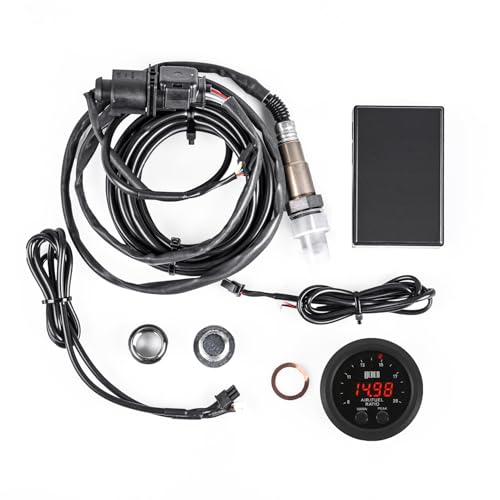
ZHSYMX’s entry-level wideband bundle offers the lowest barrier to entry for anyone who wants to get an AFR reading without spending heavily. It includes a 52mm gauge, a Bosch-compatible LSU 4.9 sensor, and a controller box — all for a price that undercuts most name-brand kits by a wide margin. The sensor is installed downstream of the three-way catalyst, which is the correct position for post-cat monitoring, and it supports system voltages up to 16V.
Several buyers report that the kit works straight out of the box on project cars ranging from a 1964 Plymouth to late-model swaps, and that the initial AFR readings are consistent with what they expect from the build. The gauge reads out in numeric AFR format and provides real-time feedback during idle and cruise tuning. For a carbureted street car where you just want to confirm you are not dangerously lean, this kit does the job.
The catch is that response time is reportedly very slow — some measurements suggest a 2-3 second lag, which means transient lean spikes during aggressive throttle stabs will go completely undetected. The included instructions are minimal, and the unit has no data logging output, so you cannot feed the signal into an ECU or tuning software. If your tuning needs are limited to steady-state idle and cruise adjustments, it works. For any real performance tuning, save for a faster controller.
Why it’s great
- Lowest price entry point for wideband AFR monitoring
- Includes LSU 4.9 sensor and controller box
- Works out of the box on many classic car projects
- 52mm standard size fits most pods
Good to know
- Very slow response — 2-3 second lag reported
- No data logging output or ECU integration
9. ZHSYMX Upgrade Digital Wideband AFR Gauge Kit
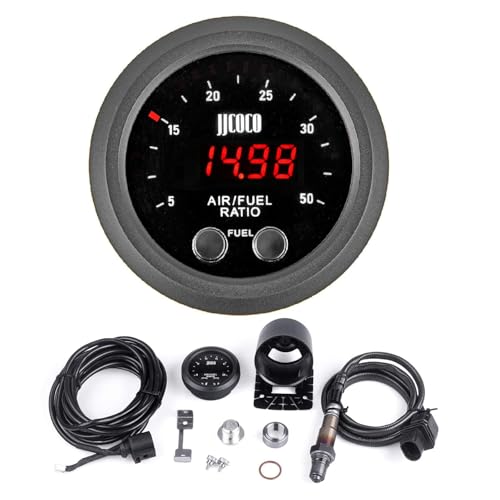
The second ZHSYMX kit in the lineup differentiates itself with multi-fuel compatibility — it officially supports gasoline, diesel, methanol, ethanol, E85, propane, methane, and hydrogen. That fuel flexibility is rare at any price point, let alone at this entry-level cost. The gauge uses the same 52mm form factor and LSU 4.9 sensor as the base model, with a housing made of ABS plastic to keep weight down to 1.4 pounds.
Reviewers who successfully installed it on carbureted engines like a Holley Sniper system report that the gauge reads accurately during initial tuning and helps dial in the mixture for both idle and cruise circuits. The kit comes with pre-wired connectors in the loom, which simplifies the electrical side of the install for beginners. The included gauge pod is functional but cheap — most owners discard it and mount the gauge directly into their dash or aftermarket panel.
Long-term reliability is the main concern here. Several owners report the wideband sensor failing after a few days of use, with the gauge locking at a fixed 20.00 AFR reading instead of displaying the expected 14.7 at idle. The 1-year warranty offers some protection, but the failure pattern suggests the sensor quality is inconsistent. For the price, it is a gamble; if you need a disposable tuning tool for a short-term project, it may serve, but for a permanent installation, upgrading to the mid-range options is safer.
Why it’s great
- Supports multiple fuel types including E85 and diesel
- Complete kit with pre-wired connectors for easy install
- Very low price point for multi-fuel capability
Good to know
- Sensor failure reported in some units after short use
- ABS plastic housing and included pod feel low-grade
FAQ
Can I use a wideband AFR gauge with a carbureted engine?
What is the difference between narrowband and wideband O2 sensors?
Where should I weld the O2 sensor bung in the exhaust?
Do wideband AFR gauges work with E85 or methanol fuel?
Final Thoughts: The Verdict
For most users, the a/f ratio gauge winner is the AEM 30-0334 X-Series because it delivers the fastest response time, the most data output options, and the slimmest gauge depth in a single package — everything a serious tuner needs. If you want direct OBD-II CANbus integration for a late-model car, grab the AEM 30-0333. And for dual-bank V-engine monitoring, nothing beats the Innovate Motorsports DLG-1.