
Dropping thousands on speakers only to have them sound thin, muddy, or disconnected is the most expensive mistake in home theater. An A/V receiver isn’t just a box that switches inputs — it’s the brain that decodes object-based audio, manages room acoustics, and feeds clean wattage to every driver. Choosing the wrong one means your Dolby Atmos height channels whisper instead of envelop, and your center channel buries dialogue under explosions.
I’m Min — the co-founder and writer behind Gadgets Feed. I’ve spent hundreds of hours cross-referencing channel configurations, HDMI 2.1 bandwidth specs, room-correction algorithms, and real-owner feedback to separate receivers that truly deliver from those that just look good on a spec sheet.
This guide digs into the specific trade-offs between THX certification, Dirac Live calibration, and multi-zone streaming so you can confidently pick the best a/v receivers for your exact setup and budget.
How To Choose The Best A/V Receivers
Picking an AVR comes down to matching its channel count, video pipeline, and room correction to your specific speakers, TV, and room size. Here are the three factors that matter most.
Channel Count and Speaker Configuration
The number before the decimal tells you how many amplifier channels are on board — 7.2 means seven amp channels and two subwoofer outputs. That supports a 5.1.2 layout (five ear-level speakers, one sub, two height channels) or a traditional 7.1 without heights. A 9.2 receiver like the Onkyo TX-RZ50 unlocks 5.1.4 or 7.1.2, giving you four overhead speakers for more precise Atmos bubble effects. If you plan to run a full 7.1.4 setup, you’ll need either a 9-channel AVR plus an external two-channel amp or an 11-channel flagship.
HDMI 2.1 Bandwidth and Gaming Features
Not all HDMI 2.1 ports are equal. Full 40 Gbps or 48 Gbps bandwidth enables uncompressed 4K/120Hz and 8K/60Hz with HDR, Variable Refresh Rate (VRR), and Auto Low Latency Mode (ALLM) for zero screen tearing. Some receivers advertise “HDMI 2.1” but are capped at 24 Gbps, which can cause black screens or reduced chroma with Xbox Series X or high-end PC graphics cards. Verify that at least two or three inputs support the full spec if next-gen gaming is part of your plan.
Room Correction and Auto-Calibration
Room correction is the single biggest differentiator in sound quality between receivers at the same power rating. Basic systems like YPAO (Yamaha) and AccuEQ (Onkyo) handle distance and level trimming. Mid-tier solutions like Audyssey MultEQ (Denon) and DCAC IX (Sony) add frequency-domain filtering. Premium options like Dirac Live (Onkyo TX-RZ50) let you create custom target curves and correct impulse response for a noticeable jump in imaging and bass tightness — especially in rooms with problematic reflections or irregular shapes.
Quick Comparison
On smaller screens, swipe sideways to see the full table.
| Model | Category | Best For | Key Spec | Amazon |
|---|---|---|---|---|
| Onkyo TX-RZ50 | Premium | Dirac Live room correction | 9.2 ch with Dirac Live | Amazon |
| Yamaha RX-A4A | Premium | Surround:AI adaptive audio | 7.2 ch, 100W, Surround:AI | Amazon |
| Sony STRAZ1000ES | Premium | 360 Spatial Sound Mapping | 7.2 ch, 100W, DCAC IX | Amazon |
| Denon AVR-S970H | Mid-Range | 90W/ch power and HEOS multi-room | 7.2 ch, 90W, HEOS, phono | Amazon |
| JBL MA7100HP | Premium | High-power Class D amplification | 7.2 ch, 125W, Class D | Amazon |
| Sony STR-AN1000 | Mid-Range | Sony 360 Spatial Sound Mapping | 7.2 ch, 165W (6 ohms) | Amazon |
| Denon AVR-S770H | Mid-Range | Best entry-level HDMI 2.1 with HEOS | 7.2 ch, 75W, HEOS, Dolby Vision | Amazon |
| Onkyo TX-NR6100 | Mid-Range | THX Select Certified gaming hub | 7.2 ch, THX Select, 8K/40Gbps | Amazon |
| Yamaha RX-V6A | Mid-Range | MusicCast multi-room streaming | 7.2 ch, YPAO R.S.C., eARC | Amazon |
| JBL MA710 | Mid-Range | White finish with phono input | 7.2 ch, 110W, phono input | Amazon |
| Pioneer VSX-935 | Budget | Entry-level 8K with Dolby Atmos Virtualization | 7.2 ch, 8K, Bluetooth 2-way | Amazon |
In‑Depth Reviews
1. Onkyo TX-RZ50 9.2-Channel AV Receiver

The TX-RZ50 is the sweet spot where premium features meet reasonable spend. Its 9.2 channels support 5.1.4 or 7.1.2 layouts, and the included Dirac Live calibration — a system normally found in units costing significantly more — delivers genuinely measurable imaging improvements over basic EQ. Owners report that Dirac Live’s impulse-response correction tightens bass and cleans up midrange comb-filtering in irregular rooms.
THX Select certification ensures consistent power delivery across all channels, and the 40 Gbps HDMI 2.1 inputs handle 4K/120Hz VRR gaming without signal drops. The Klipsch Optimize Mode automatically sets crossovers for Reference-series speakers, removing guesswork. Dual subwoofer outputs are not independently EQ’d, but Dirac Live’s multi-sub target curve management handles phase alignment manually.
The included calibration mic works with the free Dirac Live smartphone app for quick measurement, while the desktop app allows full-bandwidth correction curves for advanced users. A few owners note that HDMI switching takes 12–15 seconds, and the Onkyo Controller app lacks deep Zone 2 HDMI routing. Still, for anyone building a 7.1.4 system, this receiver outperforms many near the top tier.
Why it’s great
- Dirac Live included out of box — no extra license cost
- 9.2 channels unlock 5.1.4 Atmos layouts
- THX Select Certified for reliable power across all channels
Good to know
- HDMI handshake can take over 10 seconds
- Dual sub outputs are not independently configurable
- Printed manual not included
2. Yamaha RX-A4A AVENTAGE 7.2-Channel AV Receiver

Yamaha’s AVENTAGE line separates itself through build quality and proprietary audio processing. The RX-A4A features Surround:AI, which analyzes audio scenes in real-time and adjusts dialogue presence, surround panning, and low-frequency emphasis without manual intervention. Owners describe it as making action sequences feel more expansive while keeping vocal clarity intact without needing to boost the center channel.
All seven HDMI inputs support 8K60 and 4K120 at 40 Gbps, and YPAO R.S.C. with 3D multipoint measurement generates precision EQ filters for up to eight listening positions. The Auro-3D decoding adds a third spatial dimension beyond Atmos and DTS:X, useful for music mixes encoded in the Auro-3D format. Pre-outs for all channels allow external amplification for front left, right, and center if your speaker sensitivity demands more current.
MusicCast multi-room streaming is among the most reliable ecosystems tested — it stays connected across Wi-Fi interruptions and handles 24-bit/192 kHz FLAC without dropouts. The setup process, however, requires a USB drive for firmware updates, and the initial on-screen menus can overwhelm new users with too many sub-pages. Once calibrated, the RX-A4A runs stable and quiet, with no audible fan noise even under sustained load.
Why it’s great
- Surround:AI dynamically optimizes audio per scene
- Full pre-outs for all channels enable external amp upgrades
- Auro-3D decoding included alongside Atmos and DTS:X
Good to know
- Firmware updates require a USB flash drive
- Setup menus are dense and non-intuitive
- No front-panel HDMI input
3. Sony STRAZ1000ES Premium ES 7.2 CH 8K A/V Receiver

Sony’s ES series targets the custom-install and serious enthusiast market with robust build quality and exclusive DSP algorithms. The STRAZ1000ES uses 360 Spatial Sound Mapping, which synthesizes phantom height and surround speakers from a smaller physical layout — owners have reported that a 5.1.2 setup with this receiver convincingly mimics a 7.1.4 configuration, especially in the vertical plane where Atmos effects rain overhead.
Digital Cinema Auto Calibration IX handles distance, level, and EQ with a supplied mic and includes a manual target-curve editor for experienced users. The receiver supports Dolby Vision, HDR10, HLG, and IMAX Enhanced on all HDMI 2.1 inputs, and the backlit remote with front cover plate gives a clean, pro-install look. Custom integrators benefit from IP control and web-based setup pages that bypass the on-screen GUI entirely.
The main trade-off is the lack of HDR10+ support, which affects compatibility with certain Samsung and Panasonic panels. Owners also recommend pairing it with active cooling — the chassis runs warm under extended high-volume use. The DAC section reveals detail in good recordings but can expose harshness in poorly mastered tracks. For Sony TV owners, the S-Center sync feature pipes dialogue directly through the TV’s speaker as a phantom center channel.
Why it’s great
- 360 Spatial Sound Mapping creates convincing height effects from fewer speakers
- Full IP control and web GUI for custom installation
- Backlit remote and removable front cover for professional rack integration
Good to know
- No HDR10+ support
- Runs hot — active cooling recommended for closed cabinets
- Not a massive 11.2 channel upgrade path without external amps
4. Denon AVR-S970H 8K Ultra HD 7.2 Channel AV Receiver

The AVR-S970H sits just above the entry-level S770H, offering 90W per channel versus 75W, plus a phono input for turntable users and an extra set of HDMI inputs. Owners consistently praise its 90W rating for driving floor-standing speakers like Polk ES60s and Klipsch RP-series to satisfying cinema levels without audible strain. The built-in HEOS platform supports Spotify, TIDAL, and Amazon Music HD, and works reliably across Wi-Fi with multi-room Denon Home speakers.
Audyssey MultEQ room correction handles distance and frequency correction across six measurement positions, cleaning up room-mode bumps in the low end. The receiver supports Dolby Atmos Height Virtualization for 5.1 or 7.1 setups without ceiling speakers — a useful bridging feature if you plan to add heights later. Three of the six HDMI inputs support 8K/60Hz and 4K/120Hz with VRR, ALLM, and QFT, making it a solid partner for both PS5 and Xbox Series X.
Zone 2 operation reduces the main zone to 5.1 channels, so you lose rear-surround or height channels when feeding a second room. Some owners report that the HEOS app occasionally blocks Bluetooth headphone pairing when streaming from within the app. The on-screen Audyssey calibration is straightforward, but the lack of a printed manual frustrates first-time users. Still, the combination of power, HEOS, and phono input at this level is rare.
Why it’s great
- 90W per channel provides headroom for less sensitive tower speakers
- Built-in phono input eliminates need for external preamp
- HEOS multi-room streaming with high-res audio support
Good to know
- Zone 2 operation reduces main zone to 5.1 channels
- HEOS app blocks Bluetooth when streaming from within the app
- No printed manual included
5. JBL MA7100HP 7.2 Channel High Performance AV Receiver
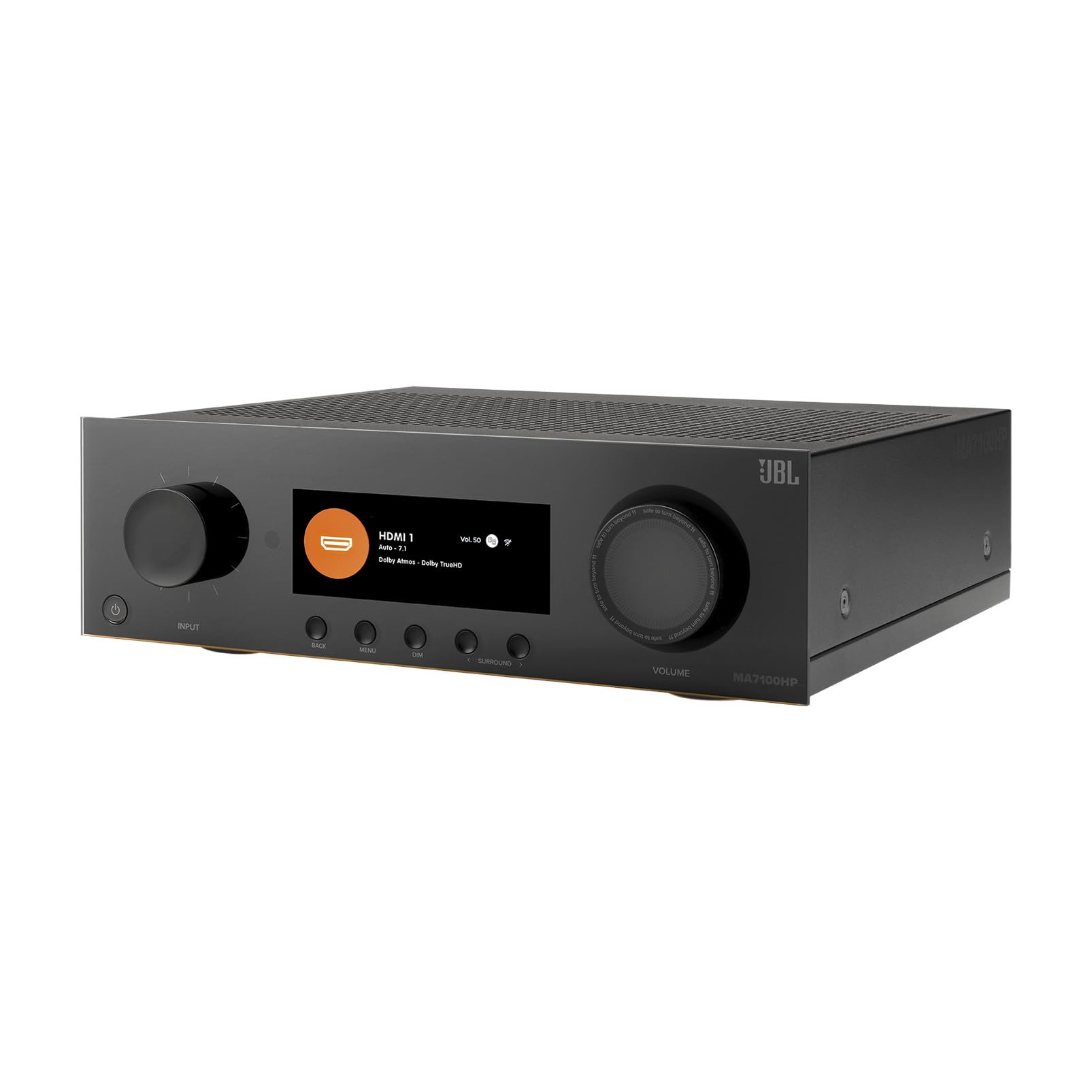
JBL’s MA7100HP targets users who want high continuous power without the heat and weight of traditional Class AB amplifiers. Its Class D design delivers 125W per channel into 8 ohms across all seven channels simultaneously, which is significantly more than many similarly priced receivers. Owners report that the extra headroom translates to cleaner transients on dynamic movie soundtracks and less compression during demanding music passages.
The receiver features six HDMI inputs (two with 8K/60Hz support) plus eARC, and its shallow chassis depth of just over 13 inches fits easily into media consoles where deeper units won’t. Network streaming includes Apple AirPlay 2 and Google Chromecast built-in, but the JBL app is more limited than HEOS or MusicCast — there’s no built-in support for Spotify Connect directly from the app, though the receiver still appears as a Spotify target on the network.
The most discussed flaw is that the receiver does not down-mix DTS-HD Master Audio to 2.1 for stereo-only systems, while Dolby TrueHD down-mixing works fine. JBL support has acknowledged this limitation, meaning owners with 2.1 setups relying on DTS-encoded Blu-rays will lose multichannel content. The remote lacks a backlight, which owners solve by adding tactile dots on the volume button. For pure 7-channel surround setups, the power delivery is exceptional.
Why it’s great
- 125W per channel from efficient Class D topology
- Very shallow chassis fits tight media consoles
- Apple AirPlay 2 and Chromecast built-in for easy streaming
Good to know
- No DTS-HD Master Audio down-mix to 2.1
- Remote is not backlit
- JBL app has limited streaming integration
6. Sony STR-AN1000 7.2 CH Surround Sound 8K A/V Receiver

The STR-AN1000 brings Sony’s 360 Spatial Sound Mapping technology to a more accessible price point than the ES series. Owners upgrading from older Sony AVRs consistently note a dramatic improvement in surround-field cohesion — the phantom height processing makes overhead effects feel like real ceiling speakers even with a 5.1.2 layout. The Digital Cinema Auto Calibration IX (DCAC IX) measures at multiple points and applies precise frequency-domain corrections.
Connectivity covers six HDMI 2.1 inputs (two with full 8K/60Hz bandwidth), Bluetooth with LDAC support, Chromecast built-in, and Apple AirPlay 2. The “Works with Sonos” certification allows the receiver to wake and switch inputs via the Sonos app when paired with a Sonos Port, making it a natural bridge between home theater and whole-home audio. The on-screen setup wizard is the most intuitive among the receivers tested here — it walks through each speaker connection step with animated diagrams.
Some owners have noted that the front display is too small to read room correction parameters from the listening position, and there is no phono input for turntables. A known issue involves Dolby Vision passthrough to Apple TV 4K failing after a firmware update, though Sony has addressed this in later patches. The 165W rating into 6 ohms at 1 kHz is not a direct comparison to 8-ohm continuous ratings, but real-world testing with Klipsch and ELAC speakers reveals ample clean power for medium rooms.
Why it’s great
- 360 Spatial Sound Mapping creates convincing height effects
- Works with Sonos certification for multi-room integration
- Graphical setup wizard simplifies first-time installation
Good to know
- No phono input for turntable users
- Small front display hard to read from seating position
- Known early Dolby Vision passthrough glitch (firmware-fixable)
7. Denon AVR-S770H 7.2 Ch Home Theater Receiver

The AVR-S770H is the most affordable Denon model with full HDMI 2.1 support, including 4K/120Hz passthrough and VRR for gaming. At 75W per channel (into 8 ohms, two channels driven), it’s best suited for bookshelf speakers or efficient tower designs above 90 dB sensitivity. Owners pairing it with efficient speakers like Klipsch Reference series report that the receiver drives them louder than expected at moderate room levels.
HEOS built-in streaming covers Amazon Music HD, TIDAL, and Spotify, and the receiver supports Dolby Atmos Height Virtualization for those without in-ceiling speakers. The Audyssey MultEQ calibration handles basic distance and level setting, though it lacks the frequency-domain filtering of higher-tier Audyssey XT32. Three of the six HDMI inputs support 8K/60Hz, and eARC reliably passes Dolby TrueHD and DTS-HD Master from TV apps back to the receiver.
A few owners report random volume drops and picture-loss incidents after firmware updates, though these appear to be isolated cases rather than a systemic pattern. The remote control has a confusing button layout with small text, making input selection less intuitive than competing models. For someone stepping into their first 4K/120Hz gaming setup or a budget 5.1.2 Atmos system, the S770H provides the essential HDMI 2.1 pipeline without paying for features they won’t use.
Why it’s great
- Full HDMI 2.1 with 4K/120Hz, VRR, and ALLM at entry-level pricing
- HEOS multi-room streaming with high-res audio
- Dolby Atmos Height Virtualization for phantom overhead effects
Good to know
- 75W/ch limits performance with low-sensitivity speakers
- Audyssey MultEQ lacks advanced frequency correction
- Remote button layout is cramped and text is small
8. Onkyo TX-NR6100 7.2 Channel THX Certified Network AV Receiver
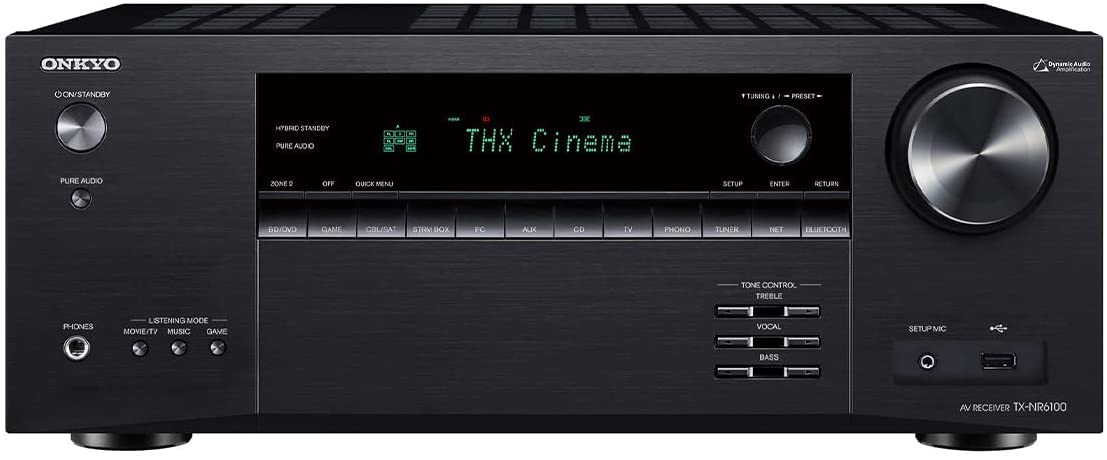
The TX-NR6100 earns its THX Select certification by delivering clean, consistent amplification across all seven channels for medium-sized rooms. Owners currently using PS5 or Xbox Series X report flawless 4K/120Hz operation with no black-screen handshake issues, thanks to the 40 Gbps HDMI 2.1 implementation on three inputs. It also supports IMAX Enhanced decoding, which pulls expanded aspect ratio and dynamic range from compatible discs.
The receiver includes AccuEQ room calibration with AccuReflex, which phase-aligns height and ear-level speakers for seamless Atmos bubble integration. Onkyo’s app gives you control over source selection, volume, and EQ adjustments from your phone. The built-in streaming covers Amazon Music HD, Spotify, and TIDAL, and Chromecast built-in allows casting from any smartphone or PC without opening a separate app.
Some owners have reported HDMI 2.1 board failures after about two years of heavy use, resulting in loss of 4K/120Hz functionality — an issue that appears more frequently in early production units. The front-panel inputs (4–6) are capped at 4K bandwidth, meaning only the three rear HDMI inputs support full 8K/40Gbps passthrough. The cooling fan is audible in quiet movie scenes, though most listeners adjust after the first few viewing sessions.
Why it’s great
- THX Select certified for reliable power delivery
- Three HDMI 2.1 inputs with full 40Gbps bandwidth for gaming
- IMAX Enhanced and AccuReflex for optimized home theater playback
Good to know
- Some early units reported HDMI 2.1 board failures after extended use
- Inputs 4-6 limited to 4K bandwidth
- Cooling fan is audible during quiet scenes
9. Yamaha RX-V6A 7.2-Channel AV Receiver with MusicCast

The RX-V6A is Yamaha’s most popular mid-range model, offering MusicCast multi-room streaming across up to 30 rooms with a stable, low-latency connection. YPAO R.S.C. with multipoint measurement provides reflective sound control that compensates for early reflections from nearby furniture and walls — owners upgrading from older Yamaha AVRs notice an immediate tightening of the stereo image. The high slew rate amplifier design is credited with the receiver’s crisp transient response on both movies and music.
Seven HDMI inputs are split into three 8K60/4K120 ports and four standard 4K60 inputs, all with HDCP 2.3 and eARC. The 200W total power figure is a maximum consumption rating rather than per-channel continuous output, but real-world listening tests show clean headroom for 5.1.2 setups with moderate sensitivity speakers. AirPlay 2, Spotify Connect, and voice control through Alexa or Google Assistant provide flexible source switching without needing the remote.
The receiver does not auto-turn on when paired with some Sony Bravia TVs via HDMI-CEC, requiring the user to power it on manually. Some owners note that the firmware update process is essential out of the box to fix early handshake bugs, and the steep initial learning curve can frustrate users accustomed to simpler soundbars. Once set up, the RX-V6A is reliable, and Yamaha’s build quality is reflected in long-term owner satisfaction — multiple reviews mention 10-year lifespans from previous Yamaha units.
Why it’s great
- MusicCast multi-room streaming with proven stability and wide coverage
- YPAO R.S.C. with multipoint Reflected Sound Control
- High slew rate design for clean transient response
Good to know
- HDMI-CEC compatibility issues with select TV brands
- Firmware update required out of the box for full HDMI 2.1 stability
- Complex setup for users migrating from soundbars
10. JBL MA710 7.2 Channel 8K AV Receiver (White)

The JBL MA710 is the most visually distinctive receiver on this list — its clean white chassis stands out in open-media rooms where black boxes feel heavy. Beyond aesthetics, it delivers 110W per channel into 8 ohms, and its compact 4.3-inch height allows it to slide into shelves where standard 6-inch units won’t fit. Owners report easy integration with smart TVs via HDMI ARC, with auto on/off and volume pass-through working reliably right after setup.
Dolby Atmos and DTS:X decoding support 5.1.2 or 7.1 channel layouts, and the built-in phono input connects a turntable without needing an external preamp. Network streaming covers Apple AirPlay 2 and Google Chromecast, though the JBL app itself is basic and doesn’t offer native Spotify or TIDAL browsing — users need to cast from their device instead. The on-screen graphical setup is clear, but a firmware update is almost always required before the unit becomes fully responsive.
The same DTS-HD Master Audio down-mix limitation present in the MA7100HP also applies to the MA710 — users with 2.1-only systems relying on DTS discs will lose multichannel audio. The remote lacks a backlight and the front panel LED is bright enough to be distracting in a dark room. For users building a 5.1.2 system with a turntable who want a white component that matches their decor, the MA710 is the only receiver at this level offering that specific combination.
Why it’s great
- Unique white finish fits bright or minimalist media consoles
- Built-in phono input for turntable connectivity
- Shallow chassis height (4.3 inches) fits tight shelves
Good to know
- No DTS-HD Master Audio down-mix to 2.1
- Remote lacks backlight and face plate glow is bright
- JBL app has minimal streaming functionality
11. Pioneer VSX-935 7.2 Channel Surround Sound Network Receiver
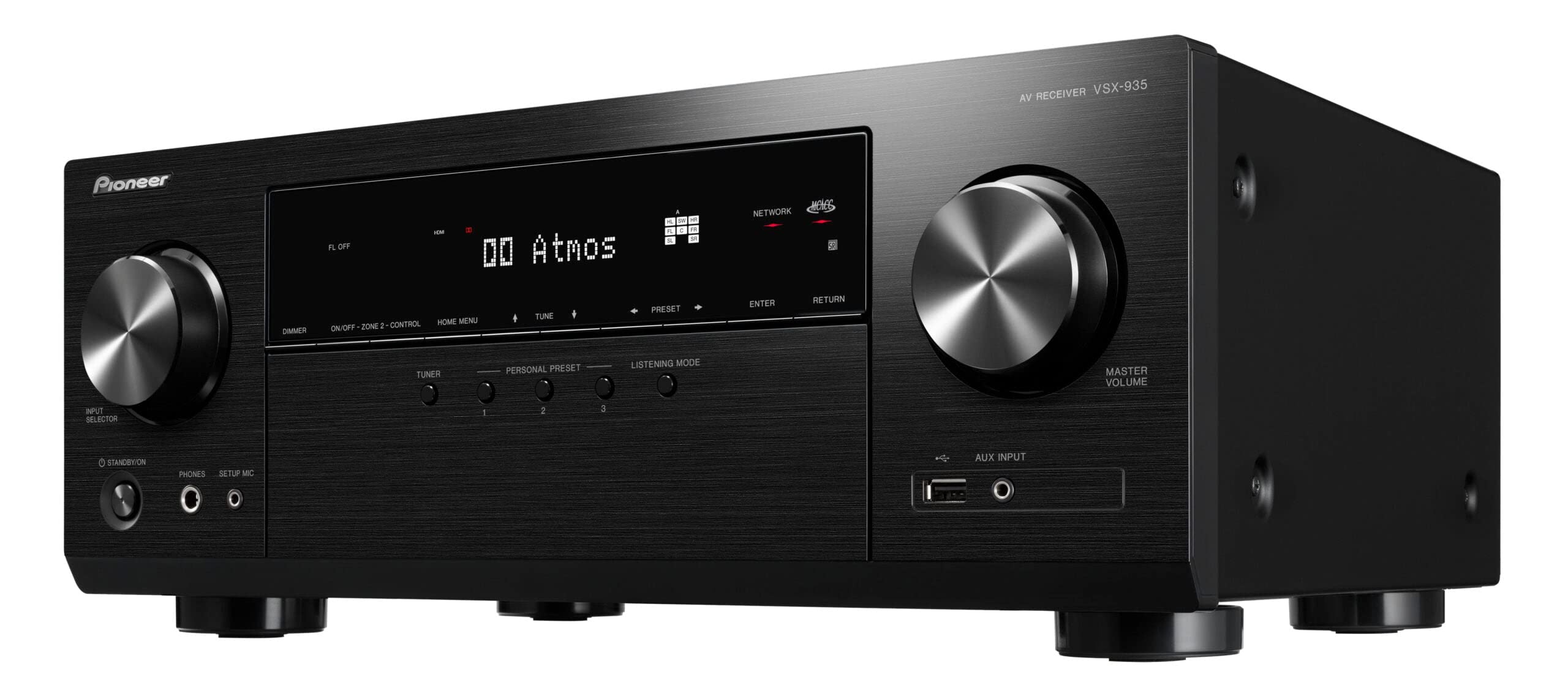
The Pioneer VSX-935 is the most accessible 8K HDMI 2.1 receiver on the market, providing Dolby Atmos Height Virtualization so budget-conscious buyers get phantom overhead effects without installing ceiling speakers. The 7.2 channel amplification is rated for typical home theater volumes with efficient speakers, and owners using Klipsch or Pioneer-branded setups note that the sound is crisp and clear with good dialogue separation at moderate levels.
Connectivity includes Bluetooth with two-way functionality (stream to the receiver or from the receiver to wireless headphones), Chromecast built-in, DTS Play-Fi, and Apple AirPlay 2. Three HDMI inputs support 8K/60Hz and 4K/120Hz, though the full bandwidth is 24Gbps rather than the 40Gbps found in higher-tier models — enough for 4K/120Hz with 8-bit color, but not uncompressed 10-bit HDR at the highest refresh rates.
The biggest drawback is the two-way Bluetooth implementation, which multiple owners describe as unreliable and confusing to operate — there’s no dedicated button, and the receiver frequently drops the pairing. Some units have arrived DOA, and the overall interface feels dated compared to competing models from Denon and Yamaha. The MCACC room calibration is basic but functional for distance and level adjustment. For buyers who simply need an affordable HDMI 2.1 refresh and are willing to work around the Bluetooth quirks, the VSX-935 delivers the core feature set.
Why it’s great
- Most affordable 8K HDMI 2.1 receiver with Dolby Atmos
- Dolby Atmos Height Virtualization provides phantom ceiling effects
- Two-way Bluetooth for private listening via wireless headphones
Good to know
- Two-way Bluetooth is unreliable and not user-friendly
- HDMI 2.1 limited to 24Gbps — no uncompressed 4K/120 10-bit HDR
- Interface feels outdated and some units arrive DOA
FAQ
How many channels do I need for Dolby Atmos?
What is the difference between HDMI eARC and regular ARC?
Can I use pre-outs to add external amplification?
Why does my AVR shut off during loud movie scenes?
Final Thoughts: The Verdict
For most users building a serious home theater, the best a/v receivers winner is the Onkyo TX-RZ50 because it bundles Dirac Live room correction with 9.2 channels and THX certification at a price that undercuts competitors with similar calibration tools. If you want a Sony ecosystem with 360 Spatial Sound Mapping and IP control for custom integration, grab the Sony STRAZ1000ES. And for a gaming-focused setup that needs reliable 4K/120 passthrough and THX certification without maxing the budget, nothing beats the Onkyo TX-NR6100.