
Our readers keep the lights on and my morning glass full of iced black tea. As an Amazon Associate, I earn from qualifying purchases.
Specs are compiled from manufacturer listings and verified buyer reviews and can change over time — please confirm the key details on the product page before buying.
Most people buy the wrong bulb twice before they get it right — once too yellow, once too harsh — because the box never tells them what the light actually feels like in a room. The fix is to match the light to the room before you buy. Below are nine good A19 bulbs (the standard teardrop shape) with the E26 screw base (the regular 26mm screw fitting most lamps use), sorted by what each one is actually best at, so you stop guessing at the shelf.
I’m Min — the founder and writer behind Gadgets Feed. This guide is built by comparing the manufacturers’ published specifications and the patterns across verified customer reviews, so you get each pick’s real strengths and trade-offs instead of marketing spin.
The short version: color temperature decides how a room feels, lumens decide how bright it gets, and the base has to be E26 to fit a normal socket. That trio is the whole game — and it is exactly what this a19 e26 bulb breakdown sorts out for you room by room.
Our Picks at a Glance


How To Choose The Best A19 E26 Bulb
An A19 is the classic pear-shaped household bulb, and E26 is the medium screw base that sits in almost every lamp, ceiling fixture and pendant in a normal home. Get those two letters and numbers right and the bulb will physically fit. Everything after that is about the quality of light, and that is where most buyers get tripped up.
Start with color temperature, not wattage
Color temperature is measured in Kelvin, and it describes the tint of the white light rather than how bright it is. Lower numbers — around 2700K to 3000K — give you a warm, slightly golden glow that suits bedrooms, living rooms and dinner tables. Higher numbers — 5000K and up — look crisp and blue-white, which is why offices, garages and bathrooms often use them.
A 5000K bulb in a cozy bedroom reads clinical to most people, and a 2700K bulb over a workbench feels dim and sleepy. Pick the Kelvin first, then shop.
Then match lumens to the room
Lumens are the actual amount of light you get. The “60W equivalent” or “100W equivalent” on the box is a rough comparison to old incandescent bulbs, not a measurement. As a working habit, treat the equivalent-watt label as a shortcut and the lumen figure as the truth — every pick below lists real lumens in the comparison table so you can line them up side by side.
Decide if you need dimming before you buy
Dimmability cannot be added later. If a bulb is listed as non-dimmable, putting it on a dimmer switch is exactly how you get the flicker and buzz that shows up in reviews across the category. If your fixture has a slider or a rotary dimmer, buy a bulb that explicitly says dimmable — two in this list qualify.
Check the CRI if color matters in that room
CRI, or color rendering index, measures how faithfully a bulb shows the true color of objects, on a scale where higher is better. In a bathroom where you check your face, or a kitchen where food should look appetizing, a higher CRI makes a visible difference. Standard everyday bulbs sit around 80 CRI, and the better ones here reach 85 or 90.
Quick Comparison
| Model | Best For | Color Temp | Brightness | Pack Size | Amazon |
|---|---|---|---|---|---|
| DAYBETTER A19 5000K 100W Equivalent★ Best Overall | Bright task and office lighting | 5000 Kelvin | 1500 lumens | 12 pack | Amazon |
| Sylvania ECO LED A19 60W EquivalentBest Value | Everyday warm white on a budget | 2700 Kelvin | 750 lumens | 8 pack | Amazon |
| GE Basic LED A19 100 WattTop Color Accuracy | High-CRI warm light, small pack | 2700 Kelvin | 1490 lumens | 2 pack | Amazon |
| GE Refresh LED A19 Daylight HD | Dimmable daylight for active rooms | 5000 Kelvin | 800 lumens | 4 pack | Amazon |
| Amazon Basics A19 60W Equivalent | Bulk relamping a whole house | 3000 Kelvin | 800 lumens | 24 pack | Amazon |
| TJOY 12 Pack A19 5000K | Big daylight brightness in bulk | 5000 Kelvin | 1500 lumens | 12 pack | Amazon |
| TJOY 24 Pack A19 Soft White | Cozy warm white at volume | 2700 Kelvin | 800 lumens | 24 pack | Amazon |
| Feit Electric A19 5CCT Dimmable | Changing your mind on color | 2700–5000 Kelvin | 800 lumens | 10 pack | Amazon |
| Linkind Matter Smart A19 | Voice control and color scenes | 6500 Kelvin | 800 lumens | — | Amazon |
In‑Depth Reviews
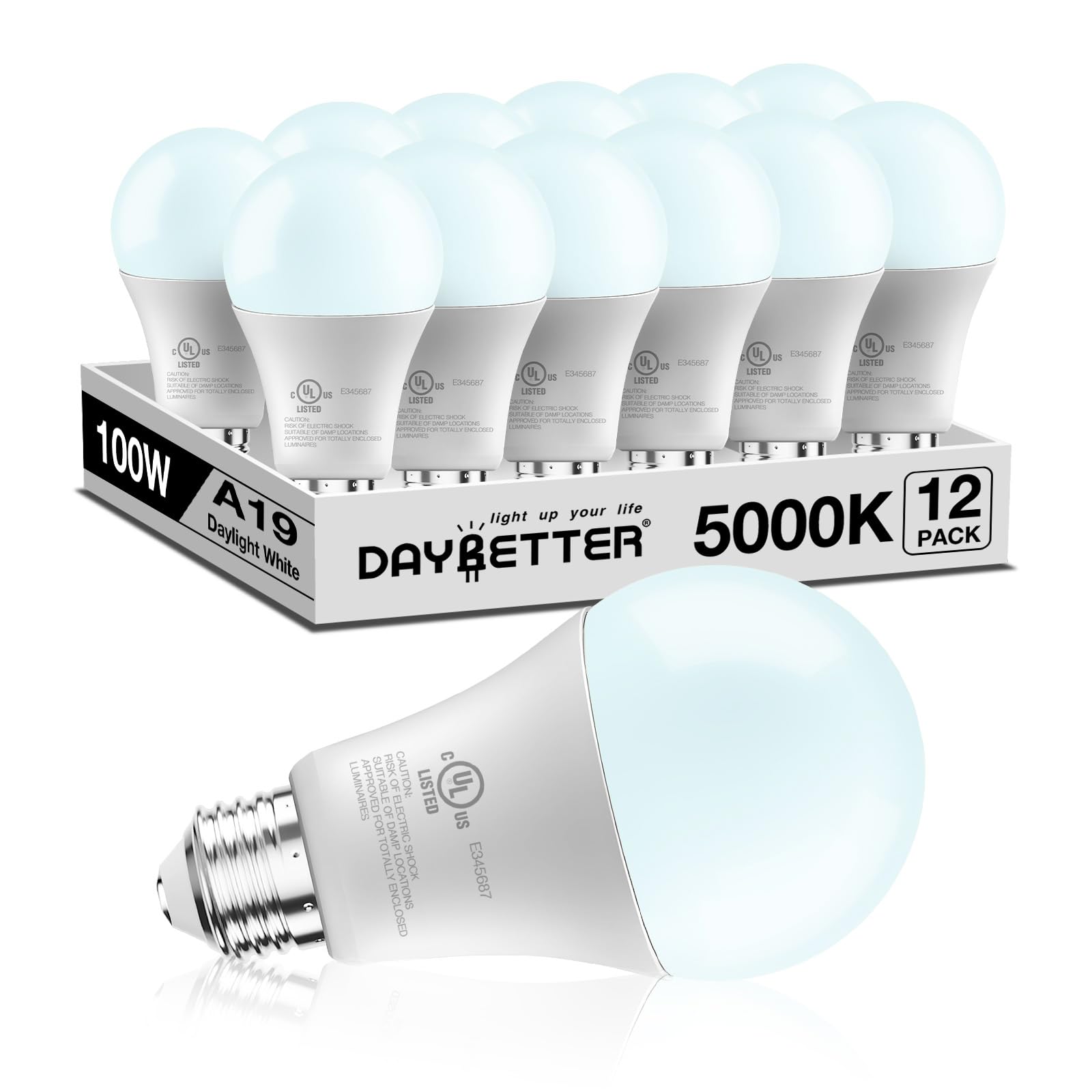
1. DAYBETTER LED Light Bulbs, A19 5000K Daylight, 100W Equivalent, 12 Pack
Our pick — 4.5+★ from 950+ verified ratings; the strongest balance of quality and price.
Twelve bulbs that flood a room with true daylight at a price that treats a whole ceiling fixture as an easy call.
If your complaint about home lighting has always been “it feels dim and orange in here,” this is the pick. Each bulb pushes 1500 lumens of bright white light — the kind that makes a home office or a kitchen prep counter feel switched-on rather than sleepy. The 5000K daylight tone is the real deal here, not a warm bulb wearing a daylight label. It reads crisp and slightly cool, which suits bathrooms, workspaces and any room where you want to see detail clearly.
The color rendering index of 85+ is the number worth understanding. CRI measures how honestly a bulb shows the true color of what it lights, so an 85+ rating means fabrics, food and skin tones look closer to natural instead of washed out under a greenish cast. A wide 280-degree beam angle spreads that light across the room rather than throwing one hot spot into the middle of it. And compared with the GE Basic pick below, this one gives you 1500 lumens against 1490 — near enough to call it a draw on raw output, but this one arrives as a twelve-pack instead of a two-pack.
What wins people over is simply how bright these are — that is the overwhelming theme across the review pages, and it holds up whether they land in a bathroom mirror fixture or a full kitchen. The honest catch is reliability, which is the one thing the feedback splits on. Some bulbs run for years; a smaller share cut out early, and flicker shows up in a handful of setups. Treat it as a pack of twelve where you have spares on hand, not a single bulb you are counting on. The 12-month service window covers you if one misbehaves.
Where this bulb pulls ahead
- 1500 lumens per bulb turns a dark room genuinely bright, backed by a 280-degree beam angle
- Real 5000K daylight, not a warm bulb with a daylight sticker
- 85+ CRI keeps colors looking natural instead of washed out
- Non-dimmable build means steady, consistent output with no dimmer buzz
What to weigh before you commit
- Daylight white is clinical in a bedroom — this is a task-light bulb
- Lifespan is the split point in feedback; a few units cut out early
- Cannot go on a dimmer switch by design
Reach for this if: you want a bright, color-accurate daylight glow across a workspace, kitchen or bathroom and you like having spares in the box.
Think twice if: your fixture has a dimmer slider — this bulb is non-dimmable and will not cooperate with one.
2. Sylvania ECO LED Light Bulb, A19 60W Equivalent, 9W, 8 Pack
Eight soft-white bulbs that do the boring everyday job so well you forget they exist.
Here is the bulb for the lamp beside your sofa and the fixture over your dinner table. At 2700K it gives you that familiar warm glow — the same tone as the incandescent bulbs it replaces — and 750 lumens is exactly the brightness a standard 60W room wants. The frosted finish softens the light so you are not staring into a bare LED chip.
Quality is what carries this one in the feedback, and plenty of owners also call out the value. The energy story is concrete: it runs at 9 watts and is rated to last up to 7 years. Compare that with the GE Refresh pick above at 13.7 years and you are looking at a shorter service life, but the Sylvania undercuts it on cost per bulb in an eight-pack.
Two things to know before it goes in your cart. First, it is non-dimmable — a dimmer switch is the wrong home for it. Second, color is the split point: most owners like the warm tone, but a share find the yellow tint too strong for their taste. Flicker also shows up in feedback more than you would like, so if you have a sensitive fixture it may not be the smoothest choice. For a plain lamp on a plain switch, none of that matters.
The everyday workhorse: 2700K warm white at 750 lumens is the sweet tone for living rooms and bedrooms, and eight bulbs covers most of a small home in one box.
The trade-off: shorter rated life at up to 7 years than the 13.7-year GE Refresh, plus a warm tone that a few owners find too yellow.
Best fit: anyone replacing a houseful of 60W incandescent bulbs who wants warm light and does not need dimming.
Look elsewhere if: you are lighting a workspace that wants crisp white, or your switch has a dimmer on it.
3. GE Basic LED Light Bulbs, 100 Watt, Soft White, A19, 2 Pack
A warm bulb with unusually honest color, sold in a small pack for the one fixture that matters.
Colors look true on this GE bulb, and the number behind that is its 90 CRI (color rendering index — a 0–100 score for how faithfully a light shows colors). That is a high score for a warm-white bulb, so a face in a bathroom mirror or a plate of food on the counter shows its real colors rather than a muddy version. It holds that accuracy at 2700K (a warm, cozy white), so you keep the soft glow while getting color accuracy you usually only see on pricier daylight bulbs.
Rated life is 9.1 years at three hours a day. The old incandescent comparison is still the useful mental model here: you get roughly the punch of a 100W bulb without the heat and the energy draw, and it comes on with no noticeable warm-up delay.
Now the honest part, and it is the most-discussed issue on this one. Flicker shows up in the feedback more than any other gripe, and a share of buyers report bulbs giving out inside two years rather than the rated window. It is also a two-pack only — no bulk option — and it is non-dimmable. If you have just one ceiling fixture that needs a warm, color-accurate bulb and you want a brand name behind it, this does that job well.
The color story: 90 CRI at 2700K is the combination most warm bulbs skip, and it is why this one reads as a careful choice.
The catch to size honestly: flicker is the recurring complaint in the feedback, and lifespan reports come in shorter than the rated 9.1 years more often than owners would like.
Pick this for: a single fixture that needs warm, true-color light — a vanity, a reading lamp, a small kitchen — where a two-pack is plenty.
Skip the bulk plan: with only two bulbs per pack and a non-dimmable build, this is not the choice for relamping a whole house.
4. GE Refresh LED Light Bulbs, 10W (60W Eqv) Daylight HD, A19, 4 Pack

Daylight that dims to your mood — the rare bright-white bulb that also works with a dimmer switch.
This is the pick if you want the crisp 5000K daylight look but your fixture has a dimmer on it. Most bright-white bulbs are non-dimmable, which is the trap. The GE Refresh is fully dimmable and works with most standard dimmer switches, so a playroom can go from bright task lighting down to something calmer in the evening. It pairs that with 90 CRI and a wide 300-degree beam angle that spreads light across the whole room instead of one harsh spot.
It runs at 10 watts to deliver 800 lumens — the replacement for a 60W incandescent — and is rated to last up to 13.7 years at three hours a day. That 13.7-year figure is the number to hold onto: compared with the Sylvania at 7 years, this is the longer-lived choice, and at 5000K against that bulb’s 2700K you are getting a far cooler, whiter tone. The daylight itself is meant for active spaces — home offices, garages, laundry rooms — where you want to see what you are doing.
The reviews are warm on quality, with function and value close behind, and the recurring note is exactly what you would hope for on a dimmable bulb: colors look less yellow and cleaner. Where the feedback splits is on lifespan — the rated 13.7 years is generous, but a slice of owners mention bulbs throwing in the towel early. If you are buying four for a dimmable fixture and want a bright, color-accurate setup, this is a solid call.
The one to grab if: your room is bright and busy by day and you want a dimmer to take it down at night, without losing the crisp white tone.
The fit is wrong if: you want a warm, cozy glow for a bedroom — 5000K runs cool and clinical and will feel wrong there.
5. Amazon Basics A19 LED Light Bulbs, 60W Equivalent, 3000K, 24 Pack

Twenty-four bulbs in one box — enough to relamp a whole house and not think about it again for years.
If the thought of changing bulbs room by room sounds like a weekend chore you would rather skip, this is the box for it. Twenty-four bulbs means you can do the living room, bedrooms, hallways and closets in one order and still have spares under the sink. It is also the biggest pack here by a wide margin — the GE Basic two-pack against these twenty-four is the difference between a single fixture and a whole home.
The tone sits at 3000K, which is a warm white with just a touch more clarity than the 2700K bulbs — close to cozy, but not quite as golden. Each bulb delivers 800 lumens at 9 watts, replacing a 60W incandescent, and the 10,000-hour rated life works out to over 9 years at three hours a day. The 80 CRI is standard for everyday lighting. The bulb even swims both ways on location — it is rated for indoor and outdoor use, so a covered porch fixture is fair game.
The feedback on this one is quiet and consistent: it works, the quality is fine, and the value is the draw. That is the right review profile for a bulk utility bulb — no drama, no surprises. The one thing to know is the 3000K tone is a middle ground, and some people want either warmer or cooler than it. Otherwise this is straightforward.
Value at scale: twenty-four bulbs at 800 lumens and 3000K does the entire house for the price of a few premium singles — and 3000K sits between cozy and crisp, which reads comfortable in most rooms.
What you give up: 80 CRI is the everyday baseline rather than the color-accurate end, and 3000K is a compromise tone that will not satisfy someone who wants a decided warm or a decided white.
Right call for: moving into a new place, finishing a remodel, or any moment where you want a drawer full of spare bulbs and a warm-in-between tone.
Wrong call if: you only need one or two bulbs, or you are chasing true color accuracy in a bathroom or kitchen — go higher on CRI for that.
6. TJOY 12 Pack LED Light Bulbs, 100 Watt Equivalent A19, 5000K Daylight
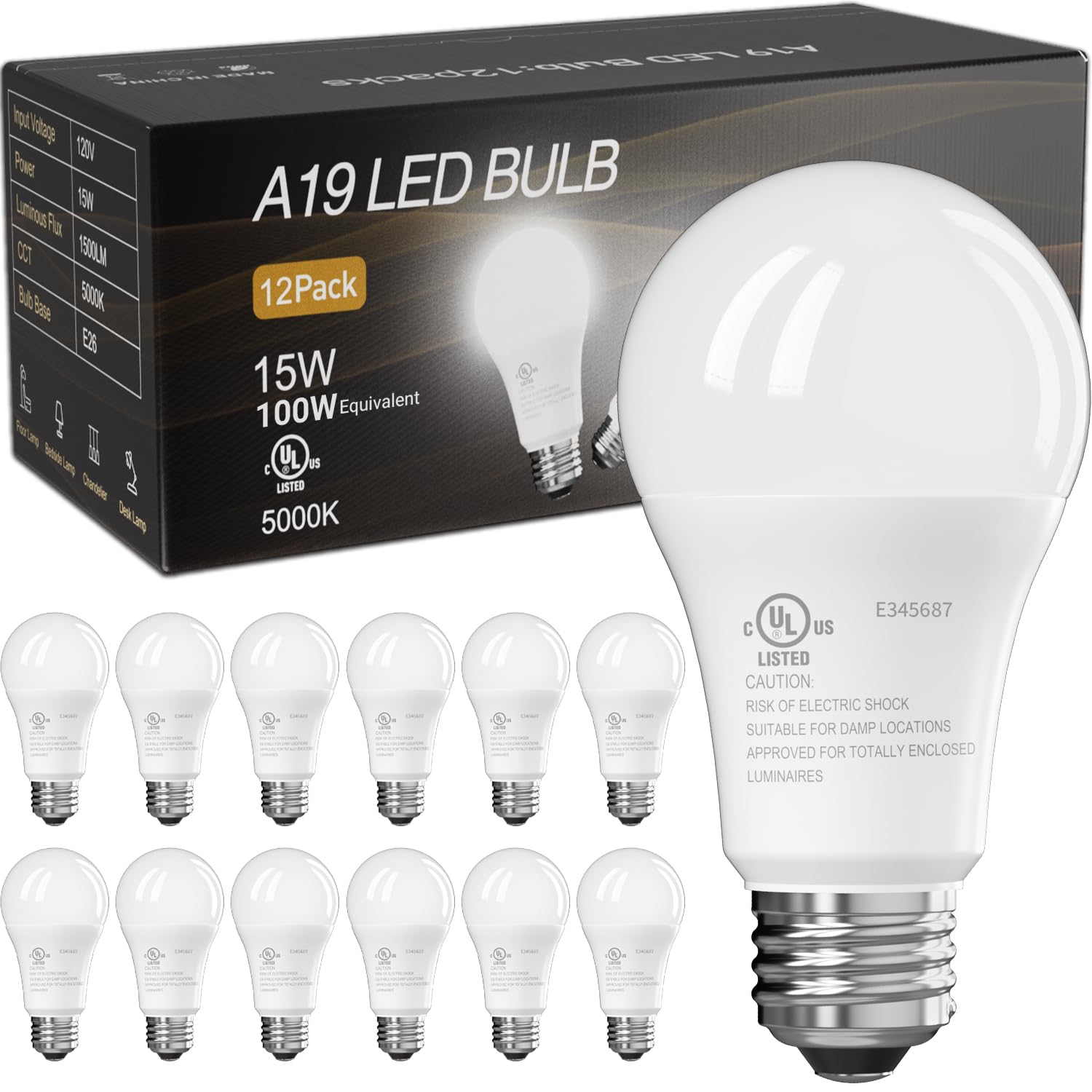
A twelve-pack of daylight bulb brightness that turns a dim room into a proper working space.
If you have a room where the current bulbs just cannot keep up — a home office, a basement, a kitchen — this is the tank in the lineup. Each bulb throws 1500 lumens of 5000K daylight, the same league as the DAYBETTER above, so you are getting real brightness not a gentle warmth. The 85+ CRI keeps colors looking natural. The 15-watt draw replaces a 100W incandescent and cuts energy use by up to 90% per the maker.
You get confidence on the build: it is UL listed, ROHS and FC certified (safety and materials standards), which matters if a fixture runs hot. It is also rated at up to 15,000 hours — about 13.7 years at three hours a day, the long end of what these bulbs promise. The 5000K tone (a cool, crisp white) is close to noon sunlight according to the maker, which is why this reads as a concentration bulb for a workspace rather than a lounge.
Brightness and value are what carry it in feedback, and the color reads as true daylight. Where the verdict splits is lifespan and flicker — some bulbs run years, some give out in days, and a handful flicker while most do not. That is the reality of a budget-bright daylight bulb: you get huge output and a twelve-pack to cover the odd dud. If a workspace upgrade is the goal, this handles it.
This earns its spot if: you want maximum daylight brightness across a big space and want twelve bulbs ready to swap.
Consider the alternative if: you need a dimmable bulb or a warm tone — this is non-dimmable and runs cool white.
7. TJOY 24 Pack A19 LED Light Bulbs, Soft Warm White 2700K, 60W Equivalent

Warm white light by the crate — the answer when every room in the house wants the same cozy glow.
Here is the matching move to the bright daylight bulbs: a 24-pack of 2700K soft white, giving you that warm, slightly romantic tone that suits dining rooms, bedrooms and any space where you want to unwind. Each bulb puts out 800 lumens at 9 watts, replacing a 60W incandescent and cutting energy use by up to 85%. Rated life is up to 13.7 years at three hours a day.
What makes this a coherent buy is the volume plus the tone together — twenty-four warm bulbs is enough to make an entire home feel of a piece. Quality is the stand-out in feedback, with brightness close behind, and the light reads as steady and non-dazzling. If you have ever walked into a house where every room had a different color temperature, you know why a single-tone 24-pack matters.
The catch is the same one that shadows any value multi-pack: lifespan and flicker are split in the feedback, with some owners reporting bulbs that fail while plenty last fine. It is also non-dimmable and 80 CRI — an everyday baseline rather than a color-accurate one. If a warm, consistent, whole-house tone sounds like the plan, this box delivers it.
Whole-home warmth: 2700K at 800 lumens across 24 bulbs means every room shares one cozy tone, and a rated 13.7-year life keeps replacements rare.
What to plan around: the non-dimmable build rules out a dimmer switch, and the feedback splits on lifespan, so the spare-bulb thinking applies.
Buy it when: warmth is the priority and one tone should run through the whole house.
Look at the daylight options if: you need crisp white for tasks, or a dimmable bulb — this is neither.
8. Feit Electric A19 LED Light Bulb, 60W EQ, 5CCT, Dimmable, 10-Pack

One bulb, five whites — the pick if you have ever bought the wrong color and wished you could undo it.
Most bulbs lock in a single tone and you find out whether you like it after it is screwed in. This Feit does the opposite. A small switch built into the base cycles through five color temperatures — 2700K, 3000K, 3500K, 4000K and 5000K — with no app, hub or wiring. So the same bulb can be warm in the bedroom and daylight-white in the kitchen. At 800 lumens and 90+ CRI, its colors stay accurate in every setting.
It is also fully dimmable, compatible with most standard LED dimmers, with no buzzing or stepping across levels. The beam angle is a wide 270 degrees, so it fills a fixture evenly. It works down to a very low level of light for late-evening use. The voltage range is 100 to 240 volts, so it is as at home on a standard US circuit as it is in other setups.
Owners praise the brightness and the color-adjustment feature most, and customers note the dimming holds up too — the light does not hum on a dimmer. Color temperature control (changing the white tone from warm to cool) is what separates it from every single-tone bulb here. The only real note: you will spend a minute fiddling with the base switch the first time, then forget it. Rated for damp locations (moist rooms), it handles bathrooms and covered porches.
This is your bulb if: you want one pack that covers every room and every mood, with dimming on top.
Pass on it if: you have already settled on a single tone and want to pay less per bulb for the same output.
9. Linkind Matter Smart Light Bulbs, Works with Apple Home, Alexa, Google Home
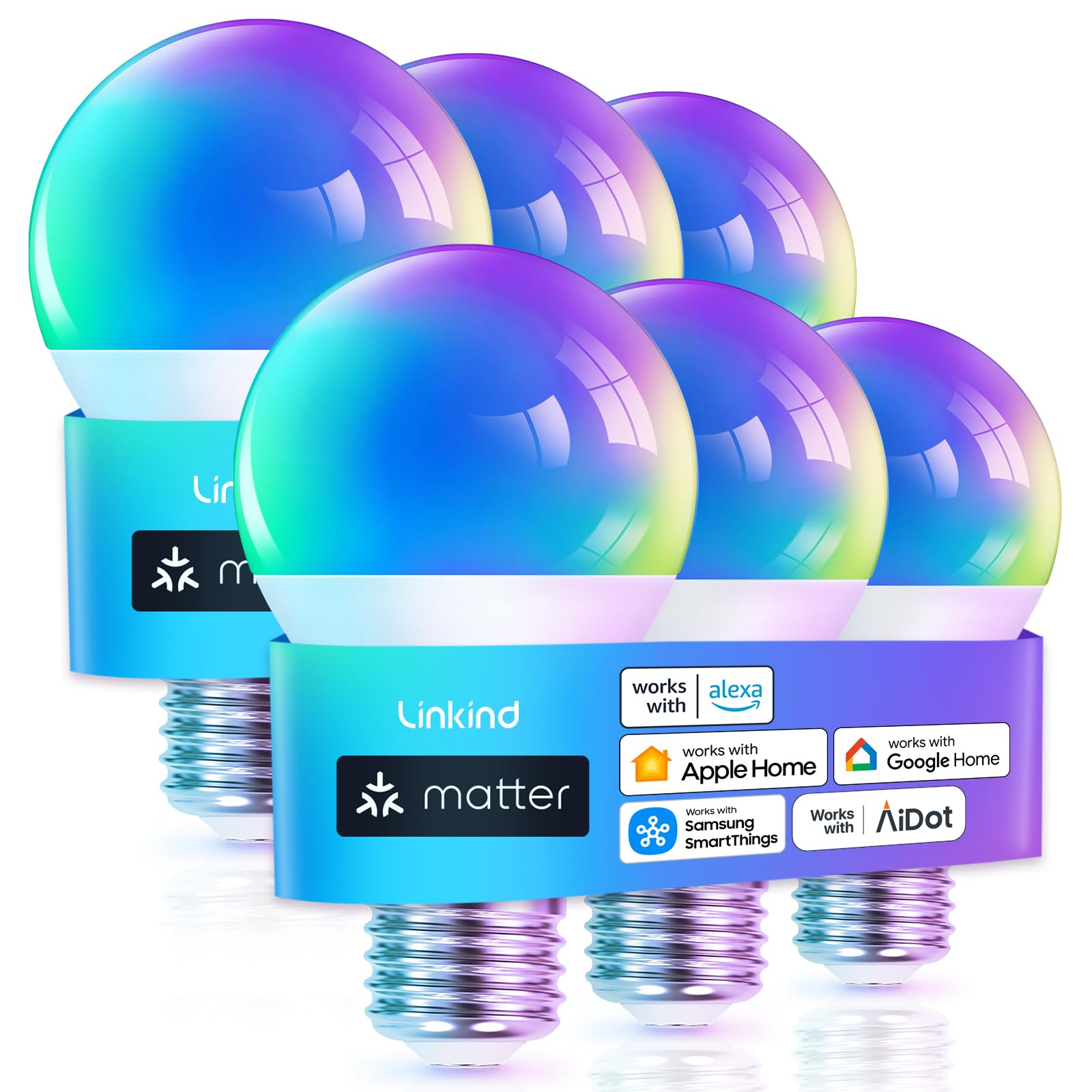
A bulb you talk to — color scenes, music sync, and voice control from the sofa.
This is the one for the person who wants their light to do more than switch on. It pairs with Alexa, Apple Home and Google Home for hands-free on, off, dim and color changes, and it is Matter certified so it works across systems instead of trapping you in one app. You get 16 million RGB colors and 104 preset scenes for movie nights, parties or winding down. The music sync function listens through your phone’s mic and pulses the light to the beat.
Underneath the smart layer it is a real bulb: 800 lumens at 60W equivalent, 90 CRI color rendering, and over 25,000 hours of rated life. Setup is the other thing it does well — a 30-second install per bulb is the sort of number owners actually mention. The Matter certification means it works with Matter hubs like HomePod, Echo or Nest, or directly through the AiDot app without a hub.
Here is where you need to be clear-eyed, and it is the most-discussed point on this bulb. Connectivity and reliability are the aspects where the feedback divides — some units stay rock solid, while a share drop off after months of use. That is the nature of smart bulbs at this tier. It is also only 2.4GHz WiFi and not compatible with traditional dimmer switches, so plan for app-based dimming. If you want smart scenes and can live with occasional re-pairing, it earns its tier.
The smart-home payoff: Matter certification plus 16 million colors and 104 preset scenes means real flexibility across platforms, with 90 CRI keeping colors true even in everyday white mode.
The honest limitation: connectivity reliability is the split point in feedback, and it is 2.4GHz WiFi only with no support for a wall dimmer — this wants a stable network and app control.
Made for you if: you are building a smart home and want a bulb that speaks Matter across Alexa, Apple Home or Google, with color scenes on tap.
Not the one for you if: you just want to flip a switch and forget it — a plain warm-white bulb does that job with none of the pairing fuss.
Understanding the Specs
Color Temperature (Kelvin)
Kelvin describes the tint of white light, not its brightness — lower numbers feel warm and golden, higher numbers feel cool and crisp. 2700K to 3000K suits bedrooms, living rooms and dining areas where you want to relax. 5000K and up suits bathrooms, offices, garages and anywhere detail matters. A bulb with a very warm tone over a workbench will read dim and sleepy, and a 5000K bulb in a bedroom reads clinical to most people. Pick the Kelvin for the room before anything else.
Lumens vs. Equivalent Watts
Lumens are how much visible light a bulb actually produces — the real number. The “60W equivalent” or “100W equivalent” label is a rough link back to old incandescent bulbs and is not a measurement of output. Two bulbs can both say 60W equivalent and land at different lumen figures, which is why the comparison table lists real lumens. Use the equivalent-watt label as a quick category shortcut and the lumen figure as the deciding number.
CRI (Color Rendering Index)
CRI scores how faithfully a bulb shows the true colors of what it lights, on a scale where higher is more accurate. Everyday bulbs sit around 80, and the better picks here reach 85 or 90. In a bathroom mirror or over a kitchen counter, a higher CRI is the difference between skin and food looking right versus washed out. It is one of the quiet specs that separates a bulb you tolerate from one you like.
Dimmability and Flicker
A non-dimmable bulb on a dimmer switch is the root cause of most flicker and buzz complaints in this category. Dimming cannot be added later, so check the label before you buy if your fixture has a slider or rotary control. On dimmable bulbs, quality dimmers and good LED compatibility keep the light smooth without stepping or humming. Flicker perception also varies from person to person, which is why some feedback flags it on bulbs others find perfectly steady.
FAQ
Will an A19 E26 bulb fit my lamp or ceiling fixture?
What is the difference between 2700K and 5000K bulbs?
Can I use a non-dimmable A19 bulb in a dimmer switch?
How many lumens do I need to replace a 60W or 100W bulb?
How long do these A19 LED bulbs actually last?
Why do some LED bulbs flicker and others do not?
Does higher CRI actually matter in a bathroom or kitchen?
What makes a bulb Matter certified and why does it matter?
Can I put an outdoor-rated A19 bulb on a covered porch?
Is a smart A19 bulb worth it over a plain warm-white one?
Final Thoughts: The Verdict
One bulb covers the widest range of rooms in most homes: the a19 e26 bulb worth buying first is the DAYBETTER 5000K 12-pack. Each bulb puts out 1500 lumens (a measure of brightness) in a color-accurate daylight tone, so a kitchen counter or bathroom mirror reads clean and bright. You also get twelve bulbs, so spares last for years. Its 4.5+ star record is among the highest in this lineup, which is why it takes the overall spot.
For a cozy living-room glow, the Sylvania ECO gives you 2700K warmth (a soft, yellow-white) at a value price. Want to change the tone on demand instead? The Feit Electric 5CCT packs five color temperatures and full dimming into one bulb.
Light that answers to your voice instead of a switch is what the Linkind Matter bulb gives you, with voice control and color scenes for a smart-home setup — as long as you have a stable 2.4GHz WiFi network. If your plan is simply to relamp a whole house in one warm, consistent tone, the Amazon Basics 24-pack quietly does that — 800 lumens of 3000K (a soft warm white) in every room, with spares left over for years.
How We Picked
We do not accept paid placement. Every pick is matched to a real buyer and a real use-case; we do not hands-on test units.
Sources & Methodology
Specifications: manufacturer listings and product documentation. Review insights: verified customer reviews, as of November 2026. Pricing: not shown on this page (it changes often); check the current price via the retailer link.
As an Amazon Associate, Gadgets Feed earns from qualifying purchases. This does not affect which products we feature.