
Our readers keep the lights on and my morning glass full of iced black tea. As an Amazon Associate, I earn from qualifying purchases.
Specs are compiled from manufacturer listings and verified buyer reviews and can change over time — please confirm the key details on the product page before buying.
The short answer: the Spiral Notebook 3-Pack from MaaIbok is the one to start with — 160 pages per book, thick paper that resists ink bleed-through, and an A5 size that fits a tote bag. But a notebook is a personal thing, and the right pick changes fast if you fill pages daily, share books between subjects, or write with a fountain pen that soaks through cheap stock. One honest note before you read on: this list uses flexible human-style matching on A5 size (roughly 5.8 x 8.3 inches, accepting the standard A5 format), so not every pick measures the exact same millimetres. They all serve the same job — a small, hard-working ruled book you can carry anywhere.
I’m Min — the founder and writer behind Gadgets Feed. This guide is built by comparing the manufacturers’ published specifications and the patterns across verified customer reviews, so you get each pick’s real strengths and trade-offs instead of marketing spin.
What follows separates the books that survive a full semester from the ones that fall apart by week three, with a quick table and plain-English specs walked through line by line. Here is the honest breakdown of the a5 spiral notebook options that actually earn their place in your bag.
Our Picks at a Glance


How To Choose The Best A5 Spiral Notebook
An A5 spiral notebook lives in your bag, gets yanked open by one cover, and takes whatever pen you throw at it. That short life explains almost every complaint you’ll read anywhere: pages that crack and tear out of weak coils, ink that ghosts onto the reverse side, and covers that curl at the corners. Pick against those three failure points and you’ll be happy with almost any book on this page.
Paper weight is the number that decides everything
Paper is measured in GSM (grams per square metre) — think of it as how much paper is packed into each sheet. An 80 GSM page is a normal sheet of writing paper; 100 GSM feels noticeably firmer under a pen; 120 GSM is close to card stock. The heavier the paper, the less likely a wet gel or fountain pen soaks through to the back side. If you write with ballpoints only, 80 GSM is plenty. If you favour ink-heavy pens, look for 100 GSM and up.
Binding style changes how you write
Side-bound coils let the book open 180° flat on a desk, and most also fold a full 360° behind themselves so the notebook takes up less space. Top-bound coils flip pages upward, which suits people filling in a book held in one hand — standing at a till, taking notes in a lecture hall, or jotting lists on a train. Neither is better; they’re different hand positions.
Page count versus pack count
One thick 300-page book gives you a single continuous record and fewer spines to carry. A multi-pack of thinner books lets you split subjects, hand one to a colleague, or use one per project. Decide if you want one long thread or several separate ones — that one question settles the purchase for most people.
Ruling and the extras worth paying for
College ruled (around 7 mm line spacing) fits more lines per page; wide ruled gives more room per word. Small add-ons genuinely change daily use: an elastic band keeps the book shut in a bag, a back pocket holds receipts and loose cards, and a pen holder means you never hunt for something to write with. None of these are luxuries once you’re travelling with the book every day.
Quick Comparison
| Model | Best For | Pack & Pages | Paper Weight | Extra Features | Amazon |
|---|---|---|---|---|---|
| MaaIbok Spiral Notebook 3-Pack★ Best Overall | Everyday notes and journaling | 3 books, 160 pages each | Thick (maker states thicker than other journals) | Elastic band, back pocket, rounded corners | Amazon |
| EMSHOI Lined Spiral JournalLongest Run | One book for a whole term | 1 book, 300 pages | 100 GSM | Pen holder, bookmark, ruler, sticky tabs | Amazon |
| Oxford Poly Spiral NotebooksToughest Paper | Heavy use and durability | 4 books, 160 pages each | 120 GSM | Privacy sheet, no-snag coil, poly cover | Amazon |
| DMSVK 4-Pack A5 Journal | Colour-coded task lists | 4 books, 114 pages each | 80 GSM | Elastic strap, inner pocket, hard cover | Amazon |
| JASLEKO 5-Subject Notebook | Multi-subject organisation | 1 book, 240 pages | Not stated | 5 removable dividers, 10 writable tabs | Amazon |
| Yansanido Top Bound Notebook | Writing in one hand | 4 books, 160 pages each | 80 GSM | Top-bound coil, hard waterproof cover | Amazon |
| Umriox Small Spiral Notebook | Purse-sized everyday carry | 4 books, 160 pages each | 80 GSM | Double-wire coil, date line per page | Amazon |
| Dynta Spiral Notebooks 5-Pack | Bulk buying and decorating | 5 books, 60 sheets each | 100 GSM | 500 GSM cover, kraft finish | Amazon |
| GINMLYDA 6-Pack Spiral Notebook | Biggest bundle, colour-coding | 6 books, 120 pages each | Not stated | 6 colour-coded kraft covers | Amazon |
In‑Depth Reviews
1. Spiral Notebook 3-Pack A5 Ruled Journal by MaaIbok
Our pick — 4.5+★ from 800+ verified ratings; the strongest balance of quality and price.
Three slim journals with thick pages, elastic bands and pockets — the everyday workhorse of the group.
You get three separate books here, each holding 160 pages at 6″ × 8.3″ — that’s the A5 footprint that slips into a handbag or a backpack side pocket without bulging. That page count matters in a comparison: this three-pack holds 160 pages per book, while the GINMLYDA six-pack carries 120 pages per book, so each individual MaaIbok book runs longer before you need the next one.
The paper is the headline. The maker specifically calls it a thick stock with 7 mm ruled lines, engineered to stop ink feathering and seeping through to the reverse. That’s the difference between writing on both sides of a sheet and stopping at the front. Add the rounded corners (no dog-ear damage in a bag), the elastic closure band, and the back pocket for receipts and business cards, and the whole thing feels considered rather than cheap.
What wins people over is the paper and the build together — the stitching, the cover stock, the way the book holds up after weeks of being hauled around. The twin-wire binding lets it lay completely flat on a desk and flip pages easily, which is exactly what you want mid-sentence in a meeting. The catch worth knowing: the cover is a soft paper cover, so it isn’t waterproof and will scuff with rough handling — slide it into a sleeve if it shares a bag with keys.
Where this one wins
- 160 pages per book across three books, so you’re not hunting for a replacement mid-term
- Thick paper built to resist feathering and seepage, so both sides of the page stay usable
- Elastic band doubles as a bookmark and keeps the book shut in a bag
- Back pocket and rounded corners make it genuinely bag-friendly
What to keep in mind
- Paper cover, not waterproof — it wants a little care in a crowded bag
- Sold as a themed three-pack, so you don’t choose the exact cover patterns individually
Take this one: if you want one purchase that covers a whole term of lecture notes, journal entries and shopping lists without thinking about it again.
Leave it: if you write almost exclusively with a fountain pen on very wet settings and want a heavy poly cover to shrug off weather.
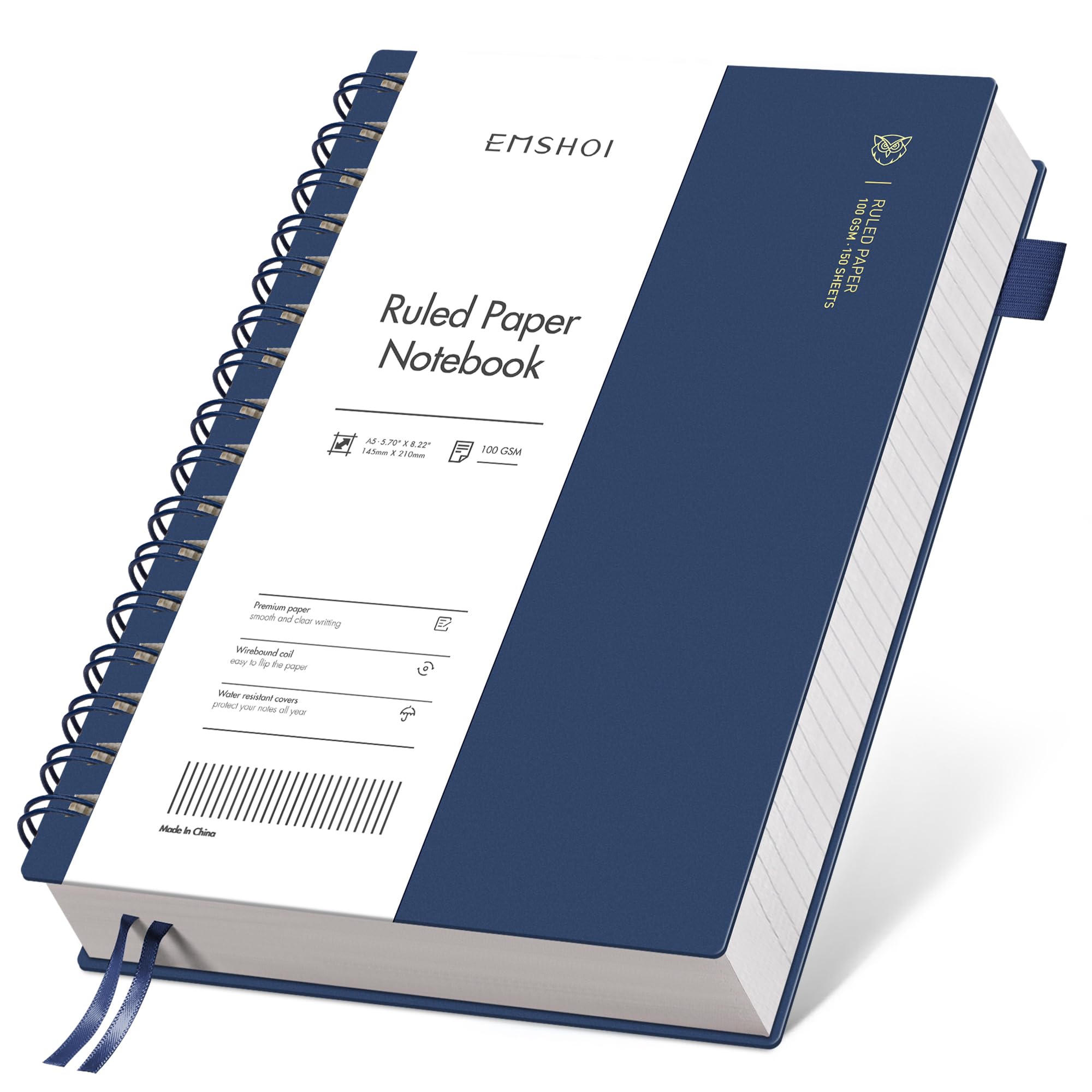
2. EMSHOI Lined Spiral Journal Notebook, 300 Pages
One fat book instead of three thin ones — 300 pages of 100 GSM paper that ends the mid-term scramble.
If you hate switching books halfway through a semester, this is your pick. You get 150 sheets totalling 300 pages in a single spine — the biggest page count on this list. The MaaIbok three-pack gives you 160 pages per book, while this one carries 300 pages in one volume. On a lecture-heavy timetable, that’s a full term in one place with no gaps in your notes.
The 100 GSM acid-free paper is the reason the machine holds up. That’s a firm sheet — noticeably more substantial than standard writing paper — and the maker states it handles most pens, pencils and markers without ghosting or bleeding. The spine also lays flat at 180° and folds a full 360° behind itself, so you can fold the book over on a narrow lecture-hall desk and still write comfortably. Navy blue plastic cover, wipeable and worry-resistant.
The accessories are where this pulls ahead of plain notebooks. There’s a pen holder, so you always have something to write with attached to the book. There’s a removable ruler, sticky index tabs for flagging pages, a bookmark ribbon, and an inner pocket. That’s a pen holder, ruler, index tabs, bookmark ribbon and inner pocket bundled into one book. The trade-off is weight and bulk: 300 pages plus a plastic cover plus accessories is the chunkiest single book here, so if you like a nearly weightless notebook in a jacket pocket this isn’t the shape for you.
Paper is the draw: at 100 GSM (grams per square metre — a measure of paper thickness), the sheets handle gel pens and highlighters without soaking through. Buyers consistently single out the paper above everything else.
The colour caveat: the navy finish divides opinion in the reviews — some love it, others expected something closer to the product photos. Order knowing that’s the one variable you don’t pick yourself.
Built for: students and office note-takers who fill pages fast and want one continuous book with all the trimmings attached.
Less ideal: if you prize a featherweight notebook or want to switch cover colours between subjects.
3. Oxford Poly Spiral Notebooks, 4-Pack, 120 GSM
The paper-heavyweight pick — 120 GSM pages inside covers that shrug off a full backpack.
Four notebooks, each with 80 sheets of 120 GSM white paper — that’s the heaviest stock on this page, and it changes how the book behaves under an ink-heavy pen. Grey college-ruled lines keep the page tidy, and the maker states plainly that ink doesn’t bleed through when writing or journaling. If yesterday’s meeting notes ghost through today’s page, 120 GSM paper is the fix.
The covers are vinyl in four jewel tones — dark blue, red, periwinkle and teal — and they’re the reason these survive real abuse. They’re thicker and semi-translucent, which gives some weather resistance a paper cover can’t match, and there’s a privacy sheet inside so the page you’re writing stays yours when you close the book in a public space. The silver twin-wire coil is no-snag by design, so it stops catching on bag straps and jacket zips — a small detail that saves actual frustration over months of use.
Here’s the honest comparison: the Oxford four-pack matches the Yansanido four-pack at 160 pages per book in the same shape, but on a thicker sheet. Where it gives ground is flexibility — 120 GSM paper is not the lightest, and the whole four-pack is a heavier load in a bag. You buy this for durability and bleed resistance, not for a pocket-light feel.
Why it holds up
- 120 GSM paper is the thickest here, so double-sided writing stays clean
- Vinyl jewel-tone covers resist wear and tear far better than paper
- No-snag coil won’t snag on bag straps or zip pulls
- Privacy sheet keeps loose notes out of sight
Fair warning
- Heavier per book than a thin-paper option, so a full four-pack is a real load in a tote
- The 120 GSM stock is meant for ink, not for a lightweight pencil-only carry
Your pick if: you write with gel pens, fountain pens or markers and want a book that treats both sides of the page as fair game.
Think twice if: you want the lightest possible notebook to carry all day.
4. DMSVK 4-Pack A5 Spiral Journal Notebook

Four colour-coded books with hard covers and an elastic strap — one per task, none lost in the bag.
Four hardcover books, each with 57 sheets (114 pages) and measuring 8.3 x 5.8 inches. That count advantage matters: this is a 4-count pack, while the Umriox set gives you 4 books too, so the difference isn’t quantity — it’s the hard cover and the waterproof, anti-scratch treatment on the boards. Those covers shield the paper inside from curling at the corners when the book’s been squashed in a backpack for weeks.
The colour thinking is what owners keep coming back to — the four Morandi shades (beige, pink, orange and green) let you assign one book per set of tasks, so “work” and “home” never share pages. The paper is 80 GSM, described as ink-friendly and suitable for ballpoints, gel pens, fountain pens, fine liners and highlighters, and there’s an inner pocket page for receipts, tickets and business cards. An elastic closure strap keeps everything shut and stops pages from flapping open when the book’s thrown in a bag.
The honest trade-off sits in the reviews: the spiral is sturdy, but the cardboard inside the cover feels lighter than a true hardcover. Some writers also find the 80 GSM paper standard rather than premium. Neither is a dealbreaker for everyday notes — it’s a fit question. If you write wet with a fountain pen and want zero bleed, look at the 100 GSM EMSHOI or the 120 GSM Oxford instead.
What buyers report: the size and the portability are the two things that keep coming up — these fit easily in purses and backpacks and still leave room to write real notes, not just a line or two.
Who it isn’t for: heavy-ink writers who need a thick sheet under a wet pen tip.
Choose this for: one book per project or subject, colour-matched so you can grab the right one at a glance.
Skip past it: if your benchmark for paper thickness is a heavy fountain-pen journal — the 80 GSM sheet here is a workhorse, not a heavyweight.
5. JASLEKO 5-Subject Notebook, 240 Pages
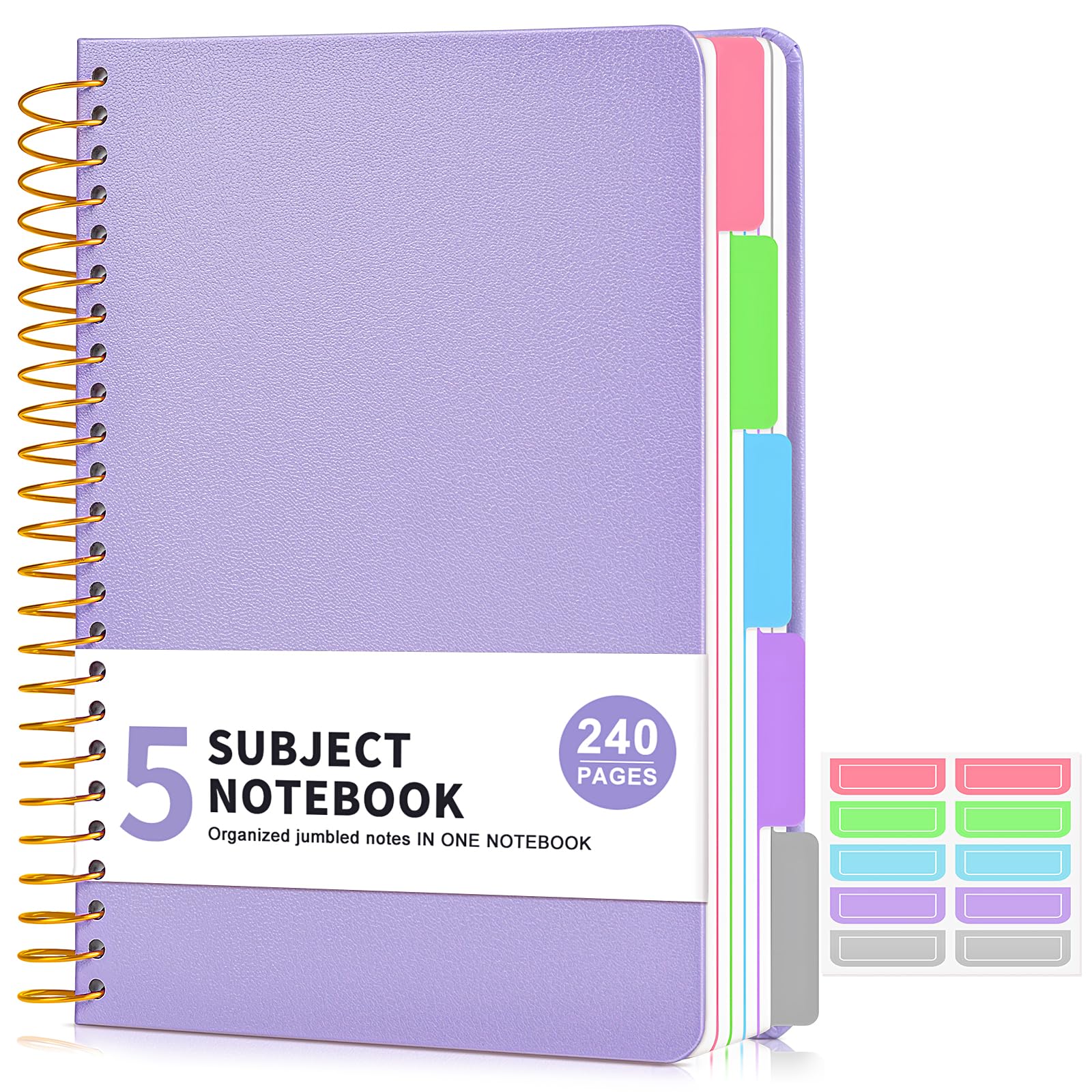
One 240-page book with five movable dividers — a semester’s worth of subjects in a single spine.
Five subjects, one book. The 5.8″ x 8.3″ page holds 240 pages, and the five removable dividers let you split them into anywhere from one to six sections — reorganise whenever your timetable changes, not just at the start of term. Each divider also carries a built-in 2.3-inch deep folder pocket, so handouts and loose sheets stay with the right subject instead of migrating to the bottom of your bag.
The 10 writable custom tabs are the clever part. They stick onto the dividers, they’re movable, and you can relabel them as you go — handy when a “Biology” section quietly becomes “Biology and lab reports.” The metal spiral coil is designed to stop pages falling out through the coil gap. The binding lets the book lie flat at 180° for writing and fold to 360° behind itself. One book replaces a stack of subject notebooks and saves backpack room.
Two things are worth flagging honestly. The page size is A5, and while that’s the point of this list, some writers find a five-subject book at this size tight — the size notes in the reviews run mixed for exactly that reason. And the value read is mixed too, since you’re paying single-book money for a book that does the work of five. If you want maximum pages for the layout and hate loose paper, this earns its keep.
The organising win
- Five removable dividers create one to six sections you can reshuffle anytime
- 10 writable tabs let you relabel subjects as the term changes
- 2.3-inch deep pockets on each divider hold loose handouts
- Metal coil fights page drop-out and still lays flat at 180°
Worth knowing
- A5 pages pack less writing room per subject than a full-size five-subject book
- Paying single-book money for one spine — the value only lands if you use all five sections
The match: college students and anyone juggling several subjects who wants everything in one place with movable sections.
The mismatch: if you’d rather carry one thin book per subject and spread the weight around.
6. Yansanido Top Bound Spiral Notebook, 4-Pack

Pages flip upward instead of sideways — the notebook for writing one-handed on the move.
Four books, 80 sheets (160 pages) each, at 8.3 x 5.9 inches with 7 mm college ruling. The defining feature is the coil position: it sits along the top edge and pages turn up and over, so you hold the book in one hand and flip with the other without the spine fighting your wrist. That makes it the natural pick for taking notes standing up — jotting sermon notes in a pew, listing items on a shop floor, or scribbling in a taxi.
The covers are thick plastic hardcovers, and the maker states they’re waterproof — a real difference from the paper and vinyl options elsewhere on this list when the book lives in a jacket pocket through a rainy walk. The paper is beige, thickened at 80 GSM, and works on both sides with no inking through to the reverse. Four colours are included — wine red, black, dark green and beige — one of each, so no arguments over who gets which.
Where this needs a heads-up: page turning is the most debated point in the reviews. Some writers find the top coil makes flipping easy; others find the same pages fiddly to turn. That’s a hand-position preference rather than a build fault — if you’ve never used a top-bound book, it’s worth knowing before you commit a whole four-pack. What wins people over is the paper: the stock is the thing that gets singled out most, ahead of anything else about the book.
Standout spec: a waterproof plastic hardcover on a notebook at this level is genuinely useful, not decorative — it means the book survives a bag that collects damp umbrellas.
Fit question: top-bound pages suit some writing angles beautifully and irritate others, so try one book before you judge the set.
Suits you if: you write while standing, holding the book one-handed, and want pages that flip skyward instead of sideways.
Not for you if: you like a traditional side-bound spine that opens flat on a desk.
7. Umriox Small Spiral Notebook, 4-Pack

Four pocket-friendly books with a date line built into every page — a diary habit in waiting.
Four colour-coded books — pink, purple, yellow and green — at 5.9 x 8.3 inches, each holding 80 sheets or 160 pages. The paper is 80 GSM with an eye-protective beige tint and 8 mm ruled lines, and every page carries a spot for the date and day of the week. That date line turns the book into a dated log you can flip back through to a specific day.
The binding is the other differentiator: a double-wire metal coil, which the maker says lays completely flat and folds a full 360° without creasing. It also helps when you tear a page out, since the double-wire construction keeps the rest of the book from scattering. Compare the binding to a single-wire book and the difference shows up in how cleanly pages survive repeated folding.
Durability is the one thing to weigh. The reviews split on it — the double-wire coil itself is sturdily built, but the covers are plastic and read as lighter-duty depending on how hard you treat your bag. If the notebook lives loose in a rucksack with keys and a water bottle, treat it with a bit of respect. For a purse, a desk drawer or a coat pocket, it’s more than enough book.
What’s prized: the paper takes the top spot with owners — thick enough that wet ink doesn’t land on the page behind it.
Sizing reality: four books in a compact A5 form fit a purse easily, but the lighter cover is the part that decides whether they last a year or a season.
Made for: a daily journaling or to-do habit where one book lives in a purse or coat pocket and gets opened several times a day.
Look elsewhere: if you need a waterproof cover or a book that survives being crushed at the bottom of a full rucksack.
8. Dynta Spiral Notebooks A5 Lined, 5-Pack

Five kraft-cover books with 100 GSM paper — the one to buy when you need a stack, not a single.
You get five notebooks at 8.3 x 5.8 inches, each with 60 lined sheets — months of journaling, work logs or study notes without a reorder. The paper is 100 GSM, and the maker states plainly that it stops ink passing through to the page behind. That suits a fountain pen, a ballpoint or a pencil, all listed as compatible with the college-ruled line spacing (narrower lines for tighter handwriting).
The cover is where the spec sheet gets interesting: a 500 GSM strong colourful cover, which is a genuinely heavy board. That’s the kind of stock that keeps the book flat in a bag instead of bending around everything else. It matters if you buy in bulk for a small business, where the books get handled daily. The kraft finish also makes them easy to decorate, label or colour-code with a marker.
Where this needs an honest note: 60 sheets per book is the shortest individual page count on this list, so a heavy writer will burn through one faster than they would the 160-page MaaIbok book. That’s the trade for buying five at once. The cover is described as soft-cover in the spec sheet despite the heavy board, so treat the corners kindly. For slow, steady use across a whole team or household, the pack maths works beautifully.
Best for volume: five books in one go with 100 GSM paper and a heavy kraft cover — the practical choice for work logs and shared offices.
The real limit: only 60 sheets per book, so the value lives in the quantity, not in the pages per spine.
Right call for: anyone stocking a home office, a small shop or a classroom where several notebooks get used at once.
Wrong call for: the single-book writer who wants maximum pages between two covers.
9. GINMLYDA 6-Pack Spiral Notebook, 120 Pages

Six colour-matched books in one bundle — the fastest way to give every subject its own cover.
Six notebooks, each with 120 pages of lined paper, measuring 8.25 x 5.5 inches. That’s 6 books against the DMSVK four-pack, and the DMSVK carries 114 pages per book compared with 120 pages here — so this bundle wins on both the number of books and the pages inside each one. Each cover is a different colour (red, blue, black, grey, dark green and kraft brown), which makes colour-coding subjects genuinely easy.
Each page is wide ruled rather than college ruled, so there’s more room between the lines. The maker lists pencils, gel pens, ink pens and highlighters as suitable, and describes the paper as thick with resistance to bleed-through. The double-wire spiral binding lets the book open a full 360° without folding creases, so it folds right back on itself when you’re writing in a tight space. The soft kraft covers are plain by design, which makes them a good base for decorating, doodling or labelling.
The most-discussed point in the reviews is the paper. Several writers describe it as thick enough for daily use, while others read it as standard stock — a mixed picture rather than a firm verdict. It’s fair to call this the bundle-first pick: if you want six colours and 120 pages a book to organise a term or an office, this delivers. If premium paper is your priority over quantity, the 100 GSM EMSHOI or the 120 GSM Oxford is the safer purchase.
Why the bundle works
- Six books with 120 pages each — the largest book count in one purchase here
- Six distinct cover colours for colour-coding subjects or projects
- Double-wire spiral opens to a full 360° with no creasing
- Plain kraft covers are easy to decorate, label or mark up
Honest limits
- Paper quality is the debated point — some find it thick, some find it standard
- Wide ruling gives fewer lines per page if you write tight
Go for this if: you want six separate colour-coded books and enough pages to last a term, all in one purchase.
Pass on it if: the paper itself is the reason you’re buying, and you want the heaviest stock on offer.
Understanding the Specs
Paper weight (GSM)
GSM means grams per square metre — a measure of how much paper is packed into each sheet, and the single number that predicts how a notebook handles ink. An 80 GSM sheet is standard writing paper; 100 GSM feels firm; 120 GSM is close to light card. The heavier the sheet, the less likely a wet pen ghosts onto the reverse side. If you write with ballpoints, 80 GSM is fine. If you prefer gel pens, fountain pens or highlighters, look for 100 GSM and up.
Binding and lay-flat
Spiral binding comes in side-bound and top-bound styles. Side-bound coils typically open 180° flat for desk writing and many fold 360° behind the book to save space. Top-bound coils turn pages upward, which suits writing with the book held in one hand. A double-wire coil tends to hold pages more securely than a single wire and help the book survive repeated folding.
Page count and sheet count
Manufacturers mix these two terms, so check the listing carefully. A sheet is one physical piece of paper with two sides; 80 sheets is 160 pages. A “300 page” book is 150 sheets. If you compare a 160-page book with a 300-page book, the 300-page one holds roughly twice the writing room — worth knowing before you assume a multipack always gives you more total pages.
Cover material
Paper covers are light and flexible but scuff easily. Vinyl and poly covers resist wear and offer some weather resistance. Hard plastic covers are the toughest, often described as waterproof, and stop paper inside from curling. If the notebook lives loose in a backpack, the cover is the part that decides how long the book looks presentable.
FAQ
Is A5 the same as a standard school notebook?
Will a fountain pen bleed through 80 GSM paper?
What does 160 pages actually mean in sheets?
Can a spiral notebook fold all the way back without breaking the coil?
Is top-bound better than side-bound?
How long does a 240-page five-subject notebook last?
Do these notebooks fit in a standard backpack pocket?
Is thicker paper worth the extra weight in a bag?
What is a privacy sheet and do I need one?
Can I tear pages out of a spiral notebook cleanly?
Final Thoughts: The Verdict
For most people, the a5 spiral notebook winner is the MaaIbok 3-Pack. Its thick paper, twin-wire lay-flat binding and 160 pages per book cover everyday journaling and note-taking without a compromise. The added elastic band and back pocket make it a genuinely useful bag companion. If you fill pages fast and want one long, continuous book with a pen holder and tabs built in, the EMSHOI 300-page journal is the better shape. For heavy-ink writers who want both sides of the page usable, the Oxford poly 4-pack with its 120 GSM sheets is the most forgiving paper here. If you’re organising several subjects in one spine, reach for the JASLEKO 5-subject book and its movable dividers. The honest nudge: match the paper weight to your pen first — 80 GSM for ballpoints, 100 GSM and up for gel or fountain pens — and let every other choice follow.
How We Picked
We do not accept paid placement. Every pick is matched to a real buyer and a real use-case; we do not hands-on test units.
Sources & Methodology
Specifications: manufacturer listings and product documentation. Review insights: verified customer reviews, as of November 2026. Pricing: not shown on this page (it changes often); check the current price via the retailer link.
As an Amazon Associate, Gadgets Feed earns from qualifying purchases. This does not affect which products we feature.