
Our readers keep the lights on and my morning glass full of iced black tea. As an Amazon Associate, I earn from qualifying purchases.
Specs are compiled from manufacturer listings and verified buyer reviews and can change over time — please confirm the key details on the product page before buying.
For a child with autism, a speech delay, or an adult rebuilding language after a stroke, the right flash card can be the difference between frustration and a breakthrough. The best sets use clear, real-life photographs — not cartoons — so the learner instantly connects the picture to the word. This guide compares the top ABA flash card sets by photo quality, card durability, and how well they support both receptive language (matching words to images) and expressive language (naming the action or feeling out loud).
I’m Min — the founder and writer behind Gadgets Feed. This guide is built by comparing the manufacturers’ published specifications and the patterns across verified customer reviews, so you get each pick’s real strengths and trade-offs instead of marketing spin.
Whether you’re a parent, therapist, or teacher, finding the right aba flash cards means choosing real photos, sturdy cardstock, and a set that grows with the learner’s skills.
Our Picks at a Glance


How To Choose The Best ABA Flash Cards
ABA (Applied Behavior Analysis) flash cards work best when they are clear, durable, and match the learner’s current skill level. The most important choice you’ll make is between real photographs and illustrated cards. Real photos show genuine facial expressions and real-world actions, which makes them easier for many learners to understand and generalize to daily life.
Real Photos vs. Cartoon Illustrations
Real-life photographs give learners an accurate model of what an emotion or action actually looks like on a person’s face or body. Cartoon drawings, while cute, can be abstract and confusing for a child who is already struggling to read social cues. For teaching verbs like “kicking” or “drinking,” a genuine photo leaves no room for misinterpretation.
Card Size and Durability
Bigger cards are easier for small hands to hold and for a group to see during a classroom lesson. Durability matters just as much — a 300GSM coated cardstock with a scratch-resistant finish will survive being dropped, bent, and wiped clean, while thinner paper cards will show wear within weeks. Think about if you need wipe-clean surfaces for multiple users.
Double-Sided Design and Learning Activities
Many of the best sets print the photo on one side and the written word on the back. This lets you use the same card for receptive language (asking the learner to point to “jumping”) and expressive language (asking them to name the action they see). Some sets go further by adding traceable words or QR codes that play a short video of the action.
Quick Comparison
| Model | Best For | Card Count | Card Size | Image Style | Amazon |
|---|---|---|---|---|---|
| Picture My Picture Verbs★ Best Overall | Learning action words | 40 | 5.91″ x 3.94″ | Real Photos | Amazon |
| My Behaviour CardsBest Portable | Portable communication | 27 | 3.66″ x 2.36″ | Illustrated | Amazon |
| My Feelings and EmotionsBest Illustrated Emotions | Emotion recognition | 27 | 3.66″ x 2.36″ | Illustrated | Amazon |
| CreateFun 50 Emotion Cards | Real-face emotion cues | 50 | 4.5″ x 3.5″ | Real Photos | Amazon |
| ALSOLIFE 80 Verb Cards | Video-enhanced learning | 80 | 3.5″ x 3.5″ | Real Photos + Video | Amazon |
| Picture My Picture Emotions | Deep emotion vocabulary | 40 | 4.3″ x 6.2″ | Real Photos | Amazon |
| CreateFun Go Together | Matching and sequencing | 50 | 3.55″ x 4.55″ | Real Photos | Amazon |
| ThinkPsych First Nouns | Building a noun vocabulary | 150 | 7″ x 4″ | 3 Styles per Card | Amazon |
| Quokka Vocabulary Builder | All-in-one 7-category set | 364 | 6″ x 5″ | Real Photos | Amazon |
In‑Depth Reviews
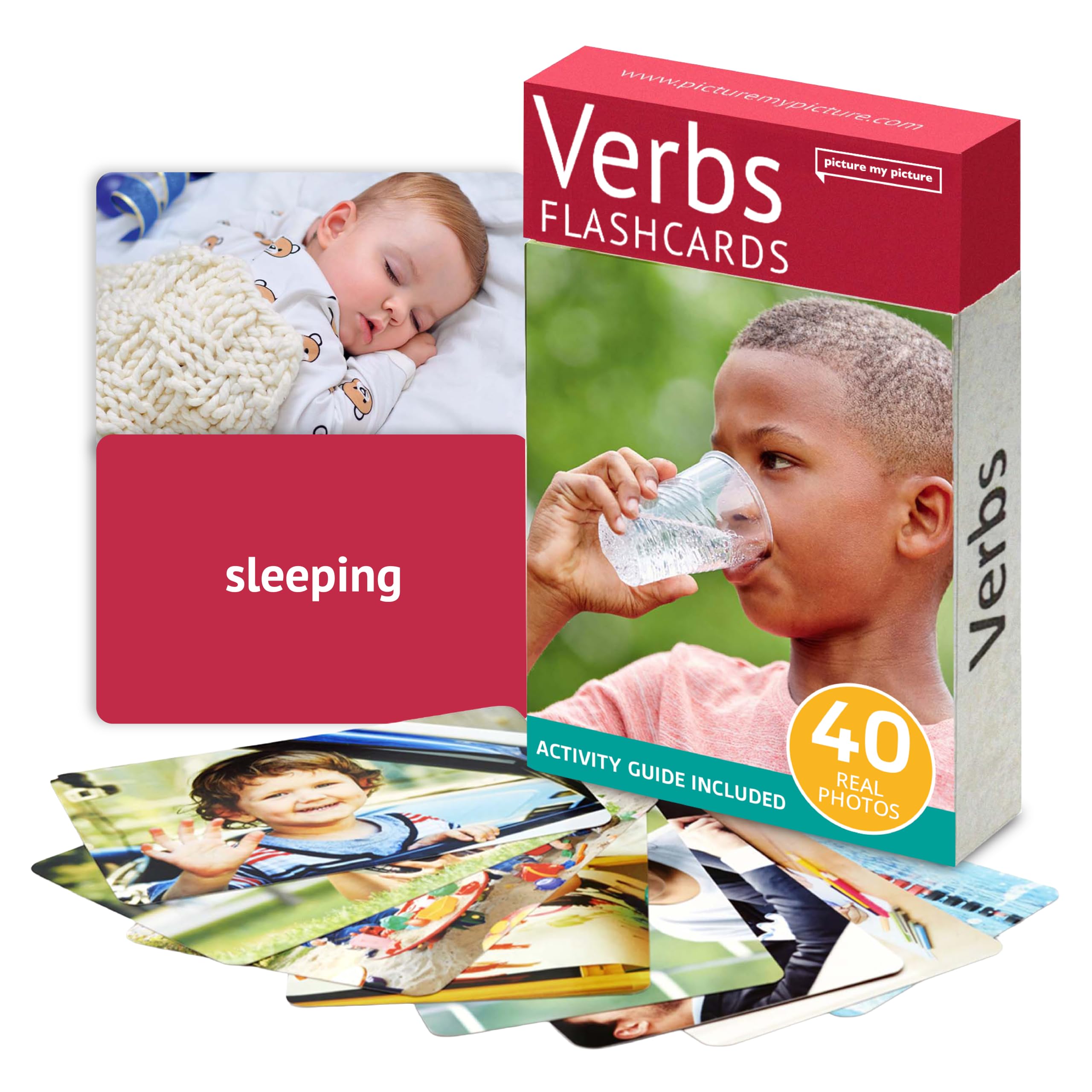
1. Picture My Picture Verbs ABA Therapy Cards Vol 1
Our pick — over 4.5★ from 900+ verified ratings; the strongest balance of quality and price.
The gold standard for learning action words, with photos so bold they teach at a glance.
The moment you open this set, the photo quality is what hits you. These are vivid, real-life photographs of people actually performing each action — kicking, drinking, waving, jumping, eating — with no cartoons or abstract illustrations that can confuse a learner. The crowd favorite among all nine sets here is the sheer quality of the cards: roughly 36 owners single out the physical quality, and a similar wave of parents reports real progress in their children’s speech. As buyers report: “The quality and boldness of the pictures is phenomenal. The thickness is just right!”
Each card is double-sided: the full-color photo faces you, and the written verb label sits clearly on the reverse. That design lets you run two different activities with the same card — first have the child point to “jumping” (receptive language), then flip it and have them name the action they see (expressive language). The cardstock is a thick 300GSM coated art card with a scratch-resistant, wipe-clean finish, so it survives classroom handling, therapy sessions, and enthusiastic young learners without showing wear.
The set is purpose-built for professional use — it’s a recommended tool among speech therapists and ABA practitioners for early intervention and autism support — but it’s just as easy for a parent to use at home. A step-by-step activity guide walks you from simple identification up to full-sentence construction, so you never wonder what to do next. The 40 cards measure 5.91 x 3.94 inches, which is a 61% larger card face than the compact My Behaviour Cards set below — a size difference that makes these far easier for a group to see during a lesson. The only recurring gripe is the tuck box: the top is short and slides off easily, so you may end up taping it shut to keep cards from scattering in your bag.
Why it leads the list
- Real photo action verbs that are immediately understandable at every skill level
- Thick 300GSM scratch-resistant cardstock that wipes clean between users
- Double-sided photo-and-word design supports two learning activities per card
The honest trade-offs
- The storage box lid slides off easily, so you may need tape to keep it closed
- Focuses on verbs only — you’ll want a separate emotions or nouns set
Reach for these if: you want the most trusted, professional-grade verb card set that works for toddlers through ESL adults.
Look elsewhere if: you need a set with emotion or noun vocabulary, since this one covers action words only.
2. My Behaviour Cards 27 Flash Cards
A pocket-sized communication lifeline that goes anywhere, held together by a clever bungee clip.
These cards are built for one specific job: giving a non-verbal child or adult a way to communicate when words aren’t working. The 27 hand-drawn, illustrated flashcards cover key behaviour and communication ideas, and they’re made from the same resistant linen-finish cardstock as professional playing cards. The whole set — measuring just 3.66 x 2.36 inches — slides into a small box with a helpful bungee clip that keeps everything safe and organized, which makes them ideal for slipping into a bag or stroller for on-the-go use.
ABA professionals and families alike report these are genuinely useful. The review pages show a clear pattern: people working in ABA find they “came in handy,” and a grandmother describes them as “fantastic and very helpful” for her grandson on the spectrum. The illustrated format and compact size are the trade-offs to weigh. Owners mention: “I like these cards, i just wish they were a little bigger. If they were double the size, they would grab the students attention better.” At roughly half the card-face size of the Picture My Picture Verbs set above (3.66 x 2.36 inches vs. 5.91 x 3.94 inches), these are best for one-on-one work where the learner holds the card, not for group lessons where everyone needs to see.
The design philosophy here is anxiety reduction. By having a set of communication cards on hand, the idea is that an individual can communicate effectively even when the words aren’t cutting it — which is why these also work for children with selective mutism and adults with Alzheimer’s. The bungee clip is the standout feature, preventing the cards from becoming a scattered mess in a therapy bag.
What wins people over: the portability and the bungee clip that keep these organized in any bag, plus the durable linen finish that resists daily handling.
Who this isn’t for: teachers running group lessons — at 3.66 x 2.36 inches, these cards are small and the illustrated style won’t grab attention from across a classroom.
3. My Feelings and Emotions 27 PECS Flashcards
For the child who won’t use words, a hand-drawn emotion card that says it for them.
This set tackles the hardest communication challenge: helping a child express what they feel. The 27 hand-drawn flashcards illustrate key emotions and items, using the same resistant linen-finish cardstock and portable small box as the Behaviour Cards set above. What makes it different is the emotional focus — these cards are designed to help a child recognize and name feelings like being overwhelmed, frustrated, or happy, using a pictorial cue when verbal expression fails.
The review picture is reassuring for parents of non-verbal children. Families using these for therapy practice at home report they’ve been “the perfect tool to help bring some of my daughter therapy practices to home,” and the cards are described as genuinely durable, which is note since several buyers expected them to feel flimsier. The manufacturer recommends these for ages 36 months to 20 years, which reflects a real range of emotional vocabulary. One pattern that does emerge: the set includes some complicated emotion words that parents of younger kids end up sorting through — a mother of a young child notes there are “too many cards with complicated emotions that I wouldn’t necessarily use.”
The practical catch is the loop that holds the cards together. One parent wishes the cards were laminated so they “couldn’t be pulled off the loop,” which is the one recurring durability note. For school-age children and for parents doing therapy follow-up at home, the emotional range here is the strength — but if you’re shopping for a toddler, you may find yourself setting aside half the deck until they’re older.
Best used for: school-age children and teens who need a concrete visual to express complicated feelings, whether at home or in a SEN (special educational needs) setting.
A note on durability: the cards themselves hold up well, but the loop that keeps them together can let cards slip off — handle the set gently.
4. CreateFun 50 Emotion Flash Cards V1

Fifty real human faces showing ten emotions, so a learner reads feelings the way they’d see them in life.
If you believe — as many speech therapists do — that you can’t teach a child to read emotions from cartoons or emojis, this set is built for you. It features 50 cards with real people showing believable emotions across 10 feelings: happy, sad, angry, scared, surprised, tired, stressed, love, excited, and disgust. The real-photo format is exactly what makes it work for teaching emotion recognition to toddlers, and one parent reports her toddler has become “a pro now” at reading others’ emotions after using the set.
The cardstock is thick, water resistant, and smudge proof, which makes these practical for repeated handling in a clinic or a home with a young child. At 4.5 x 3.5 inches, they’re a middle-ground size — bigger than the pocket-sized Amonev sets, smaller than the Picture My Picture cards. This set has a genuinely diverse, well-balanced range of images that work across ethnic lines, which parents specifically call out as a reason they chose it over other decks.
The honest note here is about the emotion vocabulary itself. The emotional representation gets the most discussion in the reviews, and it’s a mixed message: some parents love that the words are simple, while others wish the set used the easiest possible label for each feeling — one parent specifically asks for “mad instead of angry.” The 10-emotion spread also means the 50 cards repeat the same feelings across different faces, which is great for generalization but not for breadth of vocabulary. If you want both real faces AND a simpler first-word approach, think of this as a strong single-emotion deck rather than a complete feelings curriculum.
The real-face advantage
- Real people with believable expressions — no cartoons or emojis
- Water-resistant, smudge-proof thick cardstock that lasts
- Diverse images that work across ethnic lines
The vocabulary catch
- Some labels use bigger words (“angry”) where simpler ones (“mad”) might work better
- Only 10 distinct emotions, so the 50 cards repeat feelings across faces
Choose this for: teaching a toddler to read real facial expressions using photos of actual people.
Consider the trade-off: the emotion vocabulary is limited to 10 feelings, so this suits early learners more than advanced emotion work.
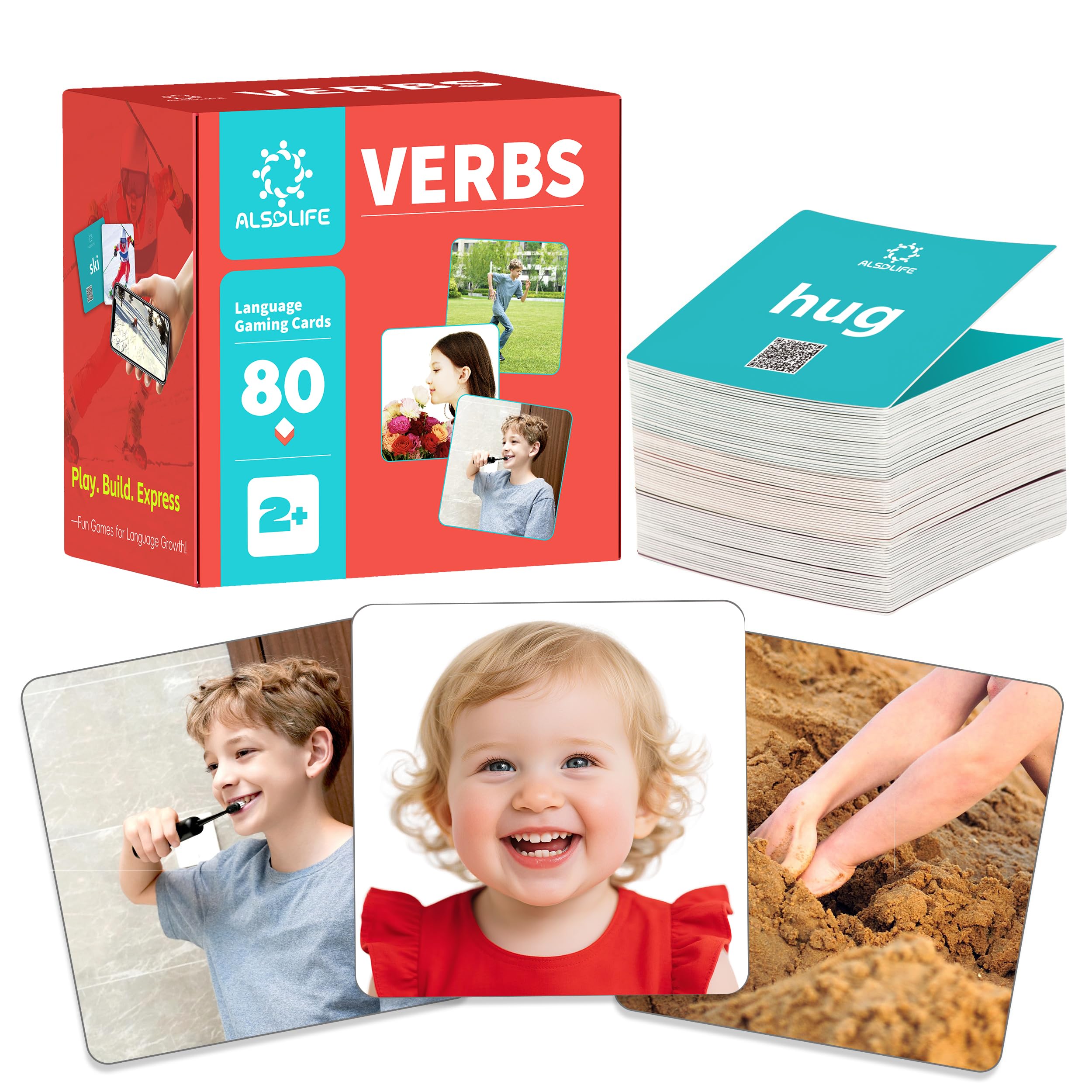
5. ALSOLIFE 80 Verb Cards Speech Therapy
The only set here that brings action verbs to life with a scan-and-play video on every card.
This set solves a problem most verb cards can’t: a still photo only shows one frozen moment of an action. Each of the 80 ALSOLIFE verb cards features a QR code that plays a short action verb video, helping kids learn and retain verbs by seeing the full motion of the action. For a child with a speech delay or autism, watching “jumping” actually happen on screen is a far richer lesson than a single still frame. Parents and therapists report this is the best of the realistic sets they’ve tried, with one noting the videos make the images “come to life.”
The card construction is genuinely thoughtful. These are extra-thick, durable 3.5 x 3.5 inch cards with double-sided lamination and rounded corners, so they survive spills, endless repetition, and toddler chaos. The back of each card features large, traceable words, so kids can practice pen control and letter formation with an erasable marker — a multi-skill approach that builds writing alongside vocabulary. The set includes a Parent Guide with 8 fun educational card games that range from simple matching to advanced challenges, plus action videos as part of the included components.
The design is expert-backed, created by speech-language pathologists for use as ABA therapy materials, ESL teaching resources, and stroke recovery flashcards. This dual audience matters: one reviewer bought these for her mother with severe aphasia and apraxia of speech and reports they’re helping. The one honest note is that the video character is described as “a bit childish” for older speech therapy clients — while the real-life videos are great, the animated presenter skews toward elementary-aged learners. If your learner is older or an adult, this may feel young; for a child in the 4-8 range, it’s tough to top.
The standout feature: the QR video that shows each verb in motion — something no other set in this guide offers.
Who it suits best: kids aged 4-8 who need motion to understand action words; adults may find the video presenter too childish.
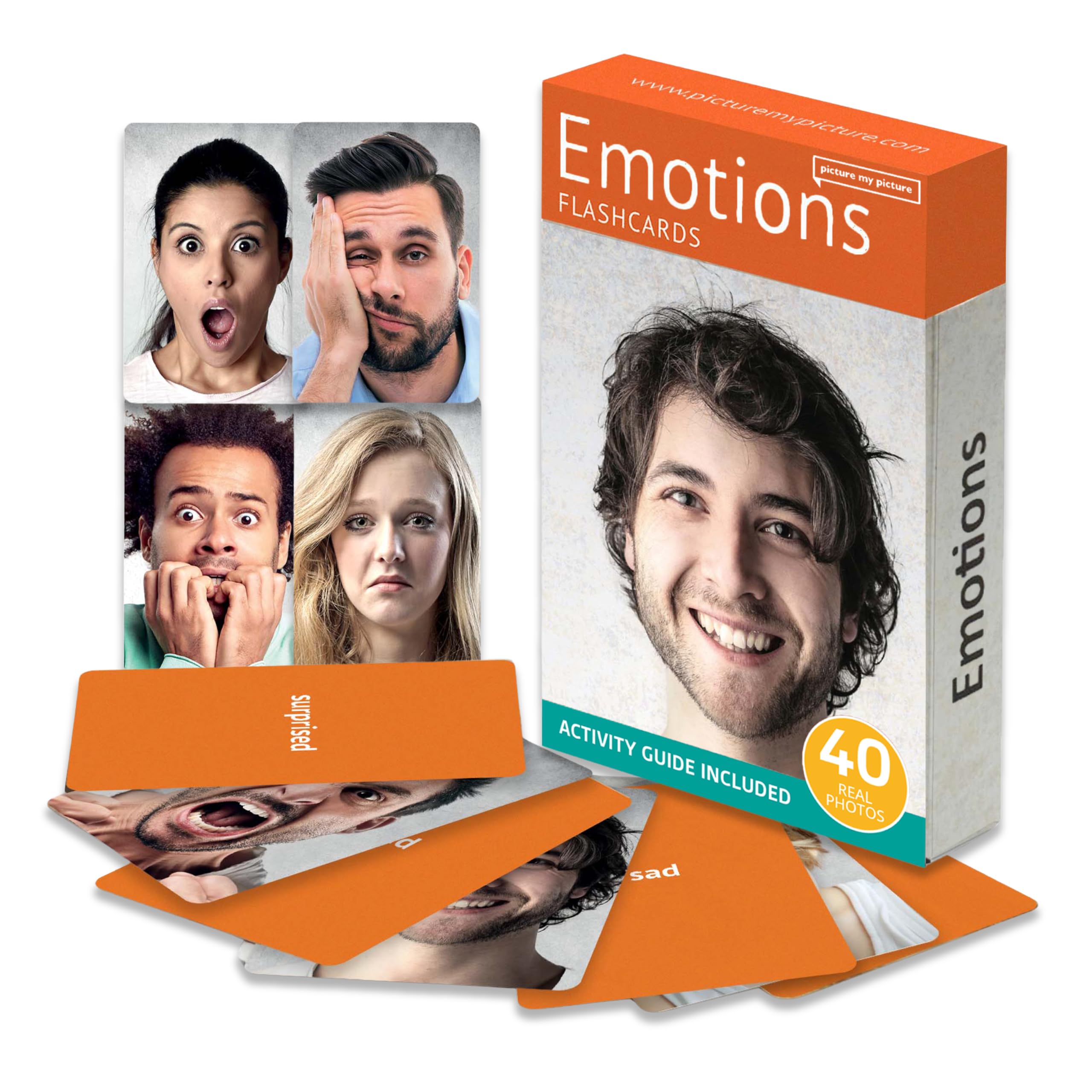
6. Picture My Picture Emotions ABA Therapy Cards Vol 1
A bigger, sturdier emotion deck that shows one feeling across four different faces.
This is the emotion-focused sibling to our Best Overall verbs set, and it shares the same winning formula: real photos, quality construction, and a thoughtful learning system. The 40 premium cards measure 4.3 x 6.2 inches — the largest card face in this entire guide — and they’re noticeably sturdy and durable in hand. What sets this deck apart is its structure: it teaches 10 core emotions — happy, sad, angry, surprised, frustrated, scared, worried, tired, silly, and bored — with four different photo cards for each feeling. That repetition across different faces and situations is the key to generalization, helping a learner recognize that “happy” looks different on different people.
The photos show real people of different ages, genders, and races, which parents love and specifically recommend to others. The set is designed by experts for early intervention and ABA therapy, but it’s equally useful at home — the included step-by-step activity guide provides multiple speech therapy games that target both receptive and expressive language. Parents report using these to bring therapy practices home, and the quality is high enough that people ask where they bought them. It also integrates with the wider Picture My Picture system — verbs, prepositions, categories — so you can build a complete language library.
The honest fit note is that while the manufacturer lists 10 emotions, some buyers count only 9 distinct true emotions represented, and a few find the set too basic for older learners. This is a trade-off of the four-cards-per-emotion design: you get depth on each feeling, but less breadth overall. For a learner who needs to really understand one emotion across contexts, this beats any single-photo-per-feeling deck; for maximum emotion variety, you’d want more distinct feelings.
What makes it special: four real-photo cards per emotion, teaching a child that the same feeling looks different on different faces.
Think twice if: you want maximum emotion variety — this deck explores 10 feelings deeply rather than covering 20+ briefly.
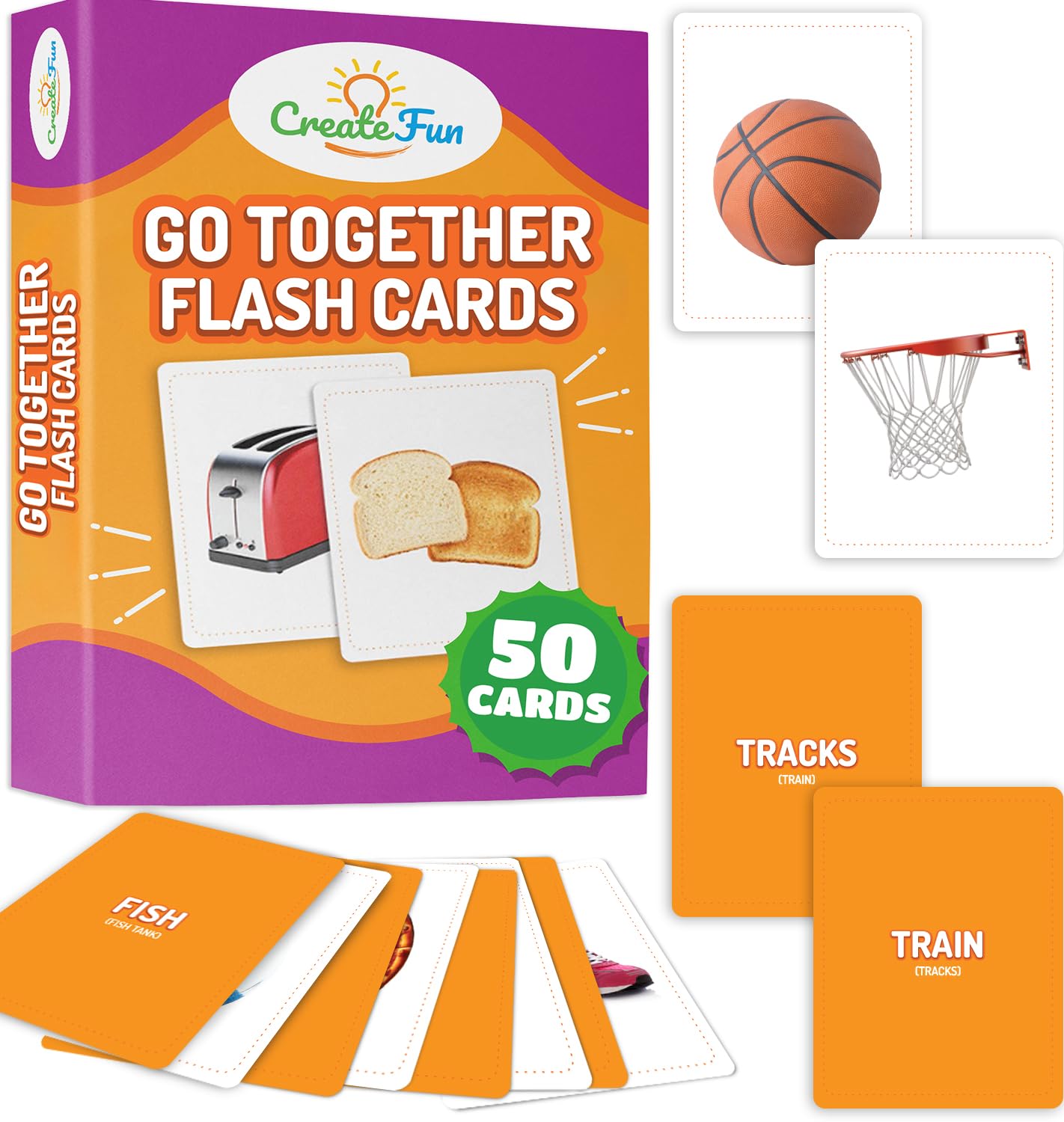
7. CreateFun Go Together Flash Cards
The matching game that teaches logic, sequencing, and conversation — one pair at a time.
This set takes a different approach from the emotion and verb decks: instead of single concepts, it teaches relationships. The 50 cards form 25 matching pairs of things that go together — think of the logic of “why does this belong with that?” — which builds critical thinking, sequencing, verbal concepts, and reasoning. The learning here is about the connection between objects, not just naming them, which makes it a stronger cognitive workout than a basic vocabulary deck. Parents report the cards “motivated my students to learn more by looking at pictures and spelling words.”
The real strength of this set is its astonishing age range. It’s marketed for toddlers and kindergarteners, but the reviews tell a broader story: it works for children, for ESL students, and for seniors. Families describe using it with an 87-year-old mother recovering from a brain bleed after a fall, and with an elderly father with short-term memory loss who “does fairly well at matching these cards.” That versatility — from preschool matching games to dementia and aphasia activities — makes it a rare tool that serves a family across generations. The cards measure 3.55 x 4.55 inches with a durable, smudge-proof, water-resistant coating.
This is the set to reach for when flashcards feel like drills and you need to make learning feel like play. The matching format naturally creates a game — lay out pairs, mix them up, find the partners — which keeps a child engaged longer than rote naming. It’s also the only set in this guide explicitly designed around the “go together” concept, so it fills a distinct niche in a complete ABA or speech therapy toolkit. The fewer cards per concept (50 total vs. 150 or 364 in mega-sets) means it’s focused rather than exhaustive, which is the right call for its matching-game purpose.
The pairing advantage
- Teaches relationships and reasoning, not just object names
- Genuinely works across ages — from toddlers to seniors with dementia
- Smudge-proof, water-resistant coating for heavy use
What to weigh
- 50 cards is a focused set, not a comprehensive vocabulary library
- The matching format is best for learners who already know basic object names
Grab this for: turning language practice into a game that works for kids and elderly family members alike.
skip it if: you need a first vocabulary deck — this one assumes knowledge of the objects and teaches the relationships between them.
8. ThinkPsych First Nouns Flash Cards

A 150-card noun library where every word appears in three different visual styles.
This is the big-box noun set, and its defining trick is the triple-format approach: each noun comes in three card variants — cartoon, realistic cartoon, and real life. That progression is powerful because it teaches a child that a “dog” in a cartoon, a “dog” in a stylized drawing, and a “dog” in a real photo are all the same concept. A parent using these with a son who has expressive language delays calls them “small and thick-great for little hands to hold and manipulate without damaging them.” The cards cover animals, clothes, food, body parts, emotions, and more, spanning a full noun vocabulary for PreK through kindergarten.
The durability story is strong. These cards are marketed as 3X thicker, laminated to protect against spills, and wipe clean. They’re certified non-toxic, BPA-free, and CPSIA compliant, which matters if a baby or toddler will handle them. The set includes 4 language games to keep learning fun, and each card has bonus words on the back to promote deeper learning as the child’s language grows. Speech professionals report using these in medical settings with adult patients working on word finding, categorizing, sequencing, and memory skills — a stroke or dementia patient gets real value from the category-based organization.
The one recurring trade-off is the price-to-value question. While the card quality is praised — the most-discussed positive is the card quality, with roughly 26 owners noting it — several buyers find the set overpriced relative to what it contains. The same reviewer who calls them “great for my adult patients” also notes they’re good quality at an affordable price, so the value verdict genuinely splits. If you want the deepest noun coverage in one box, this delivers; if you only need a small set for one learner, the cost per card here is higher than the mega-sets below.
The defining feature: three visual styles per noun — cartoon, realistic cartoon, and real life — which builds true concept generalization.
Weigh this: the value-for-money verdict is split; you’re paying for premium thickness and the triple-format design, not sheer card count.
9. Quokka Vocabulary Builder Flash Cards
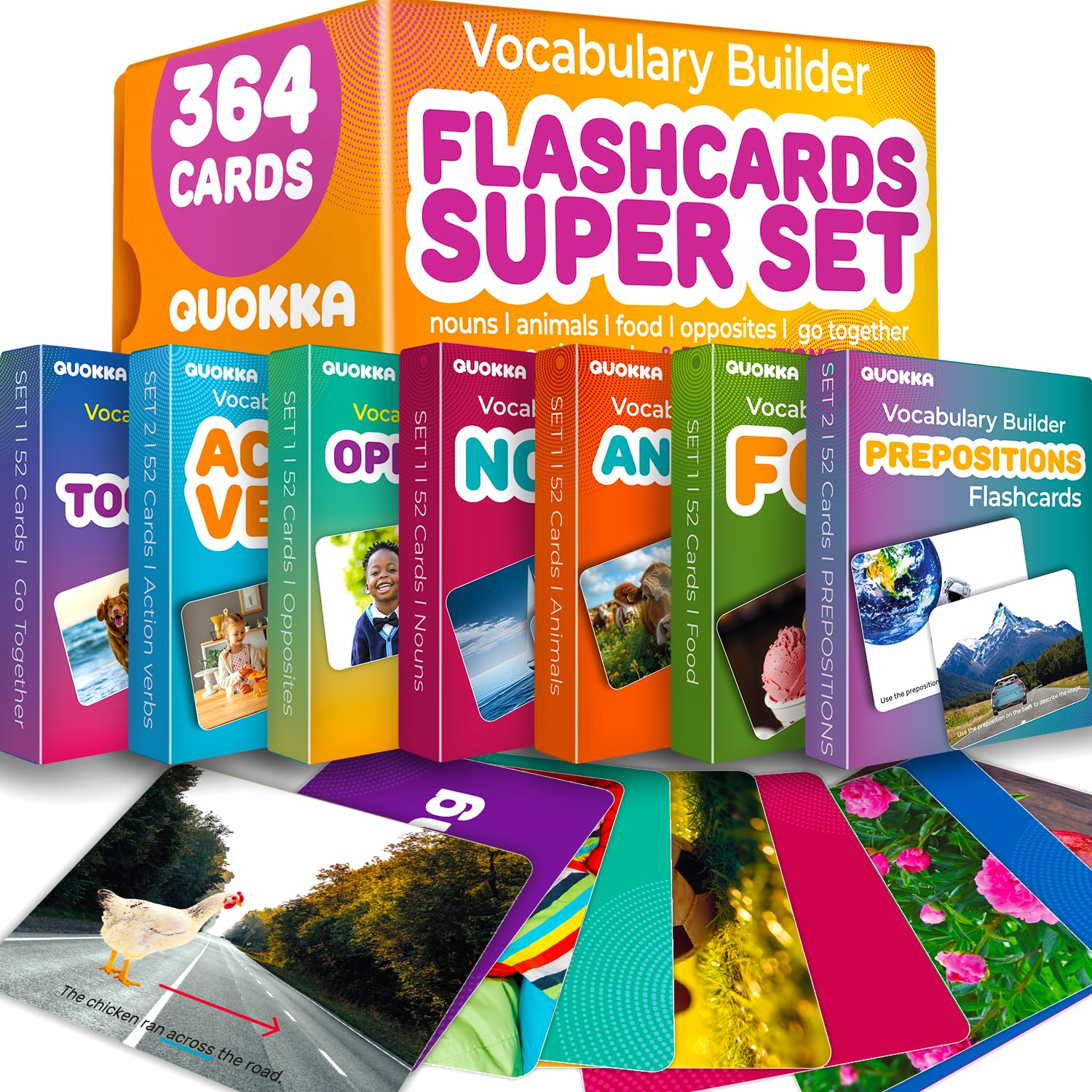
No need to buy seven separate decks — this one box holds 364 cards across seven categories.
If you’re building a complete home or classroom language library and want to buy once, this is the set that replaces the whole shelf. The Quokka Vocabulary Builder packs 364 real-photo flashcards into one box, covering seven categories: Prepositions, Nouns, Food, Go Together, Opposites, Action Verbs, and Animals. That’s the entire spread of concepts most ABA and speech therapy programs cover, in a single purchase. For a daycare, preschool, or therapy clinic, this level of coverage in one set is a genuine time-saver.
The categories are what make it valuable. Instead of buying a separate verb deck, an emotions set, and a prepositions pack, you get them all here with high-quality realistic images that make learning relatable. The picture quality is a major theme in the reviews — roughly 14 owners highlight it directly — and parents describe the cards as bright, colorful, and genuinely nice quality. One speech therapist bought them for her mother’s stroke recovery and reports they’re “helpful in expanding her vocabulary and making new pathways,” while a daycare uses them across all its classes. The cards measure 6 x 5 inches, a comfortable size for group viewing.
The honest trade-off is the visual consistency. Because the set covers so many categories, a few pictures have what one buyer calls “an international flair” that can occasionally be confusing, and the sheer 364-card count means some users wish the cards were larger, particularly for toddler-age learners. But those are fit notes, not flaws — for the price-per-card value, this set is class-leading in this guide, described as excellent value for money. It’s also backed by a responsive manufacturer: one buyer’s initial order included a missing or wrong deck, and Quokka quickly shipped a replacement. For a caregiver who wants one box that covers everything, this is the choice.
Why it’s the all-in-one pick
- 364 cards across 7 categories replace several separate decks
- High-quality real photos that work from preschool through adult stroke recovery
- Strong value — the best price-per-card ratio in this guide
The honest caveats
- A few photos have an international flavor that can occasionally confuse
- Some users wish the 6 x 5 inch cards were even larger for toddler groups
Buy this one if: you want maximum coverage in a single box for a daycare, classroom, or family with children at different levels.
Consider a smaller set if: you only need one concept — say, verbs alone — since this packs seven categories together.
Understanding the Specs
Card Thickness (GSM)
GSM stands for grams per square meter, and it measures how thick and sturdy the cardstock is. A 300GSM coated card (like the Picture My Picture sets use) is thick enough to survive classroom handling, repeated bending, and wiping clean between users. Thinner paper cards will buckle or tear within weeks of enthusiastic use. For any card meant to be used daily in therapy or by small hands, look for a thicker, scratch-resistant or laminated finish.
Double-Sided Design
The best ABA flash cards print the photo on one side and the written word on the back. This single design choice doubles the value of every card: you can practice receptive language (asking the learner to point to “jumping”) and expressive language (having them name the action they see) with the same card. Some sets, like the ALSOLIFE verb cards, add traceable words on the back so a card also builds writing skills.
FAQ
Are real-photo cards better than illustrated cards for ABA therapy?
How many cards do I actually need to start?
What does double-sided mean and why does it matter?
Will these cards work for an adult with aphasia or after a stroke?
What is the difference between a verb card and an emotion card?
How do I keep the cards clean when multiple kids use them?
Are these cards appropriate for a 2-year-old?
What does 300GSM mean for a flash card?
Final Thoughts: The Verdict
For most families and therapists, the best aba flash cards are the Picture My Picture Verbs set because the bold real photos, thick 300GSM cardstock, and double-sided design make it the most complete, professional-grade tool in this guide. If you want a deck that brings verbs to life with motion, grab the ALSOLIFE 80-card set with its QR videos. And if you’re building a whole language library in one purchase, the Quokka Vocabulary Builder packs 364 cards across seven categories for class-leading coverage.
How We Picked
We do not accept paid placement. Every pick is matched to a real buyer and a real use-case; we do not hands-on test units.
Sources & Methodology
Specifications: manufacturer listings and product documentation. Review insights: verified customer reviews, as of August 2026. Pricing: not shown on this page (it changes often); check the current price via the retailer link.
As an Amazon Associate, Gadgets Feed earns from qualifying purchases. This does not affect which products we feature.