
Our readers keep the lights on and my morning glass full of iced black tea. As an Amazon Associate, I earn from qualifying purchases.
Specs are compiled from manufacturer listings and verified buyer reviews and can change over time — please confirm the key details on the product page before buying.
Sore arm from skimming, weekends lost to manual cleaning — an above ground pool sweeper gives you back that time if you choose the right type for your pool. The trick is matching the sweeper to your pool size and your expectations, because not everything labeled “automatic” actually moves across the floor. This guide breaks down the real differences between pressure-side units, cordless robots, and premium models so you can stop shopping and start swimming.
I’m Min — the founder and writer behind Gadgets Feed. This guide is built by comparing the manufacturers’ published specifications and the patterns across verified customer reviews, so you get each pick’s real strengths and trade-offs instead of marketing spin.
The right above ground pool sweeper saves you hours of manual labor each week. With the options here, you can pick the one that fits your setup and your budget without guesswork.
Quick Picks
- WYBOT A1 Robotic Pool Cleaner – Dual-Layer Filtration, Strong Suction — Best Overall
- ABNEMEN Cordless Robotic Pool Cleaner – 180 Mins Runtime — Large Pool Pick
- Seauto SAT25 Cordless Robotic Pool Vacuum – Dual 180W Motors — Premium Pick
- BOTLUXE PC10 Robotic Pool Cleaner – 5,000 GPH Suction — Deep Clean Value
- PoolMr Cordless Robotic Pool Cleaner – 40W Strong Suction — Entry-Level Robot
- INTEX 28006E ZX100 Pressure-Side Above Ground Automatic Pool Cleaner — Budget Pressure-Side
How To Choose The Best Above Ground Pool Sweeper
Picking the right sweeper for your above ground pool depends on your pool’s size, the kind of debris that falls into it, and how much hands-on work you want to avoid. Here are the three specs that define the decision.
Suction Power and Filtration
Your sweeper’s ability to clean depends on its suction strength and the filter it uses. Suction is measured in GPH (gallons per hour — how much water it processes in an hour) or motor wattage (a unit of electrical power that tells you how strong the motor is). The filter is measured in microns (one micron is one-millionth of a meter; the smaller the number, the finer the particles it catches). A sweeper with 180-micron mesh catches sand and fine dirt, so those particles stay out of your pool water, while a coarser filter traps leaves but lets silt pass through.
Runtime and Coverage Area
For cordless robotic sweepers, the battery runtime (measured in minutes) must cover your entire pool surface in one go. The coverage area (in square feet) tells you the maximum pool floor the battery can handle before it dies. A sweeper that runs 120 minutes might cover a 1,614-square-foot pool, so a 20-foot round pool finishes in one charge, while a 180-minute model stretches to 2,000 square feet. If your pool is larger than the recommended coverage, the sweeper stops before finishing the job.
Navigation and Climbing Ability
Above ground pools have flat bottoms, liner wrinkles, and sometimes drains or steps. Look for a sweeper with track drives (tank-like treads that grip the surface) and a slope rating (the steepest grade it can climb, measured in degrees — for example, a 15-degree slope means it handles a gentle incline like a ramp). Some models also offer wall climbing to scrub the waterline (the edge where water meets the pool wall). If your pool has sharp steps or raised drains, you need a model designed to handle them.
Quick Comparison
On smaller screens, swipe sideways to see the full table.
| Model | Best For | Suction Power | Runtime | Coverage | Amazon |
|---|---|---|---|---|---|
| WYBOT A1 | Best Overall | 2,280 GPH | 130 Mins | 1,100 Sq. Ft. | $169.98$279.99Limited time dealAmazon |
| ABNEMEN Cordless | Large Pools | Not Listed | 180 Mins | 2,000 Sq. Ft. | $179.99Amazon |
| Seauto SAT25 | Premium Build | 180W Motor | 150 Mins | 2,150 Sq. Ft. | $331.49$389.99Limited time dealAmazon |
| BOTLUXE PC10 | Deep Cleaning | 5,000 GPH | 120 Mins | 1,830 Sq. Ft. | $349.99$549.99Limited time dealAmazon |
| PoolMr Cordless | Entry-Level Value | 40W Motor | 120 Mins | 1,614 Sq. Ft. | $159.99$189.99Limited time dealAmazon |
| INTEX ZX100 | Budget Pressure-Side | Pump-Dependent | Continuous | Up to 26′ Round | $72.99$94.49Amazon |
In‑Depth Reviews
1. WYBOT A1 Robotic Pool Cleaner – Dual-Layer Filtration, Strong Suction
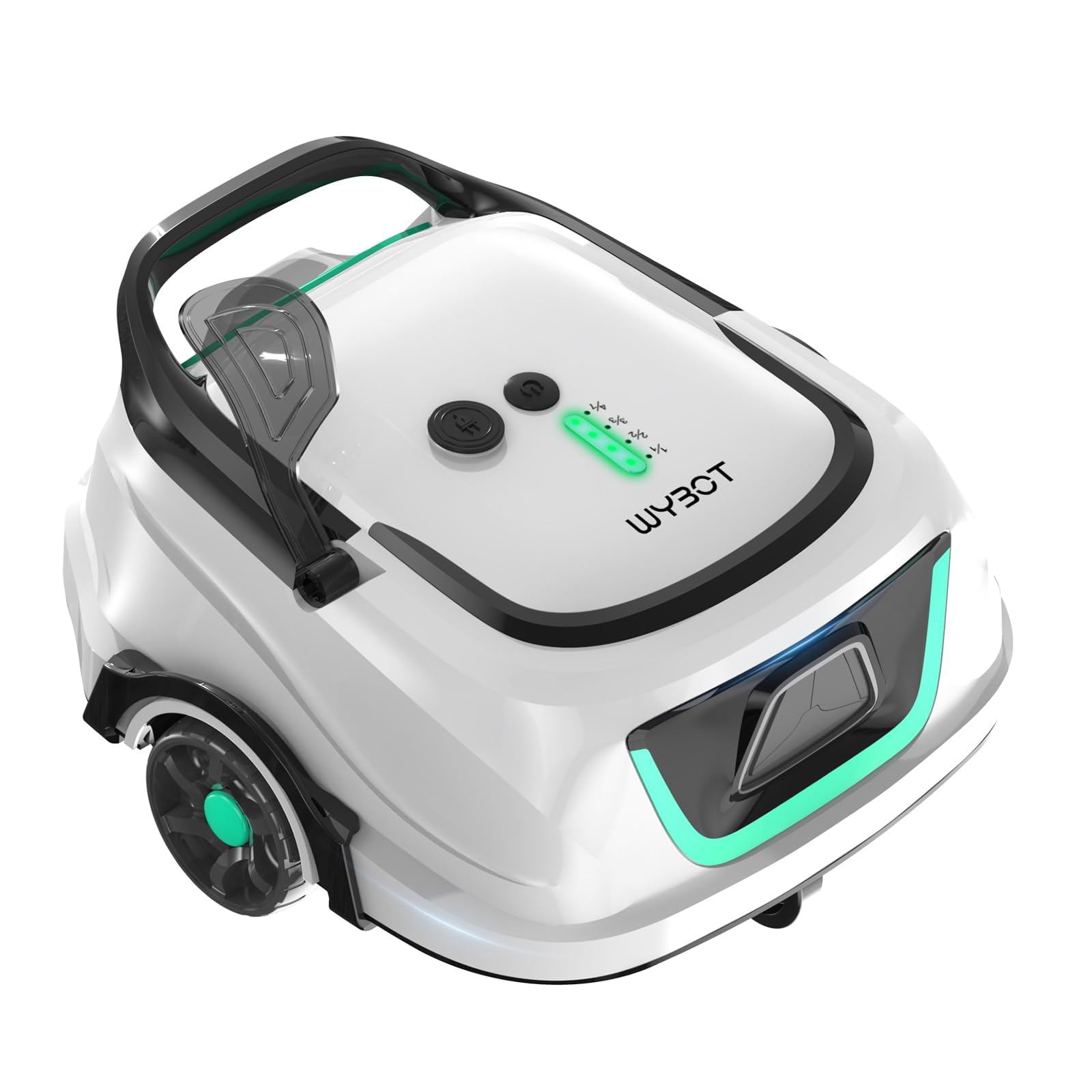
This cordless robot pulls up sand and leaves with 2,280 GPH (gallons per hour) suction — enough to handle a typical above-ground pool — and weighs only 9.8 pounds, so you can lift it out easily.
The WYBOT A1 delivers 2,280 GPH (gallons per hour — a measure of how much water it processes to generate cleaning force) of suction. That is enough to pull up sand, leaves, and fine debris from the floor, so a leaf-covered 24-foot round pool gets scrubbed clean in one run. It is designed for above-ground and flat-bottom pools up to 1,100 square feet, and its 130-minute runtime on the 58-watt-hour lithium battery gives you nearly two full hours of cleaning per charge.
what separates it is the dual-layer filtration: a 180-micron (a micron is one-millionth of a meter, so 180 microns catches tiny particles like sand) precision filter paired with a textured foam layer. Buyers report that “excellent suction for sand, leaves, and fine debris; dual-layer filtration” is the standout quality, and owners mention the 9.8-pound weight makes it easy to lift out of the pool — it weighs 9.8 pounds, versus the INTEX ZX100 at 13.7 pounds. When the battery runs low, the vacuum automatically parks near the pool wall for retrieval.
Why it wins the list: For the price, you get a genuinely self-contained robotic sweeper with a powerful motor that runs longer than most entry-level competitors — no hose connections, no pump compatibility checks.
Caveat for flat-bottom owners: This model does not climb walls and is not suitable for pools with slopes over 15 degrees (the steepness of a gentle incline; steeper than that and the robot will not grip).
Reach for this if: you have a flat-bottom above ground pool up to 1,100 square feet and want a cordless, self-contained robot that needs zero setup.
Look elsewhere if: you need wall-climbing or waterline scrubbing — those features are not included here.
2. ABNEMEN Cordless Robotic Pool Cleaner – 180 Mins Runtime
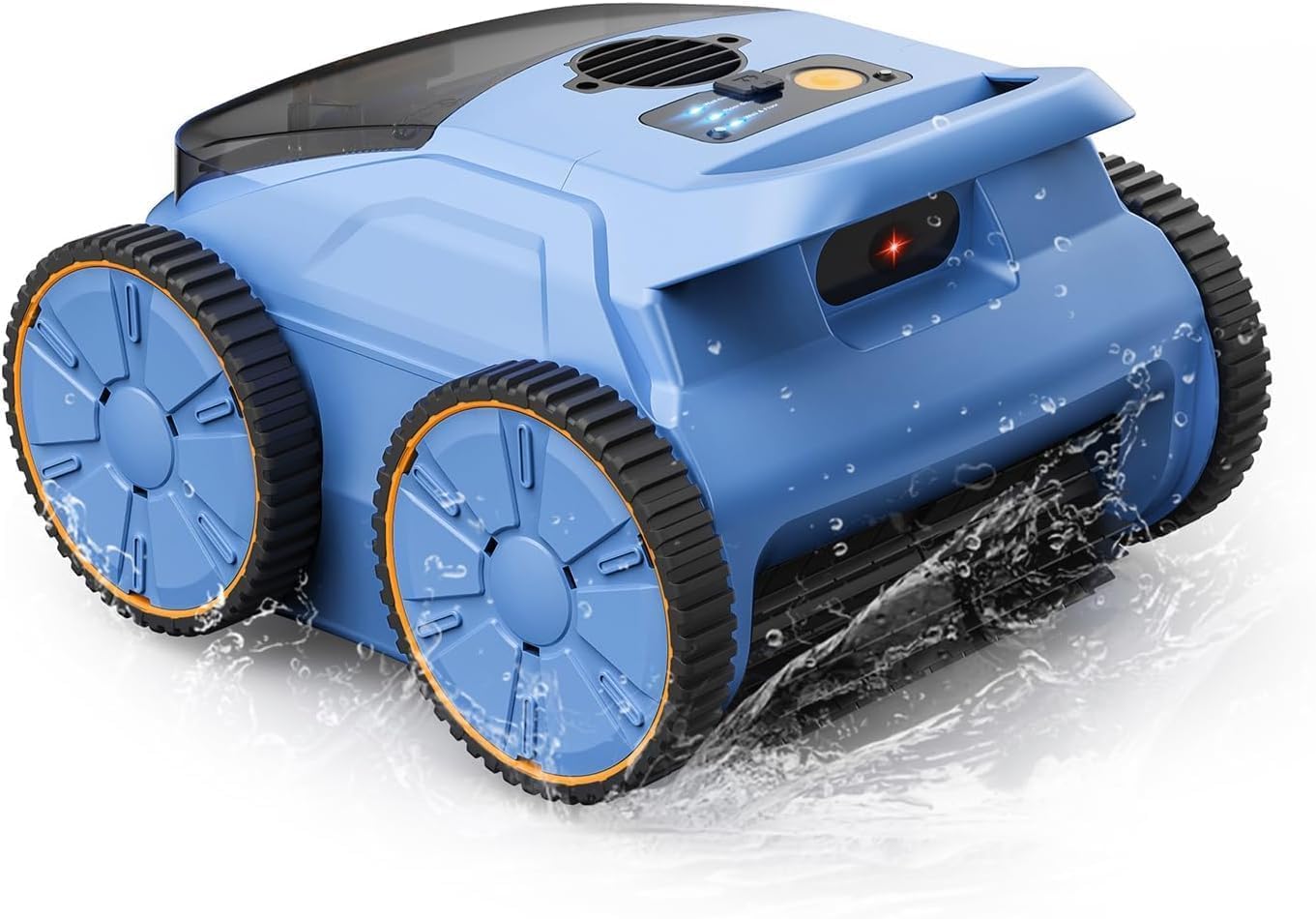
A 180-minute runtime and a 144.3-watt-hour battery — versus the WYBOT A1’s 58-watt-hour capacity — let this cleaner cover up to 2,000 square feet per charge, so a 27-foot round pool finishes in one go.
The single biggest complaint with cordless pool cleaners is running out of charge before the pool is clean. This ABNEMEN model solves that with a 180-minute runtime and a 144.3-watt-hour lithium battery — versus the 58-watt-hour WYBOT A1 above. It covers up to 2,000 square feet per charge, making it the right choice for larger above-ground pools. Customers note that “sonar navigation maps pool; tank tracks climb walls to waterline,” and the 13.78-pound unit uses premium track drives (the treads that grip the pool floor) and sonar navigation (sound-wave sensors that map the pool shape) to map efficient cleaning routes. It climbs walls and slopes up to 45 degrees (a steep grade most robots cannot handle), though the manufacturer warns it is not suitable for pools with sharp steps or raised drains. The self-parking feature returns the robot to the pool edge when the battery is low.
Why it dominates large pools: At 180 minutes, this vacuum runs longer than the 120-minute PoolMr model, giving it more time for larger pools per charge.
Heads-up about obstacles: If your above-ground pool has sharp steps, ladder protrusions, or raised drain covers, this model can get hung up — the track system is designed for smooth contours.
Choose this for: large pools over 1,200 square feet where battery endurance is the top priority and wall-climbing is desired.
skip it if: your pool bottom has sharp steps or raised drains that could trap the robot.
3. Seauto SAT25 Cordless Robotic Pool Vacuum – Dual 180W Motors
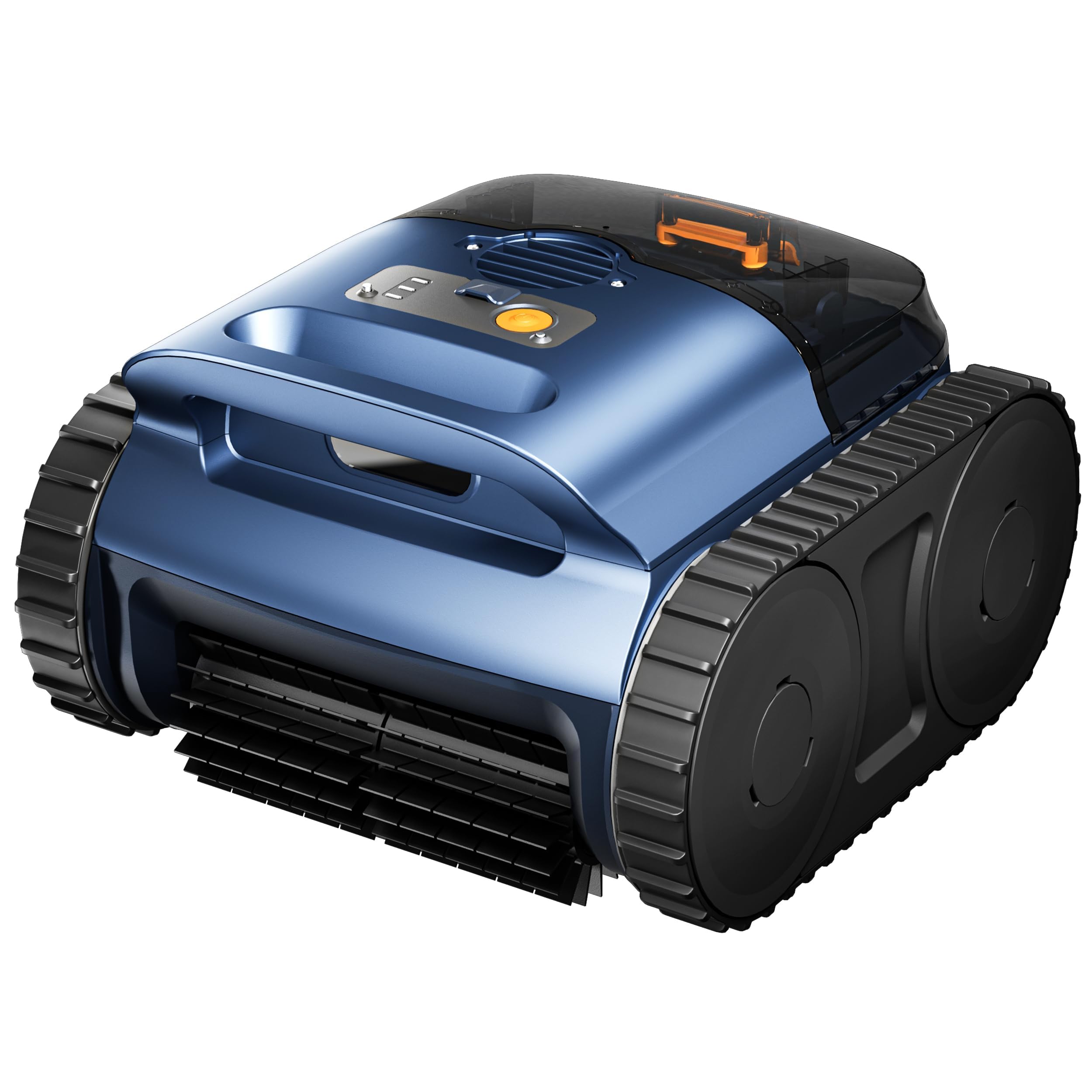
Two independent 180-watt brushless motors (electric motors with no brushes to wear out, so they run quietly and last longer) drive strong suction on floors and walls — and the 168.48-watt-hour battery covers up to 2,150 square feet, versus the ABNEMEN’s 2,000-square-foot max.
This Seauto model uses two independently controlled 180-watt brushless motors (electric motors with no brushes to wear out, meaning they last longer and run nearly silently) to deliver strong suction on both floors and walls. The 168.48-watt-hour lithium battery — the largest in this lineup — provides a 150-minute runtime and covers pools up to 2,150 square feet, versus the ABNEMEN’s 2,000-square-foot max coverage. The 19.8-pound weight comes from the industrial-grade tracks and metal components.
Upgraded sonar navigation maps the pool and plans efficient cleaning paths to minimize overlap, which reviewers point out leads to “confident floor/wall coverage” in about 91 minutes for typical pools. The IP68 certification (a water-resistance rating that means the internal electronics are sealed against continuous submersion beyond 1 meter) protects the inner components during prolonged underwater use. There is no app control — it operates through three cleaning modes selected by a push button: Floor, Wall, and Full Coverage.
Why it justifies the upgrade
- Largest battery capacity (168.48 Wh) for the longest max coverage (2,150 sq. ft.) among these picks
- Dual independent motors climb walls, steps, and uneven surfaces without stalling
- IP68-rated waterproofing for years of reliable submersion
The compromises you accept
- Heavier than any other pick here (19.8 lbs), making retrieval from the pool a bit more effort
- No app integration — cleaning modes are push-button only
- Struggles around tight stairs despite the tracks
Best suited for: large, irregularly shaped above-ground pools where wall-climbing and long runtime are must-haves, and you value a sturdy build with replaceable parts.
Not the best fit for: smaller pools where the extra weight and coverage capacity would be overkill — the WYBOT A1 or PoolMr would be a better match.
4. BOTLUXE PC10 Robotic Pool Cleaner – 5,000 GPH Suction
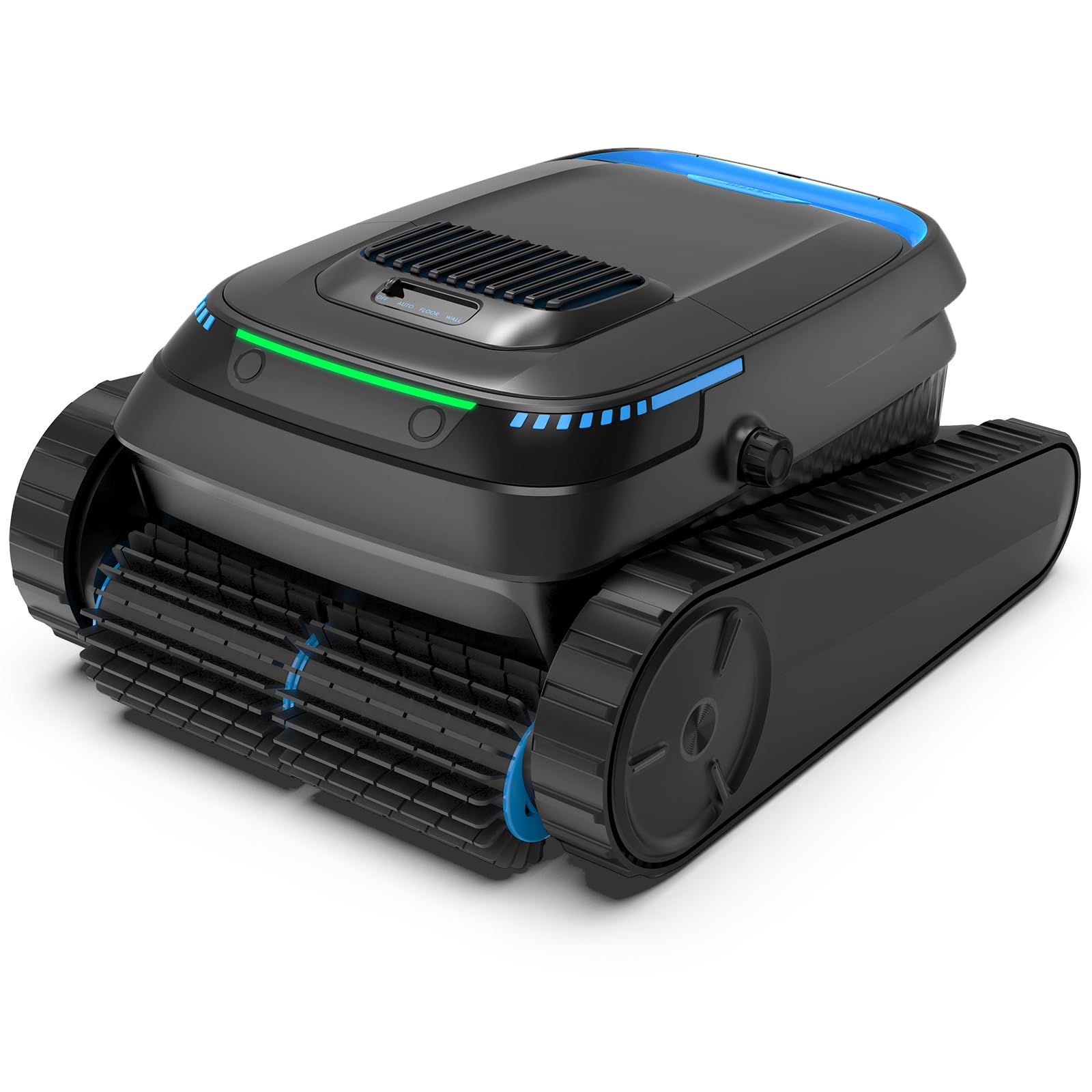
Its 5,000 GPH suction, versus the 2,280 GPH of the WYBOT A1, is enough to match some full-size pool pumps — and its 150-micron filter is the finest mesh here, catching sand particles the others miss.
The BOTLUXE PC10 stands out because of its 5,000 GPH suction power — versus the 2,280 GPH of the WYBOT A1, and a number that matches some full-size pool pumps. This high flow rating comes from dual drive motors plus a dedicated high-efficiency pump motor. It captures everything from fine sand to large leaves using a 4-liter (just over one gallon) ultra-fine filter with a 150-micron mesh (a finer mesh than the 180 microns on the WYBOT A1, meaning it catches even smaller particles). The dual active rotating brushes (two spinning brushes that sweep debris toward the suction inlet) scrub floors, walls, and the waterline.
The 5,200 mAh battery provides up to 120 minutes of run time covering pools up to 1,830 square feet, and fast charging restores full power in 2.5 hours. Shoppers say that “extremely fine filtration catches even sand particles” and the robot climbs slopes up to 30 degrees (a moderately steep incline — think a gentle slope in an above-ground pool). A notable concern from one reviewer: after three months the unit stopped charging, and customer service was inaccessible.
Performance standout: The 5,000 GPH suction is the highest raw suction figure among these picks, and the 150-micron filter is the finest mesh — if your pool gets a lot of fine dirt or pollen, this is the one that clears it.
Reliability watch: While most reviews are positive, there is a pattern suggesting some units may have charging issues — buying from a retailer with a good return policy is a smart move.
Go for this if: your above-ground pool collects fine sand and you want the strongest suction available in a cordless robot with rotating brushes.
Proceed with caution if: you cannot tolerate the risk of a potential charging defect — consider the Seauto SAT25 for a more proven track record at a similar investment.
5. PoolMr Cordless Robotic Pool Cleaner – 40W Strong Suction

A 40-watt motor (a measure of electrical power) and a 55.5-watt-hour battery give you 120 minutes of runtime to cover pools up to 1,614 square feet — for less cost than the twin-motor Seauto.
The PoolMr is the entry point into cordless robotic cleaning without the price tag of the premium models. It runs on a 40-watt motor (a measure of motor power), and reviewers confirm that the “40W suction picks up leaves/dirt.” The 55.5-watt-hour lithium battery provides up to 120 minutes of runtime, covering pools up to 1,614 square feet. That is the same coverage area as the BOTLUXE PC10 at 120 minutes, but the PoolMr costs less — a meaningful difference if your pool is on the smaller end of that range.
The dual-layer filter catches debris with a 180-micron mesh and a dense cotton sponge, and the 30 GPM (gallons per minute — another way of measuring water flow through the filter) purification system keeps the water circulating. It climbs wrinkles up to 0.2 inches and slopes up to 15 degrees (the approximate slope of a gentle ramp). One detail that matters if you use a skimmer pole: the pool hook fits a standard skimmer pole, making retrieval easy even if the unit drifts to the center.
Why it is a smart starting point: For the investment, you get a self-contained robot that picks up both large leaves and fine sand, with a battery that finishes most above-ground pools in one charge — no pump requirements or hoses to wrestle.
What you trade: A 120-minute runtime is standard, but the 40W motor has less raw power than the 180W dual motors on the Seauto — you may see it pause on bigger leaves.
Perfect for: anyone switching from a manual pole vacuum to their first robot who wants solid performance without a big investment.
Not for: pools over 1,614 square feet or owners who need wall-climbing — the PoolMr cleans only the floor.
6. INTEX 28006E ZX100 Pressure-Side Above Ground Automatic Pool Cleaner

Instead of a battery, this cleaner connects to your filter pump’s return line and uses pressurized water flow to move across the floor — no charging, no downtime, no station.
The INTEX ZX100 works differently from every other pick here. Instead of a cordless robot with its own battery, it is a pressure-side cleaner (meaning it connects to a return line from your filter pump and uses the pressurized water flow to move across the pool floor). There is no battery to charge and no charging station. The unit works with above-ground pools up to 26 feet in diameter or 36 feet by 12 feet rectangular shapes, but only if your filter pump delivers between 2,100 and 3,500 gallons per hour of water flow (GPH flow rate — the amount of water your pump moves per hour). If your pump falls outside that range, the sweeper will not work.
The 13.7-pound unit connects via a 21-foot tangle-free hose and a 1.25-inch converter. The large-capacity filter tray (0.25 gallons) collects leaves, dirt, sand, and bugs. However, some buyers report a frustrating experience: one user wrote “Does not move AT ALL, just functions as a way to move water on the bottom.” The oversized wheels rotate in only one direction, which is meant to keep the cleaning path efficient, but if your pump pressure is on the low end of the required range, the unit may just sit in place.
Why someone would choose this: It costs less than any robotic option here and works continuously as long as your pump is running — there is no battery to die midway through the pool.
The critical condition: You must confirm your pump’s GPH rating falls within the 2,100–3,500 range; even then, some users report no movement if the pressure is marginal. A buyer also noted that replacement O-rings can be hard to find.
Consider this if: you have an INTEX pool with a pump in the right flow range and you want the lowest upfront cost with no battery management.
Avoid it if: your pump is on the weaker side or you expect a robot-like pattern — this is a basic sweeper that depends entirely on your existing equipment.
Understanding the Specs
Gallons Per Hour (GPH) and Suction
GPH stands for gallons per hour — the amount of water a pool cleaner processes in an hour. A higher GPH means stronger suction, which pulls heavier debris into the filter, so a 5,000-GPH model can lift large leaves while a 2,280-GPH model handles sand and fine dirt. Motor wattage (W) is another way to measure suction power — 40W is typical for entry-level robots, while dual 180W motors provide premium cleaning force.
Battery Runtime and Watt Hours
Runtime is measured in minutes and tells you how long a cordless sweeper runs on a full charge. The lithium battery’s energy capacity is measured in watt hours (Wh) — the higher the Wh, the longer the run time. A 144.3 Wh battery (like the ABNEMEN) runs up to 180 minutes, while a 55.5 Wh pack (PoolMr) runs 120 minutes. Coverage area in square feet combines runtime with suction efficiency — it tells you the maximum pool floor size the battery can handle in one cycle.
Filter Microns and Filtration Layers
Microns measure how fine the filter mesh is — one micron equals one-millionth of a meter. A 150-micron filter catches smaller particles (fine sand, silt) than a 180-micron filter, which catches leaves and larger debris. Dual-layer filtration means the cleaner uses two materials — a plastic mesh and a foam sponge — to trap different size particles in separate stages. The filter capacity in liters (e.g., 4 liters on the BOTLUXE) tells you how much debris it holds before needing cleaning.
Navigation and Slope Climbing
Sonar navigation uses sound waves to detect the pool walls and create a cleaning path — it helps avoid redundant coverage. Slope climbing ability is measured in degrees — 15 degrees is a gentle incline found on most above-ground pool floors, while 45 degrees allows wall climbing. Track drives (tank-like treads) provide better grip than wheels on slippery pool floors. Self-parking means the robot automatically returns to the pool edge when the battery is low, making retrieval easier.
FAQ
Will any robotic pool cleaner work with my above ground pool?
How do I know if my pump can handle a pressure-side pool sweeper?
How long does a cordless pool sweeper battery last per charge?
Can a pool sweeper climb walls and clean the waterline?
What does 150-micron vs 180-micron filter mean for pool cleaning?
How often do I need to clean the filter on a robotic pool sweeper?
Will a cordless pool sweeper get stuck on ladder legs or pool wrinkles?
Is a pressure-side sweeper better than a robotic one?
Final Thoughts: The Verdict
For most owners of an above-ground pool, the above ground pool sweeper that delivers the best balance of suction power, runtime, and price is the WYBOT A1 — its 2,280 GPH suction and 130-minute runtime cover typical flat-bottom pools without a huge investment. If your pool is larger than 1,100 square feet or you need wall climbing, the ABNEMEN Cordless with its 180-minute runtime is the right call. And if you want raw cleaning strength for fine sand and heavy debris, the BOTLUXE PC10 with 5,000 GPH suction and rotating brushes is the one to beat.
How We Picked
We do not accept paid placement, and we did not hands-on test every unit. Instead, we match each pick to a real buyer and use-case by comparing the manufacturers’ published specifications against the patterns in verified customer reviews — so you get each pick’s real strengths and trade-offs instead of marketing copy.
Sources & Methodology
Specifications: manufacturer listings and product documentation. Review insights: verified customer reviews, as of July 2026. Pricing: not shown on this page (it changes often); check the current price via the retailer link.
As an Amazon Associate, Gadgets Feed earns from qualifying purchases. This does not affect which products we feature.
Product prices and availability are accurate as of the date/time indicated and are subject to change. Any price and availability information displayed on Amazon at the time of purchase will apply to the purchase of this product. As an Amazon Associate I earn from qualifying purchases.
CERTAIN CONTENT THAT APPEARS ON THIS SITE COMES FROM AMAZON. THIS CONTENT IS PROVIDED "AS IS" AND IS SUBJECT TO CHANGE OR REMOVAL AT ANY TIME.
Amazon and the Amazon logo are trademarks of Amazon.com, Inc. or its affiliates.