
Our readers keep the lights on and my morning glass full of iced black tea. As an Amazon Associate, I earn from qualifying purchases.
Specs are compiled from manufacturer listings and verified buyer reviews and can change over time — please confirm the key details on the product page before buying.
Most people shopping for an abrasive blaster get this backwards: they chase the biggest tank and overlook the one number that decides whether the tool strips rust or just sprays grit into the air — how much air your compressor can actually push. A blaster that needs more airflow than your compressor supplies will dribble media and clog constantly, and the fault is upstream, not in the tool. The four picks below cover the whole range, from a handheld unit you can run off a modest shop compressor to a benchtop cabinet that keeps the mess contained.
I’m Min — the founder and writer behind Gadgets Feed. This guide is built by comparing the manufacturers’ published specifications and the patterns across verified customer reviews, so you get each pick’s real strengths and trade-offs instead of marketing spin.
Some units gravity-feed a small hopper through a ceramic nozzle, while others pressurize a tank or seal the work inside a cabinet. Each approach changes what you can blast, how much media you burn, and how much cleanup follows. The right abrasive blaster depends on your compressor’s CFM and where you blast, not on tank size.
Our Picks at a Glance

How To Choose The Best Abrasive Blaster
The blaster is only half the system; the compressor is the other half. Your air compressor is the other half, and if it cannot keep up, no nozzle upgrade or bigger hopper will save the job. Start by reading your compressor’s CFM rating at the pressure you plan to run, then match the tool to it.
Match the blaster to your compressor’s airflow
Airflow is measured in CFM, or cubic feet per minute — the volume of air your compressor can push continuously. A handheld gravity-feed blaster sips far less air than a pressurized tank or a cabinet gun that runs nonstop. If your compressor is small, a gravity-feed unit that you refill often will outperform a tank you cannot keep pressurized.
Decide between gravity feed, tank, and cabinet
Gravity-feed blasters drop media from a small hopper into the airstream, which makes them light and cheap but limited to short bursts. Pressurized tanks hold more media and blast longer between refills, suited to larger flat surfaces. A blasting cabinet seals the work inside an enclosure, so media recycles and dust stays put — best for small parts you can fit through the door.
Pick the media and nozzle size together
Nozzle bore controls how fast media exits and how fine the grit must be. Small ceramic nozzles cut aggressively but clog with coarse grit, while larger bores pass chunkier media at a slower cut. Whatever the size, the media must be bone dry — moisture is the single most common cause of a blaster that suddenly stops flowing.
Quick Comparison
| Model | Best For | Type | Working Pressure | Item Weight | Amazon |
|---|---|---|---|---|---|
| SpeedBlaster Red Model 007R★ Best Overall | Small touch-ups and spot rust | Gravity feed | 100–125 PSI | 1.3 pounds | Amazon |
| Performance Tool M549 | Vehicles and farm equipment | Gravity feed kit | 90 psi | 3.25 pounds | Amazon |
| VEVOR 5 Gallon Sand Blaster | Large-area outdoor rust removal | Pressurized tank | 60–110 PSI | 24.7 pounds | Amazon |
| VEVOR 25 Gallon Sandblasting Cabinet | Small parts and contained cleanup | Benchtop cabinet | 40–120 PSI | 28.3 pounds | Amazon |
In‑Depth Reviews
1. SpeedBlaster® Red – Model 007R Red
Our pick — over 4★ from 300+ verified ratings; the strongest balance of quality and price.
At 1.3 pounds, this handheld blaster reaches the rusty nooks a tank never fits.
For bracket corners and door-frame dings where a wire brush stalls, this handheld reaches in and strips the rust. The SpeedBlaster uses a gravity-feed design, meaning grit drops from a small hopper into a hardened steel mixing chamber and exits through a ceramic nozzle — no pressure tank, no dragging a hose-heavy pot around. It weighs 1.3 pounds, versus 24.7 pounds for the VEVOR 5-gallon tank, so you can hold it one-handed all afternoon. And unlike the Performance Tool M549 kit above, the SpeedBlaster dials its working pressure up to 100–125 PSI.
What wins people over is the value — owners buying this for small jobs are the loudest chorus in the reviews, and the control over sand volume gets singled out as the reason it feels worth owning. A paint-and-body crew ran it on light brick cleaning and passed it from job to job. One DIYer cleared small rust spots, filled and primed them, and found the rust stayed away long enough to matter. It runs a replaceable alumina ceramic nozzle and an adjustable material control valve, and it carries a 60–125 PSI operating range with air consumption listed at 12 CFM at 125 PSI.
The honest catch is wear. The ceramic nozzle and steel insert at the base are consumables, and buyers report the nozzle wearing through after a few months of light weekend use, so budget for replacements. The hopper also has to be refilled — the maker’s own flow valve is described by some as feast-or-famine, cleaning fast when wide open but draining the hopper in minutes. Feed it dry media and the clogging complaints mostly disappear. It strips spot rust and small parts, but not whole car bodies.
Sells Itself On
- Weighs 1.3 pounds — light enough to hold one-handed over your head
- 100–125 PSI working pressure — more headroom than the M549’s 90 psi
- Adjustable material control valve lets you dial grit flow to the job
- Runs fine media like 40–80 grit glass bead and baking soda
Where It Wears
- Consumable nozzle and insert — replacements cost close to half the tool price
- Hopper refills interrupt longer runs
- Needs a large air compressor to hold pressure
- Not suited to full-body panel work
Best for spot work: rust patches, brackets, and corners a sanding block cannot reach.
Think twice for: full-panel stripping where the frequent hopper refills will slow you down.
2. Performance Tool M549 Portable Gravity-Fed Abrasive Blaster Kit
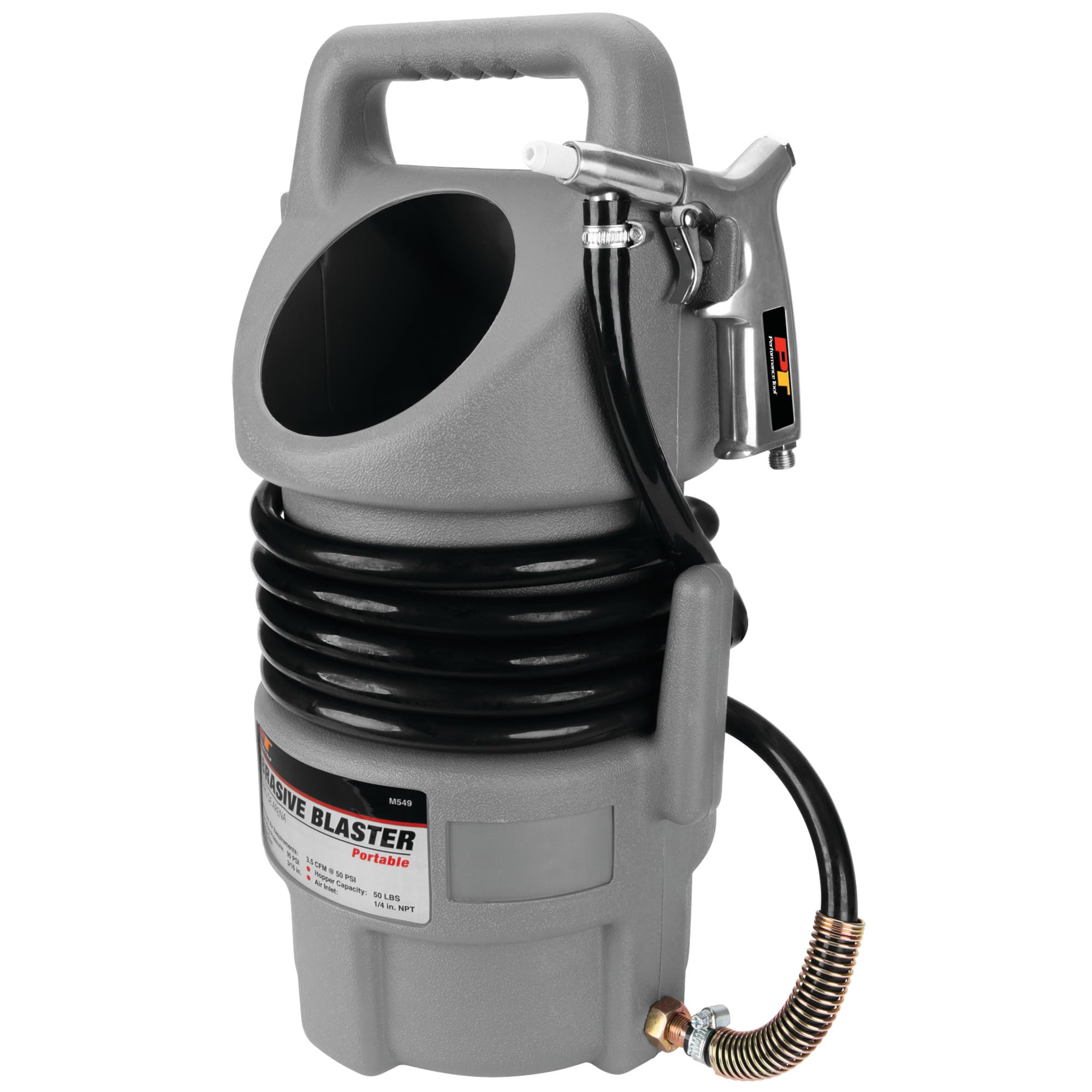
A 50-pound gravity-fed kit aimed at anyone with a car, truck, or ATV to de-rust.
This is the kit for the driveway mechanic sizing up a farm gate or a chassis corner. It holds 50 lbs of media and ships with a 15-foot hose, so you are not tethered right beside the compressor. It runs at an operating pressure of 90 psi with a minimum air requirement of 3.5 CFM at 50 psi. Pair it with silica sand, steel grit, glass beads, or pecan shells — the gravity feed keeps material moving into the airstream and does not care which abrasive you choose.
Owners mention it was “amazed at how well it worked” on their first session, and one 1968 Chevrolet owner ran 25 lbs of 70-grit aluminum oxide at 60 psi for 15 minutes on a car door frame. It knocked off most of the extra paint coats and rust, though it did not touch the factory base coat. Now the catch — that job burned through a lot of media, and the result is honest but partial. The M549 makes big flat surfaces manageable, but it is a slower, thirstier approach than a pressurized cabinet when the factory paint is still on. If you only need to feather a few rust blooms before primer, this gets there.
Fit for smaller jobs: anyone dealing with multiple vehicles or outdoor equipment who needs a portable kit rather than a fixed pot.
Blasting cost in mind: the media is a per-job expense, so plan for enough grit to finish a panel before switching to chemical strippers.
Reach for this if you have a compressor on hand and a stack of rusty car parts to clear.
Pass if you want factory paint gone in one pass — a blasting cabinet handles that better on small pieces.
3. VEVOR 5 Gallon Sand Blaster

A wheeled 5-gallon pot that strips iron frames and statues without hauling a hopper.
Step up to a pressurized tank and the work changes scale. The VEVOR 5 Gallon blaster runs on a working pressure of 60–110 PSI and pulls 6–25 CFM, meant for large-area jobs like iron frames, statues, car paint, or marble engraving. The maker asks you to pair it with a separate 5.5kW air compressor. Unlike the 1.3-pound handheld above, this one carries two 6-inch rubber wheels and an 8-foot hose, so it rolls to outdoor work and reaches immovable objects. That portability, not the tank, is the point.
The package includes four ceramic nozzles at 3/32″, 7/64″, 1/8″, and 9/64″, with the 9/64″ pre-installed — you swap bores to match grit size. A water-oil separator with a pressure gauge keeps moisture out of the line, which is what prevents wet media from clogging the valve. The maker recommends 2.8 gallons of abrasive and 60–100 grit media such as silica sand, aloxite, or glass beads — and notes the media must be dry. Running it with a small compressor is the classic mistake: customers note it needs 15 CFM or more to avoid constant pauses while pressure rebuilds.
When it runs right, a user with medium jobs simply says: “Love this pot, works great for my medium jobs.” But the mixed story here is real. Some report the unit stops flowing media entirely, especially at high pressure with soft media. The recurring gripe is the fittings — metric-sized and not stocked at big-box stores. Size the compressor honestly and feed it dry grit, and this pot does exactly what a tank should.
What Makes It Capable
- 5-gallon pressurized tank handles larger surface areas than a hopper
- 4 ceramic nozzles (3/32″ to 9/64″) let you match bore to grit
- Oil-water separator with gauge reduces wet-media clogging
- Two 6-inch wheels and an 8 ft hose for outdoor, immovable work
Worth Knowing Up Front
- Demands a high-CFM compressor — a 5.5kW unit is recommended
- Weighs 24.7 pounds, so it stays put more than it travels
- Needs bone-dry media to avoid clogging
- Not for use on wood or wet media
Choose it when you have a serious compressor and big, stationary rust to clear.
Not the one for a first-time buyer with a small pancake compressor.
4. VEVOR 25 Gallon Sandblasting Cabinet

Seals the grit inside a cabinet so you blast small parts without fogging the shop.
If cleanup is what stops you blasting indoors, this cabinet seals the grit and dust inside. The VEVOR SBC90 cabinet holds a 25-gallon capacity, or up to 33 lbs of media, and runs at just 5 CFM across a 40–120 PSI range — the lightest air demand of the four picks here. A large acrylic window backed by LED lighting keeps your hands and the part visible, and it ships with four lens protectors to save on replacement costs. The body is cold-rolled steel with a powder-coated finish for corrosion resistance.
A pre-installed sealing strip, sealant material, and an air filter are there to trap dust and keep your workspace cleaner. The included blasting gun runs the four ceramic nozzles — 4.5, 5, 6, and 7mm — and works with glass beads, silicon sand, and aluminum oxide. Buyers put it to clever uses too, not only blasting: one swapped in a wet tile saw and Dremel work, crediting the sealed box for containing debris and vapor. Owners who sealed every panel with clear caulk before assembly report no dust leaking at all, and the low 5 SCFM claim holds up.
The honest trade-off is the build itself. The steel can arrive rough, with warped panels and misaligned holes that turn assembly into an afternoon of work, and the instructions draw the sharpest criticism of any aspect. Sealant applied during assembly is what separates a clean-running unit from a dusty one. Seal every panel during assembly and this cabinet stays a quiet, tidy workstation.
Setup is the entrance fee: plan for a slow build, but sealing each panel as you go is what keeps dust inside the box rather than your lungs.
Footprint trade: it stays put on a bench, so it suits a fixed garage corner rather than a job site.
Ideal for a home or garage shooter working on small parts who wants media recycling and a contained mess.
Better look elsewhere if you need mobility — this one is a benchtop fixture, not a take-along.
Understanding the Specs
Pressure (PSI) and Airflow (CFM)
PSI stands for pounds per square inch — how hard the air pushes through the nozzle. CFM stands for cubic feet per minute — how much air volume your compressor supplies continuously. PSI gets the grit moving; CFM keeps it moving. A blaster rated 60–110 PSI still stalls if your compressor cannot deliver the listed CFM, which is why the tank’s air-consumption figure matters more than its pressure ceiling for long jobs.
Nozzle Bore and Grit Matching
Ceramic nozzles resist the abrasive wear that chews through metal ones. Bore size sets which grit you can feed: small bores like 3/32″ cut fast but demand fine media, while larger bores pass coarser grit at a lower cut speed. Media must be dry regardless of bore — moisture causes wet grit to bridge and clog the valve, so a water-oil separator on the line prevents the most common mid-job stoppage.
FAQ
How much air compressor do I need to run an abrasive blaster?
What is the difference between a gravity-feed blaster and a pressurized tank?
Can I use regular play sand in an abrasive blaster?
Why does my blaster stop flowing media?
Do abrasive blaster nozzles wear out and need replacing?
Is a sandblasting cabinet better than an open blaster for small parts?
What does the included water-oil separator actually do?
How do I match ceramic nozzle size to my grit?
Can I use an abrasive blaster on wood or delicate surfaces?
What safety gear do I need when sandblasting?
Final Thoughts: The Verdict
The crowd favorite here is the SpeedBlaster Red 007R — 4.4 stars across 300+ owners — and it holds that spot because it does the job 90% of us actually have: chasing rust off brackets, corners, and small parts without hauling a heavy pot. If you would rather buy once and cover bigger surfaces, reach for the VEVOR 5 Gallon and commit to the compressor it needs. And if you want the grit and dust sealed away on small pieces, the VEVOR 25 Gallon cabinet is the tidy choice. Whichever you pick, size the compressor’s CFM first — it makes or breaks every blasting session.
How We Picked
We do not accept paid placement. Every pick is matched to a real buyer and a real use-case; we do not hands-on test units.
Sources & Methodology
Specifications: manufacturer listings and product documentation. Review insights: verified customer reviews, as of September 2026. Pricing: not shown on this page (it changes often); check the current price via the retailer link.
As an Amazon Associate, Gadgets Feed earns from qualifying purchases. This does not affect which products we feature.