
Our readers keep the lights on and my morning glass full of iced black tea. As an Amazon Associate, I earn from qualifying purchases.
Specs are compiled from manufacturer listings and verified buyer reviews and can change over time — please confirm the key details on the product page before buying.
Choosing the right abrasive paper for wood means matching grit, backing, and mineral to the task — too coarse gouges the surface, too fine wastes time. The grit number tells you the particle size, but the backing material, the abrasive mineral, and whether it handles wet sanding all decide if your project ends up smooth or frustrating. This guide matches each pick to a specific woodworking need, from rough shaping to mirror-finish polishing.
I’m Min — the founder and writer behind Gadgets Feed. This guide is built by comparing the manufacturers’ published specifications and the patterns across verified customer reviews, so you get each pick’s real strengths and trade-offs instead of marketing spin.
Whether you are stripping paint from a handrail or wet-sanding a guitar neck to a gloss, the right abrasive paper for wood makes the difference between a weekend chore and a satisfying finish you are proud to show off.
Our Picks at a Glance

How To Choose The Best Abrasive Paper For Wood
The first rule of wood sanding is to progress through each grit step — skipping from 80 to 220 leaves deep scratches that the middle grits would remove. A 40- or 60-grit sheet tears through raw lumber fast, but you need 120 and 150 grit to erase those marks before the final 220 or 320 grit leaves a surface ready for stain or clear coat.
Aluminum Oxide vs Silicon Carbide
Aluminum oxide is the standard for wood because it fractures during use to expose fresh cutting edges, extending the sheet’s life. Silicon carbide is sharper and harder, making it the better choice for wet sanding between coats of finish or polishing metal, but it can load up quickly on bare wood. Pick your mineral based on what you are sanding, not on advertising claims.
Backing Material and Grip
Paper backing is the most common and works fine for hand sanding and palm sanders. Cloth backing flexes around curves without tearing, making it ideal for shaped edges or dowels. The no-slip grip backing on premium sheets reduces hand fatigue by keeping the paper from bunching up. For power sanders, look for pressure-sensitive adhesive (PSA) discs that stick without clips.
Quick Comparison
| Model | Best For | Grit Range | Number of Sheets | Backing | Amazon |
|---|---|---|---|---|---|
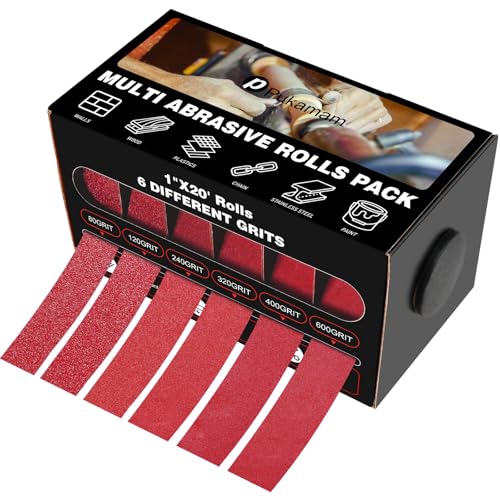
| Emery Cloth Roll 6 Grits★ Best Overall | Curved edges & tight spots | 80 – 600 | 6 rolls (19.7 ft each) | Cloth | Amazon |
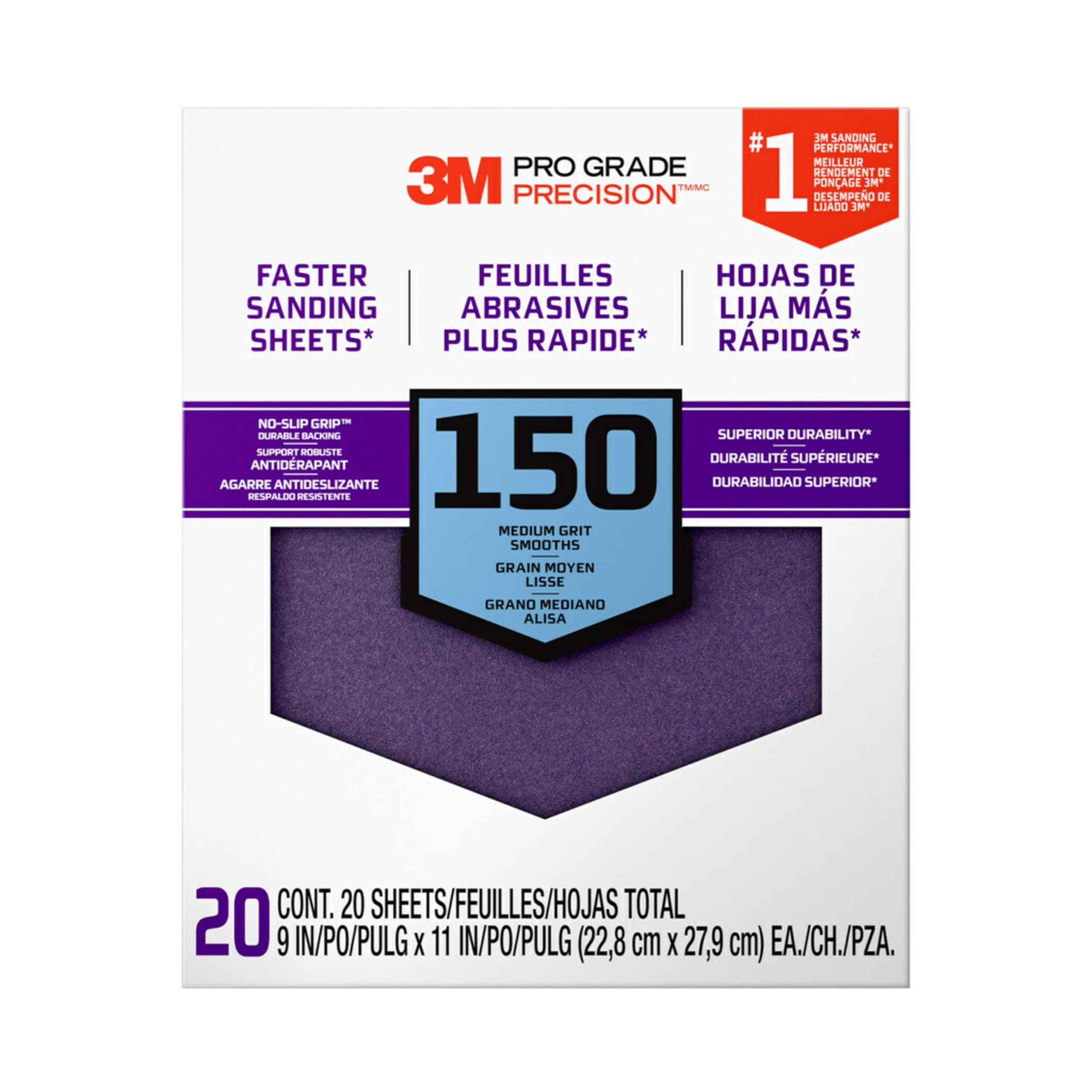
| 3M Pro Grade 150 Grit (20-Pack)Top Performer | Durable everyday sanding | 150 (single grit) | 20 | No-Slip Grip | Amazon |
| BOSHCRAFT 25 Pcs AssortmentBest Value | All-around woodworking | 80 – 320 | 25 | Paper | Amazon |
| Pihemum 20 Pcs Wet Dry | Wet sanding & fine polishing | 120 – 2000 | 20 | Paper | Amazon |
| VRKET Wet & Dry 42 Sheets | Step-by-step finishing | 120 – 3000 | 42 | Paper | Amazon |
| CowboyBOB 100 Pcs 80 Grit PSA Discs | Power sanders & speed | 80 (single grit) | 100 | PSA (self-adhesive) | Amazon |
| SciencePurchase 60-Piece 1/4 Sheets | Palm sander precision | 60 / 100 / 240 | 60 | Paper | Amazon |
| LotFancy 108 Pcs 60-5000 Grit | Ultra-fine range & versatility | 60 – 5000 | 108 | Paper | Amazon |
| 3M Pro Grade 80 Grit (20-Pack) | Aggressive stock removal | 80 (single grit) | 20 | No-Slip Grip | Amazon |
In‑Depth Reviews
1. Emery Cloth Roll, 6 Grits
Our pick — over 4.5★ from 500+ verified ratings; the strongest balance of quality and price.
The flexible cloth roll that wraps around curves without tearing.
Emery cloth is a different animal from standard paper sheets — the tear-resistant nylon backing bends into tight radius holes and around guitar necks without cracking. At 1 inch wide and nearly 20 feet per roll, this six-grit set (80, 120, 240, 320, 400, and 600) gives you a continuous strip for those hard-to-reach spots where a sheet would just bunch up. The dispenser box keeps each roll organized, so you are not wrestling with loose ends mid-project.
What wins people over here is the quality and versatility — with 23 positive mentions on quality alone, owners consistently report that each piece lasts a long time. A woodworker noted these rolls are “very helpful to allow easier sanding on edges or inside tight radius holes,” while a luthier uses them for sanding guitar and banjo necks and found the paper quality “better than expected.” The cloth is so tough, as buyers report, that you have to cut it rather than tear it — a sign of durability that pays off across multiple projects.
The honest trade-off is the narrow width. At 1 inch, it excels for detail and edge work, but it is not meant for flattening wide boards or large panels. For broad surfaces you would still want full-size sheets. The grit range also stops at 600, so if you need ultra-fine polishing above that, you will need a separate set.
Edge master: The cloth backing bends into tight corners and curved profiles that standard paper sheets cannot handle, making it the best pick for guitar necks, trim, and detail work.
Panel limitation: The 1-inch width is slow going on large flat surfaces — keep a full-size sheet for open boards and save this roll for the edges.
Reach for this if: you sand curved or detailed woodwork where paper sheets tear or cannot reach.
Look elsewhere if: you need wide sheets for panel sanding or require grits finer than 600 for polishing.
2. 3M Pro Grade 150 Grit (20-Pack)
The sheet that stays put and keeps cutting long after cheaper paper gives up.
150 grit is the balance for most wood finishing — coarse enough to remove light scratches, fine enough that you are ready for stain. This 20-pack from 3M uses premium mineral grits with technology found in their industrial Cubitron II line, and the No-Slip Grip backing is a genuine upgrade: it reduces hand fatigue because the sheet does not slide around, and it resists tearing on a palm sander.
Buyers consistently mention the sanding performance and durability as the standout traits. One longtime user reports using this type of sandpaper “forever” and confirms it “lasts significantly longer than the traditional stuff and doesn’t tear as easily on a palm sander.” The color will not discolor the surface you are sanding, and the sheet conforms to contours for easier control. At 12.5 ounces per pack, these are substantial sheets that take real pressure without disintegrating.
The catch is the single-grit limitation — if your project requires a full progression from coarse to fine, you will need to buy several different grits separately, which adds up. You get 20 sheets of 150 grit and nothing else. Also, only one of those sheets is needed for small jobs, but there is no variety here for start-to-finish work.
Endurance champion: The premium mineral blend and tear-resistant backing mean this sheet outlasts commodity sandpaper by a wide margin, especially on bare wood where you can brush off the dust and keep going.
One-grit limit: Great for a specific intermediate step, but you will need additional packs if your project spans multiple grits from rough to fine.
Best for: woodworkers who want a single reliable intermediate grit that does not tear, clogs, or lose its cut halfway through a session.
Not ideal for: anyone who needs a full range of grits in one box or prefers variety packs for different projects.
3. BOSHCRAFT 25 Pcs Sandpaper Assortment
The variety pack that saves a trip to the hardware store.
Five sheets each of 80, 120, 150, 220, and 320 grit gives you a complete sanding progression in one box — rough shaping, intermediate smoothing, and pre-finish polish. The sheets are color-coded so you can grab the right grit without squinting at tiny print, which is a simple but real time-saver when you are mid-project. BOSHCRAFT claims these are built with an anti-clogging coating and premium aluminum oxide for 2× longer life than conventional abrasives.
Quality and value for money are the most-discussed aspects here, with 43 and 34 positive mentions respectively. One buyer confirms they “sanded a wooden, painted, hand railing” and the paper “worked well and held up to strong sanding” through multiple grits. Another calls it the “best quality sandpaper sheets I’ve used,” noting no cracking like other brands. The grit counts (80, 120, 150, 220, 320) cover the essential range for wood finishing — you do not get ultra-fine grits, but for typical furniture and trim work, this is exactly what you need.
The main trade-off is the mixed feedback on durability. While some owners mention the sheets hold up well under heavy sanding, others found that the paper comes apart on their sanders. This seems to affect a minority of users, but if you are doing high-speed machine sanding all day, a more sturdy brand may be worth the extra cost.
Complete starter: Five grits in a logical progression mean you can go from raw wood to finish-ready without buying anything else — an ideal introduction to sanding.
Machine-sanding caution: A small fraction of users report the paper tearing on power sanders, so hand sanding or light machine use is the safer bet here.
Reach for this if: you want a single box that covers every step from stripping paint to final smoothing on a weekend wood project.
Look elsewhere if: you need ultra-fine grits above 320 or you run a production shop with heavy machine sanding.
4. VRKET Wet & Dry Sandpaper Set (42 Sheets)
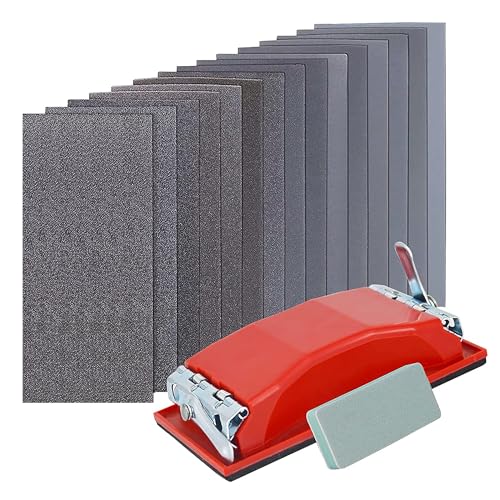
The set that takes you from coarse shaping all the way to a mirror finish.
Fourteen precision grit types from 120 to 3000 spread across 42 sheets means you can work through a complete sanding sequence without ever running out of the next step. This set also throws in a sponge polishing block (green at 3000 grit, white at 7000 grit) for the final buffing stage, so you do not need to buy separate polishing tools. The silicon carbide abrasive and electro-coated technology keep the paper from tearing when it gets damp, which matters when you wet-sand the final coat.
Quality and versatility are the top praises here, with 27 and 23 positive mentions respectively. Owners note the pack “comes with a variety of sand paper as described” and that “the paper is good quality and actually removes material.” The ergonomic hand-held design is frequently mentioned as a plus for reducing fatigue during long sessions — one buyer confirms it “fits well in a small woman’s hand.” The set works equally well for automotive paint correction, wood furniture finishing, and metal polishing.
The durability feedback is mixed. While many owners find the paper holds up well, a number of reports note that the sheets tear relatively easily compared to premium brands. The sanding block itself is functional but some consider it flimsy. If you are tackling a single demanding project and need the full grit progression, this is a strong value — just handle the sheets with care during heavy pressure sanding.
Full spectrum: With grits from 120 to 3000 plus two sponge blocks, this is a start-to-finish solution for anyone who wants professional-grade results on wood, auto, or metal.
Fragile paper: The silicon carbide sheets cut well but can tear under aggressive use — keep a lighter touch and this set performs wonderfully.
Best for: detailed finishing work where you need every grit step between coarse and ultra-fine, especially on mixed materials.
Skip if: you only sand raw lumber or need a sheet that withstands heavy machine sanding without tearing.
5. 3M Pro Grade 80 Grit (20-Pack)
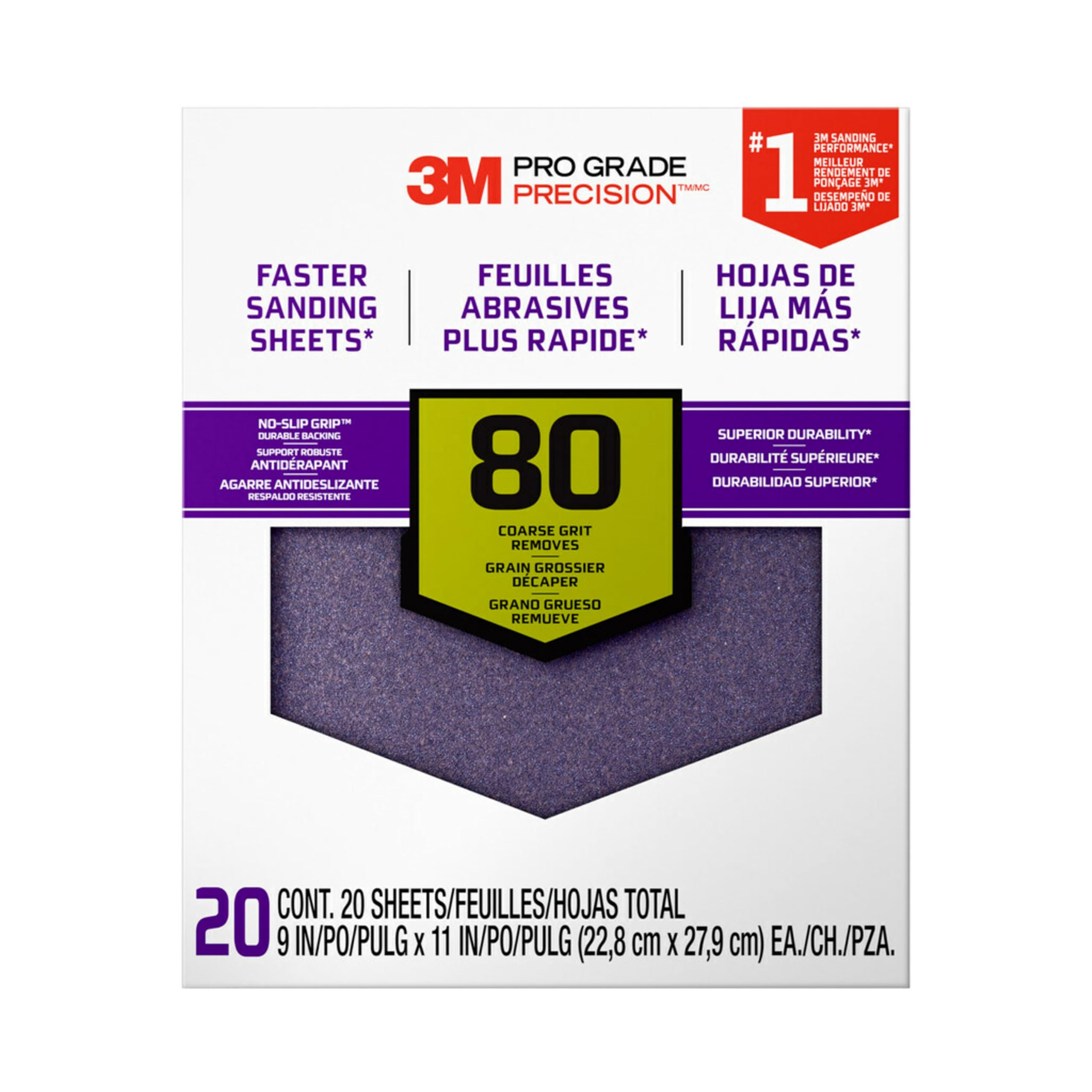
The brute-force sheet that chews through material fast.
When you need to strip old paint, shape a board, or remove a lot of wood quickly, 80 grit is where you start. This 20-pack from 3M uses the same No-Slip Grip backing and premium mineral blend as the 150-grit version, but the coarser grain makes it even more aggressive. The vinyl backing prevents cracking under pressure, so you can lean into it without the sheet disintegrating.
Owners call this sandpaper “the most aggressive and longest lasting” they have ever used, with one noting it is “superior to all competitors for woodworking and model boat building.” The no-slip backing is a real advantage during heavy stock removal — it stays in place on the sander and reduces hand fatigue because you are not constantly re-positioning the sheet. At 16 ounces for the pack, these are dense, substantial sheets that feel different from flimsy bargain paper.
The single-grit limitation is even more pronounced here than with the 150-grit pack. 80 grit is strictly for rough work — you will need a separate progression through finer grits to get a smooth finish. This is not a problem for someone who already has a grit collection, but if this is your only sandpaper, you will be disappointed trying to finish with it. The price is also on the higher end per sheet, though most buyers agree the longevity offsets the cost.
Demolition grade: The combination of 80-grit coarseness and 3M’s tear-resistant backing makes this the best choice for rapid material removal on raw wood, paint stripping, and shaping.
Rough only: This is the start of the sanding process, not the finish — budget for finer grits if you want a smooth final surface.
Reach for this if: you have heavy stock removal or paint stripping ahead and want a sheet that will not fall apart halfway through.
Look elsewhere if: you need a full-range sanding solution in one purchase or primarily do fine finishing work.
6. CowboyBOB 100 Pcs 80 Grit PSA Sanding Discs

The sticky-backed disc that feeds your DA sander for months.
If you use a dual-action (DA) sander or a 6-inch orbital sander, PSA discs are the easiest format — peel, stick, sand, and peel off when worn. This 100-disc roll of 80-grit aluminum oxide discs gives you a massive quantity of coarse abrasive for auto body work, wood shaping, or any job where you chew through discs quickly. The self-adhesive backing is designed to grip firmly and not fall off during use.
Quality and adhesion are the two most-discussed aspects, though adhesion gets mixed feedback. Many customers note the discs “stick great” and “adhere to the sander well and remove without a messy cleanup,” while a smaller number experienced rolls where some discs had no adhesive at all — one reviewer noted that their third roll had “about half had no adhesive.” This inconsistency is worth knowing about, though the majority of reviews are positive. The convenience of having 100 discs on a single roll for easy storage is a real plus.
The single-grit limitation (80 only) means you will need additional discs for finer work. The roll format also concerns some owners who worry the paper will come loose and lose the sticky part. Stick to a reliable roll and this is an excellent value for heavy sander use.
Bulk convenience: 100 discs on a single roll is the most economical way to keep a power sander running through a big project — peel and stick in seconds.
Adhesion variance: Most rolls work perfectly, but a few batches have inconsistent adhesive — check the first few discs when you open a new roll.
Best for: anyone running a 6-inch DA or orbital sander who needs a large volume of coarse discs for wood or auto body work.
Not ideal for: hand sanding, fine finishing, or buyers who prefer the consistency of individually packaged discs.
7. SciencePurchase 60-Piece 1/4 Sheet Sandpaper

The pre-cut quarter sheets that clip right into your palm sander.
Cutting a full 9×11 sheet to fit a 1/4-sheet palm sander is a small annoyance that adds up over a long day. This pack solves it by delivering 60 pre-cut sheets at the exact size — 4.5 x 5.5 inches — split evenly between 60 grit (coarse), 100 grit (medium), and 240 grit (fine). The aluminum oxide construction handles wood, metal, and painted surfaces, and the assortment lets you move from rough material removal to pre-finish smoothing without changing packs.
Buyers highlight the value for money and quality as the top reasons to buy, with 18 and 21 positive mentions respectively. One owner confirmed the sheets “fit electric hand sander” perfectly where you can “clip the sandpaper in.” Another described the pack as “premium quality, sharp, durable, and strong” and gave a professional finish to a sculpture project. The 20 sheets per grit are enough for extended work without reordering constantly.
The brittleness of the paper draws mixed reactions. While some owners find the paper does not tear easily, others describe it as “brittle” and prone to cracking on the edges. The 60-sheet count includes only three grits, so if you need intermediate steps (120, 150, 180, 220), you will need separate sheets. The 240 grit is fine enough for most pre-stain work, but not for ultra-fine polishing.
Perfect palm fit: Pre-cut to 4.5 x 5.5 inches means zero prep time — clip it into a 1/4-sheet sander and start working immediately.
Brittleness note: The paper can crack along fold lines under heavy pressure, so handle it gently when wrapping around a sanding block.
Reach for this if: you primarily use a palm sander and want a no-fuss grit assortment at the right size.
Look elsewhere if: you need a full grit progression beyond three steps or prefer a more flexible sheet that resists edge cracking.
8. Pihemum 20 Pcs Wet Dry Sandpaper (120-2000 Grit)
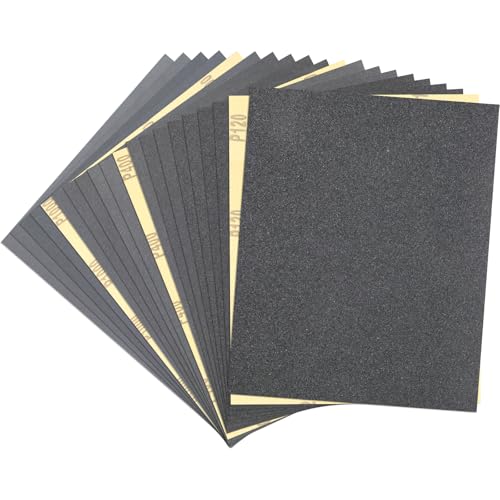
The silicon carbide pack that moves from shaping to mirror polish.
If your project calls for both coarse shaping and high-grit finishing, this 20-piece set spans 10 grits from 120 all the way to 2000, with two sheets of each grit. The electro-coated silicon carbide construction handles both wet and dry sanding — wet for reducing dust and achieving a finer scratch pattern, dry for fast material removal. Each sheet has the grit number printed on the back so you can grab what you need without squinting.
The sand quality and value for money receive the most positive mentions, with 15 and 6 respectively. Owners specifically note a “good grit selection for car headlight wet-sanding” and confirm the paper “withstood process well.” The waterproof backing means it does not turn to mush when you add water, unlike standard paper sheets. The set is particularly suited for automotive touch-ups, jewelry making, and fine wood finishing where you work through multiple grits.
The 9 x 11 inch sheet size is standard, but the 20-sheet count means only two per grit — if you do heavy sanding on a single grit, you will burn through them quickly. This is a variety pack that introduces each grit rather than stocking up on the ones you use most. For occasional use across different projects, it is a great fit. For high-volume work, you might wish for more sheets of the grits you actually use.
Broad spectrum: Ten grits from 120 to 2000 means you can tackle any sanding job from rough shaping to final polish in one purchase.
Low sheet count: With only two sheets per grit, heavy sanding on one grit will exhaust that option fast — ideal for variety, not volume.
Best for: mixed-project users who need a single kit for wood, auto, and craft sanding across a wide grit range.
Skip if: you burn through sheets quickly or know you only use a narrow grit band for repeated work.
9. LotFancy Sandpaper 60-5000 Grit (108 Pcs)

The 108-piece arsenal that covers every grit you will ever need.
Eighteen different grits from 60 to 5000, with 6 sheets of each, makes this the most comprehensive sandpaper assortment in the lineup. You get the standard woodworking grits (60, 80, 100, 120, 150, 180, 240, 320, 400) plus the ultra-fine polishing grits (600 through 5000) for bringing metal or lacquer to a mirror shine. The silicon carbide construction is waterproof, so you can wet-sand between clear coat layers without the paper falling apart. A sanding block is included — the screw clamp holds the sheet firmly, and the cushioned foam pad reduces hand fatigue.
Versatility and value for money are the strongest points, with 20 and 12 positive mentions respectively. One owner used it to “polish the scratched-up blade on my Swiss Army knife and made it look new again,” while another confirmed the “many different sizes grit of paper was able to complete my project.” The sanding block receives credit for being “easy to hold” and making it “easy to change the sand pads for fine and coarse sanding on bodywork.”
The durability feedback is notably mixed, with 11 negative mentions. Some reviewers point out the paper tears or crumbles more easily than premium brands, especially under aggressive use. The sanding block is described by several buyers as “very flimsy,” though it functions adequately for light to medium work. For the breadth of grits offered, the price is remarkably low, but the lower durability means you may go through sheets faster on tough jobs. This is a trade-off worth making if you value having every grit on hand for occasional projects.
Complete inventory: 18 grits from 60 to 5000 means you will never be caught without the right sheet — from stripping paint to polishing glass, it is all here.
Durability compromise: The sheets cut well but wear faster under heavy pressure than premium alternatives, and the included sanding block is not built for pro-level use.
Reach for this if: you want one purchase that covers every sanding and polishing need across wood, auto, metal, and crafts.
Look elsewhere if: you do heavy production sanding and need sheets that last through extended use without tearing.
Understanding the Specs
Grit Number and Grit Progression
The grit number tells you how many abrasive particles per square inch — a lower number (40, 60, 80) means coarser grains that remove material fast, while a higher number (320, 600, 2000) means finer grains that polish. The golden rule is to not skip more than one grit step at a time (go from 80 to 120 to 180, not straight from 80 to 220) because each grit leaves scratches the next one removes.
Aluminum Oxide vs Silicon Carbide
Aluminum oxide is the default for wood sanding because the grains fracture during use to create new sharp edges, extending the sheet’s life. Silicon carbide is sharper and harder, making it better for wet sanding between finish coats, polishing metal, or working with plastics and glass. For bare wood finishing, aluminum oxide is usually the better and longer-lasting choice.
Backing Types (Paper, Cloth, PSA)
Paper backing is the standard and works well on flat surfaces with hand sanders or palm sanders. Cloth backing is flexible and tear-resistant, ideal for curved edges or irregular profiles. PSA (pressure-sensitive adhesive) discs have a peel-and-stick backing for DA sanders and orbital sanders, letting you swap discs in seconds without clips or clamps.
FAQ
What is the best starting grit for raw wood?
How do I know when to move to a finer grit?
Can I use silicon carbide sandpaper on bare wood?
What does “open coat” vs “closed coat” sandpaper mean?
How long should a sandpaper sheet last?
Is wet sanding better than dry sanding for wood?
What is the difference between PSA discs and hook-and-loop discs?
Why does my sandpaper clog so fast on soft wood?
Final Thoughts: The Verdict
If you want one dependable pick, the best abrasive paper for wood winner is the Emery Cloth Roll because the cloth backing hugs curves and edges, each roll lasts through multiple projects, and the grit range covers everything from rough shaping to fine finishing. If you want the traditional sheet format with a complete grit progression, grab the BOSHCRAFT 25 Pcs Assortment. And for heavy stock removal with the most durable sheet available, the 3M Pro Grade 80 Grit is the one to reach for — it cuts aggressively and refuses to tear.
How We Picked
We do not accept paid placement. Every pick is matched to a real buyer and a real use-case; we do not hands-on test units.
Sources & Methodology
Specifications: manufacturer listings and product documentation. Review insights: verified customer reviews, as of July 2026. Pricing: not shown on this page (it changes often); check the current price via the retailer link.
As an Amazon Associate, Gadgets Feed earns from qualifying purchases. This does not affect which products we feature.