
An air conditioner blowing warm air on a scorching summer day is a special kind of misery, and restoring arctic-blast performance almost always comes down to one consumable: the correct refrigerant. Whether you are servicing a home mini-split, topping off a car’s R134a system, or tackling a recovery job with modern R1234YF, the difference between a quick fix and a costly mistake lives in the purity, fill weight, and compatibility of the coolant you choose.
I’m Min — the co-founder and writer behind Gadgets Feed. I’ve spent hundreds of hours cross-referencing compressor oil return properties, global-warming-potential ratings, vapor-pressure curves, and can-valve thread standards to build a buying guide that spares you from the confusion of mix-matching refrigerants and service adapters.
The right choice for your recharge job depends entirely on your system’s port type and the year of manufacture, and this deep-dive into the top contenders for the best ac coolant breaks down each can’s fill accuracy, connection safety, and real-world cooling recovery so you buy with confidence.
How To Choose The Best AC Coolant
AC coolant is not a one-size-fits-all commodity. Using the wrong refrigerant can cause compressor failure, component damage, or even safety hazards from over-pressure. Your first job is reading the vehicle or system sticker to determine the specific refrigerant type (R134a, R1234YF, R410A, R22, etc.). From there, consider fill accuracy, can design, and whether you need a simple top-off can or a full service kit with manifold gauges and adapters.
Know Your Refrigerant Type: R134a vs. R1234YF vs. R410A
R134a dominated vehicles from the mid-1990s through roughly 2017, and it remains popular for automotive top-offs because of its low cost and ubiquity. R1234YF replaces R134a in virtually all modern cars (2018+) due to a drastically lower global-warming potential. The two refrigerants use different service ports: R1234YF cans have a reverse-thread (left-hand) design so you cannot accidentally connect an R134a hose. R410A is common in residential mini-splits and heat pumps; it operates at much higher pressures (400-600 psi) and requires a manifold gauge set with 1/2” or 5/16” adapters.
Can Fill Weight and Purity
Refrigerant is always measured by weight, not volume. A label that says “8 oz” should deliver the correct mass, not a partially filled can. Poorly filled cans cause under-charging, which leads to poor cooling and short-cycling compressors. High-purity refrigerant (99.9% or better) ensures no moisture, acid, or oil contaminants that can clog expansion valves or degrade compressor seals. Sticking with established brands like Honeywell, Robinair, or ZeroR provides traceable purity certification.
Connection Hardware and Safety Features
For R1234YF systems, the SSV (self-sealing valve) can with reverse-thread design is mandatory — attempting to force a standard R134a tap onto a YF port destroys the valve. For R134a top-offs, a piercing-style can with integrated hose is fine for a quick fix, but a manifold gauge set offers precise pressure control and prevents overcharging. R410A mini-split servicing requires dedicated adapters (1/4” SAE to 5/16” or 1/2”), and a vacuum pump is essential to remove moisture before charging. Always check that included adapters match your system’s service port.
Quick Comparison
On smaller screens, swipe sideways to see the full table.
| Model | Category | Best For | Key Spec | Amazon |
|---|---|---|---|---|
| BACOENG Pump + Gauge Kit | Premium Kit | Full mini-split evacuation & recharge | 3.6 CFM vacuum pump, 800 psi gauges | Amazon |
| Robinair RG3 Recovery Machine | Premium Tool | Professional-grade refrigerant recovery | 1/3 HP oil-less compressor, 18 lbs | Amazon |
| Honeywell R1234YF 4-Pack | Premium Refrigerant | Modern vehicle AC top-off or recharge | 8 oz per can, HFO-R1234YF, reverse-thread | Amazon |
| ZeroR R1234YF 2-Pack | Mid-Range YF | Green alternative for 2018+ cars | 8 oz SSV can, includes service sticker | Amazon |
| cmebiz R134a 3-Pack | Mid-Range R134a | Easy DIY top-off for older cars | 3 x 6 oz cans with piercing valve | Amazon |
| SURIEN R410A Charging Hose Kit | Budget Kit | Entry-level mini-split charging | 59” hoses, 4000 psi burst | Amazon |
| Oralys R410A Manifold Gauge Set | Budget Set | Multi-refrigerant diagnosis & charging | 3-way manifold, 3 ft hoses | Amazon |
In‑Depth Reviews
1. BACOENG 3.6CFM AC Vacuum Pump and Gauge Set

This BACOENG kit bundles a 3.6 CFM vacuum pump with a full 3-way manifold gauge set, three color-coded 5-foot hoses, R410A adapters, and a carry bag — giving you a turnkey solution for evacuating and charging a residential mini-split system. The all-copper motor and aluminum housing keep the pump running cool even during extended pull-down cycles, while the sight glass lets you monitor oil levels at a glance.
The manifold gauges are rated for 800 psi working pressure and 4000 psi burst, which safely covers the high-side demands of R410A and R22 systems. Color-coded ports (blue for low, red for high, yellow for service) eliminate confusion during connection. The included R410A adapters (1/4” SAE to 5/16” and 1/2”) mate directly with modern mini-split service valves without any additional purchases.
Multiple verified users report pulling a deep vacuum on 9,000–24,000 BTU mini-splits without leaks, and the pump has held up after 8+ uses with no performance drop. The kit does not include R1234YF adapters or automotive quick-couplers, so vehicle technicians will need to buy those separately. For the price of a single service call, you get every tool needed to install and maintain a mini-split for years.
Why it’s great
- Complete HVAC kit: pump, gauges, hoses, adapters, bag — no extra buys needed
- All-copper motor and aluminum housing for reliable long-term performance
Good to know
- Not compatible with automotive R134a or R1234YF systems out of the box
- Pump is rated at 110V only; 220V systems require a separate transformer
2. Robinair RG3 Portable Refrigerant Recovery Machine

When you need to recover refrigerant before a compressor replacement or system disposal, the Robinair RG3 is the industry standard for portable recovery. Its oil-less single-cylinder compressor pulls both liquid and vapor from CFC, HFC, and HCFC refrigerants including R-410A, R22, R134a, and R404A — making it compatible with residential heat pumps, rooftop units, and automotive AC systems alike.
The 40-percent smaller footprint compared to older recovery machines, combined with an 18-pound weight and comfortable handle, makes rooftop carry and tight-space positioning genuinely practical. The high-efficiency cross-flow condenser and fan layout shorten cycle times, and the auto shut-off triggers at 550 PSI to prevent over-pressure accidents. Simple two-valve controls and easy-to-read gauges reduce the learning curve for first-time users.
Real-world recovery tests show the RG3 pulling 7.9 lbs of R-410A from a 2-ton heat pump in high ambient heat without strain. It does not include a built-in oil separator, so you may want an external one for high-oil-retention systems. For DIY enthusiasts who regularly service multiple vehicles or appliances, the RG3 pays for itself after a few recoveries versus paying shop fees for capture and disposal.
Why it’s great
- Lightweight and compact enough to carry up a ladder for rooftop service
- Auto shut-off at 550 PSI adds a critical safety layer during unattended recovery
Good to know
- No built-in oil separator; external separator recommended for some HVAC applications
- Single-cylinder design means moderate recovery speed compared to twin-cylinder units
3. Honeywell Automotive Refrigerant (4-Pack)

Honeywell’s R1234YF 4-pack delivers the latest generation automotive refrigerant in a convenient multi-can bundle. Each 8-ounce SSV (self-sealing valve) can uses the reverse-thread (left-hand) design mandated for all post-2017 vehicle AC systems, preventing any accidental connection to an R134a manifold set. The HFO-R1234YF formula offers a global warming potential of just 4, which is over 99 percent lower than R134a.
The cans are consistently filled to the stated weight — verified by multiple users who weighed theirs on a postal scale. When charged into a properly evacuated system, the refrigerant restored vent temperatures to the mid-40°F range even on 100°F days. The 4-pack provides enough material for both a full recharge (typically 16–24 oz) and a follow-up top-off, so you are not stuck mid-job with an empty can.
Users report straightforward compatibility with standard R1234YF charging tools and quick-connect couplers. A few reviewers noted that the cans do not include a built-in hose or tap, so you will need a separate YF-compatible charge hose. For the price per ounce, this pack undercuts most auto parts store single cans by a significant margin, making it the smart buy for owners of 2018+ vehicles.
Why it’s great
- Ultra-low GWP of 4 meets environmental regulations for modern vehicles
- 4-pack provides enough refrigerant for a full recharge plus a reserve can
Good to know
- Requires a separate R1234YF charge hose — no tap or hose included in the pack
- Not compatible with pre-2018 R134a systems without a full system conversion
4. ZeroR Genuine R1234YF Refrigerant (2-Pack)
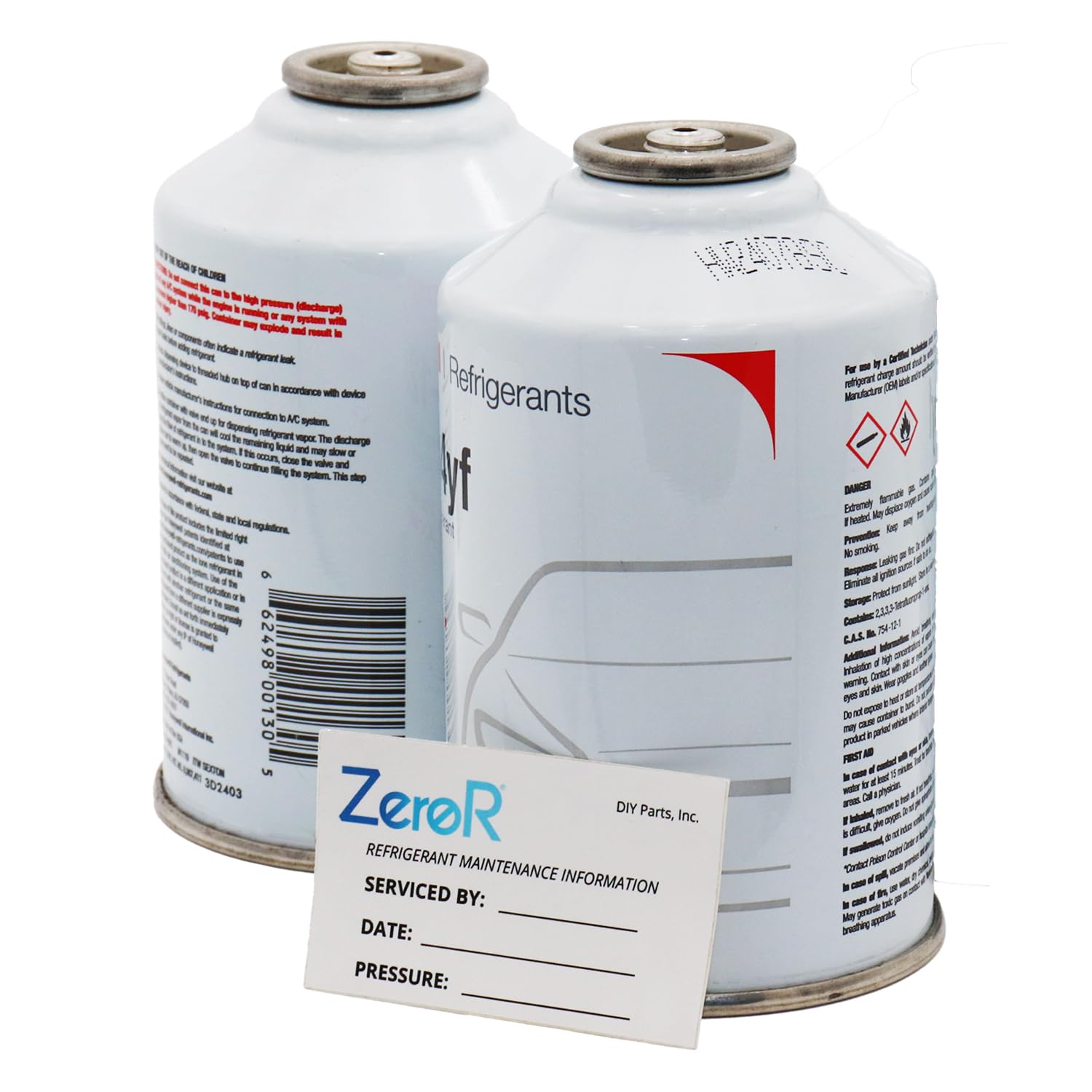
ZeroR’s R1234YF two-pack brings professional-grade HFO refrigerant to DIY car owners. Each 8-ounce can is measured by weight for precise charging, and the SSV valve with reverse-thread design ensures only YF-compatible tools can connect. A service sticker is included with each can so you can label the hood after the job — a small detail that helps future mechanics identify the refrigerant type at a glance.
The HFO-R1234YF formulation delivers the same cooling capacity as R134a while slashing the global warming potential to just 4. Users who replaced compressors on Jeeps, Grand Cherokees, and other 2018+ vehicles reported smooth charging with stable pressure readings and return of ice-cold vent temperatures. The 2-pack typically covers a full recharge on most passenger vehicles, though larger systems may require a third can.
One practical detail: the refrigerant flows best when the can is held upright and rotated occasionally during charging — a tip mentioned by several reviewers who stopped and restarted to maintain flow. The only drawback is the higher per-ounce cost compared to the Honeywell 4-pack, but for someone who only needs a single recharge every few years, the 2-pack is the right capacity without leftover inventory.
Why it’s great
- Includes a service sticker for future identification of refrigerant type
- SSV reverse-thread design eliminates risk of cross-threading with R134a tools
Good to know
- May need 3 cans for larger AC systems; 2-pack is best for typical sedans/SUVs
- Higher cost per ounce compared to the Honeywell 4-pack option
5. cmebiz Vehicle AC Refrigerant R134a (3-Pack)

For owners of older vehicles running R134a (typically model years 1994–2017), the cmebiz 3-pack offers an accessible entry point to DIY AC recharging. Each of the three 6-ounce cans comes with an integrated piercing valve, so you can connect a standard R134a charge hose without any special adapters. The refrigerant is specifically formulated to restore factory-specified cooling performance.
Real-world users report that two cans brought a 2007 Toyota FJ Cruiser back to freezing vent temperatures within about 15 minutes, and a 1998 Jeep Cherokee needed the full three cans for a thorough recharge. The included piercing valve works reliably with most R134a low-side quick-connect hoses, and the self-sealing design prevents leakage when disconnecting the tap. Several first-time DIYers mentioned that watching a short YouTube video was all the preparation needed to complete the job safely.
A critical safety note echoed in the reviews: anyone unfamiliar with high-pressure AC systems should understand that overcharging can blow hoses or damage the compressor. The cans lack a built-in pressure gauge, so you need a separate manifold gauge set or AC pro kit to monitor the low-side pressure while charging. For seasoned DIYers who already own gauges, this 3-pack is the most cost-effective way to top off a thirsty R134a system.
Why it’s great
- Three 6-ounce cans with piercing valves — ready to use out of the box
- Proven restoration of freezing vent temps on vehicles 20+ years old
Good to know
- No built-in pressure gauge; a manifold set is strongly advised to avoid overcharging
- Not for use with R1234YF, R410A, or R22 systems
6. SURIEN R410A Recharge Kit AC Charging Hose Set

The SURIEN R410A kit is the stripped-down, budget-friendly charging hose set for DIYers who already own a vacuum pump but need a hose and gauge to charge a mini-split correctly. It includes two 59-inch color-coded hoses rated for 800 PSI working pressure and 4000 PSI burst, one low-pressure gauge, and adapters for both 1/2” and 5/16” mini-split service ports. The gauge is rubber-coated for drop protection and reads R410A, R22, and R134a scales simultaneously.
Assembly is straightforward: connect the blue hose to the low-side service port, attach the yellow hose to the refrigerant tank, and open the tank valve while monitoring pressure. Users running R410A mini-splits report that the kit handled 102–140 PSI operating pressures with no leaks at the crimped ends. The included 1/4” SAE to 5/16” and 1/2” adapters fit the vast majority of modern mini-split condenser units.
Durability reviews are mixed — some users experienced leakage at the gauge connections after a single use, while others have used the kit multiple times without failure. The gauge reads in degrees Celsius only (not Fahrenheit), which can confuse users accustomed to imperial units. For the price of a single service call, this kit is a sensible gamble for a one-off mini-split install, but heavy-use DIYers should budget for a higher-end gauge set.
Why it’s great
- Includes both 5/16” and 1/2” mini-split adapters for maximum compatibility
- Very low entry cost for a one-time mini-split charging job
Good to know
- Gauge reads in Celsius only, which may require a conversion reference
- Durability concerns — some users reported failures after a single use
7. Oralys R410A Manifold Gauge Set

The Oralys manifold gauge set is an ultra-budget 3-way diagnostic kit designed for DIYers who need to work across multiple refrigerant types — R410A, R22, R134a, and R404A — without buying separate tools. The brass-and-stainless-steel manifold body houses two precision electromechanical gauges for high and low side pressure readings, and the set includes three color-coded 3-foot hoses and R410A adapters for direct connection to modern systems.
Users have successfully used this set to evacuate and recharge mini-splits running R410A, reporting no leaks at the flare connections and accurate pressure readings that matched their expectations. The 3-foot hose length is sufficient for most residential HVAC installations, though technicians working on larger commercial equipment may want longer hoses. The included adapters require a small adjustment to depress Schrader valve pins, which is a straightforward one-time setup.
The dominant concern in the review stream is quality consistency: while many users describe the set as “great for the money” and “solid for a homeowner,” a vocal minority report valves that do not fully shut off and adapters that blew apart under pressure. This inconsistency makes the Oralys set suitable only for low-risk, occasional use where a failure would not cause a major leak or safety hazard. For routine professional use, a higher-tier manifold is recommended.
Why it’s great
- Works with R410A, R22, R134a, and R404A in one affordable set
- Brass and stainless steel construction for basic corrosion resistance
Good to know
- Short 3-foot hoses reduce working range compared to standard 5-foot hoses
- Quality control issues reported; not recommended for critical or commercial jobs
FAQ
Can I use R134a in a system designed for R1234YF?
How do I know if my car’s AC uses R134a or R1234YF?
What is the difference between a charging hose and a manifold gauge set?
Do I need a vacuum pump to charge a mini-split with R410A?
How much refrigerant does a typical car AC system need?
Final Thoughts: The Verdict
For most users, the best ac coolant winner is the BACOENG 3.6CFM Vacuum Pump and Gauge Set because it eliminates the need for multiple separate purchases and gives a DIY homeowner the complete toolkit to install, evacuate, and charge a mini-split system for years. If you specifically need R1234YF for a modern vehicle, grab the Honeywell 4-pack — it delivers the lowest cost per ounce for post-2017 cars. And for a technician performing refrigerant recovery before a compressor replacement, nothing beats the Robinair RG3 for portability and reliable pull-down across multiple refrigerant types.