
When your condenser fan motor seizes mid-summer, the silence in the backyard is deafening—right before the house starts warming up. An AC electric fan motor is the unsung workhorse that pulls air across your condenser coils, dumping heat outside so your compressor doesn’t cook itself. Choosing the wrong one means a service call or a motor that burns out in two months.
I’m Min — the co-founder and writer behind Gadgets Feed. I’ve spent countless hours analyzing cross-brand compatibility, bearing types, torque curves, and thermal protection specs to separate the motors that last a decade from those that fail after one season.
Whether you’re a DIY homeowner or a service tech, this guide cuts through the noise to help you find the best ac electric fan motor for your specific unit, avoiding the common pitfalls of shaft length mismatches and wrong capacitor sizes.
How To Choose The Best AC Electric Fan Motor
Replacing a condenser or blower motor isn’t complicated, but the wrong pick means a non-functional unit or a fire hazard. Focus on four physical matching points before you compare brands or prices.
Match the Frame and Mounting Pattern
The NEMA frame size (48Y, 48, 56) defines the bolt-hole spacing and shaft height. For condenser motors, measure the stud pattern—usually 5-1/4″ x 5-1/4″ or 3.9″ x 3.9″. If the mounting holes don’t align, you’re fabricating brackets. The shaft diameter (typically 1/2″) and length must also match to fit the existing fan blade hub.
Verify Horsepower and RPM
Most residential condenser motors run 1/10 HP to 1/3 HP at 1075 RPM. Dropping to a lower HP causes the motor to run hot and trip thermal overload. Higher RPM (1725 vs 1075) moves more air but may overload the blade or cause noise. Cross-check the original motor’s nameplate; the replacement must match at least the HP and RPM range.
Check Rotation and Wiring Configuration
Condenser motors are typically reversible—swap two wires to change from clockwise (CW) to counterclockwise (CCW). The wiring schematic on the motor label must match your unit: common (black/white), capacitor (brown/brown-white), and speed tap (usually blue or red). Dual-capacitor circuits require special attention to the “fan” terminal.
Quick Comparison
On smaller screens, swipe sideways to see the full table.
| Model | Category | Best For | Key Spec | Amazon |
|---|---|---|---|---|
| A.O. Smith ORM5458 | Condenser Motor | Universal mid-range replacement | 1/3–1/6 HP, 1075 RPM | Amazon |
| MARS 10728 | Condenser Motor | Rugged OEM-level build | 1/4 HP, 1075 RPM, 1.8A | Amazon |
| VEVOR Upgraded | Condenser Motor | Budget-friendly with capacitor included | 1/5 HP, 1075 RPM, 1.3A | Amazon |
| OEM (Carrier) Regal Beloit | Condenser Motor | Exact-fit Carrier/ICP units | 1/10 HP, 1100 RPM, 0.75A | Amazon |
| Century GF2054 | Blower Motor | Belt-drive furnace/blower duty | 1/2 HP, 1725 RPM, 115V | Amazon |
| Dayton 6K778 | Blower Motor | Dependable forced-air furnace | 1/3 HP, 1725 RPM, 115V | Amazon |
| Evergreen 6205E | ECM Blower Motor | High-efficiency variable-speed | 1/2 HP, 1075 RPM, 230V, X13 | Amazon |
In‑Depth Reviews
1. A.O. Smith ORM5458 1/3-1/6 HP Condenser Motor

The Century ORM5458 (formerly A.O. Smith) is a 48Y-frame condenser motor that covers the widest HP range—1/3 through 1/6—on a single unit. That flexibility means it can replace motors in everything from a small residential split to a light commercial package unit without worrying about exact HP matching. The 1075 RPM and 208-230V rating are standard for the vast majority of North American condensers.
Installers consistently report that the adjustable mounting design fits nearly every brand, though you will need to trim the through-bolts and shaft to length. The motor uses sleeve bearings, which are quieter than ball bearings but rely on adequate oil wicking; for outdoor duty in dusty areas, occasional debris ingress can wear them faster. The capacitor is not included, so budget for a separate POC7.5 or equivalent.
Wiring is straightforward for anyone who has photographed their old connections, but the dual-voltage tap on the board requires attention—the diagram printed on the motor label must be cross-referenced with your contactor and capacitor layout. If you need a motor that fits most units with minimal fuss, this is the one to grab.
Why it’s great
- Wide HP range (1/3–1/6) covers multiple condenser sizes
- Nearly universal bolt pattern fits Carrier, Rheem, Trane, Goodman
- Reversible rotation via simple wire swap
Good to know
- Capacitor not included; you must purchase separately
- Through-bolts require trimming with a hacksaw for fit
- Sleeve bearings may wear faster in dusty environments
2. MARS 10728 1/4 HP Condenser Fan Motor

The MARS 10728 is a 1/4 HP, 1075 RPM, 1.8-amp condenser motor built with noticeably thicker gauge wire and a heavier housing than most OEM replacements. It carries a reputation among HVAC techs for outliving the original motor by years, thanks to its robust sleeve bearing design and a fully sealed winding that resists moisture ingress from rain splash.
The shaft is deliberately long to allow trimming to fit multiple blade depths, and the rotation is reversible by swapping the brown and brown/white leads. Several users report that this motor runs quieter than the original Carrier or Trane unit it replaced. The key caveat: the wire exit angle is 45° off from some OEM positions, which may require a slight bend in the electrical raceway.
For service techs who see a variety of units, the universal wiring scheme (black=common, yellow=contactor, brown=fan capacitor) saves time. The MARS 10728 is a premium-tier choice for those who want a single motor that can sit on the truck and handle most 1/4 HP condenser callouts without a second trip.
Why it’s great
- Heavy-duty build quality exceeds most OEM motors
- Long, trimmable shaft fits multiple fan blade depths
- Quiet operation with reversible rotation
Good to know
- Wire exit is offset 45° from typical OEM position
- Does not include a capacitor
- At 11.2 lbs, heavier than many budget alternatives
3. VEVOR Upgraded 1/5 HP Condenser Fan Motor

The VEVOR 1/5 HP condenser motor is the budget-friendly entry that punches above its price class by including a CBB65 5µF capacitor in the box—a practical bonus since most failed motors also kill the capacitor. It runs at 1075 RPM and 208-230V, with a reversible rotation that covers both clockwise and counterclockwise applications by simply reconfiguring the wiring harness.
The 47-inch long leads give you plenty of slack to route wires through the control panel without splicing extensions, a common headache with shorter OEM harnesses. The copper winding and overheat protection are standard, but a few users note that the bolts require an unusual thread size and the included capacitor can arrive dented. Over a 2-year span, reviewers report reliable operation in Carrier, Goodman, and Rheem condensers.
Watch the fan blade mount—some units report that the right-angle connectors prevent a weatherproof sleeve from sliding fully over the terminal block. Use dielectric grease and electrical tape to seal the connection. For a drop-in replacement under with the capacitor included, the VEVOR is hard to beat.
Why it’s great
- Capacitor included saves a separate purchase
- Extra-long 47-inch wires simplify routing
- Reversible rotation covers both CW and CCW units
Good to know
- Bolts use a non-standard thread size; nuts may not fit
- Right-angle connectors can interfere with weatherproof sleeve
- Some units shipped with dented capacitor housing
4. OEM Carrier 1/10 HP Condenser Fan Motor
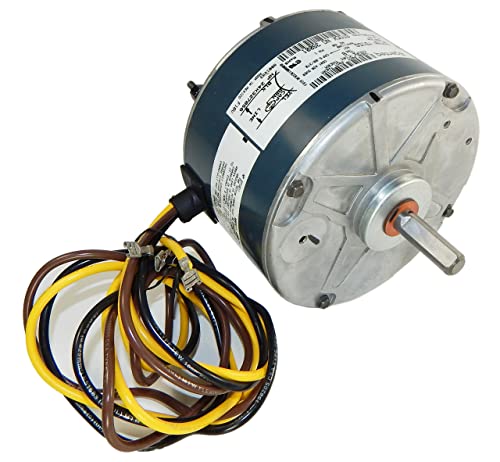
This Regal Beloit motor is the OEM-spec replacement for Carrier, Bryant, Payne, and Day & Night units using the 5KCP39BGS069S part number. At 1/10 HP and 1100 RPM, it runs slightly faster than the standard 1075 RPM motors, which can translate to marginally higher airflow when paired with the correct blade. The 5-5/8-inch body diameter and 5-1/4-inch stud pattern guarantee a bolt-in fit without bracket modifications.
The motor uses sleeve bearings and a TEAO (Totally Enclosed Air Over) design, meaning it relies on the fan airflow for cooling—never run it without the blade installed. The 40°C ambient temperature rating is fine for most climates, but units in direct Phoenix or Las Vegas sun may push that limit on the hottest days. Multiple reviewers confirm the motor mounts and wires exactly like the original, making it a 30-minute swap for a competent DIYer.
One limitation: the shaft is 1.5 inches long, which is shorter than some universal motors. If your fan blade hub is thicker than 1.5 inches, this motor will not work. But for Carrier owners wanting a true OEM drop-in, this eliminates guesswork.
Why it’s great
- Exact OEM fit for Carrier/Bryant/Payne units
- No bracket modifications required
- Requires only 0.75 amps, very energy-efficient
Good to know
- Short 1.5″ shaft may not clear thicker fan blade hubs
- 40°C ambient rating limits use in extreme desert heat
- No capacitor included; must verify your existing cap specs
5. Evergreen 6205E X13 Blower Motor

The Evergreen 6205E is not a standard PSC motor—it’s a constant-torque ECM (Electronically Commutated Motor) that replaces the failing X13 blower motors found in Carrier, Trane, Rheem, and Lennox air handlers. It runs on 208-230V and delivers four discrete speeds via 24VAC control signals, plus an automatic continuous fan speed. The brushless design draws significantly less power than a PSC equivalent, potentially saving –100 per year in electricity.
Installation is plug-and-play if your unit already has an X13-style harness. The motor self-calibrates on first power-up, selecting the correct torque profile for the attached blower wheel. Reviewers who replaced failed ECM modules (not the motor itself) report that the Evergreen solved their intermittent blower issues where replacing just the module did not. The 1/2 HP rating and 1075 RPM match the vast majority of 48-frame residential air handlers.
The primary downside: the seller provides no warranty, though the manufacturer typically honors 12–18 months. The box weight listed at 0.1 lbs is clearly a data error—expect a motor that weighs about 8 lbs. For homeowners looking to modernize their furnace blower and cut utility costs, this is the premium option.
Why it’s great
- ECM efficiency saves electricity vs PSC motors
- Four discrete speeds for precise airflow control
- Self-calibrating plug-and-play setup
Good to know
- No warranty from Amazon seller
- Requires 24VAC control signal—not compatible with simple thermostats
- Does not replace 3.0 or 2.5 ECM motors
6. Dayton 6K778 1/3 HP Blower Motor

The Dayton 6K778 is a split-phase, 1/3 HP belt-drive blower motor designed for forced-air furnaces and commercial air handlers. At 1725 RPM and 115V, it spins at nearly double the speed of a typical condenser motor, generating the static pressure needed to push air through long duct runs and restrictive filters. The open drip-proof (ODP) enclosure allows airflow through the windings, but it must be kept dry—no outdoor installation.
Techs consistently praise the Dayton for its reliability in furnace applications, with several reviewers reporting 5+ years of continuous seasonal use. The split-phase design provides higher starting torque than a PSC motor of the same HP, which matters when spinning a heavy squirrel-cage blower from a dead stop. Wiring is simple: the color-coded leads match standard furnace terminal blocks.
Users repurposing this motor for workshop tools (lathes, polishers, grinders) report that the 1725 RPM speed is ideal for buffing and woodturning. However, the motor runs hot after 30–40 minutes of continuous duty—this is normal for split-phase designs, but ensure the motor has adequate ventilation. The UL and CSA certifications add peace of mind for insurance and code compliance.
Why it’s great
- High starting torque for heavy blower wheels
- Proven reliability in furnace duty for 5+ years
- UL/CSA certified for code compliance
Good to know
- ODP enclosure is not weatherproof—indoor use only
- Runs hot during extended operation (normal for split-phase)
- Capacitor not required; but wiring must match furnace diagram
7. Century GF2054 1/2 HP Blower Motor
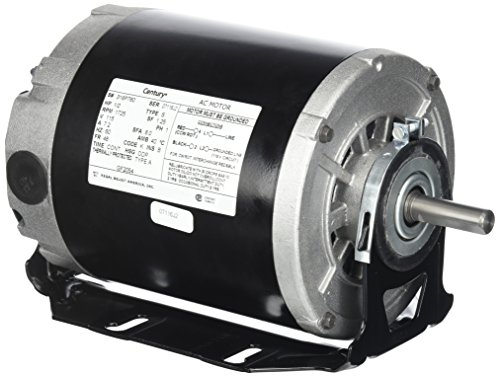
The Century GF2054 is a 1/2 HP resilient-cradle base motor designed for belt-drive blowers and workshop equipment. Its 48/56 frame compatibility means it fits the mounting footprint of many residential furnace blowers and industrial fans, while the reversible rotation allows it to be wired for either clockwise or counterclockwise shaft rotation. The 1725 RPM speed and 7.2-amp draw are standard for 1/2 HP split-phase motors.
DIYers commonly use this motor for whole-house fans, wood lathes, and bench grinders. The resilient base dampens vibration, keeping noise lower than rigid-mount motors. However, some units have arrived with the bearing seized or failed after two months; the failure rate appears higher than average for Century, possibly due to thermal switch defects. If buying, test the shaft spin and continuity immediately upon arrival.
The instructions on the metal label are clear for reversing (swap red and black wires), but the small print is easy to lose—photograph it before mounting. For a budget 1/2 HP motor that powers a fan or light-duty workshop tool, the GF2054 works well if you get a good unit.
Why it’s great
- Resilient cradle base reduces vibration noise
- Dual frame (48/56) fits most furnace and fan mounts
- Reversible rotation for flexible wiring
Good to know
- Higher-than-expected bearing failure rate in some batches
- Large pulley can overload; check startup current
- Instructions are metal-etched and hard to read in dim light
FAQ
Can I use a 1075 RPM motor to replace a 1725 RPM blower motor?
Do I need to replace the capacitor when I swap the motor?
Why does my new motor have an extra brown wire with a white stripe?
Final Thoughts: The Verdict
For most users, the ac electric fan motor winner is the A.O. Smith ORM5458 because its dual HP range and universal 48Y frame make it the safest bet for the broadest range of condenser units. If you want a motor that includes the capacitor for a simple one-box purchase, grab the VEVOR Upgraded. And for a premium, energy-saving upgrade in an air handler, nothing beats the Evergreen 6205E X13.