
Our readers keep the lights on and my morning glass full of iced black tea. As an Amazon Associate, I earn from qualifying purchases.
Specs are compiled from manufacturer listings and verified buyer reviews and can change over time — please confirm the key details on the product page before buying.
If you want to stop a fan, blower, or workshop motor from running flat-out all the time, you need a controller that matches your motor’s amp rating — and that one number decides almost everything. Get it right and your attic fan quiets down, your fireplace blower stops roaring, and your wood shop stops sounding like a wind tunnel. Get it wrong and you either burn out the controller or watch your motor lug along at the wrong speed.
I’m Min — the founder and writer behind Gadgets Feed. This guide is built by comparing the manufacturers’ published specifications and the patterns across verified customer reviews, so you get each pick’s real strengths and trade-offs instead of marketing spin.
The picks below split into two families: simple wall-mount speed dials for single-phase fans and blowers, and variable frequency drives that convert single-phase household power into three-phase output for real machinery. Everything here is sorted by what it actually does for your setup, so keep reading for the best ac electric motor controller for your job.
Our Picks at a Glance

How To Choose The Best AC Electric Motor Controller
A motor controller does one physical thing: it cuts the power your motor receives so the motor turns slower. That sounds simple until you realize the wrong unit will either hum, overheat, or refuse to slow your motor at all. The good news is that three checks cover almost every buying mistake.
Match the amps first, everything else second
Find the amp number printed on your motor’s nameplate. Your controller’s maximum current rating has to sit at or above that figure. A motor pulling 7 amps needs a controller rated 10 A — a cheaper 6-amp unit will struggle and run hot under that load.
Know which motor type you own
Shaded pole and PSC motors — the two common types in fans, blowers, and humidifiers — work with the wall-mount dials here. Capacitor-start and capacitor-run motors do not, and the manufacturer notes on these controllers say so plainly. If your motor has a hump-shaped capacitor can bolted to the side, check before you buy.
Pick a wall dial or a frequency drive
You get two ways to slow a motor. A wall-mount control wires into a standard electrical box and gives you a knob that slows a fan or blower. A variable frequency drive (VFD) is the bigger tool: it takes household single-phase power (the ordinary 120 V or 240 V from your wall) and produces three-phase output (the three-wire power industrial motors need) to run machinery like lathes, mills, and compressors, while letting you dial the motor’s frequency (how many times per second the power cycles, which sets the speed) from low speeds up past the standard wall-power rate.
Quick Comparison
| Model | Best For | Max Current | Voltage | Motor Type Support | Amazon |
|---|---|---|---|---|---|
| KBWC-16K (H9001) Wall Mount AC Fan Motor Control★ Best Overall | Attic and duct fans up to 16 A | 16 A | 115 V | PSC and shaded pole | Amazon |
| VEVOR VFD 3HP, 2.2KW, 10A Variable Frequency DriveTop Performer | Three-phase lathes, mills, compressors | 10 A | 220–240 V input | Three-phase motors | Amazon |
| XCFDP AC 220V/2.2kw 3HP Variable Frequency Drive | Bridgeport mills and drill presses | 12 A | 220 V single-phase in / three-phase out | Three-phase motors | Amazon |
| HY HUANYANG VFD Variable Frequency Drive Converter 3kW 4HP | Belt sanders and CNC spindles | 13 A | 220 V single or three-phase in | Three-phase motors | Amazon |
| KB Electronics Model KBWC-18K Variable Speed Fan Control | Whole-house and roof fans up to 8 A | 8 A | 115 V | Shaded pole and PSC | Amazon |
| KB Electronics 8811013 Solid State Variable Speed Motor Control | Inline fans and workshop blowers | 10 A | 115 V | Shaded pole and PSC | Amazon |
| CAPTIVE-AIRE VSC-6 115 VAC 6.0 amp Variable Speed Controller | Fireplace blowers and small workshop fans | 6 A | 115 V | Motors up to 6 A | Amazon |
In‑Depth Reviews
1. KBWC-16K (H9001) Wall Mount AC Fan Motor Control
Our pick — 4.5★ from 250+ verified ratings; the strongest balance of quality and price.
The 16-amp dial that swallows the amp draw of a whole-house or attic fan without flinching.
This is the one to reach for when your fan motor pulls serious current. Both facts matter once you are standing on a ladder with a screwdriver in one hand trying to tuck a control into a wall box.
What wins people over is how straightforward the swap is — wiring it in is the single most praised thing about this unit, and the adjustable minimum setting is the quiet bonus nobody expects until they find it. That trim lets you set the floor speed so the fan never stalls so low that it stops moving air. You can dial the range from a slow crawl up to nearly full, and the knob’s internal trim pot shifts the whole range when the default spread does not suit your setup.
It runs a fireplace fan, a kitchen duct fan, or a full attic vent without drama. The honest catch is the wall box: the switch body is deep, and fitting it inside a shallow box crowded with other wires will fight you. One buyer’s report on a 4.3 A, 120 V attic fan showed the control holding current steady across every speed from roughly the full range down to a crawl — so the fan keeps turning smoothly instead of stalling — with a faint harmonic hum (a low electrical buzz from the motor) audible at the lowest setting and no interference on TV signals.
Where This Unit Shines
- 16 A maximum current rating — the highest among the wall-mount picks here
- Adjustable low-speed setting lets you set a floor so the fan keeps moving air
- Weighs 4.8 ounces, so it does not strain the box or the wiring run
Set Your Expectations Here
- Deep-bodied switch — a shallow wall box packed with wires is a tight fit
- Faint harmonic hum at very low speed, and the faceplate in hand differs from some listing photos
- Not for capacitor-start or capacitor-run motors
Made for the big-draw fan: reach for this if your attic fan, kitchen duct fan, or fireplace blower pulls heavy amps and you want headroom left over.
Look elsewhere if: your wall box is shallow or already packed, or your motor carries a capacitor can.
2. VEVOR VFD 3HP, 2.2KW, 10A, 1 Phase 220V-240V Input to 3 Phase 220V-240V Output Variable Frequency Drive
A three-phase workhorse that takes ordinary household 220V and spins a lathe, mill, or compressor up to speed.
The headline here is the conversion itself: this drive takes single-phase 220–240 V input and puts out three-phase 220–240 V, with 2.2 KW, 10 A, and 3 HP of rated muscle. Output frequency runs 0–400Hz, and the detachable control panel comes off on a 7.9-inch cable so you can remote-mount the buttons on a cabinet face.
The practical part for most owners is the soft start and stop. Instead of slamming your compressor motor with full current the moment you flip a switch, the drive ramps up — that is easier on the motor and easier on the upstream breaker. There is a 10-layer protection system guarding against overcurrent, overload, overvoltage, and phase loss, plus a triple-proof painted circuit board and a forced-air fan keeping things cool during long runs.
Now the part a first-time buyer needs to hear: reliability is the most talked-about subject on this drive’s review pages, and it cuts both ways. Plenty of buyers run it flawlessly on compressors and mills, while a few report failures — one walked away from a lathe run after six months, and another lost a unit partway through a job. The manual is widely called the weak point, written in rough translation and not friendly to anyone new to drives. Buyers who stuck with it leaned on YouTube tutorials to set parameters, and a few needed the seller’s support to sort it out.
What It Delivers
- Converts 220–240 V single-phase to three-phase output for real machinery
- 0–400Hz range with a detachable panel on a 7.9-inch cable for remote control
- 10-layer protection plus a multi-sided ventilation design and cooling fan
The Honest Caveats
- Reliability feedback is genuinely mixed — most run fine, some fail early
- Manual is not written for a drive newcomer; YouTube or seller help is often needed
- Does not support external braking resistors
Fits you if: you want to run a three-phase lathe, mill, or compressor off single-phase household power and you are comfortable setting parameters with a tutorial open.
Not your match if: you need a braking resistor or you want a manual you can follow cold.
3. XCFDP AC 220V/2.2kw 3HP Variable Frequency Drive, 12A Inverter Single Phase to 3 Phase

A mill-and-lathe drive that owners keep buying a second and third time.
This one earns its spot on shop-floor results. Owners run it on Bridgeport mills, South Bend lathes, and knife belt grinders, with some buyers reporting years of steady service and a few going back to buy a second or third unit for another machine. One owner reported a drill-press unit lasting 6.5 years before replacement.
The specs line up for that kind of work: 2.2 KW (3 HP) output at 12 A, single-phase 220 V input feeding three-phase 220 V out, and an output frequency range of 0–400Hz. The bare control panel detaches on a 20-centimeter cable built into the unit, so you can move the buttons off the cabinet when the drive itself has to tuck into a tight spot. Copper coil windings and a multi-grid case design with cooling gaps between the components speed up heat shedding.
Where it falls short is documentation. The manual covers multiple models and reads as a general sheet rather than a walkthrough, and the parameter list is long enough to send a newcomer hunting for a video. A buyer with years of drive experience still spent hours working out a non-standard stop-button wiring because the standard method was not spelled out. Wiring space inside the case is tight too — pack ferrules or lever connectors rather than bulky wire nuts.
Compatibility note: the maker’s own guidance says your motor’s power should not be more than twice this unit’s power, so a 3HP drive tops out sensibly around a motor in that range.
Support position: an 18-month warranty with lifelong technical support backs it, and the listing explicitly invites you to message before buying to sort out the right model.
Buy it for: a manual mill, lathe, or drill press where you want proven shop-floor reliability and do not need hand-holding on setup.
Pass if: you want a clear step-by-step manual from the start — plan on a YouTube tutorial before you wire the stop circuit.
4. HY HUANYANG VFD Variable Frequency Drive Converter 3kW 4HP 220V

A 3 kW converter that takes single or three-phase input and stays out of your way.
The spec that separates this one is input flexibility. It runs a three-phase motor fed from either 220 V single-phase or 220 V three-phase supply, outputs 0–400Hz, and carries a 13 A rating on its 3 kW frame. That brings the higher current ceiling than the 10 A VEVOR above, which matters for a heavier motor or one drawing close to the drive’s rated limit.
For belt sanders and CNC routers, buyers report a smooth and straightforward setup. The face controls detach on an internal ribbon cable so you can remote-mount them in a separate cabinet, and it supports Mach3 control plus RS-485 communication, remote potentiometer speed control, and remote start/stop. The maker describes low noise and low electromagnetic interference, backed by a CE listing.
One practical owner detail to plan for: this drive is not dust-proof. A belt-sander owner running it in a dirty shop reports needing regular air-compressor cleaning to keep the unit healthy, and credits that upkeep with a first unit lasting five years. It is a maintenance routine, not a flaw — treat the enclosure like any shop electrical gear and blow it out.
Where It Pulls Ahead
- 13 A rating on a 3 kW (4 HP) frame — the highest current ceiling among the drives here
- Accepts either single-phase or three-phase 220 V input
- Detachable face controls, Mach3 support, and RS-485 communication
Before You Order
- Not dust-proof — a dirty shop means regular cleaning
- Braking resistor support is not wired in by default; components must be requested separately
- Torque vectoring setup can take fiddling to dial in
Built for: a belt sander, CNC spindle, or heavier three-phase motor driven from single-phase shop power, where you want current headroom and remote control.
Think twice if: your shop is a dusty environment you will not clean regularly, or you need braking built in from day one.
5. KB Electronics Model KBWC-18K (UL) Variable Speed Fan Control, Wall Mount

The 8-amp wall dial that brings a dead whole-house attic fan back to life.
This is a narrow, useful fit: 8 A at 115 V, UL and CSA approved, and built to control shaded pole and PSC motors on roof fans, attic fans, blowers, humidifiers, and ventilators. It drops into a standard 2″ x 4″ electrical wall box, so you are replacing a plain switch with a speed dial rather than rewiring a run. If your attic fan stopped switching between speeds, this is the usual fix.
Installation is where it earns goodwill — buyers describe it as essentially swapping a switch on the hot wire and ground, and it runs cool in real use because the heat sink (a metal fin that pulls heat away from the electronics) behind the face does the work. One pellet-stove owner revived a convection fan that had locked to full blast after a control-panel failure by wiring this into the fan circuit; a whole-house fan owner got a dead system moving again after struggling to find an 8 A switch anywhere.
The trade-off everyone runs into is cosmetic and physical: the housing projects roughly 3/4 inch to 7/8 inch off the wall, the cover plate pressure-fits rather than screwing down, and the exterior face is black. The design keeps the switch and its components cooler, which is exactly why it sticks out. Plan for the extra depth and the look, and it does its job.
Speed control read: how much range you get depends heavily on your motor. Some owners mention great control down to a slow crawl; others find the dial barely varies speed, and temperature runs warm on some units and cool on others.
Motor-match warning: do not pair this with a capacitor-start or capacitor-run motor — the manufacturer is explicit about that, and it is the most common reason a controller like this fails to behave.
Best for: a whole-house or roof fan on an 8 A circuit where you want a quick switch swap and a bit of speed control back.
Skip if: appearance at the wall matters to you, or your motor runs on a capacitor-start design.
6. KB Electronics 8811013 Solid State Variable Speed AC Electric Motor Control, 10.0 Max amp
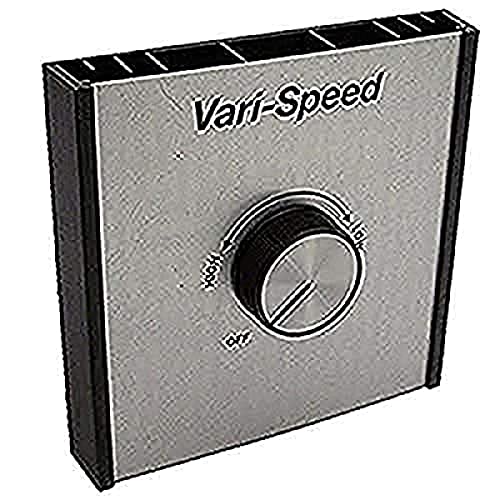
A 10-amp inline control built for a fan motor that a cheap dial cannot handle.
When a lighter controller chokes on an inline fan pulling 7 amps, this 10 A unit is the step up. It is rated for shaded pole and PSC motors at 115 V, UL and CSA approved, and it fits a standard 4″ x 4″ electrical wall box. The heat sink is the real reason to move up — it is built to shed heat under heavier loads, which is exactly the job that overheats the weaker boxes.
Adjustment runs deeper than most dials here. There is an internal adjustment behind the face that shifts the main knob’s whole range, so you can re-center the balance for your motor instead of living with the factory spread. Buyers run it on box fans, 3/4 HP fan motors, and quarter-horsepower Dayton motors, with the maker’s own load rating matching a 9-amp fan at its top setting.
Be clear-eyed about its limits. This controller trims speed, it does not command it — a buyer running a half-horsepower exhaust fan only saw the motor slow by 10 to 15 percent, and another with a Dayton quarter-horsepower fan reported it dropping to roughly half the top speed. That ceiling is often the motor, not the box, but if you expect a fan to run at a whisper on a big motor, check your expectations. It also needs a deep box, because the controller body and heat sink sit behind the face.
Why It Earns the Slot
- 10 A / 115 V rating steps up from the 6 A dials for heavier fan loads
- Dual adjustment — an internal control shifts the main knob’s range
- Built-in heat sink stays cool even on a 9-amp fan setting
The Fine Print
- Speed reduction is limited — one half-HP setup only slowed 10 to 15 percent
- Needs a deep outlet box for the body and heat sink behind the face
- Will not work with capacitor-start or capacitor-run motors
Reach for this if: you have an inline fan or workshop blower drawing up to 9 or 10 amps and want adjustable range without stepping to a full frequency drive.
Look elsewhere if: you need a fan to run at a near-whisper on a large motor, or you only have a shallow box to mount into.
7. CAPTIVE-AIRE VSC-6 115 VAC 6.0 amp Motor Variable Speed Controller
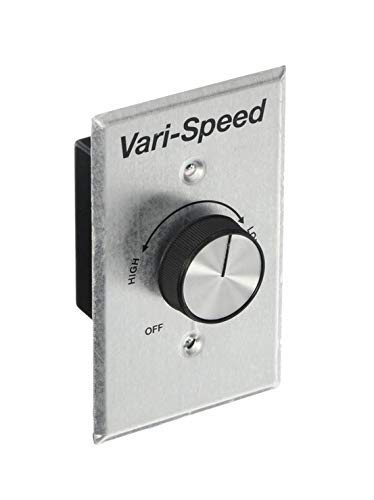
The small-knob controller that finally makes a gas fireplace fan behave.
If your fireplace blower only knows one speed — loud — this is the fix buyers keep coming back to. It is a 115 V, 6 A variable speed control rated and certified to CSA and UL standards, and the kit arrives complete: dial plate, knob, mounting screws, wire connectors, and instructions all in the box.
Customers note a specific win here. After cycling through controllers that did not work with the fireplace fan, this one brought correct speed control back — the motor ramps down, the noise drops, and the heat output becomes something you dial rather than something you endure. The knob is the whole interface, so there is nothing to program. You turn it, the fan responds.
Two things to weigh before ordering. First, the fit is precise: the maker and buyers both flag that your motor needs to be at or under 6 amps, and a whole-house fan owner found their fan did not run as fast as it had on the original switch. If you are chasing every bit of top-end airflow from a bigger fan, the 6 A ceiling is where this tops out.
Where it earns its keep: compact wall-mount wiring, a plain mechanical knob, and a full mounting kit make it a fast, tidy install for a fireplace blower or a small workshop fan that needs a sensible range of speeds.
Right for you if: you have a gas fireplace blower or small fan pulling 6 amps or less and you want the exact speed dial that finally works.
Not the pick if: your motor draws above 6 amps, or top-speed airflow is non-negotiable.
Understanding the Specs
Max Current (Amps)
This is the ceiling on how much current the controller can pass through to your motor, in amps. Your motor’s nameplate amp figure must sit at or below it. A controller rated above your motor’s draw leaves headroom; a controller rated below it runs hot and may fail. This is the single number to match first.
Voltage
The wall-mount dials here run on 115 V — standard household power. The frequency drives run on 220 V, and some accept either single-phase or three-phase input. Match the controller’s voltage to the circuit you are wiring it into, not a plug you happen to have nearby.
Motor Type
Shaded pole and PSC motors are the friendly pair for wall dials — they are the common motor types in fans, blowers, and humidifiers. Capacitor-start and capacitor-run motors do not play with these dials, and the maker notes say so plainly. Check for a capacitor can on the motor before you order.
VFD Output Frequency
On a variable frequency drive, the frequency sets motor speed. Household power runs at a fixed rate, and a VFD lets you go lower and higher — the drives here run 0–400Hz. That range is what lets a VFD run a machine slower for delicate work or push it past its normal top speed.
FAQ
How do I know which amp rating my fan motor needs?
Will a wall-mount speed control work with a capacitor-start motor?
What is the difference between a VFD and a fan speed controller?
Why does my fan hum at low speed?
Can I run a three-phase motor on single-phase household power?
My drive only slows the motor by a little — is it broken?
Do I need a deep electrical box for a motor speed controller?
How long does a VFD last?
Why is the manual on some VFDs hard to follow?
Can I mount a VFD in a dirty workshop?
Final Thoughts: The Verdict
For most people searching for the ac electric motor controller, the winner depends on matching the amps and the motor type. Reach for the KBWC-16K if you have a heavy-draw attic, duct, or fireplace fan and want the controller with the highest current rating among the wall dials — it carries a 16 A rating and a 293-review track record. Grab the VEVOR VFD if you need to run three-phase machinery — a lathe, mill, or compressor — from household power, or the CAPTIVE-AIRE VSC-6 if you just want a quiet, small-knob fix for a fireplace blower. Whatever you pick, check the amp rating on your motor before you buy — it is the one number that decides whether the controller lives up to its promise.
How We Picked
We do not accept paid placement. Every pick is matched to a real buyer and a real use-case; we do not hands-on test units.
Sources & Methodology
Specifications: manufacturer listings and product documentation. Review insights: verified customer reviews, as of September 2026. Pricing: not shown on this page (it changes often); check the current price via the retailer link.
As an Amazon Associate, Gadgets Feed earns from qualifying purchases. This does not affect which products we feature.