
An AC electric motor speed control lets you dial in exactly how fast a fan, blower, or small motor runs — turning a noisy, hurricane-force blast into a gentle, whisper-quiet breeze. The problem is that picking the wrong one means either no speed adjustment at all, or a controller that buzzes, hums, overheats, or simply stops working within weeks. This guide breaks down the seven best options, explaining which specs actually matter and which trade-offs you can live with, so you land on the controller that fits your motor and your patience.
I’m Min — the co-founder and writer behind Gadgets Feed. This guide is built by comparing the manufacturers’ published specifications and the patterns across verified customer reviews, so you get each pick’s real strengths and trade-offs instead of marketing spin.
Whether you need to quiet an attic fan, restore a vintage workshop machine, or fine-tune airflow in your home, this guide helps you choose the right ac electric motor speed control by matching its amp rating, voltage range, and motor type to your specific project.
How To Choose The Best AC Electric Motor Speed Control
Choosing the right speed controller is about matching three things: your motor’s current draw, the type of motor you have, and how you want to install it. Overlooking any one of these can lead to a setup that either doesn’t work or damages your equipment.
Match the Amp Rating First
Every controller has a maximum current rating — typically 5, 6, 8, or 15 amps. You need a controller whose amp rating is equal to or higher than the full-load amps stamped on your motor’s nameplate. A 6.0-amp motor needs at least a 6.0-amp controller; running it on a 5-amp controller risks overheating and shutdown.
Know Your Motor Type: Shaded-Pole vs. PSC vs. Capacitor-Start
Most modern fan and blower motors are either shaded-pole or permanent split capacitor (PSC) types. Solid-state Triac-based controllers handle these perfectly. Capacitor-start motors — common in pumps and compressors — are generally not compatible and can be damaged by a standard speed control. Always check your motor type before buying.
Choose Your Installation Style: Plug-In vs. Hardwired
Plug-in controllers let you adjust speed without any wiring — just plug your device into the controller box. Hardwired units replace a wall switch and need some basic electrical knowledge. Pick based on whether you want portability or a clean, permanent installation.
Quick Comparison
On smaller screens, swipe sideways to see the full table.
| Model | Category | Best For | Key Spec | Amazon |
|---|---|---|---|---|
| Versatile 15A Controller | Plug-In | High-current tools & fans | 15A max, 4000W resistive / 1500W inductive | Amazon |
| Mateell 15A Controller | Plug-In | Versatile workshop use | 15A max, 1V precision adjustment | Amazon |
| KB Electronics 8811007 | Wall Mount | Low-profile attic fan control | 6.0A max, 115V, fits 2×4 wall box | Amazon |
| Fantech WC 15 | Wall Mount | Vintage fan restoration | 5A max, 115V, adjustable low-speed set screw | Amazon |
| FICBXRA 6A Controller | Wall Mount | Exhaust and duct fans | 6.0A max, 120V, ETL approved | Amazon |
| KB Electronics KBWC-15K | Wall Mount | Range hoods & low-current motors | 5.0A max, 120V, adjustable min voltage | Amazon |
| iLIVING ILG8SFSC | Wall Mount | High-power shutter fans | 8A max, 120V, UL listed | Amazon |
In‑Depth Reviews
1. Versatile AC Motor Speed Controller – 100V-120V, 15A Max

15A max current capacity — double that of standard 5–6A controllers — makes this the top pick for anyone running high-draw tools like a belt sander or large shop fan without breaker trips.
The built-in LED voltage display shows real-time output so you can set precise speeds without guessing. Buyers report it “works perfectly to control speed of a Harbor Freight belt sander that had a defective speed control,” rescuing equipment that would otherwise be scrapped. Overload protection automatically cuts power if current exceeds 15A, protecting both controller and motor.
The catch is the plug-in design — it sits on your workbench rather than hiding in a wall. If you need a clean permanent installation, a wall-mount unit suits you better. For raw power capacity and versatility, this is the strongest pick of the group.
Why it’s great
- 15A max rating handles high-draw tools and fans
- LED voltage display gives precise, repeatable settings
- Overload protection cuts power automatically at 15A
Good to know
- Plug-in design sits on bench — not for flush wall installation
- Rated for inductive loads up to 1500W, so check your motor’s wattage
2. Motor Speed Controller AC 120V 15A Variable Adjuster

The Mateell 15A controller matches the top pick’s 15-amp maximum current capacity but adds 1-volt precision adjustment — meaning you can fine-tune the speed in smaller steps than a standard controller that jumps in larger increments. That extra precision matters when you need, say, a fan running at a barely-there whisper instead of having only a “just a little slower” option.
It shares the same plug-in form factor and overload protection as the Versatile controller, but owners mention it is particularly good at taming noisy fans: one reviewer wrote “it slowed down fan I was using while watching TV” because the original fan was too loud at full speed. The back hook design lets you clip it to a tool belt for on-the-go use, which the top pick does not offer.
Choose this one over the Versatile controller if you need finer speed steps or plan to carry the controller from job to job. If you need the absolutely highest resistive load capacity (4000W vs. the Mateell’s unspecified max), the Versatile controller has the edge on raw power.
Where it shines
- 1V precision dial gives fine-grained speed control
- Back hook clips to belt for portable use
- Overload protection shuts off at 15A for safety
Worth noting
- Not suitable for motors with built-in circuit boards or capacitors
- Plug-in design same as top pick — not for flush wall mount
3. KB Electronics 8811007 Solid State Variable Speed AC Motor Control
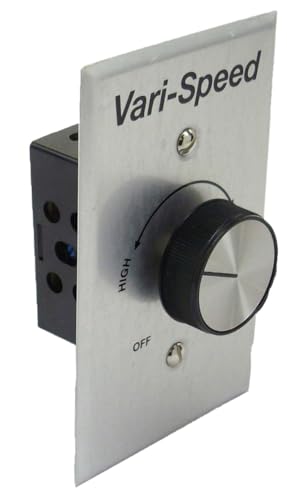
If you need a permanent, wall-mounted solution for an attic fan, fireplace blower, or whole-house ventilator, the KB Electronics 8811007 is the premium choice because it fits a standard 2×4-inch electrical wall box and disappears behind a switch plate — no bench clutter. It is rated for 6.0 amps at 115 volts, making it a direct match for most residential ventilation fans.
KB Electronics is a known brand in motor controls, and this unit uses a solid-state Triac for smooth, step-less adjustment. One buyer confirms they “used to slow an attic fan for quiet, comfortable heat circulation,” which is exactly the use case this controller was built for. It includes an adjustable minimum speed trim pot to prevent the motor from stalling at very low speeds.
The standout detail: at only 0.3 pounds and measuring 5 x 3.1 x 2 inches, it is tiny — but it is not compatible with capacitor-start motors, so double-check your motor type. If you want a flush-install controller for a dedicated ventilation fan, this is your pick.
What stands out
- Designed for standard 2×4-inch wall box — clean, hidden install
- Adjustable minimum speed prevents motor stall at low voltage
- UL and CSA approved for safety compliance
The trade-offs
- 6A max — not for high-draw motors over 6 amps
- Not for use with capacitor-start or capacitor-run motors
4. Fantech WC 15 Speed Control with On-Off Switch
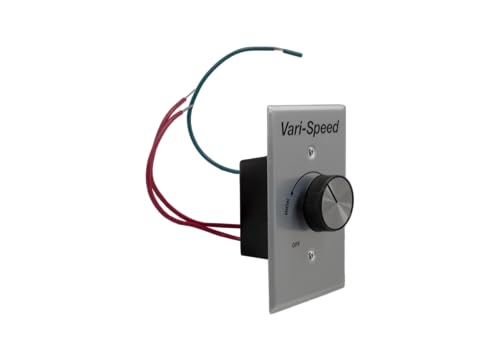
The single number that matters most in a wall-mount controller is the minimum starting voltage — and the Fantech WC 15 has an adjustable low-speed set screw that lets you dial in exactly how low the motor can go before it stalls. That feature, paired with an included brushed aluminum switch plate, makes it the go-to choice for restoring vintage fans or replacing a decades-old switch that finally gave out.
The downside is a modest 5-amp maximum current rating, meaning it is best suited for smaller fans and blowers under 600 watts. One reviewer confirms it “replaced worn 1950s fan control; straightforward install after removing faceplate” and expected it to last another 50 years, which speaks to the build quality.
At 3.87 ounces and sized for a single-gang box, this is a lightweight, reliable unit that does one thing well. If you are fixing an old fan and want a controller with a proven track record, the Fantech delivers a price-to-value read that favors long-term durability over raw power.
The upsides
- Adjustable low-speed set screw prevents motor stall at slow speeds
- Includes brushed aluminum switch plate and screws
- Proven long-term reliability — fans expect 50+ years of service
Keep in mind
- 5A limit — not for motors over 600W or 5 amps
- Some users report speed hesitation when rotating knob quickly
5. Speed Controller with On-Off Switch, 120 VAC 6.0 Amp
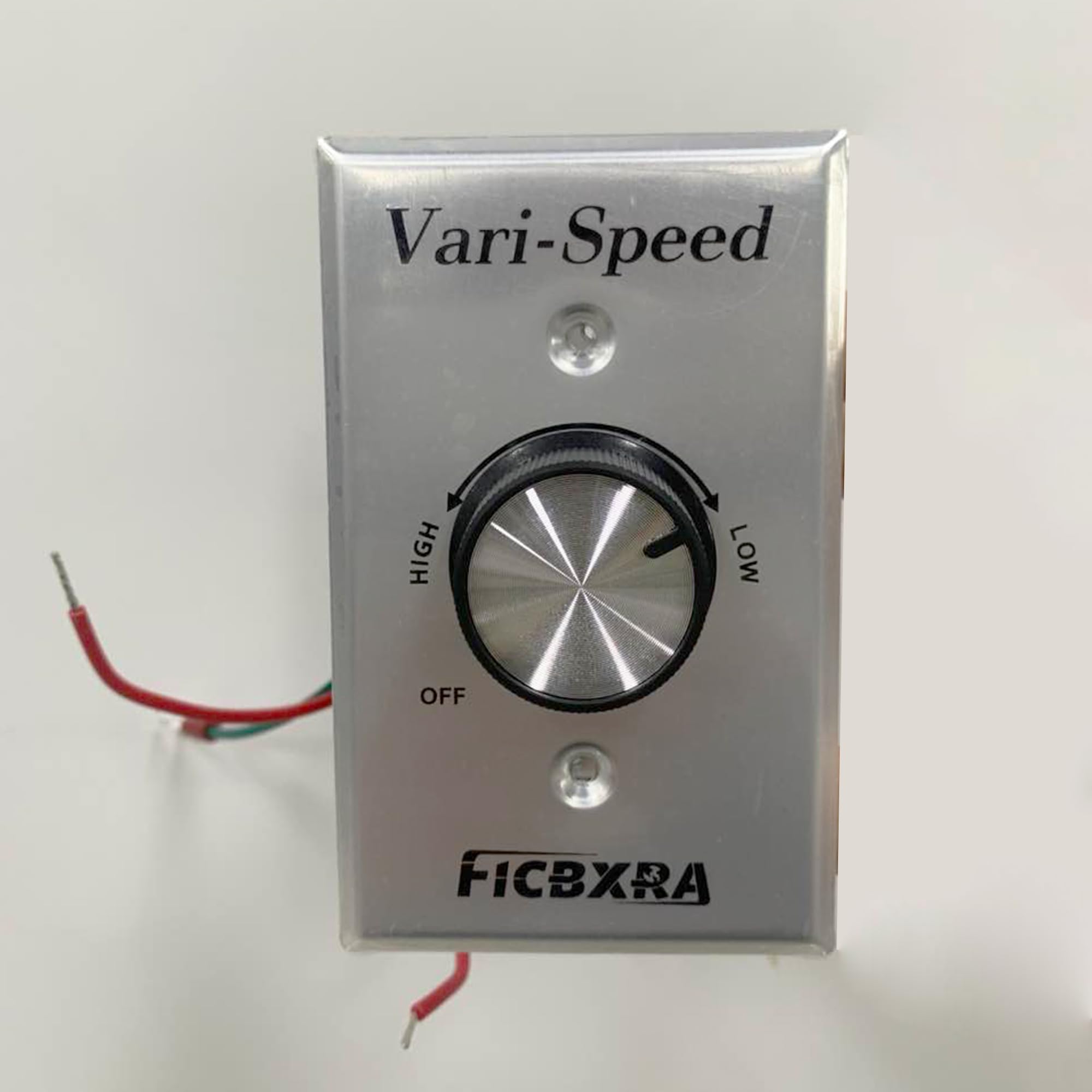
At this lower price, you get a hardwired wall-mount unit with a rotary knob and on-off switch, built from aluminum with ETL safety approval (meaning it has been tested to North American safety standards) — exactly what you need for an exhaust fan, duct fan, or tabletop blower without overpaying for features you will not use.
What you give up compared to premium options is the adjustable minimum-speed screw — this unit has a fixed low-speed stop, so you cannot fine-tune the absolute slowest speed. That said, buyers confirm it “handled 6.0 Amp motor without overheating” and report using it successfully on Vevor exhaust fans and upgraded workshop blowers. The aluminum faceplate is a nice touch over cheaper plastic alternatives.
This controller is perfect for the budget buyer who needs a reliable, code-approved wall switch for a single fan project and wants ETL certification for peace of mind or insurance compliance.
Why we’d pick it
- ETL approved for safety compliance in permanent installations
- Aluminum build feels sturdy and resists heat better than plastic
- Handles 6.0A motors reliably without overheating issues
A few caveats
- Fixed low-speed stop — no adjustable minimum voltage dial
- Requires basic electrical knowledge for hardwired installation
6. KB Electronics Model KBWC-15K Variable Speed Fan Control

The KBWC-15K is perfect for tight retrofit jobs inside range hoods, small fans, and space-constrained enclosures. Weighing only 0.2 pounds and sporting an adjustable minimum voltage calibration (an internal trim pot that sets the lowest output voltage), it is designed for permanent split capacitor (PSC) and split-phase motors common in kitchen ventilation.
One buyer used it “as a replacement for a Thermador range hood” and noted the installation required cutting the mounting plate ends to fit the housing, which tells you this unit is built for flexibility in custom installs. The 5-amp rating means it is not for heavy equipment, but it excels at small, precise motor control tasks. A minor quirk: one reviewer noted the control direction felt reversed, with high on the dial producing slower speed — so test the orientation before buttoning up the install.
Its one weakness is that the variable speed control on some units does not work as smoothly as the KB 8811007; some users found it runs slightly hotter than older models.
Strong points
- Adjustable minimum voltage calibration for fine low-speed tuning
- Weighs just 0.2 lbs — easy to fit in tight spaces
- Designed specifically for PSC and split-phase motors in range hoods
Before you buy
- 5A limit — only for small motors under 600W
- Some units may have reversed rotation direction on the dial
7. iLIVING ILG8SFSC Solid State Variable Adjustable Precision Fan Speed Controller

At an 8-amp rating, this iLIVING controller offers the highest current capacity in the guide, making it a strong value for users with high-draw fans, though its price is mid-range compared to the field.
It is UL listed (an independent safety certification) and comes with a brushed aluminum switch plate for a clean, professional finish. What that 8-amp rating buys you is the ability to run a powerful 20-inch shutter fan at variable speed without overloading the controller. Customers note it “cools the entire house” when used in a window setup for whole-house ventilation. However, buyer reports are mixed on long-term reliability: one reviewer says it “failed in 5 months,” while another has run it through multiple seasons without issue. The manufacturer replaced the failed unit promptly under warranty, which is worth noting.
If you need to control a high-draw fan that exceeds 6 amps, this is the only wall-mount controller in the lineup that can handle it. For standard 5- or 6-amp fans, the KB Electronics 8811007 offers better reliability at a lower cost.
What we like
- 8A max rating handles larger shutter and exhaust fans
- UL listed for safety in permanent home installations
- Brushed aluminum switch plate gives professional look
The downsides
- Mixed reliability reports — some units fail within months
- Intended for use with iLIVING shutter fans specifically
Understanding the Specs
Amps & Watts — The Real Limit
The amp rating on a speed controller (5A, 6A, 8A, 15A) tells you the maximum electrical current it can safely pass to your motor. Exceeding that limit can overheat the controller or damage it. To convert amps to watts, multiply by your voltage (for example: a 6A controller on a 120V circuit handles up to 720 watts). Matching or exceeding your motor’s full-load amps is the single most important spec check you will do.
Motor Compatibility — Shaded-Pole and PSC Only
Almost all AC motor speed controllers on this list work with shaded-pole motors and permanent split capacitor (PSC) motors — the standard types for fans, blowers, and ventilators. They do not work with capacitor-start motors (common in pumps, compressors, and heavy machinery) because the electronic Triac circuit cannot handle the start-up surge those motors create. Always check your motor’s nameplate for “Capacitor Start” — if it says that, do not use a standard speed control.
Wall Mount vs. Plug-In — Installation Matters
A wall-mount controller replaces your existing light switch and requires basic wiring knowledge (connecting to a live electrical box). A plug-in controller simply sits between the wall outlet and your device — no wiring required. Wall-mount units look cleaner and are safer for permanent installations, while plug-in units are portable and can be moved between tools. Choose based on whether you want a fixed or flexible setup.
The Voltage Display — Helpful or Hype?
An LED voltage display shows you the exact output voltage in real time, which is useful for repeating the same setting across different sessions — for example, “I know 85V is the perfect speed for my fan.” Without a display, you rely on the knob position alone, which can drift if the knob is bumped. For workshop use, the display is a genuine time-saver; for a hidden attic fan, it may be unnecessary.
FAQ
Can I use any AC motor speed controller on a ceiling fan?
Why does my motor hum or buzz when connected to a speed controller?
What happens if I use a speed controller on a capacitor-start motor?
How do I pick the right amp rating for my motor?
Final Thoughts: The Verdict
For most buyers, the ac electric motor speed control winner is the Versatile AC Motor Speed Controller because its 15-amp capacity, built-in voltage display, and overload protection cover the widest range of motors and tools. If you need a clean, wall-mounted unit for an attic fan, grab the KB Electronics 8811007. And for a high-current wall-mount controller for large shutter fans, the iLIVING ILG8SFSC with its 8-amp rating is the one to choose if your fan exceeds 6 amps.