
Our readers keep the lights on and my morning glass full of iced black tea. As an Amazon Associate, I earn from qualifying purchases.
Specs are compiled from manufacturer listings and verified buyer reviews and can change over time — please confirm the key details on the product page before buying.
You put a filter in your furnace or AC to protect the equipment and clean the air. But the wrong 20x25x1 filter can make your system work harder or let dust pile up. This guide looks at three top-rated options—from a premium pleated filter that catches pet dander to a basic fiberglass pick that keeps air moving freely.
I’m Min — the founder and writer behind Gadgets Feed. This guide is built by comparing the manufacturers’ published specifications and the patterns across verified customer reviews, so you get each pick’s real strengths and trade-offs instead of marketing spin.
You will find a plain breakdown of the best ac filter 20x25x1 options, including the MERV rating (a number that tells you how well the filter catches particles) each uses and how often you need to swap it.
Our Picks at a Glance
How To Choose The Best AC Filter 20x25x1
Picking the right filter depends on two main trade-offs: how much stuff you want to catch from your air versus how much airflow you want to let through. A denser filter (higher MERV rating) grabs more dust, pollen, and pet dander but can slow your system down. A looser filter (lower MERV rating) lets air flow easier but catches less.
Understanding MERV Ratings
MERV stands for Minimum Efficiency Reporting Value. It is a simple number (1 to 16) that tells you how well a filter catches particles of different sizes. A MERV 11 filter captures up to 85% of large particles such as dust mites and pollen. A MERV 3 fiberglass filter mainly catches big lint and dust to protect your equipment. If you have allergies or pets, lean toward a MERV 11. If you just want to protect the HVAC with no airflow restriction, a basic fiberglass filter works fine.
Pleated vs. Fiberglass Design
Pleated filters (like the ones labeled MERV 8 or higher) have folded media that gives them a larger surface area. This lets them trap more particles without choking the airflow as much as a flat filter would. Fiberglass filters are a mesh of spun glass fibers. They are far less restrictive, which is ideal for older systems or heat pumps that are sensitive to pressure buildup—but they catch much less from the air.
How Often to Change
Most pleated filters recommend a change every 90 days. If you have pets or live in a dusty area, you might need to swap them every 60 days. Fiberglass filters are usually changed more often (every 30 days) because they don’t hold as much dirt. Ignoring the change schedule makes your fan work harder and raises your energy use.
Quick Comparison
| Model | Best For | MERV Rating | Number of Filters | Item Weight | Amazon |
|---|---|---|---|---|---|
| Filtrete 20x25x1 Air Filter, MERV 11★ Best Overall | Allergen & pet dander reduction | MERV 11 | 6 | 4.38 Pounds | Amazon |
| Honeywell 20x25x1 MERV 11 Allergen Reducer 11000 | Electrostatic filtration at a mid-range price | MERV 11 | 4 | 1.36 Kilograms (approx. 3.0 Pounds) | Amazon |
| Glasfloss 20x25x1 Fiberglass Air Filters, 6-Pack | Maximum airflow for heat pumps | MERV 3 | 6 | 4.81 Pounds | Amazon |
In-Depth Reviews
1. Filtrete 20x25x1 Air Filter, MERV 11, MPR 1000
Our pick — over 4.5★ from 950+ verified ratings; the strongest balance of quality and price.
The pleated powerhouse that traps allergens without starving your HVAC of air.
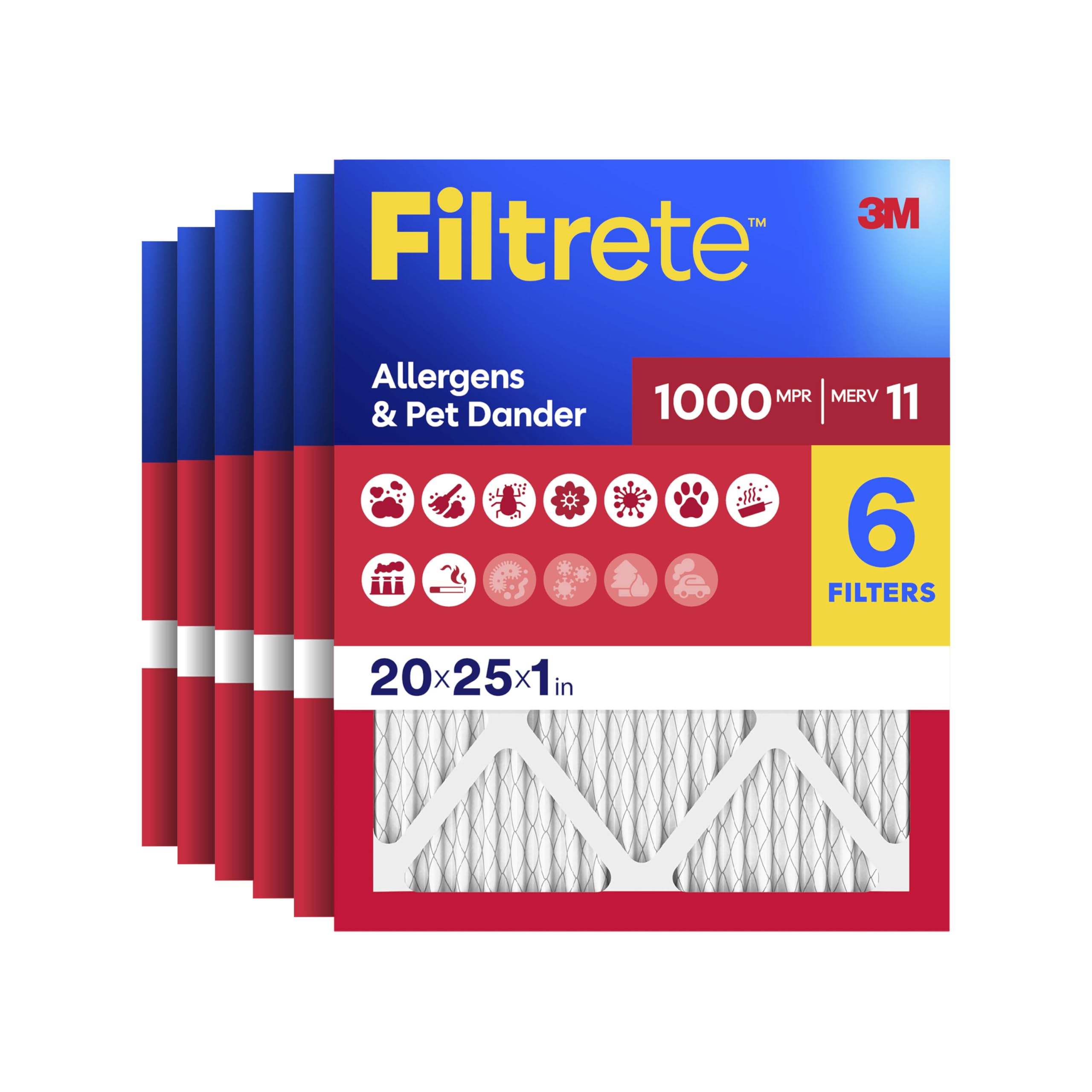
For real allergy and pet-dander relief, you want a filter that actually catches the small stuff. This Filtrete pack uses its 3-in-1 technology (the brand says it pulls in and traps unwanted particles to let cleaner air flow through) and carries a MERV 11 rating alongside an MPR (Microparticle Performance Rating, a Filtrete-specific scale for particles 0.3–1.0 microns) of 1000. That combination means it can grab microparticles as small as 0.3 to 1.0 microns—think mold spores, pet dander, and smoke.
But given that it is certified asthma and allergy-friendly (by the Asthma and Allergy Foundation of America) and you get six filters, each one lasts three months—so you swap it every 90 days, while fiberglass filters need changing every 30 days. The included Filtrete Smart App lets you set a 30-, 60-, or 90-day reminder right on your phone, so you stop guessing when it is dirty.
Unlike the Glasfloss fiberglass filter that aims for maximum airflow with a MERV 3, this Filtrete aims for cleaner air at the cost of a little more resistance. The Filtrete is also 0.43 pounds lighter than the Glasfloss pack, making it slightly easier to haul around the house.
The Air You’ll Breathe
- MERV 11 and MPR 1000 catch fine particles like pet dander and smoke
- Certified asthma and allergy-friendly from the Asthma and Allergy Foundation of America
- Smart App reminders take the guesswork out of replacement
- Metal wire backing prevents the filter from collapsing
What It Costs
- Higher upfront cost than fiberglass or lower-tier pleated filters
- Denser construction may restrict airflow in older or weak HVAC systems
Reach for this if: you or someone in your home has allergies, asthma, or pets and you want a proven, trusted brand that catches microparticles you can actually see in the air.
The single caveat: if your furnace or heat pump is older or has a history of struggling with airflow, the higher resistance of a MERV 11 like this one could cause issues.
2. Honeywell 20x25x1 MERV 11 Allergen Reducer 11000 Electrostatic Pleated HVAC AC Furnace Air Filter (4-Pack)

Electrostatic charge gives this honey of a filter an extra grab on tiny particles without choking airflow.
You may not know this, but a filter can use static electricity to help trap particles. This Honeywell uses electrostatic-charged media, meaning the fibers carry a static charge that pulls in microscopic particles like a magnet—so even though it carries the same MERV 11 rating as the Filtrete above, the technology behind it is a little different. Its electrostatic media traps up to 85% of large airborne particles like pollen, pet dander, and smoke. The 4-pack is perfect for a single-filter home that you swap every three months for a full year.
Note that the Honeywell pack contains four filters compared to six in the Filtrete pack and the filters themselves are a little lighter and less rigid in the frame. One reviewer running a WaterFurnace five-ton unit mentioned they are “performing well,” but noted the build feels less sturdy than some alternatives. The important spec here: it is made in the USA, and at 1.36 kilograms (roughly 3.0 pounds) the full pack is noticeably lighter to carry around than the 4.38-pound Filtrete pack.
If you don’t need six filters upfront and you want a MERV 11 that won’t break the bank on a per-filter basis, this is your move. The electrostatically charged media is a genuine bonus for grabbing the smallest particles—something the non-charged fiberglass Glasfloss filter cannot do at all.
The electrostatics edge: Static charge pulls in particles smaller than the pores alone would catch.
The catch: Some buyers report the frame feels a little flimsy compared to premium pleated filters; not ideal if your filter slot holds the frame tight.
Who it fits: the value-conscious buyer who still wants MERV 11 allergen reduction but does not want to stockpile six filters at once.
Who might pass: anyone with a water furnace or high-end heat pump who needs a stiffer frame to maintain a perfect seal.
3. 20x25x1 Fiberglass Air Filters, 6-Pack, AC & Furnace, Glasfloss
The airflow-first filter that keeps your heat pump from choking on a high-MERV diet.
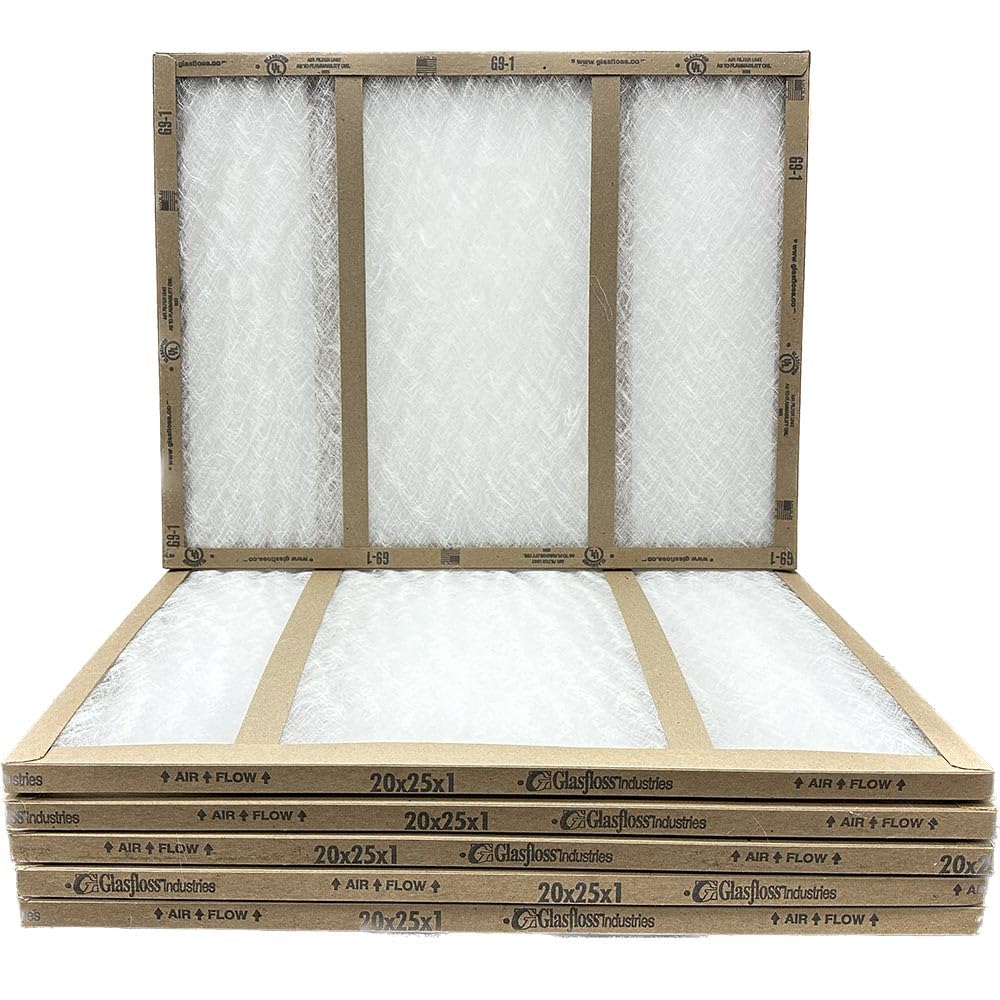
Not every home needs to catch microscopic particles. If your main goal is to protect your HVAC equipment from lint and dust bunnies without costing a lot, this Glasfloss 6-pack is your pick. It has a MERV 3 rating, which means it catches large particles but lets tiny ones pass right through. The reinforced double-strut design opens up more surface area than a standard fiberglass filter, so airflow stays free and easy. Each filter measures 19 5/8 x 24 5/8 x 3/4 inches (slightly smaller than the nominal 20x25x1), so it slides in without binding.
One buyer switched from high-MERV pleated filters to these fiberglass ones and solved a serious issue: a manufacturer diagnosed that their “outside unit lockout” was caused by using wrong pleated filters. Switching to this low-resistance fiberglass pack fixed the pressure buildup and got the heat pump working again, according to that reviewer. The 6-pack weighs 4.81 pounds—marginally heavier than the 4.38-pound Filtrete pack, at 4.81 pounds—so the box is a little fuller, but the cost per filter is far lower. There are no metal parts inside, so disposal is as simple as bagging it and tossing it in regular trash.
This is the opposite of the Filtrete: where the Filtrete sacrifices some airflow to clean the air, the Glasfloss sacrifices cleaning power to keep air moving. If your HVAC manual explicitly says to use low-MERV fiberglass filters, do not ignore it—this 6-pack is the right tool for the job.
Why It Works for Some Homes
- Double-strut design gives more surface area than a standard fiberglass filter
- Zero airflow restriction protects heat pumps and older furnaces from pressure issues
- Made in the USA by Glasfloss, a 70+ year old manufacturer
- Costs a lot less per filter than pleated options
Where It Falls Short
- MERV 3 catches very little—pollen, pet dander, and smoke will mostly pass through
- Needs changing every 30 days (compared to 90 days for a MERV 11 pleated filter)
Best for: protecting your heat pump or older furnace from airflow restriction without spending a lot on filters.
skip it if: you have allergies, asthma, pets, or care about the actual air you breathe. This filter is for equipment protection, not air quality.
Understanding the Specs
MERV Rating — What It Actually Means
MERV stands for Minimum Efficiency Reporting Value. It runs from 1 to 16. A MERV 3 filter (like the Glasfloss fiberglass) catches big stuff like lint and hair but lets pollen, pet dander, and smoke through. A MERV 11 filter (like the Filtrete and Honeywell) captures up to 85% of particles as small as 1.0 microns. For most homes with pets or allergies, MERV 8-11 is the balance—good filtration without choking your HVAC.
Electrostatic Media vs. Standard Pleated
Some filters, like the Honeywell, use electrostatic-charged fibers. This means the filter media has a static charge that attracts tiny particles like a balloon attracts hair. Standard pleated filters (like the Filtrete) rely purely on physical size of the pores. Electrostatic media can sometimes be more efficient at catching the smallest stuff without needing a super tight weave, which helps keep air flowing at a good rate.
FAQ
Will a MERV 11 filter work in any furnace?
What is the difference between a MERV 3 and a MERV 11 filter?
How often should I change my 20x25x1 filter?
Can a high-MERV filter damage my HVAC system?
What do MPR and MERV numbers mean on a Filtrete filter?
Does an electrostatic filter actually work better than a regular pleated one?
Why does my filter measure less than 20x25x1?
Can I use a fiberglass filter (MERV 3) if I have pets?
Are Honeywell and Filtrete filters the same quality at the same MERV rating?
How do I know if my filter is too restrictive for my system?
Final Thoughts: The Verdict
For most buyers, the best ac filter 20x25x1 winner is the Filtrete 20x25x1 Air Filter, MERV 11 because it delivers exceptional particle capture (MERV 11 and MPR 1000) in a trusted brand, with six filters that each last 90 days—backed by a decade of positive buyer reviews. If you want electrostatic technology with a lower per-filter cost, grab the Honeywell MERV 11 4-Pack. And for protecting a heat pump or older furnace that cannot handle high-resistance filters, the standout is the Glasfloss Fiberglass 6-Pack with its unrestricted airflow.
How We Picked
We do not accept paid placement. Every pick is matched to a real buyer and a real use-case; we do not hands-on test units.
Sources & Methodology
Specifications: manufacturer listings and product documentation. Review insights: verified customer reviews, as of July 2026. Pricing: not shown on this page (it changes often); check the current price via the retailer link.
As an Amazon Associate, Gadgets Feed earns from qualifying purchases. This does not affect which products we feature.