
Our readers keep the lights on and my morning glass full of iced black tea. As an Amazon Associate, I earn from qualifying purchases.
Specs are compiled from manufacturer listings and verified buyer reviews and can change over time — please confirm the key details on the product page before buying.
Parked in the summer heat, idling the engine to keep the cab cool burns fuel and wears on your rig. A 12V air conditioner runs off your battery bank instead, so you get cold air without the noise, fumes, or wasted diesel. This guide covers the top-rated units for vans, trucks, and RVs, breaking down real performance numbers, installation realities, and which pick fits your power setup.
I’m Min — the founder and writer behind Gadgets Feed. This guide is built by comparing the manufacturers’ published specifications and the patterns across verified customer reviews, so you get each pick’s real strengths and trade-offs instead of marketing spin.
For this roundup, we sized up the battery drain, cooling power, and installation difficulty of the best ac for car solutions that truly deliver overnight comfort without a running engine.
Our Picks at a Glance
How To Choose The Best AC For Car
Before you buy a 12V air conditioner, you need to match three numbers: the cold air output you need, the battery capacity you have, and the installation effort you can handle. These figures decide whether your setup actually keeps you cool.
Match Cooling Power to Your Space
Cooling power is measured in British Thermal Units (BTUs). A 9,000 BTU unit suits a compact van or truck cab, while a 10,000 to 11,000 BTU unit gives you extra headroom for a camper or RV. More BTUs means faster cooling, but also a higher draw on your electrical system. Consider your cabin’s size and how hot your climate gets before choosing the highest number.
Calculate Your Battery Budget
Every 12V AC unit uses a certain amount of watts per hour. A 400-600W unit runs about 8 hours on a 480Ah bank, key for overnight comfort. If you have a smaller battery, expect shorter runtime or you’ll need solar or a generator to recharge. The wattage and battery capacity in amp-hours (Ah) are the two specs to reconcile before buying.
Understand the Install Commitment
Split systems separate the noisy compressor (mounted outside) from the indoor blowing unit, giving quieter operation and more flexible mounting. Rooftop units are self-contained and sit on the roof, which suits vans and RVs with flat roofs. Both need through-wall or through-roof penetrations for refrigerant lines and wiring, so measure your mounting space and check the included components before you commit.
Quick Comparison
| Model | Best For | Cooling Power | Annual Energy | Install Type | Amazon |
|---|---|---|---|---|---|
| OutEquip Rooftop 12V★ Best Overall | Van/RV overnight campers | 10,000 BTU | 960 watts | Rooftop | Amazon |
| JAYGOVAN Split 11K | Budget split installs | 11,000 BTU | 7,200 watts | Split | Amazon |
| UAHKPA Split 9K | Compact trucks & excavators | 9,000 BTU | — | Split-system | Amazon |
| Aspligo Split 10K | Semi-trucks with big battery banks | 10,000 BTU | — | Split System | Amazon |
In‑Depth Reviews
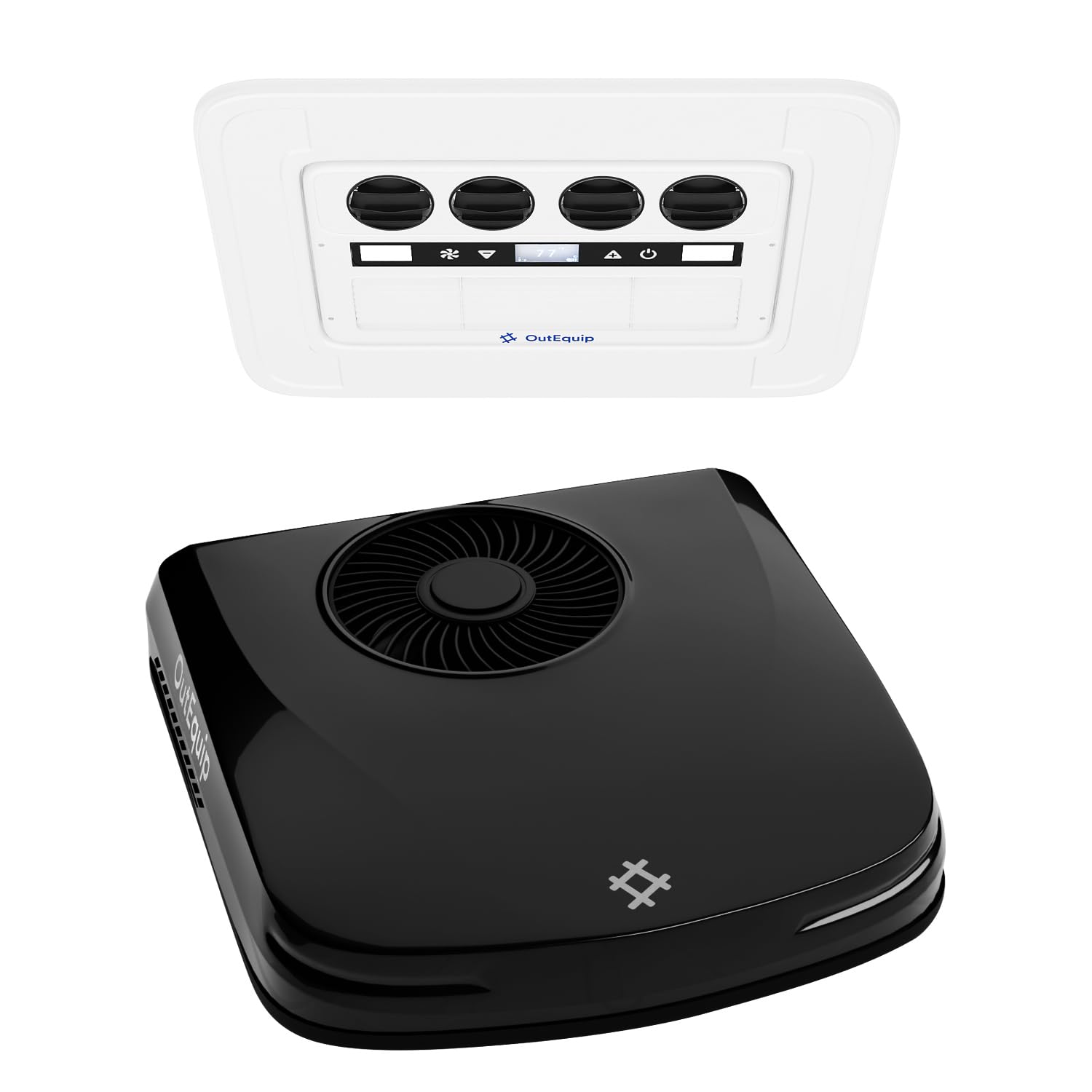
1. OutEquip 12V RV Rooftop Air Conditioner
Our pick — over 4.5★ from 20+ verified ratings; the strongest balance of quality and price.
The rooftop unit that sleeps you through a 95°F night without waking the camp.
The OutEquip is the pick for camper-van owners who want a genuine overnight setup. It cools a van in 15 minutes and runs up to 8 hours on a 480Ah house battery. On 600Ah banks, owners get up to 10 hours of parked cooling—a full night plus breakfast.
Installation feedback is consistently strong. Buyers with a 2020 Ford Transit and a 2025 Ram Promaster both called it straightforward, and the unit’s low profile makes it a clean fit. The real standout is noise — builders mention carrying on a conversation or sleeping without hearing compressor hum, thanks to the dual brushless copper motors and anti-vibration mounting. In terms of draw, owners commonly see around 650 watts, so it sips power compared to lots of competing 12V systems.
The cabin heats as well as cools, making this a four-season add for a van. One owner replaced a Dometic specifically to gain a lighter, quieter, lower-profile unit that also runs while driving. The heater is noisier than the cooling side, and the remote lacks Bluetooth on the base model, but these are small trade-offs for a unit this capable. What wins people over is the build quality — it is the thing owners rave about most by a wide margin, with value for money close behind.
Why owners praise it
- Runs up to 8 hours on a 480Ah bank and 10 hours on 600Ah
- Dual brushless copper motors keep it whisper-quiet
- UV-resistant ABS housing and zinc-coated condenser survive sun and rain
The honest caveats
- Daytime cooldown is slower in extreme sun without window covers
- Heater mode runs louder than the AC side
- Remote lacks Bluetooth on this version
Best suited for: Van and RV owners who camp off-grid overnight and value quiet sleep over raw daytime power.
Think twice if: You need aggressive daytime cooldown in brutal desert sun, where a split system with more BTU headroom pulls ahead.
2. JAYGOVAN 12V Split Type 11000BTU
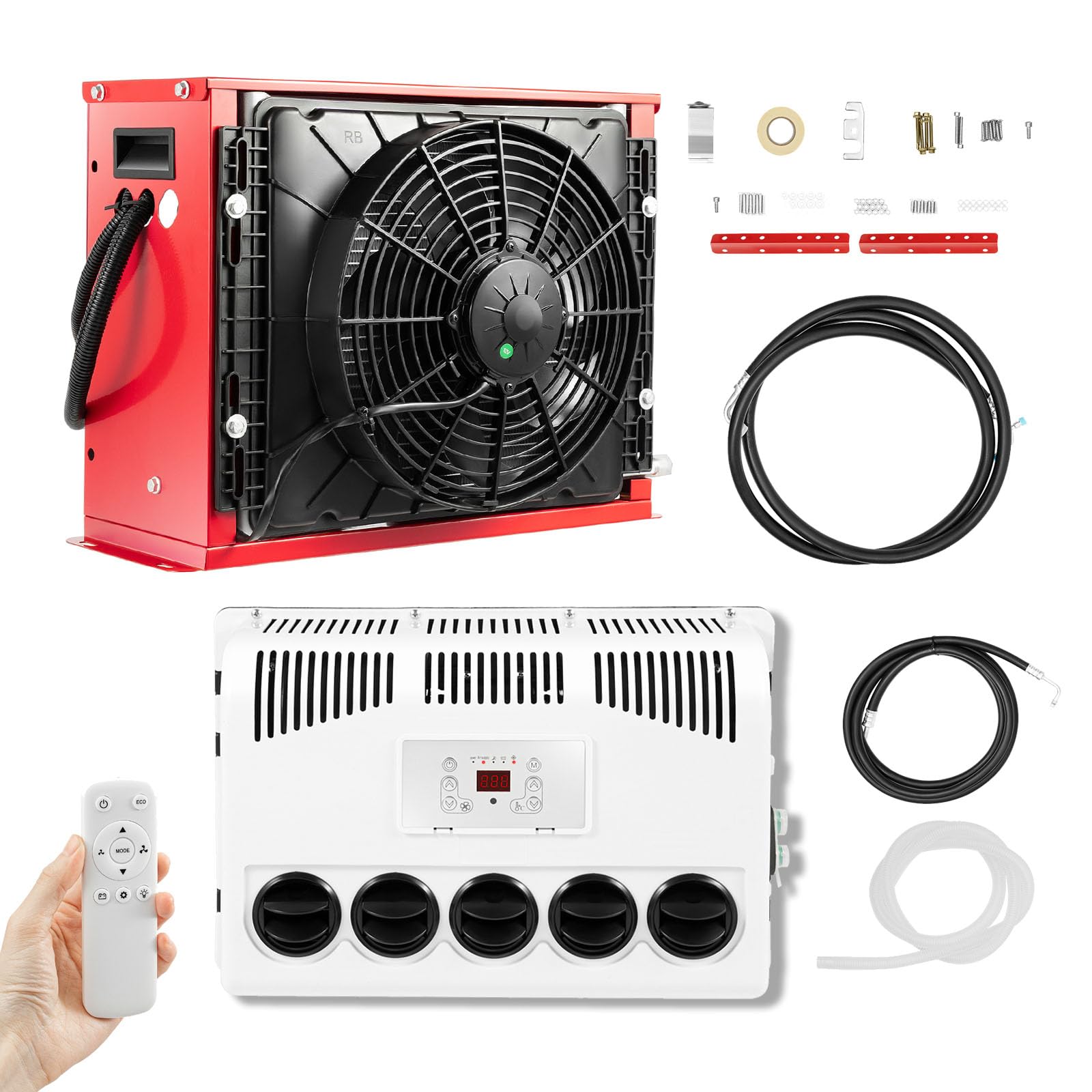
The inexpensive split unit that froze a Peterbilt so hard a blanket was required.
It’s the strongest raw output here, and truckers confirm it works: one driver running a Peterbilt at 100°F outside had to bundle up inside the cab, praising both the easy install and the quiet operation.
Efficiency is where this unit shines for off-grid use. A 1000W solar setup ran it 24/7 at 74°F in 95°F heat, drawing up to 600W. Cooling mode draws 300-400W, with the fan alone at 50W. That kind of flexibility with an 100Ah battery and a 1000W generator is the whole point of a 12V system.
The catch is consistency. Several purchasers report the unit keeps shutting off, and the supplied bolts are too weak — owners recommend swapping in grade 8 hardware with nylon nuts. Low-voltage protection kicks in at 11V, so a small or drained battery can trigger stop-and-start behavior. The display is Celsius-only, which takes a little getting used to. Still, for the price, the effectiveness is the most-praised trait, and the seller gets credit for responsive support, including replacing a compressor at no charge.
Max output, mixed feedback: Buyers who land a good unit get exceptional 11,000 BTU cooling for the money, with solar-friendly efficiency.
Who this misses: Anyone without a solid battery bank — the shutdown issues trace back to low-voltage cutoffs and weak factory hardware.
Reach for it if: You have a beefy battery setup, want the strongest cooling per dollar, and don’t mind a DIY hardware upgrade.
Look elsewhere if: You want guaranteed reliability from the start, since an occasional unit arrives with shutdown gremlins.
3. UAHKPA 12V Split Type 9000BTU

A 9,000 BTU split that cranks a chill into an excavator cab with surprising ease.
This UAHKPA split system earns its spot for compact work vehicles. It’s rated at 9,000 BTU with a power draw of 800 watts, and the specs show a starting current of 75A — so it needs a serious battery to spin up. On a large house bank, it runs over 6 hours—enough for a day of waiting or an overnight.
Buyers report it works well in excavators and camping rigs, delivering genuinely cold air. The shell uses a thickened, hard material that won’t deform or rust, and the hollow holes on the side and back help heat dissipation during long runtimes. That design choice matters when the unit sits baking in direct sun on a job site.
The recurring gripe is documentation. The manual and display are Chinese-only, and the E2 error code is mislabeled — owners learned it means low-voltage, not under-pressure. Thin drain hoses and power connectors are common failure points that buyers replace proactively. The value question is the sharpest edge: some call it a steal against a k+ branded setup, while a professional installer called it poor quality after finding a refrigerant leak. Quality and value are the two most-discussed aspects, and both read as mixed, so this is a unit for the tinkerer who sets expectations accordingly.
Function over polish: The cooling and price-to-performance are real, but the Chinese-only interface and thin fittings make it a project, not a plug-and-play buy.
Owners’ verdict: The experience splits hard between “better than expected” and “disappointed,” so buy it ready to do some research and upgrades.
Best for: Tinkerers who love a bargain, don’t mind a language barrier in the manual, and want cold air on a job-site vehicle.
skip it if: You’re not comfortable replacing connectors or wiring, or you expect a polished out-of-box experience with proper English docs.
4. Aspligo 12V Split System 10000BTU

An inverter-driven split for truckers who treat a sleeper cab like their living room.
Built for the long-haul crowd, the Aspligo packs 10,000 BTU into a split design with an inverter compressor, meaning it modulates power instead of slamming on and off. Rated power runs 380-840W at 32-70A, and the wiring uses a 12mm² pure copper core to handle that current safely. A 2x300Ah LiFePO4 bank with a 60A charger held 75°F for 34 hours on an 88% draw.
Battery preservation is the headline feature. The system runs from the battery even with the vehicle off, eliminating the fuel burn of idling. Two 300Ah lithium batteries dropped only 45% over a hot day and night, thanks to the quiet compressor and cold cabin. The whole point of an inverter unit is efficiency at partial load, and owners mention the low draw shows up in the runtime numbers.
The trade-off is the installation risk. A DIY install runs about 5-6 hours, and one owner reported a defective unit where a screw punctured the condenser’s high-pressure tube. Exposed electrical terminals also lack weather covers, so this isn’t for a rushed install. Most buyers find the build solid and the seller’s support responsive, but quality still edges out cooling performance as the most-praised element — cooling gets mixed marks because it depends heavily on the application and battery size it’s paired with.
What earns its premium
- Inverter compressor sips battery — 45% over a day and night in extreme heat
- 12mm² copper wiring handles high current safely
- Silent brushless evaporator keeps sleeper cabs quiet
What demands care
- Threaded condenser tubes can be punctured by a long screw if the build slips
- Exposed electrical terminals need weather protection in a DIY mount
- 6-hour install time requires patience and the right tools
Pick this if: You live in your truck, need multi-day battery runtime without idling, and can budget a careful weekend install.
Pass it by if: You want a quick bolt-on with zero wiring risk, since the split install demands real diligence.
Understanding the Specs
Cooling Power (BTU)
BTU, or British Thermal Unit, measures how much heat the unit can remove per hour. More BTU means faster cooldown and stronger output for larger spaces. A 9,000 BTU unit suits a compact cab, while 10,000 to 11,000 BTU covers a camper or RV better. Your cabin’s volume and local heat load decide which one you actually need.
Annual Energy Consumption (Watts)
This is how much electricity the unit draws when running. Lower wattage means less strain on your battery bank and longer runtime. For example, a unit rated at 960 watts will drain a 480Ah battery far slower than one rated at 7,200 watts. Match the wattage to your alternator, solar, and battery capacity so you don’t end up stuck with a dead bank at 2 a.m.
FAQ
How many amp-hours do I need to run a 12V AC overnight?
Can I run a 12V air conditioner off my car’s cigarette lighter?
What is the difference between a split and a rooftop 12V AC unit?
Will a 12V AC unit work while I am driving?
How long does it take to install a 12V AC unit?
Why does my 12V AC keep shutting itself off?
Is a higher BTU rating always better for my van?
Will a 12V AC drain my battery if I forget to turn it off?
Final Thoughts: The Verdict
For most people, the ac for car winner is the OutEquip Rooftop because it pairs genuinely quiet, quality cooling with up to 10 hours of runtime on a big battery bank. If you want the absolute strongest cooling per dollar, the JAYGOVAN split delivers 11,000 BTU on a budget, provided you run a solid battery setup. For truckers living in the cab, the Aspligo split is the one to reach for, its inverter compressor stretching a charge over a full day and night. Whichever you choose, spend the time matching the wattage to your battery bank before you buy — that one calculation decides whether your setup is a cool retreat or an expensive paperweight. Crowd favorites across all four units consistently land in the 3.5 to 4.6 star range, so the deciding factor is rarely the brand, but how well the unit’s power draw fits your rig. Pick the one that matches your battery and install comfort, and you’ll be sleeping cool with the engine off.
How We Picked
We do not accept paid placement. Every pick is matched to a real buyer and a real use-case; we do not hands-on test units.
Sources & Methodology
Specifications: manufacturer listings and product documentation. Review insights: verified customer reviews, as of September 2026. Pricing: not shown on this page (it changes often); check the current price via the retailer link.
As an Amazon Associate, Gadgets Feed earns from qualifying purchases. This does not affect which products we feature.