
Our readers keep the lights on and my morning glass full of iced black tea. As an Amazon Associate, I earn from qualifying purchases.
Specs are compiled from manufacturer listings and verified buyer reviews and can change over time — please confirm the key details on the product page before buying.
If you want one room cold without paying to chill the whole house, a window unit is the cheapest way to get there — and the Midea 5,000 BTU EasyCool is the safest first pick because it does the basics well and thousands of owners have lived with it for years. The mini-splits further down this page cost far more, but they heat as well as cool and run nearly silent. Which one fits you depends on how big your space is and if you want to lift a heavy box into a window yourself.
I’m Min — the founder and writer behind Gadgets Feed. This guide is built by comparing the manufacturers’ published specifications and the patterns across verified customer reviews, so you get each pick’s real strengths and trade-offs instead of marketing spin.
Cooling capacity, measured in BTU (the amount of heat a unit pulls out of a room each hour), decides whether a unit actually keeps up on a 95°F afternoon or just hums and loses ground. Below you’ll find the room size each unit is rated for, its noise level in decibels (dB, where lower is quieter), and whether it runs on a standard 115-volt outlet — the three things that decide if a unit works in your home. Here is the honest shortlist of the ac for home that earns its place in a bedroom, living room, or garage.
Our Picks at a Glance


How To Choose The Best AC For Home
Match the unit to your room first, then worry about features. A unit rated for less space than you have will run nonstop all summer and still feel warm. A unit rated for far more space than you have will cool fast and cycle off, which is actually fine — just noisier and pricier than you needed.
Square footage and BTU
A 5,000 BTU window unit is built for rooms up to 150 square feet — a small bedroom, a home office, or a dorm room. An 8,000 BTU unit reaches about 350 square feet, and a 10,000 BTU model handles roughly 450 square feet. If your room has big sun-facing windows or poor insulation, it will feel hotter than its size suggests, so lean toward the next size up.
Window box or mini-split
A window unit blocks part of a window, needs a matching window frame to sit in, and is the cheapest option by far. A mini-split (a wall-mounted head connected to an outdoor compressor by a thin line set) cools without blocking any window and adds heating, but it costs more and needs a pro to run the refrigerant lines and electrical hookup. If you rent, a window unit is the simpler call.
Where the controls sit
Mechanical units use physical knobs for temperature and fan — nothing to program, nothing to glitch. Electronic units add a remote, a digital display, timers, and eco modes. Mechanical is more reliable long-term; electronic is more convenient day-to-day, especially if you want to change settings from bed.
Quick Comparison
| Model | Best For | Cooling Power (BTU) | Room Size (sq. ft.) | Noise (dB) | Amazon |
|---|---|---|---|---|---|
| Midea 5,000 BTU EasyCool Window★ Best Overall | Small bedroom | 5,000 | 150 | — | Amazon |
| GE 5,000 BTU Mechanical WindowBest Value | Simple no-frills cooling | 5,050 | 150 | — | Amazon |
| Midea 5,000 BTU Window with RemoteBest With Remote | Bedroom with remote control | 5,000 | 150 | 52 | Amazon |
| LG LW5023 5,000 BTU Window | Narrow windows | 5,000 | 150 | 50 | Amazon |
| Frigidaire 5,000 BTU Window | Quiet small-space cooling | 5,000 | 150 | 52 | Amazon |
| Della 8,000 BTU Smart Window | Medium rooms, Wi-Fi control | 8,000 | 350 | 54 | Amazon |
| LG 8,000 BTU Window | Medium rooms, remote control | 8,000 | 350 | 53 | Amazon |
| Frigidaire 10,000 BTU Window | Large rooms | 10,000 | 450 | 53 | Amazon |
| Rellytech 12,000 BTU Mini Split | Whole-room cooling and heating | 12,000 | 750 | 42 | Amazon |
| ROVSUN 11,500 BTU Mini Split | Large rooms with Wi-Fi and voice control | 11,500 | 550 | 29 | Amazon |
| MRCOOL 12,000 BTU Mini Split | DIY mini-split installs | 12,000 | 550 | — | Amazon |
In‑Depth Reviews
1. Midea 5,000 BTU EasyCool Small Window Air Conditioner
Our pick — over 4★ from 12,000+ verified ratings; the strongest balance of quality and price.
The unit that cools a small bedroom without fuss, without a remote, and without a learning curve.
If your room tops out around 150 square feet — a bedroom, a home office, a small living room — this is the unit to start with. It runs on 5,000 BTU (a measure of how much heat it removes per hour), fits windows 23 to 36 inches wide and at least 13 inches high, and ships with all the mounting hardware, so a screwdriver is the only tool you’ll need. Buyers report running theirs for three years and counting.
What wins people over is simply that it works. The functionality is the thing owners keep coming back to, and installation is the next most talked-about plus — the included kit actually lines up with standard windows. Controls are mechanical: seven temperature settings, two cooling speeds, and two fan-only speeds, plus a two-way air direction tab so you can aim the air where you want it. No remote, no display, nothing to reset after a power blip.
Here’s the honest trade-off: cooling performance and noise sit right in the middle of owner opinion, and that split tracks closely to room size. Aim it at a bigger, hotter, sun-baked space and it will strain; put it in a proper 150-square-foot room and it does its job. The plastic body is solid but not armored — treat it carefully when you carry it in and out each season. Expect it to be at least a little louder than a box fan, which many people sleep through and some don’t.
What Earns Its Keep
- 5,000 BTU with a CEER 11.0 rating, and owners mention the electric bill stays low.
- Mechanical controls make it near-impossible to misconfigure: seven temp steps, two cool speeds, two fan speeds.
- Washable, reusable filter pulls out and rinses clean — no cartridges to buy.
- Fits windows 23″-36″ wide and 13″ high, which covers most standard double-hung windows.
Where It Falls Short
- Cooling performance and noise get mixed reviews — the honest read is that it’s a “right-sized room only” unit.
- No remote and no digital thermostat; you set it by hand, every time.
- Plastic casing is fine but not built to survive a drop off the sill.
Pick it if: you want a small-room window unit with the fewest possible things to go wrong.
Pass if: your room is bigger than 150 square feet or you need a remote and settable thermostat from across the room.
2. GE 5,000 BTU Mechanical Window Air Conditioner
A five-dial mechanical box that hits cold fast — and makes some people re-check the listing for a thermostat that isn’t there.
The GE is the unit you buy if you want cooling without a menu system. The compressor uses a rotary design (a smooth-running motor type rather than an on-off piston style), and controls are pure knobs: cooling on, fan high/low, and a dial for the cool level.
What surprises people in a good way is the speed. Customers note the room turning noticeably cooler within about two minutes of switch-on. Windows in the 150 square foot range get chilly fast; a few owners have pushed it into larger rooms and still been satisfied. The window install uses the included EZ Mount kit and a fixed chassis, so once it’s seated, it’s seated.
The honest caveat is temperature control. There’s no digital thermostat, and the unit relies on its own cycling to hold a room’s temperature — which is fine for a bedroom but not ideal if you want to dial in an exact number and walk away. Noise sits in the middle of the pack; some owners describe it as a low whoosh, others note the compressor gets noticed on the strongest setting. It’s a straightforward “cools well, but you set the feel by ear” kind of machine.
Bottom line read: the GE wins on raw speed-to-cold for a small space, and loses a little on precision. It’s the window unit for people who don’t mind one knob turn to get the room right.
Room-fit guide: 150 square feet is the listed ceiling — for a guest room, a home office, or a nursery that’s sized right, it slots in cleanly.
Reach for this if: you prefer physical dials, want fast cold, and don’t need to schedule anything.
Look elsewhere if: you want a remote, a timer, or an exact digital setpoint — an electronic unit will suit you better.
3. Midea 5,000 BTU Window Air Conditioner with Remote
Three jobs in one box — cool, circulate, dehumidify — with an LED display and a remote that works from across the room.
The third Midea in the lineup does something the first one doesn’t: it dehumidifies. The three-in-one design runs cooling, a three-speed fan, or a dedicated dry mode that pulls moisture out of a muggy room. Controls sit on an intuitive LED display and a remote (batteries included), so you can change temp, time, and mode without getting up. Rated for the same 150 square feet as its mechanical sibling.
Owners tend to frame this one around effectiveness — the unit does what it says — and the remote is the second thing they call out as a win. That matches what you’d want: bedroom install, set it, then adjust from bed. Sleep-friendly, too, with an Eco mode and an EasyTimer scheduler for programming around your routine. Installs in a standard window using included hardware; a screwdriver is required and not included.
The mixed part is the cooling conversation itself, which often depends on how big the “small room” actually is. Set expectations at 150 square feet and it performs; push it past that and owner experience splits. Noise lands in the middle, quieter than older units but not silent. The fan speeds are close to each other, so the “3-speed” pitch feels less distinct in practice than on paper.
Worth knowing: the dehumidifier mode is the differentiator versus the base EasyCool — handy in a coastal or basement bedroom where dampness is the real problem.
Get this one if: you want a small window unit with a remote and a dehumidify mode for muggy rooms.
Consider skipping if: you never touch settings after install and prefer the simplicity of plain knobs.
4. LG 5000 BTU Window Air Conditioner (LW5023)

Built for the narrow window other units won’t fit — and it points cold air up, not straight at your face.
This is the window unit to look at if your opening is tight. It fits double-hung windows sized 21 to 35 inches wide by 12 inches high, which is narrower than several others on this list. Cooling is 5,000 BTU for up to 150 square feet, and the vents aim air upward rather than blasting it horizontally — the airflow direction owners specifically call out as the reason it feels less drafty than older window units. Quieter than the average too, with sound as low as 50 dB on low mode.
Mechanical controls, two cooling modes, and two fan speeds — nothing to program. A washable, reusable filter slides out for cleaning, and LG’s Energy Save function plus R32 refrigerant handle the efficiency side. Everything needed for installation is in the box. Owners describe a genuinely vintage-feeling temperature knob and a quick install once the side panels are attached.
The side panels are the part that trips people up. Owner notes describe the side flaps as fiddly to screw on, taking longer than the rest of the install combined — work through that and it’s a five-minute job from there. Noise is one of those specs where people split: “relatively quiet” from one group, “not silent” from another. Cooling performance lands in the middle as well — some say it handles bigger spaces than the 150-square-foot rating, others hit its ceiling.
Why It Fits Tight Openings
- Window range 21″-35″ x 12″ — the narrowest fit on this page.
- Upward-blowing vents keep cold air off you while you work or sleep.
- Sound drops to 50 dB on low; the smallest pull on this list at that setting.
Where Owners Get Held Up
- The side panels take patience to line up and screw down.
- No dehumidifier mode and no digital display — just the basics.
- Owners split on whether it cools larger rooms than rated; treat 150 square feet as the ceiling.
The closing argument: for a narrow window and a room that doesn’t need fancy settings, this is the tight-fit pick.
Watch out for: budget extra time for the side panels before you start.
5. Frigidaire 5,000 BTU Window-Mounted Air Conditioner

Rated as low as 52 dBA — quiet enough that owners name it as a sleep aid, not a sleep blocker.
Frigidaire’s window box runs at 52 dBA at its quietest (a decibel level closer to a soft conversation than a rattling appliance). It cools up to 150 square feet with two fan speeds and preset temperature settings that the unit holds on its own. Owners consistently call the installation the easiest part: everything needed comes in the box, and the adjustable side panels extend to fit a range of windows without extra carpentry.
Two Frigidaire features make repeated owner lists. Auto Restart remembers your settings after a power outage and brings the unit back exactly as you left it — no walking over to reset anything. And the extra-long three-prong power cord (78 inches) means no extension cord is needed, which a lot of owners call out as one less thing to fight with. The washable filter is a simple slide-out and rinse.
Two things to keep in mind. First, some owners find the cooling balance is the highest setting, and dropping it by a step or two makes the room feel too warm — you end up switching between high and low rather than dialing in a number. Second, the plastic cabinet and its weight mean you’ll want two hands (and a helper is better) to seat it in a window. Both are the kind of trade-offs most people happily live with for a 4.3-star window unit.
One-install reality check: give yourself an hour and a second set of hands if your window frame is snug, and you’ll be done.
What you’re buying: a low-noise, auto-restart window unit with a long cord — the combination most bedrooms actually need.
For bedrooms that need quiet: this is the one to grab — 52 dBA and an auto-restart that forgives a power flicker.
Skip if: you want to set an exact digital temperature — the dial-style control leans on feel more than precision.
6. DELLA 8,000 BTU Smart Window Air Conditioner
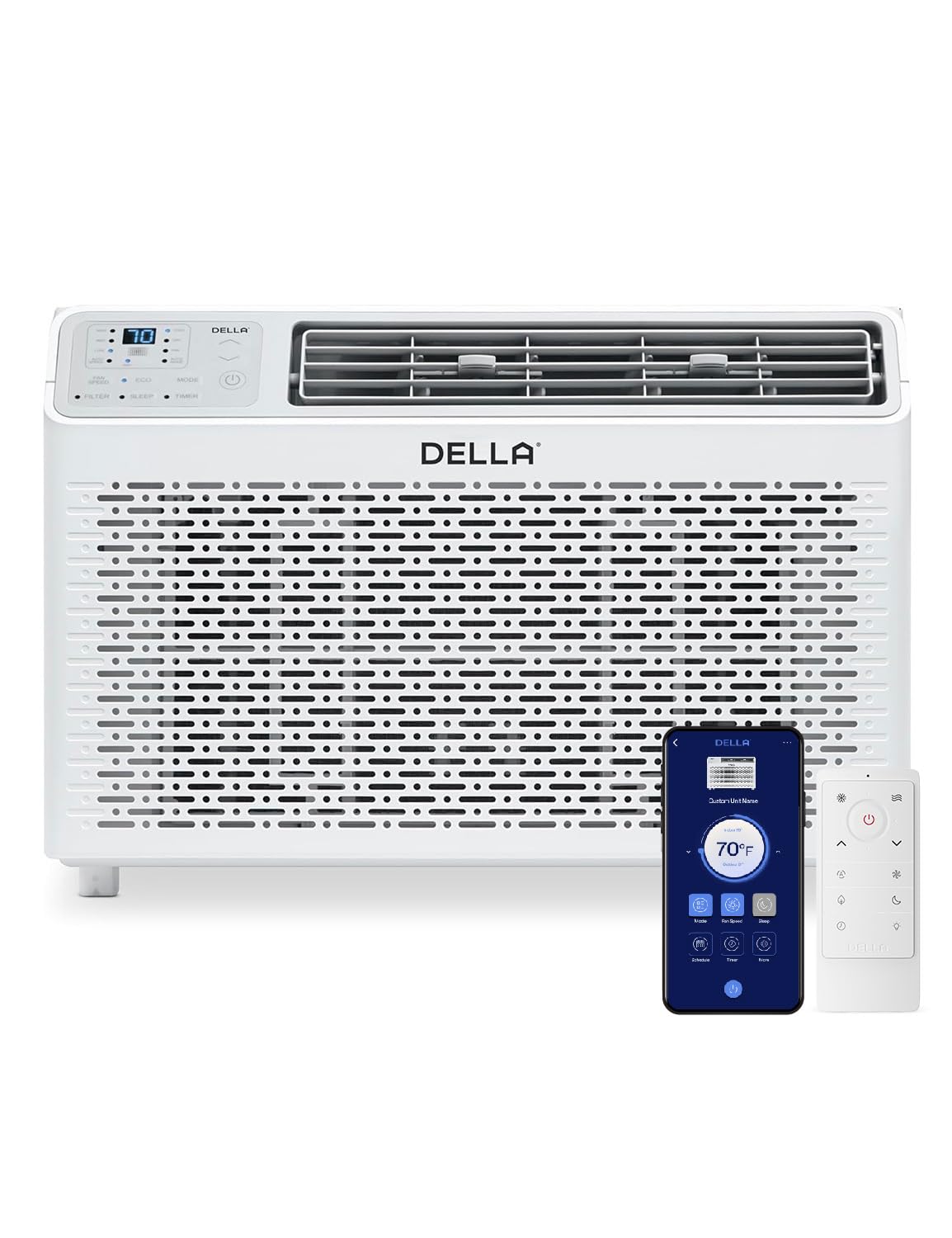
A window unit you can text from the driveway — Wi-Fi, Alexa, and 8,000 BTU of cooling for up to 350 square feet.
Stepping up from 5,000 to 8,000 BTU roughly doubles the space this unit can hold cool — 350 square feet versus 150. It runs on standard 115V, uses a 10.9 CEER efficiency rating, and adds the feature no knob-controlled unit has: a Wi-Fi connection to the Della+ app. You can adjust temperature, mode, and schedule when you’re not home, or hand it to Alexa. Temperature range runs 61°F to 88°F, with three fan speeds and four modes (Auto, Cool, Fan, Dry), a 24-hour timer, sleep mode, and eco mode.
The 4.1-star rating comes with one of the longer “success story” lists on this page — owners run two of these to hold a 1,000-square-foot home steady, and report the electric bill dropping meaningfully when a Della replaced a central unit. Remote control and cooling performance are the two things owners praise the most. If you have a smart home setup or just want to pre-cool the room from your phone, this is the differentiator versus every non-smart unit on this list.
The recurring noise gripe is real: some owners find it quiet, others describe it as loud enough to return. There’s also a small cluster of failures reported after about a year of use, including one unit that arrived dented and stopped powering on about a year in — the kind of thing that happens occasionally with any AC, but worth knowing going in. Instructions rate as the weakest part of the package; if you’re comfortable with smart home apps, you’ll get along fine.
Where It Earns Its Tech Badge
- Wi-Fi + Alexa + Google-friendly voice control via the Della+ app — set schedules remotely.
- 8,000 BTU and 350 square feet means it stretches from a bedroom to a large living room.
- 61°F-88°F range with sleep, eco, and a 24-hour timer covers day and night use.
Honest Caveats
- Noise level is mixed — some owners find it rattles, others barely notice.
- A few units have failed after about a year — the failure rate is low but nonzero.
- Instructions are thin; app setup rewards people who’ve used smart home gear before.
Best for: the buyer who wants to schedule cooling from a phone and cover a room bigger than 150 square feet.
Not for: anyone who wants the quietest possible window unit — a non-smart model will suit you better.
7. LG 8,000 BTU Window Air Conditioner (LW8024RD)
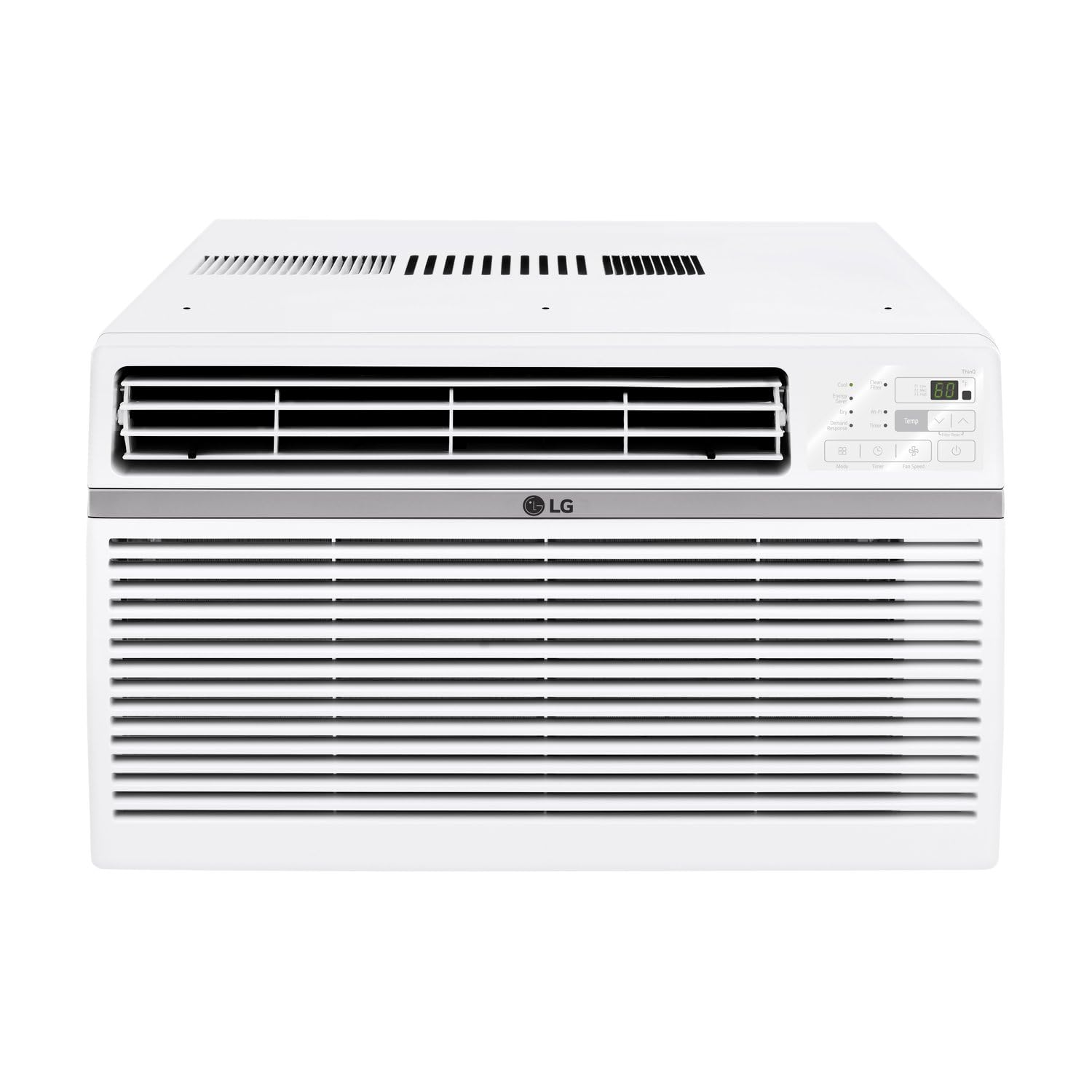
The 8,000 BTU performer owners have bought five of, and then bought again for the shed.
LG’s 8,000 BTU unit is rated for 350 square feet — a medium bedroom, a large living room, or a small open-plan space (14′ x 25′ is the spec sheet box). It runs on standard 115V and hits 220 cubic feet per minute per watt on the airflow efficiency spec, which is on the high side for its class. Three cooling speeds, three fan speeds, and Auto Cool give you more adjustability than the smaller 5,000 BTU models. A remote handles settings, and the low-noise rating bottoms out at 53 dB.
The story owners keep telling is that this LG sizes up. One owner holds a 1,000-square-foot mobile home in the mid-70s on a 95°F-to-100°F day; another drops a 300-square-foot room from 81°F to 73°F in under an hour. A long list of owners have bought multiple units and put them in different rooms. Quality is the most-praised aspect, with cooling performance running a close second. The auto-restart feature is a genuine convenience after a power cut — no walking around resetting dials.
Two caveats sit underneath the praise. Noise is one of those specs owners split on: some call it super quiet, others find it very noisy — likely depending on room size and fan setting. And a handful of units have shipped with dents or warped front vents from rough delivery; LG’s warranty and seller support have handled those gracefully when they happen. The filter light reminder can come on early too — a small annoyance, not a cooling problem.
What you get for the step up: more BTU without changing outlet, plus the LG auto-restart and remote that make it easy to live with day to day.
Room-fit test: if your target room is 300-350 square feet, this is the balance between the 5,000 BTU crowd and a mini-split.
Match this pick if: you want a mid-size window unit with the reputation for holding a bigger room.
Size up if: your room is over 350 square feet — a 10,000 BTU or mini-split will serve you better than pushing this one.
8. Frigidaire 10,000 BTU Window Air Conditioner with Remote

10,000 BTU with six-way directional airflow — the biggest window unit here that still fits a standard double-hung frame.
Frigidaire’s 10,000 BTU model is rated for up to 450 square feet — the largest window unit on this list. It runs a rotary compressor (a smooth-running design that handles long hours better than a piston-style motor) and adds a remote control with Clean Filter alerts, an Eco Mode, a Sleep Mode that nudges the temperature up overnight, and a 24-hour on/off timer. Six-way directional airflow lets you aim air in more directions than the flat vent on smaller units.
What owners describe is fast, big-room cooling — reviewers point out a 20×20 foot room dropping from 89°F to 80°F in about 10 minutes on a hot day, and a roughly 420-square-foot house cooled on a low fan setting. Remote control is a genuine upgrade at this size — you set the temperature at the thermostat without getting up. The Eco Mode and Sleep Mode combination is one of the more complete “run it overnight without thinking about it” setups on this page.
Two things to know. Number one: the unit is heavy, and owners consistently say you need two people to lift it into the window. Number two: some owners have had units that ran well for two years and then developed setting problems — a real, if rare, failure pattern in this category. The recurring convenience complaint is that the system defaults back to Eco Mode every time the power cycles, so you may be switching to Cool mode frequently if that’s your preference.
Feature worth the upcharge: the six-way directional airflow plus remote plus Eco/Sleep modes is the most feature-complete window AC at this size.
Put it where it goes: this is the unit for a big bedroom, family room, or open-plan apartment — anywhere 5,000 BTU can’t cut it.
Sized for: large rooms up to 450 square feet, with remote and full scheduling capability.
Think twice if: you’re installing solo — the weight is real and owners say it takes two.
9. Rellytech 12,000 BTU Mini Split AC/Heating System
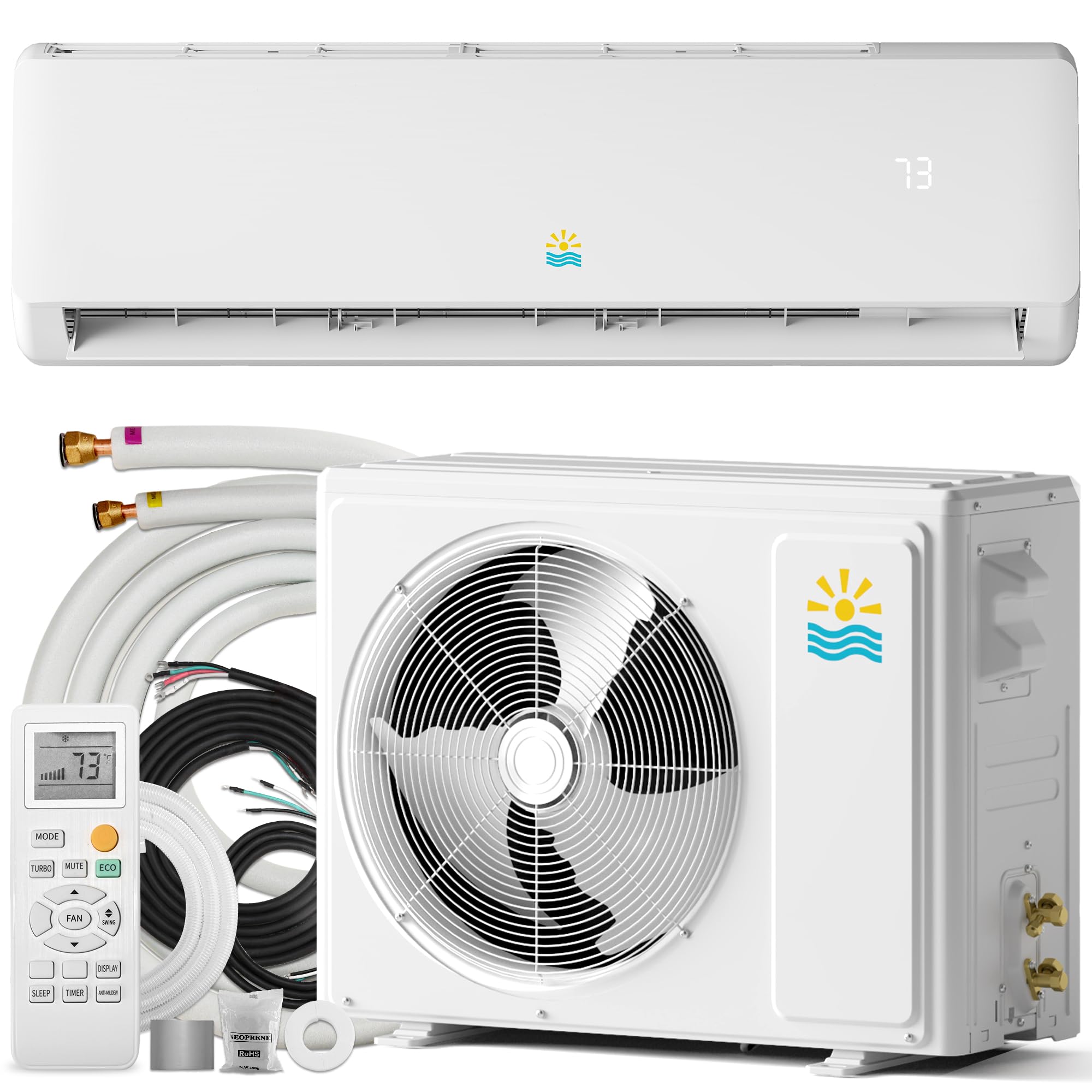
A ductless wall system that cools 750 square feet and heats them too — for about the price of two window ACs.
The Rellytech is the leap into proper split-system territory. It packs 12,000 BTU of cooling and 12,500 BTU of heating — enough to cover up to 750 square feet at a 61°F-to-88°F range — and runs on standard 115V. That means no dedicated 230V breaker required, which is a big deal for a home that wasn’t wired for central AC. Four modes (cool/heat/fan/dry), four fan speeds, a 90° vertical swing, and Eco, Sleep, and 24-hour timer functions round out the control set.
Quiet is the headline: 42 dB at the indoor head, which sits in the same range as a fridge hum. Energy is deliberately tight — 19 SEER2 and HSPF2 8.5, backed by ETL and AHRI certification and an 8-year warranty. Owners describe the system extending far beyond its listed coverage: one Florida owner runs a single unit in a 1,600-square-foot home with the thermostat set higher than their old central system, and the room still feels colder. Multiple owners call it whisper-quiet, including the outdoor unit.
The honest note: this needs professional HVAC installation to run the copper refrigerant lines and electrical hookup. Someone handy can handle the mounting and pre-charged connections, but a tech should pull the refrigerant line after — a compressor, gauges, and vacuum pump are the tools that matter and most people don’t own them. If you’re not ready for that, the window units above are simpler.
Why Mini-Split Buyers Choose It
- 12,000 BTU cooling / 12,500 BTU heating covers year-round use in one unit.
- 19 SEER2 and HSPF2 8.5 efficiency ratings on a standard 115V outlet.
- 42 dB quiet, 8-year warranty, ETL and AHRI certified.
- Four fan speeds plus a 90° swing and Sleep Mode fit bedrooms well.
Plan Around These
- Requires professional HVAC installation for refrigerant lines and electrical work.
- Takes up wall space and needs outdoor unit placement with line-set routing.
- If you rent, verify permission before installation — it’s a permanent wall change.
Cool the whole space: for a sunroom, garage conversion, or any room too big for a window unit, this is the mini-split to price.
Only if you’re ready: professional installation is part of the plan — don’t expect a weekend DIY project.
10. ROVSUN 11,500 BTU Wi-Fi Mini Split Air Conditioner & Heater

The mini-split that answers to your phone — 11,500 BTU with Wi-Fi, Alexa, and 29 dBA silence.
The ROVSUN pairs a ductless split system with the smartest control set on this page. It runs 11,500 BTU of cooling and 11,500 BTU of heating, covers up to 550 square feet, and is rated 17 SEER2 with an inverter compressor (the variable-speed type that runs continuously at low power rather than lurching on and off). Control comes three ways: the included remote, the mobile app, or voice through Alexa or Google Assistant — meaning you can pre-cool the room from the car or ask a speaker to nudge the temperature.
Quiet is the top-end spec here: 29 dBA at low speed, the lowest number on this entire list. For scale, that’s about as quiet as a whisper, and owners describe running it through the night without issue. The unit also adds automatic defrost, self-diagnosis, a 24-hour timer, wind swing, sleep mode, and eco mode, and it’s ETL and AHRI certified for reliability. In practice, shoppers say the system handling year-round temperatures from a mild 5°F up to 122°F on the operating range.
Installation is where the honest caveats sit. The included kit gets you most of the way there, but running the line set properly still wants specialized gauges and a vacuum pump — plenty of owners hire a pro for the final connection, and the instructions on their own are thin. On the rare downside: an occasional condenser has failed on buyers, and reaching support can take patience, though the company has resolved issues when pressed. Plan for the professional install, and this is a great long-term unit.
Where the value lands: you’re paying for the smart control stack and the 29 dBA quiet rating — the efficiency and heating coverage come along for the ride.
Good fit for: offices, storage rooms, or garages where remote temperature changes beat walking to a wall unit.
The right pick for: a smart-home household that wants quiet cooling and heating with app and voice control.
Only worth it if: you have a spot for the indoor head and outdoor unit and are ready for professional line-set work.
11. MRCOOL 12,000 BTU Ductless Inverter Mini Split Air Conditioner & Heat Pump

A true two-way HVAC system — heating and cooling, pre-charged lineset included, remote plus app control.
MRCOOL’s 12,000 BTU mini-split is the top of the price tier on this page and it earns the label by being the most complete system: cooling and heating in one ductless package, pre-charged condenser, lineset included, and coverage up to 550 square feet. Control flows through a remote, push buttons, an app, or voice. As a straight comparison to the ROVSUN above, the MRCOOL carries the same 12,000 BTU rating on cooling but MRCOOL’s spec sheets put it at a comparable coverage on 550 square feet — both are built for a large single room.
Owners describe the install as far easier than a traditional HVAC replacement, and the core performance — cooling, heating, and quiet operation — is what earns the position. The reporting from owners who’ve paired the 12,000 BTU with a larger companion unit in a home has been striking: buyers report electric bills dropping dramatically after replacing a central system. The Wi-Fi feature is a specific win: pre-heat or pre-cool before you get home, and set schedules so the house is comfortable when you walk in.
The honest caveats here are real. First, this needs a professional or very confident DIY hand for the electrical hookup — owners say budget for that cost before buying. Second, there’s a rare but recurring weld-point failure on the refrigerant line reported by some owners, which is where the honest “don’t size this on hope” advice comes in: give yourself margin on the BTU. Third, and this is the bigger one, MRCOOL’s manual dehumidifier mode doesn’t exist — the system covers cooling and heating only, so if you wanted the dry mode some other mini-splits carry, look at the Rellytech instead.
Why It Owns the Top Tier
- 12,000 BTU cooling andHeat Pump — covers both seasons with a pre-charged lineset included.
- Wi-Fi plus voice control (Alexa/Google Assistant) so you can pre-cool or pre-heat from your phone.
- Coverage up to 550 square feet from a single wall head.
Before You Commit
- Electrical hookup needs a licensed pro — factor that into the total budget.
- A few owners mention the refrigerant line cracking at a weld point; sizing up on BTU gives you margin.
- No dedicated dry/dehumidify mode — cooling and heating only.
The premium case: this is the pick for someone replacing central air in a well-insulated 500-square-foot space who wants one system that handles both seasons.
Hold off if: you want a true dry mode or you’re not ready to pay a pro for the electrical side.
Understanding the Specs
BTU: The Number That Decides Everything
BTU stands for British Thermal Unit — the amount of heat a unit can pull out of a room in one hour. It is the single number to match to your room size before you look at anything else. A 5,000 BTU unit is sized for up to 150 square feet, 8,000 BTU for about 350 square feet, 10,000 BTU for up to 450, and 12,000 BTU for 550 to 750 square feet depending on the model. Buy too small and the unit runs nonstop and never quite catches up; buy too big and you cool fast but pay more than you needed to.
Noise in Decibels: What You Will Actually Hear
Air conditioners list their quietest operating level in dB (decibels) — a sound pressure measurement where lower numbers are quieter. For context, a whisper is around 30 dB, a fridge hum sits near 40, and a normal conversation is roughly 60. This list runs from 29 dB at the quietest mini-split up to 54 dB on the loudest smart window unit. If the unit will live in a bedroom, look for 52 dB or below. If it’s headed for a garage or utility room, noise matters far less than BTU and durability.
SEER2 and CEER: Efficiency Ratings Explained
SEER2 is the seasonal efficiency rating used for mini-splits and central systems — a higher number means the unit uses less electricity to move the same amount of heat across a season. CEER is the window-unit equivalent. On this list, mini-splits range up to 19 SEER2, and window units list CEER figures like 10.9 and 11.0. In practice, a higher rating is what keeps the summer electric bill from jumping when the unit runs all day. It’s worth paying a little more for a better rating if the unit will run long hours.
Window Units vs. Mini-Splits: Which Fits Your Home
A window AC is a single self-contained box that hangs in a window frame — you mount it, plug it into a standard outlet, and you’re done. A mini-split has two pieces: a wall-mounted indoor head and an outdoor compressor linked by a thin copper line set, and both electrical work and refrigerant lines are involved. That second piece is where the install complexity lives on mini-splits. Choose a window unit for one room and simplicity; choose a mini-split when the room is too large for a window box, when you also want winter heating, or when you don’t want a window blocked.
FAQ
How many BTU do I need for my room size?
Will a 5,000 BTU window unit cool a bedroom?
Do I need a professional to install a mini-split?
What is the difference between SEER2 and CEER ratings?
How do I stop a window AC from being too noisy?
Can I install a mini-split in an apartment or rental?
Does cooling a room use less electricity than central air?
What size window does a typical window AC fit?
How often should I clean the air filter on a window AC?
Do I need a special outlet or breaker for a window air conditioner?
Final Thoughts: The Verdict
For most homes, the ac for home to buy first is the Midea 5,000 BTU EasyCool — it cools a small bedroom cleanly, runs on standard 115V, and has been proven for years by owners who keep buying more of them. If you want faster cold with a knob you can turn without thinking, grab the GE 5,000 BTU Mechanical. And if you’re cooling something larger than 350 square feet or you want heating in the same unit, step up to the Rellytech 12,000 BTU Mini Split — 19 SEER2, 42 dB, and coverage up to 750 square feet make it the pick that scales.
Budget time one more consideration: if you want a remote and don’t want to touch a dial, the Midea with Remote adds a dehumidify mode that most window units skip. And for a well-insulated room where quiet matters most, the ROVSUN 11,500 BTU Mini Split hits 29 dBA — the lowest number on this page — with Wi-Fi and voice control on top.
How We Picked
We do not accept paid placement. Every pick is matched to a real buyer and a real use-case; we do not hands-on test units.
Sources & Methodology
Specifications: manufacturer listings and product documentation. Review insights: verified customer reviews, as of September 2026. Pricing: not shown on this page (it changes often); check the current price via the retailer link.
As an Amazon Associate, Gadgets Feed earns from qualifying purchases. This does not affect which products we feature.