
Our readers keep the lights on and my morning glass full of iced black tea. As an Amazon Associate, I earn from qualifying purchases.
Specs are compiled from manufacturer listings and verified buyer reviews and can change over time — please confirm the key details on the product page before buying.
Sleeping in a pop-up camper on a hot night usually means sweating through the canvas or listening to a window unit rattle all night. A camper-specific AC cools the space without draining your battery or drowning out conversation. This guide ranks the best options by mounting type, BTU output, and power draw.
I’m Min — the founder and writer behind Gadgets Feed. This guide is built by comparing the manufacturers’ published specifications and the patterns across verified customer reviews, so you get each pick’s real strengths and trade-offs instead of marketing spin.
Matching your ac for pop up camper to your rig means balancing three things: cooling power (measured in BTU), how much electricity it draws, and how hard it is to install. A rooftop unit suits a full-size trailer, while a portable model works for quick tent setups.
Our Picks at a Glance


How To Choose The Best AC For Pop Up Camper
Choosing an AC for a pop-up camper means balancing small-space cooling with limited power and a canvas roof. You have a small space, a limited power supply, and often a canvas roof that can’t hold heavy rooftop gear. Start by thinking about where the unit will sit and what will power it.
Match the BTU to the Space
The British Thermal Unit (BTU) number is the cooling power. A 5,000 BTU portable unit might handle a small tent or bunk area, while a 13,500 BTU rooftop unit can cool a full trailer. Oversizing a unit for a tiny camper causes constant cycling and wasted power.
Check the Power Draw Before You Buy
Most campers run on 110V hookups, generators, or battery systems. A high-power AC can trip a weak generator or drain a battery bank in hours. Look at startup amperage and running watts, and check if the unit has a soft-start feature that eases the initial surge.
Decide Between Rooftop and Portable
Rooftop units mount through a roof opening and are the most permanent, but they need a solid roof and proper sealing. Portable units sit on the floor and vent through a hose, making them easier to move between setups but less powerful and noisier.
Quick Comparison
| Model | Best For | Cooling Power | Type | Noise Level | Amazon |
|---|---|---|---|---|---|
| Furrion Chill Cube 18K★ Best Overall | Off-grid boondocking | 18,000 BTU | Rooftop | Super quiet | Amazon |
| Dometic Penguin II 13.5KPop-Up Favorite | Pop-up campers with easy install | 13,500 BTU | Rooftop | Acceptable for most | Amazon |
| RecPro 9.5K Low ProfileBest For Small Rigs | Small campers on 16A service | 9,500 BTU | Rooftop | 54.7 dB | Amazon |
| Dometic FreshJet FJX3000 | Budget rooftop replacement | 1,460 watts (≈5,000 BTU) | Rooftop | Noticeably less noisy | Amazon |
| countrymod 5,000 BTU | Tent and small spaces | 5,000 BTU | Portable | 45dB in Sleep Mode | Amazon |
| GETUHAND 5,200 BTU | Duct-free small rooms | 5,200 BTU | Portable | 46-50dB in Sleep Mode | Amazon |
| Furrion Chill HE 13.5K | Quiet mid-size campers | 13,500 BTU | Rooftop | 50% quieter than single-fan | Amazon |
| RecPro 13.5K Ducted | Quiet, feature-rich cooling | 13,500 BTU | Rooftop | 59.7 dB | Amazon |
| VEVOR 15,000 BTU | Year-round heating & cooling | 15,000 BTU | Rooftop | Low noise | Amazon |
In‑Depth Reviews
1. Furrion Chill Cube 18K Non-Ducted RV AC
Our pick — over 4★ from 150+ verified ratings; the strongest balance of quality and price.
This 18,000 BTU rooftop unit delivers quiet, battery-friendly cooling for all-night off-grid use.
This is the unit owners reach for when they want real cooling power without tying themselves to a shore power post. The 18,000 BTU rating translates to over one ton of cooling, and the variable speed compressor ramps up and down smoothly instead of slamming on and off. Buyers report a 16′ trailer stays cool and quiet even in extreme heat, with one owner maintaining 60-degree temps in brutal conditions.
Power efficiency is the headline here. The compressor runs at 50% or 75% power modes, and owners mention it runs from a Honda EU2200 generator without complaint. For battery setups, customers note 24+ hours of runtime on an EcoFlow Delta 2 Max — a standout for boondocking trips where every watt counts.
The catch: this is the AC unit only. You’ll need the ADB (air distribution box) sold separately to complete the install, and there’s no heat pump, so it’s strictly for cooling. The remote control gets mixed feedback in reviews — some love it, others report missing components in the box. At 72.4 lbs., it’s about 10% lighter than comparable rooftop units, which helps when you’re hauling it up a ladder.
Why Owners Rave
- Runs quietly enough to watch TV on high fan speed
- Sips power — 24+ hrs on a portable battery bank
- Simple bolt-on install with step-by-step guide
Reality Check
- ADB sold separately — budget for the extra part
- No heat pump, cooling only
- Remote control quality is hit-or-miss
Grab it for: off-grid campers who run generators or battery banks and want max cooling without max noise.
Look elsewhere if: you need heating too, or you want a complete plug-and-play kit without sourcing an ADB.
2. Dometic Penguin II High Efficiency 13.5K BTU
This 13,500 BTU rooftop unit is a proven pop-up favorite for easy wiring and serious cooling.
Owners of pop-up campers specifically praise this unit for its easy install — one buyer ran a cable through the wall and used the existing roof outlet with no headaches. Its 13,500 BTU output keeps front rooms chill on summer nights, and the low-profile design cuts wind resistance while you’re on the road.
What makes the Penguin II stand out is the EPP foam housing, which trims weight and holds cooling efficiency up. The R410A refrigerant is the eco-friendly choice, reducing heat more efficiently with less environmental impact. Buyers consistently call it a strong value, with some noting it helps save on electric bills.
It’s not whisper-quiet, though — “a little noisy” comes up in reviews alongside “not overly noisy.” The trade-off is a powerful motor and fan that genuinely chills a camper fast. A few reviewers point out the bottom metal arriving dented or with cracked paint, so inspect carefully on delivery. Note this is a cool-only unit with no pre-installed controls — you’ll need a compatible CCC2 or CT thermostat.
Why It Works
- Easy install, especially for pop-up campers
- EPP foam housing keeps weight down
- Eco-friendly R410A refrigerant
Watch For
- Not the quietest option — expect some fan noise
- No controls included — thermostat required
- Occasional shipping damage reports
Pick this if: you want a dependable, powerful rooftop unit for a pop-up camper and don’t mind a little fan hum.
skip it if: silence is your top priority or you want heating built in.
3. RecPro 9.5K BTU Low Profile RV Air Conditioner
This 9,500 BTU rooftop unit runs on 16-amp service and quietly cools small campers.
Small campers often run on limited electrical service, and that’s exactly who the RecPro 9.5K was built for. One owner on a pickup camper was limited to 16-amp service and this unit fit the bill perfectly — it runs off a Westinghouse 2200W generator with no extra soft-start hardware. Shoppers say startup draws around 13 amps settling to a 7.5-amp run, which keeps your breaker happy.
At 54.7 dB, this is the quietest unit in the lineup, and reviewers back it up — one noted they can hold a conversation on high fan. The adjustable louvers swing through a wide range, so you can direct airflow exactly where you need it. The low-profile look sits sharp on van roofs, and the compact design cuts drag on the highway.
The thin spots: the included manual is confusing, especially for non-flat roofs, and the factory caulk seal needs extra screws and butyl tape to be secure. Startup surge also makes generator eco-mode unusable — you’ll need full power for those first few seconds. At 9,500 BTU, it’s the right size for small campers, not full-size trailers.
What Wins Buyers Over
- Quiet enough for conversation at full fan
- Light enough to handle alone
- Runs on 16-amp service with a small generator
Know Before Buying
- Manual is confusing for non-flat roofs
- Needs extra sealing for a watertight fit
- Low BTU — not for large trailers
Best suited for: van conversions, pickup campers, and small pop-ups on tight electrical service.
Think twice if: you’re cooling a 24-foot trailer or want plug-and-play instructions.
4. RecPro 13.5K Ducted RV Air Conditioner

This 13,500 BTU ducted rooftop unit runs at 59.7 dB, quiet enough to hear the TV.
Owners coming from loud factory units find the RecPro 13.5K a revelation. One buyer on a 2008 Keystone Cougar 5th wheel cooled both bedrooms and the main area comfortably in the low 90s, all while the unit hummed at a gentle-rain level. The remote control and touchscreen LED panel add modern convenience, and the multi-function modes — cool, dry, fan, sleep, timer — cover every campsite scenario.
Installation runs about an hour with two people, and buyers report it’s not too heavy to lift. The ducted and non-ducted compatibility means it fits most existing setups, and the low amp draw lets you run other appliances without tripping breakers. Owners mention it works especially well as a quiet replacement for loud older units, with a flush ceiling fit that looks built-in.
The honest trade-offs: cooling performance is solid but not exceptional — some owners wish it pushed colder. Durability is the bigger watch item, with multiple buyers noting cracks in the UV-resistant plastic shroud. A rare bad unit didn’t get cold at all, and returns aren’t free, so it’s worth a careful test right after install.
Owner Consensus: the quiet operation and remote control win people over, but inspect the plastic carefully on arrival.
Reach for this if: you want a feature-rich, quiet rooftop upgrade for a mid-size trailer.
Look elsewhere if: you need maximum cold output or want a tank-like build that shrugs off road abuse.
5. Furrion Chill HE RV Roof Air Conditioner 13.5K

The dual-fan rooftop unit that cools fast and cuts noise 50% versus single-fan rivals.
Furrion’s Chill HE brings two fans to the rooftop game, moving cool air faster and more evenly through your camper. The 13,500 BTU output is backed by 50% higher cooling capacity and 40% better energy efficiency versus industry standards, according to the maker. Buyers confirm strong cooling performance, with one owner cruising through a hot Florida summer without issues.
Installation is a simple bolt-on with a step-by-step guide, and the mounting kit from Amazon makes it a “plug in and go” job for many. Buyers coming from Dometic units report easy compatibility — one transferred the freeze sensor from their old Dometic to avoid error codes and it worked flawlessly with the existing thermostat. The mid-profile design keeps a low, aerodynamic look that cuts drag.
The caveats are real. This is the rooftop AC unit only — the thermostat, ADB, and controller are sold separately, which catches some buyers off guard. There are isolated reports of units freezing up, and the manufacturer’s support can demand a long drive for inspection. A few owners note the mounting bolts are finicky, so patience during install pays off.
What Wins: fast cooling from twin fans and a much quieter ride than single-fan models.
Best for: campers who want quick, efficient cooling and already have a thermostat to reuse.
Pass if: you want a complete kit in one box or need bulletproof reliability over raw specs.
6. VEVOR 15,000 BTU RV Air Conditioner with Heat Pump
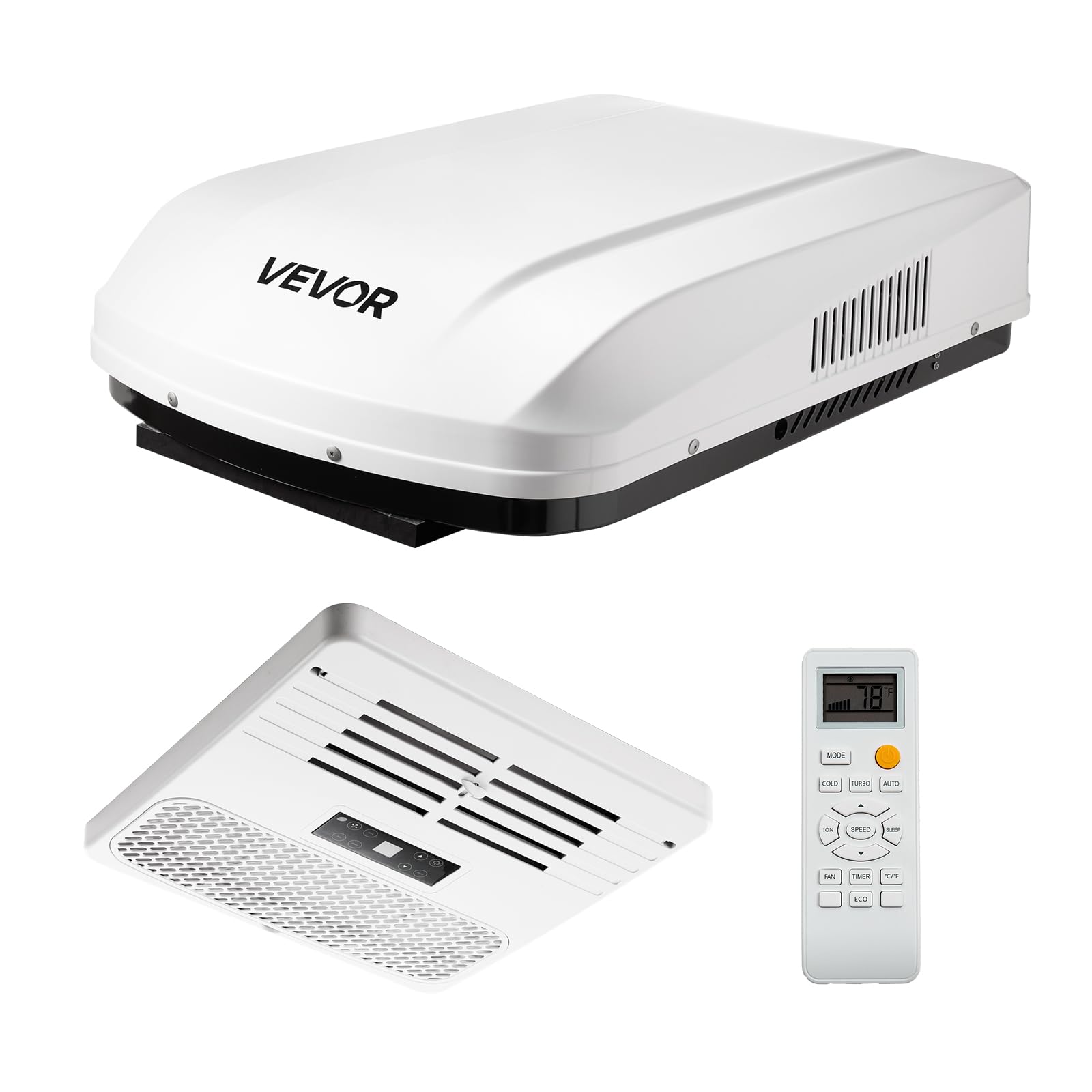
A 15,000 BTU rooftop that heats and cools, so one unit carries you through every season.
Most camper ACs are strictly coolers. The VEVOR adds a 10,236 BTU heat pump, turning it into a year-round climate solution for RVs up to 172.2 square feet. The variable-speed compressor keeps temperatures stable while cutting component wear, and the slim profile stands only 10.6 inches tall to minimize wind resistance on the road.
Control comes from both a remote and button panel, with Auto, Ion, Eco, and Dry modes plus timer and sleep functions. The ducted design fits a standard 14 1/4 x 14 1/4 inch roof opening and connects to existing ceiling ductwork for even airflow. Owners who got a good unit report it cools extremely well, maintaining temperatures several degrees below what the thermostat is set to.
Reliability is the honest concern here. Multiple customers note units that didn’t work from the start or cycled on and off every few seconds, and a few compared its cooling power unfavorably to a 5,000 BTU window unit. A cracked shroud from shipping and poor instructions also come up. The antimicrobial air filter is a nice touch, but check this unit immediately on arrival.
The Appeal
- Heat pump adds heating for shoulder seasons
- Tall 15,000 BTU output for bigger rigs
- Slim 10.6-inch low-profile design
The Gamble
- Mixed reliability reports from the start
- Instructions described as useless by some
- Weak front airflow in some setups
Get it if: you want one rooftop unit that handles both summer heat and chilly nights.
Stay clear if: you can’t risk a defective unit derailing your trip — test it immediately.
7. Dometic FreshJet FJX3000 Series Rooftop AC

A budget-name rooftop with built-in ceiling controls that’s noticeably less noisy than older Dometics.
If you want the Dometic name without the premium price tag, the FreshJet FJX3000 delivers solid function at an entry-level cost. The two-piece design simplifies assembly, and the temperature and fan speed controls integrated into the ceiling cover mean you don’t need a separate wall thermostat. Owners note the FreshJet 3 system is indeed noticeably less noisy than comparable units.
The compact, low-profile design keeps a modern look on your roof, and the powerful front-and-back airflow pushes cool air through non-ducted applications. The activated carbon filter is a thoughtful extra for keeping campsite air fresher. Buyers generally find it works well, with easy installation on RVs being a common theme.
The catches: installation draws mixed feedback — some find it easy, others say it’s a little tricky. The inner cover is described as thinner and more flexible than ideal. More concerning, a couple of reviewers point out units that cooled once and then shut off, with one blunt warning to buy from an RV source for better warranty support. At roughly 1,460 watts of cooling power, this is a lighter-duty option than the 13,500 BTU heavyweights.
Bottom Line: a decent budget rooftop for small campers, but buy with warranty protection in mind.
Suits: small campers on a budget who want Dometic reliability and built-in ceiling controls.
Skip if: you need big BTU output or want the reassurance of dealer-installed warranty support.
8. countrymod 5,000 BTU Portable Air Conditioner
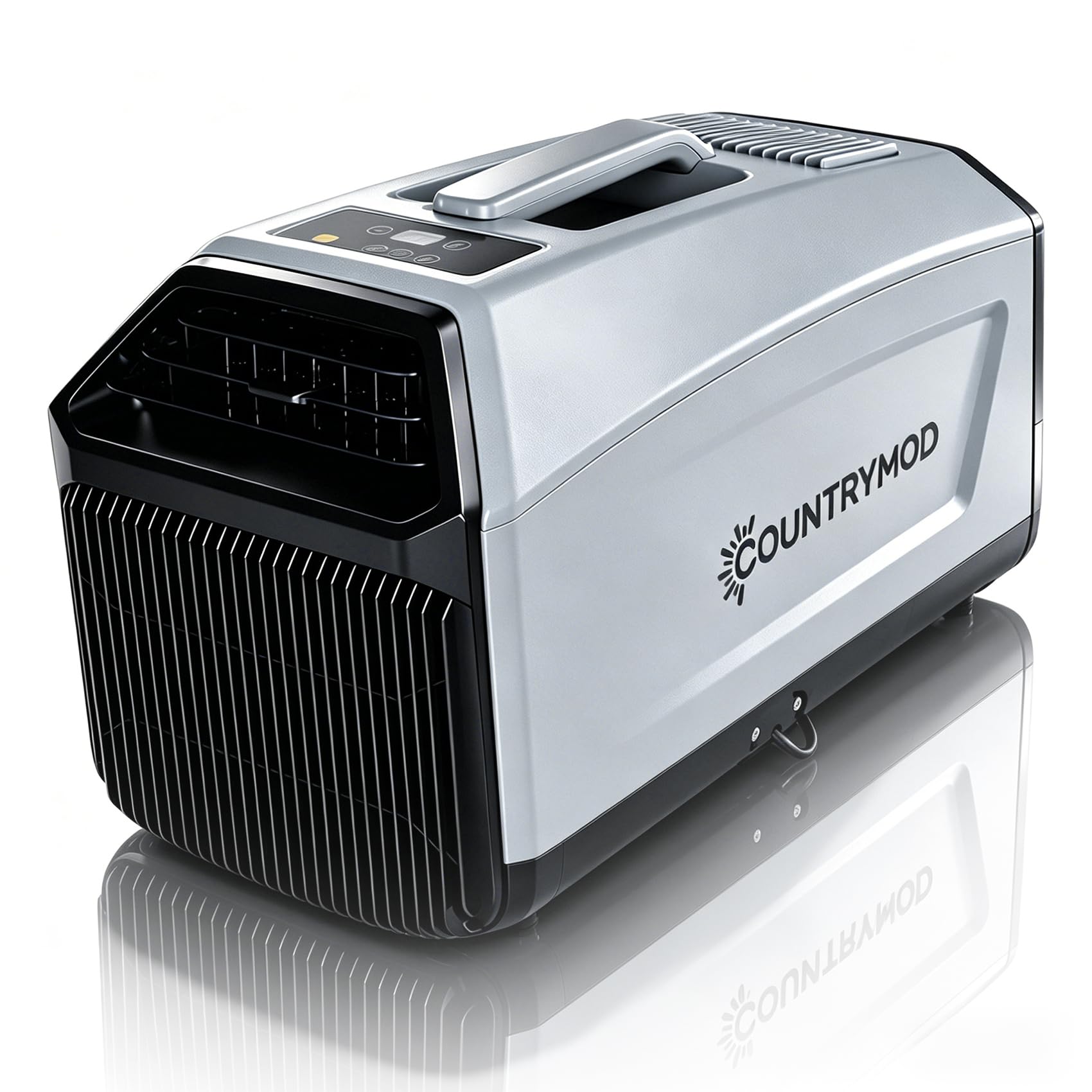
A 35-pound portable that drops into tents and small campers and quiets to 45dB at night.
This is the grab-and-go option for campers who don’t want a permanent rooftop installation. The 5,000 BTU output runs on standard 110V power and cools tents, RVs, and small rooms — with buyers reporting it drops a tent about 10°F within roughly 5 feet of the outlet. The built-in carry handle and compact footprint fit easily in a car trunk or RV storage.
It’s a 4-in-1 machine with Cooling, Sleep, Dehumidifier, and Fan modes, plus adjustable fan speeds and a timer. The remote control adds convenience from your sleeping bag, and the sleep mode’s 45dB rating keeps it from drowning out campsite quiet. Setup is genuinely simple — buyers consistently note it’s easy to get running.
The honest limits: 5,000 BTU is weak compared to full-size units, so larger areas cool slowly. It requires an outlet with no battery option, and a powerful battery bank drains fast — one owner reported an hour-hungry draw killing a high-powered Bluetti pack in 4 hours. It’s also more of an RV portable than a tent model, so know your power situation before relying on it off-grid.
What Buyers Like
- Genuinely portable at 35 lbs with a carry handle
- Four modes in one compact unit
- Fast setup with remote control
What Limits It
- Lighter cooling than full-size ACs
- No battery — needs an outlet or generator
- Big power draw for its size
Good for: tent campers and small spaces with access to shore power or a generator.
Not for: off-grid battery users or anyone needing to cool a full-size trailer.
9. GETUHAND 5,200 BTU Portable Tent Air Conditioner
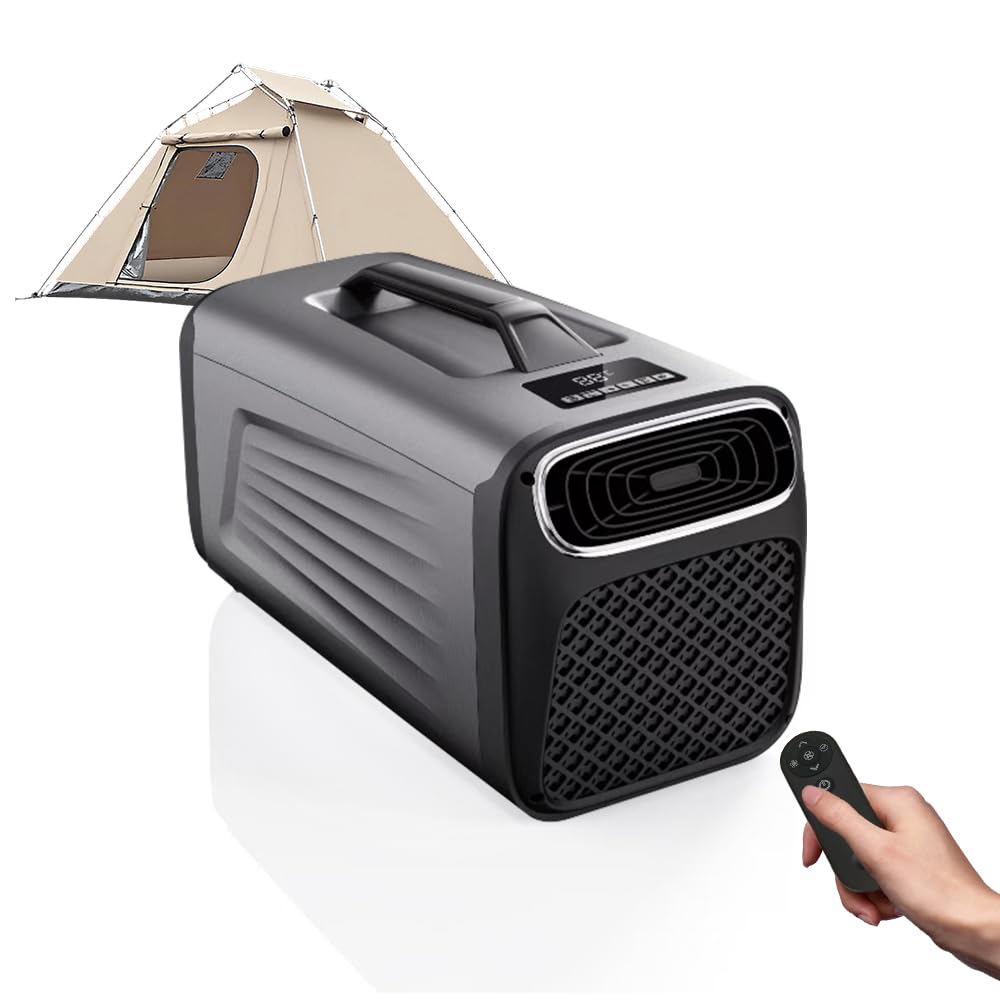
A 33-pound portable that claims an 18°F drop in five minutes — if you set the exhaust right.
The GETUHAND is pitched at fast cooling, with the maker claiming the 5,200 BTU unit and GMCC compressor can drop the temperature by 18°F in 5 minutes and cool up to 108 square feet. At 33 lbs with a carry handle, it’s easy to move one-handed, and the compact 22.4 x 11.2 x 13.8-inch footprint slides into tight camper corners. Sleep mode runs at 46-50dB with only fan sound — no compressor noise to keep you up.
Owners who set it up correctly are genuinely surprised. A four-person tent stayed cool all weekend with proper exhaust hose placement, and the unit ran quiet and lightweight throughout. The four modes — Cool, Dry, Sleep, Fan — plus a 24-hour timer give you flexibility, and drain-free operation in humidity under 70% means no bucket babysitting most nights.
The failures are dramatic when they happen. Some shoppers say it failed to cool a 48-square-foot RV after 3+ hours with no temperature change, and the output never dropped below 72°F even on the lowest setting. The short 3-foot hoses and weak fan hurt setups that need flexible venting, and several owners call it overpriced for the performance. High power draw with no battery option means it’s tethered to an outlet.
The Reality: this is a close-range cooler that shines in small tents with perfect exhaust setup, not a room-filler.
Works for: tent campers who nail the vent placement and stay within a few feet of the airflow.
Fails for: RV owners expecting whole-camper cooling or anyone without a solid outlet setup.
Understanding the Specs
BTU Output
British Thermal Units measure raw cooling power. For a pop-up camper, 5,000 BTU suits small tents and bunk areas, while 13,500 to 18,000 BTU handles full-size trailers. Don’t oversize a tiny space — a unit that’s too big cycles on and off constantly and wastes battery.
Amp Draw & Startup Surge
Campers run on 110V and often share power with other appliances. Check both the running amps and the startup surge — the moment of peak draw when the compressor kicks on. A soft-start feature eases that surge so a small generator or 16-amp campsite won’t trip.
Rooftop vs. Portable
Rooftop units mount through a roof opening and free up floor space, but need a solid roof and careful sealing against leaks. Portable units sit inside and vent through a hose — easier to move between setups and no roof modification, but they take up floor space and run louder.
Noise Level
Decibel (dB) ratings tell you how loud the unit runs. A 45-50dB unit is like a quiet conversation, while 60dB approaches normal talking volume. Pop-up campers have thin walls, so a quiet unit makes the difference between sleeping and lying awake.
FAQ
Can I run a camper AC on battery power?
Will a 5,000 BTU portable unit cool my pop-up camper?
What’s the difference between ducted and non-ducted rooftop ACs?
How do I know if my camper roof can support a rooftop AC?
Is a heat pump AC worth it for a camper?
What power does a rooftop camper AC need to start?
Do I need a thermostat with my rooftop AC?
Why does my camper AC trip the breaker?
How loud is too loud for a camper AC at night?
Can I install a rooftop AC myself?
Final Thoughts: The Verdict
For most buyers, the ac for pop up camper winner is the Furrion Chill Cube 18K because it pairs serious 18,000 BTU cooling with a battery-friendly variable speed compressor and quiet operation that make off-grid nights actually comfortable. If you want easy rooftop installation specifically for a pop-up camper, the Dometic Penguin II is the proven favorite. And for small rigs on tight power, the RecPro 9.5K hits the balance of quiet, light, and low-amp — just don’t expect it to freeze a full-size trailer.
How We Picked
We do not accept paid placement. Every pick is matched to a real buyer and a real use-case; we do not hands-on test units.
Sources & Methodology
Specifications: manufacturer listings and product documentation. Review insights: verified customer reviews, as of September 2026. Pricing: not shown on this page (it changes often); check the current price via the retailer link.
As an Amazon Associate, Gadgets Feed earns from qualifying purchases. This does not affect which products we feature.