
Our readers keep the lights on and my morning glass full of iced black tea. As an Amazon Associate, I earn from qualifying purchases.
Specs are compiled from manufacturer listings and verified buyer reviews and can change over time — please confirm the key details on the product page before buying.
Choosing the right AC for a small RV depends on one honest question: can your electrical system actually feed it? A big rooftop unit is pointless if it trips your breaker every night, and a battery-powered 12V unit only works if you have the amp-hours to spare. You need a unit that cools your space, stays quiet enough to sleep through, and matches what your rig can actually deliver.
I’m Min — the founder and writer behind Gadgets Feed. This guide is built by comparing the manufacturers’ published specifications and the patterns across verified customer reviews, so you get each pick’s real strengths and trade-offs instead of marketing spin.
You might need the raw power of a 15,000 BTU rooftop unit or the off-grid freedom of a low-draw 12V system. The ac for small rv on this list fits a rig that sleeps, parks, and travels on a real power budget.
Our Picks at a Glance

How To Choose The Best AC For Small RV
Before you buy, you need to know if your RV has the roof space, the power, and the wiring for the unit you want. A standard 14″ x 14″ roof vent opening is the most common cutout, but some units need a bigger hole or thicker roof bolts.
Match the BTU to your RV size
BTU (British Thermal Units) measures cooling power. A 10,000 BTU unit suits a camper van or small trailer, while a 13,500 BTU unit handles a mid-size coach. Buy too small and the unit runs nonstop; buy too big and it short-cycles, wasting power and leaving the air clammy.
Understand your power source
Traditional 110-120V units run off shore power or a generator and draw a lot of amps. A 12V DC unit runs straight off your house battery, which is great for boondocking—but only if your battery bank and solar can carry the load. Check the amp draw and the wattage before you commit.
Check the noise level
Noise is measured in decibels (dB). A unit rated at 40dB is library-quiet, while 55dB is like gentle rain and 65dB is more like a loud conversation. If you sleep under the unit, this number matters more than almost any other spec.
Quick Comparison
| Model | Best For | Cooling Power | Noise Level | Power Source | Amazon |
|---|---|---|---|---|---|
| RecPro RV 15K Quiet AC★ Best Overall | Whole-coach cooling | 15,000 BTU | 55.4 dB | 110-120V | Amazon |
| Gidrox 12V DC 10K BTUOff-Grid Pick | Off-grid battery power | 10,000 BTU | 40 dB | 12V DC | Amazon |
| Coleman Mach 3+Reliable Classic | Classic reliability | 13,500 BTU | — | 115V | Amazon |
| Outequip 12V 10K BTU | Quick cooling, low profile | 10,000 BTU | 54 dB | 12V DC | Amazon |
| Countrymod 12V 10K BTU | Efficiency and app control | 10,000 BTU | 45-55 dB | 12V DC | Amazon |
| Outequip 12V 10K BTU (w/Heater) | Cooling with mild heat | 10,000 BTU | — | 12V DC | Amazon |
| RecPro 13.5K Non-Ducted | Quiet 13.5K cooling | 13,500 BTU | 59.7 dB | 110-120V | Amazon |
| TURBRO Inverter 13.5K BTU | Heating and cooling | 13,500 BTU | — | 110-120V | Amazon |
| Dometic FreshJet 3 | Lightweight Dometic upgrade | 15,000 BTU | — | 110-120V | Amazon |
| Coleman-Mach 15 | Maximum 15K output | 15,000 BTU | — | 115V | Amazon |
| Dometic Penguin II | Ducted and non-ducted flexibility | 13,500 BTU | — | 110-120V | Amazon |
In‑Depth Reviews
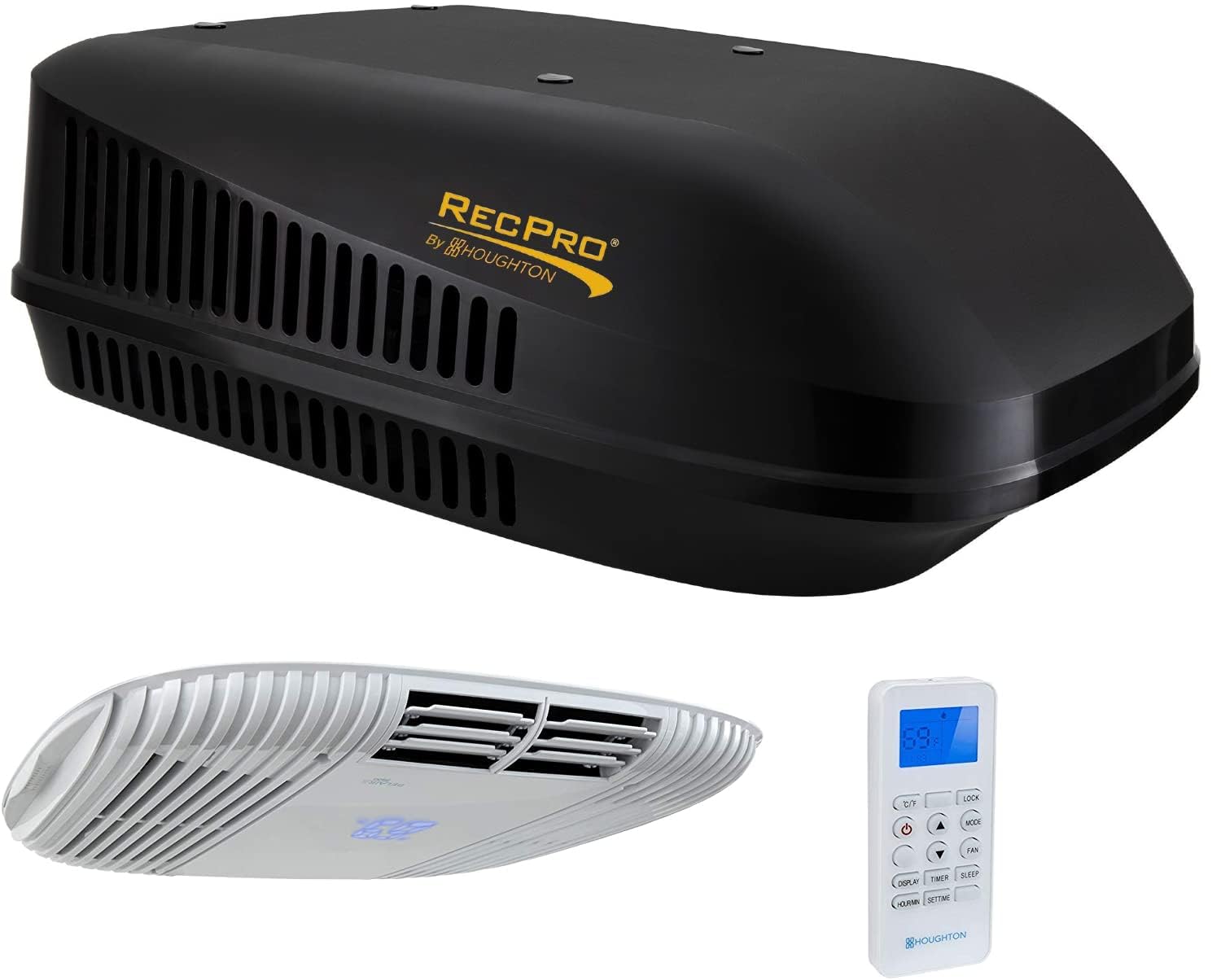
1. RecPro RV 15K Quiet AC Heat Pump Non-Ducted Black
Our pick — 4.5★ from 300+ verified ratings; the strongest balance of quality and price.
The whole-coach chiller that doubles as a winter heater without screaming at you.
Buyers report it cools a 36ft coach comfortably, even in 90-degree weather, and the built-in heat pump means it is a four-season unit, not just a summer one. That extra cooling muscle does come with a cost in noise, though: it runs at 55.4 dB, which is a 38% higher noise level than the Gidrox’s library-quiet 40dB.
Installation is the honest hurdle here. Owners consistently describe it as heavy — right around 100 lbs — so you will want a second pair of hands or a lift for the roof. The manual gets criticized as poor, with several buyers noting that DIY videos on YouTube fill in the gaps. You will also need a 20A line to feed it, so check your RV’s electrical panel before you commit. Once it is up, the wireless remote and LED touch display let you switch between cool, dry, fan, sleep, and timer modes, all without any thermostat wiring.
What wins people over is the reliability and build quality — this is the most-praised aspect of the unit by far. Owners coming from Dometic units note the sleeved pipes here prevent vibration wear, which is a common failure point on other brands. It also works with both ducted and non-ducted setups, so it is a flexible drop-in for most rigs. The catch is the timer quirk: some owners mention that setting the clock activates the timer, which they fix by removing the remote battery. It is a small annoyance on an otherwise outstanding unit.
Quiet heat pump
- Reliability is the single most-mentioned positive — owners trust it trip after trip.
- The heat pump adds real winter value, which most cooling-only units lack.
- Strong airflow from separate condenser and evaporator fans keeps the whole coach even.
Ductless install only
- At roughly 100 lbs, solo roof installation is a genuine struggle.
- It needs a dedicated 20A line, so verify your panel capacity first.
- The manuals and instructions get poor marks from multiple owners.
pick this if: you have a larger coach or trailer, want heating and cooling in one unit, and have a helper for the install.
look elsewhere if: you need a featherlight unit you can mount alone, or you run exclusively on battery power.
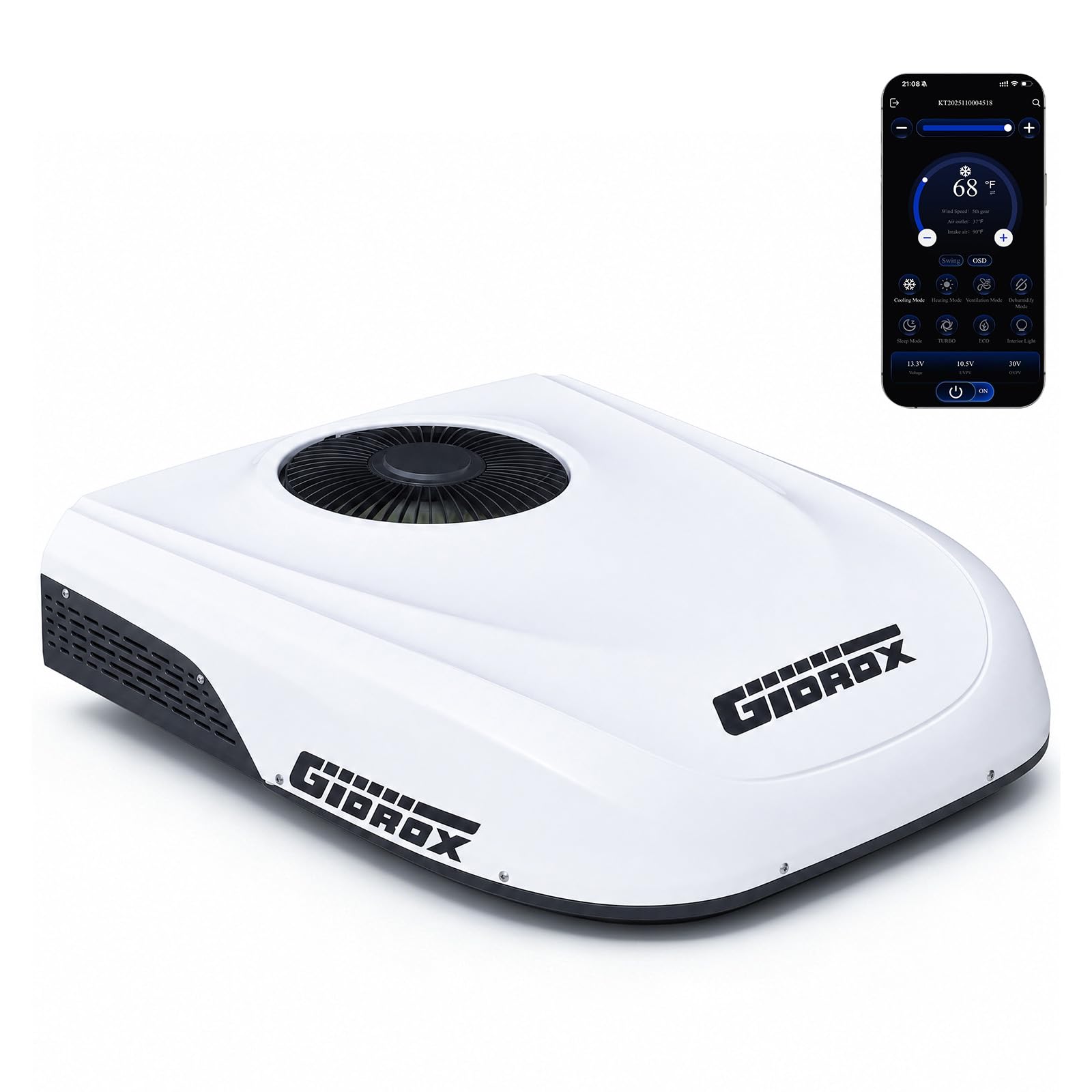
2. Gidrox 10000 BTU 12V DC RV Air Conditioner
The 12V battery whisperer that sips power and cools a skoolie on a budget.
This is the quietest unit on the entire list, hitting just 40dB in Sleep mode — that is library-quiet, a 38% gap in noise versus the RecPro’s 55.4 dB. It is also a true 12V DC unit, meaning it runs straight off your RV battery with no inverter needed. In a skoolie conversion, customers note excellent 10,000 BTU cooling, and in ECO mode it draws only 300-350W compared to an old 1,200W unit — a massive drop in power draw that makes all-night boondocking realistic.
The headline here is the 3-minute comfort claim. Advanced PTC technology delivers heat fast even on below-freezing mornings, and you switch to cooling just as quickly. You get three modes — Turbo for rapid change, ECO for efficiency, and Sleep for quiet. Control comes three ways: a smartphone app via Bluetooth, an infrared remote, and physical buttons on the unit, so you are never stuck fiddling with one interface. At just 54 lbs, it is light enough for a solo roof install, which is rare for rooftop ACs.
The honest caveat is on the power side. One buyer tried to run it on a modest battery bank and found it killed the battery even on fan mode — this unit needs a serious battery setup to shine. The same owner called the remote useless and the app unclear, though others found the app a nice addition. Installation also gets mixed reviews: the included screws are reportedly too short for thick roofs, and the 14″ bracket can be slightly oversized for a standard cutout. It is an outstanding unit, but only if your electrical system is ready for it.
The thing everyone agrees on is the cooling itself — functionality is the most-praised aspect here. It is described as a literal life saver in a skoolie, and the support team gets credit for replacing a dropped circuit board for free. Weigh the high praise against the clear power requirements, and this is a fantastic off-grid choice for someone with a proper battery bank.
reach for this if: you boondock off-grid and need ultra-quiet, low-watt cooling that your battery and solar can actually feed.
think twice if: your rig runs on a small battery or you expect plug-and-play installation on a thick roof.
3. Coleman Mach 3+ A/C Unit
The plug-and-play workhorse that beats a 25-year-old failure with zero fuss.
If your old Mach 3 finally gave up, this is the direct replacement you want. It is a 13,500 BTU unit with 320 CFM of airflow and a 13.1 cooling amp rating, running on standard 115V. Buyers highlight how perfectly it cools a 100°F Iowa summer, and one owner with a 66-foot Airstream calls its performance excellent. The plug-and-play cables mean most people skip the electrician entirely, and one owner fitted it to a 2016 Jayco Greyhawk in a single hour.
There is a 5,600 BTU electric heat element capacity built in, giving you a little warmth for chilly evenings even though this is primarily a cooling unit. The rotary scroll compressor is a proven design, and the 5-star BEE rating speaks to its efficiency. It is not the quietest option — owners describe the noise level as normal for an RV AC, similar to the older units — but it is predictable and reliable, which is exactly what a replacement should be.
The recurring gripe is the packaging and documentation. The manual is described as useless — missing pages, backwards, or absent entirely — which pushes most buyers to YouTube for installation guidance. At 75 lbs, you will want two people or a pulley to get it on the roof, and one owner’s 5-star review notes it needs three people to lift comfortably.
Performance is what wins people over here — the most-praised aspect — alongside a quality build that has kept this same design in service for decades. It is heavier and louder than modern inverter units, but for a straight-up, no-nonsense replacement that cools hard, it is hard to argue with the track record.
buy this for: a dependable, straightforward swap for an aging Mach 3, especially if you want to keep the same mounting footprint and wiring.
look elsewhere if: you demand whisper-quiet operation or you want a unit light enough for one person to lift.
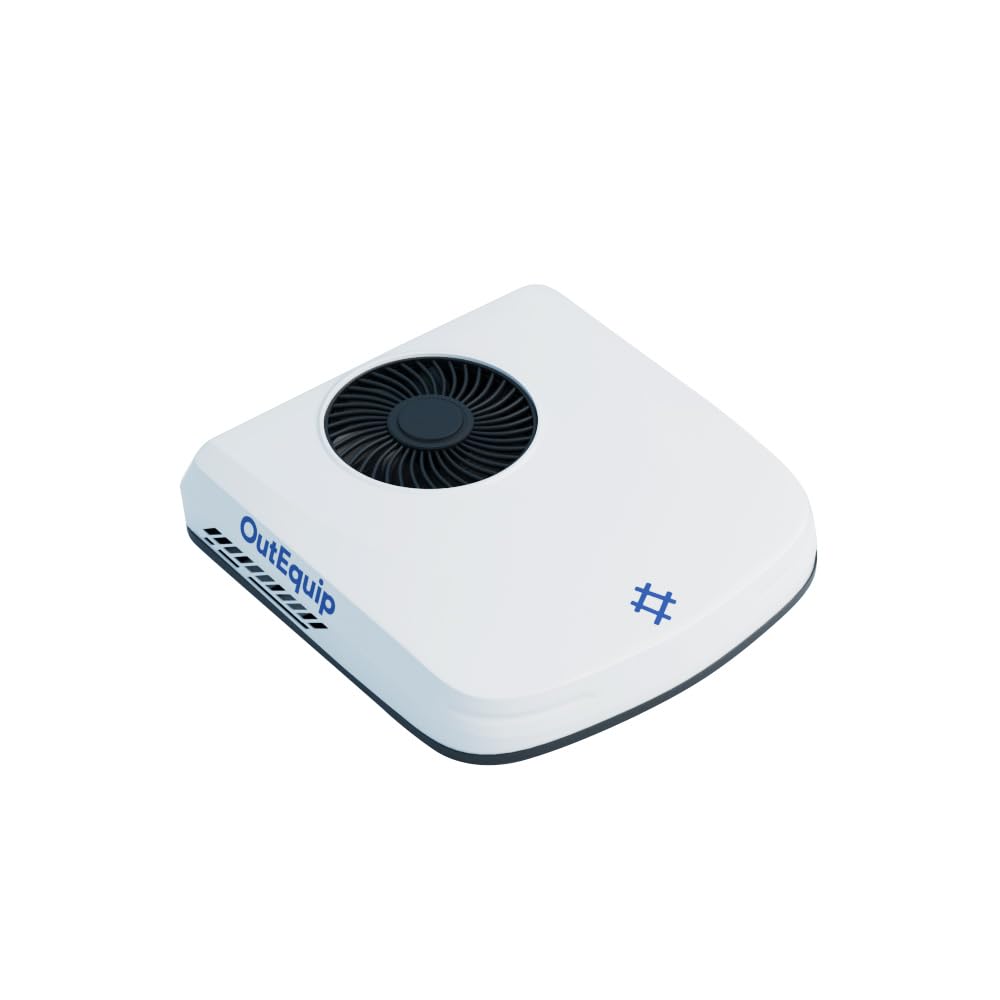
4. Outequip 12V 10000 BTU Rooftop AC
The low-profile 12V unit that drops a Class B RV to 80°F in brutal 105°F heat.
For small Class B vans with limited roof clearance, this unit is a standout. Its low-profile 28×28″ footprint fits a tight 7.5″ clearance, and at just 43 lbs it is light enough for a true solo install. The performance data is impressive: an inverter compressor held 80°F inside while it was 105°F outside, drawing only 21A in that steady state and 51A in Turbo. One owner cooled an 89°F rig down to 79°F in 25 minutes while it was 79°F outside. The cooling performance is the second most-praised aspect here, and reviewers point out a temperature difference of up to 20°F.
It runs off your 12V system directly, which is the whole point for off-grid travelers. The manufacturer claims 8 hours of cooling on a 480Ah battery and 10 hours on a 600Ah battery when parked. One owner ran it for 43 hours on a 600Ah battery, drawing just 300-500W. The brushless copper motor fans keep it quiet at 54dB on high, and the spring-supported mounts dampen vibration. The included 15ft 6AWG cable and 100A fuse mean you get the essential wiring in the box.
Installation is described as straightforward for most, with owners completing it solo in a couple of days without roof modifications. The instructions are clear overall, though a few buyers suggest more diagrams would help with part orientation. One review mentions a potential 1/4″ to 3/8″ tilt issue if the gasket is not seated right, so take your time with the torque specs. The remote works well, though you need it for the timer and lights since those are not on the main panel.
Power consumption is a genuine strength — owners consistently note the low draw and efficiency, with one STEM trailer owner relying on it to keep sensitive electronics cool. It is a quality build with copper coils and a zinc-coated condenser, built to handle the weather. For a compact van or small trailer that needs real cooling without a generator, this is one of the smartest 12V options available.
choose this for: a low-profile, lightweight 12V unit that a single person can install and that runs cleanly off a decent battery bank.
skip it if: your roof clearance is under 7.5″ or you do not have a battery setup that can sustain the amp draw.
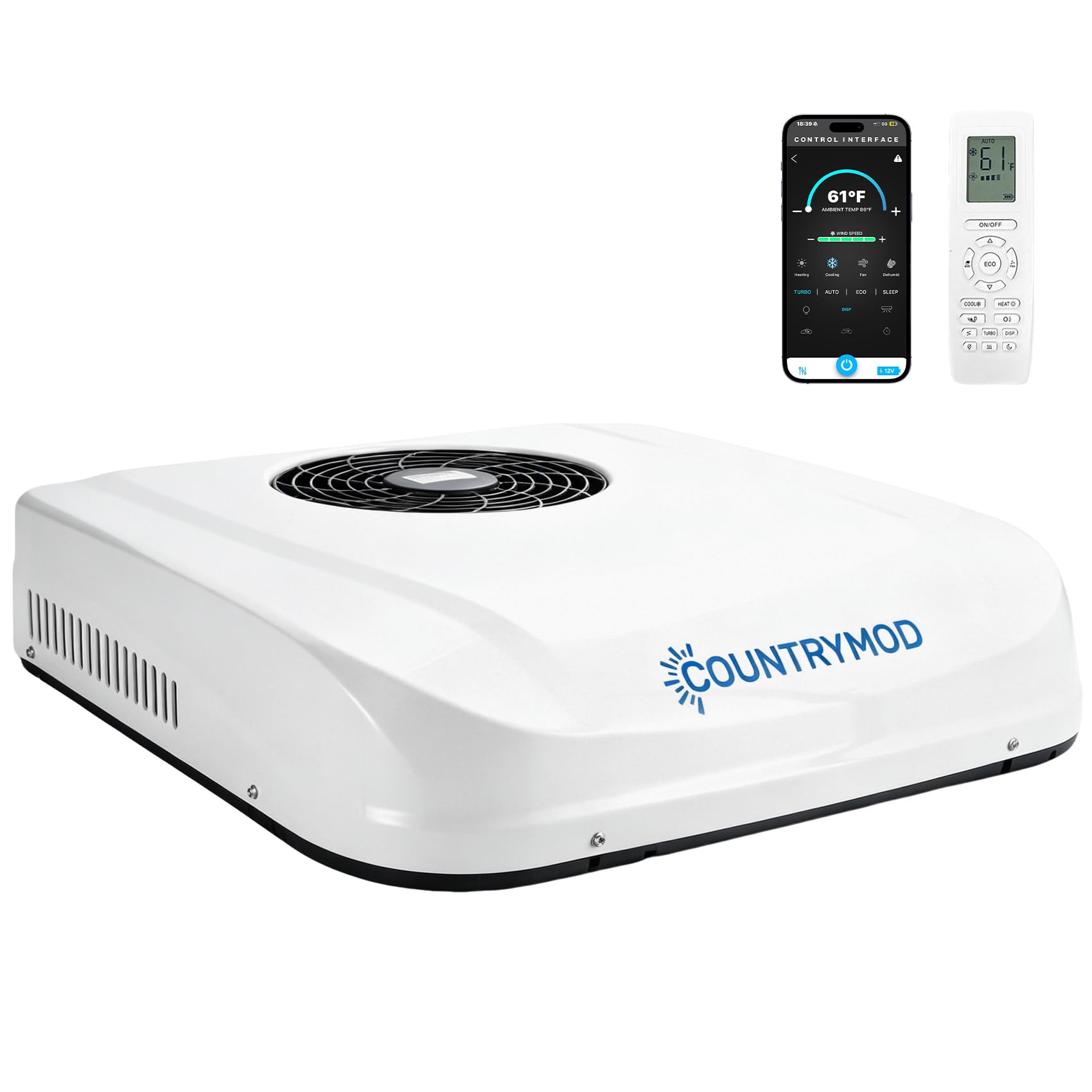
5. Countrymod 12V DC RV Air Conditioner
The inverter-powered 12V that turns a 30-foot trailer ice-cold on battery alone.
This is the efficiency-focused option in the 12V crowd. The variable-frequency inverter design means the compressor adjusts its speed to demand, so it is not blasting full power all night. At 300-900W draw and consuming just 0.3 kWh per hour, It claims to be 5 times more efficient than a standard 1.5 kWh/hour unit. — and owners back that up, reporting it uses less than 50A compared to the 150A of a traditional unit. One owner cooled a whole 30-foot trailer and said it was cooler than their old 120V unit ever was.
The horizontal compressor is the engineering story here. Unlike traditional vertical designs, it produces less vibration and a lower center of gravity, which means a more stable, durable unit that reduces road shock. It is also compact, fitting a standard 14″ x 14″ roof vent without ductwork. The noise level sits at a comfortable 45-55 dB — described as a slight wind sound — and one owner measured 44dB in Sleep mode, quiet enough for a light sleeper.
Control is a three-way affair: a keypad on the unit, a remote, and a smartphone app. Shoppers say the Bluetooth controller works well, and one notes excellent post-sale support — a rep named Tony sent a replacement controller quickly when a compressor cycling issue appeared. The dehumidifier function is a bonus, helping with that sticky camper feeling.
The catch is the power demand. This unit will not run happily on a small battery bank. One owner with 600W of solar and five lead-acid batteries only got a few hours of use, and it struggles to keep up above 90°F. They upgraded to 1,000W of solar and a 990Ah lithium bank, and now it runs all night using about 10% of capacity. You need a proper lithium setup — at least a LiFePO4 battery that holds 12V+ at the unit — for this to deliver on its promise. Owners also note the included bolts can be too short for arched roofs, so plan on picking up longer 8mm x 160mm hardware.
best for: boondockers with a serious lithium and solar setup who want efficient, app-controlled cooling all night.
not for: anyone running lead-acid batteries or expecting to cool a rig above 90°F without a big solar array.
6. Outequip 12V 10000 BTU Rooftop AC (w/Heater)
The 12V workhorse that cools a 1973 Winnebago without a generator and warms a chilly cabin.
This is the sibling of the Outequip unit above, but with a 4,500 BTU PTC heater added for chilly evenings. The cooling side is identical — 10,000 BTU that cools an RV in about 15 minutes, with a low-profile design and brushless copper motor fans for quiet operation. Owners rave about the install, which is the single most-praised aspect here: one buyer swapped out a failed engine AC in a 1973 Winnebago in a 3-hour DIY install with no generator needed, and another solo-installed it on a ProMaster van.
The heat is the differentiator. The 4,500 BTU PTC element provides supplemental warmth for mild temperatures and small spaces — the maker is upfront that it is not a primary heat source for extreme cold or large rigs. Owners using it in vintage trailers and trucks report it is effective for taking the chill off. The unit runs off 12V with a draw around 600W max, and a 600Ah battery yields 10-12 hours of cooling. One owner in a hot, humid climate reported no interior drips even at 96°F, which is a common failure point on cheaper units.
The quality of the included hardware earns repeated praise. Owners mention the ~15ft 6AWG wire and fuse are included, along with stainless bolts and a proper gasket kit. The voltage drop across the included wire is a tiny 0.03V, so you are not losing power to a thin cable. The remote and Bluetooth app both work, and customer service gets high marks — one owner got a free control board replacement without hassle.
There are a couple of limitations worth knowing. The unit lacks an exhaust fan capability, which some owners miss. The heat option requires sealing a 1″ wire hole during installation, so budget a little extra time for that. And while the install is easy for most, it still takes several hours to do properly. For a small RV or van that needs cooling plus a little warmth, this is an exceptionally well-rounded pick.
grab this if: you want a lightweight, solo-installable 12V unit with a heater for cool mornings and mild climates.
pass if: you need serious winter heating or you cannot live without an exhaust fan setting.
7. RecPro 13.5K Non-Ducted RV Air Conditioner

The mid-size RecPro that cools a trailer far quieter than the Furrion it replaced.
If the 15,000 BTU RecPro above is more than you need, this 13,500 BTU version delivers the same build quality in a more manageable package. At 59.7 dB it is quieter than many RV units, and owners consistently call it super quiet — one buyer measured it 20 dB quieter than the Furrion it replaced, which is a staggering difference in perceived loudness. The cooling performance is well-liked, with one owner reporting it keeps the bedroom and whole trailer nice and cool during the summer.
The fit and finish get strong marks. Quality is the most-praised aspect, with buyers noting the construction feels solid and well-built. It works with both ducted and non-ducted systems, giving you flexibility depending on your rig’s setup. The wireless remote and LED touch display offer cool, dry, fan, sleep, and timer modes, and there is no thermostat wiring to fuss with. It is pre-wired to plug into a standard fan hole, which made the install a quick 30-minute job for one owner working with a helper.
There is an honest split on the remote control. Some owners love it, calling the unit easy to control from anywhere in the coach. Others find it inconvenient, and one buyer had to reverse the remote plug connection to make it work at all. The wiring gets mixed feedback too, so be ready to troubleshoot a bit during setup. It also uses a reciprocating compressor, which is a proven design but not as refined as a scroll unit.
The packaging deserves a mention — one owner noted the unit arrived double-boxed and extra padded, which is a welcome change in a category where shipping damage is common. Installation instructions get good marks, which is unusual for this product class. For a small RV that wants the RecPro build quality without the full 15K footprint, this is a strong middle ground.
pick this for: a quiet, well-built 13.5K unit that installs fast and works with both ducted and non-ducted setups.
look elsewhere if: you want app control or you prefer a scroll compressor for potentially smoother operation.
8. TURBRO Inverter 13.5K BTU RV Air Conditioner
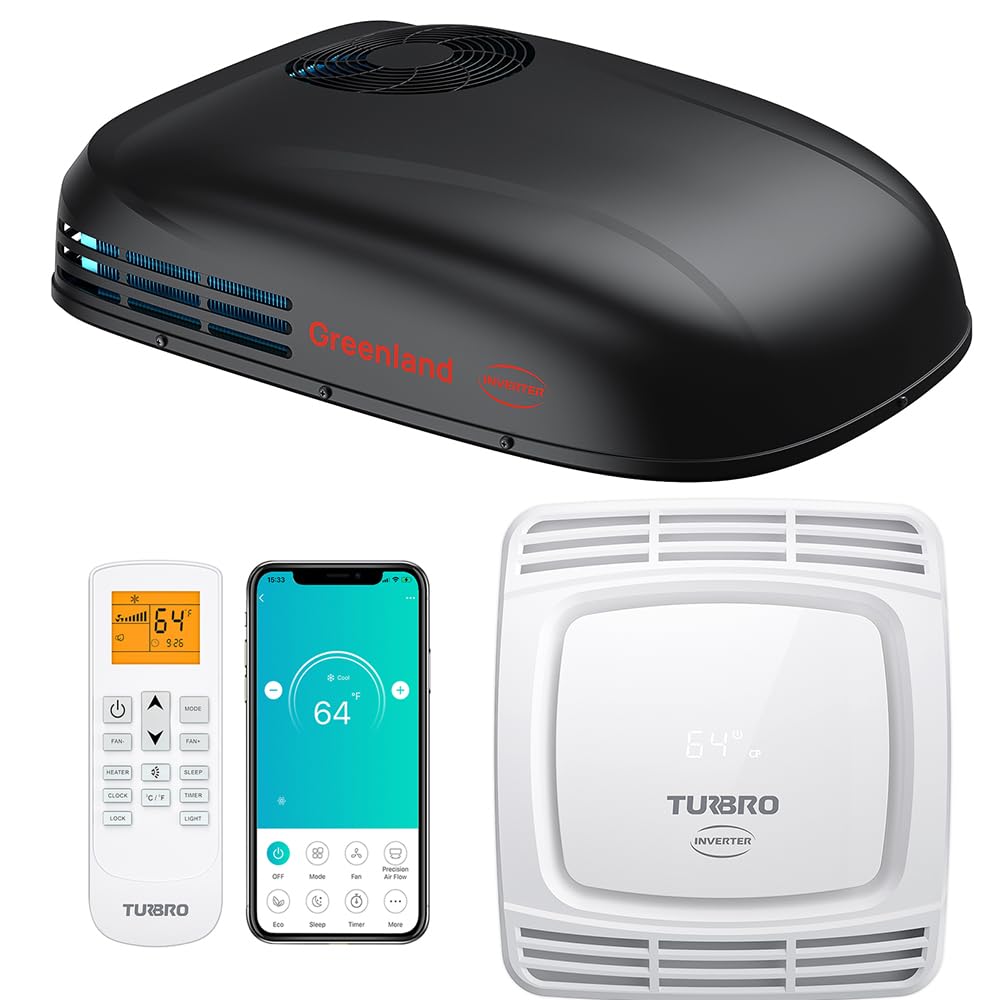
The slim inverter unit that runs on a Honda 2200 generator and heats with a heat pump.
This is the modern-tech pick for RV owners who want inverter efficiency without going full 12V. The inverter compressor delivers up to 30% greater efficiency than non-inverter systems., and its smooth start eliminates the need for an additional soft starter — which means you can run it on a small generator. One semi-truck owner runs it on a Honda 2200 in eco mode, noting it ramps up power gradually and peaks around 1,500W before settling near 800W. It cooled the cab ice cold, which is a serious test.
You get both cooling and heating here. The 13,500 BTU heat pump delivers up to four times the output of traditional electric heaters., and the unit works in environments from 19.4°F to 109.4°F. Owners in desert climates report the heating is good for a winter chill, and the cooling handles a 35-foot coach in 90°F+ weather. The slim 10.0″ thickness is up to 35% thinner than most competing units., which reduces air resistance and helps fuel economy while you drive.
The smart features are a real highlight. WiFi allows scheduling through a smart app, which owners say works well, and the ceiling assembly has an atmosphere lamp with blue, yellow, or white lights for a nice interior touch. It fits any RV or camper with a 14.25″ x 14.25″ roof opening and handles ceiling thicknesses from 1.02″ to 3.93″. One owner even installed it on a 3rd unit in a Montana with no issues.
The noise profile is the honest trade-off. While quieter than the old Penguin II it replaced for one buyer, another owner calls it a little loud, especially in direct-dump mode versus ducted. The noise level is actually the most-discussed aspect, and it is mixed — not a universal strength. The bolt hardware also runs short for thicker roofs, and there is no official TURBRO replacement for longer ones. One reviewer noted the fan runs continuously with no auto-off feature, which can be annoying if you want absolute silence at night. For a feature-packed inverter unit that runs on a small generator, though, the value is strong.
choose this for: inverter efficiency, heat pump warmth, and WiFi control — especially if you run a small generator or care about fuel economy.
think twice if: you need whisper-quiet operation or you have an unusually thick roof that standard bolts will not reach.
9. Dometic FreshJet 3 Series 15K BTU

The featherweight Dometic that bolts into your existing ADB and cools a 40-foot Class A.
If you already have a Dometic roof opening, this is the upgrade path of least resistance. The FreshJet 3 is designed to be backwards compatible — it keeps your existing ADB (air distribution box) and bolts in, with one owner calling it a direct plug-and-play from a Brisk II: unclip the 8-pin connector, remove 4 bolts, and you are done. That ease of installation is the most-praised aspect, and one buyer swapped it into a 40-foot Class A and saw better airflow and steady temperatures even at 93°F.
The 15,000 BTU rating is a serious step up for anyone coming from a smaller unit. Buyers report 48°F output at the vent, which is significantly colder than the Brisk II it replaced. The lightweight construction is a genuine selling point — it reduces weight load on the roof and makes the install easier on your back. Dometic’s e-coated evaporator coils are a standout feature: this is a flexible epoxy polymer coating that provides excellent corrosion resistance, which helps the unit survive wet, salty, and humid environments far longer.
The flip side is durability and shipping. The durability feedback is the most negative aspect here, with several owners reporting broken bases and mounting tabs — one unit arrived with 5 of 6 shroud tabs broken, though the customer service team resolved it with a replacement shroud. The packaging is repeatedly criticized as poor, with no foam or bubble wrap, leaving units at risk of shipping damage. One buyer’s unit arrived on its side with a broken cover, base, and fins, which made it unusable despite the product itself being fine.
The performance, airflow, and quiet operation all get consistent praise, and the functionality is well-liked across the board. It works even in 100°F heat, which is the real-world test that matters. This is a smart choice for Dometic owners who want an easy, high-output upgrade — just inspect the box carefully when it arrives.
best for: Dometic owners with an existing ADB who want a lightweight, high-BTU upgrade that installs in under an hour.
be cautious if: you worry about shipping damage — inspect the unit immediately and document any issues with photos.
10. Coleman-Mach 15 15,000 BTU Signature Series
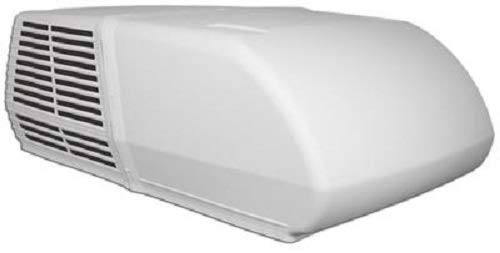
The 15K Coleman with the highest available cooling output in the family lineup.
When you need the absolute maximum cooling output from a Coleman, this is it. The 15,000 BTU rating is the flagship number for the brand, and the medium-profile design means it does not sit as tall on the roof as some high-output units. It uses a rotary scroll compressor, which is a smooth and reliable design, and the textured white shroud gives it a clean, durable finish that resists showing scuffs. The estimated efficiency of 12.5 BTU per watt means you get solid cooling per unit of electricity.
Owners call the installation straightforward, with one completing it in 2 hours (excluding a separate 6-hour wire run). The fitment is a key strength — most Coleman AC units share the same mounting pattern, so this is a drop-in replacement for a wide range of RVs and trailers. The remote control gives you the usual modes, and the pre-filter is easy to access and clean.
The noise is the honest caveat. One owner, who installed it as a non-ducted unit just 4 feet from the head of the bed, calls it noisy. That is a real consideration for a small RV where the AC is close to where you sleep. Another owner had a quality-control complaint, noting 2 of 3 compressor mounts arrived detached in a unit that cost a thousand dollars. The craftsmanship criticism is a single anecdote, but it fits a common theme in this category — inspect your unit immediately upon delivery.
For a buyer who values raw cooling power and Coleman’s proven reliability, this is a strong pick. It is the kind of unit that just works, with the brand’s typical fitment simplicity. Just plan for the noise if your bed is directly under it, and check the compressor mounts before you lift it onto the roof.
reach for this if: you want the biggest cooling output available and need a proven, widely compatible Coleman fitment.
look elsewhere if: the AC sits right over your bed and you need a quiet night’s sleep more than maximum BTU.
11. Dometic Penguin II Air Conditioner

The low-profile Dometic classic that adds rear cooling to a 38-foot fifth wheel.
This is the legacy option from Dometic, the brand most RV owners already trust. The Penguin II features a low-profile, sleek design that improves aerodynamics and reduces wind resistance while you drive. The EPP foam housing keeps the weight down while enhancing cooling efficiency, and the R410A refrigerant is the eco-friendly standard that cools more efficiently with less environmental impact. The rib-reinforced base pan adds strength for road-worthy durability.
The 13,500 BTU cooling is well-regarded, with owners using it to solve a common problem: a single AC at the front of a long rig just cannot cool the bedroom at the back. One owner of a 38-foot fifth wheel paired this with their existing ducted unit to solve that exact issue. It works in both ducted and non-ducted setups, and it is compatible with either CCC2 or CT thermostats, single or multi-zone — making it a flexible addition to a wide range of rigs.
Installation is a physical challenge. At 90 lbs, it needs a 13-foot lift to get on the roof, and one disabled owner had to wait two days for help to move it. The instructions are generic across models, so you will need to pay attention to the specifics of your rig. Once installed, the cooling is powerful — owners call it great for a pop-up camper and good for keeping rooms chill on summer nights. The noise level is acceptable but not silent, with one owner noting the blower is noticeably present.
The durability feedback is mixed, with some owners reporting the bottom metal arriving dented and paint cracked. This is largely a shipping and handling issue, but it is worth inspecting carefully on delivery. The value is strong for Dometic loyalists — one owner saved on their electric bill, and another simply called it “as advertised.” For a small RV that wants premium brand reliability and flexible thermostat compatibility, this remains a solid choice.
buy this for: Dometic quality, flexible ducted/non-ducted use, and an aerodynamic low profile that saves fuel on the move.
think twice if: you are installing solo — the 90 lb weight and high roof lift genuinely requires help.
Understanding the Specs
BTU and What It Means for Your Rig
BTU, or British Thermal Units, is the standard measure of cooling power. A 10,000 BTU unit can handle a camper van or small trailer, while 13,500 to 15,000 BTU suits a mid-size coach or a larger fifth wheel. The rule of thumb is simple: buy for the size of your living space and your climate. If you park in the desert southwest, lean toward the higher BTU number.
12V DC vs 110-120V AC
This is the biggest fork in the road. A 110-120V unit needs shore power, a generator, or a hefty inverter to run. A 12V DC unit connects straight to your house battery, which opens up off-grid boondocking. The catch is the battery bank: a 12V unit drawing 300-900W will drain a small battery fast, so you need lithium or a large lead-acid bank plus solar to sustain it overnight.
FAQ
Will a 12V RV air conditioner run off my existing battery?
What size roof opening do I need for a rooftop RV air conditioner?
Is a heat pump worth the extra cost on an RV air conditioner?
How many amps does a rooftop RV AC draw on high cooling?
Can I install a rooftop RV AC by myself?
What’s the difference between ducted and non-ducted RV air conditioners?
How long will a 12V RV AC run on a 600Ah battery bank?
What is the quietest RV air conditioner on the market?
Will a 15,000 BTU RV AC cool a small camper van too well?
How much does installation cost for a rooftop RV air conditioner?
Final Thoughts: The Verdict
For most small RV owners, the strongest all-round ac for small rv is the RecPro 15K Quiet AC Heat Pump because it pairs 15,000 BTU of serious cooling with a heat pump for year-round comfort, and its reliability record is the best in this lineup. If you boondock off-grid and want to run off battery alone, the Gidrox 12V is the quietest 12V option at just 40dB and sips power in ECO mode. And for a light, solo-installable unit in a small van, the Outequip 12V at 43 lbs with a low-profile footprint is the one to reach for — just make sure your battery bank is built for the amp draw.
How We Picked
We do not accept paid placement. Every pick is matched to a real buyer and a real use-case; we do not hands-on test units.
Sources & Methodology
Specifications: manufacturer listings and product documentation. Review insights: verified customer reviews, as of August 2026. Pricing: not shown on this page (it changes often); check the current price via the retailer link.
As an Amazon Associate, Gadgets Feed earns from qualifying purchases. This does not affect which products we feature.