
A slow refrigerant leak turns your air conditioner into an expensive air mover, silently draining performance and your wallet with every recharge can. Whether it’s a sweating copper joint in your home’s HVAC or a corroded line on your car’s compressor, pinpointing the exact breach is the only path to a permanent fix—and that requires a tool designed for the job, not guesswork with soapy water.
I’m Min — the co-founder and writer behind Gadgets Feed. I’ve spent hundreds of hours analyzing the technical specifications and real-world performance data of HVAC detection tools, comparing sensor types, sensitivity thresholds, and dye formulations to separate what actually works from what just lights up.
This guide breaks down the top contenders to help you confidently choose the right best ac leak detection kit for your specific system and skill level.
How To Choose The Best AC Leak Detection Kit
Selecting the right AC leak detection kit depends entirely on your system type (automotive versus residential HVAC), your diagnostic approach (electronic versus visual dye), and how much disassembly you are willing to perform. There are three main detection methods, and each excels in specific scenarios.
Electronic Sniffers: Sensitivity Is Everything
Electronic refrigerant sniffers use a heated diode or semiconductor sensor to detect halogen gas concentration in the air. The critical spec here is the minimum leak rate sensitivity, measured in ounces per year (oz/yr). A detector rated at 0.11 oz/yr will catch a pinhole leak that a 0.21 oz/yr unit might miss entirely. Look for models with adjustable sensitivity levels—starting at low to avoid false positives from background contamination, then cranking up to pinpoint the exact source.
UV Dye Kits: Best for Visual Confirmation
Fluorescent UV dye kits work by injecting a small amount of dye into the AC system, then using a UV light to trace the glowing trail to the leak point. This method is excellent for systems with multiple potential leak points, as it provides a definitive visual indicator. The key factors are dye formulation (must be compatible with your compressor oil and refrigerant, like PAG or POE oil), and the UV flashlight’s intensity—a minimum of 385-395 nm wavelength ensures the dye fluoresces brightly even in ambient light.
Combination & Sealer Kits: A Tradeoff in Permanence
Some all-in-one kits combine UV dye with a chemical leak sealer. These products are designed to plug small leaks from inside the system while simultaneously marking the location with dye. While convenient, they carry a risk: sealers can clog expansion valves (TXVs) or capillary tubes in sensitive systems. They are best reserved for slow leaks in older, less critical equipment where replacing a TXV is acceptable.
Quick Comparison
On smaller screens, swipe sideways to see the full table.
| Model | Category | Best For | Key Spec | Amazon |
|---|---|---|---|---|
| SENSYX SFD201 | Electronic Sniffer | Multi-gas detection + rechargeable | Japan-made semiconductor sensor | Amazon |
| Mastercool 53351 | UV Dye Kit | Comprehensive automotive/ fleet use | 50W 12V UV light | Amazon |
| Simbow WJL-6000 PRO | Electronic Sniffer | Residential HVAC + A2L refrigerant support | 1800mAh rechargeable battery | Amazon |
| Lichamp LB01 | Combo Sniffer + UV | All-in-one starter kit for DIY | 7-level sensitivity sniffer | Amazon |
| Leak Saver Ultimate 3-in-1 | Sealer + Dye | Slow leaks with sealer confirmation | Organosilane sealant formula | Amazon |
| Elitech CPU-1G | Electronic Sniffer | Budget-friendly workhorse for pros | 0.11 oz/yr max sensitivity | Amazon |
| ERRECOM Brilliant | UV Dye Only | Bulk dye injection for multiple cars | 12 x 0.2 fl oz dye vials | Amazon |
In‑Depth Reviews
1. SENSYX SFD201 Rechargeable Refrigerant & Combustible Gas Detector
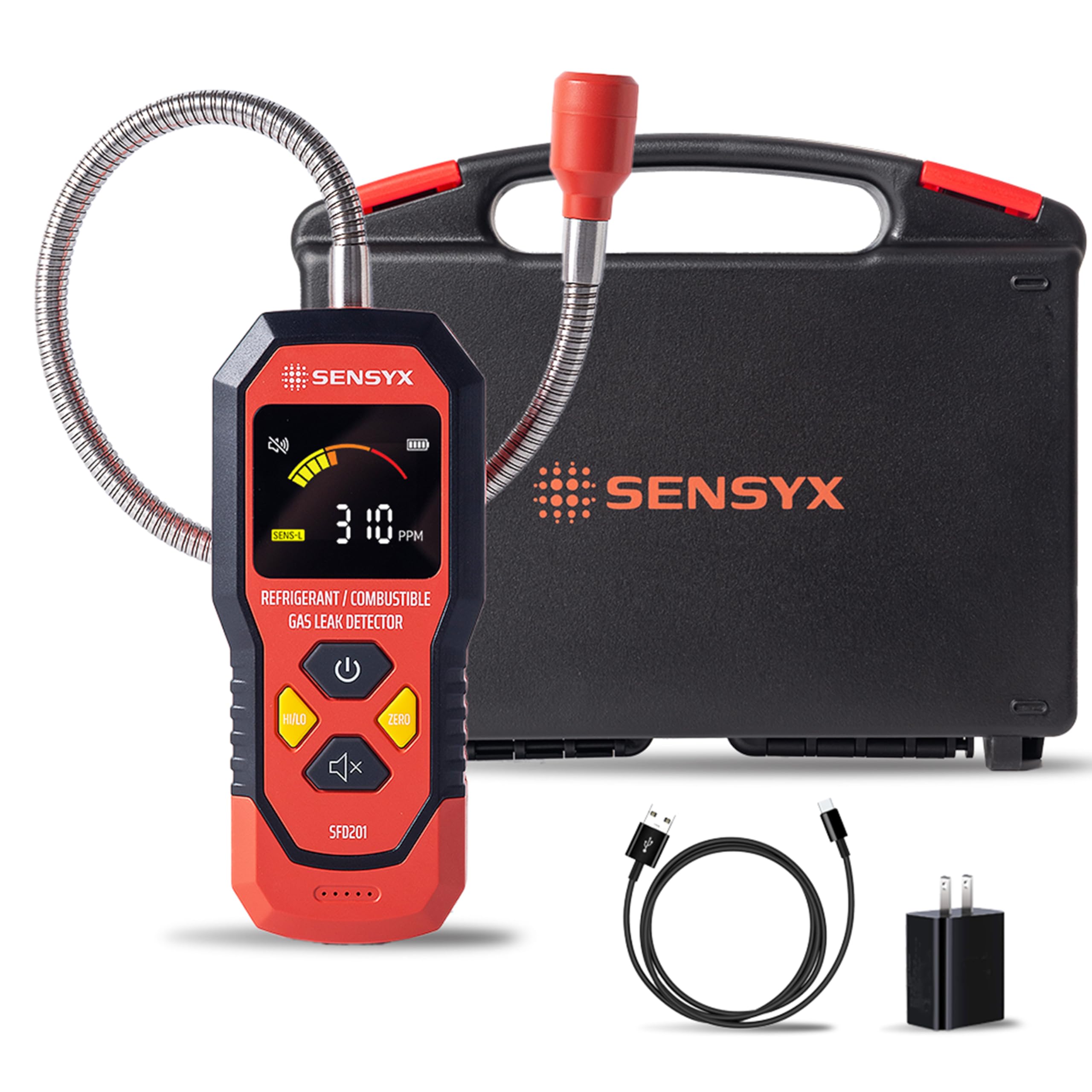
The SENSYX SFD201 sets a new benchmark for mid-range electronic sniffers by pairing a Japan-made heat dioxide semiconductor sensor with a rechargeable lithium battery and a large color LCD. The sensor delivers high/low adjustable sensitivity that actually makes a difference in the field: on low, it ignores background contamination common in engine bays, while high mode catches R-410A evaporator coil leaks other detectors miss. The 30-second warm-up and in-room calibration routine is clearly documented—calibrate in the same environment as the suspected leak, not outside, to avoid false positives.
Beyond refrigerant detection, the SFD201 also sniffs combustible gases like propane (R290) and methane, making it a genuine multi-threat tool for HVAC techs who service both cooling and gas appliances. The USB-C charging means no more hunting for dead C-cell batteries mid-job, and the slim body slides easily into a crowded tool bag. One HVAC pro reported finding both an R-410A leak and a separate natural gas leak in his first week of ownership, confirmed with a bubble solution and a second meter.
The audible alarm can be muted for quiet environments, and the large LCD shows a real-time signal bar that helps zero in on the leak’s epicenter. A few users noted the sensor is almost too sensitive—calibrating correctly is essential to avoid chasing residual gas. For a rechargeable, multi-gas sniffer at this price point, the SFD201 delivers professional-grade performance without the professional-grade price tag.
Why it’s great
- Rechargeable lithium battery with USB-C eliminates disposable battery waste
- Detects both halogen refrigerants and combustible gases in one unit
- High/low sensitivity levels adapt to different leak sizes and environments
Good to know
- Requires precise in-room calibration to avoid false positives
- Sensor detects gas presence but does not identify which specific refrigerant type
2. Mastercool 53351 Professional UV Leak Detection Kit

The Mastercool 53351 is the complete UV dye solution for shops and fleet managers who need to trace refrigerant, coolant, oil, ATF, and fuel leaks without relying on batteries. Its 50-watt 12V UV light plugs directly into a vehicle’s auxiliary port or battery terminals, producing a beam bright enough to make dye fluoresce even in direct sunlight—a stark contrast to weak handheld UV flashlights that require total darkness.
The kit includes a 1 oz oil-based dye cartridge good for ten applications, a 1 oz coolant dye, a 4 oz dye remover, UV-enhancing safety glasses, and both R134a hose/coupler and R12 adapter for legacy system compatibility. A retired master mechanic noted this kit outperformed a Snap-On equivalent costing three times as much, specifically praising the UV light’s intensity against battery-powered competitors that are “useless” in comparison.
Some users reported the UV light lens can separate from the housing after repeated thermal cycling—a potential longevity issue for full-time professionals. Additionally, the coolant dye’s orange hue can mimic dried Dexcool residue, leading to false positive readings on cooling systems. Despite these quirks, the Mastercool 53351 remains the gold standard for technicians who demand a hardwired UV light and a comprehensive dye arsenal in one rugged case.
Why it’s great
- 50W 12V UV light is vastly brighter than any battery-powered alternative
- Covers refrigerant, coolant, oil, ATF, and fuel in a single kit with universal dyes
- Includes R134a and R12 adapters for broad vehicle compatibility
Good to know
- UV light lens may detach after repeated thermal expansion cycles
- Coolant dye color can cause false positives on systems with existing residue
3. Simbow WJL-6000 PRO Refrigerant Leak Detector
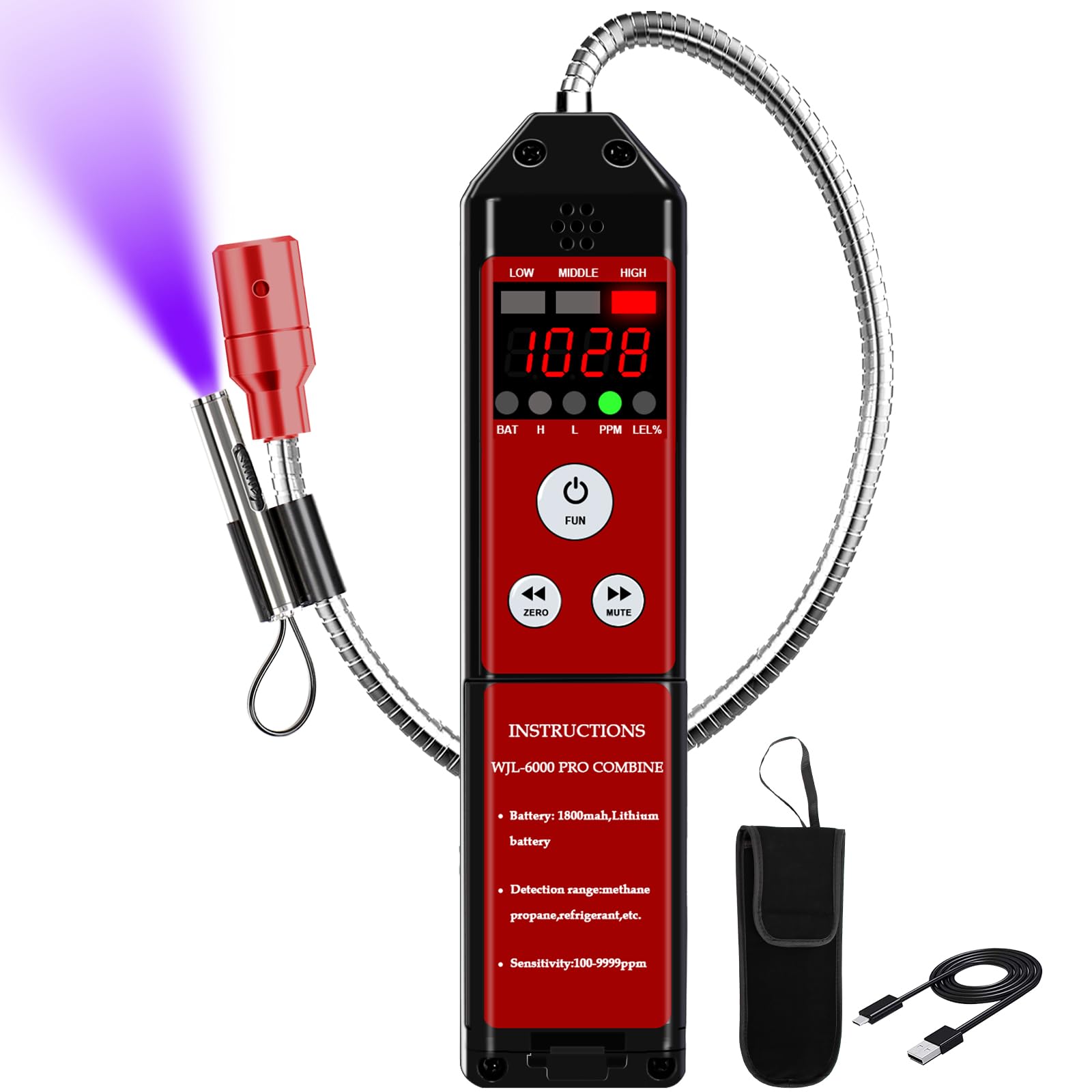
The Simbow WJL-6000 PRO delivers a feature set typically reserved for detectors costing twice as much, starting with its dual display mode that toggles between parts-per-million (PPM) and lower explosive limit percentage (LEL%). This is particularly useful for technicians working with A2L refrigerants like R32 and R454B, where both toxicity and flammability must be monitored. The all-metal probe is dirt-resistant and wear-proof, holding up to repeated insertion into tight compressor compartments.
With an 1800mAh rechargeable battery, the WJL-6000 PRO runs for over 20 hours on a single charge—more than enough for a full week of diagnostic calls. Its multi-alert system includes both digital readings and an audible alarm with a mute function for quiet operation. One user successfully used it to find a leak on a neighbor’s 14-year-old air handler, and when the professional tech arrived the next day, he confirmed the exact same location with his own high-end gear.
While the detector supports an exhaustive list of CFCs, HCFCs, HFCs, HFOs, blends, and PFCs, some users noted that sensitivity must be turned to maximum for very small leaks, which can trigger alarms from residual gas in the air. The included USB-C charging cable is a welcome modern touch, and the compact 0.5-pound body makes it easy to carry all day. For anyone needing A2L compliance and rechargeable convenience, the Simbow WJL-6000 PRO is a compelling choice.
Why it’s great
- Dual PPM and LEL% display supports A2L refrigerant safety monitoring
- 1800mAh battery delivers over 20 hours of continuous operation
- All-metal probe resists dirt and wear in harsh field conditions
Good to know
- Maximum sensitivity needed for tiny leaks may produce false alarms from ambient gas
- Mute function silences the buzzer but does not disable visual alerts
4. Lichamp LB01 AC Leak Detector Kit

The Lichamp LB01 is the quintessential starter kit for DIYers who want both an electronic sniffer and a UV dye system without buying separate tools. The sniffer offers seven sensitivity levels, with a maximum rating of 0.21 oz/yr—sufficient for all but the tiniest pinhole leaks. Its 7.9-inch flexible probe snakes around compressor clutches and tight tubing bends, and the 3-second response time means you can sweep an evaporator core quickly.
The included UV flashlight is the standout component here: 100 high-quality LEDs at 385-395 nm produce enough intensity to detect dye even in a sunlit driveway. One reviewer used the sniffer to locate a high-pressure service port leak on a truck, then confirmed the exact spot with the UV light and dye, all without any false positives from the engine fan running. The flashlight body is IP44-rated, meaning it resists dust and water splashes during outdoor work.
The kit does require a total of ten AA and AAA batteries (not included), which can be an annoyance if you don’t have a stockpile handy. The sniffer’s build quality feels basic compared to fully sealed professional units, but for the price, the combination of a flexible-probe sniffer and a genuinely powerful UV light is hard to beat. It is the perfect entry point for a homeowner or weekend mechanic ready to stop guessing.
Why it’s great
- Combines sniffer and UV dye detection in one affordable package
- UV flashlight is bright enough for daytime use, rare at this price level
- Flexible 7.9-inch probe reaches tight spaces inaccessible to rigid sensors
Good to know
- Requires 10 AA and AAA batteries that are not included
- Sniffer build quality is basic, not suited for daily pro abuse
5. Leak Saver Direct Inject Ultimate 3-in-1

The Leak Saver Ultimate 3-in-1 takes a fundamentally different approach: instead of detecting the leak externally, it seals it from the inside while simultaneously adding UV dye for visual confirmation. The active ingredient is an organosilane compound—critically, it is polymer-free, which means it will not clog expansion valves (TXVs) or capillary tubes like traditional polymer-based sealers can. This makes it safe for modern R-410A heat pumps and mini-splits with sensitive metering devices.
The kit injects directly into the low-side service port using a standard manifold gauge set, and it works with all common refrigerants including R134a, R1234yf, R410A, R290, and R600a. Over 4 million units sold since 2015 backs up the trust factor, and real-world results show it can seal leaks that professional electronic sniffers cannot even locate. One user with an 11-day-old leak—undetectable by professional tools—found the dye had pinpointed the exact coil location after the sealant circulated.
That said, this is a sealer-first, detector-second product. If you have a leak rate exceeding 7-day charge loss, this will not hold. The absence of a sniffer means you still need a UV light to see the dye, which is sold separately. For slow leaks where you want a permanent fix without cutting into lines, the Leak Saver is a uniquely effective tool. Just ensure your system has a replaceable filter-drier, because the sealer residue can accumulate there over time.
Why it’s great
- Polymer-free organosilane formula is safe for TXVs and capillary tubes
- Seals leaks from inside while dye marks the location for confirmation
- Compatible with all refrigerants including R410A, R134a, and R1234yf
Good to know
- Only effective on slow leaks where charge is not lost within 7 days
- Requires a separate UV light for visual inspection after injection
6. Elitech CPU-1G HVAC Leak Detector

The Elitech CPU-1G is the budget workhorse that HVAC pros have trusted for years, thanks to its traditional coronal sensor upgraded with a low-energy CPU for faster, more stable triggering. Its maximum sensitivity of 0.11 oz/yr is genuinely impressive at this price point—matching detectors that cost twice as much. The 14-inch flexible stainless steel probe includes two alternative sensor tips, allowing you to replace a worn tip without buying a whole new unit.
Response time is rated at 3 seconds with a 6-second warm-up, and the seven adjustable sensitivity levels let you tune out background contamination before zeroing in on the leak. One 20-year HVAC veteran reported trusting the CPU-1G 99% of the time, noting it had found leaks through walls where other detectors had failed. The unit runs on two C alkaline batteries, which are included, and provides audible beeping that increases in frequency as you approach the leak source.
The primary complaint is that the unit looks “silly” with its oversized probe, and some users have reported false positives when the sensitivity is set too high in humid environments. There is also no rechargeable battery option here—you are buying disposable C-cells forever. But if raw sensitivity at a low cost is your priority, the Elitech CPU-1G remains a proven instrument that many techs still reach for as their primary sniffer.
Why it’s great
- 0.11 oz/yr sensitivity rivals premium detectors at a fraction of the cost
- 14-inch flexible probe with replaceable tips extends tool life
- Seven sensitivity settings allow fine-tuning for different environments
Good to know
- Runs on disposable C alkaline batteries, not rechargeable
- May produce false positives in high humidity at max sensitivity
7. ERRECOM Brilliant UV Dye Kit
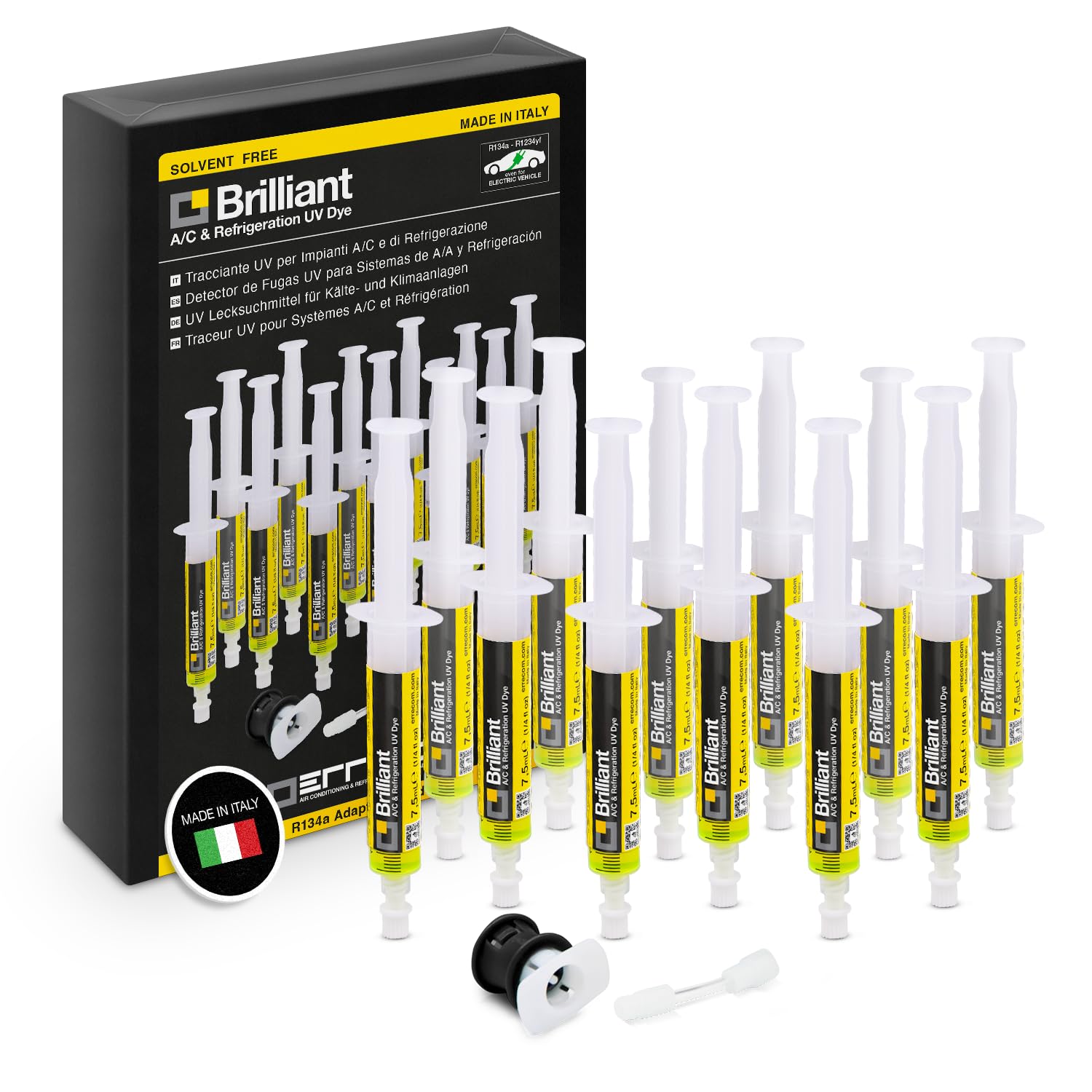
The ERRECOM Brilliant kit goes all-in on dye: you get 12 individual 0.2 fl oz vials, each enough for a single vehicle A/C system, plus a reusable R134a adapter for injection. This is the best option if you work on multiple cars and want pre-measured doses without cross-contamination between jobs. The fluorescent dye is compatible with all lubricants and refrigerants, including PAG and POE oils, and contains no solvents that could damage recovery stations.
One user described the glow under UV as “nuclear sludge,” a testament to the dye’s vividness—it immediately pinpointed a leaking evaporator core that had been invisible to soap bubbles. The Made in Italy formulation carries a reputation for consistency, and the included identification labels are a nice touch for systems that get dye added during routine service.
The major caveat: the kit includes zero instructions. Multiple buyers reported confusion over the injection process, specifically that the car’s A/C compressor must be running to relieve low-side pressure before the syringe can be used. Without that step, the pressure blows the dye back out. Additionally, the R134a adapter works only on vehicles with that port type—owners of R1234yf systems will need a separate adapter. If you already know how to inject dye, this is a brilliant value. If you are a first-timer, watch a video guide before touching the syringe.
Why it’s great
- 12 individual pre-measured vials prevent waste and cross-contamination
- Dye glows extremely bright under UV, making leaks easy to spot
- Compatible with all lubricants, refrigerants, and recovery station equipment
Good to know
- No instructions included—requires prior knowledge of injection procedure
- R134a adapter is included; R1234yf users need a separate adapter
FAQ
Can an electronic sniffer detect leaks through insulation or ductwork?
Will UV dye damage my compressor or expansion valve?
Final Thoughts: The Verdict
For most users, the best ac leak detection kit winner is the SENSYX SFD201 because it combines a rechargeable platform, a Japan-made semiconductor sensor, and multi-gas detection for both refrigerants and combustible gases. If you want a UV dye solution for visual confirmation across an entire fleet or multiple vehicles, grab the Mastercool 53351. And for a slow leak where you need to seal and mark in one step, nothing beats the Leak Saver Ultimate 3-in-1.